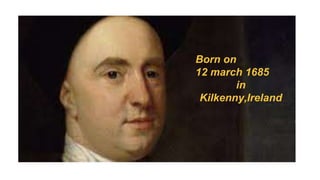
Born on
12 march 1685
in
Kilkenny,Ireland
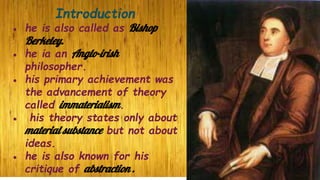
Introduction
● he is also called as Bishop
Berkeley.
● he ia an Anglo-irish
philosopher.
● his primary achievement was
the advancement of theory
called immaterialism.
● his theory states only about
material substance but not about
ideas.
● he is also known for his
critique of abstraction .
BIOGRAPHY
IRELAND
● Berkeley was born at his family home, Dysart
Castle, near Thomastown, County Kilkenny,
Ireland
● He is eldest son of William Berkeley
● He was educated at Kilkenny College and
attended Trinity College, Dublin, completing a
master's degree in 1707
● His publication that brought him notice was his An Essay towards a New Theory of
Vision
● In the essay, Berkeley examines visual distance, magnitude, position and
problems of sight and touch.
● In 1721 he was made Dean of Dromore and in 1724, Dean of Derry.
Marriage
In 1728, he married Anne Forster,
daughter of John Forster, Chief
Justice of the Irish Common
Pleas.
He then went to America
on a salary of £100 per annum.
In Newport, Rhode Island,
where he bought a plantation in
Middletown, Rhode Island – the
famous "Whitehall"
Contributions to
philosophy
According to Berkeley there are only
two kinds of things: spirits and ideas.
Spirits are simple, active beings which
produce and perceive ideas; ideas are
passive beings which are produced and
perceived.
Berkeley's proof of the existence of God
Whatever power I may have over my own thoughts, I
find the ideas actually perceived by Sense have not a
like dependence on my will. When in broad daylight I
open my eyes, it is not in my power to choose whether
I shall see or no, or to determine what particular
objects shall present themselves to my view; and so
likewise as to the hearing and other senses; the ideas
imprinted on them are not creatures of my will. There
is therefore some other Will or Spirit that produces
them.
● PC“Philosophical Commentaries”
● NTV An Essay Towards a New Theory of Vision
● PHK Of the Principles of Human Knowledge: Part
1
● 3D Three Dialogues between Hylas and Philonous
● DM De Motu, or The Principle and Nature of
Motion and the Cause of the Communication of
Motions, trans. A.A. Luce
george berkeley famous works
Death
January 14, 1753 in Oxford, United
States.
Due to Congestive heart failure

George Berkeley contribution to philosophy

  • 2.
    Born on 12 march1685 in Kilkenny,Ireland
  • 3.
    Introduction ● he isalso called as Bishop Berkeley. ● he ia an Anglo-irish philosopher. ● his primary achievement was the advancement of theory called immaterialism. ● his theory states only about material substance but not about ideas. ● he is also known for his critique of abstraction .
  • 4.
    BIOGRAPHY IRELAND ● Berkeley wasborn at his family home, Dysart Castle, near Thomastown, County Kilkenny, Ireland ● He is eldest son of William Berkeley ● He was educated at Kilkenny College and attended Trinity College, Dublin, completing a master's degree in 1707 ● His publication that brought him notice was his An Essay towards a New Theory of Vision ● In the essay, Berkeley examines visual distance, magnitude, position and problems of sight and touch. ● In 1721 he was made Dean of Dromore and in 1724, Dean of Derry.
  • 5.
    Marriage In 1728, hemarried Anne Forster, daughter of John Forster, Chief Justice of the Irish Common Pleas. He then went to America on a salary of £100 per annum. In Newport, Rhode Island, where he bought a plantation in Middletown, Rhode Island – the famous "Whitehall"
  • 6.
    Contributions to philosophy According toBerkeley there are only two kinds of things: spirits and ideas. Spirits are simple, active beings which produce and perceive ideas; ideas are passive beings which are produced and perceived.
  • 7.
    Berkeley's proof ofthe existence of God Whatever power I may have over my own thoughts, I find the ideas actually perceived by Sense have not a like dependence on my will. When in broad daylight I open my eyes, it is not in my power to choose whether I shall see or no, or to determine what particular objects shall present themselves to my view; and so likewise as to the hearing and other senses; the ideas imprinted on them are not creatures of my will. There is therefore some other Will or Spirit that produces them.
  • 8.
    ● PC“Philosophical Commentaries” ●NTV An Essay Towards a New Theory of Vision ● PHK Of the Principles of Human Knowledge: Part 1 ● 3D Three Dialogues between Hylas and Philonous ● DM De Motu, or The Principle and Nature of Motion and the Cause of the Communication of Motions, trans. A.A. Luce george berkeley famous works
  • 13.
    Death January 14, 1753in Oxford, United States. Due to Congestive heart failure