Nicolaus Copernicus
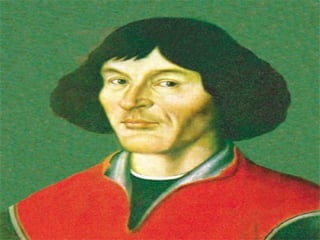
Nicolaus Copernicus (2/19/1473-5/24/1543) was a Polish
(2/19/1473-5/24/1543) was a Polish
mathematician, astronomer, jurist, physician, classical scholar,
governor, administrator, military leader, diplomat, and economist.
He is considered to be the first scientist to argue that the sun, not
Earth, was the center of the universe. Copernicus wrote his ideas
in a book called
in a book called On the Revolutions of the Celestial Spheres.
On the Revolutions of the Celestial Spheres.
Copernicus spent 25 years tracking the movements of the sun,
moon, and planets. By using mathematics, Copernicus was
convinced that the Earth revolved around the sun. Copernicus
feared that his ideas would not be taken seriously because during
this time (early 1500’s) many people, and the Catholic Church,
believed that the sun revolved around Earth. Fearing for his
safety, Copernicus did not publish his work until 1543, the same
year that he died. As expected, most people ridiculed his
conclusion and did not believe Copernicus. However, Copernicus
inspired and influenced other astronomers, like Galileo Galilei.
Galileo Galilei
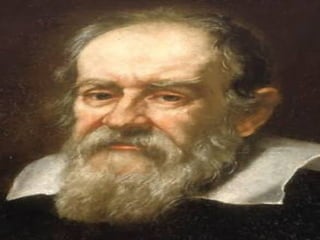
Galileo Galilei (2/15/1564-1/8/1642) was an Italian physicist, mathematician,
(2/15/1564-1/8/1642) was an Italian physicist, mathematician,
astronomer, and philosopher who played a major role in the Scientific
Revolution. As a young man, Galilei considered priesthood but he ended up
enrolling for a medical degree at the University of Pisa. He did not complete his
medical degree, but instead studied mathematics. In 1592 he taught geometry,
mechanics, and astronomy at the University of Padua. Galileo Galilei was one
of the first scientists to use experiments to discover laws of nature. When he
studied motion, he learned that moving objects accelerate, or speed up, at a
mathematically predictable rate. Galilei also built his own telescope and he was
the first person to realize that the moon is not smooth and precisely spherical.
Also, he saw dark spots appear and disappear on the sun and he also saw
several moons revolve around the planet Jupiter. Galilei wrote all of his
research, ideas, and beliefs in a book called
research, ideas, and beliefs in a book called Discourses and Mathematical
Discourses and Mathematical
Demonstrations Concerning the Two New Sciences
Demonstrations Concerning the Two New Sciences. Galilei agreed with
. Galilei agreed with
Copernicus and was convinced that Earth revolved around the sun. The
Church saw Galilei’s ideas as dangerous and he was brought before the
Inquisition in 1616. The Church forced Galilei to deny his beliefs and they
sentenced him to “house arrest” for the rest of his life.
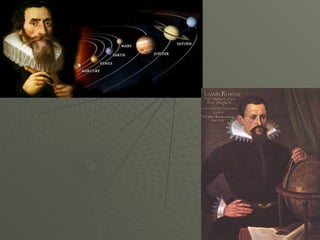
Johannes Kepler
Johannes Kepler (12/27/1571- 11/15/1630) was a German
(12/27/1571- 11/15/1630) was a German
Lutheran mathematician, astronomer, and astrologer. He was
also one of the key figures during the Scientific Revolution. Kepler
was influenced by Copernicus and he was positive that Earth did
revolve around the sun. Still, Kepler was not able to answer an
important question: How could Earth and other planets circle the
sun without flying off into space? What kept them in their orbits?
Many people did not accept Kepler’s ideas at first. In fact, even
other famous astronomers like Galilei and Descartes ignored
Kepler’s research. Kepler is famous for being the astronomer who
explained planetary motion. Kepler was convinced that all planets
revolve around the Sun and that they travel in orbits that are
ellipses, not circles as had been believed since ancient times. In
his book,
his book, Astronomia Nova,
Astronomia Nova, Kepler also discovered the speed of
Kepler also discovered the speed of
the planets and the time that each planet needs in order to
complete one revolution around the Sun.
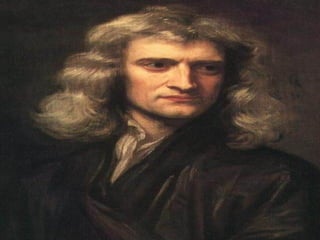
Isaac Newton
Isaac Newton (1/4/1643- 3/31/1727) was an English physicist,
(1/4/1643- 3/31/1727) was an English physicist,
mathematician, astronomer, natural philosopher, and alchemist.
He is considered by many people as the greatest person in the
history of science. According to legend, Newton was sitting under
an apple tree one day when an apple fell on the ground. At that
moment, he realized that the apple did not simply fall. It was
pulled toward Earth’s center by a forced that he called gravity.
This is the force that pulls one object toward another. Newton then
reasoned that apples fall to the ground because they are pulled to
Earth. More importantly, he realized that planets orbit the sun
because they are pulled toward the sun by gravity. Besides
explaining the laws of gravity and planetary motion, he co-founded
the field of calculus, and explained laws of light and color. His
most famous research is found in the book called
most famous research is found in the book called Philosophiae
Philosophiae
Naturalis Principia Mathematica
Francis Bacon
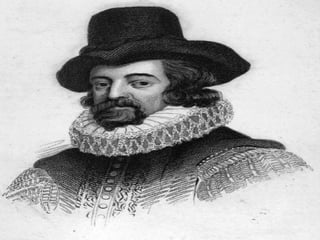
Francis Bacon (1/22/1561-4/9/1626) was an English
(1/22/1561-4/9/1626) was an English
philosopher who supported other scientist like
Copernicus and Galilei. Bacon argued against reaching
conclusions based on ancient learning. He thought that
scientists should rely on their own observations and
experiments to explain the laws of nature. Bacon
championed the use of inductive reasoning in scientific
investigations.
investigations. Inductive Reasoning
Inductive Reasoning is the process of
is the process of
reasoning from specific facts to general principles.
Bacon felt that all scientists should use inductive
reasoning and that they should perform several
observations and experiments in order to gather
accurate facts and make general conclusions. Bacon’s
work helped to establish what we know today as the
scientific method.
scientific method. The scientific method includes
The scientific method includes
observation, experiments, and careful reasoning.
Rene Descartes
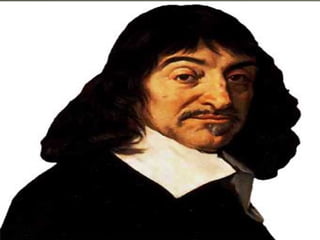
Rene Descartes (3/31/1596- 2/11/1650) was a
(3/31/1596- 2/11/1650) was a
highly influential French philosopher,
mathematician, scientist, and writer. He is known
as the “Founder of Modern Philosophy” and the
“Father of modern Mathematics”. His research is
considered influential and it continues to be
studied till this day. He was one of the key figures
during the Scientific Revolution. Descartes
believed that in order to reach the truth, it was
necessary to doubt everything except ideas that
were true beyond doubt. He also argued that the
truth can be found by using logic and reason.
Descartes is known for his famous quote “I think,
therefore I am”
therefore I am”
John Locke
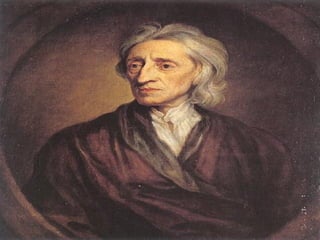
John Locke (8/29/1632-10/28/1704) was an English philosopher
(8/29/1632-10/28/1704) was an English philosopher
and one of the first people to write about the purpose of a
government. He is considered the most influential English-
language philosopher and political theorist. Locke reasoned that
by nature, people are rational. They are born with the ability to
control their own affairs. They are also born with
control their own affairs. They are also born with natural rights,
natural rights, or
or
rights that no government can take away from them. These
natural rights are the rights to life, liberty, and personal property.
Locked argued that people formed governments to protect their
natural rights. He also said that if a government did not live up to
that purpose, then people had the right to rebel and form a new
government. Locke’s ideas greatly influenced both the American
and French revolutions. He also believed that all people are born
equal and that education can free people. Locke’s most famous
work is his book called
work is his book called Essay Concerning Human Understanding
Essay Concerning Human Understanding
Jean Jacques Rousseau
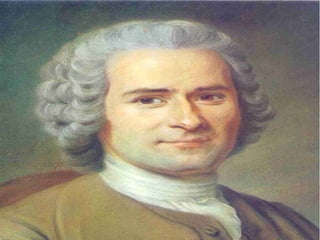
Jean Jacques Rousseau (6/28/1712-7/2/1778) was a Genevan
(6/28/1712-7/2/1778) was a Genevan
philosopher of the Enlightenment whose political ideas influenced
the French Revolution, the development of social theory, and the
growth of nationalism. Rousseau also made important
contributions to music both as a theorist and as a composer. One
of his primary concerns was the issue of liberty. He once said,
“Man is born free, and yet everywhere is in chains”. Rousseau
agreed that society existed because its members agreed to live
together for the good of one another. However, people had too
often lost their liberty by giving power to governments that did not
promote the general good. Rousseau suggested that people form
governments for protection and that rulers must protect the
people’s natural rights. Rousseau felt that corrupt governments
should not exist and that the only government with the right to rule
was one based on the will of the people.
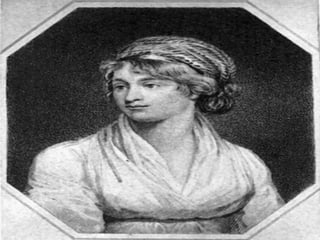
Mary Wollstonecraft
Mary Wollstonecraft (4/27/1759-9/10/1797) was a British writer,
(4/27/1759-9/10/1797) was a British writer,
philosopher, and feminist. During her short career, she wrote
novels, treatises, a travel narrative, a history of the French
Revolution, and a children’s book. Wollstonecraft is best known for
her book
her book A Vindication of the Rights of Woman
A Vindication of the Rights of Woman in which she
in which she
argues that women are not naturally inferior to men, but only
appear to be because they lack education. Her book inspired
many women and it is considered the founding document of
modern feminism. She felt that in order for women to gain liberty
and freedom, they had to become educated. She suggests that
both men and women should be treated as rational beings and
must be treated equally. She fought for the rights of women since
women were not allowed in most professions, such as law,
medicine, or teaching. Wollstonecraft died at the age of 38 due to
complications from childbirth
complications from childbirth.
.
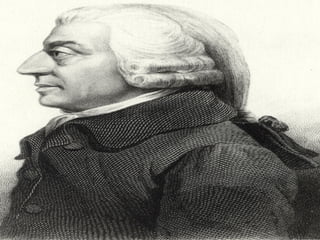
Adam Smith
Adam Smith (6/5/1723-7/17/1790) was a Scottish philosopher,
(6/5/1723-7/17/1790) was a Scottish philosopher,
writer, and economist. Adam Smith is one of the fathers of
modern economics. He is one of the key figures of the intellectual
movement known as the “Scottish Enlightenment”. He is known
for his book
for his book The Wealth of Nations
The Wealth of Nations which said that the only way
which said that the only way
for a nation to become wealthy was by allowing free trade. He
spoke out against many governments because most governments
limited trade with other countries. Smith also attacked the belief
that gold and silver made a nation wealthy. He once said, “Wealth
does not consist in money, or in gold or silver, but in what money
purchases”. Smith argues that the economy works best when
people are allowed to make their own decisions. This idea is
called
called Laissez Faire
Laissez Faire which is French for “leave alone”. Laissez
which is French for “leave alone”. Laissez
faire is the policy that the economy should be free from
government regulation
government regulation.
.
scientific_revolution_pp.ppt Copernicus 1

scientific_revolution_pp.ppt Copernicus 1

  • 1.
    Nicolaus Copernicus Nicolaus Copernicus(2/19/1473-5/24/1543) was a Polish (2/19/1473-5/24/1543) was a Polish mathematician, astronomer, jurist, physician, classical scholar, mathematician, astronomer, jurist, physician, classical scholar, governor, administrator, military leader, diplomat, and economist. governor, administrator, military leader, diplomat, and economist. He is considered to be the first scientist to argue that the sun, not He is considered to be the first scientist to argue that the sun, not Earth, was the center of the universe. Copernicus wrote his ideas Earth, was the center of the universe. Copernicus wrote his ideas in a book called in a book called On the Revolutions of the Celestial Spheres. On the Revolutions of the Celestial Spheres. Copernicus spent 25 years tracking the movements of the sun, Copernicus spent 25 years tracking the movements of the sun, moon, and planets. By using mathematics, Copernicus was moon, and planets. By using mathematics, Copernicus was convinced that the Earth revolved around the sun. Copernicus convinced that the Earth revolved around the sun. Copernicus feared that his ideas would not be taken seriously because during feared that his ideas would not be taken seriously because during this time (early 1500’s) many people, and the Catholic Church, this time (early 1500’s) many people, and the Catholic Church, believed that the sun revolved around Earth. Fearing for his believed that the sun revolved around Earth. Fearing for his safety, Copernicus did not publish his work until 1543, the same safety, Copernicus did not publish his work until 1543, the same year that he died. As expected, most people ridiculed his year that he died. As expected, most people ridiculed his conclusion and did not believe Copernicus. However, Copernicus conclusion and did not believe Copernicus. However, Copernicus inspired and influenced other astronomers, like Galileo Galilei. inspired and influenced other astronomers, like Galileo Galilei.
  • 3.
    Galileo Galilei Galileo Galilei(2/15/1564-1/8/1642) was an Italian physicist, mathematician, (2/15/1564-1/8/1642) was an Italian physicist, mathematician, astronomer, and philosopher who played a major role in the Scientific astronomer, and philosopher who played a major role in the Scientific Revolution. As a young man, Galilei considered priesthood but he ended up Revolution. As a young man, Galilei considered priesthood but he ended up enrolling for a medical degree at the University of Pisa. He did not complete his enrolling for a medical degree at the University of Pisa. He did not complete his medical degree, but instead studied mathematics. In 1592 he taught geometry, medical degree, but instead studied mathematics. In 1592 he taught geometry, mechanics, and astronomy at the University of Padua. Galileo Galilei was one mechanics, and astronomy at the University of Padua. Galileo Galilei was one of the first scientists to use experiments to discover laws of nature. When he of the first scientists to use experiments to discover laws of nature. When he studied motion, he learned that moving objects accelerate, or speed up, at a studied motion, he learned that moving objects accelerate, or speed up, at a mathematically predictable rate. Galilei also built his own telescope and he was mathematically predictable rate. Galilei also built his own telescope and he was the first person to realize that the moon is not smooth and precisely spherical. the first person to realize that the moon is not smooth and precisely spherical. Also, he saw dark spots appear and disappear on the sun and he also saw Also, he saw dark spots appear and disappear on the sun and he also saw several moons revolve around the planet Jupiter. Galilei wrote all of his several moons revolve around the planet Jupiter. Galilei wrote all of his research, ideas, and beliefs in a book called research, ideas, and beliefs in a book called Discourses and Mathematical Discourses and Mathematical Demonstrations Concerning the Two New Sciences Demonstrations Concerning the Two New Sciences. Galilei agreed with . Galilei agreed with Copernicus and was convinced that Earth revolved around the sun. The Copernicus and was convinced that Earth revolved around the sun. The Church saw Galilei’s ideas as dangerous and he was brought before the Church saw Galilei’s ideas as dangerous and he was brought before the Inquisition in 1616. The Church forced Galilei to deny his beliefs and they Inquisition in 1616. The Church forced Galilei to deny his beliefs and they sentenced him to “house arrest” for the rest of his life. sentenced him to “house arrest” for the rest of his life.
  • 5.
    Johannes Kepler Johannes Kepler(12/27/1571- 11/15/1630) was a German (12/27/1571- 11/15/1630) was a German Lutheran mathematician, astronomer, and astrologer. He was Lutheran mathematician, astronomer, and astrologer. He was also one of the key figures during the Scientific Revolution. Kepler also one of the key figures during the Scientific Revolution. Kepler was influenced by Copernicus and he was positive that Earth did was influenced by Copernicus and he was positive that Earth did revolve around the sun. Still, Kepler was not able to answer an revolve around the sun. Still, Kepler was not able to answer an important question: How could Earth and other planets circle the important question: How could Earth and other planets circle the sun without flying off into space? What kept them in their orbits? sun without flying off into space? What kept them in their orbits? Many people did not accept Kepler’s ideas at first. In fact, even Many people did not accept Kepler’s ideas at first. In fact, even other famous astronomers like Galilei and Descartes ignored other famous astronomers like Galilei and Descartes ignored Kepler’s research. Kepler is famous for being the astronomer who Kepler’s research. Kepler is famous for being the astronomer who explained planetary motion. Kepler was convinced that all planets explained planetary motion. Kepler was convinced that all planets revolve around the Sun and that they travel in orbits that are revolve around the Sun and that they travel in orbits that are ellipses, not circles as had been believed since ancient times. In ellipses, not circles as had been believed since ancient times. In his book, his book, Astronomia Nova, Astronomia Nova, Kepler also discovered the speed of Kepler also discovered the speed of the planets and the time that each planet needs in order to the planets and the time that each planet needs in order to complete one revolution around the Sun. complete one revolution around the Sun.
  • 7.
    Isaac Newton Isaac Newton(1/4/1643- 3/31/1727) was an English physicist, (1/4/1643- 3/31/1727) was an English physicist, mathematician, astronomer, natural philosopher, and alchemist. mathematician, astronomer, natural philosopher, and alchemist. He is considered by many people as the greatest person in the He is considered by many people as the greatest person in the history of science. According to legend, Newton was sitting under history of science. According to legend, Newton was sitting under an apple tree one day when an apple fell on the ground. At that an apple tree one day when an apple fell on the ground. At that moment, he realized that the apple did not simply fall. It was moment, he realized that the apple did not simply fall. It was pulled toward Earth’s center by a forced that he called gravity. pulled toward Earth’s center by a forced that he called gravity. This is the force that pulls one object toward another. Newton then This is the force that pulls one object toward another. Newton then reasoned that apples fall to the ground because they are pulled to reasoned that apples fall to the ground because they are pulled to Earth. More importantly, he realized that planets orbit the sun Earth. More importantly, he realized that planets orbit the sun because they are pulled toward the sun by gravity. Besides because they are pulled toward the sun by gravity. Besides explaining the laws of gravity and planetary motion, he co-founded explaining the laws of gravity and planetary motion, he co-founded the field of calculus, and explained laws of light and color. His the field of calculus, and explained laws of light and color. His most famous research is found in the book called most famous research is found in the book called Philosophiae Philosophiae Naturalis Principia Mathematica Naturalis Principia Mathematica
  • 9.
    Francis Bacon Francis Bacon(1/22/1561-4/9/1626) was an English (1/22/1561-4/9/1626) was an English philosopher who supported other scientist like philosopher who supported other scientist like Copernicus and Galilei. Bacon argued against reaching Copernicus and Galilei. Bacon argued against reaching conclusions based on ancient learning. He thought that conclusions based on ancient learning. He thought that scientists should rely on their own observations and scientists should rely on their own observations and experiments to explain the laws of nature. Bacon experiments to explain the laws of nature. Bacon championed the use of inductive reasoning in scientific championed the use of inductive reasoning in scientific investigations. investigations. Inductive Reasoning Inductive Reasoning is the process of is the process of reasoning from specific facts to general principles. reasoning from specific facts to general principles. Bacon felt that all scientists should use inductive Bacon felt that all scientists should use inductive reasoning and that they should perform several reasoning and that they should perform several observations and experiments in order to gather observations and experiments in order to gather accurate facts and make general conclusions. Bacon’s accurate facts and make general conclusions. Bacon’s work helped to establish what we know today as the work helped to establish what we know today as the scientific method. scientific method. The scientific method includes The scientific method includes observation, experiments, and careful reasoning. observation, experiments, and careful reasoning.
  • 11.
    Rene Descartes Rene Descartes(3/31/1596- 2/11/1650) was a (3/31/1596- 2/11/1650) was a highly influential French philosopher, highly influential French philosopher, mathematician, scientist, and writer. He is known mathematician, scientist, and writer. He is known as the “Founder of Modern Philosophy” and the as the “Founder of Modern Philosophy” and the “Father of modern Mathematics”. His research is “Father of modern Mathematics”. His research is considered influential and it continues to be considered influential and it continues to be studied till this day. He was one of the key figures studied till this day. He was one of the key figures during the Scientific Revolution. Descartes during the Scientific Revolution. Descartes believed that in order to reach the truth, it was believed that in order to reach the truth, it was necessary to doubt everything except ideas that necessary to doubt everything except ideas that were true beyond doubt. He also argued that the were true beyond doubt. He also argued that the truth can be found by using logic and reason. truth can be found by using logic and reason. Descartes is known for his famous quote “I think, Descartes is known for his famous quote “I think, therefore I am” therefore I am”
  • 13.
    John Locke John Locke(8/29/1632-10/28/1704) was an English philosopher (8/29/1632-10/28/1704) was an English philosopher and one of the first people to write about the purpose of a and one of the first people to write about the purpose of a government. He is considered the most influential English- government. He is considered the most influential English- language philosopher and political theorist. Locke reasoned that language philosopher and political theorist. Locke reasoned that by nature, people are rational. They are born with the ability to by nature, people are rational. They are born with the ability to control their own affairs. They are also born with control their own affairs. They are also born with natural rights, natural rights, or or rights that no government can take away from them. These rights that no government can take away from them. These natural rights are the rights to life, liberty, and personal property. natural rights are the rights to life, liberty, and personal property. Locked argued that people formed governments to protect their Locked argued that people formed governments to protect their natural rights. He also said that if a government did not live up to natural rights. He also said that if a government did not live up to that purpose, then people had the right to rebel and form a new that purpose, then people had the right to rebel and form a new government. Locke’s ideas greatly influenced both the American government. Locke’s ideas greatly influenced both the American and French revolutions. He also believed that all people are born and French revolutions. He also believed that all people are born equal and that education can free people. Locke’s most famous equal and that education can free people. Locke’s most famous work is his book called work is his book called Essay Concerning Human Understanding Essay Concerning Human Understanding
  • 15.
    Jean Jacques Rousseau JeanJacques Rousseau (6/28/1712-7/2/1778) was a Genevan (6/28/1712-7/2/1778) was a Genevan philosopher of the Enlightenment whose political ideas influenced philosopher of the Enlightenment whose political ideas influenced the French Revolution, the development of social theory, and the the French Revolution, the development of social theory, and the growth of nationalism. Rousseau also made important growth of nationalism. Rousseau also made important contributions to music both as a theorist and as a composer. One contributions to music both as a theorist and as a composer. One of his primary concerns was the issue of liberty. He once said, of his primary concerns was the issue of liberty. He once said, “Man is born free, and yet everywhere is in chains”. Rousseau “Man is born free, and yet everywhere is in chains”. Rousseau agreed that society existed because its members agreed to live agreed that society existed because its members agreed to live together for the good of one another. However, people had too together for the good of one another. However, people had too often lost their liberty by giving power to governments that did not often lost their liberty by giving power to governments that did not promote the general good. Rousseau suggested that people form promote the general good. Rousseau suggested that people form governments for protection and that rulers must protect the governments for protection and that rulers must protect the people’s natural rights. Rousseau felt that corrupt governments people’s natural rights. Rousseau felt that corrupt governments should not exist and that the only government with the right to rule should not exist and that the only government with the right to rule was one based on the will of the people. was one based on the will of the people.
  • 17.
    Mary Wollstonecraft Mary Wollstonecraft(4/27/1759-9/10/1797) was a British writer, (4/27/1759-9/10/1797) was a British writer, philosopher, and feminist. During her short career, she wrote philosopher, and feminist. During her short career, she wrote novels, treatises, a travel narrative, a history of the French novels, treatises, a travel narrative, a history of the French Revolution, and a children’s book. Wollstonecraft is best known for Revolution, and a children’s book. Wollstonecraft is best known for her book her book A Vindication of the Rights of Woman A Vindication of the Rights of Woman in which she in which she argues that women are not naturally inferior to men, but only argues that women are not naturally inferior to men, but only appear to be because they lack education. Her book inspired appear to be because they lack education. Her book inspired many women and it is considered the founding document of many women and it is considered the founding document of modern feminism. She felt that in order for women to gain liberty modern feminism. She felt that in order for women to gain liberty and freedom, they had to become educated. She suggests that and freedom, they had to become educated. She suggests that both men and women should be treated as rational beings and both men and women should be treated as rational beings and must be treated equally. She fought for the rights of women since must be treated equally. She fought for the rights of women since women were not allowed in most professions, such as law, women were not allowed in most professions, such as law, medicine, or teaching. Wollstonecraft died at the age of 38 due to medicine, or teaching. Wollstonecraft died at the age of 38 due to complications from childbirth complications from childbirth. .
  • 19.
    Adam Smith Adam Smith(6/5/1723-7/17/1790) was a Scottish philosopher, (6/5/1723-7/17/1790) was a Scottish philosopher, writer, and economist. Adam Smith is one of the fathers of writer, and economist. Adam Smith is one of the fathers of modern economics. He is one of the key figures of the intellectual modern economics. He is one of the key figures of the intellectual movement known as the “Scottish Enlightenment”. He is known movement known as the “Scottish Enlightenment”. He is known for his book for his book The Wealth of Nations The Wealth of Nations which said that the only way which said that the only way for a nation to become wealthy was by allowing free trade. He for a nation to become wealthy was by allowing free trade. He spoke out against many governments because most governments spoke out against many governments because most governments limited trade with other countries. Smith also attacked the belief limited trade with other countries. Smith also attacked the belief that gold and silver made a nation wealthy. He once said, “Wealth that gold and silver made a nation wealthy. He once said, “Wealth does not consist in money, or in gold or silver, but in what money does not consist in money, or in gold or silver, but in what money purchases”. Smith argues that the economy works best when purchases”. Smith argues that the economy works best when people are allowed to make their own decisions. This idea is people are allowed to make their own decisions. This idea is called called Laissez Faire Laissez Faire which is French for “leave alone”. Laissez which is French for “leave alone”. Laissez faire is the policy that the economy should be free from faire is the policy that the economy should be free from government regulation government regulation. .