Transmission
    Line

  Microwave Engineering
        CHO, Yong Heui
Microwave Engineering
1. Tx line theory

 Telegrapher’s equation

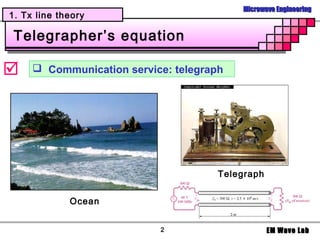
     Communication service: telegraph


                                      Telegraph


             Ocean


                           2                      EM Wave Lab
Microwave Engineering
1. Tx line theory

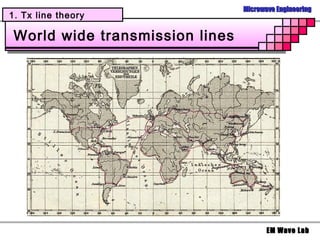
 World wide transmission lines


                                        EM Wave Lab
Microwave Engineering
1. Tx line theory

 Introduction

      The differential equations which the voltage or
        current must satisfy on a uniform transmission
        line.
       Circuit model: tie field theory and circuit theory
        together.
       Our circuit model contain the inductance L,
        capacitance C, shunt conductance G, and series
        resistance R associated with an incremental
        length of line.
       Coaxial transmission line containing a dielectric.


                              4                      EM Wave Lab
Microwave Engineering
1. Tx line theory

 Wave propagation

      V ( z , t ) = Vo cos(ωt − βz + φ )
        = Re{Vo e j (ωt − βz +φ ) }
                      jφ   − jβz   j ωt
        = Re{Vo e e                e }


                                          5          EM Wave Lab
Microwave Engineering
1. Tx line theory

 Distributed element

     Lumped element: R, L, C


      Distributed element: tx line


                              6               EM Wave Lab
Microwave Engineering
1. Tx line theory

 Circuit model

                      ˆ
  Propagation in the a z direction
   Length ∆z : R∆z[ Ω], L∆z[ H ], G∆z[1 / Ω], C∆z[ F ]


                                lim: infinitesimal approach
                                ∆z →0
                            7                        EM Wave Lab
Microwave Engineering
1. Tx line theory

 Transmission line equation

   Phasor : Vs ( z ) = Vo e jφ e − jβz
               1         1   
    Vs ( z ) =  R∆z + jω L∆z  I s ( z )
               2         2   
              1         1   
            +  R∆z + jω L∆z ( I s ( z ) + ∆I s ( z )) + Vs ( z ) + ∆Vs ( z )
              2         2   

    ∆Vs ( z )                           1     1 
              = −( R + jωL) I s ( z ) −  R + j ωL ∆I s (z) : As ∆z → 0, ∆I s → 0
    ∆z                                 2     2 

    ∆I s ( z )               ∆Vs ( z )
  −            = (Vs ( z ) +           )(G + jωC ) : As ∆z → 0, ∆Vs → 0
     ∆z                        2

                                          8                               EM Wave Lab
Microwave Engineering
1. Tx line theory

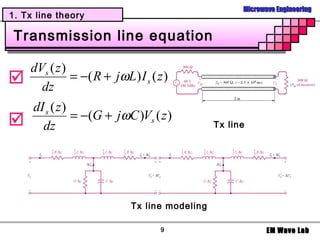
 Transmission line equation

    dVs ( z )
             = − ( R + jω L ) I s ( z )
      dz
     dI s ( z )
               = −(G + jωC )Vs ( z )
       dz                                        Tx line


                              Tx line modeling

                                      9                       EM Wave Lab
Microwave Engineering
1. Tx line theory

 Wave solution

     Traveling wave solution
                               + −γz
       - Voltage: Vs ( z ) = V0 e              + V0− eγz
        -   Current:    I s ( z ) = I 0+ e −γz − I 0− eγz

            d 2Vs ( z )
                  2
                        = ( R + jωL)(G + jωC )Vs ( z )
               dz
            γ = α + jβ = ( R + jωL)(G + jωC )


                                    10                             EM Wave Lab
Microwave Engineering
1. Tx line theory

 Characteristic impedance

     Important parameter in tx line:   Z0
                  R + j ωL
        - Z0 =
                 G + j ωC
               V0+ V0−
        - Z0 = + = −
               I0     I0


                             11                      EM Wave Lab
Microwave Engineering
1. Tx line theory

 Lossless line


       γ = jβ = jω LC

             L
       Z0 =
             C
                     + − jβz     − − jβz
       Vs ( z ) = V e
                    0       +V e0
                     +             −
                   V    − jβz V       jβz
        I s ( z) =  0
                      e     −    e0
                   Z0         Z0

                                   12              EM Wave Lab
Microwave Engineering
1. Tx line theory

 Low-loss line

        γ = α + jβ = ( R + jωL)(G + jωC )
                     j R    G 
         ≈ jω LC 1 −      +   
                     2  ωL ωC  
             1 R        
        α =  + GZ 0 
             2  Z0
               
                         
                         
              L
        Z0 ≈
              C
                            13                      EM Wave Lab
Microwave Engineering
1. Tx line theory

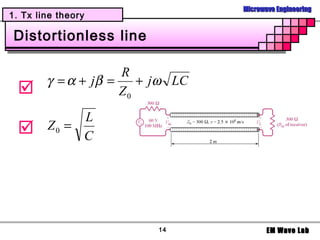
 Distortionless line

                     R
        γ = α + jβ =    + jω LC
                    Z0
             L
       Z0 =
             C


                          14             EM Wave Lab
Microwave Engineering
1. Tx line theory

 Reflection coefficient

     Voltage wave continuity conditions
      Current wave continuity conditions

                                       Vo− Z L − Z 0
                   Γ11 =| Γ | e jφ   = + =
                                       V0   Z L + Z0


                                      15                      EM Wave Lab
Microwave Engineering
1. Tx line theory

 Wave power

                           + 2

   
             1
          P = Re VI =
             2
                   *
                      V
                    ( )
                      2Z 0
                          0
                           1− Γ
                                2
                                 (   )


                           16                   EM Wave Lab
Microwave Engineering
1. Tx line theory

 SWR (Standing Wave Ratio)

     SWR: field theory
      VSWR (Voltage SWR): tx line theory


           V
      s=       max
           V   min

        1+ | Γ |
      =
        1− | Γ |

                                 Experiment
                            17                       EM Wave Lab
Microwave Engineering
1. Tx line theory

 Comparison with circuit theory


                    18                   EM Wave Lab
Microwave Engineering
1. Tx line theory

 Comparison with circuit theory


                    19                   EM Wave Lab
Microwave Engineering
1. Tx line theory

 Comparison with circuit theory


                    20                   EM Wave Lab
Microwave Engineering
1. Tx line theory

 Comparison with field theory

       For comparison, ∇ × E s = − jωµH s
       Set E s = E xs a x and H s = H ys a y
       where E xs and H ys are functions of z only.
       dE xs                dVs
            = − jωµH ys ⇔       = − ( R + j ωL ) I s
        dz                    dz
       ∇ × H s = (σ + jωε )E s
       dH ys                     dI s
           = −(σ + jωε ) E xs ⇔      = −(G + jωC )Vs
         dz                      dz
                                21                       EM Wave Lab
Microwave Engineering
1. Tx line theory

 Comparison with field theory

    A direct analogy : I s and H ys , G and σ , C and ε , Vs and E xs
     The boundary conditions on Vs and E xs
     are the same to those for I s and H ys .

    E xs = E x 0 e − jkz , jk =   jωµ (σ + jωε )
     ⇔ Vs = V0 e −γz , γ = α + jβ = ( R + jωL)(G + jωC )

     For a lossless line ( R = G = 0)
                                                       2π      ω
                                   1                β=    vp =
      γ = jβ = jω LC , v p =                            λ      β
                                   LC
                                       22                       EM Wave Lab
Microwave Engineering
1. Tx line theory

 Reflection coefficient

           E x 0 − jkz        V0 − jβz
   H ys =      e      ⇔ Is =    e
           η                  Z0
    ( Z 0 : characteristic impedance)
         jωµ          R + jωL
    η=         ⇔ Z0 =
       σ + jωε        G + jωC

         E x−0 η 2 − η1                    Vo− Z 02 − Z 01
   Γ11 = + =           ⇔ Γ11 =| Γ | e jφ = + =
         E x 0 η 2 + η1                    V0   Z 02 + Z 01
                               23                     EM Wave Lab
Microwave Engineering
1. Tx line theory

 Input impedance

 The ratio of Vs to I s at z = −l
    when Z = Z 2 for z > 0 and Z = Z1 for z < 0 :
           η 2 cos β1l + jη1 sin β1l
 ηin = η1 η cos β l + jη sin β l
            1        1      2      1

                Z 2 cos β1l + jZ1 sin β1l
  ⇔ Z in = Z1
                Z1 cos β1l + jZ 2 sin β1l


                              24                     EM Wave Lab
Microwave Engineering
1. Tx line theory

 TLM (Transmission Line Matrix)

   Equivalence: field theory and tx line theory
    Simulation tool: Micro-stripes based on TLM method


      Bluetooth antennas

                                   Current density
                           25                     EM Wave Lab
Microwave Engineering
1. Tx line theory

 Antenna impedance

      Antenna impedance (not infinity) matching
       No reflection, power efficiency


                    Handy phone antenna
                             26                    EM Wave Lab
Microwave Engineering
2. Tx line parameters

Planar line


    Assume b >> d
          εb         σ σb
     C = ,G = C =
           d         ε      d
             µd         2
     Lext =     ,R =
              b      σ c bδ
             Lext       µ d          Cross section
    Z0 =         =
              C         ε b

                                27                   EM Wave Lab
Microwave Engineering
2. Tx line parameters

Coaxial line
                                       ρL
   ∫S D • dS = Q 2πρLD = ρ L L D = 2πρ a ρ
           ρL
    E=           aρ
         2πε ' ρ
             a   ρL          ρ          ρ    b
    Vo = − ∫
                                    a
                      dρ = − L ln ρ b = L ln
            b 2πε ' ρ       2πε '      2πε ' a
                                                 Cross section
         2πε
   C=            [ F/m]
       ln(b / a )


                                          Coaxial line + connector

                                 28                      EM Wave Lab
Microwave Engineering
2. Tx line parameters

Coaxial line

          ε C ε       σ        2πσ
     RC = , = , G = C ⇒ G =           [1 / Ωm]
          σ G σ       ε      ln(b / a)
           µId b              µ b
    Φ=         ln , Lext =       ln [ H / m]
            2π    a          2π a
                  1                   1          1 1 1
    Rinner =          , Router =          ⇒R=         + [ Ω / m]
               2πaδσ c             2πbδσ c     2πδσ c  a b 
     The characteristic impedance of a coax
 
            Lext    1   µ b
     Z0 =        =       ln
             C     2π   ε a

                                 29                         EM Wave Lab

Transmission Line

  • 1.
    Transmission Line Microwave Engineering CHO, Yong Heui
  • 2.
    Microwave Engineering 1. Txline theory Telegrapher’s equation   Communication service: telegraph Telegraph Ocean 2 EM Wave Lab
  • 3.
    Microwave Engineering 1. Txline theory World wide transmission lines EM Wave Lab
  • 4.
    Microwave Engineering 1. Txline theory Introduction   The differential equations which the voltage or current must satisfy on a uniform transmission line.  Circuit model: tie field theory and circuit theory together.  Our circuit model contain the inductance L, capacitance C, shunt conductance G, and series resistance R associated with an incremental length of line.  Coaxial transmission line containing a dielectric. 4 EM Wave Lab
  • 5.
    Microwave Engineering 1. Txline theory Wave propagation  V ( z , t ) = Vo cos(ωt − βz + φ ) = Re{Vo e j (ωt − βz +φ ) } jφ − jβz j ωt = Re{Vo e e e } 5 EM Wave Lab
  • 6.
    Microwave Engineering 1. Txline theory Distributed element   Lumped element: R, L, C   Distributed element: tx line 6 EM Wave Lab
  • 7.
    Microwave Engineering 1. Txline theory Circuit model ˆ  Propagation in the a z direction Length ∆z : R∆z[ Ω], L∆z[ H ], G∆z[1 / Ω], C∆z[ F ] lim: infinitesimal approach ∆z →0 7 EM Wave Lab
  • 8.
    Microwave Engineering 1. Txline theory Transmission line equation  Phasor : Vs ( z ) = Vo e jφ e − jβz 1 1  Vs ( z ) =  R∆z + jω L∆z  I s ( z ) 2 2  1 1  +  R∆z + jω L∆z ( I s ( z ) + ∆I s ( z )) + Vs ( z ) + ∆Vs ( z ) 2 2  ∆Vs ( z ) 1 1  = −( R + jωL) I s ( z ) −  R + j ωL ∆I s (z) : As ∆z → 0, ∆I s → 0  ∆z 2 2  ∆I s ( z ) ∆Vs ( z ) − = (Vs ( z ) + )(G + jωC ) : As ∆z → 0, ∆Vs → 0 ∆z 2 8 EM Wave Lab
  • 9.
    Microwave Engineering 1. Txline theory Transmission line equation dVs ( z )  = − ( R + jω L ) I s ( z ) dz dI s ( z )  = −(G + jωC )Vs ( z ) dz Tx line Tx line modeling 9 EM Wave Lab
  • 10.
    Microwave Engineering 1. Txline theory Wave solution   Traveling wave solution + −γz - Voltage: Vs ( z ) = V0 e + V0− eγz - Current: I s ( z ) = I 0+ e −γz − I 0− eγz d 2Vs ( z ) 2 = ( R + jωL)(G + jωC )Vs ( z ) dz γ = α + jβ = ( R + jωL)(G + jωC ) 10 EM Wave Lab
  • 11.
    Microwave Engineering 1. Txline theory Characteristic impedance   Important parameter in tx line: Z0 R + j ωL - Z0 = G + j ωC V0+ V0− - Z0 = + = − I0 I0 11 EM Wave Lab
  • 12.
    Microwave Engineering 1. Txline theory Lossless line  γ = jβ = jω LC L  Z0 = C + − jβz − − jβz  Vs ( z ) = V e 0 +V e0 + − V − jβz V jβz I s ( z) = 0 e − e0 Z0 Z0 12 EM Wave Lab
  • 13.
    Microwave Engineering 1. Txline theory Low-loss line  γ = α + jβ = ( R + jωL)(G + jωC )  j R G  ≈ jω LC 1 −  +   2  ωL ωC   1 R   α =  + GZ 0  2  Z0    L  Z0 ≈ C 13 EM Wave Lab
  • 14.
    Microwave Engineering 1. Txline theory Distortionless line R γ = α + jβ = + jω LC  Z0 L  Z0 = C 14 EM Wave Lab
  • 15.
    Microwave Engineering 1. Txline theory Reflection coefficient   Voltage wave continuity conditions  Current wave continuity conditions Vo− Z L − Z 0  Γ11 =| Γ | e jφ = + = V0 Z L + Z0 15 EM Wave Lab
  • 16.
    Microwave Engineering 1. Txline theory Wave power + 2  1 P = Re VI = 2 * V ( ) 2Z 0 0 1− Γ 2 ( ) 16 EM Wave Lab
  • 17.
    Microwave Engineering 1. Txline theory SWR (Standing Wave Ratio)   SWR: field theory  VSWR (Voltage SWR): tx line theory V s= max V min 1+ | Γ | = 1− | Γ | Experiment 17 EM Wave Lab
  • 18.
    Microwave Engineering 1. Txline theory Comparison with circuit theory 18 EM Wave Lab
  • 19.
    Microwave Engineering 1. Txline theory Comparison with circuit theory 19 EM Wave Lab
  • 20.
    Microwave Engineering 1. Txline theory Comparison with circuit theory 20 EM Wave Lab
  • 21.
    Microwave Engineering 1. Txline theory Comparison with field theory For comparison, ∇ × E s = − jωµH s Set E s = E xs a x and H s = H ys a y where E xs and H ys are functions of z only. dE xs dVs  = − jωµH ys ⇔ = − ( R + j ωL ) I s dz dz ∇ × H s = (σ + jωε )E s dH ys dI s  = −(σ + jωε ) E xs ⇔ = −(G + jωC )Vs dz dz 21 EM Wave Lab
  • 22.
    Microwave Engineering 1. Txline theory Comparison with field theory  A direct analogy : I s and H ys , G and σ , C and ε , Vs and E xs The boundary conditions on Vs and E xs are the same to those for I s and H ys .  E xs = E x 0 e − jkz , jk = jωµ (σ + jωε ) ⇔ Vs = V0 e −γz , γ = α + jβ = ( R + jωL)(G + jωC )  For a lossless line ( R = G = 0) 2π ω 1 β= vp = γ = jβ = jω LC , v p = λ β LC 22 EM Wave Lab
  • 23.
    Microwave Engineering 1. Txline theory Reflection coefficient E x 0 − jkz V0 − jβz  H ys = e ⇔ Is = e η Z0 ( Z 0 : characteristic impedance) jωµ R + jωL η= ⇔ Z0 = σ + jωε G + jωC E x−0 η 2 − η1 Vo− Z 02 − Z 01  Γ11 = + = ⇔ Γ11 =| Γ | e jφ = + = E x 0 η 2 + η1 V0 Z 02 + Z 01 23 EM Wave Lab
  • 24.
    Microwave Engineering 1. Txline theory Input impedance  The ratio of Vs to I s at z = −l when Z = Z 2 for z > 0 and Z = Z1 for z < 0 : η 2 cos β1l + jη1 sin β1l  ηin = η1 η cos β l + jη sin β l 1 1 2 1 Z 2 cos β1l + jZ1 sin β1l ⇔ Z in = Z1 Z1 cos β1l + jZ 2 sin β1l 24 EM Wave Lab
  • 25.
    Microwave Engineering 1. Txline theory TLM (Transmission Line Matrix)  Equivalence: field theory and tx line theory  Simulation tool: Micro-stripes based on TLM method Bluetooth antennas Current density 25 EM Wave Lab
  • 26.
    Microwave Engineering 1. Txline theory Antenna impedance   Antenna impedance (not infinity) matching  No reflection, power efficiency Handy phone antenna 26 EM Wave Lab
  • 27.
    Microwave Engineering 2. Txline parameters Planar line  Assume b >> d εb σ σb C = ,G = C = d ε d µd 2 Lext = ,R = b σ c bδ Lext µ d Cross section  Z0 = = C ε b 27 EM Wave Lab
  • 28.
    Microwave Engineering 2. Txline parameters Coaxial line ρL  ∫S D • dS = Q 2πρLD = ρ L L D = 2πρ a ρ ρL E= aρ 2πε ' ρ a ρL ρ ρ b Vo = − ∫ a dρ = − L ln ρ b = L ln b 2πε ' ρ 2πε ' 2πε ' a Cross section 2πε  C= [ F/m] ln(b / a ) Coaxial line + connector 28 EM Wave Lab
  • 29.
    Microwave Engineering 2. Txline parameters Coaxial line ε C ε σ 2πσ  RC = , = , G = C ⇒ G = [1 / Ωm] σ G σ ε ln(b / a) µId b µ b  Φ= ln , Lext = ln [ H / m] 2π a 2π a 1 1 1 1 1  Rinner = , Router = ⇒R=  + [ Ω / m] 2πaδσ c 2πbδσ c 2πδσ c  a b  The characteristic impedance of a coax  Lext 1 µ b Z0 = = ln C 2π ε a 29 EM Wave Lab