KOCAELI UNIVERSITY
Graduate School of
Natural and Applied Sciences
Prepared By: Mohammed ABUIBAID
Email: m.a.abuibaid@gmail.com
Electronic and Communication Engineering
Adaptive Beam-Forming
AcademicYear
2015/2016
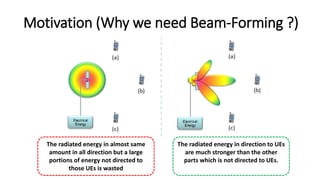
The radiated energy in direction to UEs
are much stronger than the other
parts which is not directed to UEs.
Motivation (Why we need Beam-Forming ?)
The radiated energy in almost same
amount in all direction but a large
portions of energy not directed to
those UEs is wasted
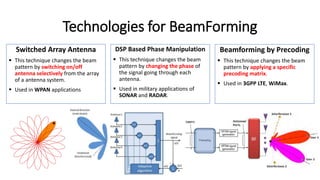
Technologies for BeamForming
Switched Array Antenna
 This technique changes the beam
pattern by switching on/off
antenna selectively from the array
of a antenna system.
 Used in WPAN applications
DSP Based Phase Manipulation
 This technique changes the beam
pattern by changing the phase of
the signal going through each
antenna.
 Used in military applications of
SONAR and RADAR.
Beamforming by Precoding
 This technique changes the beam
pattern by applying a specific
precoding matrix.
 Used in 3GPP LTE, WiMax.
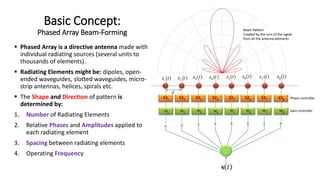
Basic Concept:
Phased Array Beam-Forming
 Phased Array is a directive antenna made with
individual radiating sources (several units to
thousands of elements).
 Radiating Elements might be: dipoles, open-
ended waveguides, slotted waveguides, micro-
strip antennas, helices, spirals etc.
 The Shape and Direction of pattern is
determined by:
1. Number of Radiating Elements
2. Relative Phases and Amplitudes applied to
each radiating element
3. Spacing between radiating elements
4. Operating Frequency
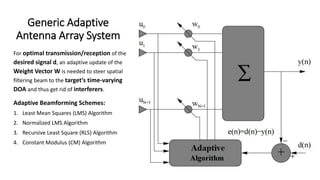
Generic Adaptive
Antenna Array System
For optimal transmission/reception of the
desired signal d, an adaptive update of the
Weight Vector W is needed to steer spatial
filtering beam to the target’s time-varying
DOA and thus get rid of interferers.
Adaptive Beamforming Schemes:
1. Least Mean Squares (LMS) Algorithm
2. Normalized LMS Algorithm
3. Recursive Least Square (RLS) Algorithm
4. Constant Modulus (CM) Algorithm
General Classifications Of Adaptive Array Algorithms
Non-blind Adaptive Algorithms
rely on statistical knowledge
about the transmitted signal in
order to converge to a solution.
Blind Adaptive Algorithms
do not require prior training, and
hence they are referred to as
“blind” algorithms.
Least Mean Squares (LMS) Algorithm
LMS Algorithm Summary
The LMS algorithm for a 𝑝 𝑡ℎorder algorithm can be
summarized as:
Parameters: 𝑝 = filter order
𝜇 = step size
Initialization: ℎ 0 = 𝑧𝑒𝑟𝑜𝑠(𝑝)
Computation: For 𝑛 = 0,1,2, . . .
𝑥 𝑛 = [𝑥 𝑛 , 𝑥 𝑛 − 1 , . . . , 𝑥 𝑛 − 𝑝 + 1 ] 𝑇
𝑒 𝑛 = 𝑑 𝑛 − ℎ 𝐻(𝑛) 𝑥 𝑛
ℎ 𝑛 + 1 = ℎ 𝑛 − 𝜇𝑒∗ 𝑛 𝑥 𝑛
Advantages & DisAdvantages of LMS algorithm:
1. Simplicity in implementation
2. Stable and robust performance against different
signal conditions
3. Slow convergence (due to eigenvalue spread)
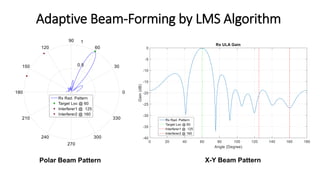
Adaptive Beam-Forming by LMS Algorithm
Polar Beam Pattern X-Y Beam Pattern
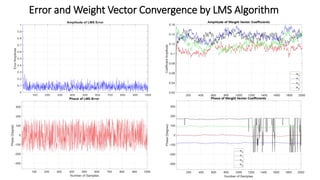
Error and Weight Vector Convergence by LMS Algorithm
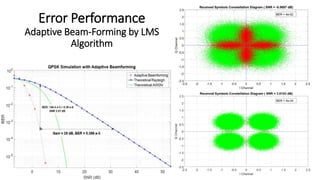
Error Performance
Adaptive Beam-Forming by LMS
Algorithm
Normalized LMS Algorithm
NLMS Algorithm Summary
The NLMS algorithm for a 𝒑 𝒕𝒉
order algorithm can be summarized as:
Parameters: 𝑝 = filter order
𝜇 = step size
Initialization: ℎ 0 = 𝑧𝑒𝑟𝑜𝑠(𝑝)
Computation: For 𝑛 = 0,1,2, . . .
𝑥 𝑛 = [𝑥 𝑛 , 𝑥 𝑛 − 1 , . . . , 𝑥 𝑛 − 𝑝 + 1 ] 𝑇
𝑒 𝑛 = 𝑑 𝑛 − ℎ 𝐻
(𝑛) 𝑥 𝑛
ℎ 𝑛 + 1 = ℎ 𝑛 −
𝜇𝑒∗
𝑛 𝑥 𝑛
𝑥 𝐻 𝑛 𝑥 𝑛
Improvements on ‘Pure’ LMS algorithm:
 LMS algorithm is sensitive to the scaling of its input 𝑥 𝑛
 Choosing a learning rate 𝜇 that guarantees stability of
LMS algorithm is impossible.
 NLMS Algorithm solves this problem by normalizing with
the power of the input, thereby converging faster than
LMS
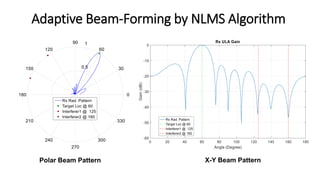
Polar Beam Pattern X-Y Beam Pattern
Adaptive Beam-Forming by NLMS Algorithm
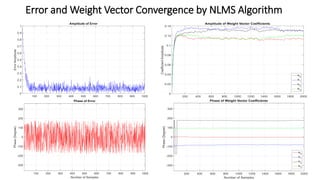
Error and Weight Vector Convergence by NLMS Algorithm
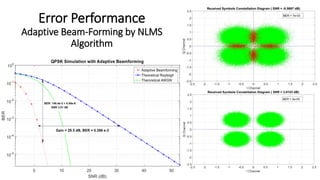
Error Performance
Adaptive Beam-Forming by NLMS
Algorithm
Recursive Least Square (RLS) Algorithm
RLS Algorithm Summary
The RLS algorithm for a 𝒑 𝒕𝒉
order RLS filter can be
summarized as:
Parameters: 𝑝 = filter order
𝜆 = forgetting factor
𝛿 = value to initialize 𝑷 0
Initialization : 𝑤 𝑛 = 0
𝑥 𝑘 = 0, 𝑘 = −𝑝, . . . , −1
𝑑 𝑘 = 0, 𝑘 = −𝑝, . . . , −1
𝑷 0 = 𝛿−1
𝐼 𝑝×𝑝
Advantages & DisAdvantages of RLS algorithm:
 No need to invert matrices, thereby saving computational
power.
 It provides intuition behind its results.
 Faster than LMS and NLMS but more complex
Computation: For 𝑛 = 0,1,2, . . .
𝑥 𝑛 = [𝑥 𝑛 , 𝑥 𝑛 − 1 , . . . , 𝑥 𝑛 − 𝑝 ] 𝑇
𝛼 𝑛 = 𝑑 𝑛 − 𝑥 𝑇(𝑛) 𝑤 𝑛 − 1
𝒈 𝑛 =
𝑷 𝑛 − 1 𝑥∗ 𝑛
𝜆 + 𝑥 𝑇 𝑛 𝑷 𝑛 − 1 𝑥∗ 𝑛
𝑷 𝑛 = 𝜆−1 𝑷 𝑛 − 1 − 𝑔 𝑛 𝑥 𝑇(𝑛)𝜆−1 𝑷 𝑛 − 1
w 𝑛 = 𝑤 𝑛 − 1 − 𝛼(𝑛) 𝑔 𝑛
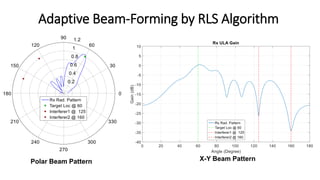
Polar Beam Pattern X-Y Beam Pattern
Adaptive Beam-Forming by RLS Algorithm
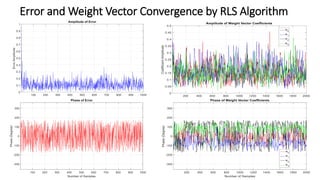
Error and Weight Vector Convergence by RLS Algorithm
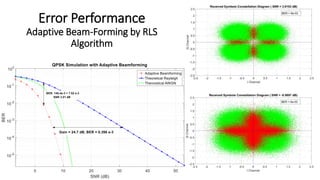
Error Performance
Adaptive Beam-Forming by RLS
Algorithm
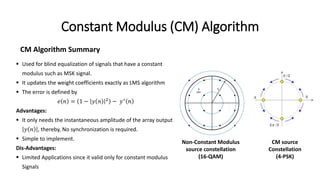
Constant Modulus (CM) Algorithm
CM Algorithm Summary
 Used for blind equalization of signals that have a constant
modulus such as MSK signal.
 It updates the weight coefficients exactly as LMS algorithm
 The error is defined by
𝑒 𝑛 = 1 − 𝑦 𝑛 2
− 𝑦∗
𝑛
Advantages:
 It only needs the instantaneous amplitude of the array output
𝑦 𝑛 , thereby, No synchronization is required.
 Simple to implement.
Dis-Advantages:
 Limited Applications since it valid only for constant modulus
Signals
Non-Constant Modulus
source constellation
(16-QAM)
CM source
Constellation
(4-PSK)
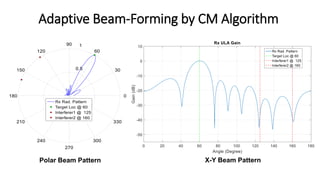
Polar Beam Pattern X-Y Beam Pattern
Adaptive Beam-Forming by CM Algorithm
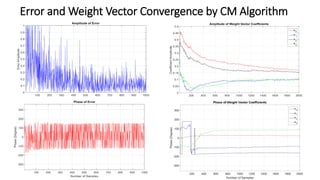
Error and Weight Vector Convergence by CM Algorithm
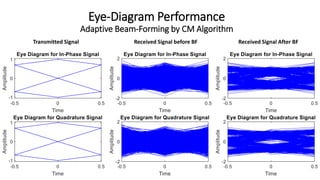
Eye-Diagram Performance
Adaptive Beam-Forming by CM Algorithm
Transmitted Signal Received Signal before BF Received Signal After BF
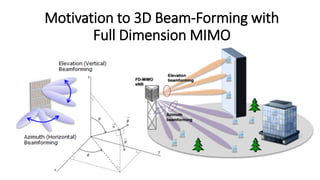
Motivation to 3D Beam-Forming with
Full Dimension MIMO
Agenda
1. Introduction Videos about LTE AP Pro
2. Overview on LTE and 4.5 G Evolution Around the World
3. LTE Advance Pro: Enhancements
4. LTE Advance Pro: New Use Cases
5. Case Study: Turkey’s Mobile Operators Evolution towards 4.5 G
6. Summary of LTE Advance Pro
7. MATLAB Simulation: 2D Beamforming algorithms (LMS, NLMS RLS and CM)
8. References
References
[1] http://www.dailysabah.com/technology/2015/08/26/turkeys-45g-mobile-technology-tender-concludes-with-a-record-bid-
of-396-billion
[2] http://www.huawei.com/en/news/2016/2/Huawei-Opened-Massive-Commercial-Use-Era-of-45G
[3] http://www.huawei.com/en/news/2016/5/Huawei-Helps-Turkey-with-45G
[4] White paper: LTE-Advanced Pro Pushing LTE capabilities towards 5G, Nokia Solutions and Networks
[5] White paper: Nokia Active Antenna Systems: A step-change in base station site performance, Nokia Solutions and Networks
[6] Ericsson White paper: LTE release 13, Uen 284 23-8267 | April 2015 ,
[7] Leading the path towards 5G with LTE Advanced Pro January 2016 Qualcomm Technologies, Inc.
[8] Progress on LAA and its relationship to LTE-U and MulteFire™ Qualcomm Technologies, Inc. February 22, 2016
[9] Mobile technology shares: 2020 forecast, Global mobile Suppliers Association (GSA), March 3, 2016.
[10] Global 4.5G Development presented in Turkey 4.5G Industry Summit on May 10, 2016 – Istanbul, Turkey
[11] LTE MTC: Optimizing LTE Advanced for Machine-Type Communications, Qualcomm Technologies, Inc. November 2014
Mohammed Abuibaid
Live & Breathe Wireless

Adaptive Beamforming Algorithms

  • 1.
    KOCAELI UNIVERSITY Graduate Schoolof Natural and Applied Sciences Prepared By: Mohammed ABUIBAID Email: m.a.abuibaid@gmail.com Electronic and Communication Engineering Adaptive Beam-Forming AcademicYear 2015/2016
  • 2.
    The radiated energyin direction to UEs are much stronger than the other parts which is not directed to UEs. Motivation (Why we need Beam-Forming ?) The radiated energy in almost same amount in all direction but a large portions of energy not directed to those UEs is wasted
  • 3.
    Technologies for BeamForming SwitchedArray Antenna  This technique changes the beam pattern by switching on/off antenna selectively from the array of a antenna system.  Used in WPAN applications DSP Based Phase Manipulation  This technique changes the beam pattern by changing the phase of the signal going through each antenna.  Used in military applications of SONAR and RADAR. Beamforming by Precoding  This technique changes the beam pattern by applying a specific precoding matrix.  Used in 3GPP LTE, WiMax.
  • 4.
    Basic Concept: Phased ArrayBeam-Forming  Phased Array is a directive antenna made with individual radiating sources (several units to thousands of elements).  Radiating Elements might be: dipoles, open- ended waveguides, slotted waveguides, micro- strip antennas, helices, spirals etc.  The Shape and Direction of pattern is determined by: 1. Number of Radiating Elements 2. Relative Phases and Amplitudes applied to each radiating element 3. Spacing between radiating elements 4. Operating Frequency
  • 5.
    Generic Adaptive Antenna ArraySystem For optimal transmission/reception of the desired signal d, an adaptive update of the Weight Vector W is needed to steer spatial filtering beam to the target’s time-varying DOA and thus get rid of interferers. Adaptive Beamforming Schemes: 1. Least Mean Squares (LMS) Algorithm 2. Normalized LMS Algorithm 3. Recursive Least Square (RLS) Algorithm 4. Constant Modulus (CM) Algorithm
  • 6.
    General Classifications OfAdaptive Array Algorithms Non-blind Adaptive Algorithms rely on statistical knowledge about the transmitted signal in order to converge to a solution. Blind Adaptive Algorithms do not require prior training, and hence they are referred to as “blind” algorithms.
  • 7.
    Least Mean Squares(LMS) Algorithm LMS Algorithm Summary The LMS algorithm for a 𝑝 𝑡ℎorder algorithm can be summarized as: Parameters: 𝑝 = filter order 𝜇 = step size Initialization: ℎ 0 = 𝑧𝑒𝑟𝑜𝑠(𝑝) Computation: For 𝑛 = 0,1,2, . . . 𝑥 𝑛 = [𝑥 𝑛 , 𝑥 𝑛 − 1 , . . . , 𝑥 𝑛 − 𝑝 + 1 ] 𝑇 𝑒 𝑛 = 𝑑 𝑛 − ℎ 𝐻(𝑛) 𝑥 𝑛 ℎ 𝑛 + 1 = ℎ 𝑛 − 𝜇𝑒∗ 𝑛 𝑥 𝑛 Advantages & DisAdvantages of LMS algorithm: 1. Simplicity in implementation 2. Stable and robust performance against different signal conditions 3. Slow convergence (due to eigenvalue spread)
  • 8.
    Adaptive Beam-Forming byLMS Algorithm Polar Beam Pattern X-Y Beam Pattern
  • 9.
    Error and WeightVector Convergence by LMS Algorithm
  • 10.
  • 11.
    Normalized LMS Algorithm NLMSAlgorithm Summary The NLMS algorithm for a 𝒑 𝒕𝒉 order algorithm can be summarized as: Parameters: 𝑝 = filter order 𝜇 = step size Initialization: ℎ 0 = 𝑧𝑒𝑟𝑜𝑠(𝑝) Computation: For 𝑛 = 0,1,2, . . . 𝑥 𝑛 = [𝑥 𝑛 , 𝑥 𝑛 − 1 , . . . , 𝑥 𝑛 − 𝑝 + 1 ] 𝑇 𝑒 𝑛 = 𝑑 𝑛 − ℎ 𝐻 (𝑛) 𝑥 𝑛 ℎ 𝑛 + 1 = ℎ 𝑛 − 𝜇𝑒∗ 𝑛 𝑥 𝑛 𝑥 𝐻 𝑛 𝑥 𝑛 Improvements on ‘Pure’ LMS algorithm:  LMS algorithm is sensitive to the scaling of its input 𝑥 𝑛  Choosing a learning rate 𝜇 that guarantees stability of LMS algorithm is impossible.  NLMS Algorithm solves this problem by normalizing with the power of the input, thereby converging faster than LMS
  • 12.
    Polar Beam PatternX-Y Beam Pattern Adaptive Beam-Forming by NLMS Algorithm
  • 13.
    Error and WeightVector Convergence by NLMS Algorithm
  • 14.
  • 15.
    Recursive Least Square(RLS) Algorithm RLS Algorithm Summary The RLS algorithm for a 𝒑 𝒕𝒉 order RLS filter can be summarized as: Parameters: 𝑝 = filter order 𝜆 = forgetting factor 𝛿 = value to initialize 𝑷 0 Initialization : 𝑤 𝑛 = 0 𝑥 𝑘 = 0, 𝑘 = −𝑝, . . . , −1 𝑑 𝑘 = 0, 𝑘 = −𝑝, . . . , −1 𝑷 0 = 𝛿−1 𝐼 𝑝×𝑝 Advantages & DisAdvantages of RLS algorithm:  No need to invert matrices, thereby saving computational power.  It provides intuition behind its results.  Faster than LMS and NLMS but more complex Computation: For 𝑛 = 0,1,2, . . . 𝑥 𝑛 = [𝑥 𝑛 , 𝑥 𝑛 − 1 , . . . , 𝑥 𝑛 − 𝑝 ] 𝑇 𝛼 𝑛 = 𝑑 𝑛 − 𝑥 𝑇(𝑛) 𝑤 𝑛 − 1 𝒈 𝑛 = 𝑷 𝑛 − 1 𝑥∗ 𝑛 𝜆 + 𝑥 𝑇 𝑛 𝑷 𝑛 − 1 𝑥∗ 𝑛 𝑷 𝑛 = 𝜆−1 𝑷 𝑛 − 1 − 𝑔 𝑛 𝑥 𝑇(𝑛)𝜆−1 𝑷 𝑛 − 1 w 𝑛 = 𝑤 𝑛 − 1 − 𝛼(𝑛) 𝑔 𝑛
  • 16.
    Polar Beam PatternX-Y Beam Pattern Adaptive Beam-Forming by RLS Algorithm
  • 17.
    Error and WeightVector Convergence by RLS Algorithm
  • 18.
  • 19.
    Constant Modulus (CM)Algorithm CM Algorithm Summary  Used for blind equalization of signals that have a constant modulus such as MSK signal.  It updates the weight coefficients exactly as LMS algorithm  The error is defined by 𝑒 𝑛 = 1 − 𝑦 𝑛 2 − 𝑦∗ 𝑛 Advantages:  It only needs the instantaneous amplitude of the array output 𝑦 𝑛 , thereby, No synchronization is required.  Simple to implement. Dis-Advantages:  Limited Applications since it valid only for constant modulus Signals Non-Constant Modulus source constellation (16-QAM) CM source Constellation (4-PSK)
  • 20.
    Polar Beam PatternX-Y Beam Pattern Adaptive Beam-Forming by CM Algorithm
  • 21.
    Error and WeightVector Convergence by CM Algorithm
  • 22.
    Eye-Diagram Performance Adaptive Beam-Formingby CM Algorithm Transmitted Signal Received Signal before BF Received Signal After BF
  • 23.
    Motivation to 3DBeam-Forming with Full Dimension MIMO
  • 24.
    Agenda 1. Introduction Videosabout LTE AP Pro 2. Overview on LTE and 4.5 G Evolution Around the World 3. LTE Advance Pro: Enhancements 4. LTE Advance Pro: New Use Cases 5. Case Study: Turkey’s Mobile Operators Evolution towards 4.5 G 6. Summary of LTE Advance Pro 7. MATLAB Simulation: 2D Beamforming algorithms (LMS, NLMS RLS and CM) 8. References
  • 25.
    References [1] http://www.dailysabah.com/technology/2015/08/26/turkeys-45g-mobile-technology-tender-concludes-with-a-record-bid- of-396-billion [2] http://www.huawei.com/en/news/2016/2/Huawei-Opened-Massive-Commercial-Use-Era-of-45G [3]http://www.huawei.com/en/news/2016/5/Huawei-Helps-Turkey-with-45G [4] White paper: LTE-Advanced Pro Pushing LTE capabilities towards 5G, Nokia Solutions and Networks [5] White paper: Nokia Active Antenna Systems: A step-change in base station site performance, Nokia Solutions and Networks [6] Ericsson White paper: LTE release 13, Uen 284 23-8267 | April 2015 , [7] Leading the path towards 5G with LTE Advanced Pro January 2016 Qualcomm Technologies, Inc. [8] Progress on LAA and its relationship to LTE-U and MulteFire™ Qualcomm Technologies, Inc. February 22, 2016 [9] Mobile technology shares: 2020 forecast, Global mobile Suppliers Association (GSA), March 3, 2016. [10] Global 4.5G Development presented in Turkey 4.5G Industry Summit on May 10, 2016 – Istanbul, Turkey [11] LTE MTC: Optimizing LTE Advanced for Machine-Type Communications, Qualcomm Technologies, Inc. November 2014
  • 26.
    Mohammed Abuibaid Live &Breathe Wireless

Editor's Notes

  • #4 SONAR:  Sound Navigation and Ranging RADAR: Radio Detection and Ranging