Microwaves UCL
1
Propagation models for wireless mobile
communications
D. Vanhoenacker-Janvier,
Microwave Lab. UCL, Louvain-la-Neuve,
Belgium
AT1-Propagation in wired, wireless and optical communications
Microwaves UCL
2
Content of the presentation
- Free space losses
- Plane earth losses
- Models for wireless channel
macrocells
shadowing
narrowband fast fading
wideband fast fading
megacells
This presentation is based on the following reference:
S.R. Saunders, Antennas and propagation for wireless
communication systems, Wiley, 1999.
Microwaves UCL
3
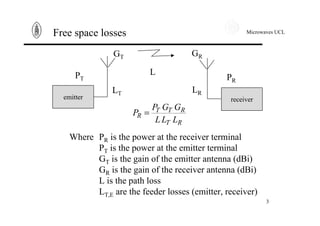
Free space losses
emitter receiver
GT GR
LPT PR
RT
RTT
R
LLL
GGP
P =
LT LR
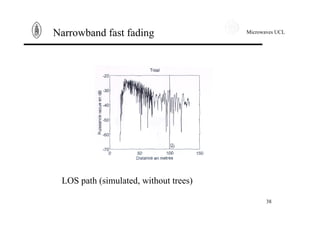
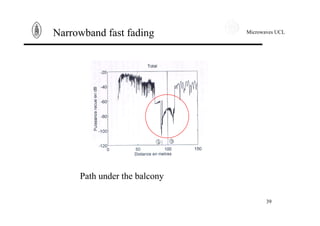
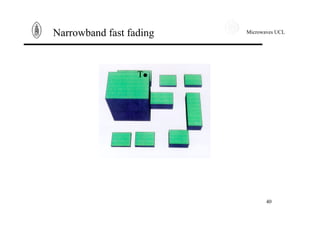
Where PR is the power at the receiver terminal
PT is the power at the emitter terminal
GT is the gain of the emitter antenna (dBi)
GR is the gain of the receiver antenna (dBi)
L is the path loss
LT,E are the feeder losses (emitter, receiver)
Microwaves UCL
4
Free space losses
TI
T
TT P
L
GP
EIRP ==
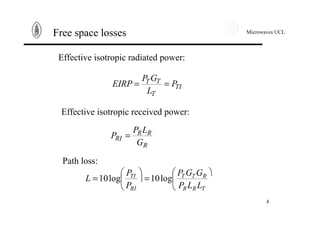
Effective isotropic radiated power:
Effective isotropic received power:
R
RR
RI
G
LP
P =
Path loss:
ö
ç
è
æ
=÷
ö
ç
è
æ
=
TRR
RTT
RI
TI
LLP
GGP
P
P
L log10log10
Microwaves UCL
5
Free space losses
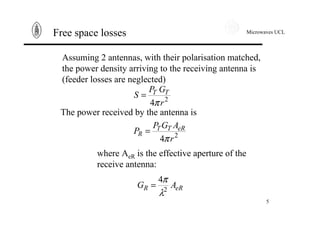
Assuming 2 antennas, with their polarisation matched,
the power density arriving to the receiving antenna is
(feeder losses are neglected)
2
4 r
GP
S TT
π
=
The power received by the antenna is
2
4 r
AGP
P eRTT
R
π
=
where AeR is the effective aperture of the
receive antenna:
eRR AG 2
4
λ
π
=
Microwaves UCL
6
Free space losses
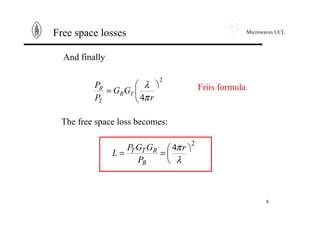
And finally
2
4
ö
ç
è
æ
=
r
GG
P
P
TR
T
R
π
λ Friis formula
The free space loss becomes:
2
4 ö
ç
è
æ==
λ
πr
P
GGP
L
R
RTT
Microwaves UCL
7
Plane earth loss
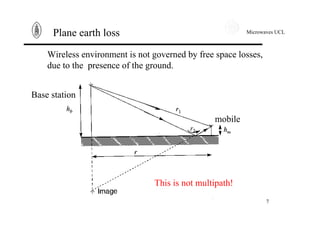
Wireless environment is not governed by free space losses,
due to the presence of the ground.
Base station
mobile
This is not multipath!
Microwaves UCL
8
Plane earth loss
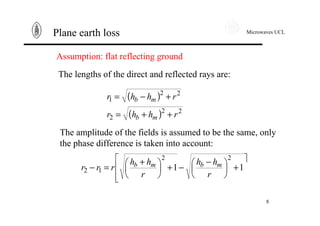
Assumption: flat reflecting ground
( )
( ) 22
2
22
1
rhhr
rhhr
mb
mb
++=
+−=
The lengths of the direct and reflected rays are:
The amplitude of the fields is assumed to be the same, only
the phase difference is taken into account:
ù
ê
ê
ë
é
+÷
ø
ö
ç
è
æ −
−+÷
ø
ö
ç
è
æ +
=− 11
22
12
r
hh
r
hh
rrr mbmb
Microwaves UCL
9
Plane earth loss
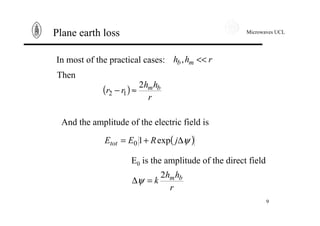
In most of the practical cases: rhh mb <<,
And the amplitude of the electric field is
( )ψ∆+= jREEtot exp10
Then
( )
r
hh
rr bm2
12 ≈−
E0 is the amplitude of the direct field
r
hh
k bm2
=∆ψ
Microwaves UCL
10
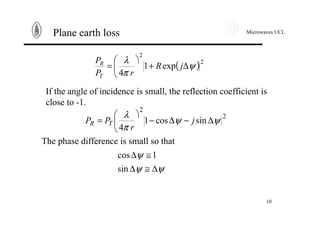
Plane earth loss
( )2
2
exp1
4
ψ
π
λ
∆+
ö
ç
è
æ
= jR
rP
P
T
R
If the angle of incidence is small, the reflection coefficient is
close to -1.
2
2
sincos1
4
ψψ
π
λ
∆−∆−
ö
ç
è
æ
= j
r
PP TR
The phase difference is small so that
ψψ
ψ
∆≅∆
≅∆
sin
1cos
Microwaves UCL
11
Plane earth loss
22
2
2
4
44
ö
ç
è
æ
÷
ö
ç
è
æ
≅∆÷
ö
ç
è
æ
≅
d
hh
r
P
r
PP bm
TTR
λ
π
π
λ
ψ
π
λ
2
2
ö
ç
è
æ
≅
d
hh
PP bm
TR
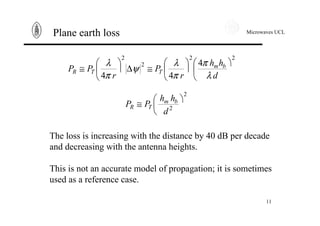
The loss is increasing with the distance by 40 dB per decade
and decreasing with the antenna heights.
This is not an accurate model of propagation; it is sometimes
used as a reference case.
Microwaves UCL
12
Models for wireless channel
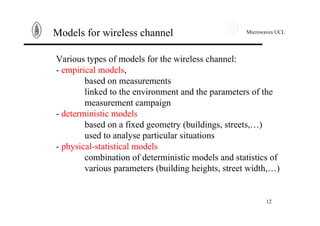
Various types of models for the wireless channel:
- empirical models,
based on measurements
linked to the environment and the parameters of the
measurement campaign
- deterministic models
based on a fixed geometry (buildings, streets,…)
used to analyse particular situations
- physical-statistical models
combination of deterministic models and statistics of
various parameters (building heights, street width,…)
Microwaves UCL
13
Models for wireless channel
- Models for macrocells
- Shadowing
- Narrowband fast fading
- Wideband fast fading
- Megacells
Microwaves UCL
14
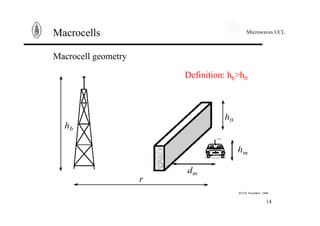
Macrocells
Macrocell geometry
Definition: hb>h0
Microwaves UCL
15
Macrocells
Macrocell models are used by system designers to place
the base stations.
They are
- simple
- dependent on distance from the base station only
- based on measurement (empirical models)
Microwaves UCL
16
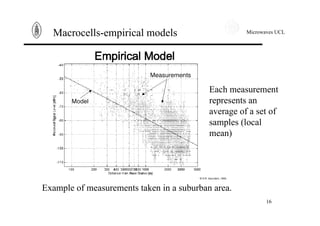
Macrocells-empirical models
Example of measurements taken in a suburban area.
Each measurement
represents an
average of a set of
samples (local
mean)
Microwaves UCL
17
Macrocells-empirical models
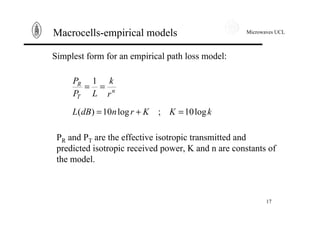
Simplest form for an empirical path loss model:
kKKrndBL
r
k
LP
P
n
T
R
log10;log10)(
1
=+=
==
PR and PT are the effective isotropic transmitted and
predicted isotropic received power, K and n are constants of
the model.
Microwaves UCL
18
Macrocells -empirical models
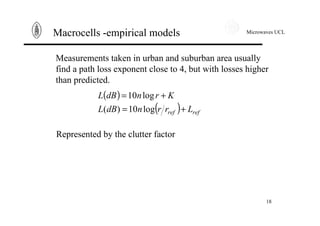
Measurements taken in urban and suburban area usually
find a path loss exponent close to 4, but with losses higher
than predicted.
( )
( ) refref LrrndBL
KrndBL
+=
+=
log10)(
log10
Represented by the clutter factor
Microwaves UCL
19
Macrocells -empirical models
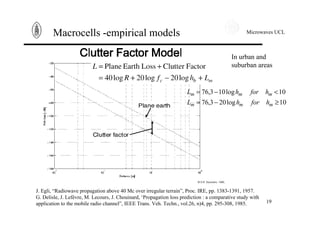
In urban and
suburban areas
J. Egli, “Radiowave propagation above 40 Mc over irregular terrain”, Proc. IRE, pp. 1383-1391, 1957.
G. Delisle, J. Lefèvre, M. Lecours, J. Chouinard, ‘Propagation loss prediction : a comparative study with
application to the mobile radio channel”, IEEE Trans. Veh. Techn., vol.26, n)4, pp. 295-308, 1985.
10log203,76
10log103,76
≥−=
<−=
mmm
mmm
hforhL
hforhL
Microwaves UCL
20
Macrocells -empirical models
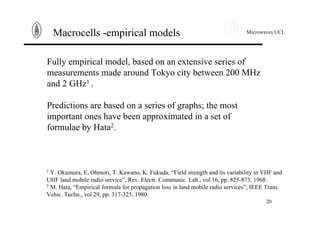
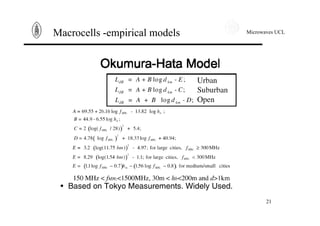
Fully empirical model, based on an extensive series of
measurements made around Tokyo city between 200 MHz
and 2 GHz1 .
Predictions are based on a series of graphs; the most
important ones have been approximated in a set of
formulae by Hata2.
1 Y. Okumura, E. Ohmori, T. Kawano, K. Fukuda, “Field strength and its variability in VHF and
UHF land mobile radio service”, Rev. Electr. Communic. Lab., vol.16, pp. 825-873, 1968.
2 M. Hata, “Empirical formula for propagation loss in land mobile radio services”, IEEE Trans.
Vehic. Techn., vol 29, pp. 317-325, 1980.
Microwaves UCL
21
Macrocells -empirical models
Microwaves UCL
22
Macrocells -empirical models
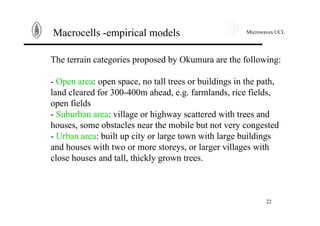
The terrain categories proposed by Okumura are the following:
- Open area: open space, no tall trees or buildings in the path,
land cleared for 300-400m ahead, e.g. farmlands, rice fields,
open fields
- Suburban area: village or highway scattered with trees and
houses, some obstacles near the mobile but not very congested
- Urban area: built up city or large town with large buildings
and houses with two or more storeys, or larger villages with
close houses and tall, thickly grown trees.
Microwaves UCL
23
Macrocells -empirical models
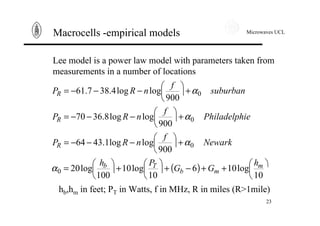
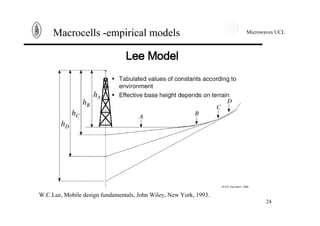
Lee model is a power law model with parameters taken from
measurements in a number of locations
( ) ö
ç
è
æ++−+÷
ö
ç
è
æ+÷
ö
ç
è
æ=
+÷
ö
ç
è
æ−−−=
+÷
ö
ç
è
æ−−−=
+÷
ö
ç
è
æ−−−=
10
log106
10
log10
100
log20
900
loglog1.4364
900
loglog8.3670
900
loglog4.387.61
0
0
0
0
m
mb
Tb
R
R
R
h
GG
Ph
Newark
f
nRP
iePhiladelph
f
nRP
suburban
f
nRP
α
α
α
α
hb,hm in feet; PT in Watts, f in MHz, R in miles (R>1mile)
Microwaves UCL
24
Macrocells -empirical models
W.C.Lee, Mobile design fundamentals, John Wiley, New York, 1993.
Microwaves UCL
25
Macrocells -empirical models
Limitations of the empirical models:
- they can only be used over parameter ranges included in the
original measurement set.
- environment must be classified subjectively according
categories, which may be different in different countries.
- they provide no physical insight into the mechanisms by
which propagation occurs.
Microwaves UCL
26
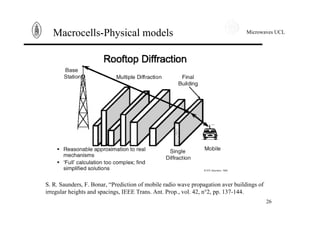
Macrocells-Physical models
S. R. Saunders, F. Bonar, “Prediction of mobile radio wave propagation aver buildings of
irregular heights and spacings, IEEE Trans. Ant. Prop., vol. 42, n°2, pp. 137-144.
Microwaves UCL
27
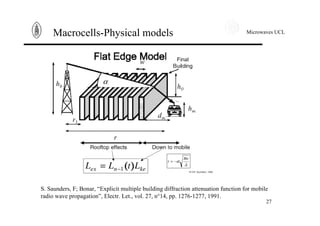
Macrocells-Physical models
S. Saunders, F; Bonar, “Explicit multiple building diffraction attenuation function for mobile
radio wave propagation”, Electr. Let., vol. 27, n°14, pp. 1276-1277, 1991.
Microwaves UCL
28
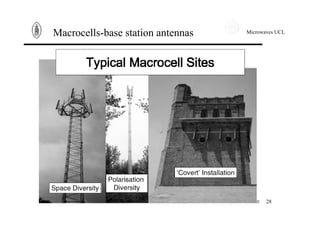
Macrocells-base station antennas
Microwaves UCL
29
Shadowing
Microwaves UCL
30
Shadowing
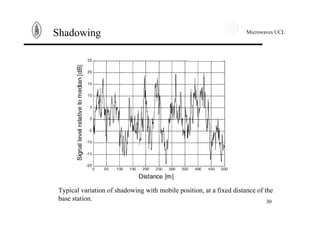
Typical variation of shadowing with mobile position, at a fixed distance of the
base station.
Microwaves UCL
31
Shadowing
Microwaves UCL
32
Shadowing
Microwaves UCL
33
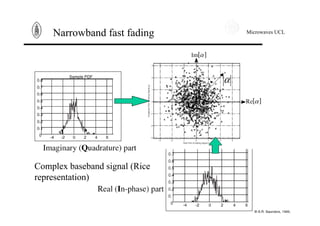
Narrowband fast fading
After path loss and shadowing, there is still significant
variation in the signal as mobile moves over distances which
are small compared with the shadowing.
This phenomenon is
Fast fading
and can be described by
deterministic models
statistical models
Microwaves UCL
34
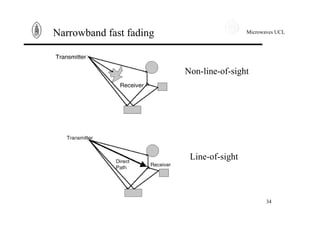
Narrowband fast fading
Non-line-of-sight
Line-of-sight
Microwaves UCL
35
Narrowband fast fading
Deterministic model: ray-tracing method
The built-up area is composed of parallelepipedic blocs
with plane faces representing buildings either vegetation.
The field arriving at the receiver results from the
combination of all components arriving at the terminal:
- direct component (if it exists)
- reflected components (various orders of reflection)
- diffracted components (various orders of diffraction)
- scattered components (d∼λ).
It is necessary to know the√electrical characteristics of the
blocs (ε and σ) at the frequency of interest.
Microwaves UCL
36
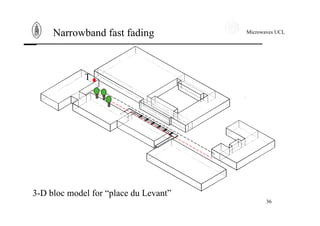
Narrowband fast fading
3-D bloc model for “place du Levant”
T
Microwaves UCL
37
Narrowband fast fading
30 40 50 60 70 80 90
−60
−55
−50
−45
−40
−35
−30
12.5 GHz
Distance from Maxwell building, [m]
Receivedpower,[dB]
30 40 50 60 70 80 90
−65
−60
−55
−50
−45
−40
−35
−30
30 GHz
Distance from Maxwell building, [m]
Receivedpower,[dB]
+
Simulation winter
Simulation summer
Meas. winter
Meas. summer
Comparison between simulation and measurement
Microwaves UCL
38
Narrowband fast fading
LOS path (simulated, without trees)
Microwaves UCL
39
Narrowband fast fading
Path under the balcony
Microwaves UCL
40
Narrowband fast fading
T
Microwaves UCL
41
Narrowband fast fading
Statistical model for the multipath signal
A sum of enough independent variables approaches very
closely a normal distribution.
In the NLOS case, the real and imaginary parts of the electric
field components are composed of a sum of a large number of
waves
they have a normal distribution
Microwaves UCL
42
Narrowband fast fading
Complex baseband signal (Rice
representation)
Microwaves UCL
43
Narrowband fast fading
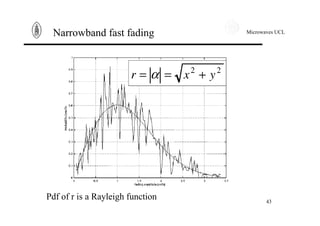
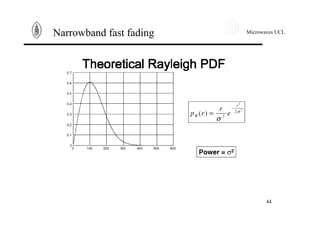
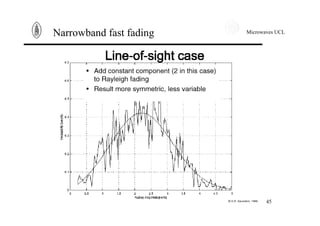
Pdf of r is a Rayleigh function
Microwaves UCL
44
Narrowband fast fading
Microwaves UCL
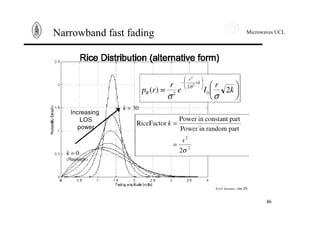
45
Narrowband fast fading
Microwaves UCL
46
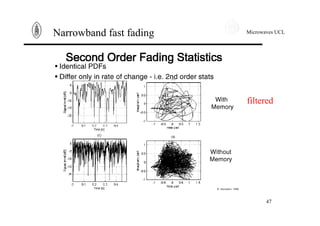
Narrowband fast fading
Microwaves UCL
47
Narrowband fast fading
filtered
Microwaves UCL
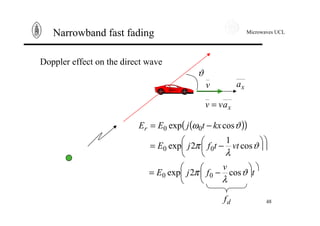
48
Narrowband fast fading
Doppler effect on the direct wave
v
ϑ
( )( )
ö
ç
è
æ
÷
ö
ç
è
æ
−=
÷
ö
ç
è
æ
÷
ö
ç
è
æ
−=
−=
t
v
fjE
vttfjE
kxtjEEr
ϑ
λ
π
ϑ
λ
π
ϑω
cos2exp
cos
1
2exp
cosexp
00
00
00
xavv =
xa
df
Microwaves UCL
49
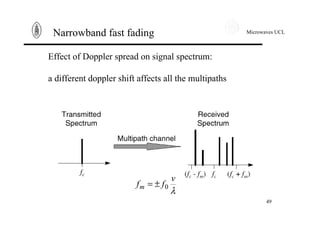
Narrowband fast fading
Effect of Doppler spread on signal spectrum:
a different doppler shift affects all the multipaths
λ
v
ffm 0±=
Microwaves UCL
50
Narrowband fast fading
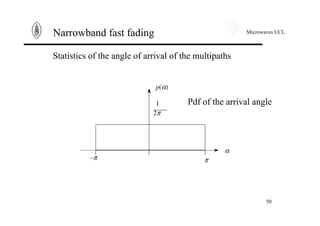
Statistics of the angle of arrival of the multipaths
Pdf of the arrival angle
Microwaves UCL
51
Narrowband fast fading
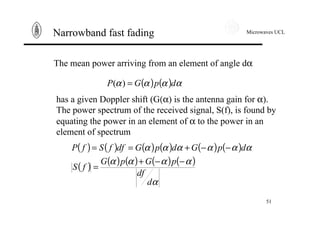
The mean power arriving from an element of angle dα
( ) ( ) αααα dpGP =)(
has a given Doppler shift (G(α) is the antenna gain for α).
The power spectrum of the received signal, S(f), is found by
equating the power in an element of α to the power in an
element of spectrum
( ) ( ) ( ) ( ) ( ) ( )
( )
( ) ( ) ( ) ( )
α
αααα
αααααα
d
df
pGpG
fS
dpGdpGdffSfP
−−+
=
−−+==
Microwaves UCL
52
Narrowband fast fading
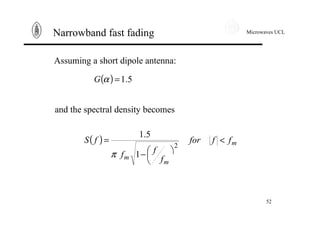
Assuming a short dipole antenna:
( ) 5.1=αG
and the spectral density becomes
( ) m
m
m
fffor
f
ff
fS <
öç
è
æ−
=
2
1
5.1
π
Microwaves UCL
53
Narrowband fast fading
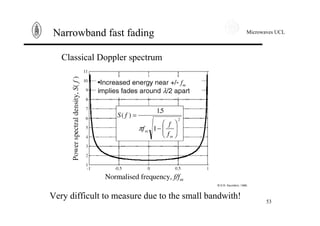
Classical Doppler spectrum
Very difficult to measure due to the small bandwith!
Microwaves UCL
54
Narrowband fast fading
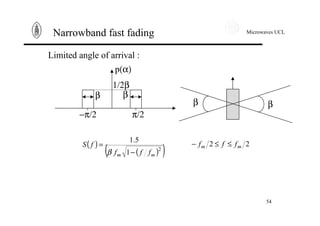
Limited angle of arrival :
−π/2 π/2
β β
1/2β
p(α)
β β
( )
( )( )2
1
5.1
mm fff
fS
−
=
β
22 mm fff ≤≤−
Microwaves UCL
55
Narrowband fast fading
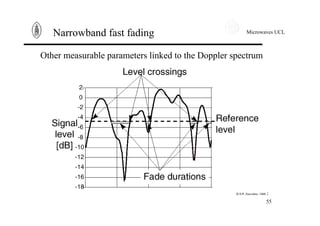
Other measurable parameters linked to the Doppler spectrum
Microwaves UCL
56
Narrowband fast fading
LCR
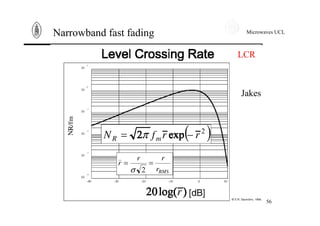
Jakes
Microwaves UCL
57
Narrowband fast fading
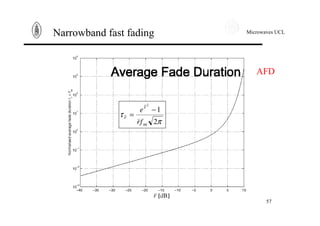
AFD
Microwaves UCL
58
Narrowband fast fading
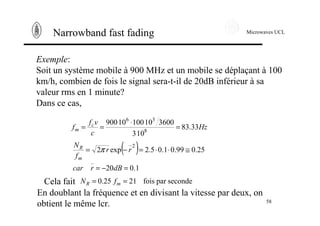
Exemple:
Soit un système mobile à 900 MHz et un mobile se déplaçant à 100
km/h, combien de fois le signal sera-t-il de 20dB inférieur à sa
valeur rms en 1 minute?
Dans ce cas,
Hz
c
vf
f c
m 33.83
103
36001010010900
8
36
=
⋅
==
( )
1.020
25.099.01.05.2exp2
2
=−=
≅⋅⋅=−=
dBrcar
rr
f
N
m
R
π
Cela fait secondeparfois2125.0 == mR fN
En doublant la fréquence et en divisant la vitesse par deux, on
obtient le même lcr.
Microwaves UCL
59
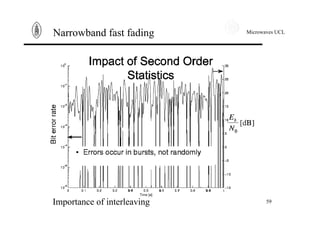
Narrowband fast fading
Importance of interleaving
Microwaves UCL
60
Narrowband fast fading
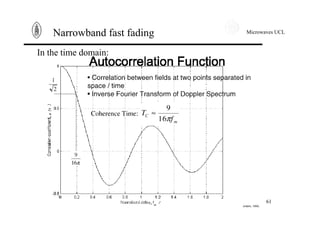
Another way to see Doppler effect is to work in time domain.
The inverse Fourier Transform of the power spectral density is
the autocorrelation function. It expresses correlation between a
signal at t and its value at t+τ. The autocorrelation function of
the received signal writes down
( ) ( ) ( )[ ] [ ]2*
αταατρ EttE +=
For the classical spectrum, one obtains
( ) ( )τπρ mfJt 20=
The coherence time is defined as the time during which teh
channel can be considered as constant. The signals, shorter then
the coherence time are not affected by the Doppler shift nor the
speed of the mobile.
Microwaves UCL
61
Narrowband fast fading
In the time domain:
Microwaves UCL
62
Narrowband fast fading
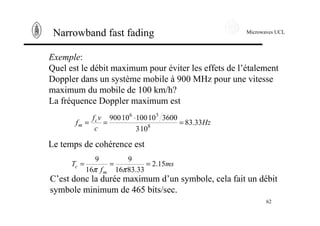
Exemple:
Quel est le débit maximum pour éviter les effets de l’étalement
Doppler dans un système mobile à 900 MHz pour une vitesse
maximum du mobile de 100 km/h?
La fréquence Doppler maximum est
Hz
c
vf
f c
m 33.83
103
36001010010900
8
36
=
⋅
==
Le temps de cohérence est
ms
f
T
m
c 15.2
33.8316
9
16
9
===
ππ
C’est donc la durée maximum d’un symbole, cela fait un débit
symbole minimum de 465 bits/sec.
Microwaves UCL
63
Wideband fast fading
Microwaves UCL
64
Wideband fast fading
Microwaves UCL
65
Wideband fast fading
Microwaves UCL
66
Wideband fast fading
Microwaves UCL
67
Wideband fast fading
Microwaves UCL
68
Wideband fast fading
Microwaves UCL
69
Wideband fast fading
Microwaves UCL
70
Wideband fast fading
Microwaves UCL
71
Wideband fast fading
Microwaves UCL
72
Wideband fast fading
Microwaves UCL
73
Megacells
Microwaves UCL
74
Megacells
Microwaves UCL
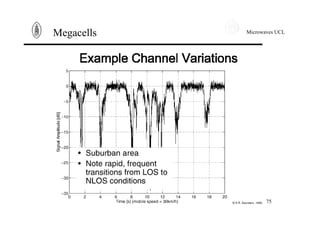
75
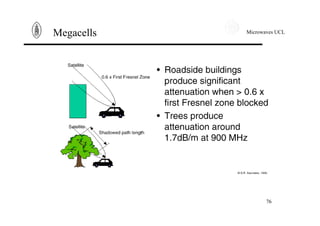
Megacells
Microwaves UCL
76
Megacells
Microwaves UCL
77
Megacells
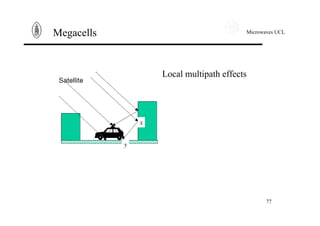
Local multipath effects
Microwaves UCL
78
Megacells
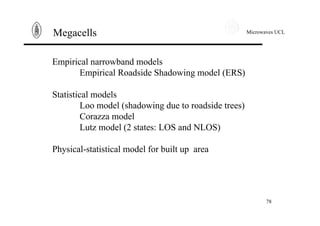
Empirical narrowband models
Empirical Roadside Shadowing model (ERS)
Statistical models
Loo model (shadowing due to roadside trees)
Corazza model
Lutz model (2 states: LOS and NLOS)
Physical-statistical model for built up area
Microwaves UCL
79
Megacells
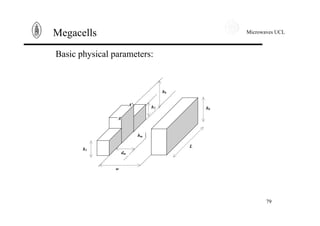
dm
w
hm
hb
hb
h2
h1
L
A'
A
Basic physical parameters:
Microwaves UCL
80
Megacells
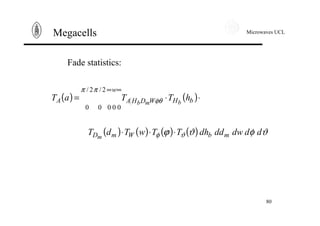
Fade statistics:
( ) ( )
( ) ( ) ( ) ( ) ϑφϑϕ ϑφ
π π
φθ
dddwdddhTTwTdT
hTTaT
mbWmD
w
bHWDHAA
m
bmb
⋅⋅⋅
⋅⋅=
∞ ∞2/
0
2/
0 0 0 0
Microwaves UCL
81
Megacells
0 2 4 6 8 10 12 14 16 18 20
0
0.05
0.1
0.15
0.2
0.25
0.3
Building height, [m]
Probabilitydensityfunction
Guildford
Building height distribution
Microwaves UCL
82
Megacells
5 15 25 35 45 55 65 75 85
0
0.005
0.01
0.015
0.02
0.025
0.03
0.035
0.04
Elevation angle, [deg.]
Probabilitydensityfunction
Maximum elevation angle
for Iridium constellation
at London
Microwaves UCL
83
Megacells
0 10 20 30 40 50 60
0
0.01
0.02
0.03
0.04
0.05
0.06
0.07
Street width, [m]
Probabilitydensityfunction
Street width distribution in
Guildford
Microwaves UCL
84
Megacells
0 1 2 3 4 5 6
0
0.05
0.1
0.15
0.2
0.25
0.3
0.35
Satellite azimuth angle, [rad.]
Probabilitydensity
Distribution of the nearest satellite azimuth
angle (relative to earth parallels) for Iridium at
London
Microwaves UCL
85
Megacells
0 1 2 3 4 5 6
0.15
0.152
0.154
0.156
0.158
0.16
0.162
0.164
0.166
0.168
0.17
Satellite azimuth angle, [rad.]
Probabilitydensity Distribution of the global azimuth angle (relative to
street axis) for Iridium constellation at London
Microwaves UCL
86
Megacells

Propagation Model

  • 1.
    Microwaves UCL 1 Propagation modelsfor wireless mobile communications D. Vanhoenacker-Janvier, Microwave Lab. UCL, Louvain-la-Neuve, Belgium AT1-Propagation in wired, wireless and optical communications
  • 2.
    Microwaves UCL 2 Content ofthe presentation - Free space losses - Plane earth losses - Models for wireless channel macrocells shadowing narrowband fast fading wideband fast fading megacells This presentation is based on the following reference: S.R. Saunders, Antennas and propagation for wireless communication systems, Wiley, 1999.
  • 3.
    Microwaves UCL 3 Free spacelosses emitter receiver GT GR LPT PR RT RTT R LLL GGP P = LT LR Where PR is the power at the receiver terminal PT is the power at the emitter terminal GT is the gain of the emitter antenna (dBi) GR is the gain of the receiver antenna (dBi) L is the path loss LT,E are the feeder losses (emitter, receiver)
  • 4.
    Microwaves UCL 4 Free spacelosses TI T TT P L GP EIRP == Effective isotropic radiated power: Effective isotropic received power: R RR RI G LP P = Path loss: ö ç è æ =÷ ö ç è æ = TRR RTT RI TI LLP GGP P P L log10log10
  • 5.
    Microwaves UCL 5 Free spacelosses Assuming 2 antennas, with their polarisation matched, the power density arriving to the receiving antenna is (feeder losses are neglected) 2 4 r GP S TT π = The power received by the antenna is 2 4 r AGP P eRTT R π = where AeR is the effective aperture of the receive antenna: eRR AG 2 4 λ π =
  • 6.
    Microwaves UCL 6 Free spacelosses And finally 2 4 ö ç è æ = r GG P P TR T R π λ Friis formula The free space loss becomes: 2 4 ö ç è æ== λ πr P GGP L R RTT
  • 7.
    Microwaves UCL 7 Plane earthloss Wireless environment is not governed by free space losses, due to the presence of the ground. Base station mobile This is not multipath!
  • 8.
    Microwaves UCL 8 Plane earthloss Assumption: flat reflecting ground ( ) ( ) 22 2 22 1 rhhr rhhr mb mb ++= +−= The lengths of the direct and reflected rays are: The amplitude of the fields is assumed to be the same, only the phase difference is taken into account: ù ê ê ë é +÷ ø ö ç è æ − −+÷ ø ö ç è æ + =− 11 22 12 r hh r hh rrr mbmb
  • 9.
    Microwaves UCL 9 Plane earthloss In most of the practical cases: rhh mb <<, And the amplitude of the electric field is ( )ψ∆+= jREEtot exp10 Then ( ) r hh rr bm2 12 ≈− E0 is the amplitude of the direct field r hh k bm2 =∆ψ
  • 10.
    Microwaves UCL 10 Plane earthloss ( )2 2 exp1 4 ψ π λ ∆+ ö ç è æ = jR rP P T R If the angle of incidence is small, the reflection coefficient is close to -1. 2 2 sincos1 4 ψψ π λ ∆−∆− ö ç è æ = j r PP TR The phase difference is small so that ψψ ψ ∆≅∆ ≅∆ sin 1cos
  • 11.
    Microwaves UCL 11 Plane earthloss 22 2 2 4 44 ö ç è æ ÷ ö ç è æ ≅∆÷ ö ç è æ ≅ d hh r P r PP bm TTR λ π π λ ψ π λ 2 2 ö ç è æ ≅ d hh PP bm TR The loss is increasing with the distance by 40 dB per decade and decreasing with the antenna heights. This is not an accurate model of propagation; it is sometimes used as a reference case.
  • 12.
    Microwaves UCL 12 Models forwireless channel Various types of models for the wireless channel: - empirical models, based on measurements linked to the environment and the parameters of the measurement campaign - deterministic models based on a fixed geometry (buildings, streets,…) used to analyse particular situations - physical-statistical models combination of deterministic models and statistics of various parameters (building heights, street width,…)
  • 13.
    Microwaves UCL 13 Models forwireless channel - Models for macrocells - Shadowing - Narrowband fast fading - Wideband fast fading - Megacells
  • 14.
  • 15.
    Microwaves UCL 15 Macrocells Macrocell modelsare used by system designers to place the base stations. They are - simple - dependent on distance from the base station only - based on measurement (empirical models)
  • 16.
    Microwaves UCL 16 Macrocells-empirical models Exampleof measurements taken in a suburban area. Each measurement represents an average of a set of samples (local mean)
  • 17.
    Microwaves UCL 17 Macrocells-empirical models Simplestform for an empirical path loss model: kKKrndBL r k LP P n T R log10;log10)( 1 =+= == PR and PT are the effective isotropic transmitted and predicted isotropic received power, K and n are constants of the model.
  • 18.
    Microwaves UCL 18 Macrocells -empiricalmodels Measurements taken in urban and suburban area usually find a path loss exponent close to 4, but with losses higher than predicted. ( ) ( ) refref LrrndBL KrndBL += += log10)( log10 Represented by the clutter factor
  • 19.
    Microwaves UCL 19 Macrocells -empiricalmodels In urban and suburban areas J. Egli, “Radiowave propagation above 40 Mc over irregular terrain”, Proc. IRE, pp. 1383-1391, 1957. G. Delisle, J. Lefèvre, M. Lecours, J. Chouinard, ‘Propagation loss prediction : a comparative study with application to the mobile radio channel”, IEEE Trans. Veh. Techn., vol.26, n)4, pp. 295-308, 1985. 10log203,76 10log103,76 ≥−= <−= mmm mmm hforhL hforhL
  • 20.
    Microwaves UCL 20 Macrocells -empiricalmodels Fully empirical model, based on an extensive series of measurements made around Tokyo city between 200 MHz and 2 GHz1 . Predictions are based on a series of graphs; the most important ones have been approximated in a set of formulae by Hata2. 1 Y. Okumura, E. Ohmori, T. Kawano, K. Fukuda, “Field strength and its variability in VHF and UHF land mobile radio service”, Rev. Electr. Communic. Lab., vol.16, pp. 825-873, 1968. 2 M. Hata, “Empirical formula for propagation loss in land mobile radio services”, IEEE Trans. Vehic. Techn., vol 29, pp. 317-325, 1980.
  • 21.
  • 22.
    Microwaves UCL 22 Macrocells -empiricalmodels The terrain categories proposed by Okumura are the following: - Open area: open space, no tall trees or buildings in the path, land cleared for 300-400m ahead, e.g. farmlands, rice fields, open fields - Suburban area: village or highway scattered with trees and houses, some obstacles near the mobile but not very congested - Urban area: built up city or large town with large buildings and houses with two or more storeys, or larger villages with close houses and tall, thickly grown trees.
  • 23.
    Microwaves UCL 23 Macrocells -empiricalmodels Lee model is a power law model with parameters taken from measurements in a number of locations ( ) ö ç è æ++−+÷ ö ç è æ+÷ ö ç è æ= +÷ ö ç è æ−−−= +÷ ö ç è æ−−−= +÷ ö ç è æ−−−= 10 log106 10 log10 100 log20 900 loglog1.4364 900 loglog8.3670 900 loglog4.387.61 0 0 0 0 m mb Tb R R R h GG Ph Newark f nRP iePhiladelph f nRP suburban f nRP α α α α hb,hm in feet; PT in Watts, f in MHz, R in miles (R>1mile)
  • 24.
    Microwaves UCL 24 Macrocells -empiricalmodels W.C.Lee, Mobile design fundamentals, John Wiley, New York, 1993.
  • 25.
    Microwaves UCL 25 Macrocells -empiricalmodels Limitations of the empirical models: - they can only be used over parameter ranges included in the original measurement set. - environment must be classified subjectively according categories, which may be different in different countries. - they provide no physical insight into the mechanisms by which propagation occurs.
  • 26.
    Microwaves UCL 26 Macrocells-Physical models S.R. Saunders, F. Bonar, “Prediction of mobile radio wave propagation aver buildings of irregular heights and spacings, IEEE Trans. Ant. Prop., vol. 42, n°2, pp. 137-144.
  • 27.
    Microwaves UCL 27 Macrocells-Physical models S.Saunders, F; Bonar, “Explicit multiple building diffraction attenuation function for mobile radio wave propagation”, Electr. Let., vol. 27, n°14, pp. 1276-1277, 1991.
  • 28.
  • 29.
  • 30.
    Microwaves UCL 30 Shadowing Typical variationof shadowing with mobile position, at a fixed distance of the base station.
  • 31.
  • 32.
  • 33.
    Microwaves UCL 33 Narrowband fastfading After path loss and shadowing, there is still significant variation in the signal as mobile moves over distances which are small compared with the shadowing. This phenomenon is Fast fading and can be described by deterministic models statistical models
  • 34.
    Microwaves UCL 34 Narrowband fastfading Non-line-of-sight Line-of-sight
  • 35.
    Microwaves UCL 35 Narrowband fastfading Deterministic model: ray-tracing method The built-up area is composed of parallelepipedic blocs with plane faces representing buildings either vegetation. The field arriving at the receiver results from the combination of all components arriving at the terminal: - direct component (if it exists) - reflected components (various orders of reflection) - diffracted components (various orders of diffraction) - scattered components (d∼λ). It is necessary to know the√electrical characteristics of the blocs (ε and σ) at the frequency of interest.
  • 36.
    Microwaves UCL 36 Narrowband fastfading 3-D bloc model for “place du Levant” T
  • 37.
    Microwaves UCL 37 Narrowband fastfading 30 40 50 60 70 80 90 −60 −55 −50 −45 −40 −35 −30 12.5 GHz Distance from Maxwell building, [m] Receivedpower,[dB] 30 40 50 60 70 80 90 −65 −60 −55 −50 −45 −40 −35 −30 30 GHz Distance from Maxwell building, [m] Receivedpower,[dB] + Simulation winter Simulation summer Meas. winter Meas. summer Comparison between simulation and measurement
  • 38.
    Microwaves UCL 38 Narrowband fastfading LOS path (simulated, without trees)
  • 39.
    Microwaves UCL 39 Narrowband fastfading Path under the balcony
  • 40.
  • 41.
    Microwaves UCL 41 Narrowband fastfading Statistical model for the multipath signal A sum of enough independent variables approaches very closely a normal distribution. In the NLOS case, the real and imaginary parts of the electric field components are composed of a sum of a large number of waves they have a normal distribution
  • 42.
    Microwaves UCL 42 Narrowband fastfading Complex baseband signal (Rice representation)
  • 43.
    Microwaves UCL 43 Narrowband fastfading Pdf of r is a Rayleigh function
  • 44.
  • 45.
  • 46.
  • 47.
  • 48.
    Microwaves UCL 48 Narrowband fastfading Doppler effect on the direct wave v ϑ ( )( ) ö ç è æ ÷ ö ç è æ −= ÷ ö ç è æ ÷ ö ç è æ −= −= t v fjE vttfjE kxtjEEr ϑ λ π ϑ λ π ϑω cos2exp cos 1 2exp cosexp 00 00 00 xavv = xa df
  • 49.
    Microwaves UCL 49 Narrowband fastfading Effect of Doppler spread on signal spectrum: a different doppler shift affects all the multipaths λ v ffm 0±=
  • 50.
    Microwaves UCL 50 Narrowband fastfading Statistics of the angle of arrival of the multipaths Pdf of the arrival angle
  • 51.
    Microwaves UCL 51 Narrowband fastfading The mean power arriving from an element of angle dα ( ) ( ) αααα dpGP =)( has a given Doppler shift (G(α) is the antenna gain for α). The power spectrum of the received signal, S(f), is found by equating the power in an element of α to the power in an element of spectrum ( ) ( ) ( ) ( ) ( ) ( ) ( ) ( ) ( ) ( ) ( ) α αααα αααααα d df pGpG fS dpGdpGdffSfP −−+ = −−+==
  • 52.
    Microwaves UCL 52 Narrowband fastfading Assuming a short dipole antenna: ( ) 5.1=αG and the spectral density becomes ( ) m m m fffor f ff fS < öç è æ− = 2 1 5.1 π
  • 53.
    Microwaves UCL 53 Narrowband fastfading Classical Doppler spectrum Very difficult to measure due to the small bandwith!
  • 54.
    Microwaves UCL 54 Narrowband fastfading Limited angle of arrival : −π/2 π/2 β β 1/2β p(α) β β ( ) ( )( )2 1 5.1 mm fff fS − = β 22 mm fff ≤≤−
  • 55.
    Microwaves UCL 55 Narrowband fastfading Other measurable parameters linked to the Doppler spectrum
  • 56.
  • 57.
  • 58.
    Microwaves UCL 58 Narrowband fastfading Exemple: Soit un système mobile à 900 MHz et un mobile se déplaçant à 100 km/h, combien de fois le signal sera-t-il de 20dB inférieur à sa valeur rms en 1 minute? Dans ce cas, Hz c vf f c m 33.83 103 36001010010900 8 36 = ⋅ == ( ) 1.020 25.099.01.05.2exp2 2 =−= ≅⋅⋅=−= dBrcar rr f N m R π Cela fait secondeparfois2125.0 == mR fN En doublant la fréquence et en divisant la vitesse par deux, on obtient le même lcr.
  • 59.
    Microwaves UCL 59 Narrowband fastfading Importance of interleaving
  • 60.
    Microwaves UCL 60 Narrowband fastfading Another way to see Doppler effect is to work in time domain. The inverse Fourier Transform of the power spectral density is the autocorrelation function. It expresses correlation between a signal at t and its value at t+τ. The autocorrelation function of the received signal writes down ( ) ( ) ( )[ ] [ ]2* αταατρ EttE += For the classical spectrum, one obtains ( ) ( )τπρ mfJt 20= The coherence time is defined as the time during which teh channel can be considered as constant. The signals, shorter then the coherence time are not affected by the Doppler shift nor the speed of the mobile.
  • 61.
    Microwaves UCL 61 Narrowband fastfading In the time domain:
  • 62.
    Microwaves UCL 62 Narrowband fastfading Exemple: Quel est le débit maximum pour éviter les effets de l’étalement Doppler dans un système mobile à 900 MHz pour une vitesse maximum du mobile de 100 km/h? La fréquence Doppler maximum est Hz c vf f c m 33.83 103 36001010010900 8 36 = ⋅ == Le temps de cohérence est ms f T m c 15.2 33.8316 9 16 9 === ππ C’est donc la durée maximum d’un symbole, cela fait un débit symbole minimum de 465 bits/sec.
  • 63.
  • 64.
  • 65.
  • 66.
  • 67.
  • 68.
  • 69.
  • 70.
  • 71.
  • 72.
  • 73.
  • 74.
  • 75.
  • 76.
  • 77.
  • 78.
    Microwaves UCL 78 Megacells Empirical narrowbandmodels Empirical Roadside Shadowing model (ERS) Statistical models Loo model (shadowing due to roadside trees) Corazza model Lutz model (2 states: LOS and NLOS) Physical-statistical model for built up area
  • 79.
  • 80.
    Microwaves UCL 80 Megacells Fade statistics: () ( ) ( ) ( ) ( ) ( ) ϑφϑϕ ϑφ π π φθ dddwdddhTTwTdT hTTaT mbWmD w bHWDHAA m bmb ⋅⋅⋅ ⋅⋅= ∞ ∞2/ 0 2/ 0 0 0 0
  • 81.
    Microwaves UCL 81 Megacells 0 24 6 8 10 12 14 16 18 20 0 0.05 0.1 0.15 0.2 0.25 0.3 Building height, [m] Probabilitydensityfunction Guildford Building height distribution
  • 82.
    Microwaves UCL 82 Megacells 5 1525 35 45 55 65 75 85 0 0.005 0.01 0.015 0.02 0.025 0.03 0.035 0.04 Elevation angle, [deg.] Probabilitydensityfunction Maximum elevation angle for Iridium constellation at London
  • 83.
    Microwaves UCL 83 Megacells 0 1020 30 40 50 60 0 0.01 0.02 0.03 0.04 0.05 0.06 0.07 Street width, [m] Probabilitydensityfunction Street width distribution in Guildford
  • 84.
    Microwaves UCL 84 Megacells 0 12 3 4 5 6 0 0.05 0.1 0.15 0.2 0.25 0.3 0.35 Satellite azimuth angle, [rad.] Probabilitydensity Distribution of the nearest satellite azimuth angle (relative to earth parallels) for Iridium at London
  • 85.
    Microwaves UCL 85 Megacells 0 12 3 4 5 6 0.15 0.152 0.154 0.156 0.158 0.16 0.162 0.164 0.166 0.168 0.17 Satellite azimuth angle, [rad.] Probabilitydensity Distribution of the global azimuth angle (relative to street axis) for Iridium constellation at London
  • 86.