Multiple Access Techniques
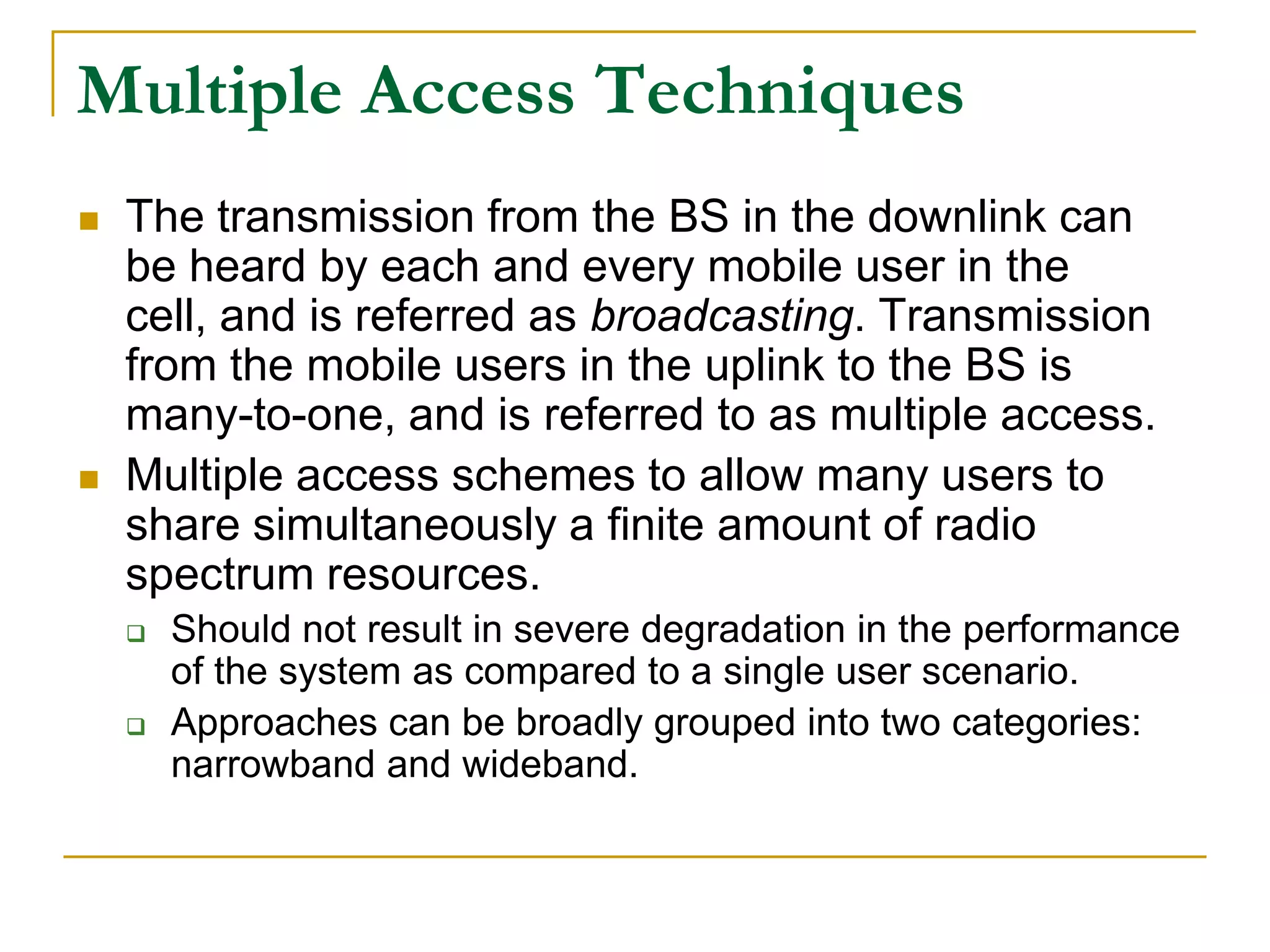
 The transmission from the BS in the downlink can
be heard by each and every mobile user in the
cell, and is referred as broadcasting. Transmission
from the mobile users in the uplink to the BS is
many-to-one, and is referred to as multiple access.
 Multiple access schemes to allow many users to
share simultaneously a finite amount of radio
spectrum resources.
 Should not result in severe degradation in the performance
of the system as compared to a single user scenario.
 Approaches can be broadly grouped into two categories:
narrowband and wideband.
Multiple Access Techniques
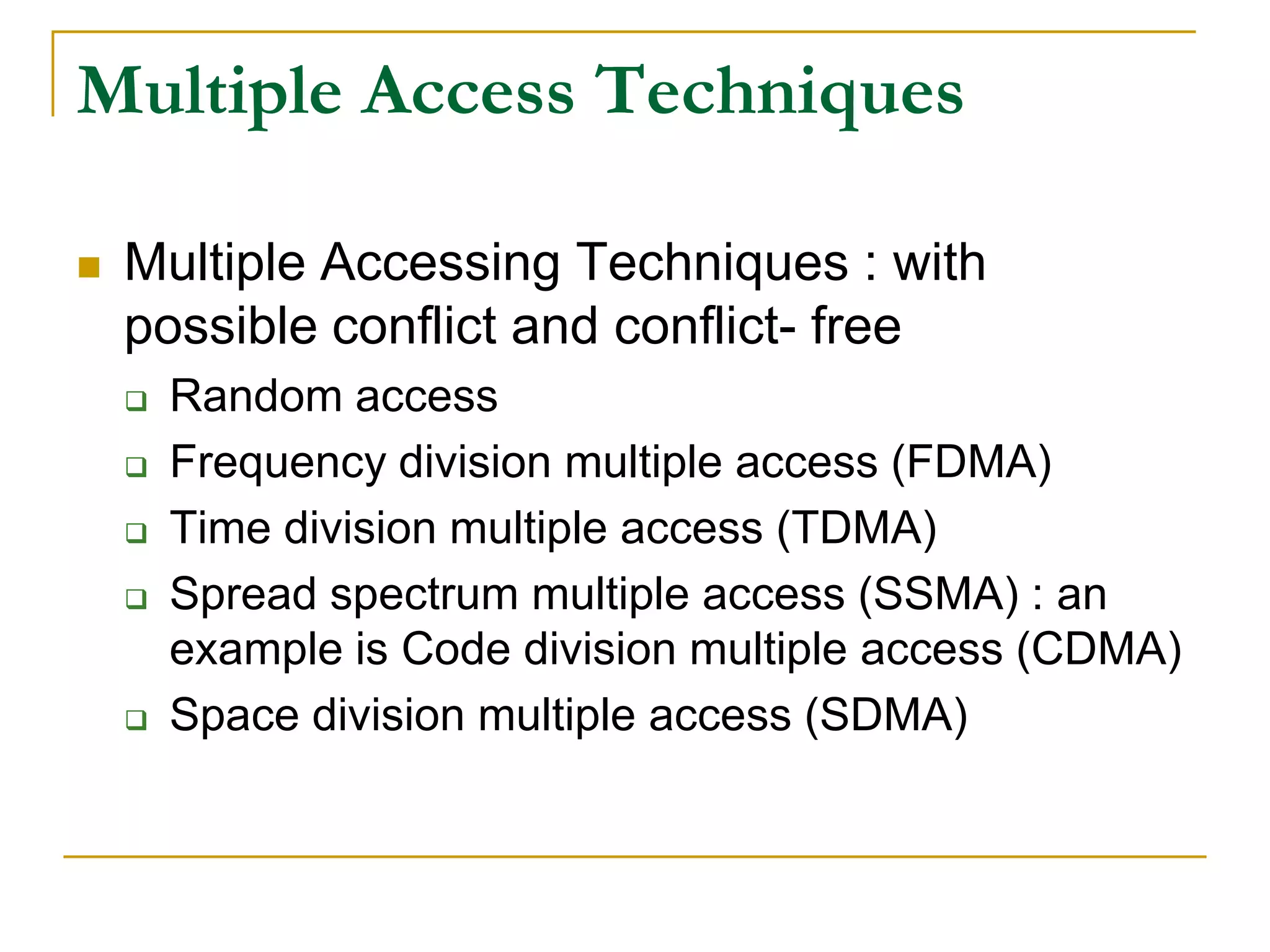
 Multiple Accessing Techniques : with
possible conflict and conflict- free
 Random access
 Frequency division multiple access (FDMA)
 Time division multiple access (TDMA)
 Spread spectrum multiple access (SSMA) : an
example is Code division multiple access (CDMA)
 Space division multiple access (SDMA)
Multiple Access Techniques --
Narrowband Systems
 Transmission experiences nonselective fading. This
means that when fades occur, all of the information (i.e.
the whole channel) is affected.
 Channel system : generally total spectrum is divided into
a number of relatively narrow radio channels (e.g.
FDMA). Occurrence of call blocking if channels are all
being used. Unused bandwidth in each channel cannot
be used by other users.
Narrowband Systems (Interleaving + coding
techniques are used)
 Data generated in source 1 2 3 4
5 … 8 9 10 11 12 … 15 16 17
18 …
 Transmitted data 1 8 15 22 29 …
2 9 16 23 … 3 10 17 24 …
 Received data 1 8 15 22 29 … 2 9
16 23 30 … 3 10 17 24 31 …
 with the shaded data bits undergo
deep fade
 Deinterleaved data 1 2 3 4 5 … 8
9 … 15 16 17 18 …
Multiple Access Techniques --
Wideband Systems
 The main feature of wideband systems is that either
all the spectrum available (e.g. CDMA, TDMA) or a
considerable portion of it is used by each user (e.g.
TDMA+FDMA).
 The advantage of wideband systems is that the
transmission bandwidth always exceeds the
coherence bandwidth for which the signal
experiences only selective fading. That is, only a
small fraction of the frequencies composing the
signal is affected by fading.
 Signal can be distorted and therefore equalization is
needed but unlikely that a total signal fade will
occur.
Duplexing
 For voice or data communications, must
assure two way communication (duplexing, it
is possible to talk and listen simultaneously).
Duplexing may be done using frequency or
time domain techniques.
 Forward (downlink) band provides traffic from the
BS to the mobile
 Reverse (uplink) band provides traffic from the
mobile to the BS.
Frequency division duplexing (FDD)
 Provides two distinct bands of frequencies for
every user, one for downlink and one for
uplink.
 A large interval between these frequency
bands must be allowed so that interference is
minimized. Reverse
Channel
Forward
Channel
frequencyfc,
R
fc,,
F
Frequency separation
Frequency separation should be carefully decided
Frequency separation is constant
Time division duplexing (TDD)
 In TDD communications, both directions of transmission use
one contiguous frequency allocation, but two separate time
slots to provide both a forward and reverse link.
 Because transmission from mobile to BS and from BS to
mobile alternates in time, this scheme is also known as “ping
pong”.
 As a consequence of the use of the same frequency band, the
communication quality in both directions is the same. This is
different from FDD.
Time division duplexing (TDD)
F R R R R
0 1 2 3 4 5 6 7 …
….
Reverse
Channel
Forward
Channel
timeTi
Time separation
Ti+1
channel
Slot number
F F F
Random Access -- Aloha systems
 Aloha is a packet-switching system. The time interval required to
transmit one packet is called a slot.
 When transmissions from two or more users overlap, they
destroy each other, whether it is complete overlap or partial
overlap – collision takes place.
 The maximum interval over which two packets can overlap and
destroy each other is called the vulnerable period.
 The mode of random access in which users can transmit at
anytime is called pure Aloha. In this case, the vulnerable period
is two slot times.
 A version in which users are restricted to transmit only from the
instant corresponding to the slot boundary is referred to as
slotted Aloha. The alignment of transmission to coincide with the
slot boundary means that packets can only experience complete
overlap, so the vulnerable period is only one slot time.
Random Access -- Aloha systems
Throughput of Aloha systems
 In the Aloha systems, a transmitting user upon
hearing a collision, backs off for a random delay
interval and transmits again, until success is
achieved. This is known as collision resolution.
 We assume that the total traffic generated for
transmission (including re-transmission) obeys a
Poisson distribution.
 The transmission is successful when there is no
other packet transmission during the vulnerable
period.
Throughput of Aloha systems
 P (success) =P (no other packet transmission occurs
within a vulnerable period)
 Let S be the throughput, defined as the successfully
transmitted traffic load, and G be the total offered
channel traffic load. Assuming that traffic generated for
transmission obeys a Poisson distribution, then
P (no other packet transmission occurs) = exp(−τG)
where τ is the vulnerable period.
Hence P (success) = exp (−τG)
By definition P (success) = S /G,
therefore S = G exp (−τG)
Throughput of Aloha systems
Delay
 The delay experienced by a packet in the
system is measured from the instant of the
packet’s arrival until the instant the sender
receives confirmation.
 It is a function of the number of
transmission, the retransmission delay and
the time required for the sender to receive
confirmation of successful transmission.
Delay
 The mean number of transmission until success
 The average packet delay for pure Aloha
 The average packet delay for slotted Aloha
 The mean re-transmission delay depends on the collision
resolution algorithm used.
Delay
FDMA
 In FDMA, each user is allocated a unique
frequency band or channel. During the period
of the call, no other user can share the same
frequency band.
FDMA
 All channels in a cell are available to all the mobiles. Channel
assignment is carried out on a first-come first- served basis.
 The number of channels, given a frequency spectrum
BT , depends on the modulation technique (hence Bw or Bc )
and the guard bands between the channels 2Bguard . These
guard bands allow for imperfect filters and oscillators and can
be used to minimize adjacent channel interference.
 FDMA is usually implemented in narrowband systems.
Main features
 Continuous transmission : the channels, once assigned, are used
on a non-time-sharing basis. This means that both subscriber
and BS can use their corresponding allotted channels
continuously and simultaneously.
 Narrow bandwidth : Analog cellular systems use 25-30 kHz.
Digital FDMA systems can make use of low bit rate speech
coding techniques to reduce the channel band even more.
 If FDMA channels are not in use, then they sit idle and cannot be
used by other users to increase capacity.
 Low ISI : Symbol time is large compared to delay spread. No
equalizer is required (Delay spread is generally less than a few
μs – flat fading).
Main features
 Low overhead : Carry overhead messages for
control, synchronization purposes. As the allotted channels can
be used continuously, fewer bits need to be dedicated compared
to TDMA channels.
 Simple hardware at mobile unit and BS : (1) no digital processing
needed to combat ISI (2) ease of framing and synchronization.
 Use of duplexer since both the transmitter and receiver operate
at the same time. This results in an increase in the cost of mobile
and BSs.
 FDMA required tight RF filtering to minimize adjacent channel
interference.
Nonlinear effects in FDMA
 In a FDMA system, many channels share the same
antenna at the BS. The power amplifiers or the
power combiners, when operated at or near
saturation are nonlinear.
 The nonlinear ties generate inter-modulation
frequencies.
 Undesirable harmonics generated outside the mobile radio
band cause interference to adjacent services.
 Undesirable harmonics present inside the band cause
interference to other users in the mobile system.
FDMA
TDMA
 TDMA systems divide the channel time into frames.
Each frame is further partitioned into time slots. In
each slot only one user is allowed to either transmit
or receive.
 Unlike FDMA, only digital data and digital modulation
must be used.
 Each user occupies a cyclically repeating time
slot, so a channel may be thought of as a particular
time slot of every frame, where N time slots
comprise a frame.
Features
 Multiple channels per carrier or RF channels.
 Burst transmission since channels are used
on a timesharing basis. Transmitter can be
turned off during idle periods.
 Narrow or wide bandwidth – depends on
factors such as modulation scheme, number
of voice channels per carrier channel.
 High ISI – Higher transmission symbol
rate, hence resulting in high ISI. Adaptive
equalizer required.
Features
 High framing overhead – A reasonable amount of the
total transmitted bits must be dedicated to
synchronization purposes, channel identification. Also
guard slots are necessary to separate users.
TDMA Frame
Preamble Information Trail Bits
Slot 1 Slot 2 …Slot 3 Slot N
Guard
Bits
Sync
Bits
CRCInformation
One TDMA Frame
One TDMA Slot
A Frame repeats in time
Control
Bits
Features
 A guard time between the two time slots must be allowed
in order to avoid interference, especially in the uplink
direction. All mobiles should synchronize with BS to
minimize interference.
Features
 The use of digital technology permits the inclusion of
several facilities in the mobile unit, increasing its
complexity. One example is the use of slow
frequency hopping to counteract multi-path fading.
 Flexible data rates by assigning multiple time slots
to different users based on their demand.
 No duplexer used since uses different time slots for
transmission and reception. Even if FDD is used, a
switch rather than a duplexer is required.
 Lower BS cost : the use of multiple channels per
carrier channel provides a proportional reduction of
the equipment at the BS.
Features
 Efficient power utilization : FDMA systems require a
3- to 6-dB power back off in order to compensate for
inter-modulation effects.
 Efficient handoff : TDMA systems can take
advantage of the fact that the transmitter is switched
off during idle time slots to improve the handoff
procedure. An enhanced link control, such as that
provided by mobile assisted handoff (MAHO) can be
carried out by a subscriber by listening to
neighboring base station during the idle slot of the
TDMA frame.
Efficiency of TDMA
 Efficiency of TDMA is a measure of the
percentage of bits per frame which contain
transmitted data. The transmitted data
include source and channel coding bits.
 bOH includes all overhead bits such as
preamble, guard bits, etc.
TDMA/TDD and TDMA/FDD
 In TDMA/TDD system, half of the time slots
in the frame information message would be
used for the forward link channels and half
would be used for reverse link channels.
Same channel conditions.
 In TDMA/FDD systems, same frame
structure can be used for both forward and
reverse transmission but carrier frequencies
used are different.
TDMA/TDD and TDMA/FDD
Cellular Systems and MAC
Cellular System Multiple Access Technique
AMPS FDMA/FDD
GSM TDMA/FDD
USDC (IS-54 and IS-136) TDMA/FDD
PDC TDMA/FDD
CT2 Cordless Phone FDMA/TDD
DECT Cordless Phone FDMA/TDD
US IS-95 CDMA/FDD
W-CDMA CDMA/FDD
CDMA/TDD
cdma2000 CDMA/FDD
CDMA/TDD
Synchronous and asynchronous TDMA
 Previously we mentioned the same slot of all the frames are
assigned to the same user. The slot assignment can actually be
fixed or dynamic.
 If the assigned slot is fixed from frame to frame for the duration of
the connection, the users have to synchronize to their respective
assigned slots. This mode of TDMA is referred to as STDMA.
 With packet-switched transmission, it is more efficient to allow a
user to transmit only when it has packets to send. Transmission
slots are dynamically assigned from frame to frame. This mode is
known as ATDMA.
 A TDMA is implemented using a reservation access mechanism.
SSMA
 Spread spectrum systems : The desired
signal is transmitted over a bandwidth which
is much larger than the Nyquist bandwidth. It
is first developed for military applications for
 Security
 Undetectability: minimum probability of being
detected
 Robust against intentional jammers
Applications
 Security
 Robust against unintentional interference
 It is not bandwidth efficient when used by a single
user but has the capability to overcome narrowband
jamming signals (cannot overcome AWGN or
wideband jamming signal) and multi-path.
 Providing multiple access
 If many users can share the same spread spectrum
bandwidth without interfering with one
another, bandwidth efficient improved but will affect
the capability to overcome jamming.
Spread Spectrum Access
 Two techniques
 Frequency Hopped Multiple Access (FHMA)
 Direct Sequence Multiple Access (DSMA)
 Also called Code Division Multiple Access – CDMA
Frequency Hopping (FHMA)
 Digital muliple access technique
 A wideband radio channel is used.
 Same wideband spectrum is used
 The carrier frequency of users are varied in a pseudo-
random fashion.
 Each user is using a narrowband channel (spectrum)
at a specific instance of time.
 The random change in frequency make the change of
using the same narrowband channel very low.
Frequency Hopping (FHMA)
 The sender receiver change frequency (calling
hopping) using the same pseudo-random
sequence, hence they are synchronized.
 Rate of hopping versus Symbol rate
 If hopping rate is greather: Called Fast Frequency
Hopping
 One bit transmitted in multiple hops.
 If symbol rate is greater: Called Slow Frequency
Hopping
 Multiple bits are transmitted in a hopping period
 GSM and Bluetooth are example systems
EE 552/452 Spring 2007
Code Division Multiple Access (CDMA)
 In CDMA, the narrowband message signal is multiplied
by a very large bandwidth signal called spreading signal
(code) before modulation and transmission over the air.
This is called spreading.
 CDMA is also called DSSS (Direct Sequence Spread
Spectrum). DSSS is a more general term.
 Message consists of symbols
 Has symbol period and hence, symbol rate
Code Division Multiple Access (CDMA)
 Spreading signal (code) consists of chips
 Has Chip period and and hence, chip rate
 Spreading signal use a pseudo-noise (PN) sequence (a
pseudo-random sequence)
 PN sequence is called a codeword
 Each user has its own cordword
 Codewords are orthogonal. (low autocorrelation)
 Chip rate is oder of magnitude larger than the symbol rate.
 The receiver correlator distinguishes the senders
signal by examining the wideband signal with the
same time-synchronized spreading code
 The sent signal is recovered by despreading process
at the receiver.
CDMA Advantages Low power spectral density.
 Signal is spread over a larger frequency band
 Other systems suffer less from the transmitter
 Interference limited operation
 All frequency spectrum is used
 Privacy
 The codeword is known only between the
sender and receiver. Hence other users can
not decode the messages that are in transit
 Reduction of multipath affects by using a larger
spectrum
CDMA Advantages
 Random access possible
 Users can start their transmission at any time
 Cell capacity is not concerete fixed like in
TDMA or FDMA systems. Has soft capacity
 Higher capacity than TDMA and FDMA
 No frequency management
 No equalizers needed
 No guard time needed
 Enables soft handoff
CDMA Principle
1
0
1
1 1 1 0 1 0 1 1 1 1 1 0 1 0 1 1
Chip period
One bit period (symbol period)
Data
Coded
Signal
Input to the modulator (phase modulation)
Represent bit 1 with +1
Represent bit 0 with -1
Processing Gain
 Main parameter of CDMA is the processing gain that is
defined as:
R
B
R
B
G
chipspread
p
Gp: processing gain
Bspread: PN code rate
Bchip: Chip rate
R: Data rate
 IS-95 System (Narrowband CDMA) has a gain of 64. Other
systems have gain between 10 and 100.
 1.228 Mhz chipping rate
 1.25 MHz spread bandwidth
Near Far Problem and Power Control
 At a receiver, the signals
may come from various
(multiple sources.
 The strongest signal
usually captures the
modulator. The other
signals are considered
as noise
 Each source may have
different distances to
the base station
B
M
M
M
M
pr(M)
Near Far Problem and Power Control
 In CDMA, we want a base station to receive
CDMA coded signals from various mobile users at
the same time.
 Therefore the receiver power at the base station for all
mobile users should be close to eacother.
 This requires power control at the mobiles.
 Power Control: Base station monitors the RSSI
values from different mobiles and then sends
power change commands to the mobiles over a
forward channel. The mobiles then adjust their
transmit power.
DSSS Transmitter
+
PN Code
Generator
Chip Clock
Baseband
BPF
Oscillator
fc
Message sss(t)
m(t)
p(t)
Transmitted
Signal
)2cos()()(
2
)( tftptm
T
E
ts c
s
s
ss
DSSS Receiver
)(tsss )(tp
)(tm
IF Wideband
Filter
PN Code
Generator
Phase Shift Keying
Demodulator
Synchronization
System
Received
Data
Received
DSSS Signal
at IF
)(1 ts
)2cos()(
2
)(1 tftm
T
E
ts c
s
s
Spectra of Received Signal
Frequency Frequency
Spectral
Density
Spectral
Density
Signal
Interference
Interference
Signal
Output of Wideband filter Output of Correlator after
dispreading,
Input to Demodulator
CDMA Example
R
A B
Receiver (a base station)
Transmitter (a mobile) Transmitter
Codeword=010011 Codeword=101010
Data=1011… Data=0010…
Data transmitted from A and B is multiplexed using CDMA and codeword.
The Receiver de-multiplexes the data using dispreading.
CDMA Example – transmission from two sources
1 0 1 0 1 01 0 1 0 1 01 0 1 0 1 0
CodeData
0 1 0 0 1 1 0 1 0 0 1 10 1 0 0 1 10 1 0 0 1 1
1 0 1 1 0 0 0 1 0 0 1 1 1 0 1 1 0 0
0 0 1 0
1 0 1 0 1 0
1 0 1 0 1 0 1 0 1 0 1 0 1 0 1 0 1 00 1 0 1 0 1
1 0 1 1
1 0 1 1 0 0
Transmitted
A+B
Signal
A Data
A
Codeword
B Data
B
Codeword
CodeData
A Signal
B Signal
CDMA Example – recovering signal A at the receiver
0 1 0 0
A+B
Signal
received
A
Codeword
at
receiver
CodeB)(A
Integrator
Output
Comparator
Output
Take the inverse of this to obtain A
CDMA Example – recovering signal B at the receiver
1 1 0 1
A+B
Signal
received
B
Codeword
at
receiver
CodeB)(A
Integrator
Output
Comparator
Output
Take the inverse of this to obtain B
CDMA Example – using wrong codeword at the
receiver
X 0 1 1
Noise
A+B
Signal
received
Wrong
Codeword
Used at
receiver
Integrator
Output
Comparator
Output
Wrong codeword will not be able to decode the original data!
Hybrid Spread Spectrum Techniques
 FDMA/CDMA
 Available wideband spectrum is frequency
divided into number narrowband radio channels.
CDMA is employed inside each channel.
 DS/FHMA
 The signals are spread using spreading codes
(direct sequence signals are obtained), but these
signal are not transmitted over a constant carrier
frequency; they are transmitted over a frequency
hopping carrier frequency.
Hybrid Spread Spectrum Techniques Time Division CDMA (TCDMA)
 Each cell is using a different spreading code (CDMA
employed between cells) that is conveyed to the mobiles
in its range.
 Inside each cell (inside a CDMA channel), TDMA is
employed to multiplex multiple users.
 Time Division Frequency Hopping
 At each time slot, the user is hopped to a new frequency
according to a pseudo-random hopping sequence.
 Employed in severe co-interference and multi-path
environments.
 Bluetooth and GSM are using this technique.
Capacity of CDMA Systems
 Uplink Single-cell System Model
BTS
...
.
.
.
...
.
.
.
User 1
User 2
User k
User Ku
User n
Assumptions
• Total active users Ku
•The intra-cell MAI can be
modeled as AWGN
• Perfect power control is
assumed
• Random sequences
Capacity of CDMA Systems Coarse estimate of the reverse link (uplink) capacity
 Assumptions:
 Single Cell.
 The interference caused by other users in the cell can be
modeled as AWGN.
 Perfect power control is used, i.e. the received power of each
user at the base station is the same.
 If the received power of each user is Ps watts, and the
background noise can be ignored (ex: micro-cells), then the total
interference power (MAI) at the output of the desired user’s
detector is
where Ku is the total number of equal energy users in the cell.
Suppose each user can operate against Gaussian noise at a bit-
energy-to-noise density level of Eb/Io. Let W be the entire spread
bandwidth, then the interference spectral density can be
expressed as:
su PKI 1
)(/0 sidedoneHzWatts
W
I
I
EE 552/452 Spring 2007
Capacity of CDMA Systems
Interference
limited
Also, the bit energy Eb is
Thus,
b
s
b
R
P
E
0b
b
bb
0
s
u
IE
RW
RE
WI
P
I
1K
★Now, if we consider the factors of voice activity (Gv), sectorized
antenna gain (GA), and other-cell interface factor (f), where
Gv 1/v = 2.67
GA (three sectors) 2.4
f = (Interference form other cells)/(Interference from given cell) 0.6
Capacity of CDMA SystemsIn this case, Ku can be approximated by
Ex: If Gv 2.67, GA 2.4, f 0.6
If (Eb/Io) required is 6 dB (i.e. Eb/Io = 4)
which will be larger than the TDMA or FDMA systems in the cellular
environment.
f1
GG
IE
RW
K Av
0b
b
u
ob
b
u
IE
RW
K
4
b
u
R
W
K
SDMA
 Use spot beam antennas
 The different beam area can use
TDMA, FDMA, CDMA
 Sectorized antenna can be thought of as a SDMA
 Adaptive antennas can be used in the future
(simultaneously steer energy
in the direction of many users) spot beam
antenna
Features:
 A large number of independently steered
high-gain beams can be formed without any
resulting degradation in SNR ratio.
 Beams can be assigned to individual
users, thereby assuring that all links operate
with maximum gain.
 Adaptive beam forming can be easily
implemented to improve the system capacity
by suppressing co channel interference.

Chapter 7 multiple access techniques

  • 1.
    Multiple Access Techniques The transmission from the BS in the downlink can be heard by each and every mobile user in the cell, and is referred as broadcasting. Transmission from the mobile users in the uplink to the BS is many-to-one, and is referred to as multiple access.  Multiple access schemes to allow many users to share simultaneously a finite amount of radio spectrum resources.  Should not result in severe degradation in the performance of the system as compared to a single user scenario.  Approaches can be broadly grouped into two categories: narrowband and wideband.
  • 2.
    Multiple Access Techniques Multiple Accessing Techniques : with possible conflict and conflict- free  Random access  Frequency division multiple access (FDMA)  Time division multiple access (TDMA)  Spread spectrum multiple access (SSMA) : an example is Code division multiple access (CDMA)  Space division multiple access (SDMA)
  • 3.
    Multiple Access Techniques-- Narrowband Systems  Transmission experiences nonselective fading. This means that when fades occur, all of the information (i.e. the whole channel) is affected.  Channel system : generally total spectrum is divided into a number of relatively narrow radio channels (e.g. FDMA). Occurrence of call blocking if channels are all being used. Unused bandwidth in each channel cannot be used by other users.
  • 4.
    Narrowband Systems (Interleaving+ coding techniques are used)  Data generated in source 1 2 3 4 5 … 8 9 10 11 12 … 15 16 17 18 …  Transmitted data 1 8 15 22 29 … 2 9 16 23 … 3 10 17 24 …  Received data 1 8 15 22 29 … 2 9 16 23 30 … 3 10 17 24 31 …  with the shaded data bits undergo deep fade  Deinterleaved data 1 2 3 4 5 … 8 9 … 15 16 17 18 …
  • 5.
    Multiple Access Techniques-- Wideband Systems  The main feature of wideband systems is that either all the spectrum available (e.g. CDMA, TDMA) or a considerable portion of it is used by each user (e.g. TDMA+FDMA).  The advantage of wideband systems is that the transmission bandwidth always exceeds the coherence bandwidth for which the signal experiences only selective fading. That is, only a small fraction of the frequencies composing the signal is affected by fading.  Signal can be distorted and therefore equalization is needed but unlikely that a total signal fade will occur.
  • 6.
    Duplexing  For voiceor data communications, must assure two way communication (duplexing, it is possible to talk and listen simultaneously). Duplexing may be done using frequency or time domain techniques.  Forward (downlink) band provides traffic from the BS to the mobile  Reverse (uplink) band provides traffic from the mobile to the BS.
  • 7.
    Frequency division duplexing(FDD)  Provides two distinct bands of frequencies for every user, one for downlink and one for uplink.  A large interval between these frequency bands must be allowed so that interference is minimized. Reverse Channel Forward Channel frequencyfc, R fc,, F Frequency separation Frequency separation should be carefully decided Frequency separation is constant
  • 8.
    Time division duplexing(TDD)  In TDD communications, both directions of transmission use one contiguous frequency allocation, but two separate time slots to provide both a forward and reverse link.  Because transmission from mobile to BS and from BS to mobile alternates in time, this scheme is also known as “ping pong”.  As a consequence of the use of the same frequency band, the communication quality in both directions is the same. This is different from FDD.
  • 9.
    Time division duplexing(TDD) F R R R R 0 1 2 3 4 5 6 7 … …. Reverse Channel Forward Channel timeTi Time separation Ti+1 channel Slot number F F F
  • 10.
    Random Access --Aloha systems  Aloha is a packet-switching system. The time interval required to transmit one packet is called a slot.  When transmissions from two or more users overlap, they destroy each other, whether it is complete overlap or partial overlap – collision takes place.  The maximum interval over which two packets can overlap and destroy each other is called the vulnerable period.  The mode of random access in which users can transmit at anytime is called pure Aloha. In this case, the vulnerable period is two slot times.  A version in which users are restricted to transmit only from the instant corresponding to the slot boundary is referred to as slotted Aloha. The alignment of transmission to coincide with the slot boundary means that packets can only experience complete overlap, so the vulnerable period is only one slot time.
  • 11.
    Random Access --Aloha systems
  • 12.
    Throughput of Alohasystems  In the Aloha systems, a transmitting user upon hearing a collision, backs off for a random delay interval and transmits again, until success is achieved. This is known as collision resolution.  We assume that the total traffic generated for transmission (including re-transmission) obeys a Poisson distribution.  The transmission is successful when there is no other packet transmission during the vulnerable period.
  • 13.
  • 14.
    Throughput of Alohasystems  P (success) =P (no other packet transmission occurs within a vulnerable period)  Let S be the throughput, defined as the successfully transmitted traffic load, and G be the total offered channel traffic load. Assuming that traffic generated for transmission obeys a Poisson distribution, then P (no other packet transmission occurs) = exp(−τG) where τ is the vulnerable period. Hence P (success) = exp (−τG) By definition P (success) = S /G, therefore S = G exp (−τG)
  • 15.
  • 16.
    Delay  The delayexperienced by a packet in the system is measured from the instant of the packet’s arrival until the instant the sender receives confirmation.  It is a function of the number of transmission, the retransmission delay and the time required for the sender to receive confirmation of successful transmission.
  • 17.
    Delay  The meannumber of transmission until success  The average packet delay for pure Aloha  The average packet delay for slotted Aloha  The mean re-transmission delay depends on the collision resolution algorithm used.
  • 18.
  • 19.
    FDMA  In FDMA,each user is allocated a unique frequency band or channel. During the period of the call, no other user can share the same frequency band.
  • 20.
    FDMA  All channelsin a cell are available to all the mobiles. Channel assignment is carried out on a first-come first- served basis.  The number of channels, given a frequency spectrum BT , depends on the modulation technique (hence Bw or Bc ) and the guard bands between the channels 2Bguard . These guard bands allow for imperfect filters and oscillators and can be used to minimize adjacent channel interference.  FDMA is usually implemented in narrowband systems.
  • 21.
    Main features  Continuoustransmission : the channels, once assigned, are used on a non-time-sharing basis. This means that both subscriber and BS can use their corresponding allotted channels continuously and simultaneously.  Narrow bandwidth : Analog cellular systems use 25-30 kHz. Digital FDMA systems can make use of low bit rate speech coding techniques to reduce the channel band even more.  If FDMA channels are not in use, then they sit idle and cannot be used by other users to increase capacity.  Low ISI : Symbol time is large compared to delay spread. No equalizer is required (Delay spread is generally less than a few μs – flat fading).
  • 22.
    Main features  Lowoverhead : Carry overhead messages for control, synchronization purposes. As the allotted channels can be used continuously, fewer bits need to be dedicated compared to TDMA channels.  Simple hardware at mobile unit and BS : (1) no digital processing needed to combat ISI (2) ease of framing and synchronization.  Use of duplexer since both the transmitter and receiver operate at the same time. This results in an increase in the cost of mobile and BSs.  FDMA required tight RF filtering to minimize adjacent channel interference.
  • 23.
    Nonlinear effects inFDMA  In a FDMA system, many channels share the same antenna at the BS. The power amplifiers or the power combiners, when operated at or near saturation are nonlinear.  The nonlinear ties generate inter-modulation frequencies.  Undesirable harmonics generated outside the mobile radio band cause interference to adjacent services.  Undesirable harmonics present inside the band cause interference to other users in the mobile system.
  • 24.
  • 25.
    TDMA  TDMA systemsdivide the channel time into frames. Each frame is further partitioned into time slots. In each slot only one user is allowed to either transmit or receive.  Unlike FDMA, only digital data and digital modulation must be used.  Each user occupies a cyclically repeating time slot, so a channel may be thought of as a particular time slot of every frame, where N time slots comprise a frame.
  • 26.
    Features  Multiple channelsper carrier or RF channels.  Burst transmission since channels are used on a timesharing basis. Transmitter can be turned off during idle periods.  Narrow or wide bandwidth – depends on factors such as modulation scheme, number of voice channels per carrier channel.  High ISI – Higher transmission symbol rate, hence resulting in high ISI. Adaptive equalizer required.
  • 27.
    Features  High framingoverhead – A reasonable amount of the total transmitted bits must be dedicated to synchronization purposes, channel identification. Also guard slots are necessary to separate users.
  • 28.
    TDMA Frame Preamble InformationTrail Bits Slot 1 Slot 2 …Slot 3 Slot N Guard Bits Sync Bits CRCInformation One TDMA Frame One TDMA Slot A Frame repeats in time Control Bits
  • 29.
    Features  A guardtime between the two time slots must be allowed in order to avoid interference, especially in the uplink direction. All mobiles should synchronize with BS to minimize interference.
  • 30.
    Features  The useof digital technology permits the inclusion of several facilities in the mobile unit, increasing its complexity. One example is the use of slow frequency hopping to counteract multi-path fading.  Flexible data rates by assigning multiple time slots to different users based on their demand.  No duplexer used since uses different time slots for transmission and reception. Even if FDD is used, a switch rather than a duplexer is required.  Lower BS cost : the use of multiple channels per carrier channel provides a proportional reduction of the equipment at the BS.
  • 31.
    Features  Efficient powerutilization : FDMA systems require a 3- to 6-dB power back off in order to compensate for inter-modulation effects.  Efficient handoff : TDMA systems can take advantage of the fact that the transmitter is switched off during idle time slots to improve the handoff procedure. An enhanced link control, such as that provided by mobile assisted handoff (MAHO) can be carried out by a subscriber by listening to neighboring base station during the idle slot of the TDMA frame.
  • 32.
    Efficiency of TDMA Efficiency of TDMA is a measure of the percentage of bits per frame which contain transmitted data. The transmitted data include source and channel coding bits.  bOH includes all overhead bits such as preamble, guard bits, etc.
  • 33.
    TDMA/TDD and TDMA/FDD In TDMA/TDD system, half of the time slots in the frame information message would be used for the forward link channels and half would be used for reverse link channels. Same channel conditions.  In TDMA/FDD systems, same frame structure can be used for both forward and reverse transmission but carrier frequencies used are different.
  • 34.
  • 35.
    Cellular Systems andMAC Cellular System Multiple Access Technique AMPS FDMA/FDD GSM TDMA/FDD USDC (IS-54 and IS-136) TDMA/FDD PDC TDMA/FDD CT2 Cordless Phone FDMA/TDD DECT Cordless Phone FDMA/TDD US IS-95 CDMA/FDD W-CDMA CDMA/FDD CDMA/TDD cdma2000 CDMA/FDD CDMA/TDD
  • 36.
    Synchronous and asynchronousTDMA  Previously we mentioned the same slot of all the frames are assigned to the same user. The slot assignment can actually be fixed or dynamic.  If the assigned slot is fixed from frame to frame for the duration of the connection, the users have to synchronize to their respective assigned slots. This mode of TDMA is referred to as STDMA.  With packet-switched transmission, it is more efficient to allow a user to transmit only when it has packets to send. Transmission slots are dynamically assigned from frame to frame. This mode is known as ATDMA.  A TDMA is implemented using a reservation access mechanism.
  • 37.
    SSMA  Spread spectrumsystems : The desired signal is transmitted over a bandwidth which is much larger than the Nyquist bandwidth. It is first developed for military applications for  Security  Undetectability: minimum probability of being detected  Robust against intentional jammers
  • 38.
    Applications  Security  Robustagainst unintentional interference  It is not bandwidth efficient when used by a single user but has the capability to overcome narrowband jamming signals (cannot overcome AWGN or wideband jamming signal) and multi-path.  Providing multiple access  If many users can share the same spread spectrum bandwidth without interfering with one another, bandwidth efficient improved but will affect the capability to overcome jamming.
  • 39.
    Spread Spectrum Access Two techniques  Frequency Hopped Multiple Access (FHMA)  Direct Sequence Multiple Access (DSMA)  Also called Code Division Multiple Access – CDMA
  • 40.
    Frequency Hopping (FHMA) Digital muliple access technique  A wideband radio channel is used.  Same wideband spectrum is used  The carrier frequency of users are varied in a pseudo- random fashion.  Each user is using a narrowband channel (spectrum) at a specific instance of time.  The random change in frequency make the change of using the same narrowband channel very low.
  • 41.
    Frequency Hopping (FHMA) The sender receiver change frequency (calling hopping) using the same pseudo-random sequence, hence they are synchronized.  Rate of hopping versus Symbol rate  If hopping rate is greather: Called Fast Frequency Hopping  One bit transmitted in multiple hops.  If symbol rate is greater: Called Slow Frequency Hopping  Multiple bits are transmitted in a hopping period  GSM and Bluetooth are example systems
  • 42.
    EE 552/452 Spring2007 Code Division Multiple Access (CDMA)  In CDMA, the narrowband message signal is multiplied by a very large bandwidth signal called spreading signal (code) before modulation and transmission over the air. This is called spreading.  CDMA is also called DSSS (Direct Sequence Spread Spectrum). DSSS is a more general term.  Message consists of symbols  Has symbol period and hence, symbol rate
  • 43.
    Code Division MultipleAccess (CDMA)  Spreading signal (code) consists of chips  Has Chip period and and hence, chip rate  Spreading signal use a pseudo-noise (PN) sequence (a pseudo-random sequence)  PN sequence is called a codeword  Each user has its own cordword  Codewords are orthogonal. (low autocorrelation)  Chip rate is oder of magnitude larger than the symbol rate.  The receiver correlator distinguishes the senders signal by examining the wideband signal with the same time-synchronized spreading code  The sent signal is recovered by despreading process at the receiver.
  • 44.
    CDMA Advantages Lowpower spectral density.  Signal is spread over a larger frequency band  Other systems suffer less from the transmitter  Interference limited operation  All frequency spectrum is used  Privacy  The codeword is known only between the sender and receiver. Hence other users can not decode the messages that are in transit  Reduction of multipath affects by using a larger spectrum
  • 45.
    CDMA Advantages  Randomaccess possible  Users can start their transmission at any time  Cell capacity is not concerete fixed like in TDMA or FDMA systems. Has soft capacity  Higher capacity than TDMA and FDMA  No frequency management  No equalizers needed  No guard time needed  Enables soft handoff
  • 46.
    CDMA Principle 1 0 1 1 11 0 1 0 1 1 1 1 1 0 1 0 1 1 Chip period One bit period (symbol period) Data Coded Signal Input to the modulator (phase modulation) Represent bit 1 with +1 Represent bit 0 with -1
  • 47.
    Processing Gain  Mainparameter of CDMA is the processing gain that is defined as: R B R B G chipspread p Gp: processing gain Bspread: PN code rate Bchip: Chip rate R: Data rate  IS-95 System (Narrowband CDMA) has a gain of 64. Other systems have gain between 10 and 100.  1.228 Mhz chipping rate  1.25 MHz spread bandwidth
  • 48.
    Near Far Problemand Power Control  At a receiver, the signals may come from various (multiple sources.  The strongest signal usually captures the modulator. The other signals are considered as noise  Each source may have different distances to the base station B M M M M pr(M)
  • 49.
    Near Far Problemand Power Control  In CDMA, we want a base station to receive CDMA coded signals from various mobile users at the same time.  Therefore the receiver power at the base station for all mobile users should be close to eacother.  This requires power control at the mobiles.  Power Control: Base station monitors the RSSI values from different mobiles and then sends power change commands to the mobiles over a forward channel. The mobiles then adjust their transmit power.
  • 50.
    DSSS Transmitter + PN Code Generator ChipClock Baseband BPF Oscillator fc Message sss(t) m(t) p(t) Transmitted Signal )2cos()()( 2 )( tftptm T E ts c s s ss
  • 51.
    DSSS Receiver )(tsss )(tp )(tm IFWideband Filter PN Code Generator Phase Shift Keying Demodulator Synchronization System Received Data Received DSSS Signal at IF )(1 ts )2cos()( 2 )(1 tftm T E ts c s s
  • 52.
    Spectra of ReceivedSignal Frequency Frequency Spectral Density Spectral Density Signal Interference Interference Signal Output of Wideband filter Output of Correlator after dispreading, Input to Demodulator
  • 53.
    CDMA Example R A B Receiver(a base station) Transmitter (a mobile) Transmitter Codeword=010011 Codeword=101010 Data=1011… Data=0010… Data transmitted from A and B is multiplexed using CDMA and codeword. The Receiver de-multiplexes the data using dispreading.
  • 54.
    CDMA Example –transmission from two sources 1 0 1 0 1 01 0 1 0 1 01 0 1 0 1 0 CodeData 0 1 0 0 1 1 0 1 0 0 1 10 1 0 0 1 10 1 0 0 1 1 1 0 1 1 0 0 0 1 0 0 1 1 1 0 1 1 0 0 0 0 1 0 1 0 1 0 1 0 1 0 1 0 1 0 1 0 1 0 1 0 1 0 1 0 1 00 1 0 1 0 1 1 0 1 1 1 0 1 1 0 0 Transmitted A+B Signal A Data A Codeword B Data B Codeword CodeData A Signal B Signal
  • 55.
    CDMA Example –recovering signal A at the receiver 0 1 0 0 A+B Signal received A Codeword at receiver CodeB)(A Integrator Output Comparator Output Take the inverse of this to obtain A
  • 56.
    CDMA Example –recovering signal B at the receiver 1 1 0 1 A+B Signal received B Codeword at receiver CodeB)(A Integrator Output Comparator Output Take the inverse of this to obtain B
  • 57.
    CDMA Example –using wrong codeword at the receiver X 0 1 1 Noise A+B Signal received Wrong Codeword Used at receiver Integrator Output Comparator Output Wrong codeword will not be able to decode the original data!
  • 58.
    Hybrid Spread SpectrumTechniques  FDMA/CDMA  Available wideband spectrum is frequency divided into number narrowband radio channels. CDMA is employed inside each channel.  DS/FHMA  The signals are spread using spreading codes (direct sequence signals are obtained), but these signal are not transmitted over a constant carrier frequency; they are transmitted over a frequency hopping carrier frequency.
  • 59.
    Hybrid Spread SpectrumTechniques Time Division CDMA (TCDMA)  Each cell is using a different spreading code (CDMA employed between cells) that is conveyed to the mobiles in its range.  Inside each cell (inside a CDMA channel), TDMA is employed to multiplex multiple users.  Time Division Frequency Hopping  At each time slot, the user is hopped to a new frequency according to a pseudo-random hopping sequence.  Employed in severe co-interference and multi-path environments.  Bluetooth and GSM are using this technique.
  • 60.
    Capacity of CDMASystems  Uplink Single-cell System Model BTS ... . . . ... . . . User 1 User 2 User k User Ku User n Assumptions • Total active users Ku •The intra-cell MAI can be modeled as AWGN • Perfect power control is assumed • Random sequences
  • 61.
    Capacity of CDMASystems Coarse estimate of the reverse link (uplink) capacity  Assumptions:  Single Cell.  The interference caused by other users in the cell can be modeled as AWGN.  Perfect power control is used, i.e. the received power of each user at the base station is the same.  If the received power of each user is Ps watts, and the background noise can be ignored (ex: micro-cells), then the total interference power (MAI) at the output of the desired user’s detector is where Ku is the total number of equal energy users in the cell. Suppose each user can operate against Gaussian noise at a bit- energy-to-noise density level of Eb/Io. Let W be the entire spread bandwidth, then the interference spectral density can be expressed as: su PKI 1 )(/0 sidedoneHzWatts W I I
  • 62.
    EE 552/452 Spring2007 Capacity of CDMA Systems Interference limited Also, the bit energy Eb is Thus, b s b R P E 0b b bb 0 s u IE RW RE WI P I 1K ★Now, if we consider the factors of voice activity (Gv), sectorized antenna gain (GA), and other-cell interface factor (f), where Gv 1/v = 2.67 GA (three sectors) 2.4 f = (Interference form other cells)/(Interference from given cell) 0.6
  • 63.
    Capacity of CDMASystemsIn this case, Ku can be approximated by Ex: If Gv 2.67, GA 2.4, f 0.6 If (Eb/Io) required is 6 dB (i.e. Eb/Io = 4) which will be larger than the TDMA or FDMA systems in the cellular environment. f1 GG IE RW K Av 0b b u ob b u IE RW K 4 b u R W K
  • 64.
    SDMA  Use spotbeam antennas  The different beam area can use TDMA, FDMA, CDMA  Sectorized antenna can be thought of as a SDMA  Adaptive antennas can be used in the future (simultaneously steer energy in the direction of many users) spot beam antenna
  • 65.
    Features:  A largenumber of independently steered high-gain beams can be formed without any resulting degradation in SNR ratio.  Beams can be assigned to individual users, thereby assuring that all links operate with maximum gain.  Adaptive beam forming can be easily implemented to improve the system capacity by suppressing co channel interference.