Chapter 4. Capacity of
Click to edit
Wireless Channels

Master title style

Wireless Communication : Andrea Goldsmith

Ashish Rauniyar, and Oka Danil
Department of IT Convergence
Kumoh National Institute of Technology
16 October 2013
1
Shannon Capacity and Mutual Information
• Shannon defined capacity as the maximum mutual information of channel.
• Maximum error-free data rate a channel can support.
• Mutual information :
• Mutual information measures the information that X and Y share: it
measures how many knowing on of these variables reduces uncertainty
about the other [1].
Capacity in AWGN
• Consider a discrete-time Additive White Gaussian Noise (AWGN) channel
with channel input/output relationship.
•

𝑦 𝑖 = 𝑥 𝑖 + 𝑛 𝑖 , where 𝑥 𝑖 is the channel input at time 𝑖, 𝑦 𝑖 is the
corresponding channel output and 𝑛 𝑖 is a White Gaussian Noise random
process.

• The channel SNR, the power in 𝑥 𝑖 divided by the power in 𝑛 𝑖 , is

constant and given by 𝛾 =

𝑃
𝑁0 𝐵

, P is transmit power,𝑁0 is the power

spectral density of the noise with unit W/Hz.
• The capacity of channel by Shannon’s formula:
𝐶 = 𝐵 𝑙𝑜𝑔2 1 + 𝛾 , where the capacity units are bits per second (bps).
Channel and System Model- Flat Fading Channel

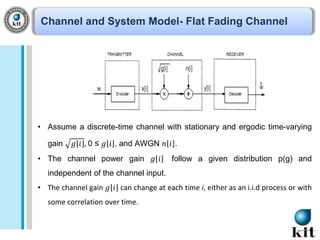
• Assume a discrete-time channel with stationary and ergodic time-varying

gain

𝑔 𝑖 , 0 ≤ 𝑔 𝑖 , and AWGN 𝑛 𝑖 .

• The channel power gain

𝑔 𝑖

follow a given distribution p(g) and

independent of the channel input.
• The channel gain 𝑔 𝑖 can change at each time i, either as an i.i.d process or with

some correlation over time.
Channel and System Model (Cont…)
• In block fading channel g[i] is constant over some blocklength T after
which time g[i] changes to a new independent value based on the
distribution p(g).
• Let P denote the average transmit signal power, 𝑁0 /2 denote the noise
spectral density of n[i], and B denote the received signal bandwidth.
• The instantaneous received signal-to-noise ratio (SNR) is,

and its expected value over all time is

.
Capacity of Flat-Fading Channels
We will consider 3 different scenarios :
1. Channel Distribution Information (CDI) : The distribution of g[i] is known to
the transmitter and receiver.
2. Receiver CSI : The value of g[i] is known at the receiver at time i, and both
the transmitter and receiver know the distribution of g[i].
3. Transmitter and Receiver CSI : The value of g[i] is known at the transmitter

and receiver at time i, and both the transmitter and receiver know the
distribution of g[i].
Channel Side Information at Receiver
• The value of g[i] is known at the receiver at time i, and both the transmitter
and receiver know the distribution of g[i].
• In this case there are two channel capacity that are relevant to system design:
Shannon (ergodic) capacity and capacity with outage.
• Shannon capacity the rate transmitter over the channel is constant.
• Capacity with outage is defined as the maximum rate that can be transmitted

over a channel with some outage probability corresponding to the probability
that the transmission cannot be decoded with negligible error probability.
Shannon (Ergodic Capacity)
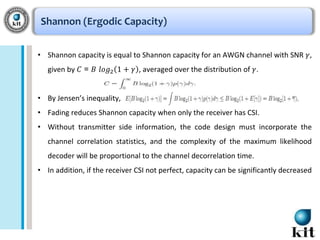
• Shannon capacity is equal to Shannon capacity for an AWGN channel with SNR 𝛾,
given by 𝐶 = 𝐵 𝑙𝑜𝑔2 1 + 𝛾 , averaged over the distribution of 𝛾.
• By Jensen’s inequality,
• Fading reduces Shannon capacity when only the receiver has CSI.
• Without transmitter side information, the code design must incorporate the

channel correlation statistics, and the complexity of the maximum likelihood
decoder will be proportional to the channel decorrelation time.
• In addition, if the receiver CSI not perfect, capacity can be significantly decreased
Capacity with Outage
• Capacity with outage allows bits sent over a given transmission burst to be
decoded at the end of the burst with some probability that these bits will be
decoded incorrectly.
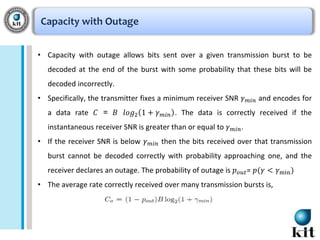
• Specifically, the transmitter fixes a minimum receiver SNR 𝛾
a data rate 𝐶 = 𝐵 𝑙𝑜𝑔2 1 + 𝛾

𝑚𝑖𝑛

𝑚𝑖𝑛

and encodes for

. The data is correctly received if the

instantaneous receiver SNR is greater than or equal to 𝛾

• If the receiver SNR is below 𝛾

𝑚𝑖𝑛

𝑚𝑖𝑛 .

then the bits received over that transmission

burst cannot be decoded correctly with probability approaching one, and the
receiver declares an outage. The probability of outage is 𝑝 𝑜𝑢𝑡 = 𝑝(𝛾 < 𝛾min )
• The average rate correctly received over many transmission bursts is,
Channel Side Information at the Transmitter and Receiver
• When both the transmitter and receiver have CSI, the transmitter can adapt
its transmission strategy relative to this CSI.
• In this case there is no notion of capacity versus outage where the
transmitter sends bits that cannot be decoded, since the transmitter knows
the channel and thus will not send bits unless they can be decoded correctly.
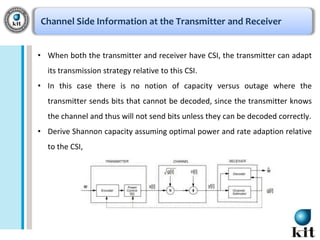
• Derive Shannon capacity assuming optimal power and rate adaption relative

to the CSI,
Shannon Capacity
• Consider the Shannon capacity when the channel power gain g[i] is known to
both the transmitter and receiver at time i.
• Let us now allow the transmit power S(𝛾) to vary with 𝛾, subject to an
average power constraint 𝑆:
Time Diversity System
• Multiplexed coding and decoding to achieve the capacity given by

•

The proof is “time diversity” system with multiplexed input and
demultiplexed output as show below
Optimal Power Allocation
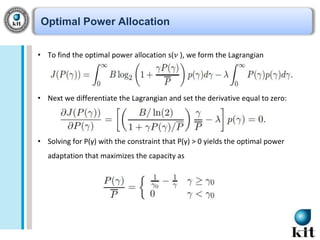
• To find the optimal power allocation s(𝜈 ), we form the Lagrangian

• Next we differentiate the Lagrangian and set the derivative equal to zero:

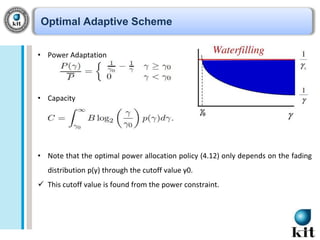
• Solving for P(γ) with the constraint that P(γ) > 0 yields the optimal power
adaptation that maximizes the capacity as
Optimal Adaptive Scheme
• Power Adaptation

• Capacity

• Note that the optimal power allocation policy (4.12) only depends on the fading
distribution p(γ) through the cutoff value γ0.
 This cutoff value is found from the power constraint.
Optimal Power Control
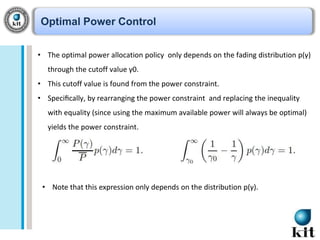
• The optimal power allocation policy only depends on the fading distribution p(γ)
through the cutoff value γ0.
• This cutoff value is found from the power constraint.
• Specifically, by rearranging the power constraint and replacing the inequality
with equality (since using the maximum available power will always be optimal)
yields the power constraint.

• Note that this expression only depends on the distribution p(γ).
Zero-Outage Capacity and Channel Inversion
Zero-Outage Capacity
• Fading inverted to maintain constant SNR.
• Simplifies design (fixed rate).
• Since the data rate is fixed under all channel conditions and there is no channel
outage.
Channel Inversion
• Suboptimal transmitter adaptation scheme where the transmitter uses the CSI to
maintain a constant received power.
• This power adaptation, called channel inversion, is given by P(γ)/P = 𝜎/γ, where 𝜎
equals the constant received SNR that can be maintained with the transmit power
constraint. 𝜎 satisfies 𝜎 =1/E[1/γ].
• In Rayleigh fading E[1/γ] is infinite, and thus the zero-outage capacity given by is zero.
Outage Capacity and Truncated Channel Inversion
• The outage capacity is defined as the maximum data rate that can be maintained
by suspending transmission in bad fading states.
• We can maintain a higher constant data rate in the other state and can increase
the channel capacity.
• Outage Capacity is achieved with a truncated inversion policy for power
adaption which only compensates for fading above a certain cutoff fade depth

γ0:
• where γ0 is based on the outage probability: pout= p(γ<γ0). Since the channel is
only used when γ >= γ0, 𝜎 =1/Eγ0 [1/γ], where
Outage Capacity with Truncation
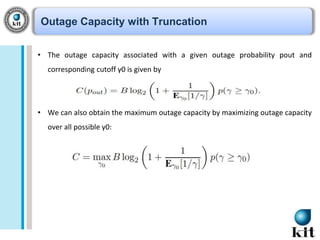
• The outage capacity associated with a given outage probability pout and
corresponding cutoff γ0 is given by

• We can also obtain the maximum outage capacity by maximizing outage capacity
over all possible γ0:
Capacity of Time-Invariant Frequency-Selective Fading
Channels
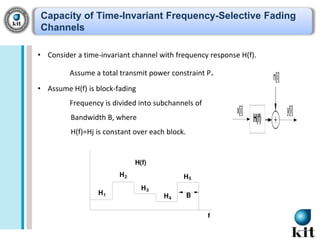
• Consider a time-invariant channel with frequency response H(f).
Assume a total transmit power constraint P.

• Assume H(f) is block-fading
Frequency is divided into subchannels of
Bandwidth B, where
H(f)=Hj is constant over each block.
Time-Invariant Frequency-Selective Fading Channel
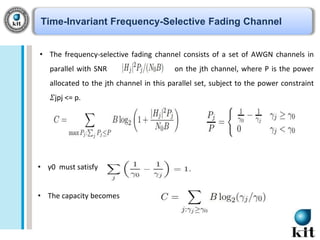
• The frequency-selective fading channel consists of a set of AWGN channels in
parallel with SNR

on the jth channel, where P is the power

allocated to the jth channel in this parallel set, subject to the power constraint

𝛴jpj <= p.

• γ0 must satisfy
• The capacity becomes
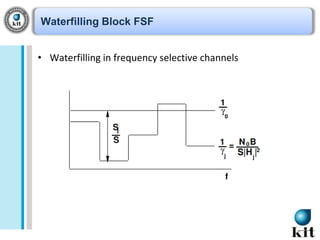
Waterfilling Block FSF
• Waterfilling in frequency selective channels
Time-Variant Frequency-Selective Fading Channel
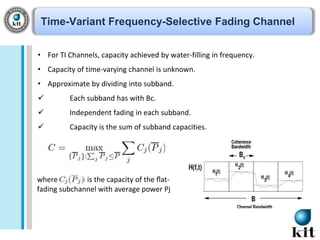
• For TI Channels, capacity achieved by water-filling in frequency.
• Capacity of time-varying channel is unknown.
• Approximate by dividing into subband.


Each subband has with Bc.



Independent fading in each subband.



Capacity is the sum of subband capacities.

where
I is the capacity of the flatfading subchannel with average power Pj
Thank You

Wireless Channels Capacity

  • 1.
    Chapter 4. Capacityof Click to edit Wireless Channels Master title style Wireless Communication : Andrea Goldsmith Ashish Rauniyar, and Oka Danil Department of IT Convergence Kumoh National Institute of Technology 16 October 2013 1
  • 2.
    Shannon Capacity andMutual Information • Shannon defined capacity as the maximum mutual information of channel. • Maximum error-free data rate a channel can support. • Mutual information : • Mutual information measures the information that X and Y share: it measures how many knowing on of these variables reduces uncertainty about the other [1].
  • 3.
    Capacity in AWGN •Consider a discrete-time Additive White Gaussian Noise (AWGN) channel with channel input/output relationship. • 𝑦 𝑖 = 𝑥 𝑖 + 𝑛 𝑖 , where 𝑥 𝑖 is the channel input at time 𝑖, 𝑦 𝑖 is the corresponding channel output and 𝑛 𝑖 is a White Gaussian Noise random process. • The channel SNR, the power in 𝑥 𝑖 divided by the power in 𝑛 𝑖 , is constant and given by 𝛾 = 𝑃 𝑁0 𝐵 , P is transmit power,𝑁0 is the power spectral density of the noise with unit W/Hz. • The capacity of channel by Shannon’s formula: 𝐶 = 𝐵 𝑙𝑜𝑔2 1 + 𝛾 , where the capacity units are bits per second (bps).
  • 4.
    Channel and SystemModel- Flat Fading Channel • Assume a discrete-time channel with stationary and ergodic time-varying gain 𝑔 𝑖 , 0 ≤ 𝑔 𝑖 , and AWGN 𝑛 𝑖 . • The channel power gain 𝑔 𝑖 follow a given distribution p(g) and independent of the channel input. • The channel gain 𝑔 𝑖 can change at each time i, either as an i.i.d process or with some correlation over time.
  • 5.
    Channel and SystemModel (Cont…) • In block fading channel g[i] is constant over some blocklength T after which time g[i] changes to a new independent value based on the distribution p(g). • Let P denote the average transmit signal power, 𝑁0 /2 denote the noise spectral density of n[i], and B denote the received signal bandwidth. • The instantaneous received signal-to-noise ratio (SNR) is, and its expected value over all time is .
  • 6.
    Capacity of Flat-FadingChannels We will consider 3 different scenarios : 1. Channel Distribution Information (CDI) : The distribution of g[i] is known to the transmitter and receiver. 2. Receiver CSI : The value of g[i] is known at the receiver at time i, and both the transmitter and receiver know the distribution of g[i]. 3. Transmitter and Receiver CSI : The value of g[i] is known at the transmitter and receiver at time i, and both the transmitter and receiver know the distribution of g[i].
  • 7.
    Channel Side Informationat Receiver • The value of g[i] is known at the receiver at time i, and both the transmitter and receiver know the distribution of g[i]. • In this case there are two channel capacity that are relevant to system design: Shannon (ergodic) capacity and capacity with outage. • Shannon capacity the rate transmitter over the channel is constant. • Capacity with outage is defined as the maximum rate that can be transmitted over a channel with some outage probability corresponding to the probability that the transmission cannot be decoded with negligible error probability.
  • 8.
    Shannon (Ergodic Capacity) •Shannon capacity is equal to Shannon capacity for an AWGN channel with SNR 𝛾, given by 𝐶 = 𝐵 𝑙𝑜𝑔2 1 + 𝛾 , averaged over the distribution of 𝛾. • By Jensen’s inequality, • Fading reduces Shannon capacity when only the receiver has CSI. • Without transmitter side information, the code design must incorporate the channel correlation statistics, and the complexity of the maximum likelihood decoder will be proportional to the channel decorrelation time. • In addition, if the receiver CSI not perfect, capacity can be significantly decreased
  • 9.
    Capacity with Outage •Capacity with outage allows bits sent over a given transmission burst to be decoded at the end of the burst with some probability that these bits will be decoded incorrectly. • Specifically, the transmitter fixes a minimum receiver SNR 𝛾 a data rate 𝐶 = 𝐵 𝑙𝑜𝑔2 1 + 𝛾 𝑚𝑖𝑛 𝑚𝑖𝑛 and encodes for . The data is correctly received if the instantaneous receiver SNR is greater than or equal to 𝛾 • If the receiver SNR is below 𝛾 𝑚𝑖𝑛 𝑚𝑖𝑛 . then the bits received over that transmission burst cannot be decoded correctly with probability approaching one, and the receiver declares an outage. The probability of outage is 𝑝 𝑜𝑢𝑡 = 𝑝(𝛾 < 𝛾min ) • The average rate correctly received over many transmission bursts is,
  • 10.
    Channel Side Informationat the Transmitter and Receiver • When both the transmitter and receiver have CSI, the transmitter can adapt its transmission strategy relative to this CSI. • In this case there is no notion of capacity versus outage where the transmitter sends bits that cannot be decoded, since the transmitter knows the channel and thus will not send bits unless they can be decoded correctly. • Derive Shannon capacity assuming optimal power and rate adaption relative to the CSI,
  • 11.
    Shannon Capacity • Considerthe Shannon capacity when the channel power gain g[i] is known to both the transmitter and receiver at time i. • Let us now allow the transmit power S(𝛾) to vary with 𝛾, subject to an average power constraint 𝑆:
  • 12.
    Time Diversity System •Multiplexed coding and decoding to achieve the capacity given by • The proof is “time diversity” system with multiplexed input and demultiplexed output as show below
  • 13.
    Optimal Power Allocation •To find the optimal power allocation s(𝜈 ), we form the Lagrangian • Next we differentiate the Lagrangian and set the derivative equal to zero: • Solving for P(γ) with the constraint that P(γ) > 0 yields the optimal power adaptation that maximizes the capacity as
  • 14.
    Optimal Adaptive Scheme •Power Adaptation • Capacity • Note that the optimal power allocation policy (4.12) only depends on the fading distribution p(γ) through the cutoff value γ0.  This cutoff value is found from the power constraint.
  • 15.
    Optimal Power Control •The optimal power allocation policy only depends on the fading distribution p(γ) through the cutoff value γ0. • This cutoff value is found from the power constraint. • Specifically, by rearranging the power constraint and replacing the inequality with equality (since using the maximum available power will always be optimal) yields the power constraint. • Note that this expression only depends on the distribution p(γ).
  • 16.
    Zero-Outage Capacity andChannel Inversion Zero-Outage Capacity • Fading inverted to maintain constant SNR. • Simplifies design (fixed rate). • Since the data rate is fixed under all channel conditions and there is no channel outage. Channel Inversion • Suboptimal transmitter adaptation scheme where the transmitter uses the CSI to maintain a constant received power. • This power adaptation, called channel inversion, is given by P(γ)/P = 𝜎/γ, where 𝜎 equals the constant received SNR that can be maintained with the transmit power constraint. 𝜎 satisfies 𝜎 =1/E[1/γ]. • In Rayleigh fading E[1/γ] is infinite, and thus the zero-outage capacity given by is zero.
  • 17.
    Outage Capacity andTruncated Channel Inversion • The outage capacity is defined as the maximum data rate that can be maintained by suspending transmission in bad fading states. • We can maintain a higher constant data rate in the other state and can increase the channel capacity. • Outage Capacity is achieved with a truncated inversion policy for power adaption which only compensates for fading above a certain cutoff fade depth γ0: • where γ0 is based on the outage probability: pout= p(γ<γ0). Since the channel is only used when γ >= γ0, 𝜎 =1/Eγ0 [1/γ], where
  • 18.
    Outage Capacity withTruncation • The outage capacity associated with a given outage probability pout and corresponding cutoff γ0 is given by • We can also obtain the maximum outage capacity by maximizing outage capacity over all possible γ0:
  • 19.
    Capacity of Time-InvariantFrequency-Selective Fading Channels • Consider a time-invariant channel with frequency response H(f). Assume a total transmit power constraint P. • Assume H(f) is block-fading Frequency is divided into subchannels of Bandwidth B, where H(f)=Hj is constant over each block.
  • 20.
    Time-Invariant Frequency-Selective FadingChannel • The frequency-selective fading channel consists of a set of AWGN channels in parallel with SNR on the jth channel, where P is the power allocated to the jth channel in this parallel set, subject to the power constraint 𝛴jpj <= p. • γ0 must satisfy • The capacity becomes
  • 21.
    Waterfilling Block FSF •Waterfilling in frequency selective channels
  • 22.
    Time-Variant Frequency-Selective FadingChannel • For TI Channels, capacity achieved by water-filling in frequency. • Capacity of time-varying channel is unknown. • Approximate by dividing into subband.  Each subband has with Bc.  Independent fading in each subband.  Capacity is the sum of subband capacities. where I is the capacity of the flatfading subchannel with average power Pj
  • 23.