‫ر‬َ‫ـد‬ْ‫ق‬‫ِـ‬‫ن‬،،،‫لما‬‫اننا‬ ‫نصدق‬ْْ‫ق‬ِ‫ن‬‫ر‬َ‫د‬
LECTURE (6)
FIR Filter Design
Assist. Prof. Amr E. Mohamed
Ideal Filters
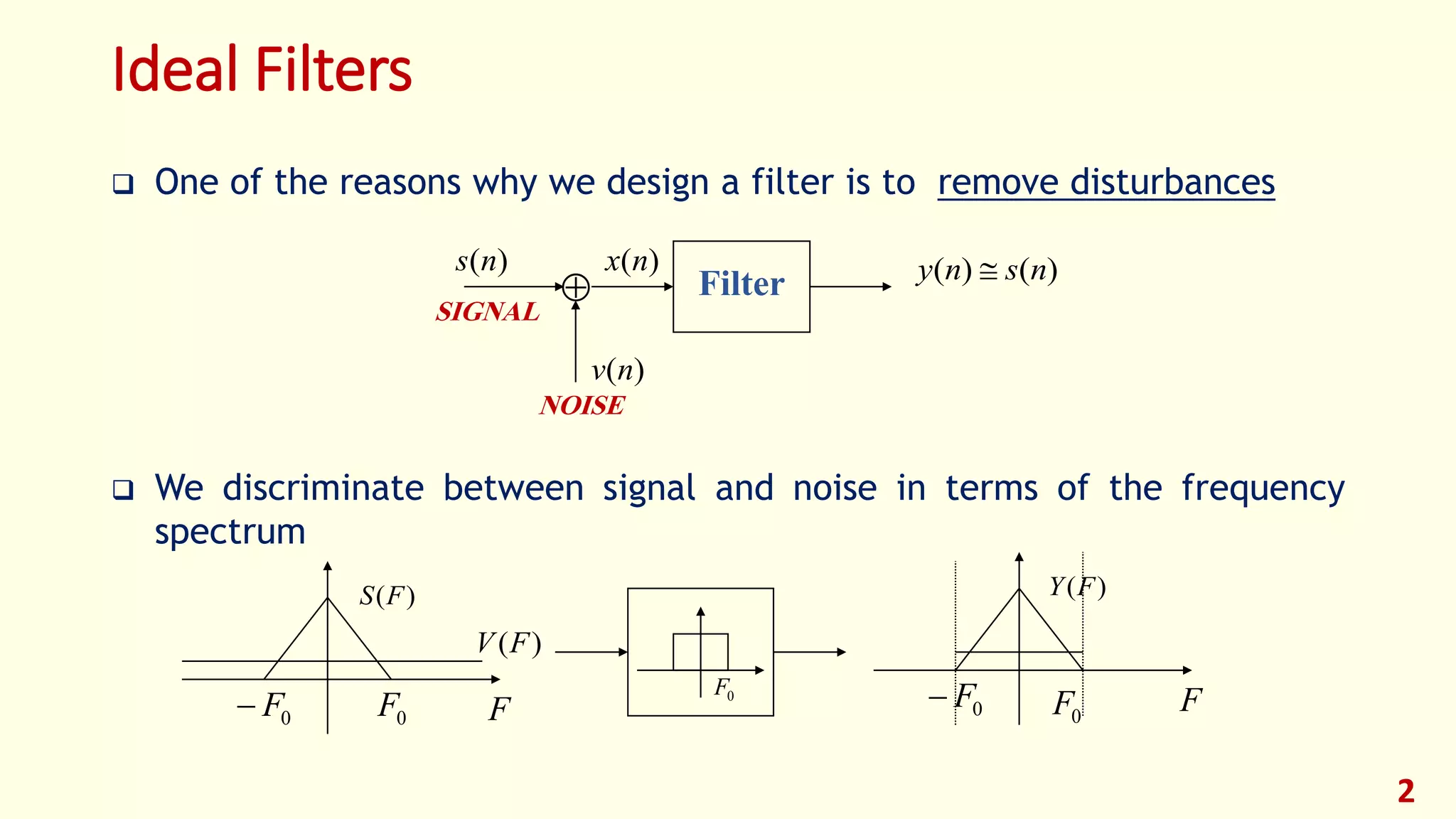
 One of the reasons why we design a filter is to remove disturbances
 We discriminate between signal and noise in terms of the frequency
spectrum
2

)(ns
)(nv
)(nx )()( nsny Filter
SIGNAL
NOISE
F
)(FS
)(FV
0F0F 0F
F
)(FY
0F0F
Conditions for Non-Distortion
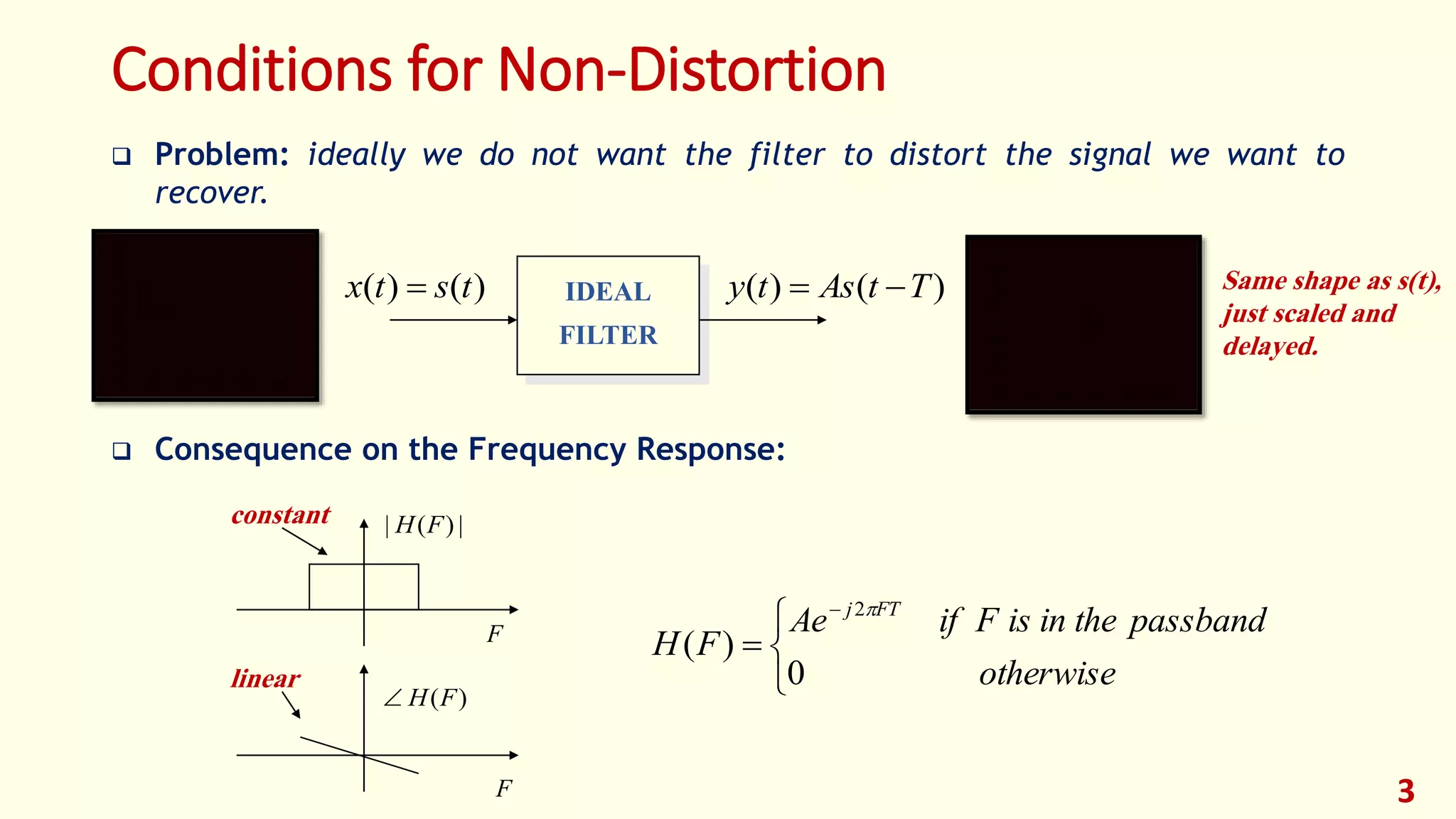
 Problem: ideally we do not want the filter to distort the signal we want to
recover.
 Consequence on the Frequency Response:
3
IDEAL
FILTER
)()( tstx  )()( TtAsty  Same shape as s(t),
just scaled and
delayed.
0 200 400 600 800 1000
-2
-1.5
-1
-0.5
0
0.5
1
1.5
2
0 200 400 600 800 1000
-2
-1.5
-1
-0.5
0
0.5
1
1.5
2





otherwise
passbandtheinisFifAe
FH
FTj
0
)(
2
F
F
|)(| FH
)(FH
constant
linear
Phase Distortion
 Phase distortion results from a variable time delay (phase delay) for
different frequency components of a signal.
 If the phase response of a filter is a linear function of frequency, then
the phase delay is constant for all frequencies and no phase distortion
occurs.
4
Real Time Implementation
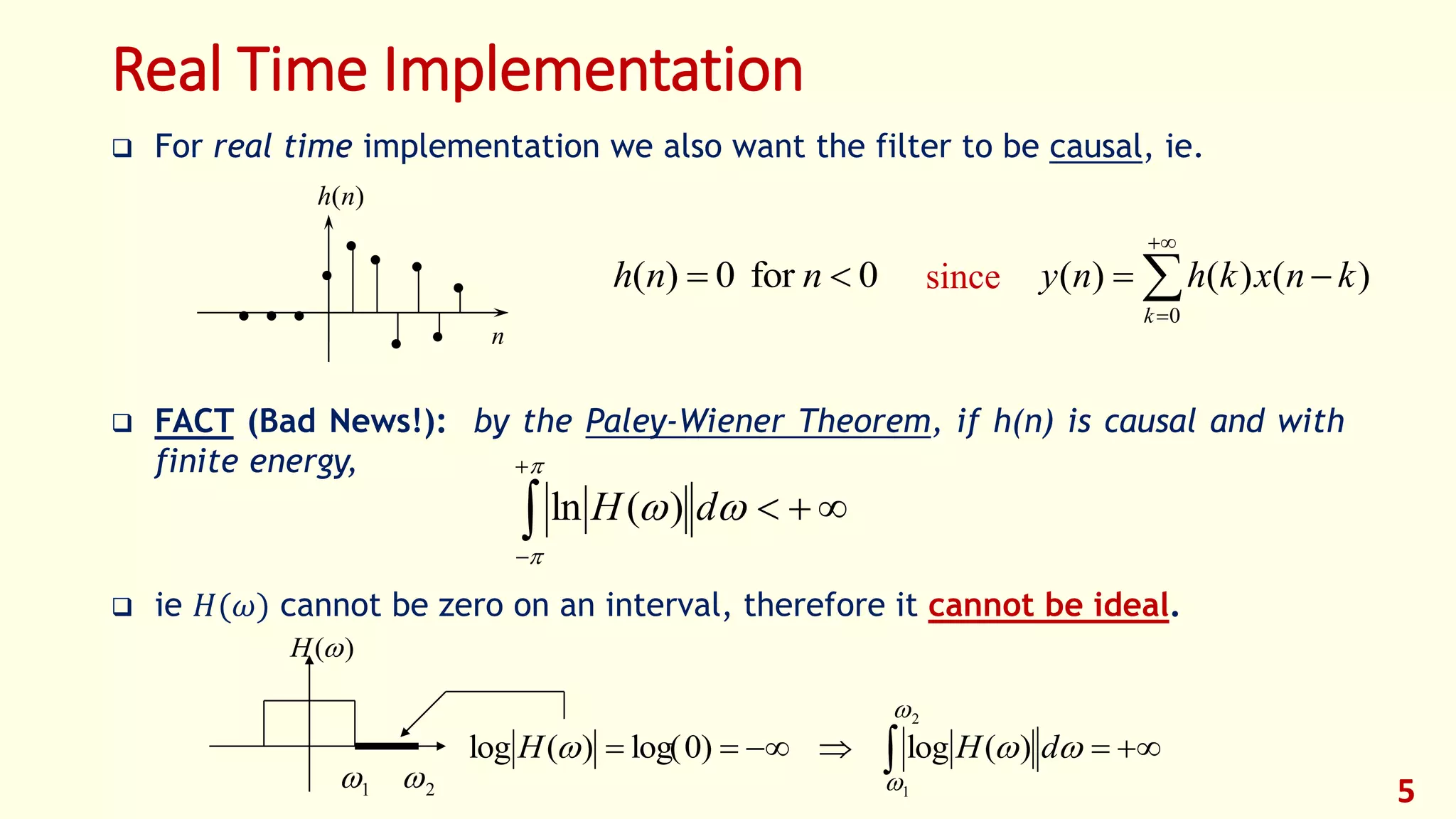
 For real time implementation we also want the filter to be causal, ie.
 FACT (Bad News!): by the Paley-Wiener Theorem, if h(n) is causal and with
finite energy,
 ie 𝐻(𝜔) cannot be zero on an interval, therefore it cannot be ideal.
5
0for0)(  nnh

 




h n( )
n

since 



0
)()()(
k
knxkhny






 dH )(ln
)(H
   dHH )(log)0log()(log
1 2 1
2
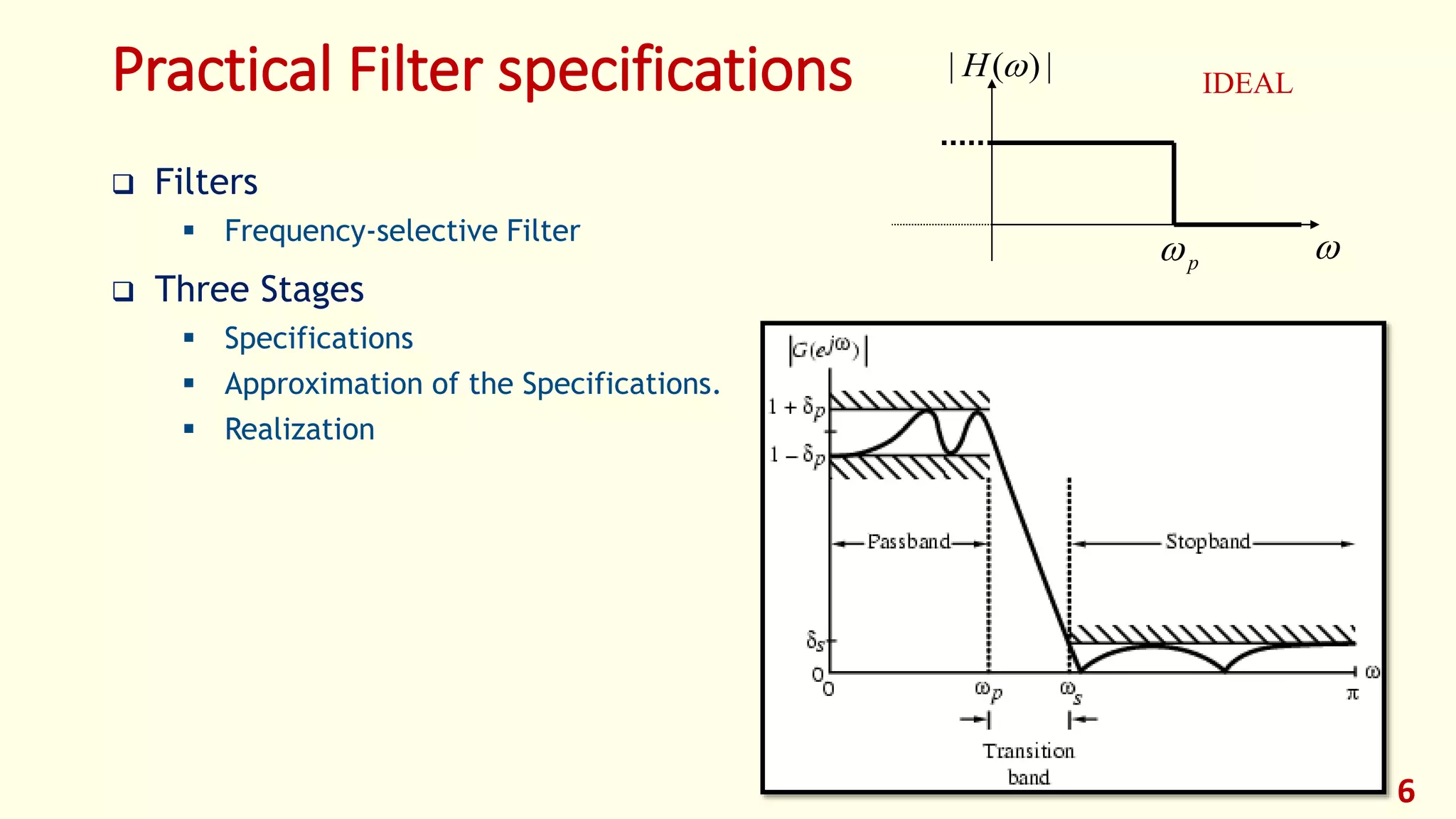
Practical Filter specifications
 Filters
 Frequency-selective Filter
 Three Stages
 Specifications
 Approximation of the Specifications.
 Realization
6

|)(| H
p
IDEAL
Practical Filter specifications
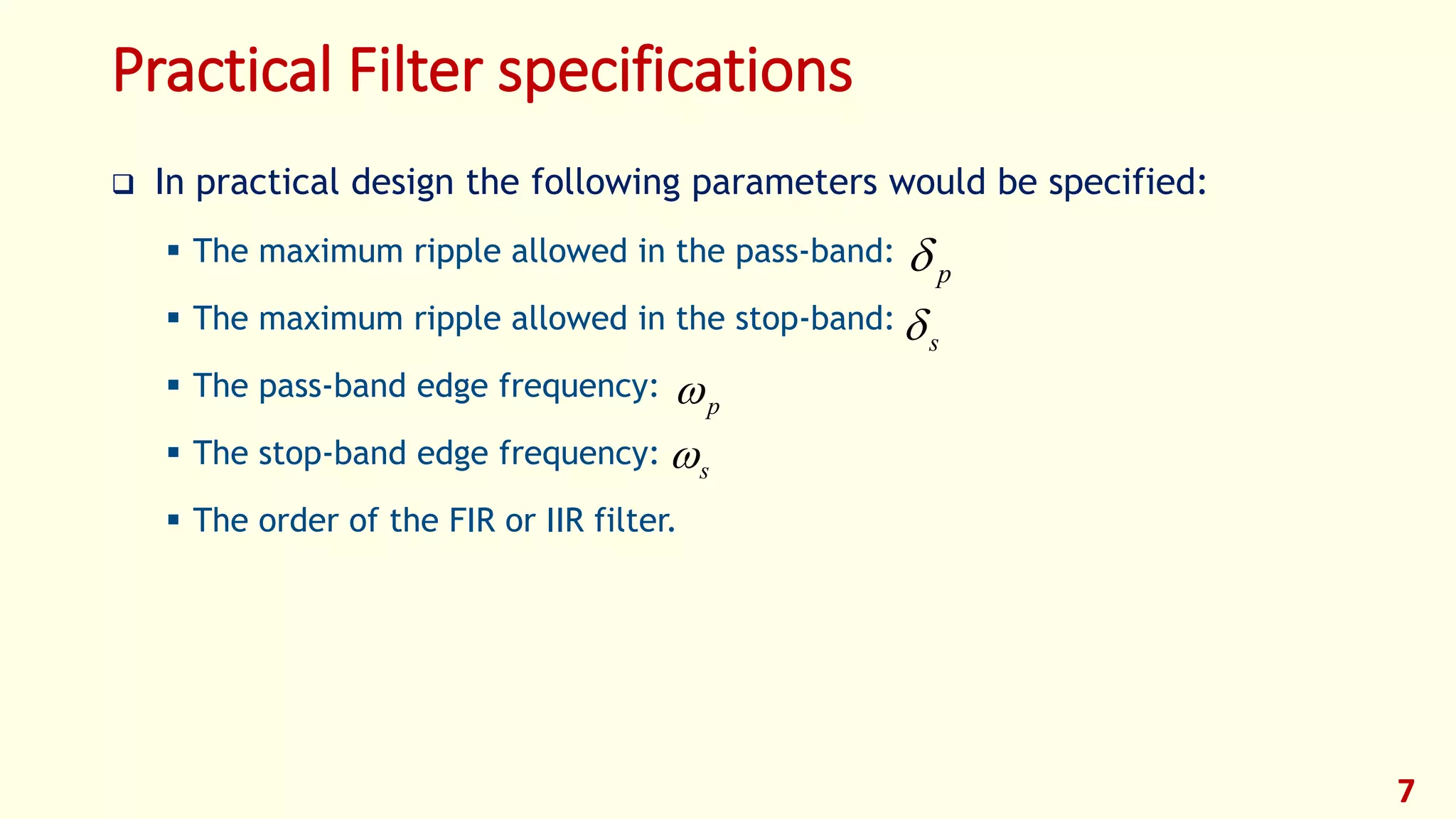
 In practical design the following parameters would be specified:
 The maximum ripple allowed in the pass-band:
 The maximum ripple allowed in the stop-band:
 The pass-band edge frequency:
 The stop-band edge frequency:
 The order of the FIR or IIR filter.
7
p
s
p
s
Selection of Digital Filters (FIR & IIR)
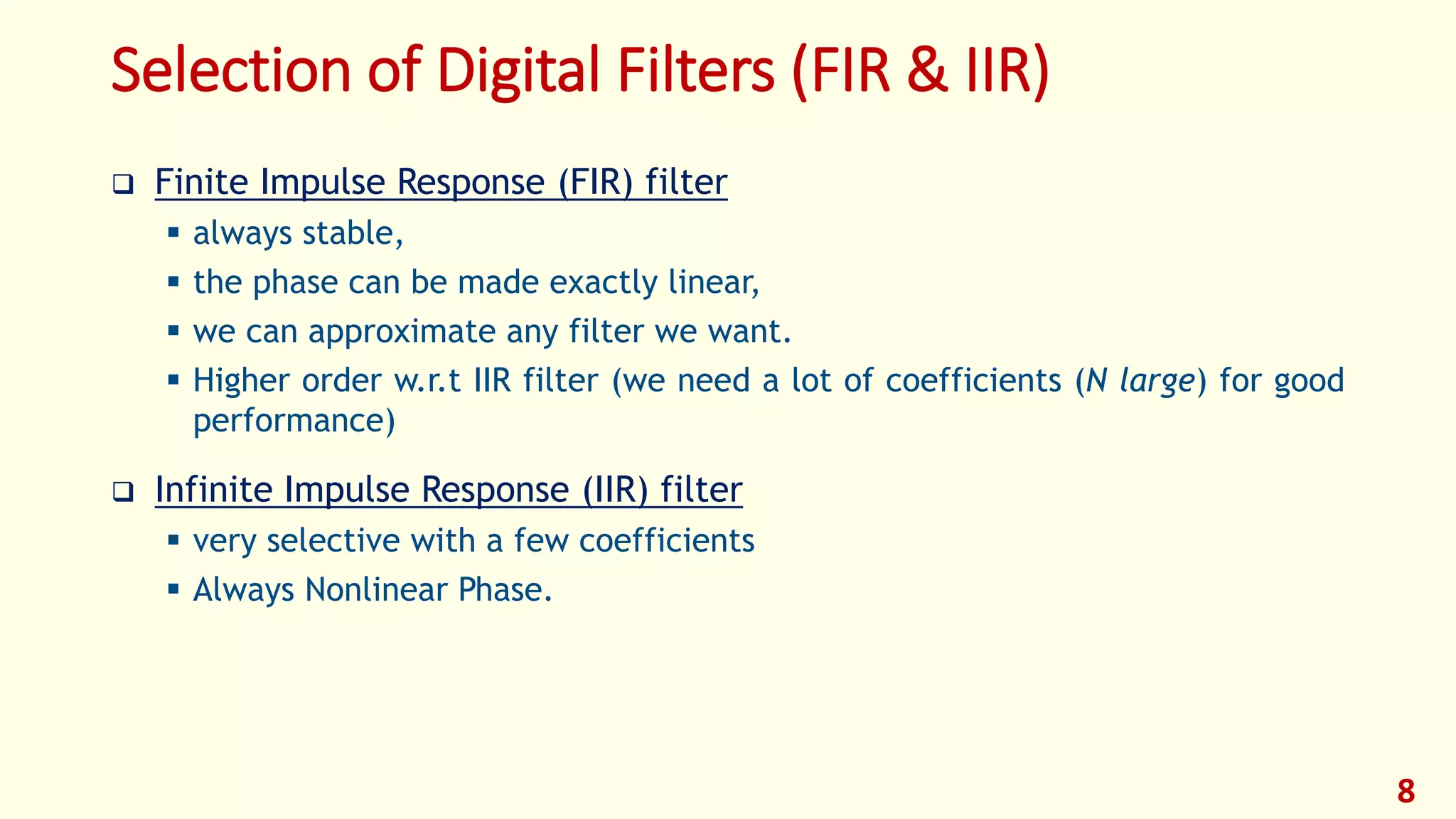
 Finite Impulse Response (FIR) filter
 always stable,
 the phase can be made exactly linear,
 we can approximate any filter we want.
 Higher order w.r.t IIR filter (we need a lot of coefficients (N large) for good
performance)
 Infinite Impulse Response (IIR) filter
 very selective with a few coefficients
 Always Nonlinear Phase.
8
Design of FIR Filters
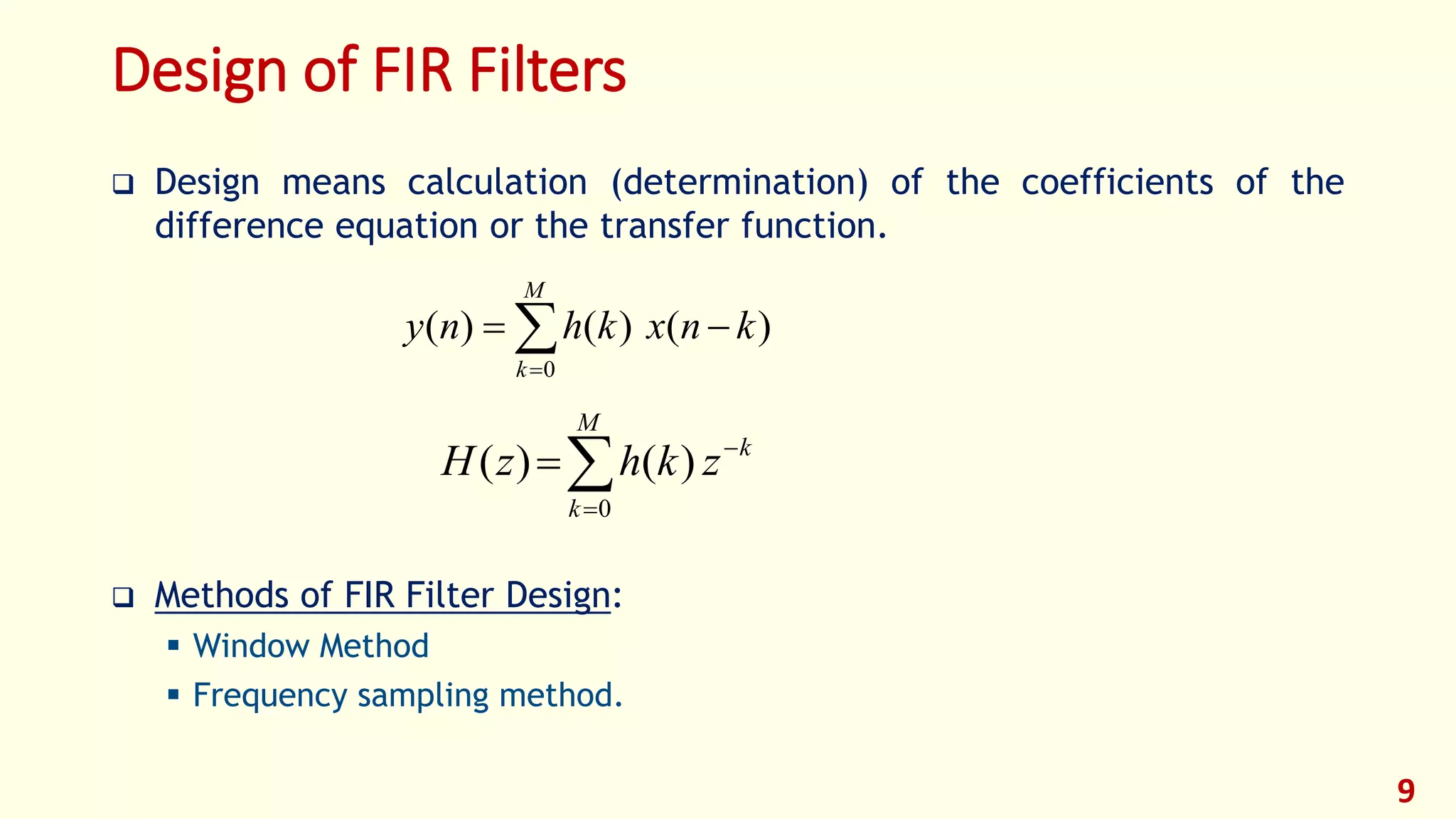
 Design means calculation (determination) of the coefficients of the
difference equation or the transfer function.
 Methods of FIR Filter Design:
 Window Method
 Frequency sampling method.
9


M
k
knxkhny
0
)()()(



M
k
k
zkhzH
0
)()(
Window Method
10
11
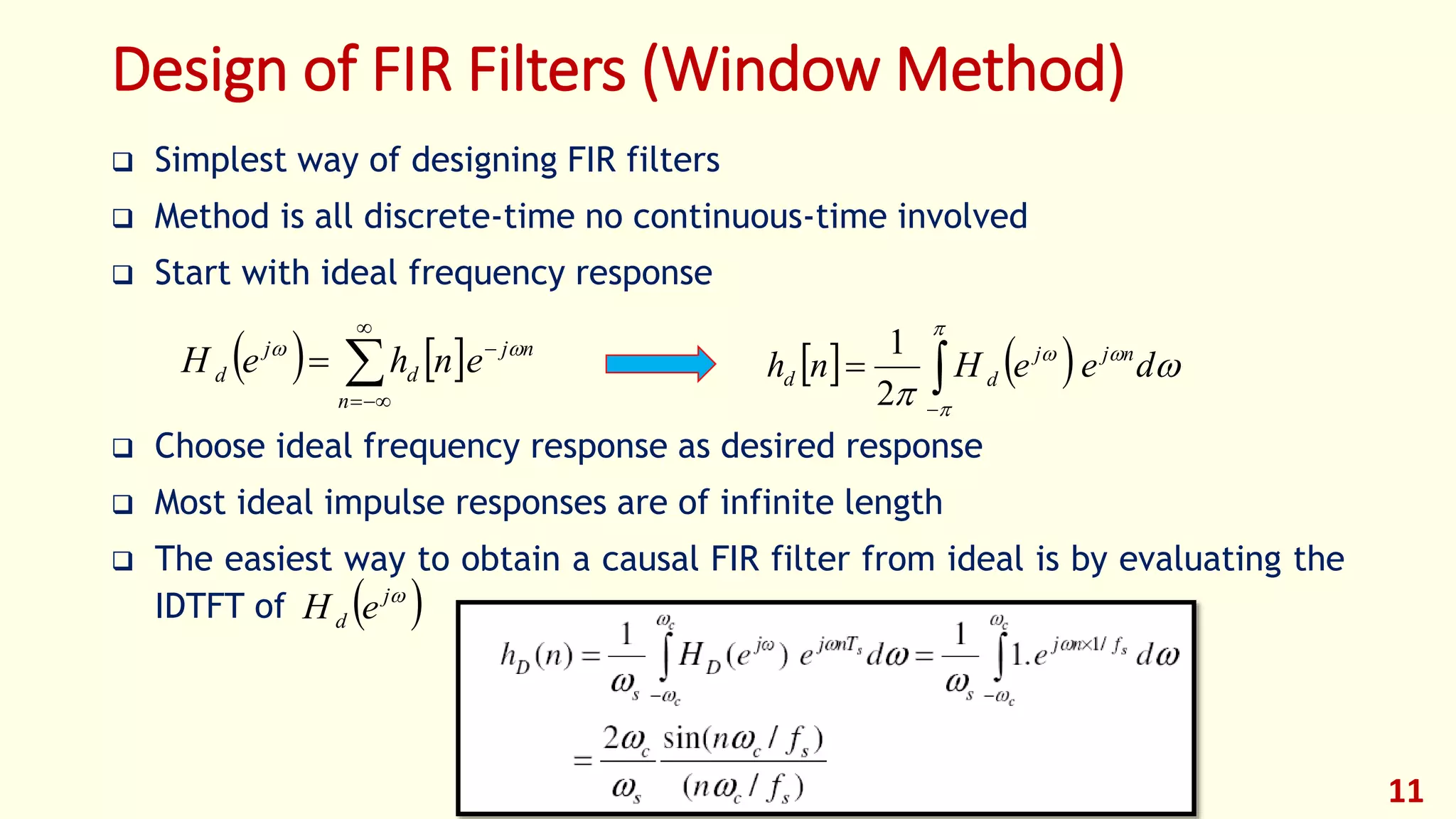
Design of FIR Filters (Window Method)
 Simplest way of designing FIR filters
 Method is all discrete-time no continuous-time involved
 Start with ideal frequency response
 Choose ideal frequency response as desired response
 Most ideal impulse responses are of infinite length
 The easiest way to obtain a causal FIR filter from ideal is by evaluating the
IDTFT of
   




n
nj
d
j
d enheH 
    




deeHnh njj
dd 

2
1
 j
d eH
12
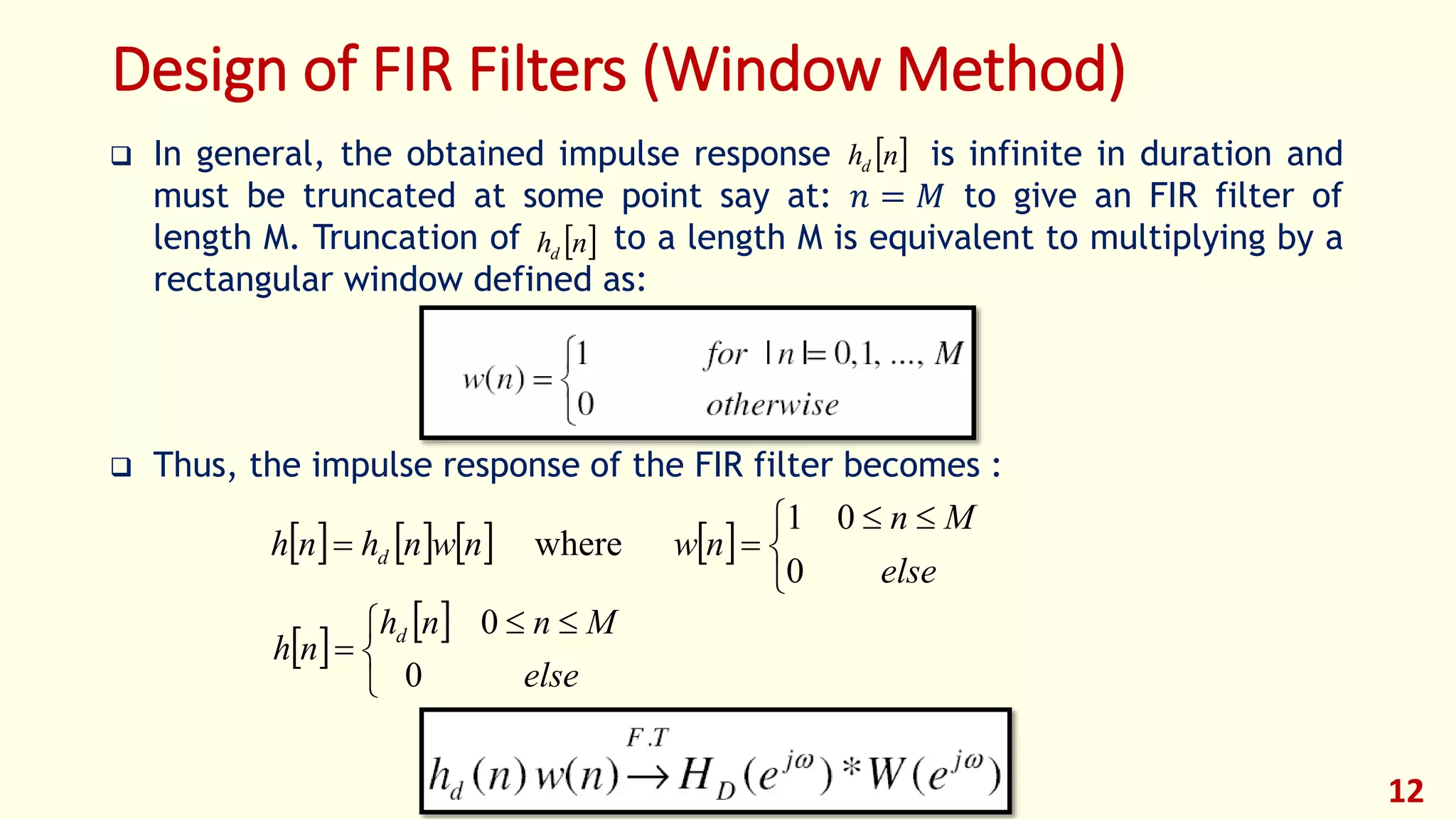
Design of FIR Filters (Window Method)
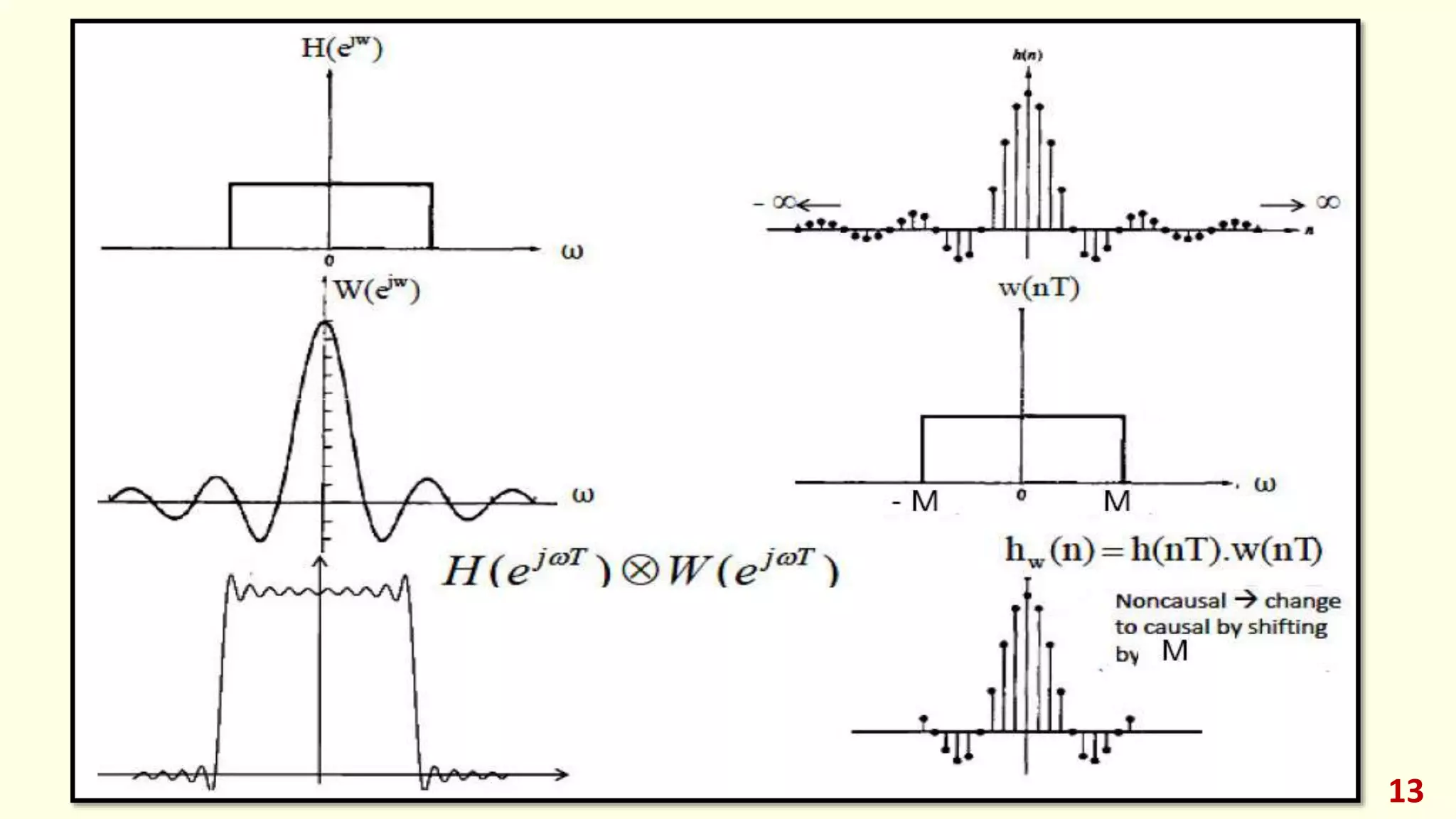
 In general, the obtained impulse response is infinite in duration and
must be truncated at some point say at: 𝑛 = 𝑀 to give an FIR filter of
length M. Truncation of to a length M is equivalent to multiplying by a
rectangular window defined as:
 Thus, the impulse response of the FIR filter becomes :
 
 


 

else
Mnnh
nh d
0
0
       


 

else
Mn
nwnwnhnh d
0
01
where
 nhd
 nhd
13
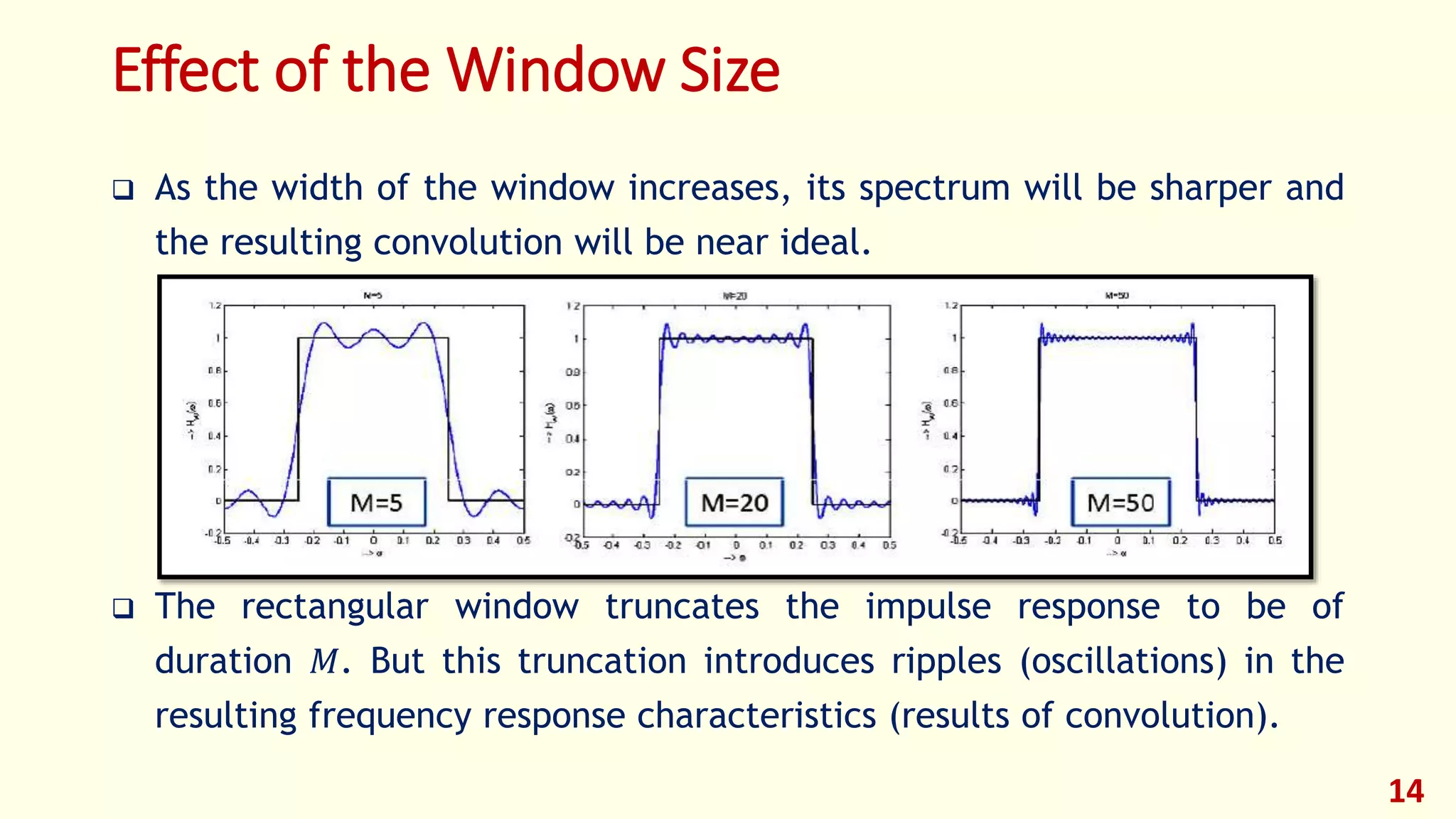
Effect of the Window Size
 As the width of the window increases, its spectrum will be sharper and
the resulting convolution will be near ideal.
 The rectangular window truncates the impulse response to be of
duration 𝑀. But this truncation introduces ripples (oscillations) in the
resulting frequency response characteristics (results of convolution).
14
>> n=0:20;
>> omega=pi/4; % This is the cut-off frequency
>> h=(omega/pi)*sinc(omega*(n-10)/pi); % Note the 10 step shift
>> stem(n,h)
>> title('Sample-Shifted LP Impulse Response')
>> xlabel('n')
>> ylabel('h[n]')
>> fvtool(h,1)
0 2 4 6 8 10 12 14 16 18 20
-0.1
-0.05
0
0.05
0.1
0.15
0.2
0.25
Sample-Shifted LP Impulse Response
n
h[n]
0 0.1 0.2 0.3 0.4 0.5 0.6 0.7 0.8 0.9
0
0.2
0.4
0.6
0.8
1
1.2
1.4
Normalized Frequency ( rad/sample)
Magnitude
Magnitude Response
Note the linear phase properties of
the impulse response
Example: 21 Coefficient LP Filter with Ω0 = π/4
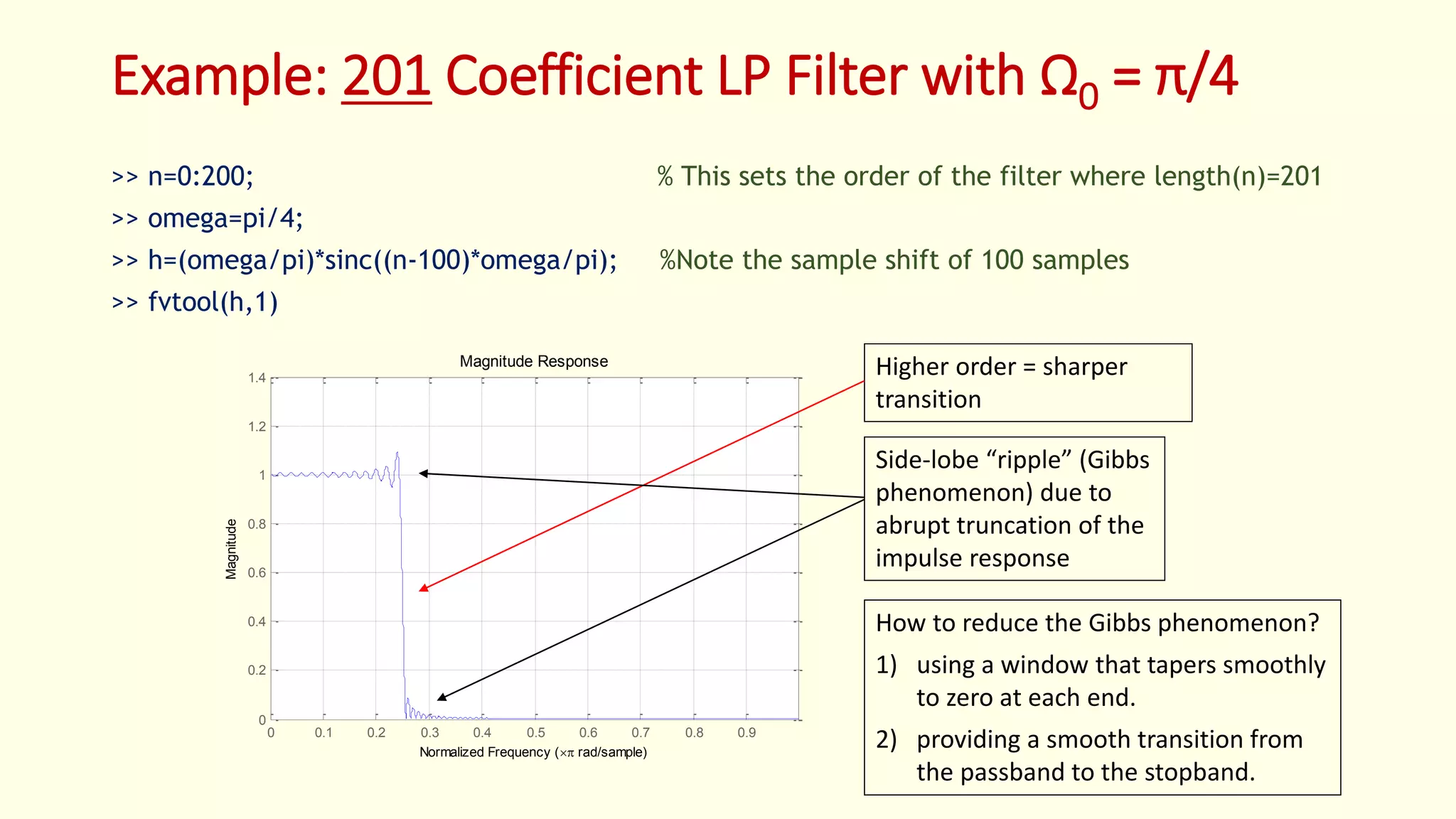
>> n=0:200; % This sets the order of the filter where length(n)=201
>> omega=pi/4;
>> h=(omega/pi)*sinc((n-100)*omega/pi); %Note the sample shift of 100 samples
>> fvtool(h,1)
0 0.1 0.2 0.3 0.4 0.5 0.6 0.7 0.8 0.9
0
0.2
0.4
0.6
0.8
1
1.2
1.4
Normalized Frequency ( rad/sample)
Magnitude
Magnitude Response
Higher order = sharper
transition
Side-lobe “ripple” (Gibbs
phenomenon) due to
abrupt truncation of the
impulse response
Example: 201 Coefficient LP Filter with Ω0 = π/4
How to reduce the Gibbs phenomenon?
1) using a window that tapers smoothly
to zero at each end.
2) providing a smooth transition from
the passband to the stopband.
17
Windowing in Frequency Domain
 Windowed frequency response
 The windowed version is smeared version of desired response
 If w[n]=1 for all n, then W(ej) is pulse train with 2 period
     
  





deWeHeH jj
d
j 


2
1
18
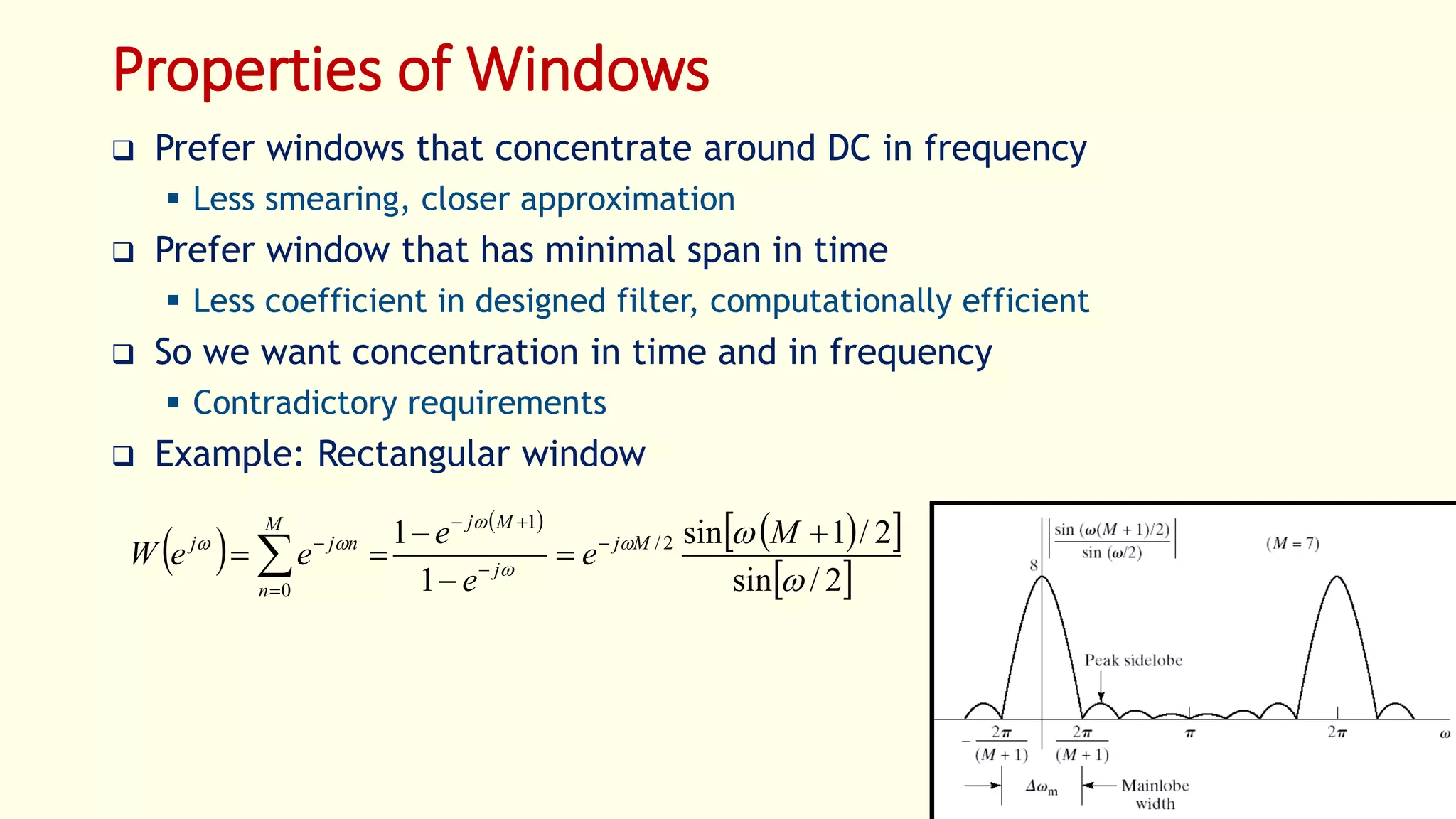
Properties of Windows
 Prefer windows that concentrate around DC in frequency
 Less smearing, closer approximation
 Prefer window that has minimal span in time
 Less coefficient in designed filter, computationally efficient
 So we want concentration in time and in frequency
 Contradictory requirements
 Example: Rectangular window
 
 
  
 2/sin
2/1sin
1
1 2/
1
0 



 



 





M
e
e
e
eeW Mj
j
MjM
n
njj
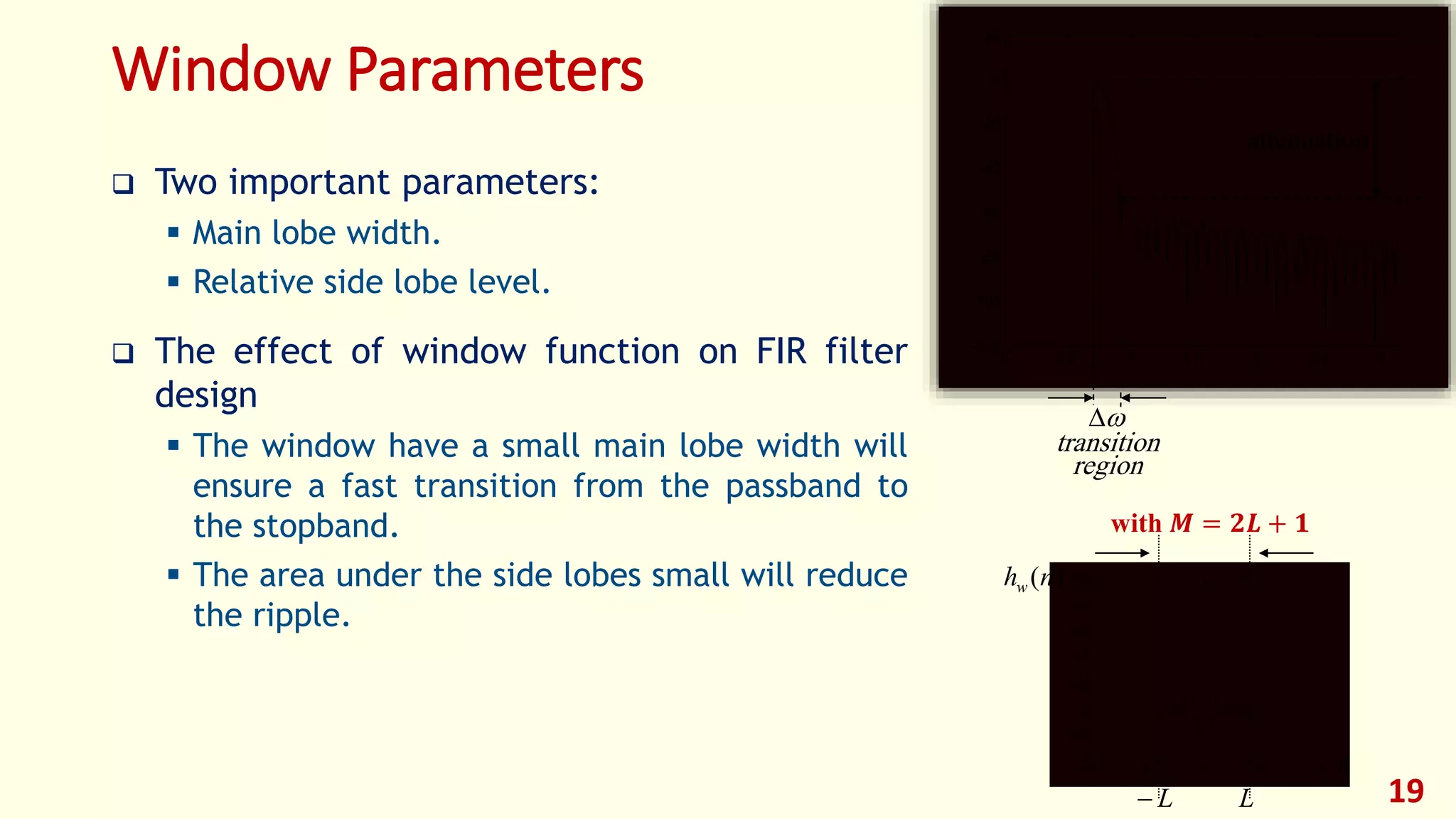
Window Parameters
 Two important parameters:
 Main lobe width.
 Relative side lobe level.
 The effect of window function on FIR filter
design
 The window have a small main lobe width will
ensure a fast transition from the passband to
the stopband.
 The area under the side lobes small will reduce
the ripple.
19
0 0.5 1 1.5 2 2.5 3
-120
-100
-80
-60
-40
-20
0
20

attenuation
transition
region
-100 -50 0 50 100
-0.1
-0.05
0
0.05
0.1
0.15
0.2
0.25
L L
)(nhw
n
with 𝑴 = 𝟐𝑳 + 𝟏
20
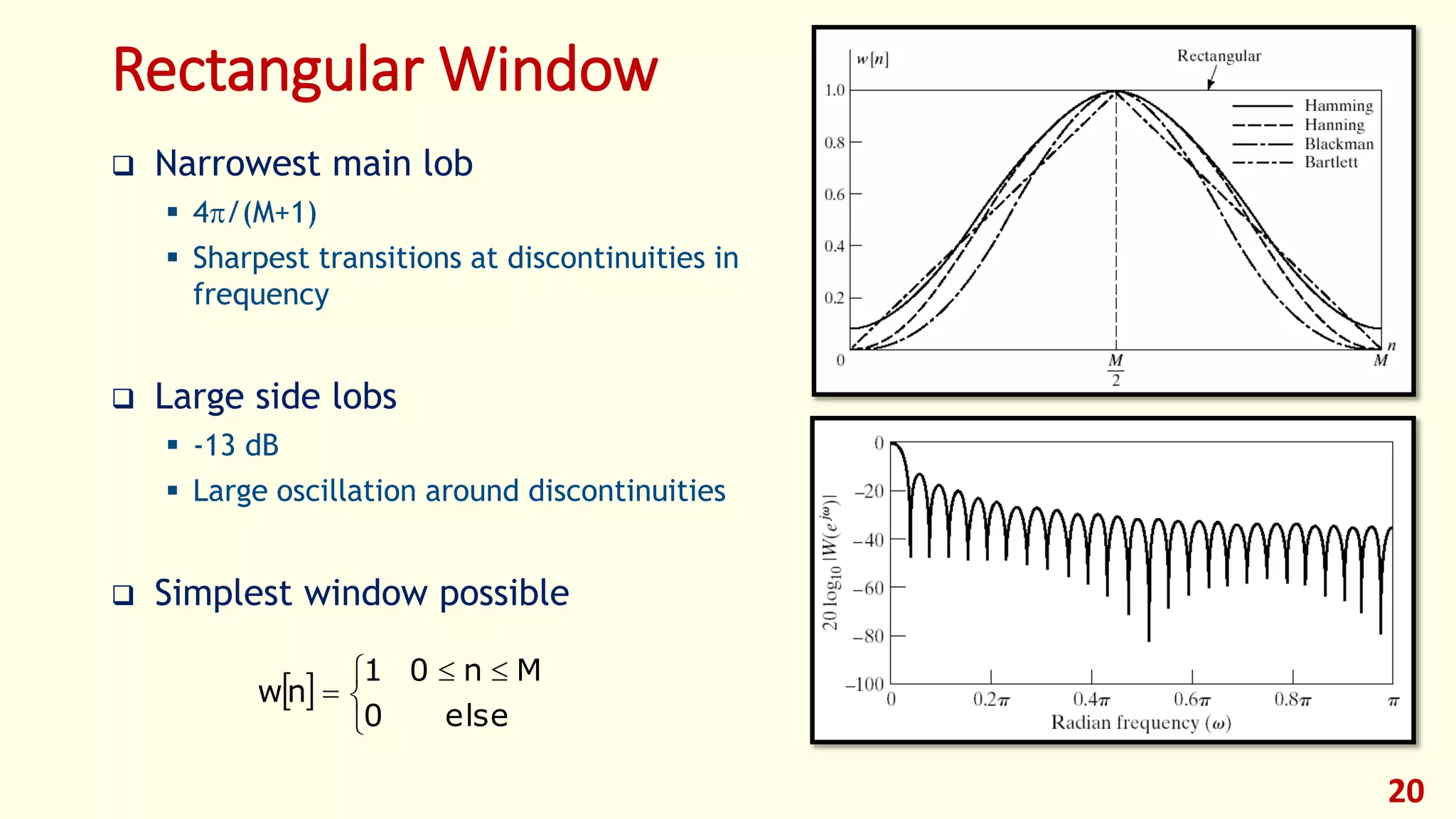
Rectangular Window
 


 

else0
Mn01
nw
 Narrowest main lob
 4/(M+1)
 Sharpest transitions at discontinuities in
frequency
 Large side lobs
 -13 dB
 Large oscillation around discontinuities
 Simplest window possible
21
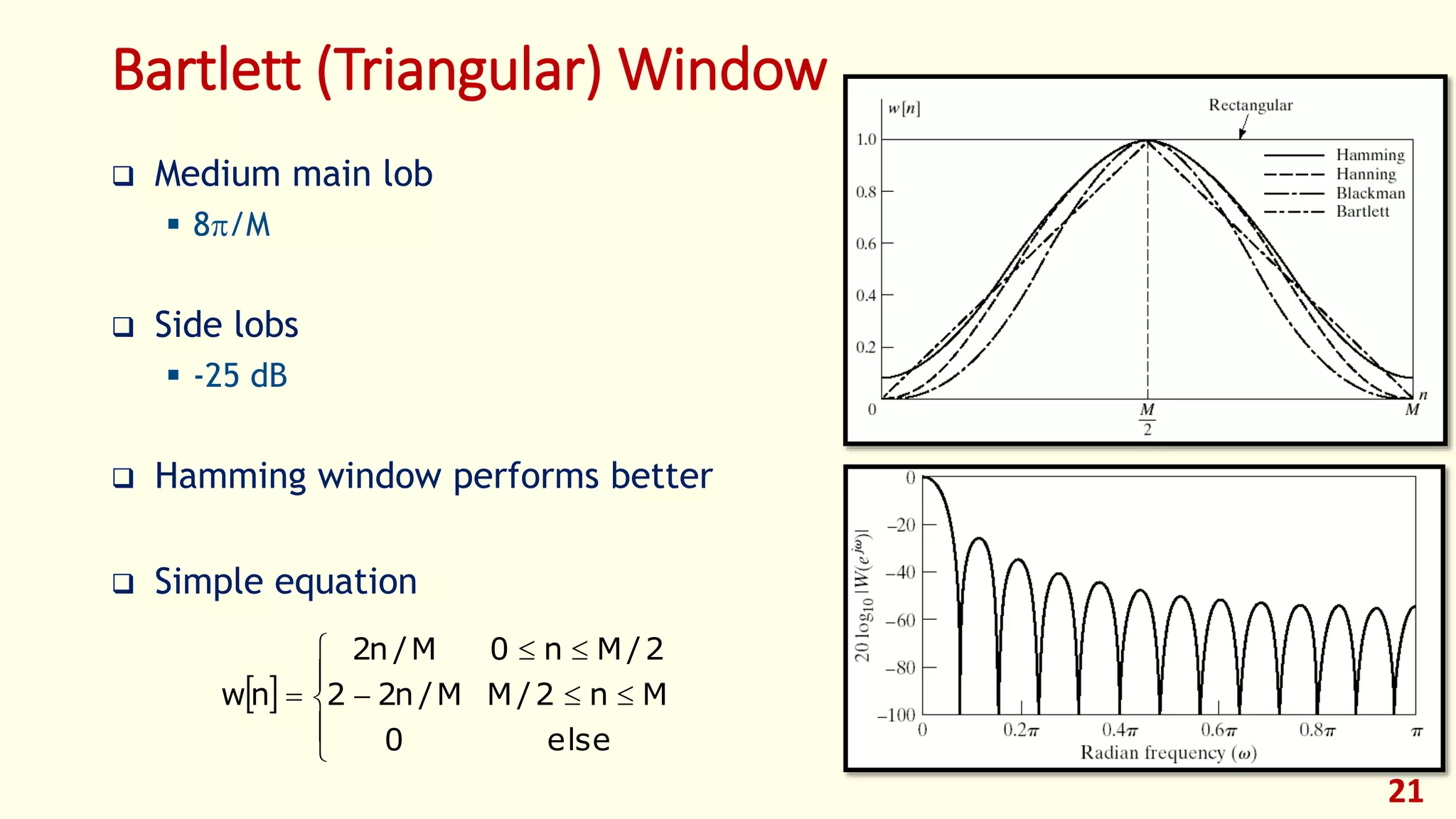
Bartlett (Triangular) Window
 








else0
Mn2/MM/n22
2/Mn0M/n2
nw
 Medium main lob
 8/M
 Side lobs
 -25 dB
 Hamming window performs better
 Simple equation
22
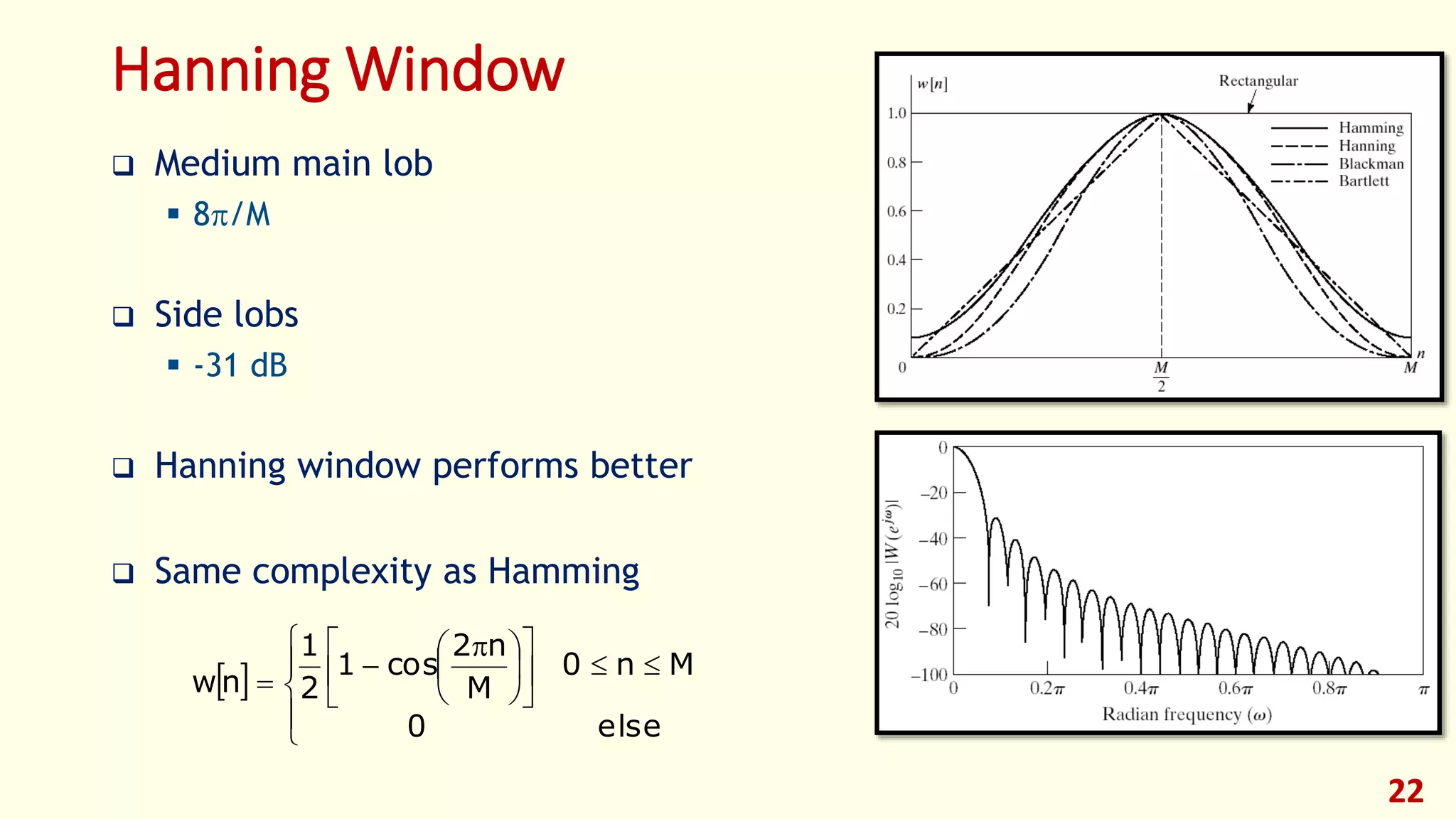
Hanning Window
 
















 


else0
Mn0
M
n2
cos1
2
1
nw
 Medium main lob
 8/M
 Side lobs
 -31 dB
 Hanning window performs better
 Same complexity as Hamming
23
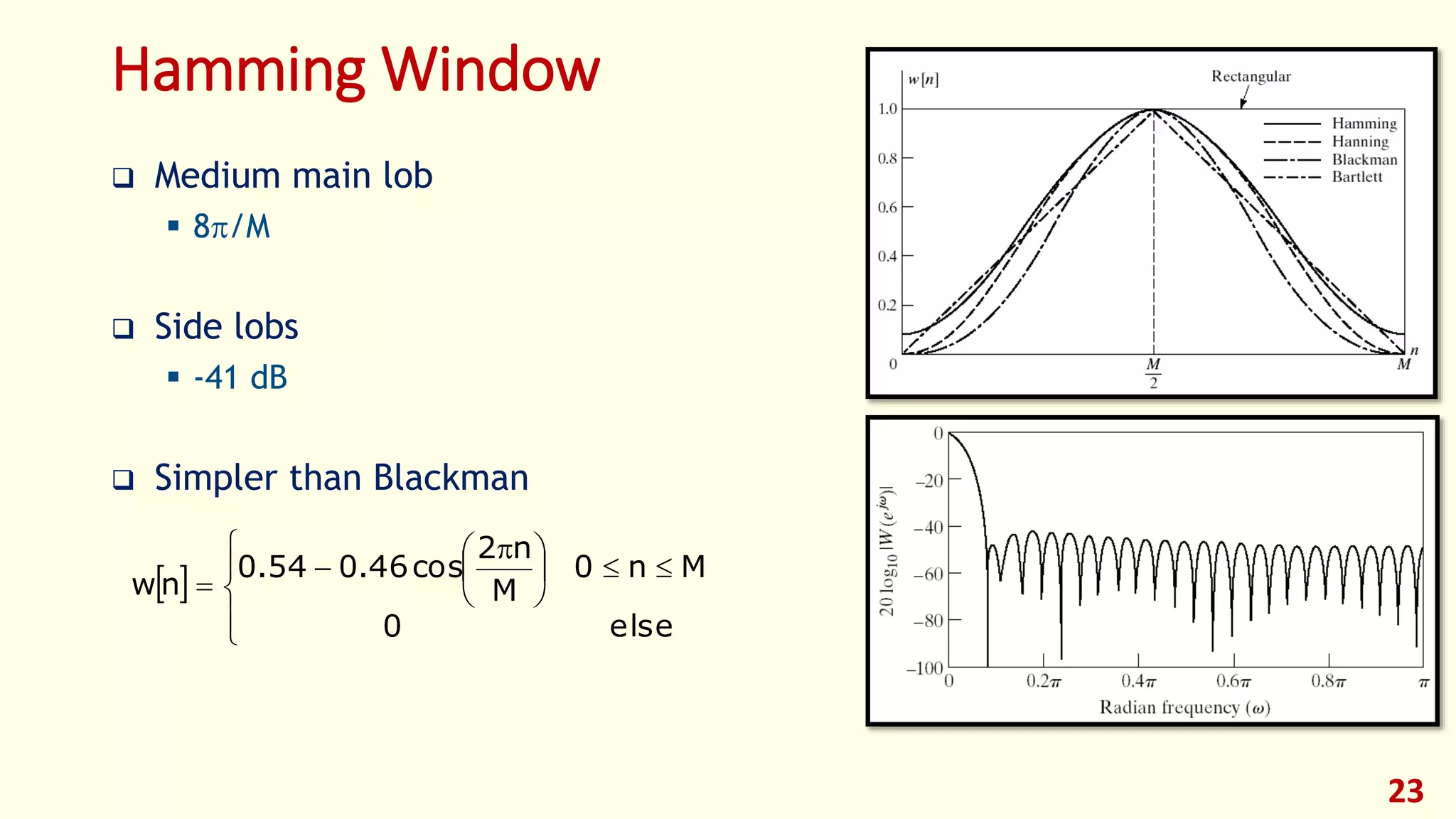
Hamming Window
 Medium main lob
 8/M
 Side lobs
 -41 dB
 Simpler than Blackman
 









 


else0
Mn0
M
n2
cos46.054.0
nw
24
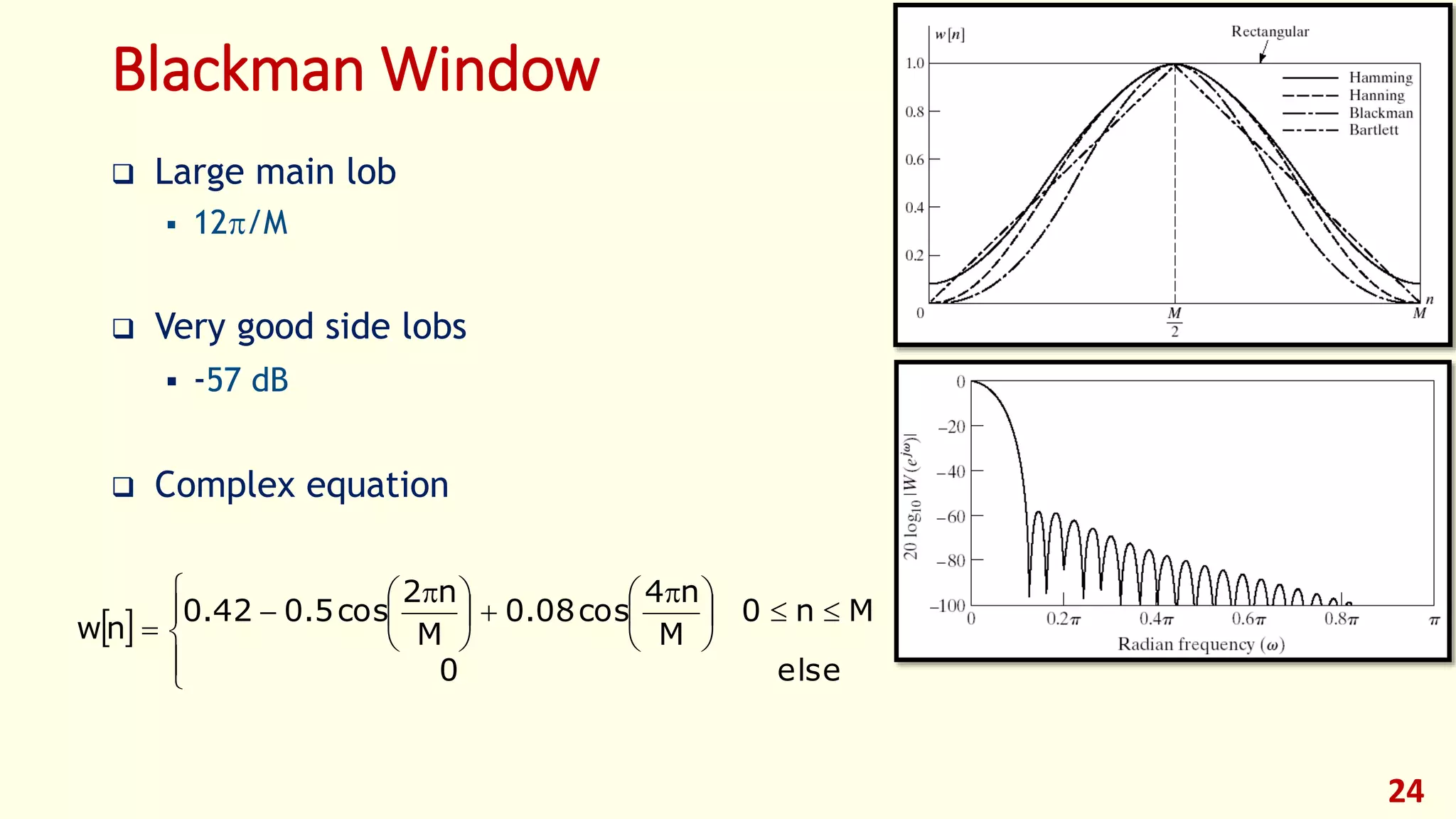
Blackman Window
 









 





 


else0
Mn0
M
n4
cos08.0
M
n2
cos5.042.0
nw
 Large main lob
 12/M
 Very good side lobs
 -57 dB
 Complex equation
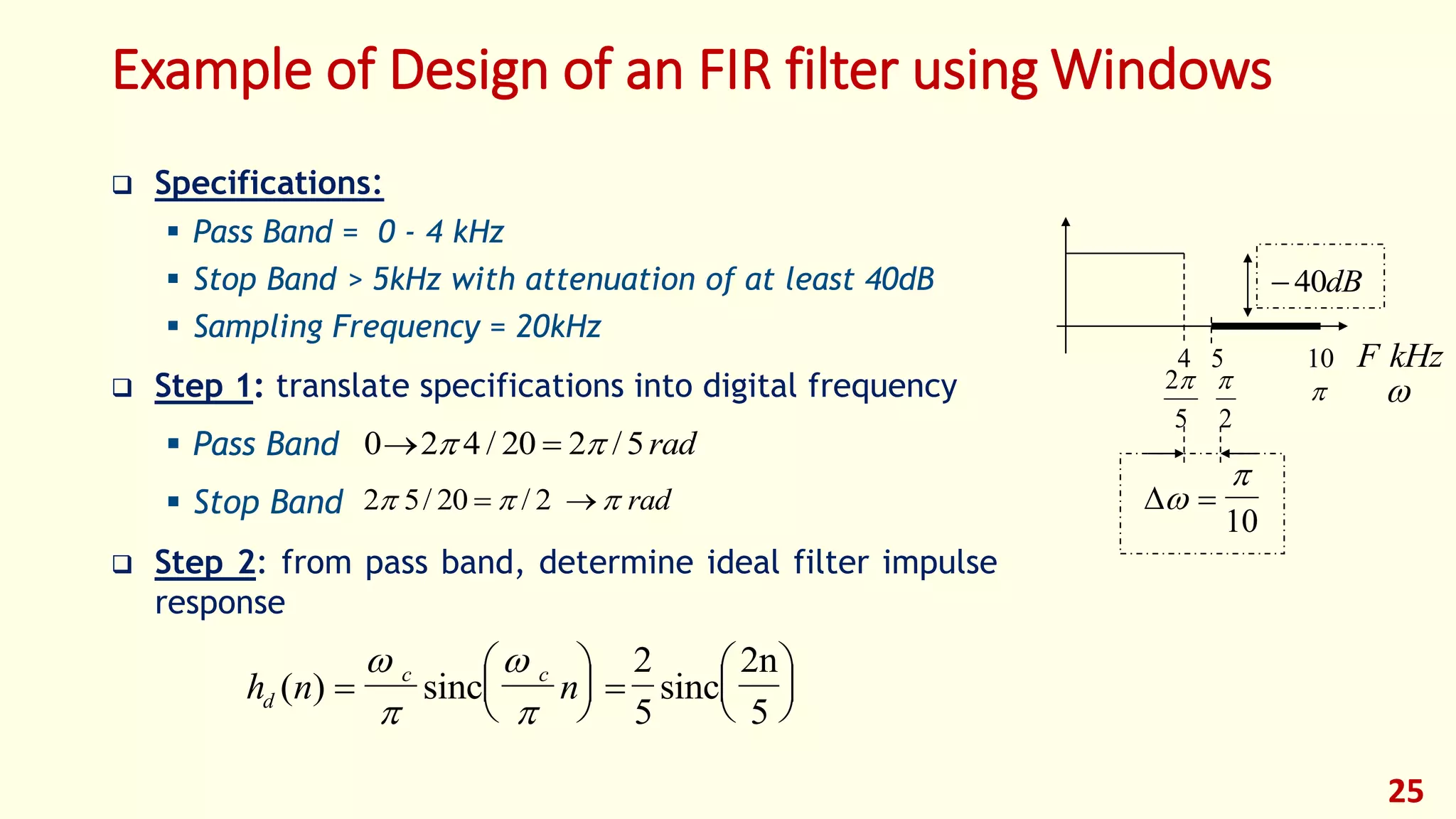
Example of Design of an FIR filter using Windows
 Specifications:
 Pass Band = 0 - 4 kHz
 Stop Band > 5kHz with attenuation of at least 40dB
 Sampling Frequency = 20kHz
 Step 1: translate specifications into digital frequency
 Pass Band
 Stop Band
 Step 2: from pass band, determine ideal filter impulse
response
25
2 5 20 2  / /  rad
0 2 4 20 2 5  / / rad
h n nd
c c
( ) 





 










sinc sinc
2n
5
2
5
40dB
F kHz54 10

2
2
5




10
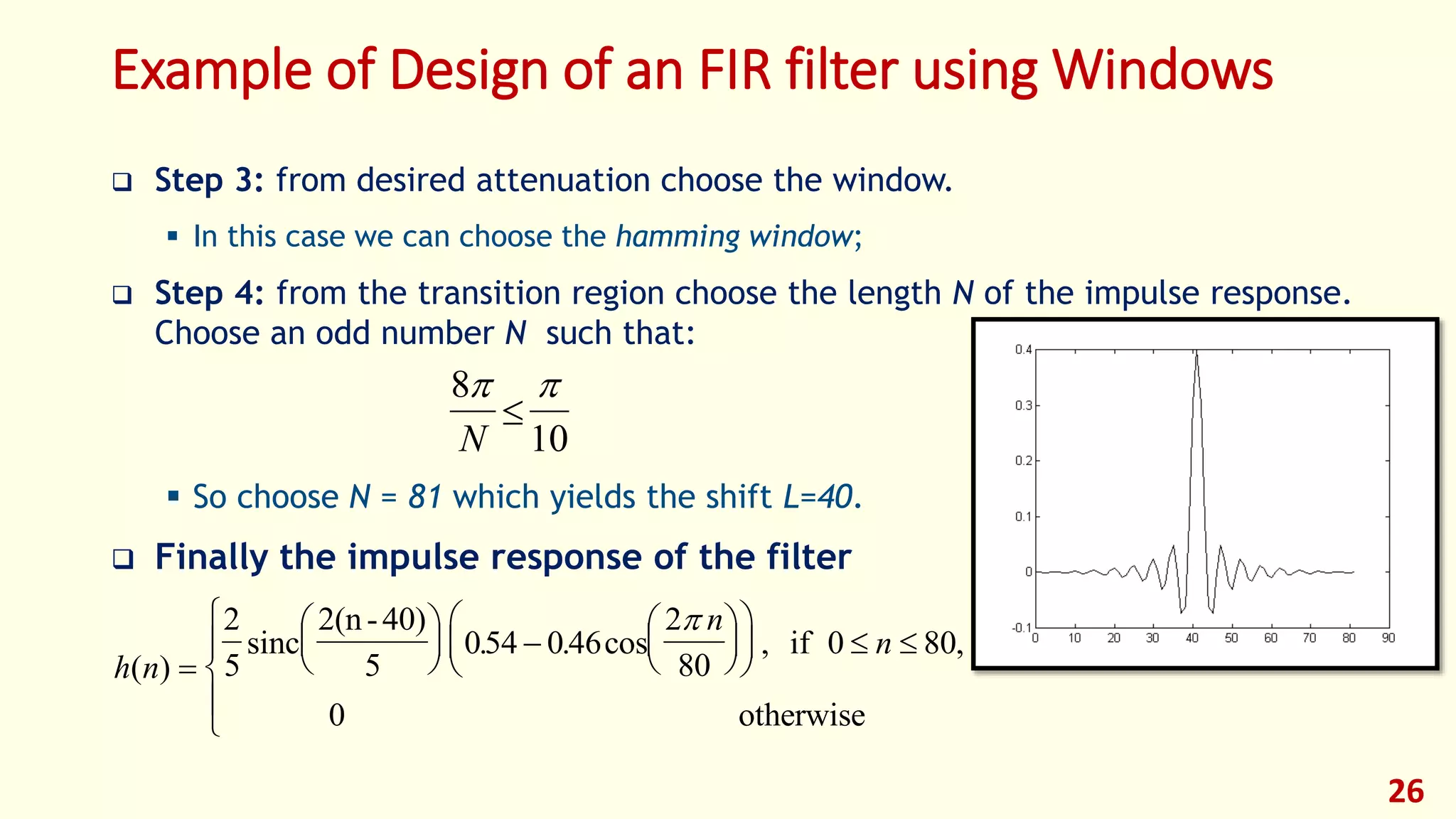
Example of Design of an FIR filter using Windows
 Step 3: from desired attenuation choose the window.
 In this case we can choose the hamming window;
 Step 4: from the transition region choose the length N of the impulse response.
Choose an odd number N such that:
 So choose N = 81 which yields the shift L=40.
 Finally the impulse response of the filter
26
8
10
 
N

h n
n
n
( )
. . cos , ,






 











  





2
5
054 046
2
80
0 80sinc
2(n-40)
5
if
0 otherwise

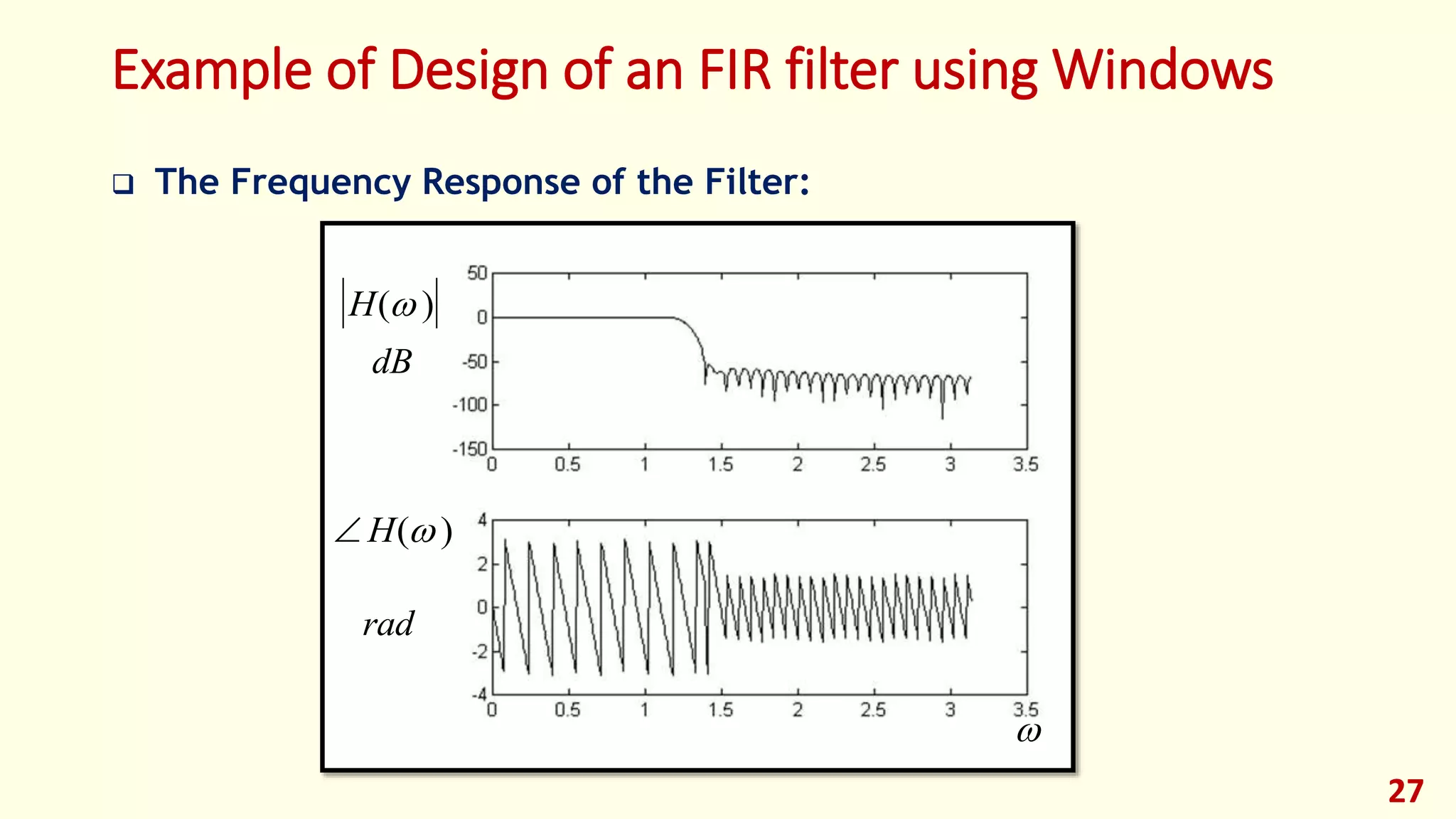
Example of Design of an FIR filter using Windows
 The Frequency Response of the Filter:
27


H( )
 H( )
dB
rad
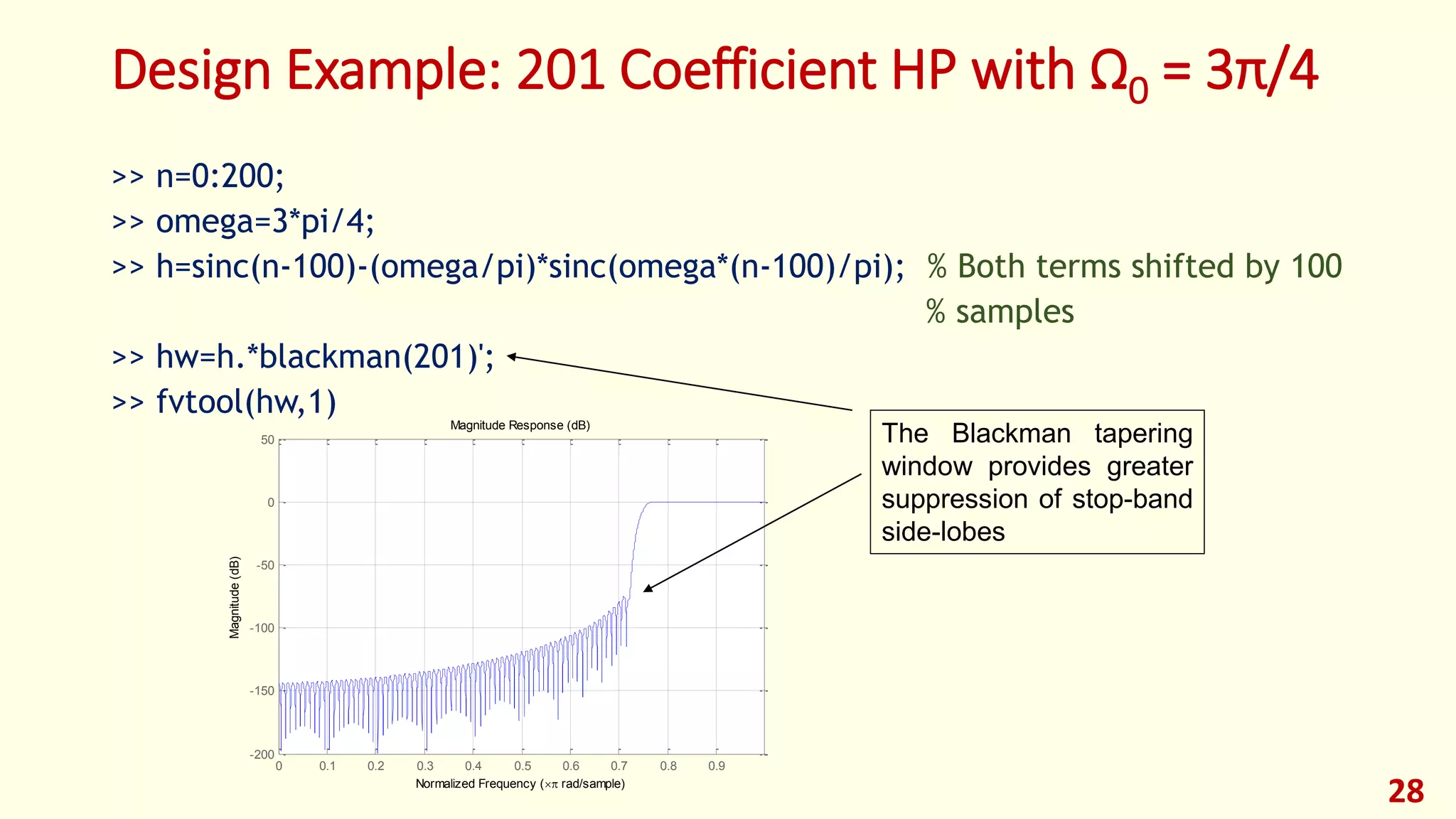
Design Example: 201 Coefficient HP with Ω0 = 3π/4
>> n=0:200;
>> omega=3*pi/4;
>> h=sinc(n-100)-(omega/pi)*sinc(omega*(n-100)/pi); % Both terms shifted by 100
% samples
>> hw=h.*blackman(201)';
>> fvtool(hw,1)
28
0 0.1 0.2 0.3 0.4 0.5 0.6 0.7 0.8 0.9
-200
-150
-100
-50
0
50
Normalized Frequency ( rad/sample)
Magnitude(dB)
Magnitude Response (dB)
The Blackman tapering
window provides greater
suppression of stop-band
side-lobes
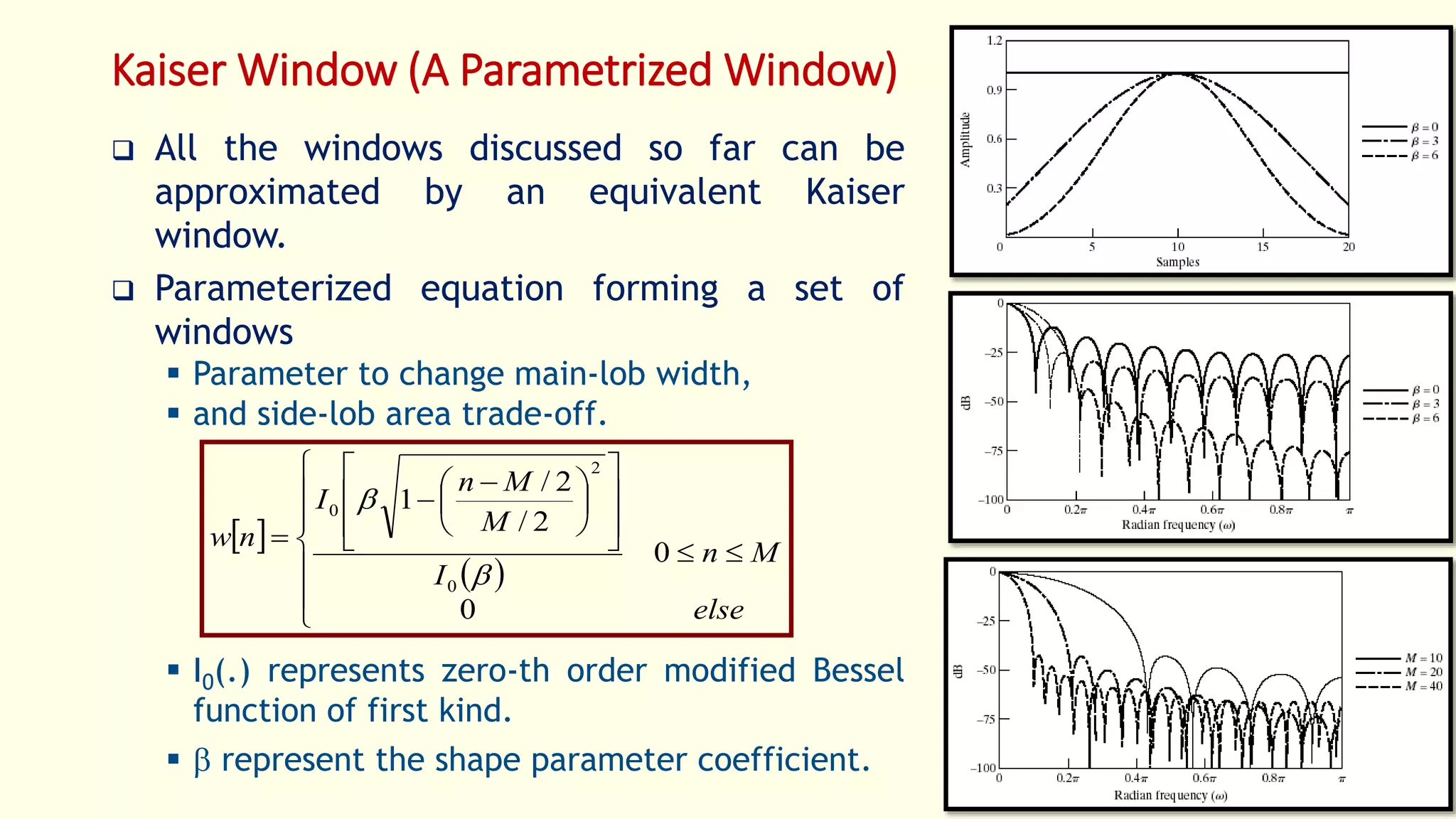
Kaiser Window (A Parametrized Window)
 All the windows discussed so far can be
approximated by an equivalent Kaiser
window.
 Parameterized equation forming a set of
windows
 Parameter to change main-lob width,
 and side-lob area trade-off.
 I0(.) represents zero-th order modified Bessel
function of first kind.
  represent the shape parameter coefficient.
29
 
 





















 


else
Mn
I
M
Mn
I
nw
0
0
2/
2/
1
0
2
0


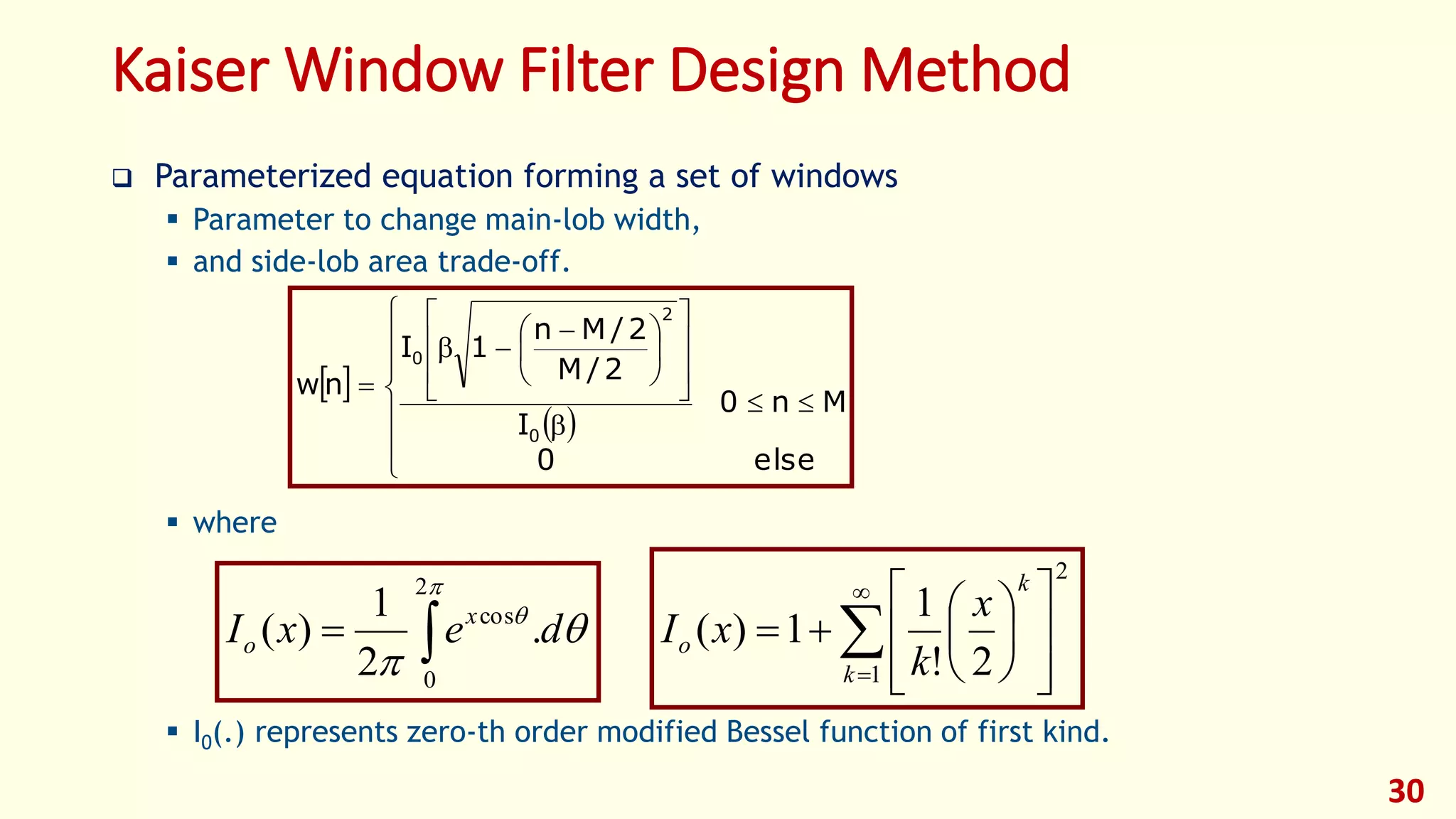
Kaiser Window Filter Design Method
 Parameterized equation forming a set of windows
 Parameter to change main-lob width,
 and side-lob area trade-off.
 where
 I0(.) represents zero-th order modified Bessel function of first kind.
30
 
 






















 


else0
Mn0
I
2/M
2/Mn
1I
nw
0
2
0





2
0
cos
.
2
1
)( dexI x
o 

 














1
2
2!
1
1)(
k
k
o
x
k
xI
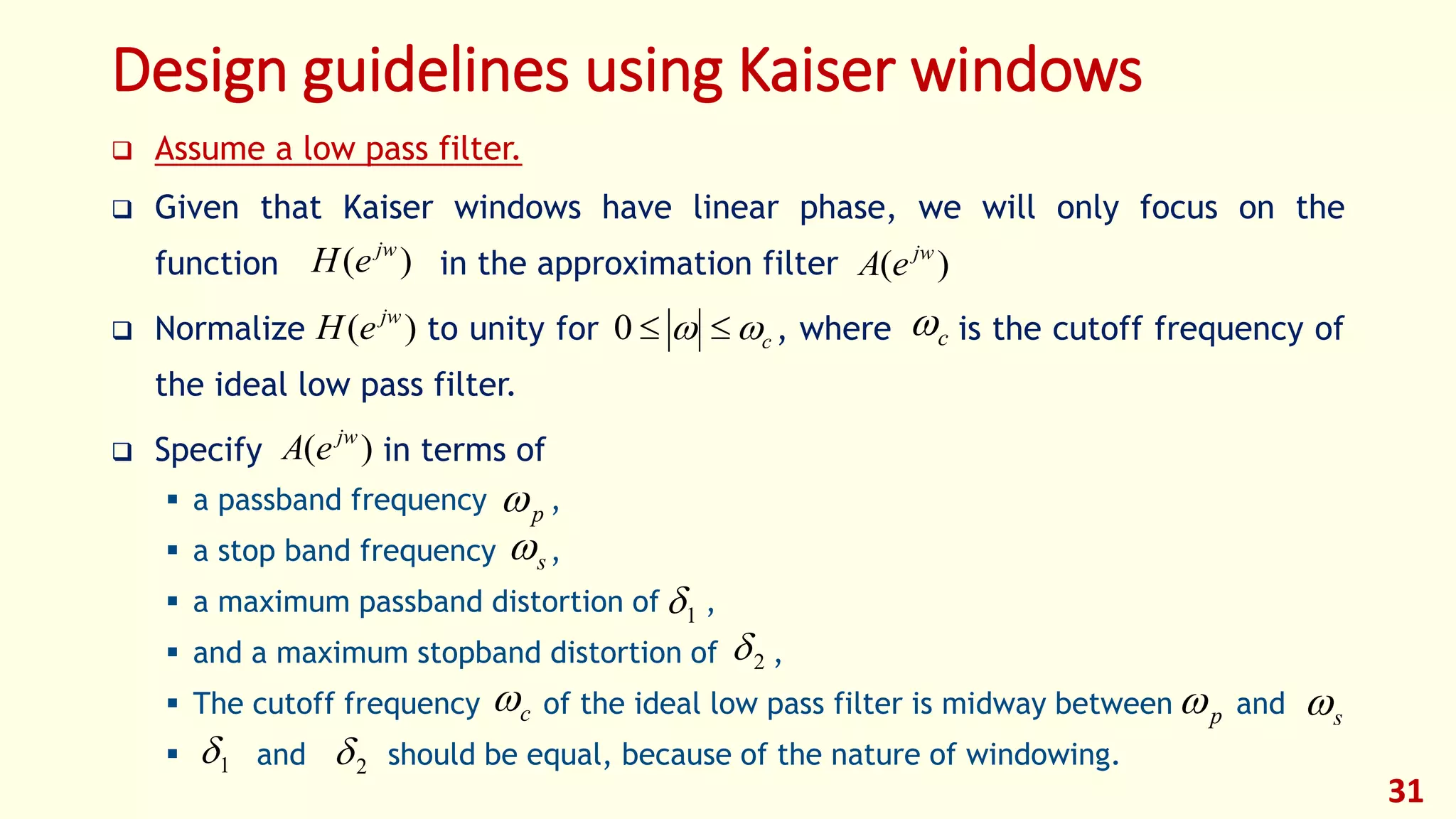
Design guidelines using Kaiser windows
 Assume a low pass filter.
 Given that Kaiser windows have linear phase, we will only focus on the
function in the approximation filter
 Normalize to unity for , where is the cutoff frequency of
the ideal low pass filter.
 Specify in terms of
 a passband frequency ,
 a stop band frequency ,
 a maximum passband distortion of ,
 and a maximum stopband distortion of ,
 The cutoff frequency of the ideal low pass filter is midway between and
 and should be equal, because of the nature of windowing.
31
)( jw
eA)( jw
eH
)( jw
eH c 0 c
)( jw
eA
p
s
1
2
c p s
1 2
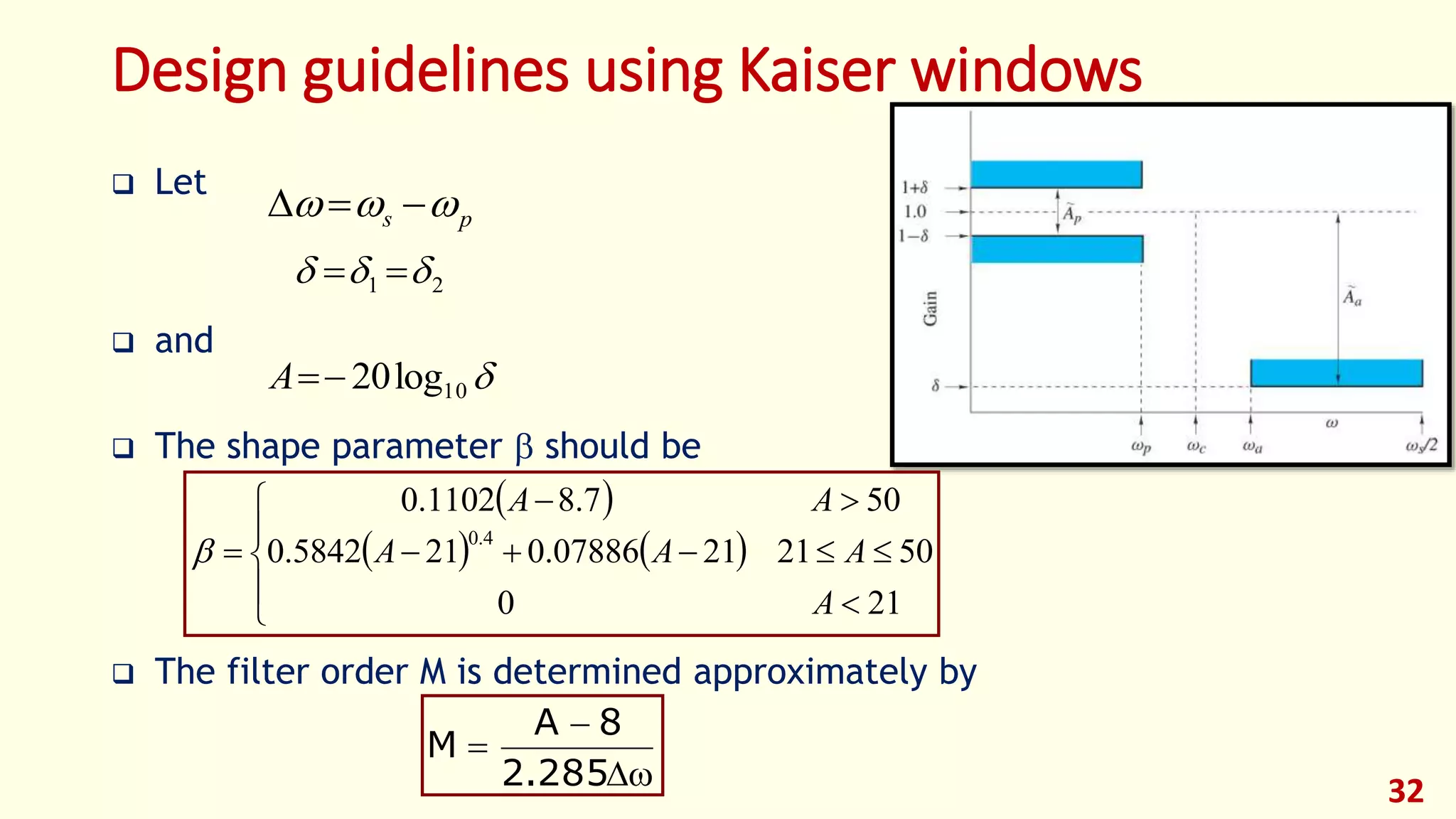
Design guidelines using Kaiser windows
 Let
 and
 The shape parameter  should be
 The filter order M is determined approximately by
32
ps  
21  
10log20A
 
   









210
50212107886.0215842.0
507.81102.0
4.0
A
AAA
AA




285.2
8A
M
33
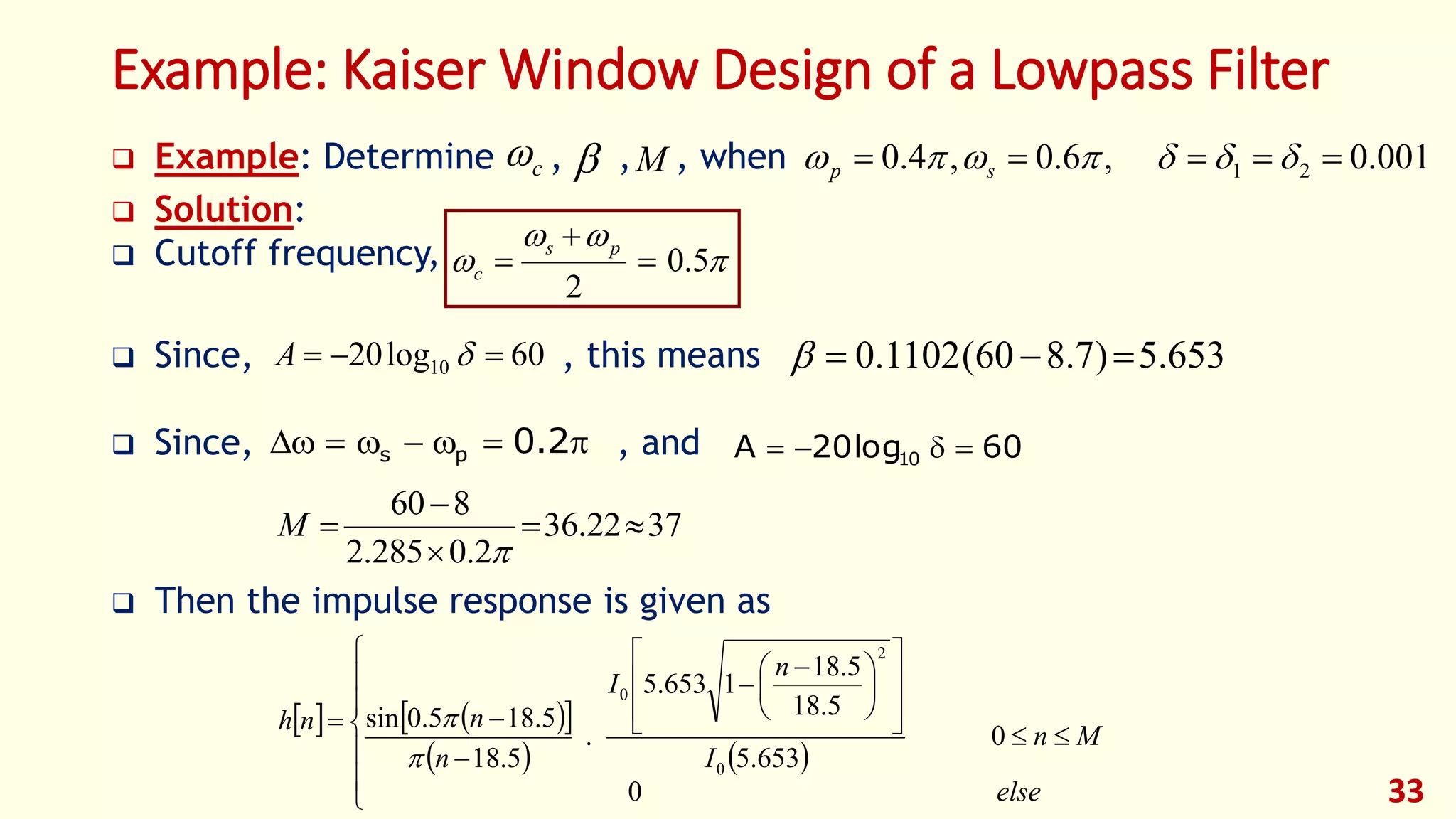
Example: Kaiser Window Design of a Lowpass Filter
 Example: Determine , , , when
 Solution:
 Cutoff frequency,
 Since, , this means
 Since, , and
 Then the impulse response is given as
001.0,6.0,4.0 21   sp


 5.0
2



ps
c
 2.0ps
60log20 10  A 653.5)7.860(1102.0 
3722.36
2.0285.2
860





M
    
   





















 



else
Mn
I
n
I
n
nnh
0
0
653.5
5.18
5.18
1653.5
.
5.18
5.185.0sin
0
2
0


c  M
60log20A 10 
34
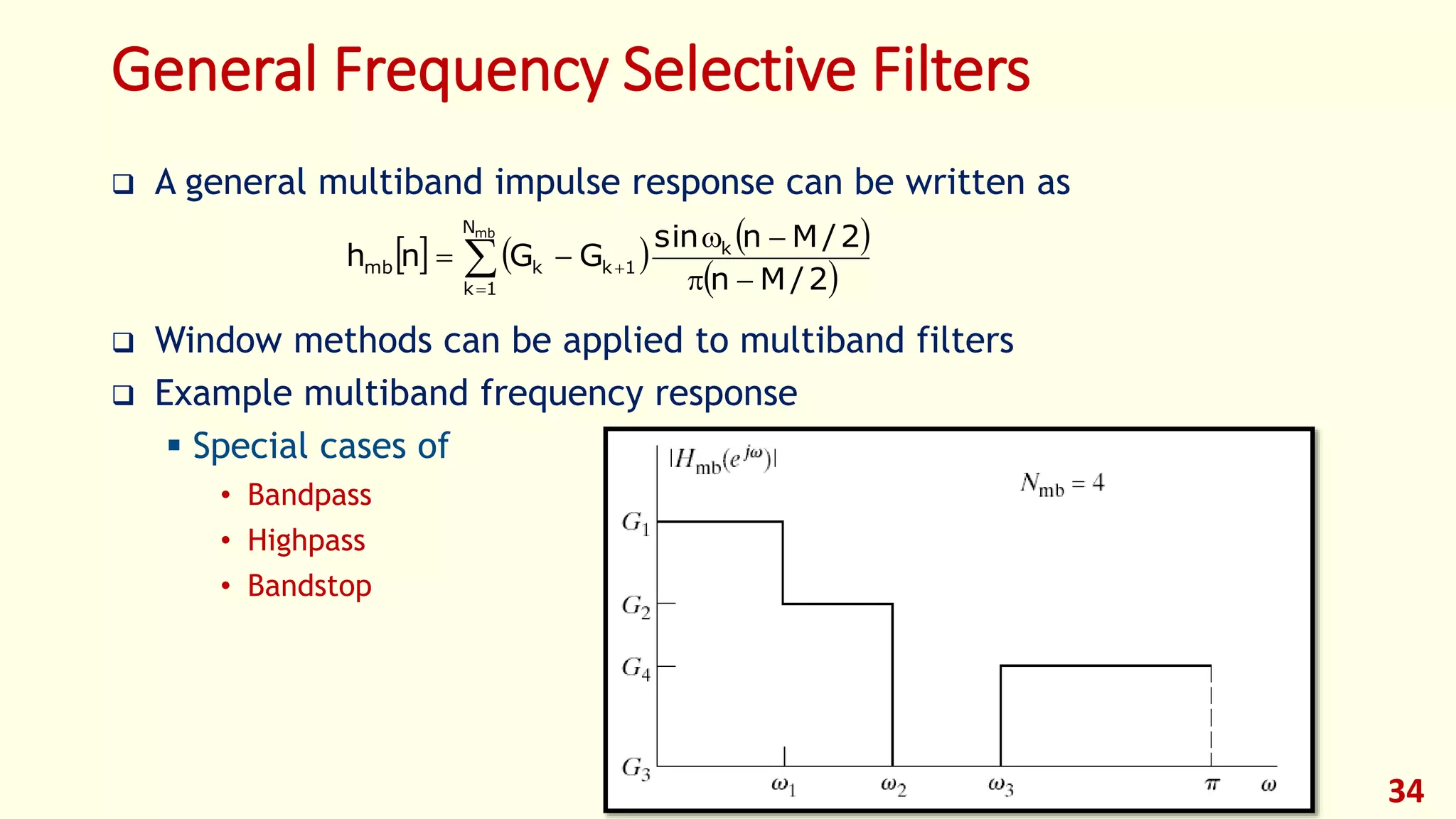
General Frequency Selective Filters
 A general multiband impulse response can be written as
 Window methods can be applied to multiband filters
 Example multiband frequency response
 Special cases of
• Bandpass
• Highpass
• Bandstop
     
 




mbN
1k
k
1kkmb
2/Mn
2/Mnsin
GGnh
Frequency Sampling Method
35
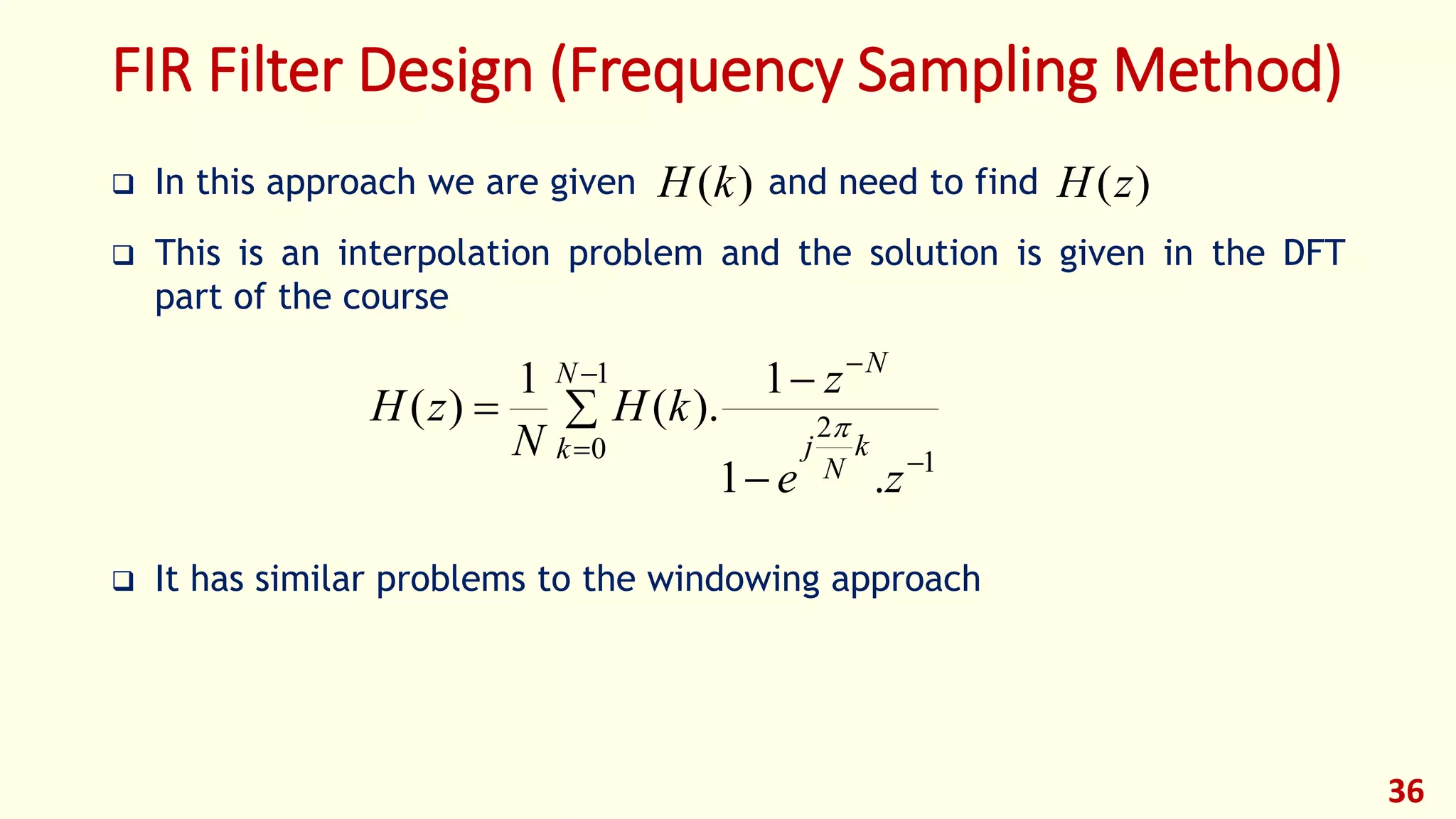
FIR Filter Design (Frequency Sampling Method)
 In this approach we are given and need to find
 This is an interpolation problem and the solution is given in the DFT
part of the course
 It has similar problems to the windowing approach
36





 
1
0 1
2
.1
1
).(
1
)(
N
k k
N
j
N
ze
z
kH
N
zH 
)(kH )(zH
37

DSP_2018_FOEHU - Lec 06 - FIR Filter Design

  • 1.
  • 2.
    Ideal Filters  Oneof the reasons why we design a filter is to remove disturbances  We discriminate between signal and noise in terms of the frequency spectrum 2  )(ns )(nv )(nx )()( nsny Filter SIGNAL NOISE F )(FS )(FV 0F0F 0F F )(FY 0F0F
  • 3.
    Conditions for Non-Distortion Problem: ideally we do not want the filter to distort the signal we want to recover.  Consequence on the Frequency Response: 3 IDEAL FILTER )()( tstx  )()( TtAsty  Same shape as s(t), just scaled and delayed. 0 200 400 600 800 1000 -2 -1.5 -1 -0.5 0 0.5 1 1.5 2 0 200 400 600 800 1000 -2 -1.5 -1 -0.5 0 0.5 1 1.5 2      otherwise passbandtheinisFifAe FH FTj 0 )( 2 F F |)(| FH )(FH constant linear
  • 4.
    Phase Distortion  Phasedistortion results from a variable time delay (phase delay) for different frequency components of a signal.  If the phase response of a filter is a linear function of frequency, then the phase delay is constant for all frequencies and no phase distortion occurs. 4
  • 5.
    Real Time Implementation For real time implementation we also want the filter to be causal, ie.  FACT (Bad News!): by the Paley-Wiener Theorem, if h(n) is causal and with finite energy,  ie 𝐻(𝜔) cannot be zero on an interval, therefore it cannot be ideal. 5 0for0)(  nnh        h n( ) n  since     0 )()()( k knxkhny        dH )(ln )(H    dHH )(log)0log()(log 1 2 1 2
  • 6.
    Practical Filter specifications Filters  Frequency-selective Filter  Three Stages  Specifications  Approximation of the Specifications.  Realization 6  |)(| H p IDEAL
  • 7.
    Practical Filter specifications In practical design the following parameters would be specified:  The maximum ripple allowed in the pass-band:  The maximum ripple allowed in the stop-band:  The pass-band edge frequency:  The stop-band edge frequency:  The order of the FIR or IIR filter. 7 p s p s
  • 8.
    Selection of DigitalFilters (FIR & IIR)  Finite Impulse Response (FIR) filter  always stable,  the phase can be made exactly linear,  we can approximate any filter we want.  Higher order w.r.t IIR filter (we need a lot of coefficients (N large) for good performance)  Infinite Impulse Response (IIR) filter  very selective with a few coefficients  Always Nonlinear Phase. 8
  • 9.
    Design of FIRFilters  Design means calculation (determination) of the coefficients of the difference equation or the transfer function.  Methods of FIR Filter Design:  Window Method  Frequency sampling method. 9   M k knxkhny 0 )()()(    M k k zkhzH 0 )()(
  • 10.
  • 11.
    11 Design of FIRFilters (Window Method)  Simplest way of designing FIR filters  Method is all discrete-time no continuous-time involved  Start with ideal frequency response  Choose ideal frequency response as desired response  Most ideal impulse responses are of infinite length  The easiest way to obtain a causal FIR filter from ideal is by evaluating the IDTFT of         n nj d j d enheH           deeHnh njj dd   2 1  j d eH
  • 12.
    12 Design of FIRFilters (Window Method)  In general, the obtained impulse response is infinite in duration and must be truncated at some point say at: 𝑛 = 𝑀 to give an FIR filter of length M. Truncation of to a length M is equivalent to multiplying by a rectangular window defined as:  Thus, the impulse response of the FIR filter becomes :          else Mnnh nh d 0 0              else Mn nwnwnhnh d 0 01 where  nhd  nhd
  • 13.
  • 14.
    Effect of theWindow Size  As the width of the window increases, its spectrum will be sharper and the resulting convolution will be near ideal.  The rectangular window truncates the impulse response to be of duration 𝑀. But this truncation introduces ripples (oscillations) in the resulting frequency response characteristics (results of convolution). 14
  • 15.
    >> n=0:20; >> omega=pi/4;% This is the cut-off frequency >> h=(omega/pi)*sinc(omega*(n-10)/pi); % Note the 10 step shift >> stem(n,h) >> title('Sample-Shifted LP Impulse Response') >> xlabel('n') >> ylabel('h[n]') >> fvtool(h,1) 0 2 4 6 8 10 12 14 16 18 20 -0.1 -0.05 0 0.05 0.1 0.15 0.2 0.25 Sample-Shifted LP Impulse Response n h[n] 0 0.1 0.2 0.3 0.4 0.5 0.6 0.7 0.8 0.9 0 0.2 0.4 0.6 0.8 1 1.2 1.4 Normalized Frequency ( rad/sample) Magnitude Magnitude Response Note the linear phase properties of the impulse response Example: 21 Coefficient LP Filter with Ω0 = π/4
  • 16.
    >> n=0:200; %This sets the order of the filter where length(n)=201 >> omega=pi/4; >> h=(omega/pi)*sinc((n-100)*omega/pi); %Note the sample shift of 100 samples >> fvtool(h,1) 0 0.1 0.2 0.3 0.4 0.5 0.6 0.7 0.8 0.9 0 0.2 0.4 0.6 0.8 1 1.2 1.4 Normalized Frequency ( rad/sample) Magnitude Magnitude Response Higher order = sharper transition Side-lobe “ripple” (Gibbs phenomenon) due to abrupt truncation of the impulse response Example: 201 Coefficient LP Filter with Ω0 = π/4 How to reduce the Gibbs phenomenon? 1) using a window that tapers smoothly to zero at each end. 2) providing a smooth transition from the passband to the stopband.
  • 17.
    17 Windowing in FrequencyDomain  Windowed frequency response  The windowed version is smeared version of desired response  If w[n]=1 for all n, then W(ej) is pulse train with 2 period               deWeHeH jj d j    2 1
  • 18.
    18 Properties of Windows Prefer windows that concentrate around DC in frequency  Less smearing, closer approximation  Prefer window that has minimal span in time  Less coefficient in designed filter, computationally efficient  So we want concentration in time and in frequency  Contradictory requirements  Example: Rectangular window         2/sin 2/1sin 1 1 2/ 1 0                 M e e e eeW Mj j MjM n njj
  • 19.
    Window Parameters  Twoimportant parameters:  Main lobe width.  Relative side lobe level.  The effect of window function on FIR filter design  The window have a small main lobe width will ensure a fast transition from the passband to the stopband.  The area under the side lobes small will reduce the ripple. 19 0 0.5 1 1.5 2 2.5 3 -120 -100 -80 -60 -40 -20 0 20  attenuation transition region -100 -50 0 50 100 -0.1 -0.05 0 0.05 0.1 0.15 0.2 0.25 L L )(nhw n with 𝑴 = 𝟐𝑳 + 𝟏
  • 20.
    20 Rectangular Window       else0 Mn01 nw  Narrowest main lob  4/(M+1)  Sharpest transitions at discontinuities in frequency  Large side lobs  -13 dB  Large oscillation around discontinuities  Simplest window possible
  • 21.
    21 Bartlett (Triangular) Window          else0 Mn2/MM/n22 2/Mn0M/n2 nw  Medium main lob  8/M  Side lobs  -25 dB  Hamming window performs better  Simple equation
  • 22.
    22 Hanning Window                      else0 Mn0 M n2 cos1 2 1 nw  Medium main lob  8/M  Side lobs  -31 dB  Hanning window performs better  Same complexity as Hamming
  • 23.
    23 Hamming Window  Mediummain lob  8/M  Side lobs  -41 dB  Simpler than Blackman                else0 Mn0 M n2 cos46.054.0 nw
  • 24.
    24 Blackman Window                      else0 Mn0 M n4 cos08.0 M n2 cos5.042.0 nw  Large main lob  12/M  Very good side lobs  -57 dB  Complex equation
  • 25.
    Example of Designof an FIR filter using Windows  Specifications:  Pass Band = 0 - 4 kHz  Stop Band > 5kHz with attenuation of at least 40dB  Sampling Frequency = 20kHz  Step 1: translate specifications into digital frequency  Pass Band  Stop Band  Step 2: from pass band, determine ideal filter impulse response 25 2 5 20 2  / /  rad 0 2 4 20 2 5  / / rad h n nd c c ( )                   sinc sinc 2n 5 2 5 40dB F kHz54 10  2 2 5     10
  • 26.
    Example of Designof an FIR filter using Windows  Step 3: from desired attenuation choose the window.  In this case we can choose the hamming window;  Step 4: from the transition region choose the length N of the impulse response. Choose an odd number N such that:  So choose N = 81 which yields the shift L=40.  Finally the impulse response of the filter 26 8 10   N  h n n n ( ) . . cos , ,                            2 5 054 046 2 80 0 80sinc 2(n-40) 5 if 0 otherwise 
  • 27.
    Example of Designof an FIR filter using Windows  The Frequency Response of the Filter: 27   H( )  H( ) dB rad
  • 28.
    Design Example: 201Coefficient HP with Ω0 = 3π/4 >> n=0:200; >> omega=3*pi/4; >> h=sinc(n-100)-(omega/pi)*sinc(omega*(n-100)/pi); % Both terms shifted by 100 % samples >> hw=h.*blackman(201)'; >> fvtool(hw,1) 28 0 0.1 0.2 0.3 0.4 0.5 0.6 0.7 0.8 0.9 -200 -150 -100 -50 0 50 Normalized Frequency ( rad/sample) Magnitude(dB) Magnitude Response (dB) The Blackman tapering window provides greater suppression of stop-band side-lobes
  • 29.
    Kaiser Window (AParametrized Window)  All the windows discussed so far can be approximated by an equivalent Kaiser window.  Parameterized equation forming a set of windows  Parameter to change main-lob width,  and side-lob area trade-off.  I0(.) represents zero-th order modified Bessel function of first kind.   represent the shape parameter coefficient. 29                              else Mn I M Mn I nw 0 0 2/ 2/ 1 0 2 0  
  • 30.
    Kaiser Window FilterDesign Method  Parameterized equation forming a set of windows  Parameter to change main-lob width,  and side-lob area trade-off.  where  I0(.) represents zero-th order modified Bessel function of first kind. 30                               else0 Mn0 I 2/M 2/Mn 1I nw 0 2 0      2 0 cos . 2 1 )( dexI x o                   1 2 2! 1 1)( k k o x k xI
  • 31.
    Design guidelines usingKaiser windows  Assume a low pass filter.  Given that Kaiser windows have linear phase, we will only focus on the function in the approximation filter  Normalize to unity for , where is the cutoff frequency of the ideal low pass filter.  Specify in terms of  a passband frequency ,  a stop band frequency ,  a maximum passband distortion of ,  and a maximum stopband distortion of ,  The cutoff frequency of the ideal low pass filter is midway between and  and should be equal, because of the nature of windowing. 31 )( jw eA)( jw eH )( jw eH c 0 c )( jw eA p s 1 2 c p s 1 2
  • 32.
    Design guidelines usingKaiser windows  Let  and  The shape parameter  should be  The filter order M is determined approximately by 32 ps   21   10log20A                210 50212107886.0215842.0 507.81102.0 4.0 A AAA AA     285.2 8A M
  • 33.
    33 Example: Kaiser WindowDesign of a Lowpass Filter  Example: Determine , , , when  Solution:  Cutoff frequency,  Since, , this means  Since, , and  Then the impulse response is given as 001.0,6.0,4.0 21   sp    5.0 2    ps c  2.0ps 60log20 10  A 653.5)7.860(1102.0  3722.36 2.0285.2 860      M                                    else Mn I n I n nnh 0 0 653.5 5.18 5.18 1653.5 . 5.18 5.185.0sin 0 2 0   c  M 60log20A 10 
  • 34.
    34 General Frequency SelectiveFilters  A general multiband impulse response can be written as  Window methods can be applied to multiband filters  Example multiband frequency response  Special cases of • Bandpass • Highpass • Bandstop             mbN 1k k 1kkmb 2/Mn 2/Mnsin GGnh
  • 35.
  • 36.
    FIR Filter Design(Frequency Sampling Method)  In this approach we are given and need to find  This is an interpolation problem and the solution is given in the DFT part of the course  It has similar problems to the windowing approach 36        1 0 1 2 .1 1 ).( 1 )( N k k N j N ze z kH N zH  )(kH )(zH
  • 37.