Transmission Line Theory
Introduction:
        In an electronic system, the delivery of power
requires the connection of two wires between the source
and the load. At low frequencies, power is considered to
be delivered to the load through the wire.
        In the microwave frequency region, power is
considered to be in electric and magnetic fields that are
guided from lace to place by some physical structure. Any
physical structure that will guide an electromagnetic wave
place to place is called a Transmission Line.
Types of Transmission Lines
 1.   Two wire line
 2.   Coaxial cable
 3.   Waveguide
         Rectangular
         Circular
 4.   Planar Transmission Lines
         Strip line
         Microstrip line
         Slot line
         Fin line
         Coplanar Waveguide
         Coplanar slot line
Analysis of differences between Low
        and High Frequency
   At low frequencies, the circuit elements are lumped since
    voltage and current waves affect the entire circuit at the same
    time.
   At microwave frequencies, such treatment of circuit elements
    is not possible since voltag and current waves do not affect the
    entire circuit at the same time.
   The circuit must be broken down into unit sections within
    which the circuit elements are considered to be lumped.
   This is because the dimensions of the circuit are comparable to
    the wavelength of the waves according to the formula:
                          c/f
    where,
    c = velocity of light
    f = frequency of voltage/current
Transmission Line Concepts
   The transmission line is divided into small units where the
    circuit elements can be lumped.
   Assuming the resistance of the lines is zero, then the
    transmission line can be modeled as an LC ladder
    network with inductors in the series arms and the
    capacitors in the shunt arms.
   The value of inductance and capacitance of each part
    determines the velocity of propagation of energy down the
    line.
   Time taken for a wave to travel one unit length is equal to
                    T(s) = (LC)0.5
   Velocity of the wave is equal to
                    v (m/s) = 1/T
   Impedance at any point is equal to
                    Z = V (at any point)/I (at any point)
                    Z = (L/C)0.5
Line terminated in its characteristic
impedance: If the end of the transmission line is
terminated in a resistor equal in value to the
characteristic impedance of the line as calculated
by the formula Z=(L/C)0.5 , then the voltage and
current are compatible and no reflections occur.
Line terminated in a short: When the end of the
transmission line is terminated in a short (RL = 0),
the voltage at the short must be equal to the
product of the current and the resistance.
Line terminated in an open: When the line is
terminated in an open, the resistance between the
open ends of the line must be infinite. Thus the
current at the open end is zero.
Reflection from Resistive loads
►   When the resistive load termination is not equal to the
    characteristic impedance, part of the power is reflected
    back and the remainder is absorbed by the load. The
    amount of voltage reflected back is called voltage reflection
    coefficient.
                        Vr/Vi
    where Vr = incident voltage
            Vi = reflected voltage

►   The reflection coefficient is also given by
                        = (ZL - ZO)/(ZL + ZO)
Standing Waves
   A standing wave is formed by the addition of incident and reflected waves
    and has nodal points that remain stationary with time.
   Voltage Standing Wave Ratio:
                    VSWR = Vmax/Vmin
   Voltage standing wave ratio expressed in decibels is called the Standing
    Wave Ratio:
                    SWR (dB) = 20log10VSWR
   The maximum impedance of the line is given by:
                    Zmax = Vmax/Imin
   The minimum impedance of the line is given by:
                    Zmin = Vmin/Imax
    or alternatively:
                      Zmin = Zo/VSWR
   Relationship between VSWR and Reflection Coefficient:
                    VSWR = (1 + 1 - 
(VSWR – 1)/(VSWR + 1)
General Input Impedance Equation
 Input impedance of a transmission line at a
  distance L from the load impedance ZL with a
  characteristic Zo is
      Zinput = Zo [(ZL + j Zo BL)/(Zo + j ZL BL)]
  where B is called phase constant or
  wavelength constant and is defined by the
  equation
      B = 2
Half and Quarter wave transmission lines
  The relationship of the input impedance at the
   input of the half-wave transmission line with its
   terminating impedance is got by letting L =
   in the impedance equation.
         Zinput = ZL 
  The relationship of the input impedance at the
   input of the quarter-wave transmission line with
   its terminating impedance is got by letting L =
   in the impedance equation.
         Zinput = (Zinput Zoutput)0.5 
Effect of Lossy line on voltage and
               current waves
  The effect of resistance in a transmission line is to continuously
   reduce the amplitude of both incident and reflected voltage and
   current waves.
 Skin Effect: As frequency increases, depth of penetration into
   adjacent conductive surfaces decreases for boundary currents
   associated with electromagnetic waves. This results in the
   confinement of the voltage and current waves at the boundary of
   the transmission line, thus making the transmission more lossy.
 The skin depth is given by:

        skin depth (m) = 1f0.5
   where f = frequency, Hz
          = permeability, H/m
= conductivity, S/m
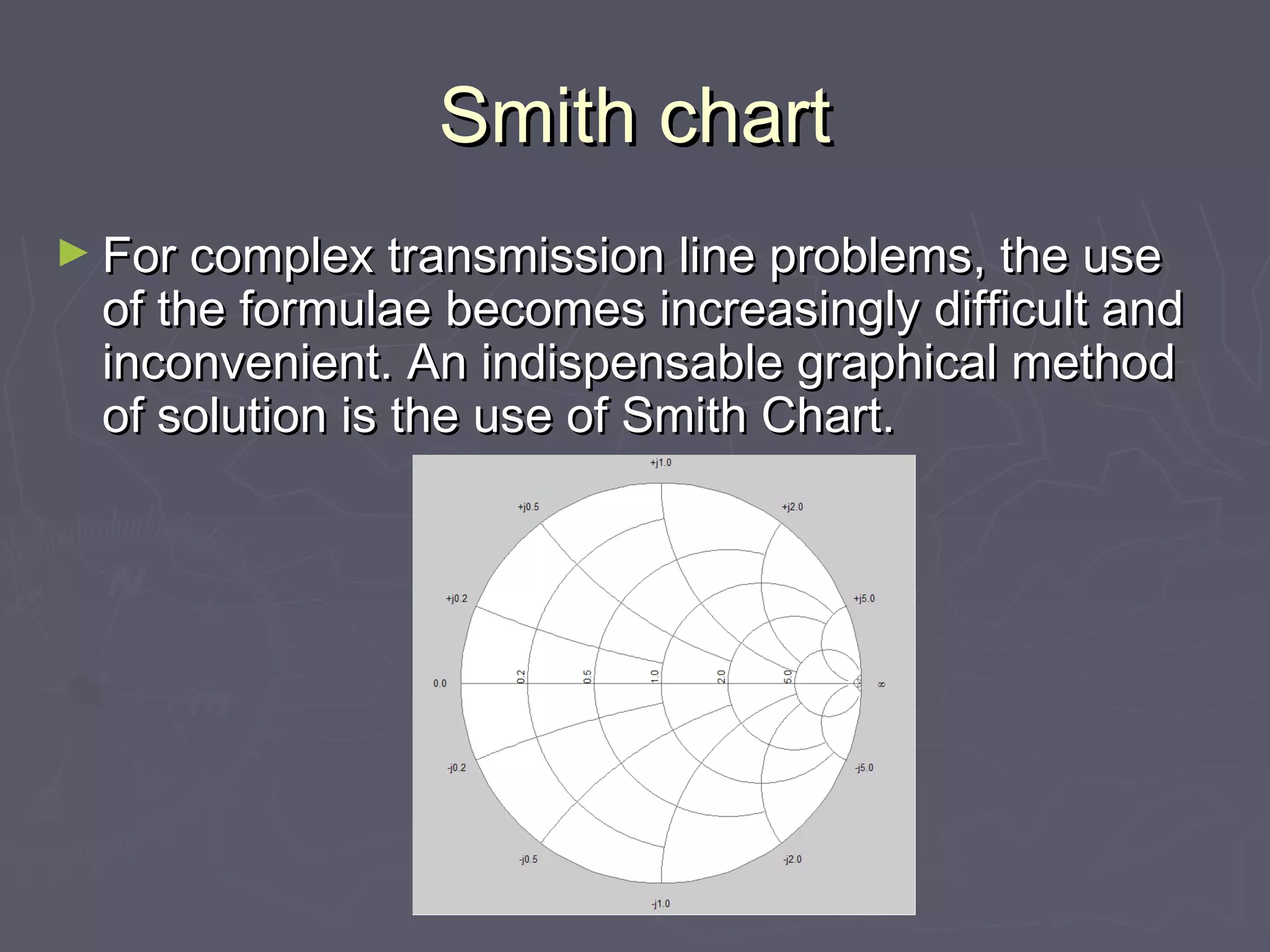
Smith chart
► For complex transmission line problems, the use
  of the formulae becomes increasingly difficult and
  inconvenient. An indispensable graphical method
  of solution is the use of Smith Chart.
Components of a Smith Chart
   Horizontal line: The horizontal line running through the
    center of the Smith chart represents either the resistive ir the
    conductive component. Zero resistance or conductance is
    located on the left end and infinite resistance or conductance is
    located on the right end of the line.

   Circles of constant resistance and conductance: Circles of
    constant resistance are drawn on the Smith chart tangent to the
    right-hand side of the chart and its intersection with the
    centerline. These circles of constant resistance are used to
    locate complex impedances and to assist in obtaining solutions
    to problems involving the Smith chart.

   Lines of constant reactance: Lines of constant reactance are
    shown on the Smith chart with curves that start from a given
    reactance value on the outer circle and end at the right-hand
    side of the center line.
Solutions to Microwave problems using Smith chart

        The types of problems for which Smith charts are used
         include the following:
    1.     Plotting a complex impedance on a Smith chart
    2.     Finding VSWR for a given load
    3.     Finding the admittance for a given impedance
    4.     Finding the input impedance of a transmission line terminated
           in a short or open.
    5.     Finding the input impedance at any distance from a load ZL.
    6.     Locating the first maximum and minimum from any load
    7.     Matching a transmission line to a load with a single series
           stub.
    8.     Matching a transmission line with a single parallel stub
    9.     Matching a transmission line to a load with two parallel stubs.
Plotting a Complex Impedance on a Smith Chart

 To locate a complex impedance, Z = R+-jX or
  admittance Y = G +- jB on a Smith chart,
  normalize the real and imaginary part of the
  complex impedance. Locating the value of the
  normalized real term on the horizontal line scale
  locates the resistance circle. Locating the
  normalized value of the imaginary term on the
  outer circle locates the curve of constant
  reactance. The intersection of the circle and the
  curve locates the complex impedance on the
  Smith chart.
Finding the VSWR for a given load
 Normalize   the load and plot its location on
  the Smith chart.
 Draw a circle with a radius equal to the
  distance between the 1.0 point and the
  location of the normalized load and the
  center of the Smith chart as the center.
 The intersection of the right-hand side of
  the circle with the horizontal resistance
  line locates the value of the VSWR.
Finding the Input Impedance at any
Distance from the Load
 The  load impedance is first normalized and is
  located on the Smith chart.
 The VSWR circle is drawn for the load.
 A line is drawn from the 1.0 point through the
  load to the outer wavelength scale.
 To locate the input impedance on a Smith chart
  of the transmission line at any given distance
  from the load, advance in clockwise direction
  from the located point, a distance in wavelength
  equal to the distance to the new location on the
  transmission line.
Power Loss
   Return Power Loss: When an electromagnetic wave
    travels down a transmission line and encounters a
    mismatched load or a discontinuity in the line, part of the
    incident power is reflected back down the line. The return
    loss is defined as:
                Preturn = 10 log10 Pi/Pr
                 Preturn = 20 log10 1/
   Mismatch Power Loss: The term mismatch loss is used
    to describe the loss caused by the reflection due to a
    mismatched line. It is defined as
                 Pmismatch = 10 log10 Pi/(Pi - Pr)
Microwave Components
   Microwave components do the following functions:
    1.    Terminate the wave
    2.    Split the wave into paths
    3.    Control the direction of the wave
    4.    Switch power
    5.    Reduce power
    6.    Sample fixed amounts of power
    7.    Transmit or absorb fixed frequencies
    8.    Transmit power in one direction
    9.    Shift the phase of the wave
    10.   Detect and mix waves
Coaxial components

   Connectors: Microwave coaxial connectors required to connect two
    coaxial lines are als called connector pairs (male and female). They
    must match the characteristic impedance of the attached lines and be
    designed to have minimum reflection coefficients and not radiate
    power through the connector.
    E.g. APC-3.5, BNC, SMA, SMC, Type N

   Coaxial sections: Coaxial line sections slip inside each other while
    still making electrical contact. These sections are useful for matching
    loads and making slotted line measurements. Double and triple stub
    tuning configurations are available as coaxial stub tuning sections.

   Attenuators: The function of an attenuator is to reduce the power of
    the signal through it by a fixed or adjustable amount. The different
    types of attenuators are:
    1.   Fixed attenuators
    2.   Step attenuators
    3.   Variable attenuators
Coaxial components (contd.)

 Coaxial   cavities: Coaxial cavities are
  concentric lines or coaxial lines with an air
  dielectric and closed ends. Propagation of
  EM waves is in TEM mode.
 Coaxial wave meters: Wave meters use a
  cavity to allow the transmission or absorption
  of a wave at a frequency equal to the
  resonant frequency of the cavity. Coaxial
  cavities are used as wave meters.
Waveguide components
    The waveguide components generally encountered are:
    1.    Directional couplers
    2.    Tee junctions
    3.    Attenuators
    4.    Impedance changing devices
    5.    Waveguide terminating devices
    6.    Slotted sections
    7.    Ferrite devices
    8.    Isolator switches
    9.    Circulators
    10.   Cavities
    11.   Wavemeters
    12.   Filters
    13.   Detectors
    14.   Mixers
Tees

   Hybrid Tee junction: Tee junctions are used
    to split waves from one waveguide to two
    other waveguides. There are two ways of
    connecting the third arm to the waveguide –
    1.   along the long dimension, called E=plane Tee.
    2.   along the narrow dimension, called H-Plane Tee
    Hybrid Tee junction: the E-plane and H-
    plane tees can be combined to form a
    hybrid tee junction called Magic Tee
Attenuators
   Attenuators are components that reduce the amount of power a fixed
    amount, a variable amount or in a series of fixed steps from the input
    to the output of the device. They operate on the principle of interfering
    with the electric field or magnetic field or both.
   Slide vane attenuators: They work on the principle that a resistive
    material placed in parallel with the E-lines of a field current will induce
    a current in the material that will result in I2R power loss.
   Flap attenuator: A flap attenuator has a vane that is dropped into the
    waveguide through a slot in the top of the guide. The further the vane
    is inserted into the waveguide, the greater the attenuation.
   Rotary vane attenuator: It is a precision waveguide attenuator in which
    attenuation follows a mathematical law. In this device, attenuation is
    independent on frequency.
Isolators
   Mismatch or discontinuities cause energy to be reflected back
    down the line. Reflected energy is undesirable. Thus, to
    prevent reflected energy from reaching the source, isolators are
    used.
   Faraday Rotational Isolator: It combines ferrite material to
    shift the phase of an electromagnetic wave in its vicinity and
    attenuation vanes to attenuate an electric field that is parallel to
    the resistive plane.
   Resonant absorption isolator: A device that can be used for
    higher powers. It consists of a section of rectangular waveguide
    with ferrite material placed half way to the center of the
    waveguide, along the axis of the guide.

519 transmission line theory

  • 1.
    Transmission Line Theory Introduction: In an electronic system, the delivery of power requires the connection of two wires between the source and the load. At low frequencies, power is considered to be delivered to the load through the wire. In the microwave frequency region, power is considered to be in electric and magnetic fields that are guided from lace to place by some physical structure. Any physical structure that will guide an electromagnetic wave place to place is called a Transmission Line.
  • 2.
    Types of TransmissionLines 1. Two wire line 2. Coaxial cable 3. Waveguide  Rectangular  Circular 4. Planar Transmission Lines  Strip line  Microstrip line  Slot line  Fin line  Coplanar Waveguide  Coplanar slot line
  • 3.
    Analysis of differencesbetween Low and High Frequency  At low frequencies, the circuit elements are lumped since voltage and current waves affect the entire circuit at the same time.  At microwave frequencies, such treatment of circuit elements is not possible since voltag and current waves do not affect the entire circuit at the same time.  The circuit must be broken down into unit sections within which the circuit elements are considered to be lumped.  This is because the dimensions of the circuit are comparable to the wavelength of the waves according to the formula: c/f where, c = velocity of light f = frequency of voltage/current
  • 4.
    Transmission Line Concepts  The transmission line is divided into small units where the circuit elements can be lumped.  Assuming the resistance of the lines is zero, then the transmission line can be modeled as an LC ladder network with inductors in the series arms and the capacitors in the shunt arms.  The value of inductance and capacitance of each part determines the velocity of propagation of energy down the line.  Time taken for a wave to travel one unit length is equal to T(s) = (LC)0.5  Velocity of the wave is equal to v (m/s) = 1/T  Impedance at any point is equal to Z = V (at any point)/I (at any point) Z = (L/C)0.5
  • 5.
    Line terminated inits characteristic impedance: If the end of the transmission line is terminated in a resistor equal in value to the characteristic impedance of the line as calculated by the formula Z=(L/C)0.5 , then the voltage and current are compatible and no reflections occur. Line terminated in a short: When the end of the transmission line is terminated in a short (RL = 0), the voltage at the short must be equal to the product of the current and the resistance. Line terminated in an open: When the line is terminated in an open, the resistance between the open ends of the line must be infinite. Thus the current at the open end is zero.
  • 6.
    Reflection from Resistiveloads ► When the resistive load termination is not equal to the characteristic impedance, part of the power is reflected back and the remainder is absorbed by the load. The amount of voltage reflected back is called voltage reflection coefficient. Vr/Vi where Vr = incident voltage Vi = reflected voltage ► The reflection coefficient is also given by  = (ZL - ZO)/(ZL + ZO)
  • 7.
    Standing Waves  A standing wave is formed by the addition of incident and reflected waves and has nodal points that remain stationary with time.  Voltage Standing Wave Ratio: VSWR = Vmax/Vmin  Voltage standing wave ratio expressed in decibels is called the Standing Wave Ratio: SWR (dB) = 20log10VSWR  The maximum impedance of the line is given by: Zmax = Vmax/Imin  The minimum impedance of the line is given by: Zmin = Vmin/Imax or alternatively: Zmin = Zo/VSWR  Relationship between VSWR and Reflection Coefficient: VSWR = (1 + 1 -  (VSWR – 1)/(VSWR + 1)
  • 8.
    General Input ImpedanceEquation  Input impedance of a transmission line at a distance L from the load impedance ZL with a characteristic Zo is Zinput = Zo [(ZL + j Zo BL)/(Zo + j ZL BL)] where B is called phase constant or wavelength constant and is defined by the equation B = 2
  • 9.
    Half and Quarterwave transmission lines  The relationship of the input impedance at the input of the half-wave transmission line with its terminating impedance is got by letting L = in the impedance equation. Zinput = ZL   The relationship of the input impedance at the input of the quarter-wave transmission line with its terminating impedance is got by letting L = in the impedance equation. Zinput = (Zinput Zoutput)0.5 
  • 10.
    Effect of Lossyline on voltage and current waves  The effect of resistance in a transmission line is to continuously reduce the amplitude of both incident and reflected voltage and current waves.  Skin Effect: As frequency increases, depth of penetration into adjacent conductive surfaces decreases for boundary currents associated with electromagnetic waves. This results in the confinement of the voltage and current waves at the boundary of the transmission line, thus making the transmission more lossy.  The skin depth is given by: skin depth (m) = 1f0.5 where f = frequency, Hz = permeability, H/m = conductivity, S/m
  • 11.
    Smith chart ► Forcomplex transmission line problems, the use of the formulae becomes increasingly difficult and inconvenient. An indispensable graphical method of solution is the use of Smith Chart.
  • 12.
    Components of aSmith Chart  Horizontal line: The horizontal line running through the center of the Smith chart represents either the resistive ir the conductive component. Zero resistance or conductance is located on the left end and infinite resistance or conductance is located on the right end of the line.  Circles of constant resistance and conductance: Circles of constant resistance are drawn on the Smith chart tangent to the right-hand side of the chart and its intersection with the centerline. These circles of constant resistance are used to locate complex impedances and to assist in obtaining solutions to problems involving the Smith chart.  Lines of constant reactance: Lines of constant reactance are shown on the Smith chart with curves that start from a given reactance value on the outer circle and end at the right-hand side of the center line.
  • 13.
    Solutions to Microwaveproblems using Smith chart  The types of problems for which Smith charts are used include the following: 1. Plotting a complex impedance on a Smith chart 2. Finding VSWR for a given load 3. Finding the admittance for a given impedance 4. Finding the input impedance of a transmission line terminated in a short or open. 5. Finding the input impedance at any distance from a load ZL. 6. Locating the first maximum and minimum from any load 7. Matching a transmission line to a load with a single series stub. 8. Matching a transmission line with a single parallel stub 9. Matching a transmission line to a load with two parallel stubs.
  • 14.
    Plotting a ComplexImpedance on a Smith Chart  To locate a complex impedance, Z = R+-jX or admittance Y = G +- jB on a Smith chart, normalize the real and imaginary part of the complex impedance. Locating the value of the normalized real term on the horizontal line scale locates the resistance circle. Locating the normalized value of the imaginary term on the outer circle locates the curve of constant reactance. The intersection of the circle and the curve locates the complex impedance on the Smith chart.
  • 15.
    Finding the VSWRfor a given load  Normalize the load and plot its location on the Smith chart.  Draw a circle with a radius equal to the distance between the 1.0 point and the location of the normalized load and the center of the Smith chart as the center.  The intersection of the right-hand side of the circle with the horizontal resistance line locates the value of the VSWR.
  • 16.
    Finding the InputImpedance at any Distance from the Load  The load impedance is first normalized and is located on the Smith chart.  The VSWR circle is drawn for the load.  A line is drawn from the 1.0 point through the load to the outer wavelength scale.  To locate the input impedance on a Smith chart of the transmission line at any given distance from the load, advance in clockwise direction from the located point, a distance in wavelength equal to the distance to the new location on the transmission line.
  • 17.
    Power Loss  Return Power Loss: When an electromagnetic wave travels down a transmission line and encounters a mismatched load or a discontinuity in the line, part of the incident power is reflected back down the line. The return loss is defined as: Preturn = 10 log10 Pi/Pr Preturn = 20 log10 1/  Mismatch Power Loss: The term mismatch loss is used to describe the loss caused by the reflection due to a mismatched line. It is defined as Pmismatch = 10 log10 Pi/(Pi - Pr)
  • 18.
    Microwave Components  Microwave components do the following functions: 1. Terminate the wave 2. Split the wave into paths 3. Control the direction of the wave 4. Switch power 5. Reduce power 6. Sample fixed amounts of power 7. Transmit or absorb fixed frequencies 8. Transmit power in one direction 9. Shift the phase of the wave 10. Detect and mix waves
  • 19.
    Coaxial components  Connectors: Microwave coaxial connectors required to connect two coaxial lines are als called connector pairs (male and female). They must match the characteristic impedance of the attached lines and be designed to have minimum reflection coefficients and not radiate power through the connector. E.g. APC-3.5, BNC, SMA, SMC, Type N  Coaxial sections: Coaxial line sections slip inside each other while still making electrical contact. These sections are useful for matching loads and making slotted line measurements. Double and triple stub tuning configurations are available as coaxial stub tuning sections.  Attenuators: The function of an attenuator is to reduce the power of the signal through it by a fixed or adjustable amount. The different types of attenuators are: 1. Fixed attenuators 2. Step attenuators 3. Variable attenuators
  • 20.
    Coaxial components (contd.) Coaxial cavities: Coaxial cavities are concentric lines or coaxial lines with an air dielectric and closed ends. Propagation of EM waves is in TEM mode.  Coaxial wave meters: Wave meters use a cavity to allow the transmission or absorption of a wave at a frequency equal to the resonant frequency of the cavity. Coaxial cavities are used as wave meters.
  • 21.
    Waveguide components  The waveguide components generally encountered are: 1. Directional couplers 2. Tee junctions 3. Attenuators 4. Impedance changing devices 5. Waveguide terminating devices 6. Slotted sections 7. Ferrite devices 8. Isolator switches 9. Circulators 10. Cavities 11. Wavemeters 12. Filters 13. Detectors 14. Mixers
  • 22.
    Tees  Hybrid Tee junction: Tee junctions are used to split waves from one waveguide to two other waveguides. There are two ways of connecting the third arm to the waveguide – 1. along the long dimension, called E=plane Tee. 2. along the narrow dimension, called H-Plane Tee  Hybrid Tee junction: the E-plane and H- plane tees can be combined to form a hybrid tee junction called Magic Tee
  • 23.
    Attenuators  Attenuators are components that reduce the amount of power a fixed amount, a variable amount or in a series of fixed steps from the input to the output of the device. They operate on the principle of interfering with the electric field or magnetic field or both.  Slide vane attenuators: They work on the principle that a resistive material placed in parallel with the E-lines of a field current will induce a current in the material that will result in I2R power loss.  Flap attenuator: A flap attenuator has a vane that is dropped into the waveguide through a slot in the top of the guide. The further the vane is inserted into the waveguide, the greater the attenuation.  Rotary vane attenuator: It is a precision waveguide attenuator in which attenuation follows a mathematical law. In this device, attenuation is independent on frequency.
  • 24.
    Isolators  Mismatch or discontinuities cause energy to be reflected back down the line. Reflected energy is undesirable. Thus, to prevent reflected energy from reaching the source, isolators are used.  Faraday Rotational Isolator: It combines ferrite material to shift the phase of an electromagnetic wave in its vicinity and attenuation vanes to attenuate an electric field that is parallel to the resistive plane.  Resonant absorption isolator: A device that can be used for higher powers. It consists of a section of rectangular waveguide with ferrite material placed half way to the center of the waveguide, along the axis of the guide.