KAVOSHCOM
RF Communication Circuits
Lecture 1: Transmission Lines
A wave guiding structure is one that carries a signal
(or power) from one point to another.
There are three common types:
 Transmission lines
 Fiber-optic guides
 Waveguides
Waveguiding Structures
2
Transmission Line
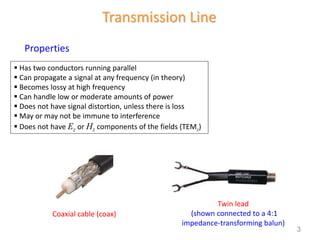
 Has two conductors running parallel
 Can propagate a signal at any frequency (in theory)
 Becomes lossy at high frequency
 Can handle low or moderate amounts of power
 Does not have signal distortion, unless there is loss
 May or may not be immune to interference
 Does not have Ez or Hz components of the fields (TEMz)
Properties
Coaxial cable (coax)
Twin lead
(shown connected to a 4:1
impedance-transforming balun)
3
Transmission Line (cont.)
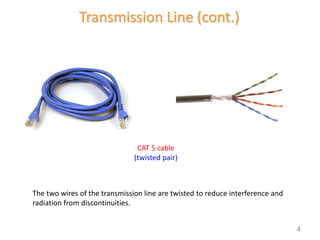
CAT 5 cable
(twisted pair)
The two wires of the transmission line are twisted to reduce interference and
radiation from discontinuities.
4
Transmission Line (cont.)
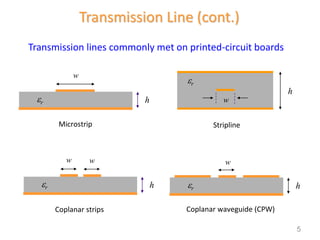
Microstrip
h
w
er
er
w
Stripline
h
Transmission lines commonly met on printed-circuit boards
Coplanar strips
h
er
w w
Coplanar waveguide (CPW)
h
er
w
5
Transmission Line (cont.)
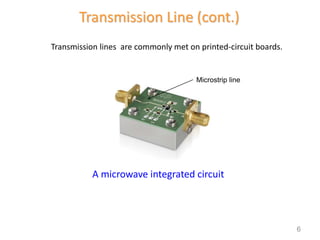
Transmission lines are commonly met on printed-circuit boards.
A microwave integrated circuit
Microstrip line
6
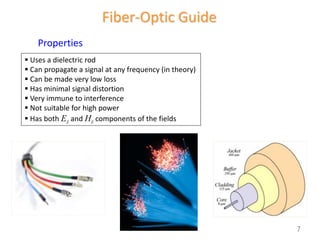
Fiber-Optic Guide
Properties
 Uses a dielectric rod
 Can propagate a signal at any frequency (in theory)
 Can be made very low loss
 Has minimal signal distortion
 Very immune to interference
 Not suitable for high power
 Has both Ez and Hz components of the fields
7
Fiber-Optic Guide (cont.)
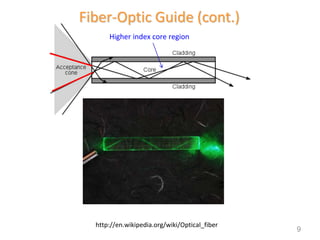
Two types of fiber-optic guides:
1) Single-mode fiber
2) Multi-mode fiber
Carries a single mode, as with the mode on a
transmission line or waveguide. Requires the fiber
diameter to be small relative to a wavelength.
Has a fiber diameter that is large relative to a
wavelength. It operates on the principle of total internal
reflection (critical angle effect).
8
Fiber-Optic Guide (cont.)
http://en.wikipedia.org/wiki/Optical_fiber
Higher index core region
9
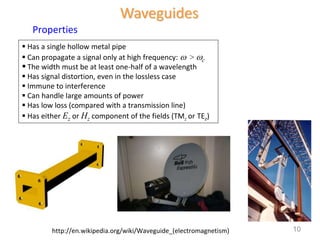
Waveguides
 Has a single hollow metal pipe
 Can propagate a signal only at high frequency:  > c
 The width must be at least one-half of a wavelength
 Has signal distortion, even in the lossless case
 Immune to interference
 Can handle large amounts of power
 Has low loss (compared with a transmission line)
 Has either Ez or Hz component of the fields (TMz or TEz)
Properties
http://en.wikipedia.org/wiki/Waveguide_(electromagnetism) 10
 Lumped circuits: resistors, capacitors,
inductors
neglect time delays (phase)
account for propagation and
time delays (phase change)
Transmission-Line Theory
 Distributed circuit elements: transmission lines
We need transmission-line theory whenever the length of
a line is significant compared with a wavelength.
11
Transmission Line
2 conductors
4 per-unit-length parameters:
C = capacitance/length [F/m]
L = inductance/length [H/m]
R = resistance/length [/m]
G = conductance/length [ /m or S/m]

Dz
12
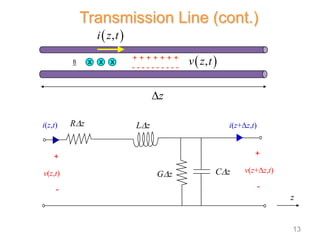
Transmission Line (cont.)
z
D
 
,
i z t
+ + + + + + +
- - - - - - - - - -
 
,
v z t
x x x
B
13
RDz LDz
GDz CDz
z
v(z+Dz,t)
+
-
v(z,t)
+
-
i(z,t) i(z+Dz,t)
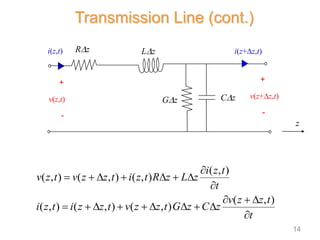
( , )
( , ) ( , ) ( , )
( , )
( , ) ( , ) ( , )
i z t
v z t v z z t i z t R z L z
t
v z z t
i z t i z z t v z z t G z C z
t

  D  D  D

  D
  D   D D  D

Transmission Line (cont.)
14
RDz LDz
GDz CDz
z
v(z+Dz,t)
+
-
v(z,t)
+
-
i(z,t) i(z+Dz,t)
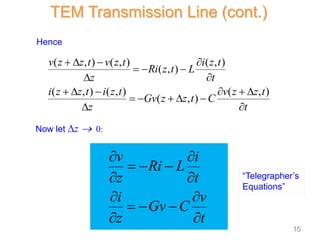
Hence
( , ) ( , ) ( , )
( , )
( , ) ( , ) ( , )
( , )
v z z t v z t i z t
Ri z t L
z t
i z z t i z t v z z t
Gv z z t C
z t
 D  
  
D 
 D    D
   D 
D 
Now let Dz  0:
v i
Ri L
z t
i v
Gv C
z t
 
  
 
 
  
 
“Telegrapher’s
Equations”
TEM Transmission Line (cont.)
15
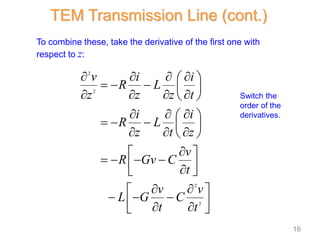
To combine these, take the derivative of the first one with
respect to z:
2
2
2
2
v i i
R L
z z z t
i i
R L
z t z
v
R Gv C
t
v v
L G C
t t
   
 
    
   
 
  
 
    
  
 

 
   
 

 
 
 
  
 
 
 
Switch the
order of the
derivatives.
TEM Transmission Line (cont.)
16
 
2 2
2 2
( ) 0
v v v
RG v RC LG LC
z t t
  
 
    
 
  
 
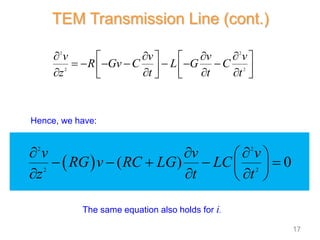
The same equation also holds for i.
Hence, we have:
2 2
2 2
v v v v
R Gv C L G C
z t t t
   
   
      
   
   
   
TEM Transmission Line (cont.)
17
 
2
2
2
( ) ( ) 0
d V
RG V RC LG j V LC V
dz
 
     
 
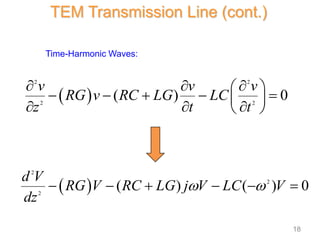
2 2
2 2
( ) 0
v v v
RG v RC LG LC
z t t
  
 
    
 
  
 
TEM Transmission Line (cont.)
Time-Harmonic Waves:
18
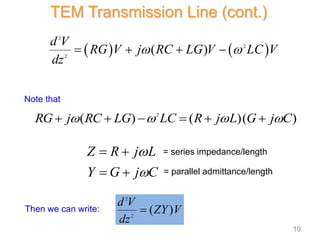
Note that
= series impedance/length
   
2
2
2
( )
d V
RG V j RC LG V LC V
dz
 
   
2
( ) ( )( )
RG j RC LG LC R j L G j C
   
     
Z R j L
Y G j C


 
  = parallel admittance/length
Then we can write:
2
2
( )
d V
ZY V
dz

TEM Transmission Line (cont.)
19
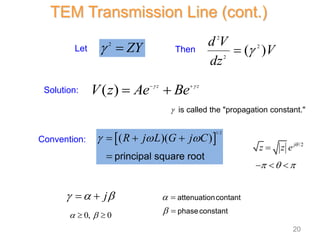
Let
Convention:
Solution:
2
  ZY
( ) z z
V z Ae Be
 
 
 
 
1/2
( )( )
R j L G j C
  
  
 principal square root
2
2
2
( )
d V
V
dz


Then
TEM Transmission Line (cont.)
 is called the "propagation constant."
/2
j
z z e 

  
  
j
  
 
0, 0
 
 




attenuationcontant
phaseconstant
20
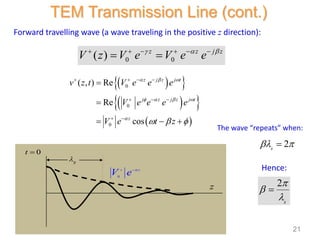
TEM Transmission Line (cont.)
0 0
( ) z z j z
V z V e V e e
  
     
 
Forward travelling wave (a wave traveling in the positive z direction):
 
 
 
 
 
0
0
0
( , ) Re
Re
cos
z j z j t
j z j z j t
z
v z t V e e e
V e e e e
V e t z
  
   

  
   
  
 


  
g

0
t 
z
0
z
V e 
 
2
g




2
g
 

The wave “repeats” when:
Hence:
21
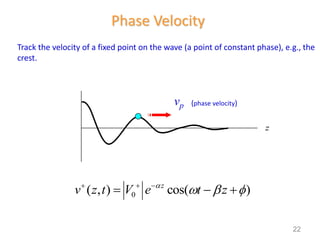
Phase Velocity
Track the velocity of a fixed point on the wave (a point of constant phase), e.g., the
crest.
0
( , ) cos( )
z
v z t V e t z

  
  
  
z
vp (phase velocity)
22
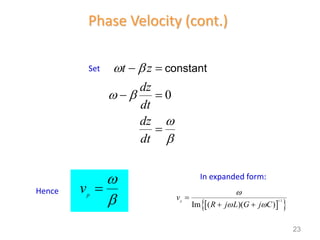
Phase Velocity (cont.)
0
constant
 
 


 
 

t z
dz
dt
dz
dt
Set
Hence p
v



 
 
1/2
Im ( )( )
p
v
R j L G j C

 

 
In expanded form:
23
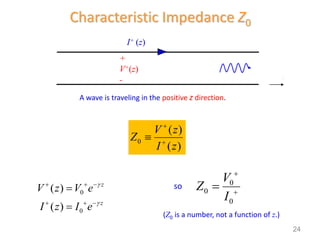
Characteristic Impedance Z0
0
( )
( )
V z
Z
I z



0
0
( )
( )
z
z
V z V e
I z I e


  
  


so 0
0
0
V
Z
I



+
V+(z)
-
I+ (z)
z
A wave is traveling in the positive z direction.
(Z0 is a number, not a function of z.)
24
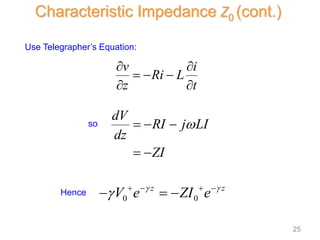
Use Telegrapher’s Equation:
v i
Ri L
z t
 
  
 
so
dV
RI j LI
dz
ZI

  
 
Hence
0 0
z z
V e ZI e
 
    
  
Characteristic Impedance Z0 (cont.)
25
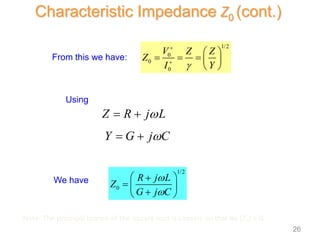
From this we have:
Using
We have
1/2
0
0
0
V Z Z
Z
I Y



 
    
 
Y G j C

 
1/2
0
R j L
Z
G j C


 

  

 
Characteristic Impedance Z0 (cont.)
Z R j L

 
Note: The principal branch of the square root is chosen, so that Re (Z0) > 0.
26
 
0
0
0 0
j z j j z
z z
z j z
V e e
V z V e V
V e e e
e
e
 
 

  


  

   


 
 
   
 
 
 
0
0 cos
c
, R
os
e j t
z
z
V e t
v z t V z
z
V z
e
e t



 
  

 
 









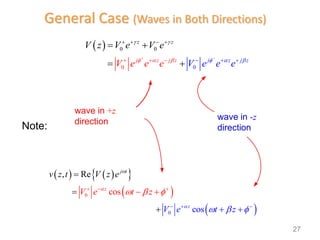
Note:
wave in +z
direction
wave in -z
direction
General Case (Waves in Both Directions)
27
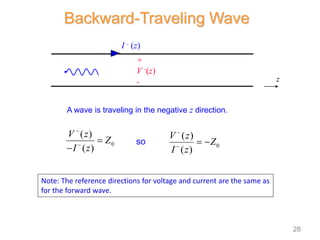
Backward-Traveling Wave
0
( )
( )
V z
Z
I z



 0
( )
( )
V z
Z
I z


 
so
+
V -(z)
-
I - (z)
z
A wave is traveling in the negative z direction.
Note: The reference directions for voltage and current are the same as
for the forward wave.
28
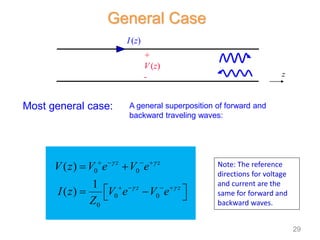
General Case
0 0
0 0
0
( )
1
( )
z z
z z
V z V e V e
I z V e V e
Z
 
 
   
   
 
 
 
 
A general superposition of forward and
backward traveling waves:
Most general case:
Note: The reference
directions for voltage
and current are the
same for forward and
backward waves.
29
+
V(z)
-
I(z)
z
 
 
  
1
2
1
2
0
0 0
0 0
0 0
z z
z z
V z V e V e
V V
I z e e
Z
j R j L G j C
R j L
Z
G j
Z
C
 
 
    


   
 
 

 
   
 
 
 

 






I(z)
V(z)
+
-
z
 
2
m
g




[m/s]
p
v



guided wavelength  g
phase velocity  vp
Summary of Basic TL formulas
30
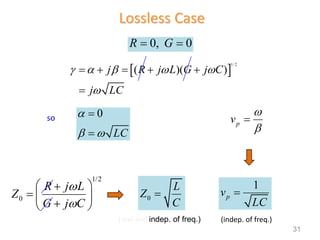
Lossless Case
0, 0
R G
 
 
1/ 2
( )( )
j R j L G j C
j LC
    

    

so 0
LC

 


1/2
0
R j L
Z
G j C


 

  

 
0
L
Z
C

1
p
v
LC

p
v



(indep. of freq.)
(real and indep. of freq.)
31
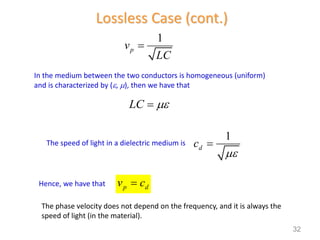
Lossless Case (cont.)
1
p
v
LC

In the medium between the two conductors is homogeneous (uniform)
and is characterized by (e, ), then we have that
LC e

The speed of light in a dielectric medium is
1
d
c
e

Hence, we have that p d
v c

The phase velocity does not depend on the frequency, and it is always the
speed of light (in the material).
(proof given later)
32
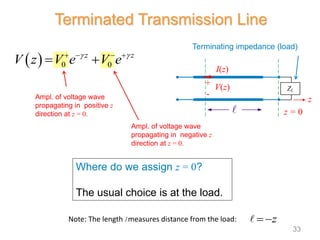
  0 0
z z
V z V e V e
 
   
 
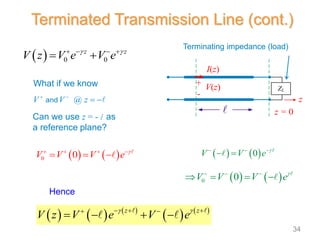
Where do we assign z = 0?
The usual choice is at the load.
I(z)
V(z)
+
-
z
ZL
z = 0
Terminating impedance (load)
Ampl. of voltage wave
propagating in negative z
direction at z = 0.
Ampl. of voltage wave
propagating in positive z
direction at z = 0.
Terminated Transmission Line
Note: The length l measures distance from the load: z
 
33
What if we know
@
V V z
 
 
and
   
0 0
V V V e 
   
  
     
   
z z
V z V e V e
 
  
 
   
   
0
V V e 
  
 
   
0 0
V V V e
  
   
Terminated Transmission Line (cont.)
  0 0
z z
V z V e V e
 
   
 
Hence
Can we use z = - l as
a reference plane?
I(z)
V(z)
+
-
z
ZL
z = 0
Terminating impedance (load)
34
     
   
( ) ( )
z z
V z V e V e
 
    
 
   
Terminated Transmission Line (cont.)
     
0 0
z z
V z V e V e
 
   
 
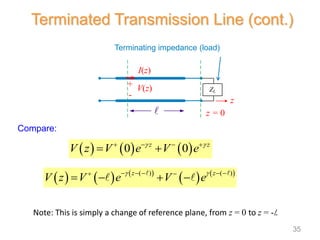
Compare:
Note: This is simply a change of reference plane, from z = 0 to z = -l.
I(z)
V(z)
+
-
z
ZL
z = 0
Terminating impedance (load)
35
  0 0
z z
V z V e V e
 
   
 
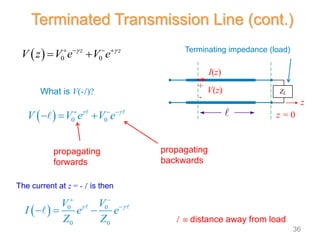
What is V(-l )?
  0 0
V V e V e
 
  
  
  0 0
0 0
V V
I e e
Z Z
 
 

  
propagating
forwards
propagating
backwards
Terminated Transmission Line (cont.)
l  distance away from load
The current at z = - l is then
I(z)
V(z)
+
-
z
ZL
z = 0
Terminating impedance (load)
36
   
2
0
0
1 L
V
I e e
Z
 


  
  2
0
0
0
0 0 1
V
V e
V V e e
e
V
V  
 


 
 

 
 
 

 
 
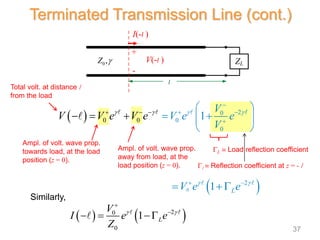
Total volt. at distance l
from the load
Ampl. of volt. wave prop.
towards load, at the load
position (z = 0).
Similarly,
Ampl. of volt. wave prop.
away from load, at the
load position (z = 0).
 
0
2
1 L
V e e
 
 
 
L  Load reflection coefficient
Terminated Transmission Line (cont.)
I(-l )
V(-l )
+
l
ZL
-
0,
Z 
l  Reflection coefficient at z = - l
37
   
   
 
 
 
2
0
2
2
0
0
2
0
1
1
1
1
L
L
L
L
V V e e
V
I e e
Z
V e
Z Z
I e
 
 


 




   
  
 
    
 
  

 
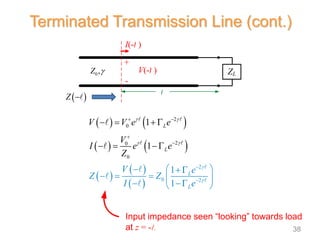
Input impedance seen “looking” towards load
at z = -l .
Terminated Transmission Line (cont.)
I(-l )
V(-l )
+
l
ZL
-
0,
Z 
 
Z 
38
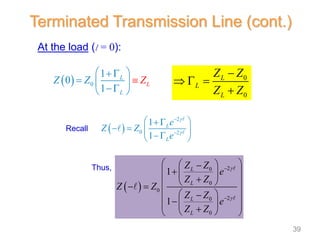
At the load (l = 0):
  0
1
0
1
L
L
L
Z Z Z
 

  


 
Thus,
 
2
0
0
0
2
0
0
1
1
L
L
L
L
Z Z
e
Z Z
Z Z
Z Z
e
Z Z




 
 


 
 

 
 
 
 
 


 
 
 

 
 
Terminated Transmission Line (cont.)
0
0
L
L
L
Z Z
Z Z

  

 
2
0 2
1
1
L
L
e
Z Z
e




 
 
   

 
Recall
39
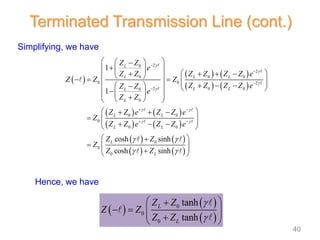
Simplifying, we have
 
 
 
0
0
0
tanh
tanh
L
L
Z Z
Z Z
Z Z


 

   
 

 
Terminated Transmission Line (cont.)
 
   
   
   
   
   
   
2
0
2
0 0 0
0 0 2
2 0 0
0
0
0 0
0
0 0
0
0
0
1
1
cosh sinh
cosh sinh
L
L L L
L L
L
L
L L
L L
L
L
Z Z
e
Z Z Z Z Z Z e
Z Z Z
Z Z Z Z e
Z Z
e
Z Z
Z Z e Z Z e
Z
Z Z e Z Z e
Z Z
Z
Z Z




 
 
 
 




 
 
 
 


 
   
   
 
 
    
 
    
 
  

 
 
 

 
 
 
  
  
 
  
 
 

 
 




Hence, we have
40
   
   
 
2
0
2
0
0
2
0 2
1
1
1
1
j j
L
j j
L
j
L
j
L
V V e e
V
I e e
Z
e
Z Z
e
 
 


 




   
  
 
 
   

 
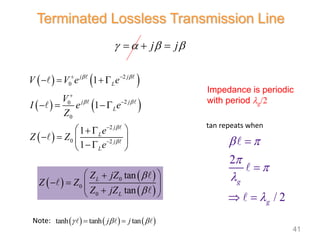
Impedance is periodic
with period g/2
2
/ 2
g
g
 






 
Terminated Lossless Transmission Line
j j
   
  
Note:      
tanh tanh tan
j j
  
 
tan repeats when
 
 
 
0
0
0
tan
tan
L
L
Z jZ
Z Z
Z jZ


 

   
 

 
41
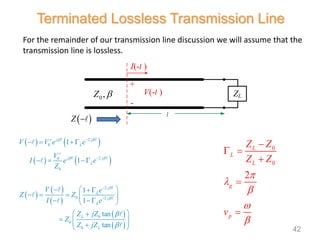
For the remainder of our transmission line discussion we will assume that the
transmission line is lossless.
   
   
 
 
 
 
 
2
0
2
0
0
2
0 2
0
0
0
1
1
1
1
tan
tan
j j
L
j j
L
j
L
j
L
L
L
V V e e
V
I e e
Z
V e
Z Z
I e
Z jZ
Z
Z jZ
 
 




 




   
  
  
 
    
 
 
 

  
 

 
0
0
2
L
L
L
g
p
Z Z
Z Z
v






 



Terminated Lossless Transmission Line
I(-l )
V(-l )
+
l
ZL
-
0 ,
Z 
 
Z 
42
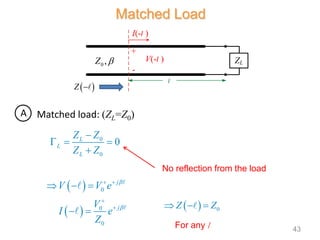
Matched load: (ZL=Z0)
0
0
0
L
L
L
Z Z
Z Z

  

For any l
No reflection from the load
A
Matched Load
I(-l )
V(-l )
+
l
ZL
-
0 ,
Z 
 
Z 
  0
Z Z
  
 
 
0
0
0
j
j
V V e
V
I e
Z


 


  
 
43
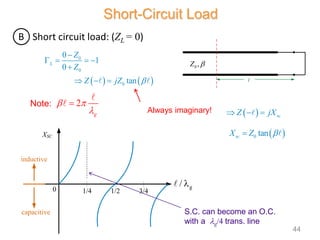
Short circuit load: (ZL = 0)
   
0
0
0
0
1
0
tan
L
Z
Z
Z jZ 

   

  
Always imaginary!
Note:
B
2
g
 


  sc
Z jX
  
S.C. can become an O.C.
with a g/4 trans. line
0 1/4 1/2 3/4
g
/ 
XSC
inductive
capacitive
Short-Circuit Load
l
0 ,
Z 
 
0 tan
sc
X Z 

44
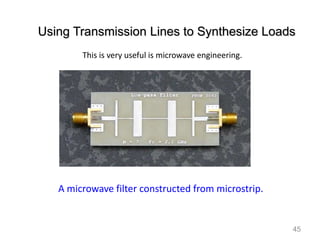
Using Transmission Lines to Synthesize Loads
A microwave filter constructed from microstrip.
This is very useful is microwave engineering.
45
 
 
 
0
0
0
tan
tan
L
in
L
Z jZ d
Z Z d Z
Z jZ d


 

    
 

 
  in
TH
in TH
Z
V d V
Z Z
 
    

 
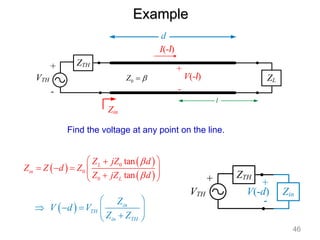
I(-l)
V(-l)
+
l
ZL
-
0
Z 

ZTH
VTH
d
Zin
+
-
ZTH
VTH
+
Zin
V(-d)
+
-
Example
Find the voltage at any point on the line.
46
Note:    
0
2
1 j
L
j
V V e e
 
 



0
0
L
L
L
Z Z
Z Z

 

   
2
0 1
j d j d in
TH
in TH
L
V d
Z
Z
e V
Z
V e  
 
  
 
  

 
   
2
2
1
1
j
j d
in L
TH j d
m TH L
Z e
V V e
Z Z e




 

   
 
     
  
 
 
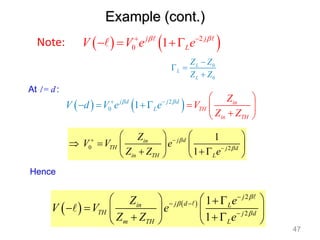
At l = d:
Hence
Example (cont.)
0 2
1
1
j d
in
TH j d
in TH L
Z
V V e
Z Z e


 

   
     
 
 
 
47
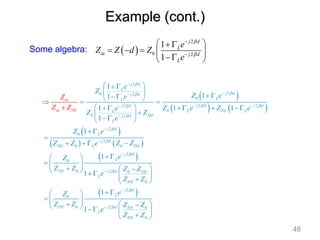
Some algebra:  
2
0 2
1
1
j d
L
in j d
L
e
Z Z d Z
e




 

    

 
 
   
 
   
 
2
2
0 2
0
2 2
2
0
0 2
2
0
2
0 0
2
0
2
0 0
0
1
1
1
1 1
1
1
1
1
1
j d
L
j d
j d
L
L
j d j d
j d
L TH L
L
TH
j d
L
j d
L
j d
TH L TH
j d
L
j d
TH TH
L
TH
in
in TH
e
Z
Z e
e
Z e Z e
e
Z Z
e
Z e
Z Z e Z Z
e
Z
Z
Z
Z Z
Z Z Z
e
Z Z
Z



 









 






 
 
   
 
 
  
      
 

 
 
 
 

  


 
 
  
  

     

 

 
2
0
2
0 0
0
1
1
j d
L
j d
TH TH
L
TH
e
Z Z Z Z
e
Z Z




 
 
 
  

     

 
Example (cont.)
48
   
2
0
2
0
1
1
j
j d L
TH j d
TH S L
Z e
V V e
Z Z e




 

   

     
  
   
2
0
2
0
1
1
j d
in L
j d
in TH TH S L
Z Z e
Z Z Z Z e




  
 
   
   
  
where 0
0
TH
S
TH
Z Z
Z Z

 

Example (cont.)
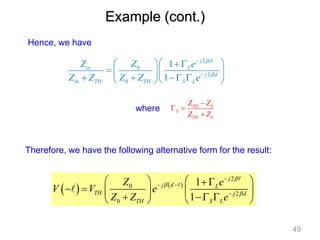
Therefore, we have the following alternative form for the result:
Hence, we have
49
   
2
0
2
0
1
1
j
j d L
TH j d
TH S L
Z e
V V e
Z Z e




 

   

     
  
   
Example (cont.)
I(-l)
V(-l)
+
l
ZL
-
0
Z 

ZTH
VTH
d
Zin
+
-
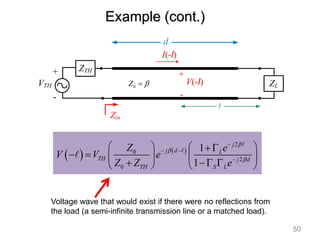
Voltage wave that would exist if there were no reflections from
the load (a semi-infinite transmission line or a matched load).
50
 
 
       
2 2
2 2 2 2
0
0
1 j d j d
L L S
j d j d j d j d
TH L S L L S L S
TH
e e
Z
V d V e e e e
Z Z
 
   
 
   
 
    
 
  
   
          
     
 

 
 

 
Example (cont.)
ZL
0
Z 

ZTH
VTH
d
+
-
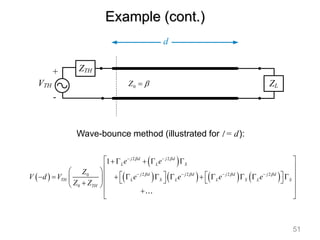
Wave-bounce method (illustrated for l = d):
51
Example (cont.)
 
   
   
2
2 2
2
2 2 2
0
0
1
1
j d j d
L S L S
j d j d j d
TH L L S L S
TH
e e
Z
V d V e e e
Z Z
 
  
 
  
 
      
 
  
 
          
  
 
 

  

 
 
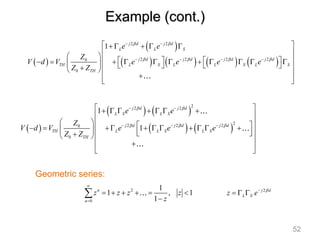
Geometric series:
2
0
1
1 , 1
1
n
n
z z z z
z


     


 
 
       
2 2
2 2 2 2
0
0
1 j d j d
L L S
j d j d j d j d
TH L S L L S L S
TH
e e
Z
V d V e e e e
Z Z
 
   
 
   
 
    
 
  
   
          
     
 

 
 

 
2
j d
L S
z e 

  
52
Example (cont.)
or
 
2
0
2
0
2
1
1
1
1
j d
L s
TH
j d
TH
L j d
L s
e
Z
V d V
Z Z
e
e






 
 
 
  
    
 

   
 
 
 
 
 
 
 
2
0
2
0
1
1
j d
L
TH j d
TH L s
Z e
V d V
Z Z e




  

    
  
  
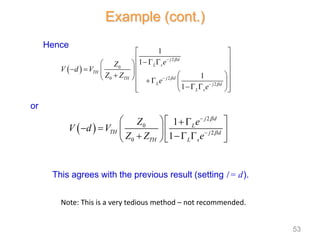
This agrees with the previous result (setting l = d).
Note: This is a very tedious method – not recommended.
Hence
53
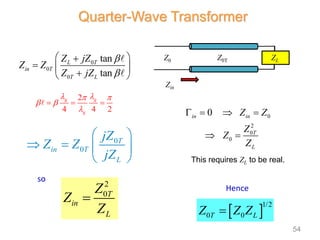
0
0
0
tan
tan
L T
in T
T L
Z jZ
Z Z
Z jZ


 

  

 
2
4 4 2
g g
g
 
 
 

  
0
0
T
in T
L
jZ
Z Z
jZ
 
   
 
0
2
0
0
0
in in
T
L
Z Z
Z
Z
Z
   
 
Quarter-Wave Transformer
2
0T
in
L
Z
Z
Z

so
 
1/2
0 0
T L
Z Z Z

Hence
This requires ZL to be real.
ZL
Z0 Z0T
Zin
54
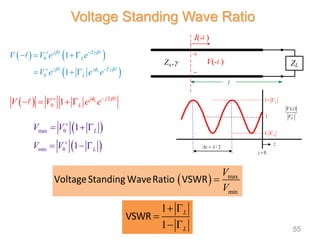
  2
0 1 L
j j
L
V V e e
 
 
   
   
 
2
0
2
0
1
1 L
j j
L
j
j j
L
V V e e
V e e e
 

 
 
 
   
  
 
 
max 0
min 0
1
1
L
L
V V
V V


  
  
  max
min
V
V

VoltageStanding WaveRatio VSWR
Voltage Standing Wave Ratio
I(-l )
V(-l )
+
l
ZL
-
0 ,
Z 
1
1
L
L
 

 
VSWR
z
1+ L

1
1- L

0
( )
V z
V 
/ 2
z 
D 
0
z 
55

emtl

  • 1.
  • 2.
    A wave guidingstructure is one that carries a signal (or power) from one point to another. There are three common types:  Transmission lines  Fiber-optic guides  Waveguides Waveguiding Structures 2
  • 3.
    Transmission Line  Hastwo conductors running parallel  Can propagate a signal at any frequency (in theory)  Becomes lossy at high frequency  Can handle low or moderate amounts of power  Does not have signal distortion, unless there is loss  May or may not be immune to interference  Does not have Ez or Hz components of the fields (TEMz) Properties Coaxial cable (coax) Twin lead (shown connected to a 4:1 impedance-transforming balun) 3
  • 4.
    Transmission Line (cont.) CAT5 cable (twisted pair) The two wires of the transmission line are twisted to reduce interference and radiation from discontinuities. 4
  • 5.
    Transmission Line (cont.) Microstrip h w er er w Stripline h Transmissionlines commonly met on printed-circuit boards Coplanar strips h er w w Coplanar waveguide (CPW) h er w 5
  • 6.
    Transmission Line (cont.) Transmissionlines are commonly met on printed-circuit boards. A microwave integrated circuit Microstrip line 6
  • 7.
    Fiber-Optic Guide Properties  Usesa dielectric rod  Can propagate a signal at any frequency (in theory)  Can be made very low loss  Has minimal signal distortion  Very immune to interference  Not suitable for high power  Has both Ez and Hz components of the fields 7
  • 8.
    Fiber-Optic Guide (cont.) Twotypes of fiber-optic guides: 1) Single-mode fiber 2) Multi-mode fiber Carries a single mode, as with the mode on a transmission line or waveguide. Requires the fiber diameter to be small relative to a wavelength. Has a fiber diameter that is large relative to a wavelength. It operates on the principle of total internal reflection (critical angle effect). 8
  • 9.
  • 10.
    Waveguides  Has asingle hollow metal pipe  Can propagate a signal only at high frequency:  > c  The width must be at least one-half of a wavelength  Has signal distortion, even in the lossless case  Immune to interference  Can handle large amounts of power  Has low loss (compared with a transmission line)  Has either Ez or Hz component of the fields (TMz or TEz) Properties http://en.wikipedia.org/wiki/Waveguide_(electromagnetism) 10
  • 11.
     Lumped circuits:resistors, capacitors, inductors neglect time delays (phase) account for propagation and time delays (phase change) Transmission-Line Theory  Distributed circuit elements: transmission lines We need transmission-line theory whenever the length of a line is significant compared with a wavelength. 11
  • 12.
    Transmission Line 2 conductors 4per-unit-length parameters: C = capacitance/length [F/m] L = inductance/length [H/m] R = resistance/length [/m] G = conductance/length [ /m or S/m]  Dz 12
  • 13.
    Transmission Line (cont.) z D  , i z t + + + + + + + - - - - - - - - - -   , v z t x x x B 13 RDz LDz GDz CDz z v(z+Dz,t) + - v(z,t) + - i(z,t) i(z+Dz,t)
  • 14.
    ( , ) (, ) ( , ) ( , ) ( , ) ( , ) ( , ) ( , ) i z t v z t v z z t i z t R z L z t v z z t i z t i z z t v z z t G z C z t    D  D  D    D   D   D D  D  Transmission Line (cont.) 14 RDz LDz GDz CDz z v(z+Dz,t) + - v(z,t) + - i(z,t) i(z+Dz,t)
  • 15.
    Hence ( , )( , ) ( , ) ( , ) ( , ) ( , ) ( , ) ( , ) v z z t v z t i z t Ri z t L z t i z z t i z t v z z t Gv z z t C z t  D      D   D    D    D  D  Now let Dz  0: v i Ri L z t i v Gv C z t               “Telegrapher’s Equations” TEM Transmission Line (cont.) 15
  • 16.
    To combine these,take the derivative of the first one with respect to z: 2 2 2 2 v i i R L z z z t i i R L z t z v R Gv C t v v L G C t t                                                          Switch the order of the derivatives. TEM Transmission Line (cont.) 16
  • 17.
      2 2 22 ( ) 0 v v v RG v RC LG LC z t t                  The same equation also holds for i. Hence, we have: 2 2 2 2 v v v v R Gv C L G C z t t t                            TEM Transmission Line (cont.) 17
  • 18.
      2 2 2 ( )( ) 0 d V RG V RC LG j V LC V dz           2 2 2 2 ( ) 0 v v v RG v RC LG LC z t t                  TEM Transmission Line (cont.) Time-Harmonic Waves: 18
  • 19.
    Note that = seriesimpedance/length     2 2 2 ( ) d V RG V j RC LG V LC V dz       2 ( ) ( )( ) RG j RC LG LC R j L G j C           Z R j L Y G j C       = parallel admittance/length Then we can write: 2 2 ( ) d V ZY V dz  TEM Transmission Line (cont.) 19
  • 20.
    Let Convention: Solution: 2   ZY () z z V z Ae Be         1/2 ( )( ) R j L G j C        principal square root 2 2 2 ( ) d V V dz   Then TEM Transmission Line (cont.)  is called the "propagation constant." /2 j z z e         j      0, 0         attenuationcontant phaseconstant 20
  • 21.
    TEM Transmission Line(cont.) 0 0 ( ) z z j z V z V e V e e            Forward travelling wave (a wave traveling in the positive z direction):           0 0 0 ( , ) Re Re cos z j z j t j z j z j t z v z t V e e e V e e e e V e t z                          g  0 t  z 0 z V e    2 g     2 g    The wave “repeats” when: Hence: 21
  • 22.
    Phase Velocity Track thevelocity of a fixed point on the wave (a point of constant phase), e.g., the crest. 0 ( , ) cos( ) z v z t V e t z           z vp (phase velocity) 22
  • 23.
    Phase Velocity (cont.) 0 constant           t z dz dt dz dt Set Hence p v        1/2 Im ( )( ) p v R j L G j C       In expanded form: 23
  • 24.
    Characteristic Impedance Z0 0 () ( ) V z Z I z    0 0 ( ) ( ) z z V z V e I z I e           so 0 0 0 V Z I    + V+(z) - I+ (z) z A wave is traveling in the positive z direction. (Z0 is a number, not a function of z.) 24
  • 25.
    Use Telegrapher’s Equation: vi Ri L z t        so dV RI j LI dz ZI       Hence 0 0 z z V e ZI e           Characteristic Impedance Z0 (cont.) 25
  • 26.
    From this wehave: Using We have 1/2 0 0 0 V Z Z Z I Y             Y G j C    1/2 0 R j L Z G j C            Characteristic Impedance Z0 (cont.) Z R j L    Note: The principal branch of the square root is chosen, so that Re (Z0) > 0. 26
  • 27.
      0 0 0 0 jz j j z z z z j z V e e V z V e V V e e e e e                                   0 0 cos c , R os e j t z z V e t v z t V z z V z e e t                       Note: wave in +z direction wave in -z direction General Case (Waves in Both Directions) 27
  • 28.
    Backward-Traveling Wave 0 ( ) () V z Z I z     0 ( ) ( ) V z Z I z     so + V -(z) - I - (z) z A wave is traveling in the negative z direction. Note: The reference directions for voltage and current are the same as for the forward wave. 28
  • 29.
    General Case 0 0 00 0 ( ) 1 ( ) z z z z V z V e V e I z V e V e Z                     A general superposition of forward and backward traveling waves: Most general case: Note: The reference directions for voltage and current are the same for forward and backward waves. 29 + V(z) - I(z) z
  • 30.
          1 2 1 2 0 0 0 0 0 0 0 z z z z V z V e V e V V I z e e Z j R j L G j C R j L Z G j Z C                                          I(z) V(z) + - z   2 m g     [m/s] p v    guided wavelength  g phase velocity  vp Summary of Basic TL formulas 30
  • 31.
    Lossless Case 0, 0 RG     1/ 2 ( )( ) j R j L G j C j LC             so 0 LC      1/2 0 R j L Z G j C            0 L Z C  1 p v LC  p v    (indep. of freq.) (real and indep. of freq.) 31
  • 32.
    Lossless Case (cont.) 1 p v LC  Inthe medium between the two conductors is homogeneous (uniform) and is characterized by (e, ), then we have that LC e  The speed of light in a dielectric medium is 1 d c e  Hence, we have that p d v c  The phase velocity does not depend on the frequency, and it is always the speed of light (in the material). (proof given later) 32
  • 33.
      00 z z V z V e V e         Where do we assign z = 0? The usual choice is at the load. I(z) V(z) + - z ZL z = 0 Terminating impedance (load) Ampl. of voltage wave propagating in negative z direction at z = 0. Ampl. of voltage wave propagating in positive z direction at z = 0. Terminated Transmission Line Note: The length l measures distance from the load: z   33
  • 34.
    What if weknow @ V V z     and     0 0 V V V e                   z z V z V e V e                0 V V e           0 0 V V V e        Terminated Transmission Line (cont.)   0 0 z z V z V e V e         Hence Can we use z = - l as a reference plane? I(z) V(z) + - z ZL z = 0 Terminating impedance (load) 34
  • 35.
             ( ) ( ) z z V z V e V e              Terminated Transmission Line (cont.)       0 0 z z V z V e V e         Compare: Note: This is simply a change of reference plane, from z = 0 to z = -l. I(z) V(z) + - z ZL z = 0 Terminating impedance (load) 35
  • 36.
      00 z z V z V e V e         What is V(-l )?   0 0 V V e V e           0 0 0 0 V V I e e Z Z         propagating forwards propagating backwards Terminated Transmission Line (cont.) l  distance away from load The current at z = - l is then I(z) V(z) + - z ZL z = 0 Terminating impedance (load) 36
  • 37.
       2 0 0 1 L V I e e Z          2 0 0 0 0 0 1 V V e V V e e e V V                       Total volt. at distance l from the load Ampl. of volt. wave prop. towards load, at the load position (z = 0). Similarly, Ampl. of volt. wave prop. away from load, at the load position (z = 0).   0 2 1 L V e e       L  Load reflection coefficient Terminated Transmission Line (cont.) I(-l ) V(-l ) + l ZL - 0, Z  l  Reflection coefficient at z = - l 37
  • 38.
                 2 0 2 2 0 0 2 0 1 1 1 1 L L L L V V e e V I e e Z V e Z Z I e                                   Input impedance seen “looking” towards load at z = -l . Terminated Transmission Line (cont.) I(-l ) V(-l ) + l ZL - 0, Z    Z  38
  • 39.
    At the load(l = 0):   0 1 0 1 L L L Z Z Z           Thus,   2 0 0 0 2 0 0 1 1 L L L L Z Z e Z Z Z Z Z Z e Z Z                                       Terminated Transmission Line (cont.) 0 0 L L L Z Z Z Z        2 0 2 1 1 L L e Z Z e                Recall 39
  • 40.
    Simplifying, we have      0 0 0 tanh tanh L L Z Z Z Z Z Z               Terminated Transmission Line (cont.)                           2 0 2 0 0 0 0 0 2 2 0 0 0 0 0 0 0 0 0 0 0 0 1 1 cosh sinh cosh sinh L L L L L L L L L L L L L L Z Z e Z Z Z Z Z Z e Z Z Z Z Z Z Z e Z Z e Z Z Z Z e Z Z e Z Z Z e Z Z e Z Z Z Z Z                                                                                                Hence, we have 40
  • 41.
             2 0 2 0 0 2 0 2 1 1 1 1 j j L j j L j L j L V V e e V I e e Z e Z Z e                               Impedance is periodic with period g/2 2 / 2 g g           Terminated Lossless Transmission Line j j        Note:       tanh tanh tan j j      tan repeats when       0 0 0 tan tan L L Z jZ Z Z Z jZ               41
  • 42.
    For the remainderof our transmission line discussion we will assume that the transmission line is lossless.                   2 0 2 0 0 2 0 2 0 0 0 1 1 1 1 tan tan j j L j j L j L j L L L V V e e V I e e Z V e Z Z I e Z jZ Z Z jZ                                               0 0 2 L L L g p Z Z Z Z v            Terminated Lossless Transmission Line I(-l ) V(-l ) + l ZL - 0 , Z    Z  42
  • 43.
    Matched load: (ZL=Z0) 0 0 0 L L L ZZ Z Z      For any l No reflection from the load A Matched Load I(-l ) V(-l ) + l ZL - 0 , Z    Z    0 Z Z        0 0 0 j j V V e V I e Z            43
  • 44.
    Short circuit load:(ZL = 0)     0 0 0 0 1 0 tan L Z Z Z jZ           Always imaginary! Note: B 2 g       sc Z jX    S.C. can become an O.C. with a g/4 trans. line 0 1/4 1/2 3/4 g /  XSC inductive capacitive Short-Circuit Load l 0 , Z    0 tan sc X Z   44
  • 45.
    Using Transmission Linesto Synthesize Loads A microwave filter constructed from microstrip. This is very useful is microwave engineering. 45
  • 46.
         0 0 0 tan tan L in L Z jZ d Z Z d Z Z jZ d                  in TH in TH Z V d V Z Z           I(-l) V(-l) + l ZL - 0 Z   ZTH VTH d Zin + - ZTH VTH + Zin V(-d) + - Example Find the voltage at any point on the line. 46
  • 47.
    Note:    0 2 1 j L j V V e e        0 0 L L L Z Z Z Z         2 0 1 j d j d in TH in TH L V d Z Z e V Z V e                    2 2 1 1 j j d in L TH j d m TH L Z e V V e Z Z e                           At l = d: Hence Example (cont.) 0 2 1 1 j d in TH j d in TH L Z V V e Z Z e                      47
  • 48.
    Some algebra:  2 0 2 1 1 j d L in j d L e Z Z d Z e                              2 2 0 2 0 2 2 2 0 0 2 2 0 2 0 0 2 0 2 0 0 0 1 1 1 1 1 1 1 1 1 1 j d L j d j d L L j d j d j d L TH L L TH j d L j d L j d TH L TH j d L j d TH TH L TH in in TH e Z Z e e Z e Z e e Z Z e Z e Z Z e Z Z e Z Z Z Z Z Z Z Z e Z Z Z                                                                                     2 0 2 0 0 0 1 1 j d L j d TH TH L TH e Z Z Z Z e Z Z                        Example (cont.) 48
  • 49.
       2 0 2 0 1 1 j j d L TH j d TH S L Z e V V e Z Z e                          2 0 2 0 1 1 j d in L j d in TH TH S L Z Z e Z Z Z Z e                     where 0 0 TH S TH Z Z Z Z     Example (cont.) Therefore, we have the following alternative form for the result: Hence, we have 49
  • 50.
       2 0 2 0 1 1 j j d L TH j d TH S L Z e V V e Z Z e                          Example (cont.) I(-l) V(-l) + l ZL - 0 Z   ZTH VTH d Zin + - Voltage wave that would exist if there were no reflections from the load (a semi-infinite transmission line or a matched load). 50
  • 51.
               2 2 2 2 2 2 0 0 1 j d j d L L S j d j d j d j d TH L S L L S L S TH e e Z V d V e e e e Z Z                                                        Example (cont.) ZL 0 Z   ZTH VTH d + - Wave-bounce method (illustrated for l = d): 51
  • 52.
    Example (cont.)          2 2 2 2 2 2 2 0 0 1 1 j d j d L S L S j d j d j d TH L L S L S TH e e Z V d V e e e Z Z                                                      Geometric series: 2 0 1 1 , 1 1 n n z z z z z                       2 2 2 2 2 2 0 0 1 j d j d L L S j d j d j d j d TH L S L L S L S TH e e Z V d V e e e e Z Z                                                        2 j d L S z e      52
  • 53.
    Example (cont.) or   2 0 2 0 2 1 1 1 1 jd L s TH j d TH L j d L s e Z V d V Z Z e e                                          2 0 2 0 1 1 j d L TH j d TH L s Z e V d V Z Z e                    This agrees with the previous result (setting l = d). Note: This is a very tedious method – not recommended. Hence 53
  • 54.
    0 0 0 tan tan L T in T TL Z jZ Z Z Z jZ            2 4 4 2 g g g           0 0 T in T L jZ Z Z jZ         0 2 0 0 0 in in T L Z Z Z Z Z       Quarter-Wave Transformer 2 0T in L Z Z Z  so   1/2 0 0 T L Z Z Z  Hence This requires ZL to be real. ZL Z0 Z0T Zin 54
  • 55.
      2 01 L j j L V V e e               2 0 2 0 1 1 L j j L j j j L V V e e V e e e                     max 0 min 0 1 1 L L V V V V           max min V V  VoltageStanding WaveRatio VSWR Voltage Standing Wave Ratio I(-l ) V(-l ) + l ZL - 0 , Z  1 1 L L      VSWR z 1+ L  1 1- L  0 ( ) V z V  / 2 z  D  0 z  55