Microelectronics Technology:
Photolithography
(Mask Engineering,Manufacturing Methods & Process
Modeling)
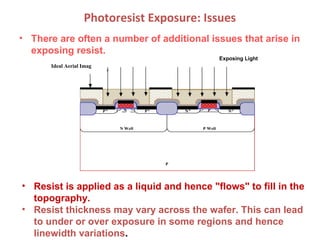
Photoresist Exposure: Issues
Ideal Aerial Imag
Exposing Light
• There are often a number of additional issues that arise in
exposing resist.
• Resist is applied as a liquid and hence "flows" to fill in the
topography.
• Resist thickness may vary across the wafer. This can lead
to under or over exposure in some regions and hence
linewidth variations.
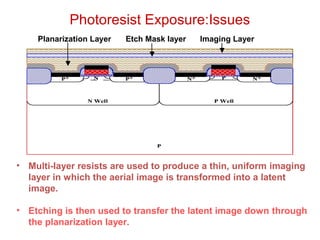
Photoresist Exposure:Issues
Planarization Layer Etch Mask layer Imaging Layer
• Multi-layer resists are used to produce a thin, uniform imaging
layer in which the aerial image is transformed into a latent
image.
• Etching is then used to transfer the latent image down through
the planarization layer.
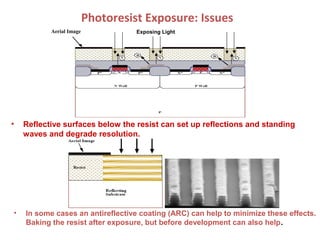
Photoresist Exposure: Issues
Aerial Image Exposing Light
• Reflective surfaces below the resist can set up reflections and standing
waves and degrade resolution.
• In some cases an antireflective coating (ARC) can help to minimize these effects.
Baking the resist after exposure, but before development can also help.
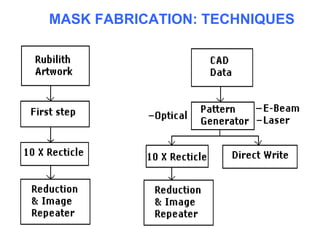
MASK FABRICATION: TECHNIQUES
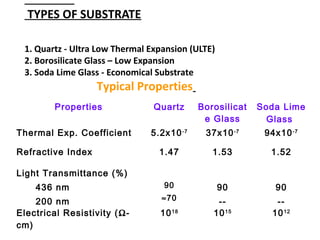
TYPES OF SUBSTRATE
1. Quartz - Ultra Low Thermal Expansion (ULTE)
2. Borosilicate Glass – Low Expansion
3. Soda Lime Glass - Economical Substrate
Typical Properties
Properties Quartz Borosilicat
e Glass
Soda Lime
Glass
Thermal Exp. Coefficient 5.2x10⁻⁷
37x10-7
94x10-7
Refractive Index 1.47 1.53 1.52
Light Transmittance (%)
436 nm
200 nm
90
≈70
90
--
90
--
Electrical Resistivity (Ω-
cm)
1018
1015
1012
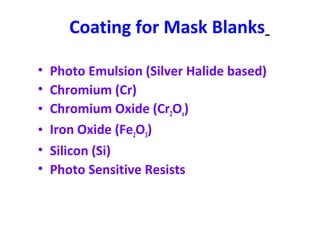
Coating for Mask Blanks
• Photo Emulsion (Silver Halide based)
• Chromium (Cr)
• Chromium Oxide (Cr2Ox)
• Iron Oxide (Fe2O3)
• Silicon (Si)
• Photo Sensitive Resists
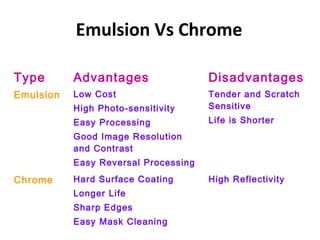
Emulsion Vs Chrome
Type Advantages Disadvantages
Emulsion Low Cost
High Photo-sensitivity
Easy Processing
Good Image Resolution
and Contrast
Easy Reversal Processing
Tender and Scratch
Sensitive
Life is Shorter
Chrome Hard Surface Coating
Longer Life
Sharp Edges
Easy Mask Cleaning
High Reflectivity
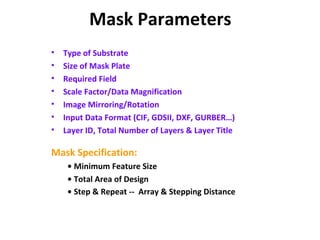
Mask Parameters
• Type of Substrate
• Size of Mask Plate
• Required Field
• Scale Factor/Data Magnification
• Image Mirroring/Rotation
• Input Data Format (CIF, GDSII, DXF, GURBER…)
• Layer ID, Total Number of Layers & Layer Title
Mask Specification:
• Minimum Feature Size
• Total Area of Design
• Step & Repeat -- Array & Stepping Distance
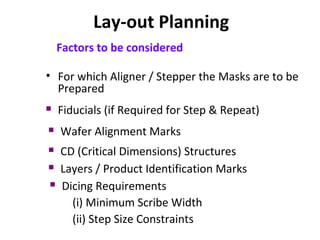
Lay-out Planning
Factors to be considered
• For which Aligner / Stepper the Masks are to be
Prepared
 Fiducials (if Required for Step & Repeat)
 Wafer Alignment Marks
 CD (Critical Dimensions) Structures
 Layers / Product Identification Marks
 Dicing Requirements
(i) Minimum Scribe Width
(ii) Step Size Constraints
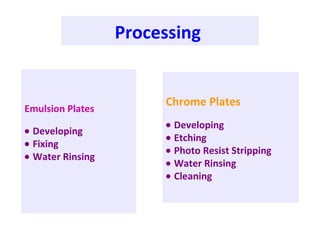
Processing
Emulsion Plates
• Developing
• Fixing
• Water Rinsing
Chrome Plates
• Developing
• Etching
• Photo Resist Stripping
• Water Rinsing
• Cleaning
Mask Quality Inspection
• Visual Inspection
• Measurement
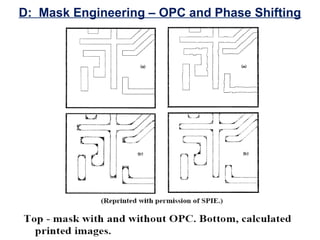
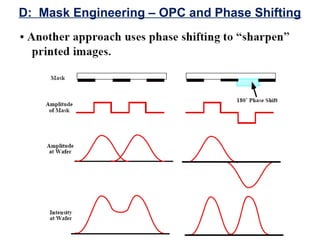
D: Mask Engineering – OPC and Phase Shifting
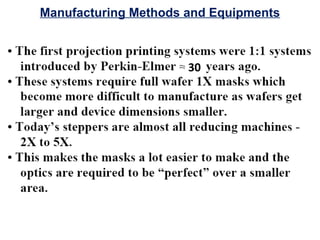
Manufacturing Methods and Equipments
30
Manufacturing Methods and Equipments
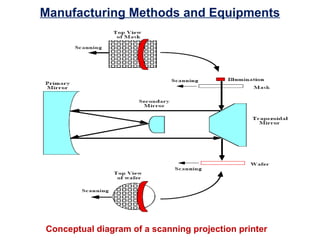
Conceptual diagram of a scanning projection printer
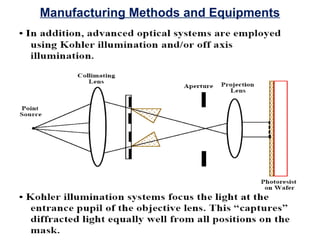
Manufacturing Methods and Equipments
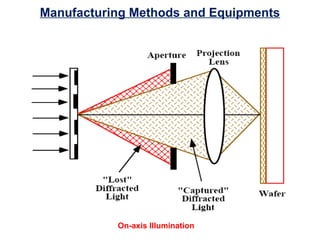
On-axis Illumination
Manufacturing Methods and Equipments
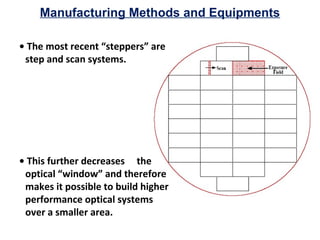
• This further decreases the
optical “window” and therefore
makes it possible to build higher
performance optical systems
over a smaller area.
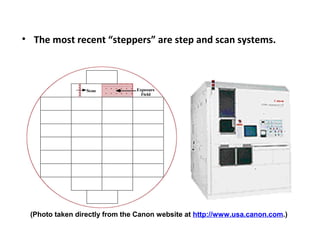
• The most recent “steppers” are
step and scan systems.
Electron Beam Lithography
• Process of scanning a beam of electrons
in a patterned fashion across a surface
covered with a electron resist.
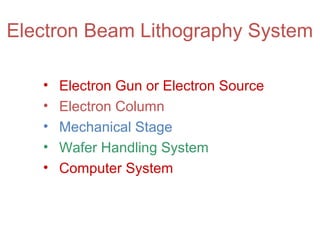
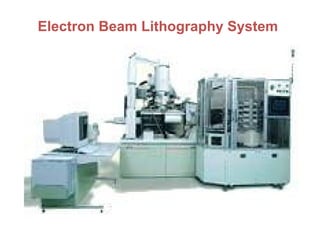
Electron Beam Lithography System
• Electron Gun or Electron Source
• Electron Column
• Mechanical Stage
• Wafer Handling System
• Computer System
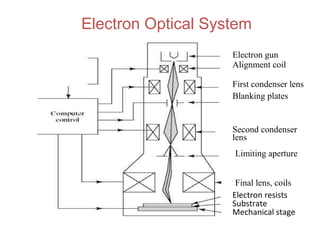
Electron Optical System
Electron gun
Alignment coil
First condenser lens
Blanking plates
Second condenser
lens
Limiting aperture
Final lens, coils
Electron resists
Substrate
Mechanical stage
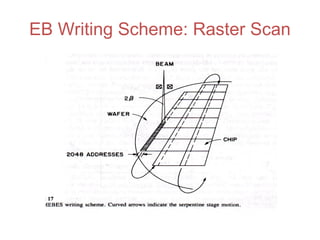
EB Writing Scheme: Raster Scan
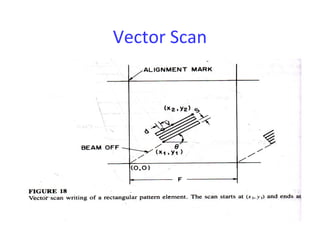
Vector Scan
Electron Beam Lithography
• Advantages
• Better Resolution
• Disadvantages
• Low Throughput
• High Cost
Models and Simulation
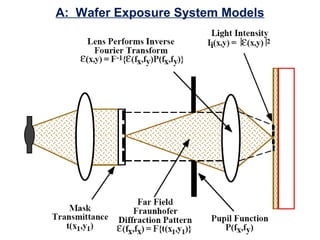
• Lithography simulation relies on models from two fields of
science:
• Optics to model the formation of the aerial image.
– Water Exposure System Models
• Chemistry to model the formation of the latent image in the
resist.
– Optical Intensity Pattern in the Resist
– Photoresist Exposure
– Photoresist Baking
– Photoresist Developing
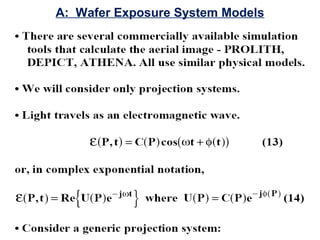
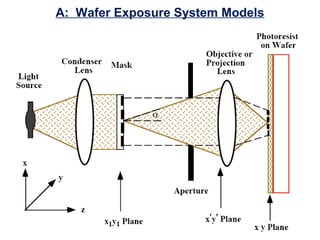
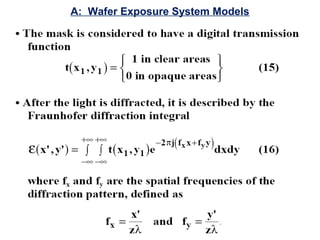
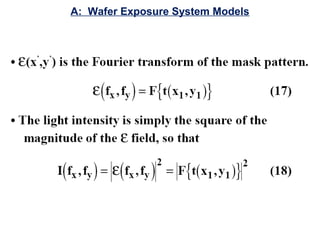
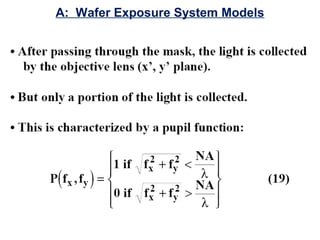
A: Wafer Exposure System Models
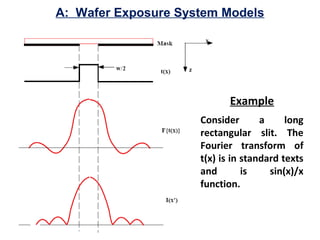
Example
Consider a long
rectangular slit. The
Fourier transform of
t(x) is in standard texts
and is sin(x)/x
function.
A: Wafer Exposure System Models
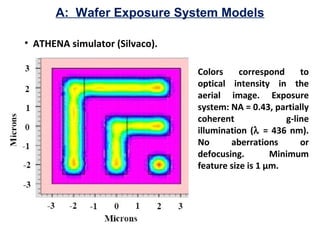
Colors correspond to
optical intensity in the
aerial image. Exposure
system: NA = 0.43, partially
coherent g-line
illumination (λ = 436 nm).
No aberrations or
defocusing. Minimum
feature size is 1 µm.
• ATHENA simulator (Silvaco).
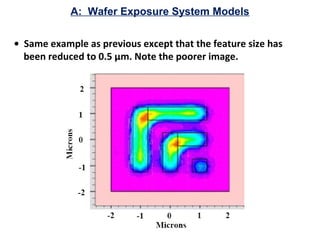
A: Wafer Exposure System Models
• Same example as previous except that the feature size has
been reduced to 0.5 µm. Note the poorer image.
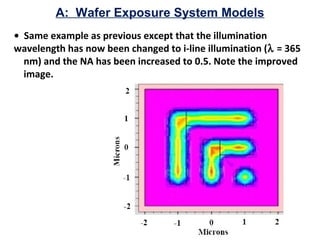
A: Wafer Exposure System Models
• Same example as previous except that the illumination
wavelength has now been changed to i-line illumination (λ = 365
nm) and the NA has been increased to 0.5. Note the improved
image.
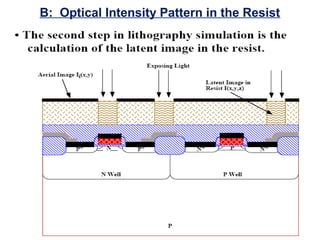
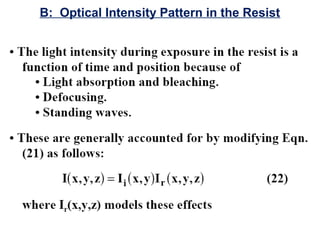
B: Optical Intensity Pattern in the Resist
• Example of calculation of light intensity distribution in a photoresist layer
during exposure using the ATHENA simulator. A simple structure is defined
with a photoresist layer covering a silicon substrate which has two flat regions
and a sloped sidewall.
The simulation shows the
[PAC] calculated
concentration after an
exposure of 200 mJ cm-2
.
Lower [PAC] values
correspond to more
exposure. The color
contours thus
correspond to the
integrated light intensity
from the exposure.
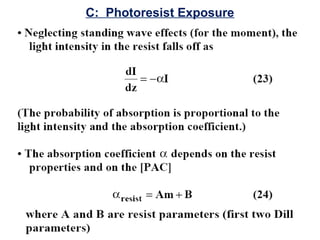
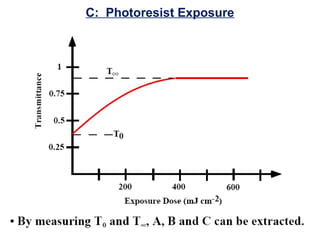
C: Photoresist Exposure
dz
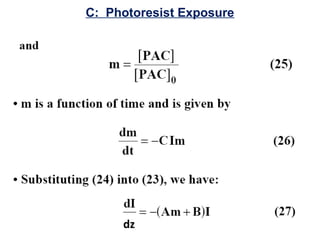
C: Photoresist Exposure
D: Photoresist Baking
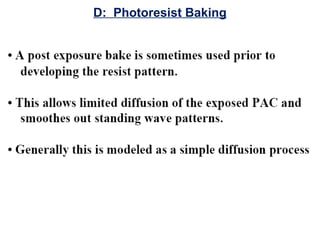
• Same simulation example as last one except that a post exposure bake of 45
minutes at 115 °C has now been included. The color contours again
correspond to the [PAC] after exposure. Note that the standing wave effects
apparent earlier have been “smeared out” by this bake, producing a more
uniform [PAC] distribution.
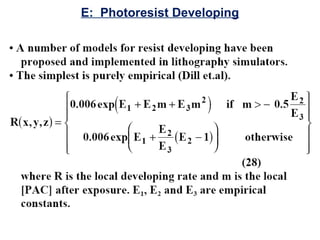
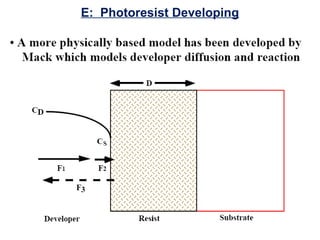
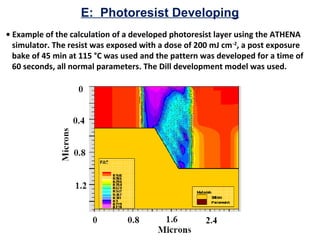
E: Photoresist Developing
• Example of the calculation of a developed photoresist layer using the ATHENA
simulator. The resist was exposed with a dose of 200 mJ cm-2
, a post exposure
bake of 45 min at 115 °C was used and the pattern was developed for a time of
60 seconds, all normal parameters. The Dill development model was used.
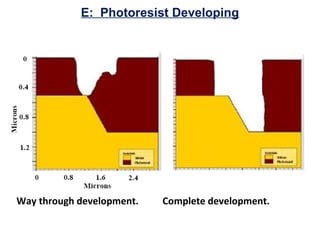
E: Photoresist Developing
Way through development. Complete development.
Future Trends
• Optical lithography has been extended to the 100 nm
generation and it may be extendible up to 70 / 50 nm
features.
• Beyond that, there is no general agreement on which
approach will work in manufacturing.
• Possibilities include e-beam, e-beam projection, X-ray
and EUV.
• New resists will likely be required for these systems.
Summary of Key Ideas
• Lithography is the key pacing item for developing new
technology generations.
• Exposure tools today generally use projection optics
with diffraction limited performance.
• g and i-line resists are based on DNQ materials and are
used down to 0.35 µm dimensions.
• DUV resists use chemical amplification and are generally
used for smaller feature sizes.
Summary of Key Ideas
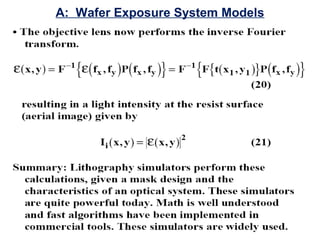
• Lithography simulation tools are based on Fourier
optics and do an excellent job of simulating optical
system performance. Thus aerial images can be
accurately calculated.
• Photoresist modeling (exposure, development,
postbake) is less advanced because chemistry is
involved which is not as well understood. Thus latent
images are less accurately calculated today.
• A new approach to lithography may be required in the
next few years.
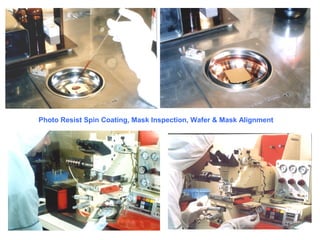
Photo Resist Spin Coating, Mask Inspection, Wafer & Mask Alignment
Manufacturing Methods and Equipments
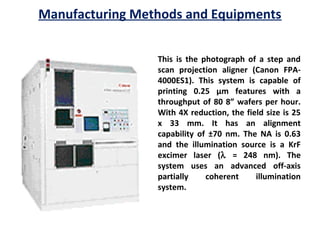
This is the photograph of a step and
scan projection aligner (Canon FPA-
4000ES1). This system is capable of
printing 0.25 µm features with a
throughput of 80 8” wafers per hour.
With 4X reduction, the field size is 25
x 33 mm. It has an alignment
capability of ±70 nm. The NA is 0.63
and the illumination source is a KrF
excimer laser (λ = 248 nm). The
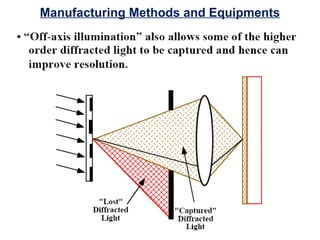
system uses an advanced off-axis
partially coherent illumination
system.
Electron Beam Lithography System
• The most recent “steppers” are step and scan systems.
(Photo taken directly from the Canon website at http://www.usa.canon.com.)
5.2. lithography 3,4,5 final,2013

5.2. lithography 3,4,5 final,2013

  • 1.
  • 2.
    Photoresist Exposure: Issues IdealAerial Imag Exposing Light • There are often a number of additional issues that arise in exposing resist. • Resist is applied as a liquid and hence "flows" to fill in the topography. • Resist thickness may vary across the wafer. This can lead to under or over exposure in some regions and hence linewidth variations.
  • 3.
    Photoresist Exposure:Issues Planarization LayerEtch Mask layer Imaging Layer • Multi-layer resists are used to produce a thin, uniform imaging layer in which the aerial image is transformed into a latent image. • Etching is then used to transfer the latent image down through the planarization layer.
  • 4.
    Photoresist Exposure: Issues AerialImage Exposing Light • Reflective surfaces below the resist can set up reflections and standing waves and degrade resolution. • In some cases an antireflective coating (ARC) can help to minimize these effects. Baking the resist after exposure, but before development can also help.
  • 5.
  • 6.
    TYPES OF SUBSTRATE 1.Quartz - Ultra Low Thermal Expansion (ULTE) 2. Borosilicate Glass – Low Expansion 3. Soda Lime Glass - Economical Substrate Typical Properties Properties Quartz Borosilicat e Glass Soda Lime Glass Thermal Exp. Coefficient 5.2x10⁻⁷ 37x10-7 94x10-7 Refractive Index 1.47 1.53 1.52 Light Transmittance (%) 436 nm 200 nm 90 ≈70 90 -- 90 -- Electrical Resistivity (Ω- cm) 1018 1015 1012
  • 7.
    Coating for MaskBlanks • Photo Emulsion (Silver Halide based) • Chromium (Cr) • Chromium Oxide (Cr2Ox) • Iron Oxide (Fe2O3) • Silicon (Si) • Photo Sensitive Resists
  • 8.
    Emulsion Vs Chrome TypeAdvantages Disadvantages Emulsion Low Cost High Photo-sensitivity Easy Processing Good Image Resolution and Contrast Easy Reversal Processing Tender and Scratch Sensitive Life is Shorter Chrome Hard Surface Coating Longer Life Sharp Edges Easy Mask Cleaning High Reflectivity
  • 9.
    Mask Parameters • Typeof Substrate • Size of Mask Plate • Required Field • Scale Factor/Data Magnification • Image Mirroring/Rotation • Input Data Format (CIF, GDSII, DXF, GURBER…) • Layer ID, Total Number of Layers & Layer Title Mask Specification: • Minimum Feature Size • Total Area of Design • Step & Repeat -- Array & Stepping Distance
  • 10.
    Lay-out Planning Factors tobe considered • For which Aligner / Stepper the Masks are to be Prepared  Fiducials (if Required for Step & Repeat)  Wafer Alignment Marks  CD (Critical Dimensions) Structures  Layers / Product Identification Marks  Dicing Requirements (i) Minimum Scribe Width (ii) Step Size Constraints
  • 11.
    Processing Emulsion Plates • Developing •Fixing • Water Rinsing Chrome Plates • Developing • Etching • Photo Resist Stripping • Water Rinsing • Cleaning
  • 12.
    Mask Quality Inspection •Visual Inspection • Measurement
  • 14.
    D: Mask Engineering– OPC and Phase Shifting
  • 15.
    D: Mask Engineering– OPC and Phase Shifting
  • 16.
    D: Mask Engineering– OPC and Phase Shifting
  • 17.
    D: Mask Engineering– OPC and Phase Shifting
  • 18.
  • 19.
    Manufacturing Methods andEquipments Conceptual diagram of a scanning projection printer
  • 20.
  • 21.
    Manufacturing Methods andEquipments On-axis Illumination
  • 22.
  • 23.
    Manufacturing Methods andEquipments • This further decreases the optical “window” and therefore makes it possible to build higher performance optical systems over a smaller area. • The most recent “steppers” are step and scan systems.
  • 24.
    Electron Beam Lithography •Process of scanning a beam of electrons in a patterned fashion across a surface covered with a electron resist.
  • 25.
    Electron Beam LithographySystem • Electron Gun or Electron Source • Electron Column • Mechanical Stage • Wafer Handling System • Computer System
  • 26.
    Electron Optical System Electrongun Alignment coil First condenser lens Blanking plates Second condenser lens Limiting aperture Final lens, coils Electron resists Substrate Mechanical stage
  • 27.
    EB Writing Scheme:Raster Scan
  • 28.
  • 29.
    Electron Beam Lithography •Advantages • Better Resolution • Disadvantages • Low Throughput • High Cost
  • 30.
    Models and Simulation •Lithography simulation relies on models from two fields of science: • Optics to model the formation of the aerial image. – Water Exposure System Models • Chemistry to model the formation of the latent image in the resist. – Optical Intensity Pattern in the Resist – Photoresist Exposure – Photoresist Baking – Photoresist Developing
  • 31.
    A: Wafer ExposureSystem Models
  • 32.
    A: Wafer ExposureSystem Models
  • 33.
    A: Wafer ExposureSystem Models
  • 34.
    A: Wafer ExposureSystem Models
  • 35.
    A: Wafer ExposureSystem Models
  • 36.
    A: Wafer ExposureSystem Models Example Consider a long rectangular slit. The Fourier transform of t(x) is in standard texts and is sin(x)/x function.
  • 37.
    A: Wafer ExposureSystem Models
  • 38.
    A: Wafer ExposureSystem Models
  • 39.
    A: Wafer ExposureSystem Models Colors correspond to optical intensity in the aerial image. Exposure system: NA = 0.43, partially coherent g-line illumination (λ = 436 nm). No aberrations or defocusing. Minimum feature size is 1 µm. • ATHENA simulator (Silvaco).
  • 40.
    A: Wafer ExposureSystem Models • Same example as previous except that the feature size has been reduced to 0.5 µm. Note the poorer image.
  • 41.
    A: Wafer ExposureSystem Models • Same example as previous except that the illumination wavelength has now been changed to i-line illumination (λ = 365 nm) and the NA has been increased to 0.5. Note the improved image.
  • 42.
    B: Optical IntensityPattern in the Resist
  • 43.
    B: Optical IntensityPattern in the Resist
  • 44.
    B: Optical IntensityPattern in the Resist • Example of calculation of light intensity distribution in a photoresist layer during exposure using the ATHENA simulator. A simple structure is defined with a photoresist layer covering a silicon substrate which has two flat regions and a sloped sidewall. The simulation shows the [PAC] calculated concentration after an exposure of 200 mJ cm-2 . Lower [PAC] values correspond to more exposure. The color contours thus correspond to the integrated light intensity from the exposure.
  • 45.
  • 46.
  • 47.
  • 48.
  • 49.
  • 50.
    D: Photoresist Baking •Same simulation example as last one except that a post exposure bake of 45 minutes at 115 °C has now been included. The color contours again correspond to the [PAC] after exposure. Note that the standing wave effects apparent earlier have been “smeared out” by this bake, producing a more uniform [PAC] distribution.
  • 51.
  • 52.
  • 53.
    E: Photoresist Developing •Example of the calculation of a developed photoresist layer using the ATHENA simulator. The resist was exposed with a dose of 200 mJ cm-2 , a post exposure bake of 45 min at 115 °C was used and the pattern was developed for a time of 60 seconds, all normal parameters. The Dill development model was used.
  • 54.
    E: Photoresist Developing Waythrough development. Complete development.
  • 55.
    Future Trends • Opticallithography has been extended to the 100 nm generation and it may be extendible up to 70 / 50 nm features. • Beyond that, there is no general agreement on which approach will work in manufacturing. • Possibilities include e-beam, e-beam projection, X-ray and EUV. • New resists will likely be required for these systems.
  • 56.
    Summary of KeyIdeas • Lithography is the key pacing item for developing new technology generations. • Exposure tools today generally use projection optics with diffraction limited performance. • g and i-line resists are based on DNQ materials and are used down to 0.35 µm dimensions. • DUV resists use chemical amplification and are generally used for smaller feature sizes.
  • 57.
    Summary of KeyIdeas • Lithography simulation tools are based on Fourier optics and do an excellent job of simulating optical system performance. Thus aerial images can be accurately calculated. • Photoresist modeling (exposure, development, postbake) is less advanced because chemistry is involved which is not as well understood. Thus latent images are less accurately calculated today. • A new approach to lithography may be required in the next few years.
  • 58.
    Photo Resist SpinCoating, Mask Inspection, Wafer & Mask Alignment
  • 59.
    Manufacturing Methods andEquipments This is the photograph of a step and scan projection aligner (Canon FPA- 4000ES1). This system is capable of printing 0.25 µm features with a throughput of 80 8” wafers per hour. With 4X reduction, the field size is 25 x 33 mm. It has an alignment capability of ±70 nm. The NA is 0.63 and the illumination source is a KrF excimer laser (λ = 248 nm). The system uses an advanced off-axis partially coherent illumination system.
  • 60.
  • 61.
    • The mostrecent “steppers” are step and scan systems. (Photo taken directly from the Canon website at http://www.usa.canon.com.)