PHOTOLITHOGRAPHY
AND
DIFFUSION
By Kumar Gaurav, B.Tech(3rd year)
1
INTRODUCTION
Photolithography
 Temporarily coat photoresist on wafer
 Transfers designed pattern to
photoresist
 Most important process in IC
fabrication
 40 to 50% total wafer process time
 Determines the minimum feature size
2
3
OVERVIEW OF PHOTOLITHOGRAPHY (CTND.)
 􀂄 Lithography consists of patterning substrate by
employing the interaction of beams of photons or
particles with materials.
 􀂄 Photolithography is widely used in the integrated
circuits (ICs) manufacturing.
 􀂄 The process of IC manufacturing consists of a
series of 10-20 steps or more, called mask layers
where layers of materials coated with resists are
patterned then transferred onto the material layer.
OVERVIEW OF PHOTOLITHOGRAPHY (CTND.)
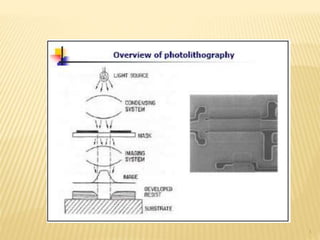
 􀂄 A photolithography system consists of a light
source, a mask, and a optical projection system.
 􀂄 Photoresists are radiation sensitive materials that
usually consist of a photo-sensitive compound, a
polymeric backbone, and a solvent.
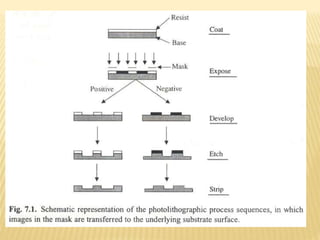
 􀂄 Resists can be classified upon their solubility after
exposure into: positive resists (solubility of
exposed area increases) and negative resists
(solubility of exposed area decreases).
APPLICATIONS OF PHOTOLITHOGRAPHY
 Main application: IC patterning process
 Other applications: Printed electronic board,
nameplate, printer plate, and et al.
6
PHOTORESIST
 Photo sensitive material
 Temporarily coated on wafer
surface
 Transfer design image on it through
exposure
 Very similar to the photo sensitive
coating on the film for camera
7
8
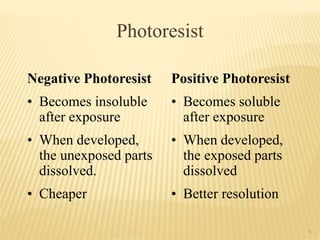
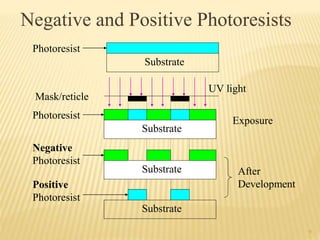
Photoresist
Negative Photoresist
• Becomes insoluble
after exposure
• When developed,
the unexposed parts
dissolved.
• Cheaper
Positive Photoresist
• Becomes soluble
after exposure
• When developed,
the exposed parts
dissolved
• Better resolution
9
Mask/reticle
Exposure
After
Development
Negative
Photoresist
UV light
Positive
Photoresist
Substrate
Substrate
Substrate
Photoresist
Negative and Positive Photoresists
Substrate
Photoresist
PHOTORESIST COMPOSITION
 Polymer
 Solvents
 Sensitizers
 Additives
10
POLYMER
 Solid organic material
 Transfers designed pattern to wafer
surface
 Changes solubility due to photochemical
reaction when exposed to UV rays.
SOLVENT
 Dissolves polymers into liquid
 Allow application of thin PR layers by
spinning. 11
SENSITIZERS
 Controls and/or modifies photochemical
reaction of resist during exposure.
 Determines exposure time and intensity
ADDITIVES
 Various added chemical to achieve desired
process results, such as dyes to reduce
reflection.
NEGATIVE RESIST
 Most negative PR are polyisoprene type
 Exposed PR becomes cross-linked
polymer
 Cross-linked polymer has higher
chemical etch resistance.
 Unexposed part will be dissolved in
development solution.
12
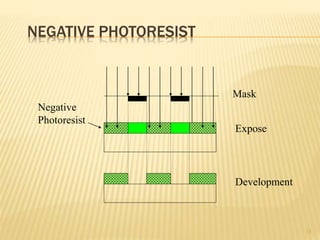
NEGATIVE PHOTORESIST
13
Mask
Expose
Development
Negative
Photoresist
NEGATIVE PHOTORESIST
14
Disadvantages
• Polymer absorbs the development solvent
• Poor resolution due to PR swelling
• Environmental and safety issues due to the
main solvents xylene.
POSITIVE PHOTORESIST
 Exposed part dissolve in developer solution
 Image the same that on the mask
 Higher resolution
 Commonly used in IC fabs
15
POSITIVE PHOTORESIST
 Novolac resin polymer
 Acetate type solvents
 Sensitizer cross-linked within the resin
 Energy from the light dissociates the
sensitizer and breaks down the cross-
links
 Resin becomes more soluble in base
solution
16
REQUIREMENT OF PHOTORESIST
 High resolution
 Thinner PR film has higher the resolution
 Thinner PR film, the lower the etching and ion
implantation resistance
 High etch resistance
 Good adhesion
 Wider process latitude
 Higher tolerance to process condition change
17
PHOTORESIST PHYSICAL PROPERTIES
18
• Photoresist must be able to withstand
process conditions
• Coating, spinning, baking, developing.
• Etch resistance
• Ion implantation blocking
PHOTORESIST PERFORMANCE FACTOR
 Resolution
 Adhesion
 Expose rate, Sensitivity and Exposure
Source
 Process latitude
 Pinholes
 Particle and Contamination Levels
 Step Coverage
 Thermal Flow
19
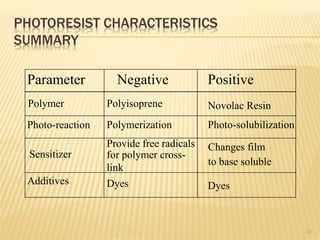
PHOTORESIST CHARACTERISTICS
SUMMARY
20
Parameter Negative Positive
Polymer Polyisoprene Novolac Resin
Photo-reaction Polymerization Photo-solubilization
Sensitizer
Provide free radicals
for polymer cross-
link
Changes film
to base soluble
Additives Dyes Dyes
21
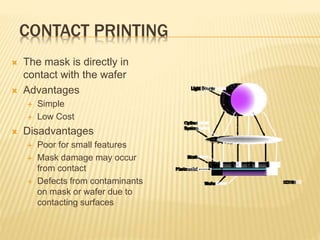
CONTACT PRINTING
 The mask is directly in
contact with the wafer
 Advantages
 Simple
 Low Cost
 Disadvantages
 Poor for small features
 Mask damage may occur
from contact
 Defects from contaminants
on mask or wafer due to
contacting surfaces
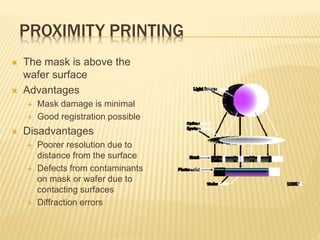
PROXIMITY PRINTING
 The mask is above the
wafer surface
 Advantages
 Mask damage is minimal
 Good registration possible
 Disadvantages
 Poorer resolution due to
distance from the surface
 Defects from contaminants
on mask or wafer due to
contacting surfaces
 Diffraction errors
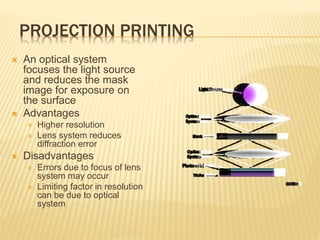
PROJECTION PRINTING
 An optical system
focuses the light source
and reduces the mask
image for exposure on
the surface
 Advantages
 Higher resolution
 Lens system reduces
diffraction error
 Disadvantages
 Errors due to focus of lens
system may occur
 Limiting factor in resolution
can be due to optical
system
PHOTOLITHOGRAPHY PROCESS
25
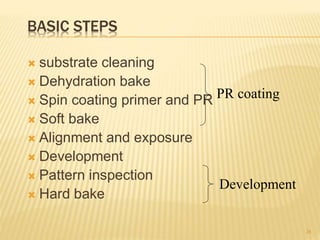
BASIC STEPS
 substrate cleaning
 Dehydration bake
 Spin coating primer and PR
 Soft bake
 Alignment and exposure
 Development
 Pattern inspection
 Hard bake
26
PR coating
Development
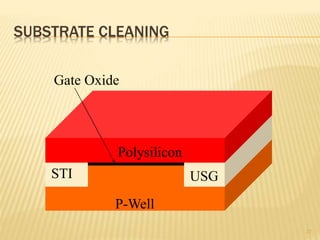
SUBSTRATE CLEANING
27
P-Well
USGSTI
Polysilicon
Gate Oxide
SUBSTRATE CLEANING
 Particularly troublesome grease, oil or wax stains
 2-5 min ultrasonic bath in trichloroethylene (TCE)
 or trichloroethane (TCA), 65-75ºC (carcinogenic)
 Standard grease removal
 2-5 min ultrasonic bath in acetone
 2-5 min ultrasonic bath in methanol
 2-5 min ultrasonic bath in D.I. H2O
 Repeat the first three steps 3 times
 30 sec rinse under free flowing D.I. H2O
 Oxide and other material removal
 5 min H2O:H2O2:NH3OH 4:1:1 70-80ºC (cleaning Ge)
 30 sec 50% HF (Glass or SiO2)
 D.I. H2O 3 rinses
 5 min H2O:H2O2:HCl 5:1:1 70-80ºC
 D.I. H2O 3 rinses
 Spin dry (wafer) / N2 blow dry
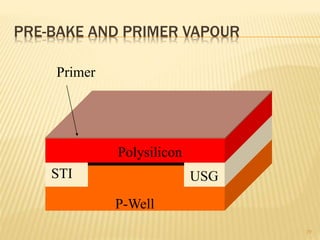
PRE-BAKE AND PRIMER VAPOUR
29
P-Well
USGSTI
Polysilicon
Primer
PRE-BAKE
 Remove the resist solvent
 Convection Oven
90-100 ºC, 15-20 min
removal starts at surface
solvent trapping
 Conduction (hotplate)
75-85ºC, 40-60 sec
removal starts at bottom
uniform heating
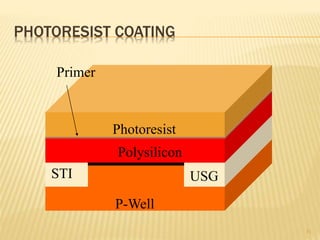
PHOTORESIST COATING
31
P-Well
USGSTI
Polysilicon
Photoresist
Primer
PHOTORESIST COATING
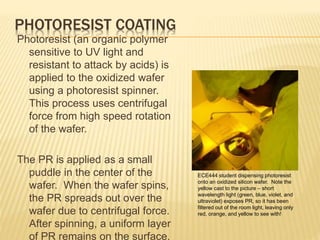
Photoresist (an organic polymer
sensitive to UV light and
resistant to attack by acids) is
applied to the oxidized wafer
using a photoresist spinner.
This process uses centrifugal
force from high speed rotation
of the wafer.
The PR is applied as a small
puddle in the center of the
wafer. When the wafer spins,
the PR spreads out over the
wafer due to centrifugal force.
After spinning, a uniform layer
of PR remains on the surface.
ECE444 student dispensing photoresist
onto an oxidized silicon wafer. Note the
yellow cast to the picture – short
wavelength light (green, blue, violet, and
ultraviolet) exposes PR, so it has been
filtered out of the room light, leaving only
red, orange, and yellow to see with!
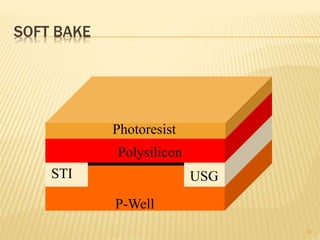
SOFT BAKE
33
P-Well
USGSTI
Polysilicon
Photoresist
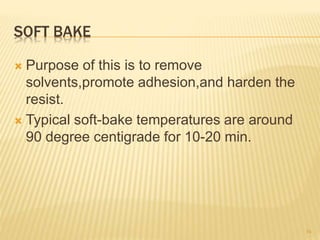
SOFT BAKE
 Purpose of this is to remove
solvents,promote adhesion,and harden the
resist.
 Typical soft-bake temperatures are around
90 degree centigrade for 10-20 min.
34
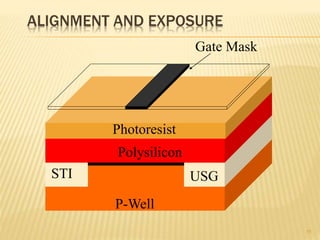
ALIGNMENT AND EXPOSURE
35
P-Well
USGSTI
Polysilicon
Photoresist
Gate Mask
ALIGNMENT AND EXPOSURE
36
Gate Mask
P-Well
USGSTI
Polysilicon
Photoresist
ALIGNMENT AND EXPOSURE
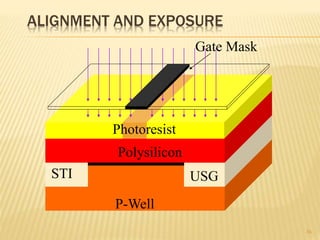
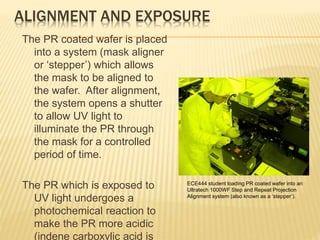
The PR coated wafer is placed
into a system (mask aligner
or ‘stepper’) which allows
the mask to be aligned to
the wafer. After alignment,
the system opens a shutter
to allow UV light to
illuminate the PR through
the mask for a controlled
period of time.
The PR which is exposed to
UV light undergoes a
photochemical reaction to
make the PR more acidic
(indene carboxylic acid is
ECE444 student loading PR coated wafer into an
Ultratech 1000WF Step and Repeat Projection
Alignment system (also known as a ‘stepper’).
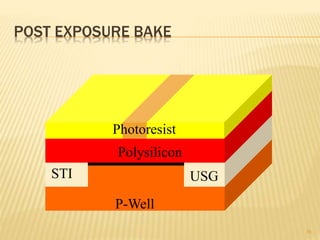
POST EXPOSURE BAKE
38
P-Well
USGSTI
Polysilicon
Photoresist
DEVELOPMENT
39
P-Well
USGSTI
Polysilicon
PR
40
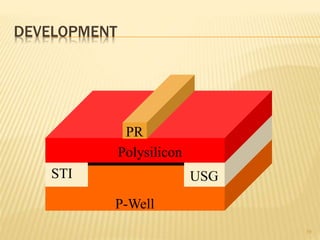
After the wafer is exposed to UV light through the mask, the acidic
regions of PR are removed by dipping the wafer into an alkaline
(base) developing solution. The acidic PR reacts chemically with
the basic developer to form water soluble salts that dissolve in the
developer.
At this point the mask image can be seen in the PR (remember that
the PR was illuminated with UV light through the mask, so only
light in the shape of the circuit reaches the PR – the rest of the PR
did not change!).
Note: the image from the mask has only been transferred to the PR.
The PR will be used as a mask for etching the underlying oxide in
an acid bath.
DEVELOPMENT
HARD BAKE
41
P-Well
USGSTI
Polysilicon
PR
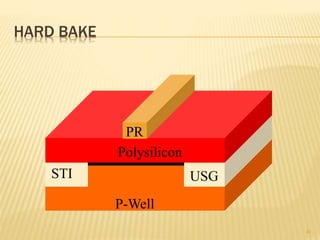
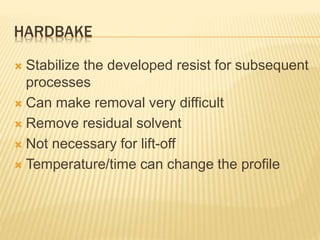
HARDBAKE
 Stabilize the developed resist for subsequent
processes
 Can make removal very difficult
 Remove residual solvent
 Not necessary for lift-off
 Temperature/time can change the profile
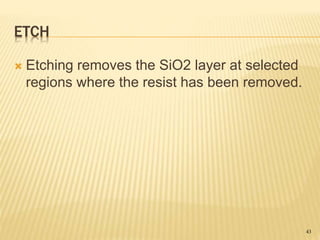
ETCH
 Etching removes the SiO2 layer at selected
regions where the resist has been removed.
43
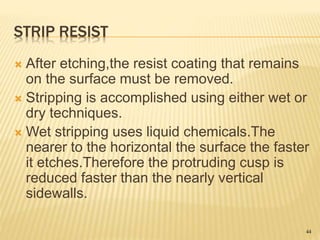
STRIP RESIST
 After etching,the resist coating that remains
on the surface must be removed.
 Stripping is accomplished using either wet or
dry techniques.
 Wet stripping uses liquid chemicals.The
nearer to the horizontal the surface the faster
it etches.Therefore the protruding cusp is
reduced faster than the nearly vertical
sidewalls.
44
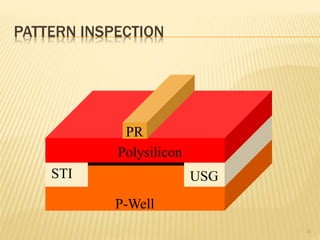
PATTERN INSPECTION
45
P-Well
USGSTI
Polysilicon
PR
47
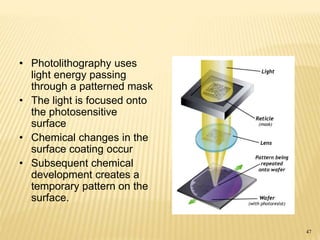
• Photolithography uses
light energy passing
through a patterned mask
• The light is focused onto
the photosensitive
surface
• Chemical changes in the
surface coating occur
• Subsequent chemical
development creates a
temporary pattern on the
surface.
48
DIFFUSION – CONTINUED
In the periodic table, the closer elements are to each other,
the more similar they are. So the best candidates would
come from column V (which have five outer shell
electrons). The element closest to silicon in column V is
phosphorus.
If phosphorus is inserted into the silicon wafer in a certain
way, it will take the place of a silicon atom and bond with
its four neighbor silicon atoms. After bonding,
phosphorus has an electron left over that is not bonded
to a silicon atom. It turns out this extra electron is not
strongly held by the phosphorus atom any more, so it
can be removed easily. This electron then becomes a
‘carrier’ for current – it is free to move around the wafer.
So the conductivity of the silicon wafer increases. This
type of silicon ‘doped’ with phosphorus is called an n-
type semiconductor.
DIFFUSION
Silicon is a column IV element – this means there are four
electrons in the outermost shell of the atom. It is these
electrons that are used when bonding to other atoms. In
a wafer, each silicon atom bonds to four other silicon
atoms (each Si-Si bond shares one electron). So in an
intrinsic (pure) silicon wafer, all the electrons in the outer
shell are part of a bond – they are ‘stuck’ between the
bonded silicon atoms.
In order for current to flow in a material there must be
‘loose’ electrons. But all the electrons in silicon are
working at holding the atoms together, which means it is
not a good conductor of current.
So what can be done to allow the silicon to conduct current
more easily? Free ‘carriers’ of current must be added.
The goal is to find an element about the same size as a
silicon atom so that it fits together well with the silicon,
but with more electrons in its outer shell.
DIFFUSION – CONTINUED
Extending this idea of inserting an element with a different
number of valence electrons, a column III element
(such as boron) could be added to the silicon wafer. In
this case, the boron will try to bond with four silicon
atoms, but it only has three electrons to bond with.
This means there is an incomplete bond with one of
the silicon atoms – a ‘hole’ where an electron would
normally be. This ‘hole’ behaves much like an electron
and can move around the wafer, but with an opposite
charge (+). So a different type of current carrier is
present in the wafer that increases the wafer’s
conductivity. This type of silicon ‘doped’ with boron is
called a p-type semiconductor.
By adding impurities to silicon, the conductivity increases.
This conductivity can be adjusted by the amount of
impurity added.
DIFFUSION – CONTINUED
Now for the interesting part - when n-type silicon comes into contact with p-type
silicon. A built-in potential (voltage) develops that must be overcome before
current can flow from the n-type to p-type regions.
Think of carriers as being able to only move across a flat surface or down a
slope. The built in potential is a hill that the carrier can not go up. So in
order for the carrier to keep moving, the low part must be pushed up to be
level or higher than the top of the hill. In the case of an n-type / p-type
junction, the energy to push up the low side comes in the form of a voltage
applied to the wafer. The voltage is used to ‘push up’ the ‘ground’ on the low
side of the hill before current flows from n-type to p-type regions.
But if the voltage is reversed, the energy is used to push the low side lower
while keeping the high side at the same height! That means the carrier
probably won’t ever make it up the higher hill, so it is stuck (no current
flows).
DIFFUSION – CONTINUED
So when n-type silicon is brought into contact with
p-type silicon (a pn junction), current can flow in
only one direction. This is the fundamental
semiconductor device – a pn junction diode – a
one way switch for current.
The devices used in integrated circuits are
specialized combinations of pn junctions. The
junctions are formed by the addition of impurity
atoms from columns III and V of the periodic
table into the silicon wafer through diffusion.
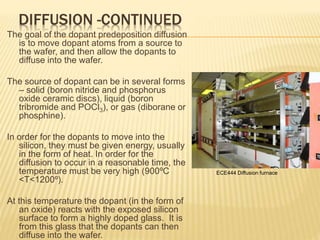
DIFFUSION -CONTINUED
The goal of the dopant predeposition diffusion
is to move dopant atoms from a source to
the wafer, and then allow the dopants to
diffuse into the wafer.
The source of dopant can be in several forms
– solid (boron nitride and phosphorus
oxide ceramic discs), liquid (boron
tribromide and POCl3), or gas (diborane or
phosphine).
In order for the dopants to move into the
silicon, they must be given energy, usually
in the form of heat. In order for the
diffusion to occur in a reasonable time, the
temperature must be very high (900ºC
<T<1200º).
At this temperature the dopant (in the form of
an oxide) reacts with the exposed silicon
surface to form a highly doped glass. It is
from this glass that the dopants can then
diffuse into the wafer.
ECE444 Diffusion furnace
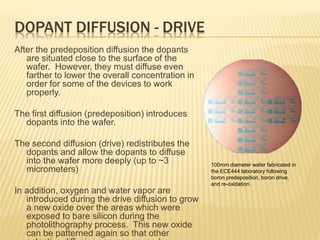
DOPANT DIFFUSION - DRIVE
After the predeposition diffusion the dopants
are situated close to the surface of the
wafer. However, they must diffuse even
farther to lower the overall concentration in
order for some of the devices to work
properly.
The first diffusion (predeposition) introduces
dopants into the wafer.
The second diffusion (drive) redistributes the
dopants and allow the dopants to diffuse
into the wafer more deeply (up to ~3
micrometers)
In addition, oxygen and water vapor are
introduced during the drive diffusion to grow
a new oxide over the areas which were
exposed to bare silicon during the
photolithography process. This new oxide
can be patterned again so that other
100mm diameter wafer fabricated in
the ECE444 laboratory following
boron predeposition, boron drive,
and re-oxidation.
56

photolithography

  • 1.
  • 2.
    INTRODUCTION Photolithography  Temporarily coatphotoresist on wafer  Transfers designed pattern to photoresist  Most important process in IC fabrication  40 to 50% total wafer process time  Determines the minimum feature size 2
  • 3.
  • 4.
    OVERVIEW OF PHOTOLITHOGRAPHY(CTND.)  􀂄 Lithography consists of patterning substrate by employing the interaction of beams of photons or particles with materials.  􀂄 Photolithography is widely used in the integrated circuits (ICs) manufacturing.  􀂄 The process of IC manufacturing consists of a series of 10-20 steps or more, called mask layers where layers of materials coated with resists are patterned then transferred onto the material layer.
  • 5.
    OVERVIEW OF PHOTOLITHOGRAPHY(CTND.)  􀂄 A photolithography system consists of a light source, a mask, and a optical projection system.  􀂄 Photoresists are radiation sensitive materials that usually consist of a photo-sensitive compound, a polymeric backbone, and a solvent.  􀂄 Resists can be classified upon their solubility after exposure into: positive resists (solubility of exposed area increases) and negative resists (solubility of exposed area decreases).
  • 6.
    APPLICATIONS OF PHOTOLITHOGRAPHY Main application: IC patterning process  Other applications: Printed electronic board, nameplate, printer plate, and et al. 6
  • 7.
    PHOTORESIST  Photo sensitivematerial  Temporarily coated on wafer surface  Transfer design image on it through exposure  Very similar to the photo sensitive coating on the film for camera 7
  • 8.
    8 Photoresist Negative Photoresist • Becomesinsoluble after exposure • When developed, the unexposed parts dissolved. • Cheaper Positive Photoresist • Becomes soluble after exposure • When developed, the exposed parts dissolved • Better resolution
  • 9.
  • 10.
    PHOTORESIST COMPOSITION  Polymer Solvents  Sensitizers  Additives 10 POLYMER  Solid organic material  Transfers designed pattern to wafer surface  Changes solubility due to photochemical reaction when exposed to UV rays.
  • 11.
    SOLVENT  Dissolves polymersinto liquid  Allow application of thin PR layers by spinning. 11 SENSITIZERS  Controls and/or modifies photochemical reaction of resist during exposure.  Determines exposure time and intensity ADDITIVES  Various added chemical to achieve desired process results, such as dyes to reduce reflection.
  • 12.
    NEGATIVE RESIST  Mostnegative PR are polyisoprene type  Exposed PR becomes cross-linked polymer  Cross-linked polymer has higher chemical etch resistance.  Unexposed part will be dissolved in development solution. 12
  • 13.
  • 14.
    NEGATIVE PHOTORESIST 14 Disadvantages • Polymerabsorbs the development solvent • Poor resolution due to PR swelling • Environmental and safety issues due to the main solvents xylene.
  • 15.
    POSITIVE PHOTORESIST  Exposedpart dissolve in developer solution  Image the same that on the mask  Higher resolution  Commonly used in IC fabs 15
  • 16.
    POSITIVE PHOTORESIST  Novolacresin polymer  Acetate type solvents  Sensitizer cross-linked within the resin  Energy from the light dissociates the sensitizer and breaks down the cross- links  Resin becomes more soluble in base solution 16
  • 17.
    REQUIREMENT OF PHOTORESIST High resolution  Thinner PR film has higher the resolution  Thinner PR film, the lower the etching and ion implantation resistance  High etch resistance  Good adhesion  Wider process latitude  Higher tolerance to process condition change 17
  • 18.
    PHOTORESIST PHYSICAL PROPERTIES 18 •Photoresist must be able to withstand process conditions • Coating, spinning, baking, developing. • Etch resistance • Ion implantation blocking
  • 19.
    PHOTORESIST PERFORMANCE FACTOR Resolution  Adhesion  Expose rate, Sensitivity and Exposure Source  Process latitude  Pinholes  Particle and Contamination Levels  Step Coverage  Thermal Flow 19
  • 20.
    PHOTORESIST CHARACTERISTICS SUMMARY 20 Parameter NegativePositive Polymer Polyisoprene Novolac Resin Photo-reaction Polymerization Photo-solubilization Sensitizer Provide free radicals for polymer cross- link Changes film to base soluble Additives Dyes Dyes
  • 21.
  • 22.
    CONTACT PRINTING  Themask is directly in contact with the wafer  Advantages  Simple  Low Cost  Disadvantages  Poor for small features  Mask damage may occur from contact  Defects from contaminants on mask or wafer due to contacting surfaces
  • 23.
    PROXIMITY PRINTING  Themask is above the wafer surface  Advantages  Mask damage is minimal  Good registration possible  Disadvantages  Poorer resolution due to distance from the surface  Defects from contaminants on mask or wafer due to contacting surfaces  Diffraction errors
  • 24.
    PROJECTION PRINTING  Anoptical system focuses the light source and reduces the mask image for exposure on the surface  Advantages  Higher resolution  Lens system reduces diffraction error  Disadvantages  Errors due to focus of lens system may occur  Limiting factor in resolution can be due to optical system
  • 25.
  • 26.
    BASIC STEPS  substratecleaning  Dehydration bake  Spin coating primer and PR  Soft bake  Alignment and exposure  Development  Pattern inspection  Hard bake 26 PR coating Development
  • 27.
  • 28.
    SUBSTRATE CLEANING  Particularlytroublesome grease, oil or wax stains  2-5 min ultrasonic bath in trichloroethylene (TCE)  or trichloroethane (TCA), 65-75ºC (carcinogenic)  Standard grease removal  2-5 min ultrasonic bath in acetone  2-5 min ultrasonic bath in methanol  2-5 min ultrasonic bath in D.I. H2O  Repeat the first three steps 3 times  30 sec rinse under free flowing D.I. H2O  Oxide and other material removal  5 min H2O:H2O2:NH3OH 4:1:1 70-80ºC (cleaning Ge)  30 sec 50% HF (Glass or SiO2)  D.I. H2O 3 rinses  5 min H2O:H2O2:HCl 5:1:1 70-80ºC  D.I. H2O 3 rinses  Spin dry (wafer) / N2 blow dry
  • 29.
    PRE-BAKE AND PRIMERVAPOUR 29 P-Well USGSTI Polysilicon Primer
  • 30.
    PRE-BAKE  Remove theresist solvent  Convection Oven 90-100 ºC, 15-20 min removal starts at surface solvent trapping  Conduction (hotplate) 75-85ºC, 40-60 sec removal starts at bottom uniform heating
  • 31.
  • 32.
    PHOTORESIST COATING Photoresist (anorganic polymer sensitive to UV light and resistant to attack by acids) is applied to the oxidized wafer using a photoresist spinner. This process uses centrifugal force from high speed rotation of the wafer. The PR is applied as a small puddle in the center of the wafer. When the wafer spins, the PR spreads out over the wafer due to centrifugal force. After spinning, a uniform layer of PR remains on the surface. ECE444 student dispensing photoresist onto an oxidized silicon wafer. Note the yellow cast to the picture – short wavelength light (green, blue, violet, and ultraviolet) exposes PR, so it has been filtered out of the room light, leaving only red, orange, and yellow to see with!
  • 33.
  • 34.
    SOFT BAKE  Purposeof this is to remove solvents,promote adhesion,and harden the resist.  Typical soft-bake temperatures are around 90 degree centigrade for 10-20 min. 34
  • 35.
  • 36.
    ALIGNMENT AND EXPOSURE 36 GateMask P-Well USGSTI Polysilicon Photoresist
  • 37.
    ALIGNMENT AND EXPOSURE ThePR coated wafer is placed into a system (mask aligner or ‘stepper’) which allows the mask to be aligned to the wafer. After alignment, the system opens a shutter to allow UV light to illuminate the PR through the mask for a controlled period of time. The PR which is exposed to UV light undergoes a photochemical reaction to make the PR more acidic (indene carboxylic acid is ECE444 student loading PR coated wafer into an Ultratech 1000WF Step and Repeat Projection Alignment system (also known as a ‘stepper’).
  • 38.
  • 39.
  • 40.
    40 After the waferis exposed to UV light through the mask, the acidic regions of PR are removed by dipping the wafer into an alkaline (base) developing solution. The acidic PR reacts chemically with the basic developer to form water soluble salts that dissolve in the developer. At this point the mask image can be seen in the PR (remember that the PR was illuminated with UV light through the mask, so only light in the shape of the circuit reaches the PR – the rest of the PR did not change!). Note: the image from the mask has only been transferred to the PR. The PR will be used as a mask for etching the underlying oxide in an acid bath. DEVELOPMENT
  • 41.
  • 42.
    HARDBAKE  Stabilize thedeveloped resist for subsequent processes  Can make removal very difficult  Remove residual solvent  Not necessary for lift-off  Temperature/time can change the profile
  • 43.
    ETCH  Etching removesthe SiO2 layer at selected regions where the resist has been removed. 43
  • 44.
    STRIP RESIST  Afteretching,the resist coating that remains on the surface must be removed.  Stripping is accomplished using either wet or dry techniques.  Wet stripping uses liquid chemicals.The nearer to the horizontal the surface the faster it etches.Therefore the protruding cusp is reduced faster than the nearly vertical sidewalls. 44
  • 45.
  • 47.
    47 • Photolithography uses lightenergy passing through a patterned mask • The light is focused onto the photosensitive surface • Chemical changes in the surface coating occur • Subsequent chemical development creates a temporary pattern on the surface.
  • 48.
  • 49.
    DIFFUSION – CONTINUED Inthe periodic table, the closer elements are to each other, the more similar they are. So the best candidates would come from column V (which have five outer shell electrons). The element closest to silicon in column V is phosphorus. If phosphorus is inserted into the silicon wafer in a certain way, it will take the place of a silicon atom and bond with its four neighbor silicon atoms. After bonding, phosphorus has an electron left over that is not bonded to a silicon atom. It turns out this extra electron is not strongly held by the phosphorus atom any more, so it can be removed easily. This electron then becomes a ‘carrier’ for current – it is free to move around the wafer. So the conductivity of the silicon wafer increases. This type of silicon ‘doped’ with phosphorus is called an n- type semiconductor.
  • 50.
    DIFFUSION Silicon is acolumn IV element – this means there are four electrons in the outermost shell of the atom. It is these electrons that are used when bonding to other atoms. In a wafer, each silicon atom bonds to four other silicon atoms (each Si-Si bond shares one electron). So in an intrinsic (pure) silicon wafer, all the electrons in the outer shell are part of a bond – they are ‘stuck’ between the bonded silicon atoms. In order for current to flow in a material there must be ‘loose’ electrons. But all the electrons in silicon are working at holding the atoms together, which means it is not a good conductor of current. So what can be done to allow the silicon to conduct current more easily? Free ‘carriers’ of current must be added. The goal is to find an element about the same size as a silicon atom so that it fits together well with the silicon, but with more electrons in its outer shell.
  • 51.
    DIFFUSION – CONTINUED Extendingthis idea of inserting an element with a different number of valence electrons, a column III element (such as boron) could be added to the silicon wafer. In this case, the boron will try to bond with four silicon atoms, but it only has three electrons to bond with. This means there is an incomplete bond with one of the silicon atoms – a ‘hole’ where an electron would normally be. This ‘hole’ behaves much like an electron and can move around the wafer, but with an opposite charge (+). So a different type of current carrier is present in the wafer that increases the wafer’s conductivity. This type of silicon ‘doped’ with boron is called a p-type semiconductor. By adding impurities to silicon, the conductivity increases. This conductivity can be adjusted by the amount of impurity added.
  • 52.
    DIFFUSION – CONTINUED Nowfor the interesting part - when n-type silicon comes into contact with p-type silicon. A built-in potential (voltage) develops that must be overcome before current can flow from the n-type to p-type regions. Think of carriers as being able to only move across a flat surface or down a slope. The built in potential is a hill that the carrier can not go up. So in order for the carrier to keep moving, the low part must be pushed up to be level or higher than the top of the hill. In the case of an n-type / p-type junction, the energy to push up the low side comes in the form of a voltage applied to the wafer. The voltage is used to ‘push up’ the ‘ground’ on the low side of the hill before current flows from n-type to p-type regions. But if the voltage is reversed, the energy is used to push the low side lower while keeping the high side at the same height! That means the carrier probably won’t ever make it up the higher hill, so it is stuck (no current flows).
  • 53.
    DIFFUSION – CONTINUED Sowhen n-type silicon is brought into contact with p-type silicon (a pn junction), current can flow in only one direction. This is the fundamental semiconductor device – a pn junction diode – a one way switch for current. The devices used in integrated circuits are specialized combinations of pn junctions. The junctions are formed by the addition of impurity atoms from columns III and V of the periodic table into the silicon wafer through diffusion.
  • 54.
    DIFFUSION -CONTINUED The goalof the dopant predeposition diffusion is to move dopant atoms from a source to the wafer, and then allow the dopants to diffuse into the wafer. The source of dopant can be in several forms – solid (boron nitride and phosphorus oxide ceramic discs), liquid (boron tribromide and POCl3), or gas (diborane or phosphine). In order for the dopants to move into the silicon, they must be given energy, usually in the form of heat. In order for the diffusion to occur in a reasonable time, the temperature must be very high (900ºC <T<1200º). At this temperature the dopant (in the form of an oxide) reacts with the exposed silicon surface to form a highly doped glass. It is from this glass that the dopants can then diffuse into the wafer. ECE444 Diffusion furnace
  • 55.
    DOPANT DIFFUSION -DRIVE After the predeposition diffusion the dopants are situated close to the surface of the wafer. However, they must diffuse even farther to lower the overall concentration in order for some of the devices to work properly. The first diffusion (predeposition) introduces dopants into the wafer. The second diffusion (drive) redistributes the dopants and allow the dopants to diffuse into the wafer more deeply (up to ~3 micrometers) In addition, oxygen and water vapor are introduced during the drive diffusion to grow a new oxide over the areas which were exposed to bare silicon during the photolithography process. This new oxide can be patterned again so that other 100mm diameter wafer fabricated in the ECE444 laboratory following boron predeposition, boron drive, and re-oxidation.
  • 56.