5.13.4 Volume
The student is able to (I can):
• Calculate the volume of prisms, cylinders, pyramids, and
cones
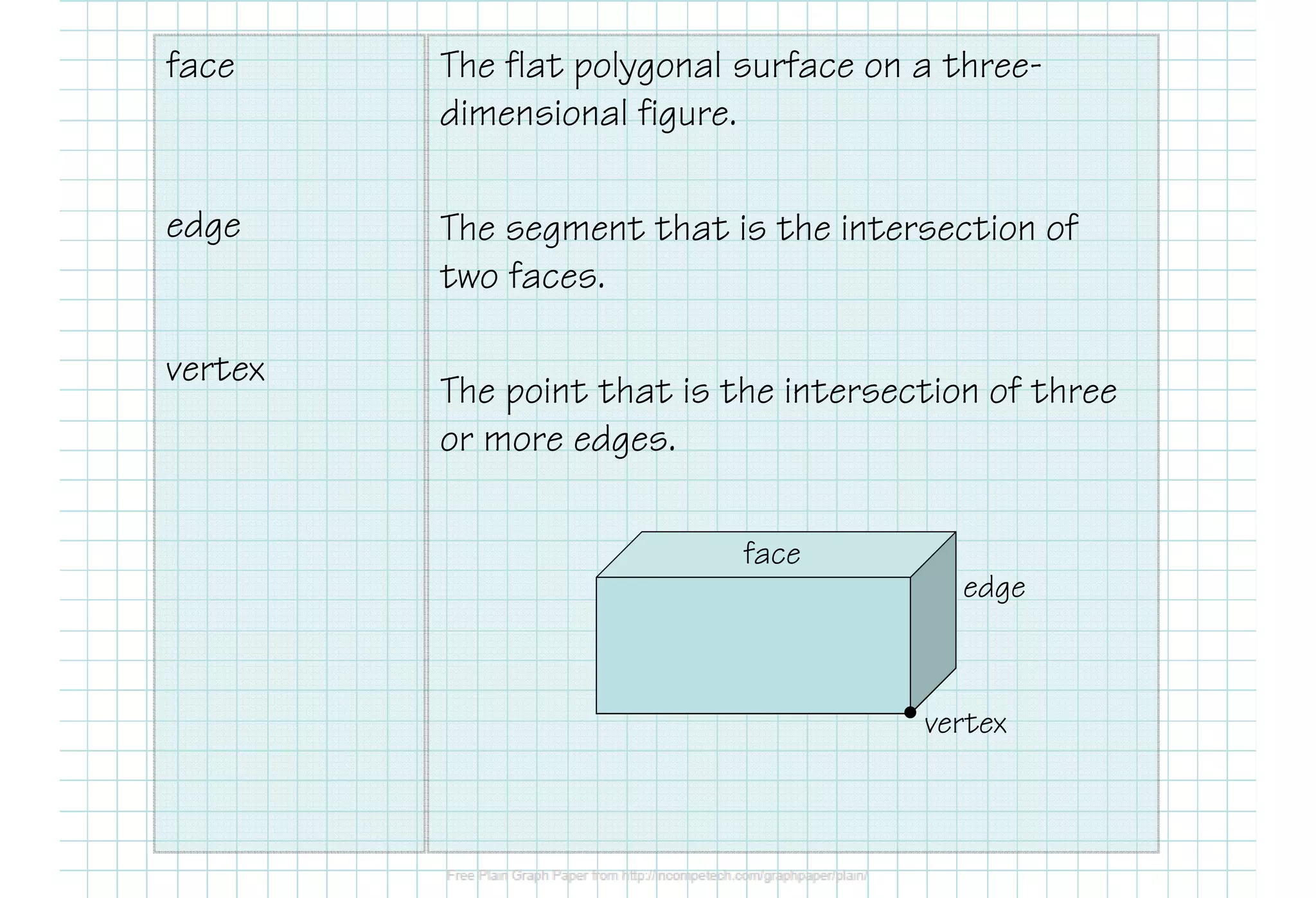
face
edge
vertex
The flat polygonal surface on a three-
dimensional figure.
The segment that is the intersection of
two faces.
The point that is the intersection of three
or more edges.
face
edge
vertex•
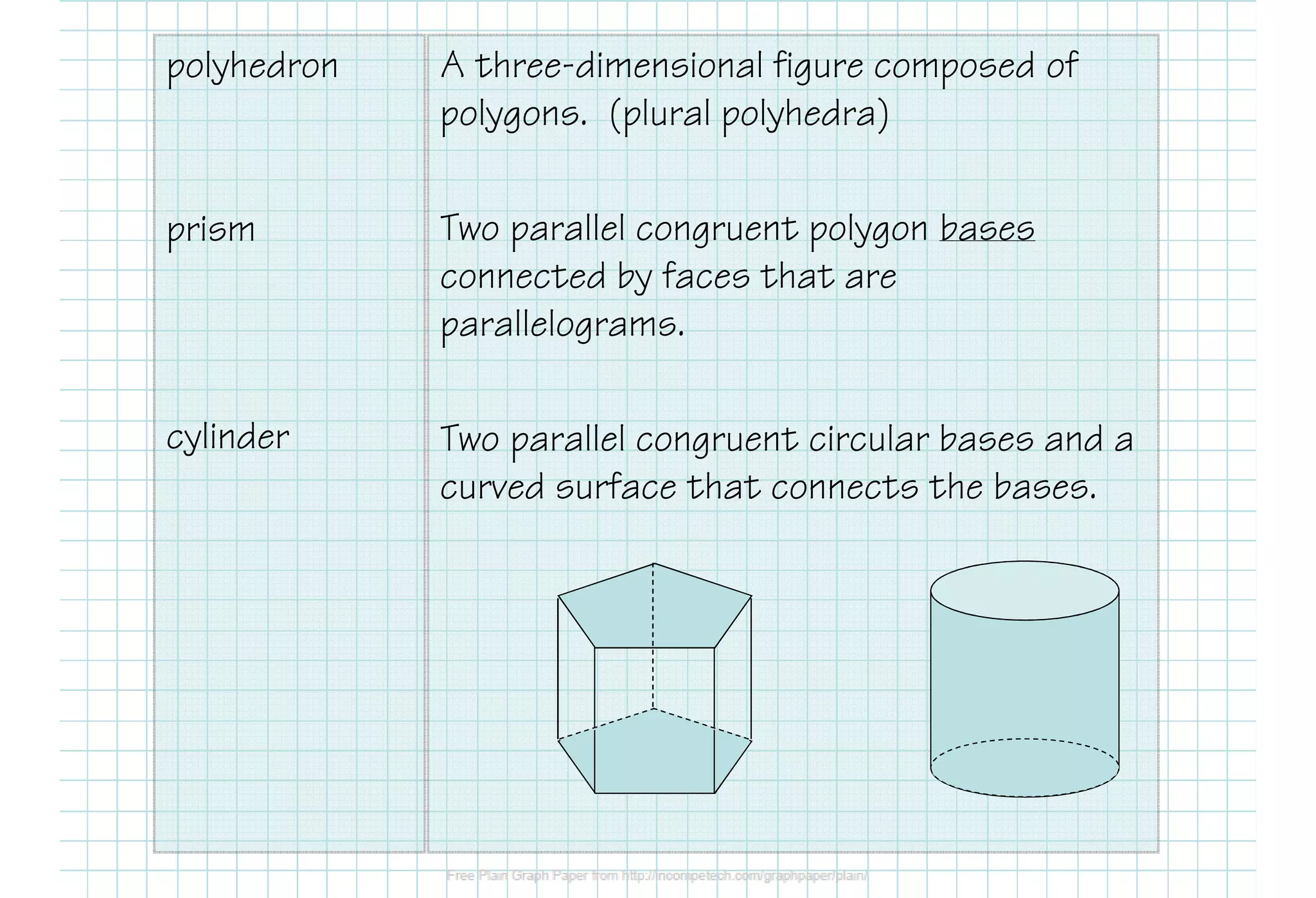
polyhedron
prism
cylinder
A three-dimensional figure composed of
polygons. (plural polyhedra)
Two parallel congruent polygon bases
connected by faces that are
parallelograms.
Two parallel congruent circular bases and a
curved surface that connects the bases.
pyramid
cone
A polygonal base with triangular faces that
meet at a common vertex.
A circular base and a curved surface that
connects the base to a vertex.
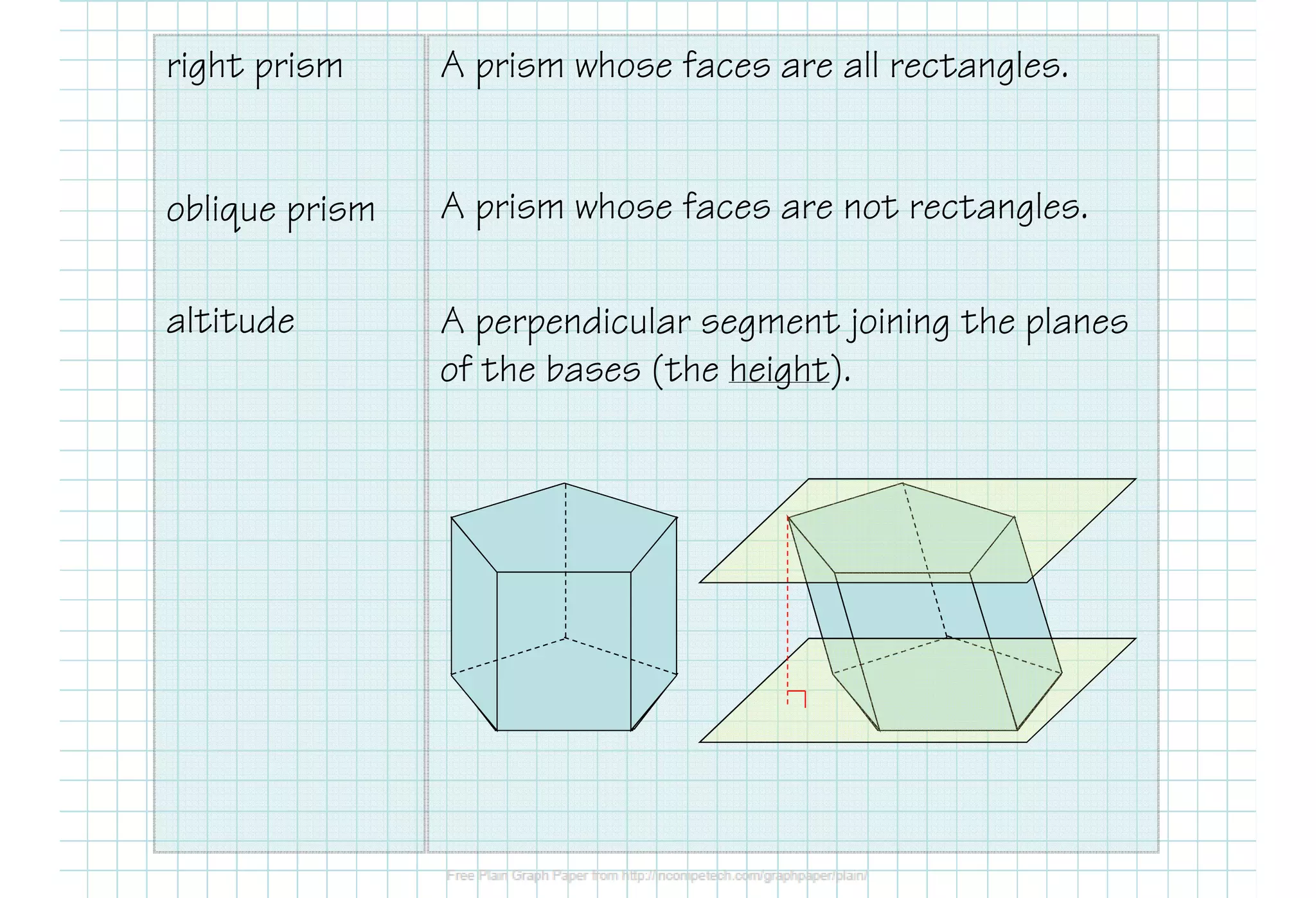
right prism
oblique prism
altitude
A prism whose faces are all rectangles.
A prism whose faces are not rectangles.
A perpendicular segment joining the planes
of the bases (the height).
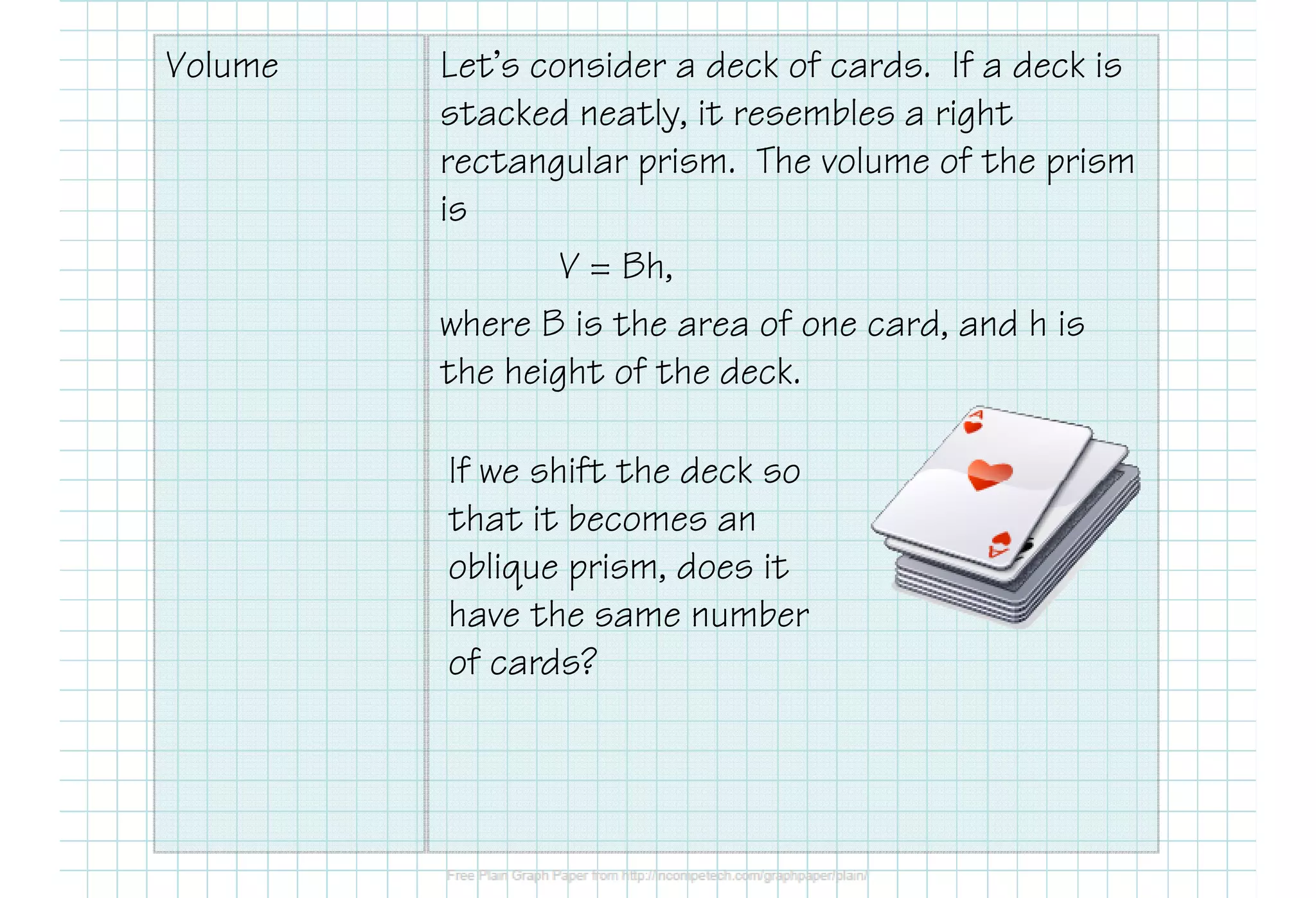
Volume Let’s consider a deck of cards. If a deck is
stacked neatly, it resembles a right
rectangular prism. The volume of the prism
is
V = Bh,
where B is the area of one card, and h is
the height of the deck.
If we shift the deck so
that it becomes an
oblique prism, does it
have the same number
of cards?
For any prism, whether right or oblique, the
volume is
V = Bh
where h is the altitude, not the length of
the lateral edge.
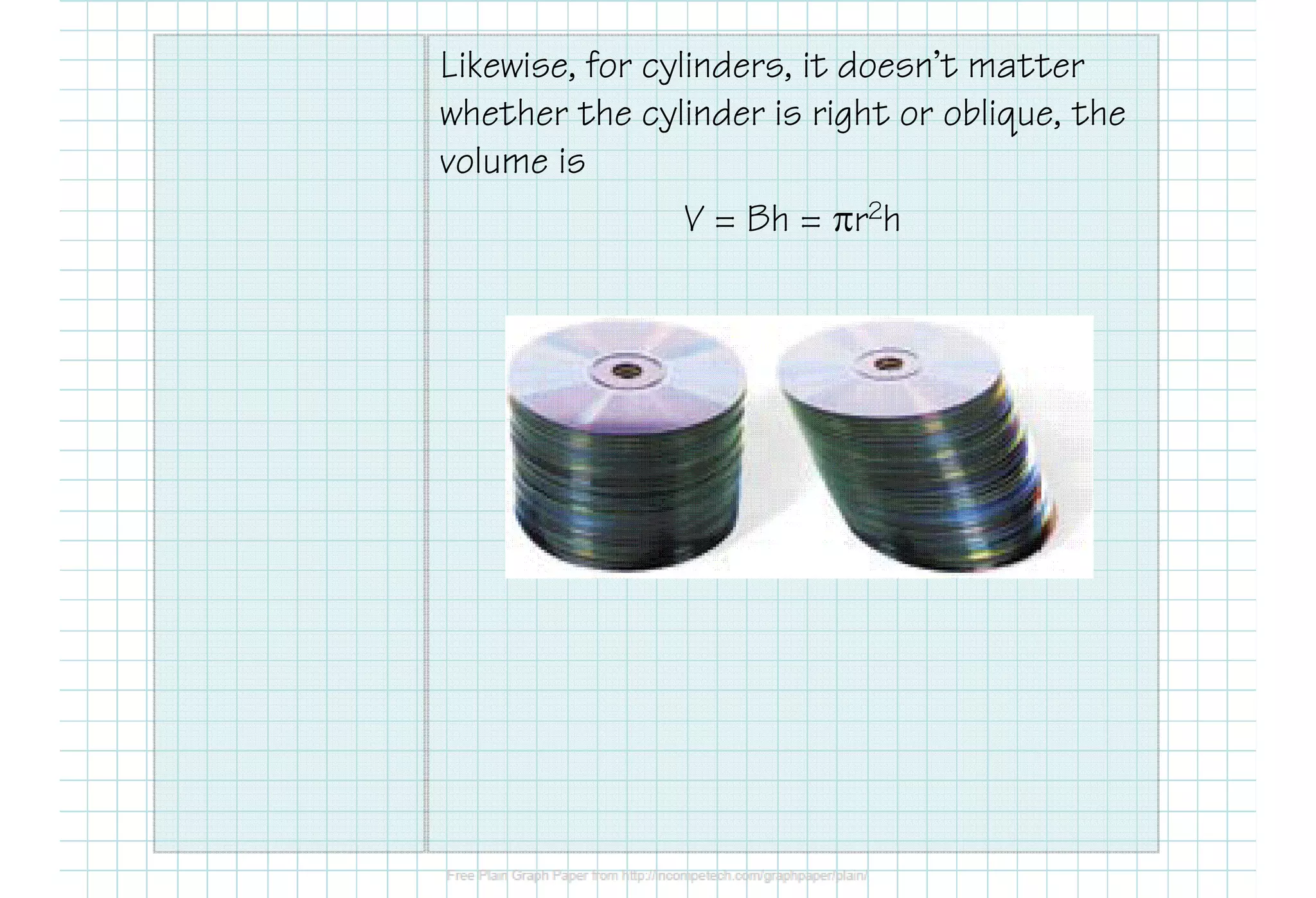
Likewise, for cylinders, it doesn’t matter
whether the cylinder is right or oblique, the
volume is
V = Bh = πr2h
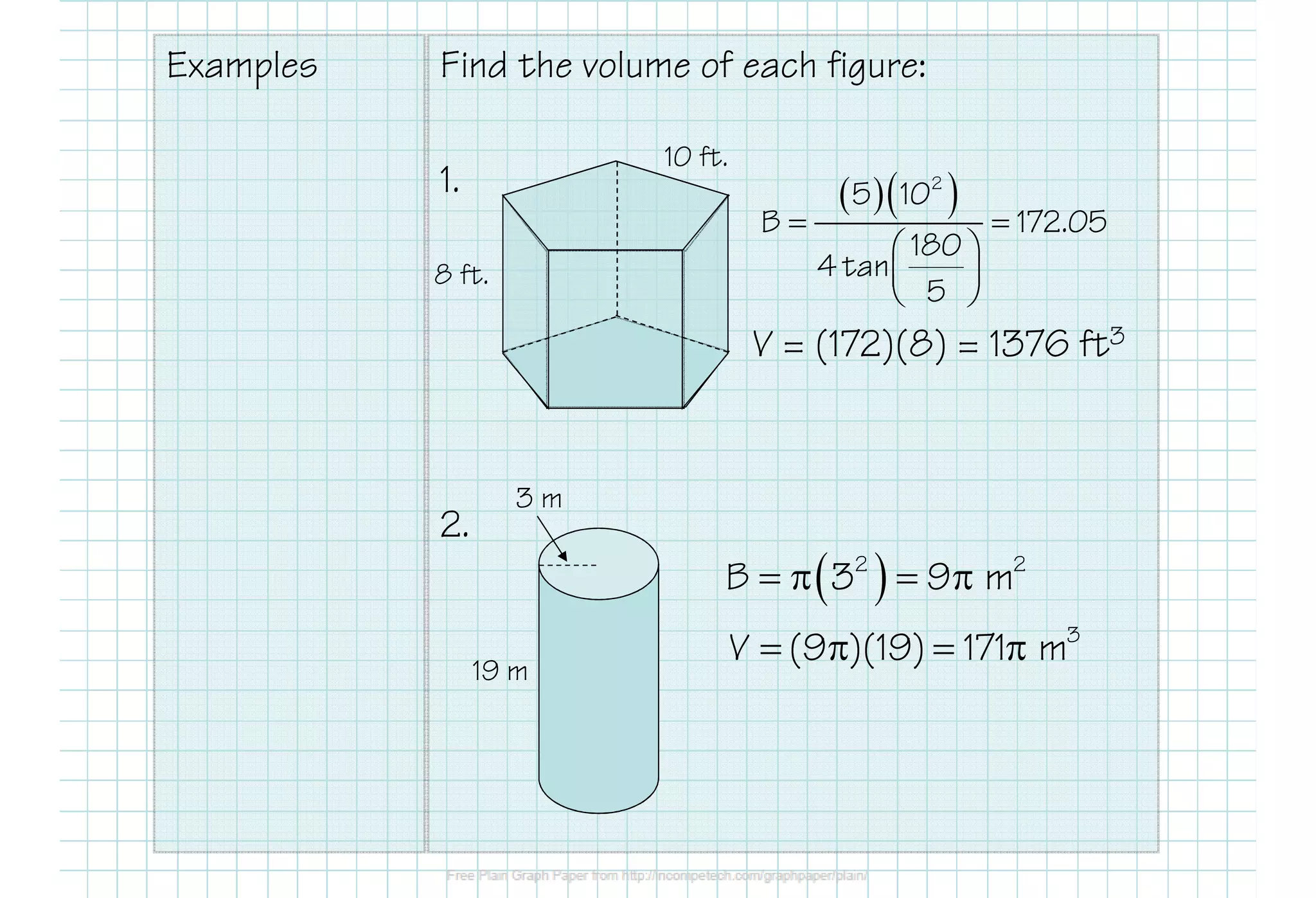
Examples Find the volume of each figure:
1.
2.
10 ft.
8 ft.
3 m
19 m
( )2 2
B 3 9 m= π = π
3
V (9 )(19) 171 m= π = π
( )( )= =
 
 
 
2
5 10
B 172.05
180
4 tan
5
V = (172)(8) = 1376 ft3
The volume of a pyramid with base area B
and height h is
1
V Bh
3
=
The volume of a cone is
21 1
V Bh r h
3 3
= = π
Examples Find the volume of the following:
1.
2.
2
22 3
B 3 yd
4
= =
= = 31
V ( 3)(3) 3 yd
3
10 mm
10 mm
13 mm
5 mm
12 mm
(Pyth. triple)
21
V (10 )(12)
3
=
3
400 mm=
2 yd
3 yd
2 yd
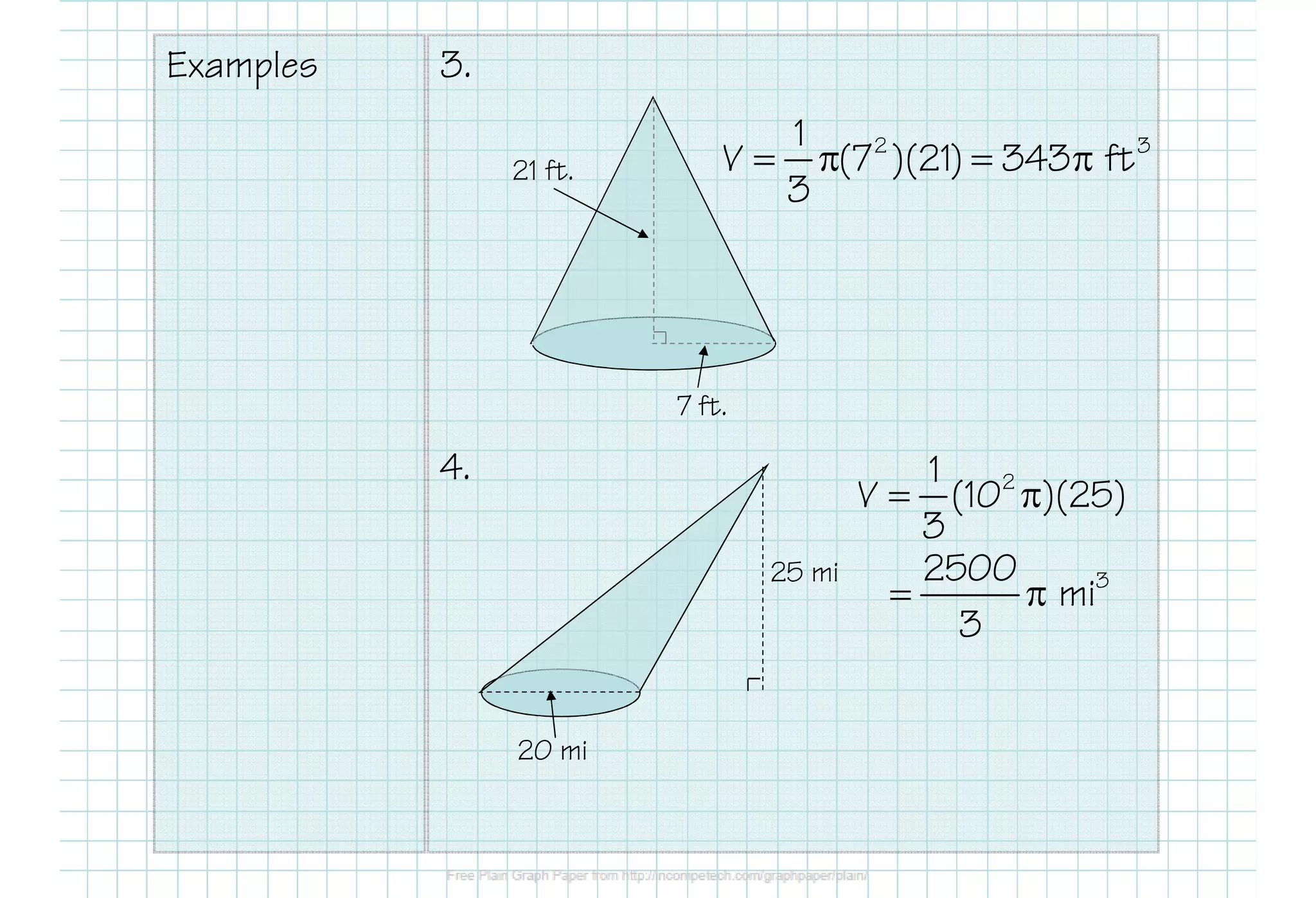
Examples 3.
4.
7 ft.
21 ft.
2 31
V (7 )(21) 343 ft
3
= π = π
25 mi
20 mi
21
V (10 )(25)
3
= π
32500
mi
3
= π

5.13.4 Volume

  • 1.
    5.13.4 Volume The studentis able to (I can): • Calculate the volume of prisms, cylinders, pyramids, and cones
  • 2.
    face edge vertex The flat polygonalsurface on a three- dimensional figure. The segment that is the intersection of two faces. The point that is the intersection of three or more edges. face edge vertex•
  • 3.
    polyhedron prism cylinder A three-dimensional figurecomposed of polygons. (plural polyhedra) Two parallel congruent polygon bases connected by faces that are parallelograms. Two parallel congruent circular bases and a curved surface that connects the bases.
  • 4.
    pyramid cone A polygonal basewith triangular faces that meet at a common vertex. A circular base and a curved surface that connects the base to a vertex.
  • 5.
    right prism oblique prism altitude Aprism whose faces are all rectangles. A prism whose faces are not rectangles. A perpendicular segment joining the planes of the bases (the height).
  • 6.
    Volume Let’s considera deck of cards. If a deck is stacked neatly, it resembles a right rectangular prism. The volume of the prism is V = Bh, where B is the area of one card, and h is the height of the deck. If we shift the deck so that it becomes an oblique prism, does it have the same number of cards?
  • 7.
    For any prism,whether right or oblique, the volume is V = Bh where h is the altitude, not the length of the lateral edge.
  • 8.
    Likewise, for cylinders,it doesn’t matter whether the cylinder is right or oblique, the volume is V = Bh = πr2h
  • 9.
    Examples Find thevolume of each figure: 1. 2. 10 ft. 8 ft. 3 m 19 m ( )2 2 B 3 9 m= π = π 3 V (9 )(19) 171 m= π = π ( )( )= =       2 5 10 B 172.05 180 4 tan 5 V = (172)(8) = 1376 ft3
  • 10.
    The volume ofa pyramid with base area B and height h is 1 V Bh 3 = The volume of a cone is 21 1 V Bh r h 3 3 = = π
  • 11.
    Examples Find thevolume of the following: 1. 2. 2 22 3 B 3 yd 4 = = = = 31 V ( 3)(3) 3 yd 3 10 mm 10 mm 13 mm 5 mm 12 mm (Pyth. triple) 21 V (10 )(12) 3 = 3 400 mm= 2 yd 3 yd 2 yd
  • 12.
    Examples 3. 4. 7 ft. 21ft. 2 31 V (7 )(21) 343 ft 3 = π = π 25 mi 20 mi 21 V (10 )(25) 3 = π 32500 mi 3 = π