MADE BY-NIKUND JAIN
CLASS-9TH-C
ROLL NO.-12
A PRESENTATIONON
MENSURATION
Mensuration comes from the word measurement which is the
assignment of a number to a characteristic of an object or event, which
can be compared with other objects or events. The scope and
application of a measurement is dependent on the context and
discipline. In the natural sciences and engineering, measurements do
not apply to nominal properties of objects or events.
WHATIS MENSURATION?.......
Before SI units were widely adopted around the world, the British systems
of English unitsand later imperial units were used in Britain,
the Commonwealth and the United States. The metric system is a
decimal systems of measurement based on its units for length, the metre and
for mass, the kilogram. It exists in several variations, with different choices
of base units, though these do not affect its day-to-day use. Since the 1960s,
the International System of Units (SI) is the internationally recognised metric
system.
DIFFERENTUNITSANDSYSTEMS….
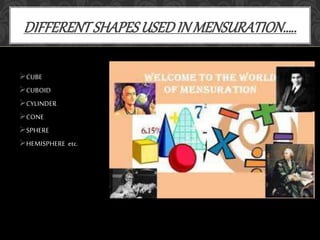
CUBE
CUBOID
CYLINDER
CONE
SPHERE
HEMISPHERE etc.
DIFFERENTSHAPESUSEDIN MENSURATION…..
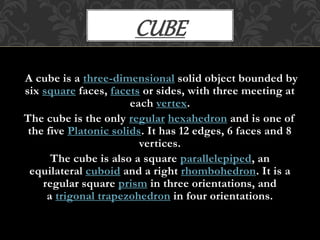
A cube is a three-dimensional solid object bounded by
six square faces, facets or sides, with three meeting at
each vertex.
The cube is the only regular hexahedron and is one of
the five Platonic solids. It has 12 edges, 6 faces and 8
vertices.
The cube is also a square parallelepiped, an
equilateral cuboid and a right rhombohedron. It is a
regular square prism in three orientations, and
a trigonal trapezohedron in four orientations.
CUBE
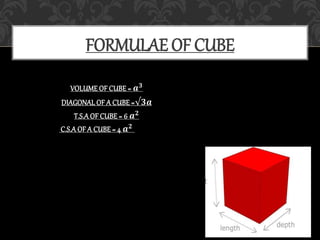
VOLUME OF CUBE = 𝒂 𝟑
DIAGONAL OF A CUBE =√𝟑𝒂
T.S.A OF CUBE = 6 𝒂 𝟐
C.S.A OF A CUBE = 4 𝒂 𝟐
FORMULAE OF CUBE
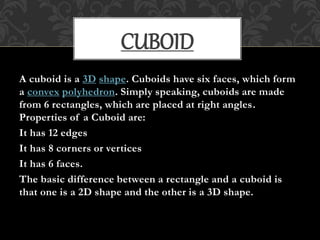
A cuboid is a 3D shape. Cuboids have six faces, which form
a convex polyhedron. Simply speaking, cuboids are made
from 6 rectangles, which are placed at right angles.
Properties of a Cuboid are:
It has 12 edges
It has 8 corners or vertices
It has 6 faces.
The basic difference between a rectangle and a cuboid is
that one is a 2D shape and the other is a 3D shape.
CUBOID
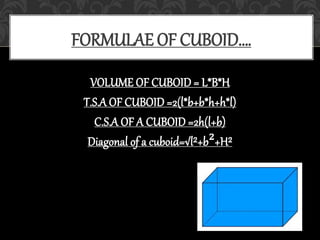
VOLUME OF CUBOID = L*B*H
T.S.A OF CUBOID =2(l*b+b*h+h*l)
C.S.A OF A CUBOID =2h(l+b)
Diagonal of a cuboid=√l²+b²+H²
FORMULAE OF CUBOID….
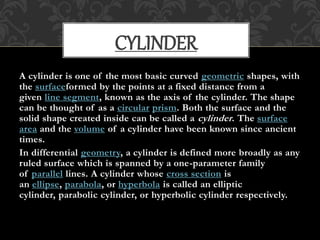
A cylinder is one of the most basic curved geometric shapes, with
the surfaceformed by the points at a fixed distance from a
given line segment, known as the axis of the cylinder. The shape
can be thought of as a circular prism. Both the surface and the
solid shape created inside can be called a cylinder. The surface
area and the volume of a cylinder have been known since ancient
times.
In differential geometry, a cylinder is defined more broadly as any
ruled surface which is spanned by a one-parameter family
of parallel lines. A cylinder whose cross section is
an ellipse, parabola, or hyperbola is called an elliptic
cylinder, parabolic cylinder, or hyperbolic cylinder respectively.
CYLINDER
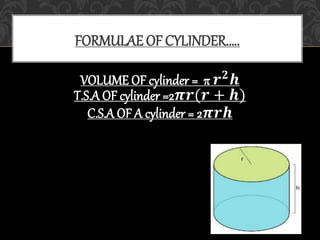
VOLUME OF cylinder = π 𝒓 𝟐
𝒉
T.S.A OF cylinder =2𝝅𝒓(𝒓 + 𝒉)
C.S.A OF A cylinder = 2𝝅𝒓𝒉
FORMULAE OF CYLINDER…..
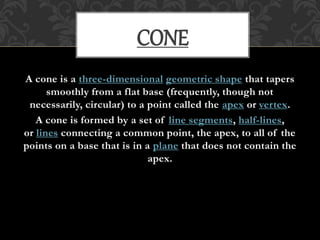
A cone is a three-dimensional geometric shape that tapers
smoothly from a flat base (frequently, though not
necessarily, circular) to a point called the apex or vertex.
A cone is formed by a set of line segments, half-lines,
or lines connecting a common point, the apex, to all of the
points on a base that is in a plane that does not contain the
apex.
CONE
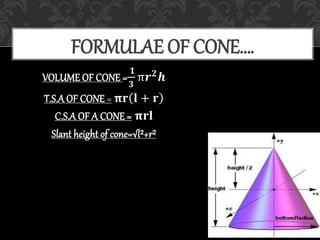
VOLUME OF CONE =
𝟏
𝟑
π𝒓 𝟐
𝒉
T.S.A OF CONE = 𝛑𝐫 𝐥 + 𝐫
C.S.A OF A CONE = 𝛑𝐫𝐥
Slant height of cone=√l²+r²
FORMULAE OF CONE….
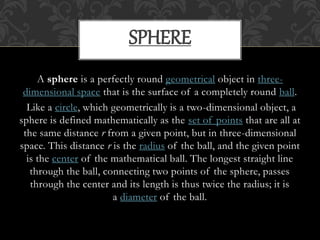
A sphere is a perfectly round geometrical object in three-
dimensional space that is the surface of a completely round ball.
Like a circle, which geometrically is a two-dimensional object, a
sphere is defined mathematically as the set of points that are all at
the same distance r from a given point, but in three-dimensional
space. This distance r is the radius of the ball, and the given point
is the center of the mathematical ball. The longest straight line
through the ball, connecting two points of the sphere, passes
through the center and its length is thus twice the radius; it is
a diameter of the ball.
SPHERE
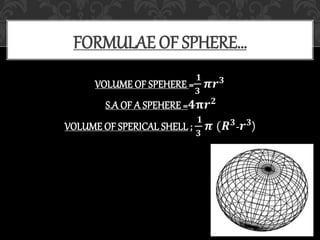
VOLUME OF SPEHERE =
𝟏
𝟑
𝝅𝒓 𝟑
S.A OF A SPEHERE =𝟒𝛑𝒓 𝟐
VOLUME OF SPERICAL SHELL ;
𝟏
𝟑
𝝅 (𝑹 𝟑-𝒓 𝟑)
FORMULAE OF SPHERE…
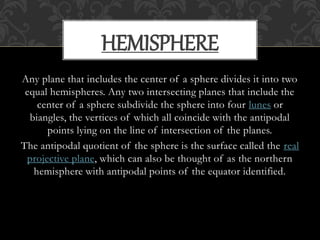
Any plane that includes the center of a sphere divides it into two
equal hemispheres. Any two intersecting planes that include the
center of a sphere subdivide the sphere into four lunes or
biangles, the vertices of which all coincide with the antipodal
points lying on the line of intersection of the planes.
The antipodal quotient of the sphere is the surface called the real
projective plane, which can also be thought of as the northern
hemisphere with antipodal points of the equator identified.
HEMISPHERE
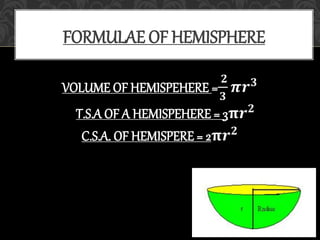
VOLUME OF HEMISPEHERE =
𝟐
𝟑
𝝅𝒓 𝟑
T.S.A OF A HEMISPEHERE = 3𝛑𝒓 𝟐
C.S.A. OF HEMISPERE = 2𝛑𝒓 𝟐
FORMULAE OF HEMISPHERE
Mensuration by nikund

Mensuration by nikund

  • 1.
    MADE BY-NIKUND JAIN CLASS-9TH-C ROLLNO.-12 A PRESENTATIONON MENSURATION
  • 2.
    Mensuration comes fromthe word measurement which is the assignment of a number to a characteristic of an object or event, which can be compared with other objects or events. The scope and application of a measurement is dependent on the context and discipline. In the natural sciences and engineering, measurements do not apply to nominal properties of objects or events. WHATIS MENSURATION?.......
  • 3.
    Before SI unitswere widely adopted around the world, the British systems of English unitsand later imperial units were used in Britain, the Commonwealth and the United States. The metric system is a decimal systems of measurement based on its units for length, the metre and for mass, the kilogram. It exists in several variations, with different choices of base units, though these do not affect its day-to-day use. Since the 1960s, the International System of Units (SI) is the internationally recognised metric system. DIFFERENTUNITSANDSYSTEMS….
  • 4.
  • 5.
    A cube isa three-dimensional solid object bounded by six square faces, facets or sides, with three meeting at each vertex. The cube is the only regular hexahedron and is one of the five Platonic solids. It has 12 edges, 6 faces and 8 vertices. The cube is also a square parallelepiped, an equilateral cuboid and a right rhombohedron. It is a regular square prism in three orientations, and a trigonal trapezohedron in four orientations. CUBE
  • 6.
    VOLUME OF CUBE= 𝒂 𝟑 VOLUME OF CUBE = 𝒂 𝟑 DIAGONAL OF A CUBE =√𝟑𝒂 T.S.A OF CUBE = 6 𝒂 𝟐 C.S.A OF A CUBE = 4 𝒂 𝟐 C.S.A OF A CUBE = 4 𝒂 𝟐 FORMULAE OF CUBE
  • 7.
    A cuboid isa 3D shape. Cuboids have six faces, which form a convex polyhedron. Simply speaking, cuboids are made from 6 rectangles, which are placed at right angles. Properties of a Cuboid are: It has 12 edges It has 8 corners or vertices It has 6 faces. The basic difference between a rectangle and a cuboid is that one is a 2D shape and the other is a 3D shape. CUBOID
  • 8.
    VOLUME OF CUBOID= L*B*H T.S.A OF CUBOID =2(l*b+b*h+h*l) C.S.A OF A CUBOID =2h(l+b) Diagonal of a cuboid=√l²+b²+H² FORMULAE OF CUBOID….
  • 9.
    A cylinder isone of the most basic curved geometric shapes, with the surfaceformed by the points at a fixed distance from a given line segment, known as the axis of the cylinder. The shape can be thought of as a circular prism. Both the surface and the solid shape created inside can be called a cylinder. The surface area and the volume of a cylinder have been known since ancient times. In differential geometry, a cylinder is defined more broadly as any ruled surface which is spanned by a one-parameter family of parallel lines. A cylinder whose cross section is an ellipse, parabola, or hyperbola is called an elliptic cylinder, parabolic cylinder, or hyperbolic cylinder respectively. CYLINDER
  • 10.
    VOLUME OF cylinder= π 𝒓 𝟐 𝒉 T.S.A OF cylinder =2𝝅𝒓(𝒓 + 𝒉) C.S.A OF A cylinder = 2𝝅𝒓𝒉 FORMULAE OF CYLINDER…..
  • 11.
    A cone isa three-dimensional geometric shape that tapers smoothly from a flat base (frequently, though not necessarily, circular) to a point called the apex or vertex. A cone is formed by a set of line segments, half-lines, or lines connecting a common point, the apex, to all of the points on a base that is in a plane that does not contain the apex. CONE
  • 12.
    VOLUME OF CONE= 𝟏 𝟑 π𝒓 𝟐 𝒉 T.S.A OF CONE = 𝛑𝐫 𝐥 + 𝐫 C.S.A OF A CONE = 𝛑𝐫𝐥 Slant height of cone=√l²+r² FORMULAE OF CONE….
  • 13.
    A sphere isa perfectly round geometrical object in three- dimensional space that is the surface of a completely round ball. Like a circle, which geometrically is a two-dimensional object, a sphere is defined mathematically as the set of points that are all at the same distance r from a given point, but in three-dimensional space. This distance r is the radius of the ball, and the given point is the center of the mathematical ball. The longest straight line through the ball, connecting two points of the sphere, passes through the center and its length is thus twice the radius; it is a diameter of the ball. SPHERE
  • 14.
    VOLUME OF SPEHERE= 𝟏 𝟑 𝝅𝒓 𝟑 S.A OF A SPEHERE =𝟒𝛑𝒓 𝟐 VOLUME OF SPERICAL SHELL ; 𝟏 𝟑 𝝅 (𝑹 𝟑-𝒓 𝟑) FORMULAE OF SPHERE…
  • 15.
    Any plane thatincludes the center of a sphere divides it into two equal hemispheres. Any two intersecting planes that include the center of a sphere subdivide the sphere into four lunes or biangles, the vertices of which all coincide with the antipodal points lying on the line of intersection of the planes. The antipodal quotient of the sphere is the surface called the real projective plane, which can also be thought of as the northern hemisphere with antipodal points of the equator identified. HEMISPHERE
  • 16.
    VOLUME OF HEMISPEHERE= 𝟐 𝟑 𝝅𝒓 𝟑 T.S.A OF A HEMISPEHERE = 3𝛑𝒓 𝟐 C.S.A. OF HEMISPERE = 2𝛑𝒓 𝟐 FORMULAE OF HEMISPHERE