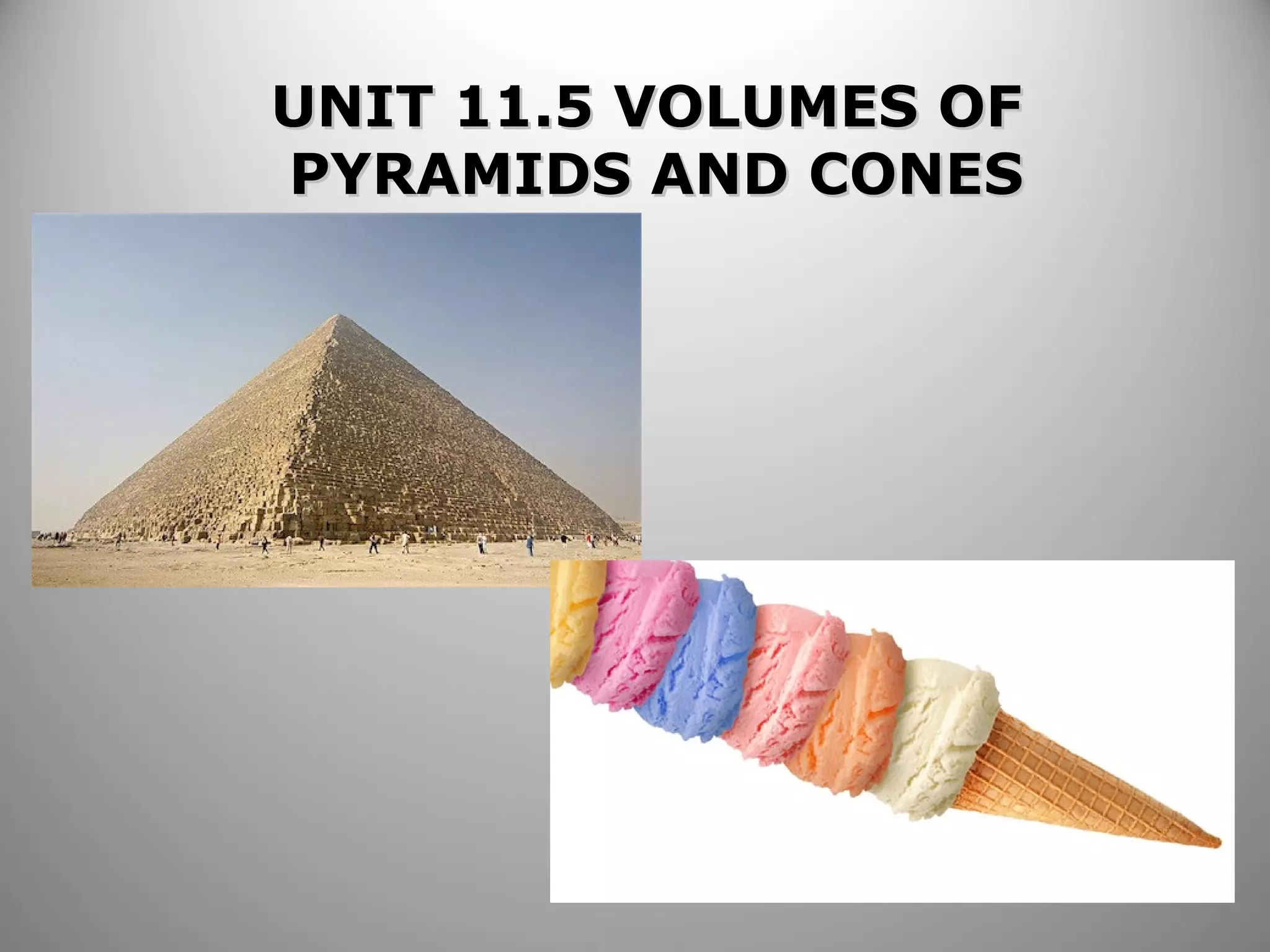

UNIT 11.5 VOLUMES OFUNIT 11.5 VOLUMES OF
PYRAMIDS AND CONESPYRAMIDS AND CONES
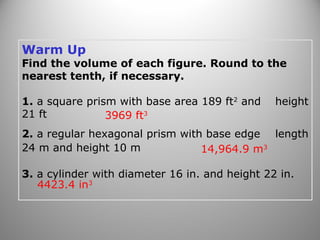
Warm Up
Find the volume of each figure. Round to the
nearest tenth, if necessary.
1. a square prism with base area 189 ft2
and height
21 ft
2. a regular hexagonal prism with base edge length
24 m and height 10 m
3. a cylinder with diameter 16 in. and height 22 in.
3969 ft3
14,964.9 m3
4423.4 in3
Learn and apply the formula for the
volume of a pyramid.
Learn and apply the formula for the
volume of a cone.
Objectives
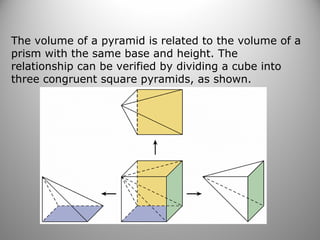
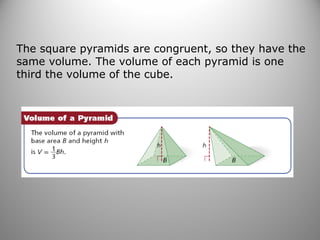
The volume of a pyramid is related to the volume of a
prism with the same base and height. The
relationship can be verified by dividing a cube into
three congruent square pyramids, as shown.
The square pyramids are congruent, so they have the
same volume. The volume of each pyramid is one
third the volume of the cube.
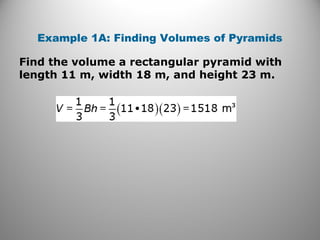
Example 1A: Finding Volumes of Pyramids
Find the volume a rectangular pyramid with
length 11 m, width 18 m, and height 23 m.
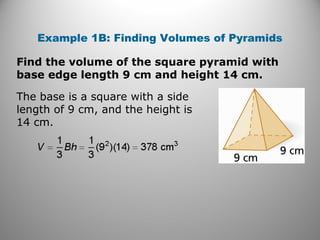
Example 1B: Finding Volumes of Pyramids
Find the volume of the square pyramid with
base edge length 9 cm and height 14 cm.
The base is a square with a side
length of 9 cm, and the height is
14 cm.
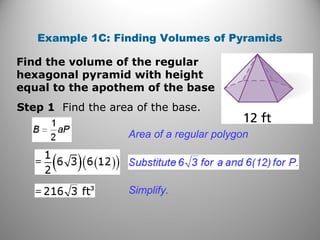
Example 1C: Finding Volumes of Pyramids
Find the volume of the regular
hexagonal pyramid with height
equal to the apothem of the base
Step 1 Find the area of the base.
Area of a regular polygon
Simplify.
Example 1C Continued
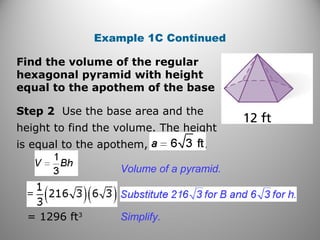
Step 2 Use the base area and the
height to find the volume. The height
is equal to the apothem, .
Volume of a pyramid.
= 1296 ft3
Find the volume of the regular
hexagonal pyramid with height
equal to the apothem of the base
Simplify.
Check It Out! Example 1
Find the volume of a regular hexagonal pyramid
with a base edge length of 2 cm and a height
equal to the area of the base.
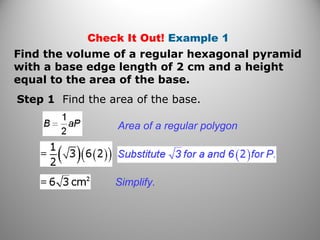
Step 1 Find the area of the base.
Area of a regular polygon
Simplify.
Check It Out! Example 1 Continued
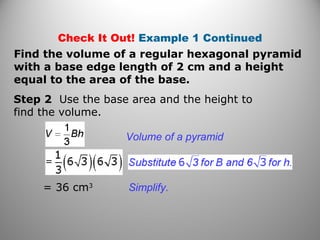
Step 2 Use the base area and the height to
find the volume.
Volume of a pyramid
Find the volume of a regular hexagonal pyramid
with a base edge length of 2 cm and a height
equal to the area of the base.
= 36 cm3
Simplify.
An art gallery is a 6-story square pyramid with
base area acre (1 acre = 4840 yd2
, 1 story ≈
10 ft). Estimate the volume in cubic yards and
cubic feet.
Example 2: Architecture Application
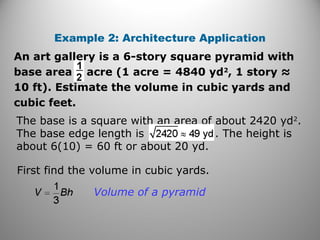
First find the volume in cubic yards.
Volume of a pyramid
The base is a square with an area of about 2420 yd2
.
The base edge length is . The height is
about 6(10) = 60 ft or about 20 yd.
Example 2 Continued
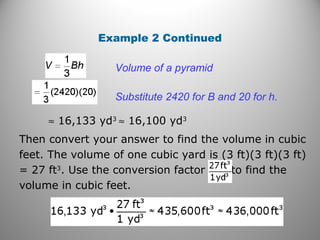
Substitute 2420 for B and 20 for h.
≈ 16,133 yd3
≈ 16,100 yd3
Volume of a pyramid
Then convert your answer to find the volume in cubic
feet. The volume of one cubic yard is (3 ft)(3 ft)(3 ft)
= 27 ft3
. Use the conversion factor to find the
volume in cubic feet.
Check It Out! Example 2
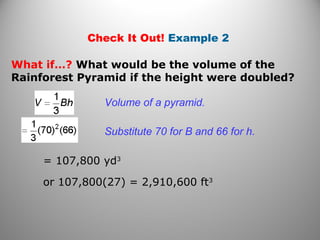
What if…? What would be the volume of the
Rainforest Pyramid if the height were doubled?
Volume of a pyramid.
Substitute 70 for B and 66 for h.
= 107,800 yd3
or 107,800(27) = 2,910,600 ft3
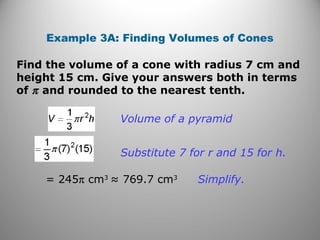
= 245π cm3
≈ 769.7 cm3
Example 3A: Finding Volumes of Cones
Find the volume of a cone with radius 7 cm and
height 15 cm. Give your answers both in terms
of π and rounded to the nearest tenth.
Volume of a pyramid
Substitute 7 for r and 15 for h.
Simplify.
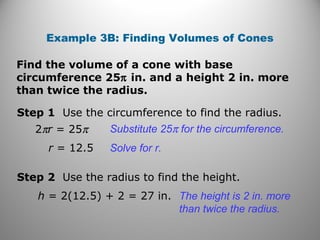
Example 3B: Finding Volumes of Cones
Find the volume of a cone with base
circumference 25π in. and a height 2 in. more
than twice the radius.
Step 1 Use the circumference to find the radius.
Step 2 Use the radius to find the height.
h = 2(12.5) + 2 = 27 in. The height is 2 in. more
than twice the radius.
2πr = 25π Substitute 25π for the circumference.
r = 12.5 Solve for r.
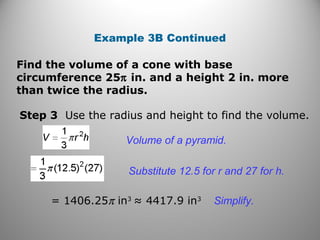
Example 3B Continued
Step 3 Use the radius and height to find the volume.
Volume of a pyramid.
Substitute 12.5 for r and 27 for h.
= 1406.25π in3
≈ 4417.9 in3
Simplify.
Find the volume of a cone with base
circumference 25π in. and a height 2 in. more
than twice the radius.
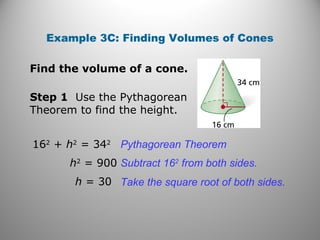
Example 3C: Finding Volumes of Cones
Find the volume of a cone.
Step 1 Use the Pythagorean
Theorem to find the height.
162
+ h2
= 342
Pythagorean Theorem
h2
= 900 Subtract 162
from both sides.
h = 30 Take the square root of both sides.
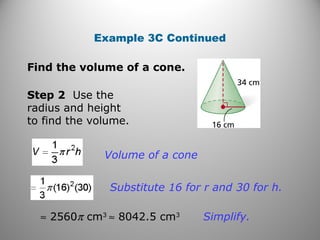
Example 3C Continued
Step 2 Use the
radius and height
to find the volume.
Volume of a cone
Substitute 16 for r and 30 for h.
≈ 2560π cm3
≈ 8042.5 cm3
Simplify.
Find the volume of a cone.
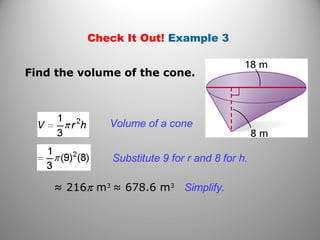
Check It Out! Example 3
Find the volume of the cone.
Volume of a cone
Substitute 9 for r and 8 for h.
≈ 216π m3
≈ 678.6 m3
Simplify.
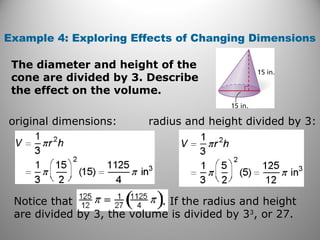
Example 4: Exploring Effects of Changing Dimensions
original dimensions: radius and height divided by 3:
Notice that . If the radius and height
are divided by 3, the volume is divided by 33
, or 27.
The diameter and height of the
cone are divided by 3. Describe
the effect on the volume.
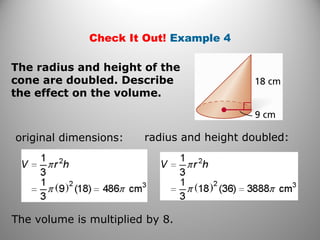
Check It Out! Example 4
original dimensions: radius and height doubled:
The volume is multiplied by 8.
The radius and height of the
cone are doubled. Describe
the effect on the volume.
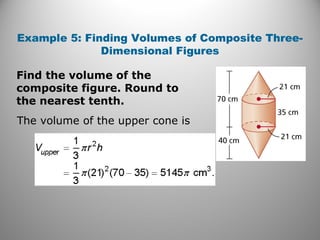
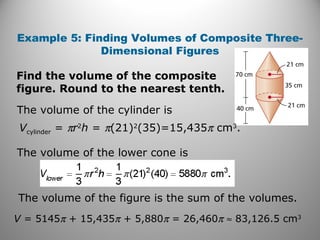
Example 5: Finding Volumes of Composite Three-
Dimensional Figures
Find the volume of the
composite figure. Round to
the nearest tenth.
The volume of the upper cone is
Example 5: Finding Volumes of Composite Three-
Dimensional Figures
The volume of the cylinder is
The volume of the lower cone is
The volume of the figure is the sum of the volumes.
Find the volume of the composite
figure. Round to the nearest tenth.
Vcylinder = πr2
h = π(21)2
(35)=15,435π cm3
.
V = 5145π + 15,435π + 5,880π = 26,460π ≈ 83,126.5 cm3
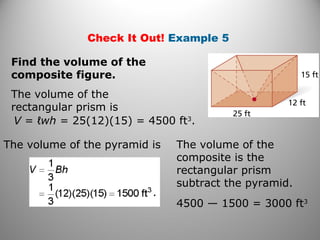
Check It Out! Example 5
Find the volume of the
composite figure.
The volume of the
rectangular prism is
V = ℓwh = 25(12)(15) = 4500 ft3
.
The volume of the pyramid is The volume of the
composite is the
rectangular prism
subtract the pyramid.
4500 — 1500 = 3000 ft3
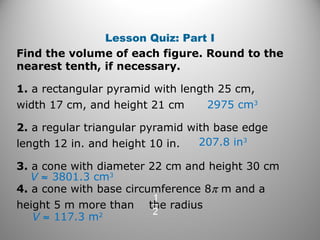
Lesson Quiz: Part I
Find the volume of each figure. Round to the
nearest tenth, if necessary.
1. a rectangular pyramid with length 25 cm,
width 17 cm, and height 21 cm
2. a regular triangular pyramid with base edge
length 12 in. and height 10 in.
3. a cone with diameter 22 cm and height 30 cm
4. a cone with base circumference 8π m and a
height 5 m more than the radius
2975 cm3
207.8 in3
V ≈ 3801.3 cm3
V ≈ 117.3 m2
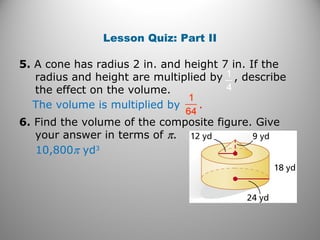
Lesson Quiz: Part II
5. A cone has radius 2 in. and height 7 in. If the
radius and height are multiplied by , describe
the effect on the volume.
6. Find the volume of the composite figure. Give
your answer in terms of π.
The volume is multiplied by .
10,800π yd3
All rights belong to their
respective owners.
Copyright Disclaimer Under
Section 107 of the Copyright Act
1976, allowance is made for
"fair use" for purposes such as
criticism, comment, news
reporting, TEACHING,
scholarship, and research. 
Fair use is a use permitted by
copyright statute that might
otherwise be infringing. 
Non-profit, EDUCATIONAL or
personal use tips the balance in
favor of fair use.

Geometry unit 11.5

  • 1.
    UNIT 11.5 VOLUMESOFUNIT 11.5 VOLUMES OF PYRAMIDS AND CONESPYRAMIDS AND CONES
  • 2.
    Warm Up Find thevolume of each figure. Round to the nearest tenth, if necessary. 1. a square prism with base area 189 ft2 and height 21 ft 2. a regular hexagonal prism with base edge length 24 m and height 10 m 3. a cylinder with diameter 16 in. and height 22 in. 3969 ft3 14,964.9 m3 4423.4 in3
  • 3.
    Learn and applythe formula for the volume of a pyramid. Learn and apply the formula for the volume of a cone. Objectives
  • 4.
    The volume ofa pyramid is related to the volume of a prism with the same base and height. The relationship can be verified by dividing a cube into three congruent square pyramids, as shown.
  • 5.
    The square pyramidsare congruent, so they have the same volume. The volume of each pyramid is one third the volume of the cube.
  • 6.
    Example 1A: FindingVolumes of Pyramids Find the volume a rectangular pyramid with length 11 m, width 18 m, and height 23 m.
  • 7.
    Example 1B: FindingVolumes of Pyramids Find the volume of the square pyramid with base edge length 9 cm and height 14 cm. The base is a square with a side length of 9 cm, and the height is 14 cm.
  • 8.
    Example 1C: FindingVolumes of Pyramids Find the volume of the regular hexagonal pyramid with height equal to the apothem of the base Step 1 Find the area of the base. Area of a regular polygon Simplify.
  • 9.
    Example 1C Continued Step2 Use the base area and the height to find the volume. The height is equal to the apothem, . Volume of a pyramid. = 1296 ft3 Find the volume of the regular hexagonal pyramid with height equal to the apothem of the base Simplify.
  • 10.
    Check It Out!Example 1 Find the volume of a regular hexagonal pyramid with a base edge length of 2 cm and a height equal to the area of the base. Step 1 Find the area of the base. Area of a regular polygon Simplify.
  • 11.
    Check It Out!Example 1 Continued Step 2 Use the base area and the height to find the volume. Volume of a pyramid Find the volume of a regular hexagonal pyramid with a base edge length of 2 cm and a height equal to the area of the base. = 36 cm3 Simplify.
  • 12.
    An art galleryis a 6-story square pyramid with base area acre (1 acre = 4840 yd2 , 1 story ≈ 10 ft). Estimate the volume in cubic yards and cubic feet. Example 2: Architecture Application First find the volume in cubic yards. Volume of a pyramid The base is a square with an area of about 2420 yd2 . The base edge length is . The height is about 6(10) = 60 ft or about 20 yd.
  • 13.
    Example 2 Continued Substitute2420 for B and 20 for h. ≈ 16,133 yd3 ≈ 16,100 yd3 Volume of a pyramid Then convert your answer to find the volume in cubic feet. The volume of one cubic yard is (3 ft)(3 ft)(3 ft) = 27 ft3 . Use the conversion factor to find the volume in cubic feet.
  • 14.
    Check It Out!Example 2 What if…? What would be the volume of the Rainforest Pyramid if the height were doubled? Volume of a pyramid. Substitute 70 for B and 66 for h. = 107,800 yd3 or 107,800(27) = 2,910,600 ft3
  • 16.
    = 245π cm3 ≈769.7 cm3 Example 3A: Finding Volumes of Cones Find the volume of a cone with radius 7 cm and height 15 cm. Give your answers both in terms of π and rounded to the nearest tenth. Volume of a pyramid Substitute 7 for r and 15 for h. Simplify.
  • 17.
    Example 3B: FindingVolumes of Cones Find the volume of a cone with base circumference 25π in. and a height 2 in. more than twice the radius. Step 1 Use the circumference to find the radius. Step 2 Use the radius to find the height. h = 2(12.5) + 2 = 27 in. The height is 2 in. more than twice the radius. 2πr = 25π Substitute 25π for the circumference. r = 12.5 Solve for r.
  • 18.
    Example 3B Continued Step3 Use the radius and height to find the volume. Volume of a pyramid. Substitute 12.5 for r and 27 for h. = 1406.25π in3 ≈ 4417.9 in3 Simplify. Find the volume of a cone with base circumference 25π in. and a height 2 in. more than twice the radius.
  • 19.
    Example 3C: FindingVolumes of Cones Find the volume of a cone. Step 1 Use the Pythagorean Theorem to find the height. 162 + h2 = 342 Pythagorean Theorem h2 = 900 Subtract 162 from both sides. h = 30 Take the square root of both sides.
  • 20.
    Example 3C Continued Step2 Use the radius and height to find the volume. Volume of a cone Substitute 16 for r and 30 for h. ≈ 2560π cm3 ≈ 8042.5 cm3 Simplify. Find the volume of a cone.
  • 21.
    Check It Out!Example 3 Find the volume of the cone. Volume of a cone Substitute 9 for r and 8 for h. ≈ 216π m3 ≈ 678.6 m3 Simplify.
  • 22.
    Example 4: ExploringEffects of Changing Dimensions original dimensions: radius and height divided by 3: Notice that . If the radius and height are divided by 3, the volume is divided by 33 , or 27. The diameter and height of the cone are divided by 3. Describe the effect on the volume.
  • 23.
    Check It Out!Example 4 original dimensions: radius and height doubled: The volume is multiplied by 8. The radius and height of the cone are doubled. Describe the effect on the volume.
  • 24.
    Example 5: FindingVolumes of Composite Three- Dimensional Figures Find the volume of the composite figure. Round to the nearest tenth. The volume of the upper cone is
  • 25.
    Example 5: FindingVolumes of Composite Three- Dimensional Figures The volume of the cylinder is The volume of the lower cone is The volume of the figure is the sum of the volumes. Find the volume of the composite figure. Round to the nearest tenth. Vcylinder = πr2 h = π(21)2 (35)=15,435π cm3 . V = 5145π + 15,435π + 5,880π = 26,460π ≈ 83,126.5 cm3
  • 26.
    Check It Out!Example 5 Find the volume of the composite figure. The volume of the rectangular prism is V = ℓwh = 25(12)(15) = 4500 ft3 . The volume of the pyramid is The volume of the composite is the rectangular prism subtract the pyramid. 4500 — 1500 = 3000 ft3
  • 27.
    Lesson Quiz: PartI Find the volume of each figure. Round to the nearest tenth, if necessary. 1. a rectangular pyramid with length 25 cm, width 17 cm, and height 21 cm 2. a regular triangular pyramid with base edge length 12 in. and height 10 in. 3. a cone with diameter 22 cm and height 30 cm 4. a cone with base circumference 8π m and a height 5 m more than the radius 2975 cm3 207.8 in3 V ≈ 3801.3 cm3 V ≈ 117.3 m2
  • 28.
    Lesson Quiz: PartII 5. A cone has radius 2 in. and height 7 in. If the radius and height are multiplied by , describe the effect on the volume. 6. Find the volume of the composite figure. Give your answer in terms of π. The volume is multiplied by . 10,800π yd3
  • 29.
    All rights belongto their respective owners. Copyright Disclaimer Under Section 107 of the Copyright Act 1976, allowance is made for "fair use" for purposes such as criticism, comment, news reporting, TEACHING, scholarship, and research.  Fair use is a use permitted by copyright statute that might otherwise be infringing.  Non-profit, EDUCATIONAL or personal use tips the balance in favor of fair use.