The Area of a Trapezium
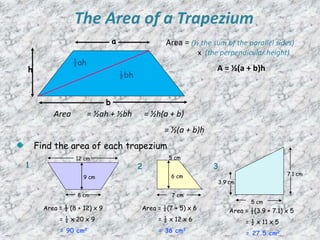
Area = (½ the sum of the parallel sides)
x (the perpendicular height)
A = ½(a + b)h
a
b
h
½ah
½bh
Area = ½ah + ½bh = ½h(a + b)
= ½(a + b)h
Find the area of each trapezium
1
8 cm
12 cm
9 cm
2
5 cm
7 cm
6 cm
3
5 cm
3.9 cm
7.1 cm
Area = ½ (8 + 12) x 9
= ½ x 20 x 9
= 90 cm2
Area = ½(7 + 5) x 6
= ½ x 12 x 6
= 36 cm2
Area = ½(3.9 + 7.1) x 5
= ½ x 11 x 5
= 27.5 cm2
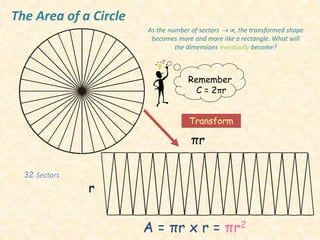
32 Sectors
Transform
Remember
C = 2πr
?
?
As the number of sectors  , the transformed shape
becomes more and more like a rectangle. What will
the dimensions eventually become?
½C
r
πr
A = πr x r = πr2
The Area of a Circle
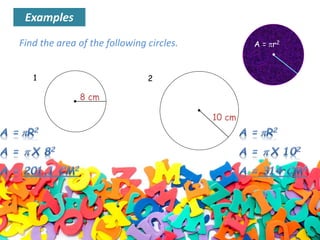
Find the area of the following circles. A = r2
8 cm
1
10 cm
2
Examples
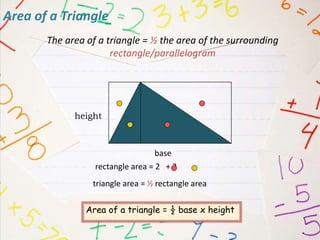
Area of a Triangle
rectangle area = 2 + 2
triangle area = ½ rectangle area
base
height
Area of a triangle = ½ base x height
The area of a triangle = ½ the area of the surrounding
rectangle/parallelogram
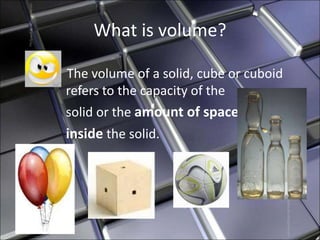
What is volume?
The volume of a solid, cube or cuboid
refers to the capacity of the
solid or the amount of space
inside the solid.
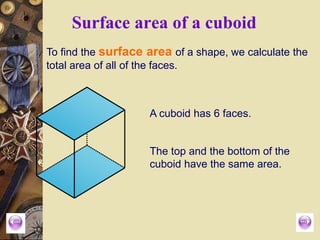
To find the surface area of a shape, we calculate the
total area of all of the faces.
A cuboid has 6 faces.
The top and the bottom of the
cuboid have the same area.
Surface area of a cuboid
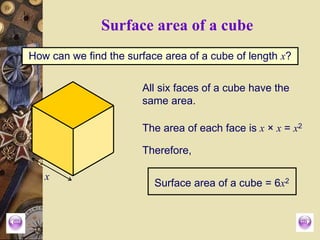
How can we find the surface area of a cube of length x?
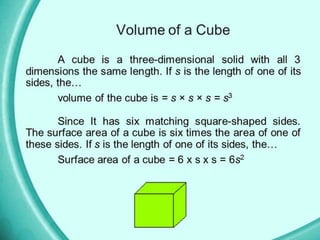
Surface area of a cube
x
All six faces of a cube have the
same area.
The area of each face is x × x = x2
Therefore,
Surface area of a cube = 6x2
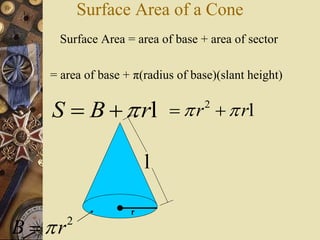
Surface Area of a Cone
Surface Area = area of base + area of sector
= area of base + π(radius of base)(slant height)
S B r  l 2
r r   l
l
2
B r
r
Acknowledgement
Mensuration

Mensuration

  • 4.
    The Area ofa Trapezium Area = (½ the sum of the parallel sides) x (the perpendicular height) A = ½(a + b)h a b h ½ah ½bh Area = ½ah + ½bh = ½h(a + b) = ½(a + b)h Find the area of each trapezium 1 8 cm 12 cm 9 cm 2 5 cm 7 cm 6 cm 3 5 cm 3.9 cm 7.1 cm Area = ½ (8 + 12) x 9 = ½ x 20 x 9 = 90 cm2 Area = ½(7 + 5) x 6 = ½ x 12 x 6 = 36 cm2 Area = ½(3.9 + 7.1) x 5 = ½ x 11 x 5 = 27.5 cm2
  • 6.
    32 Sectors Transform Remember C =2πr ? ? As the number of sectors  , the transformed shape becomes more and more like a rectangle. What will the dimensions eventually become? ½C r πr A = πr x r = πr2 The Area of a Circle
  • 7.
    Find the areaof the following circles. A = r2 8 cm 1 10 cm 2 Examples
  • 8.
    Area of aTriangle rectangle area = 2 + 2 triangle area = ½ rectangle area base height Area of a triangle = ½ base x height The area of a triangle = ½ the area of the surrounding rectangle/parallelogram
  • 10.
    What is volume? Thevolume of a solid, cube or cuboid refers to the capacity of the solid or the amount of space inside the solid.
  • 17.
    To find thesurface area of a shape, we calculate the total area of all of the faces. A cuboid has 6 faces. The top and the bottom of the cuboid have the same area. Surface area of a cuboid
  • 18.
    How can wefind the surface area of a cube of length x? Surface area of a cube x All six faces of a cube have the same area. The area of each face is x × x = x2 Therefore, Surface area of a cube = 6x2
  • 19.
    Surface Area ofa Cone Surface Area = area of base + area of sector = area of base + π(radius of base)(slant height) S B r  l 2 r r   l l 2 B r r
  • 20.