Volume of Prisms and Cylinders
The student is able to (I can):
• Classify three-dimensional figures according to their
properties
• Calculate the volumes of prisms and cylinders
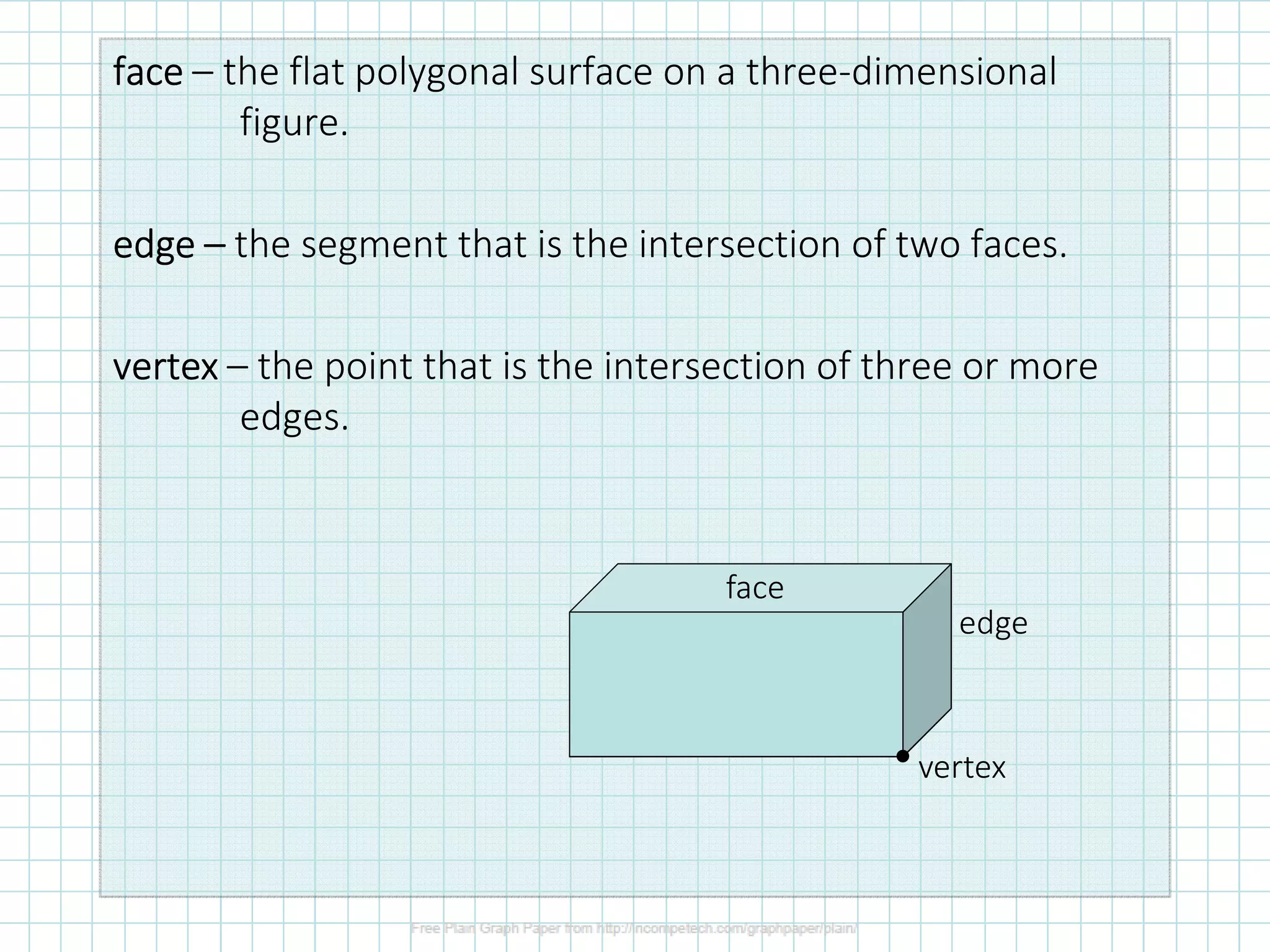
facefacefaceface – the flat polygonal surface on a three-dimensional
figure.
edgeedgeedgeedge –––– the segment that is the intersection of two faces.
vertexvertexvertexvertex – the point that is the intersection of three or more
edges.
face
edge
vertex•
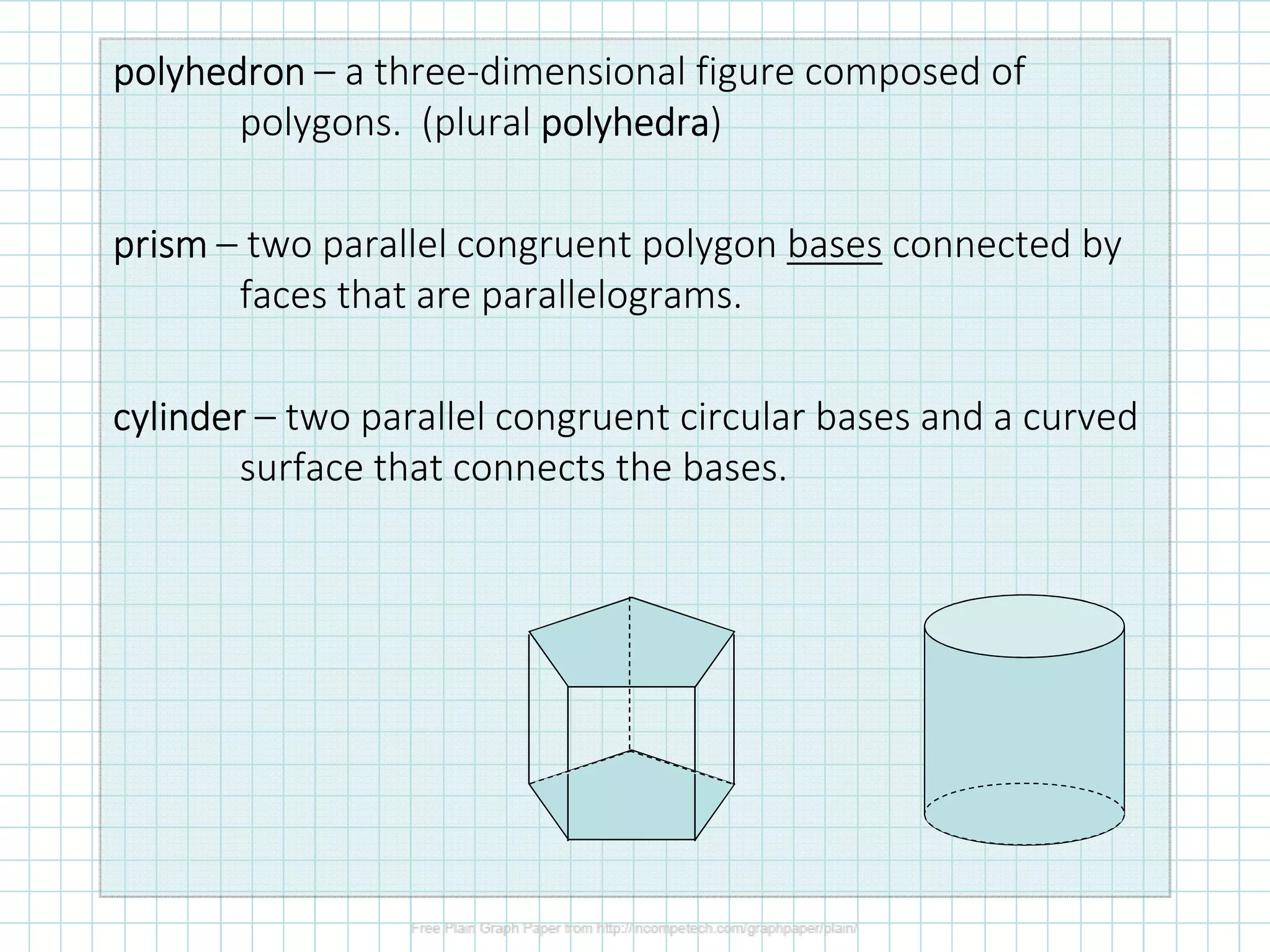
polyhedronpolyhedronpolyhedronpolyhedron – a three-dimensional figure composed of
polygons. (plural polyhedrapolyhedrapolyhedrapolyhedra)
prismprismprismprism – two parallel congruent polygon bases connected by
faces that are parallelograms.
cylindercylindercylindercylinder – two parallel congruent circular bases and a curved
surface that connects the bases.
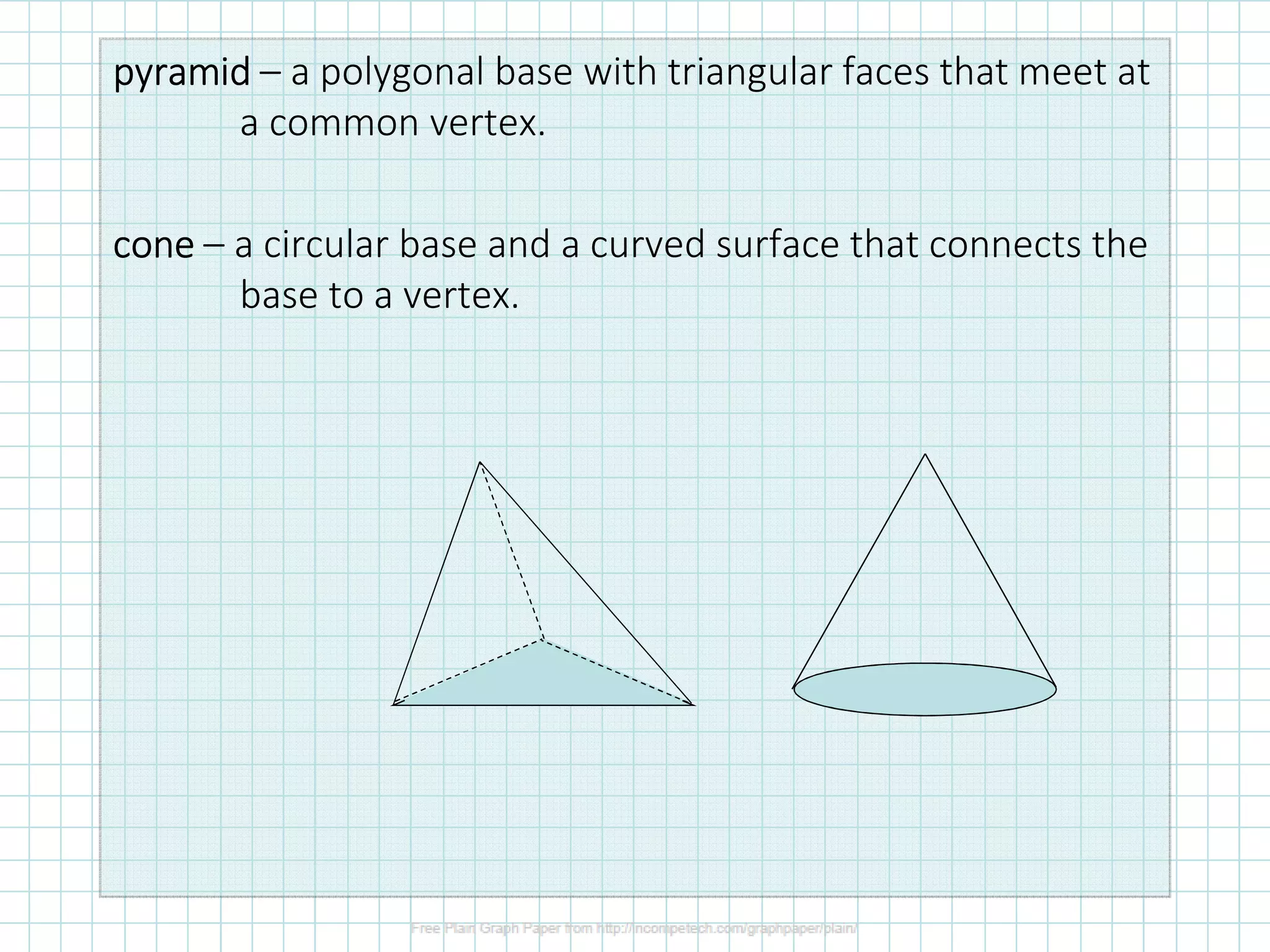
pyramidpyramidpyramidpyramid – a polygonal base with triangular faces that meet at
a common vertex.
coneconeconecone – a circular base and a curved surface that connects the
base to a vertex.
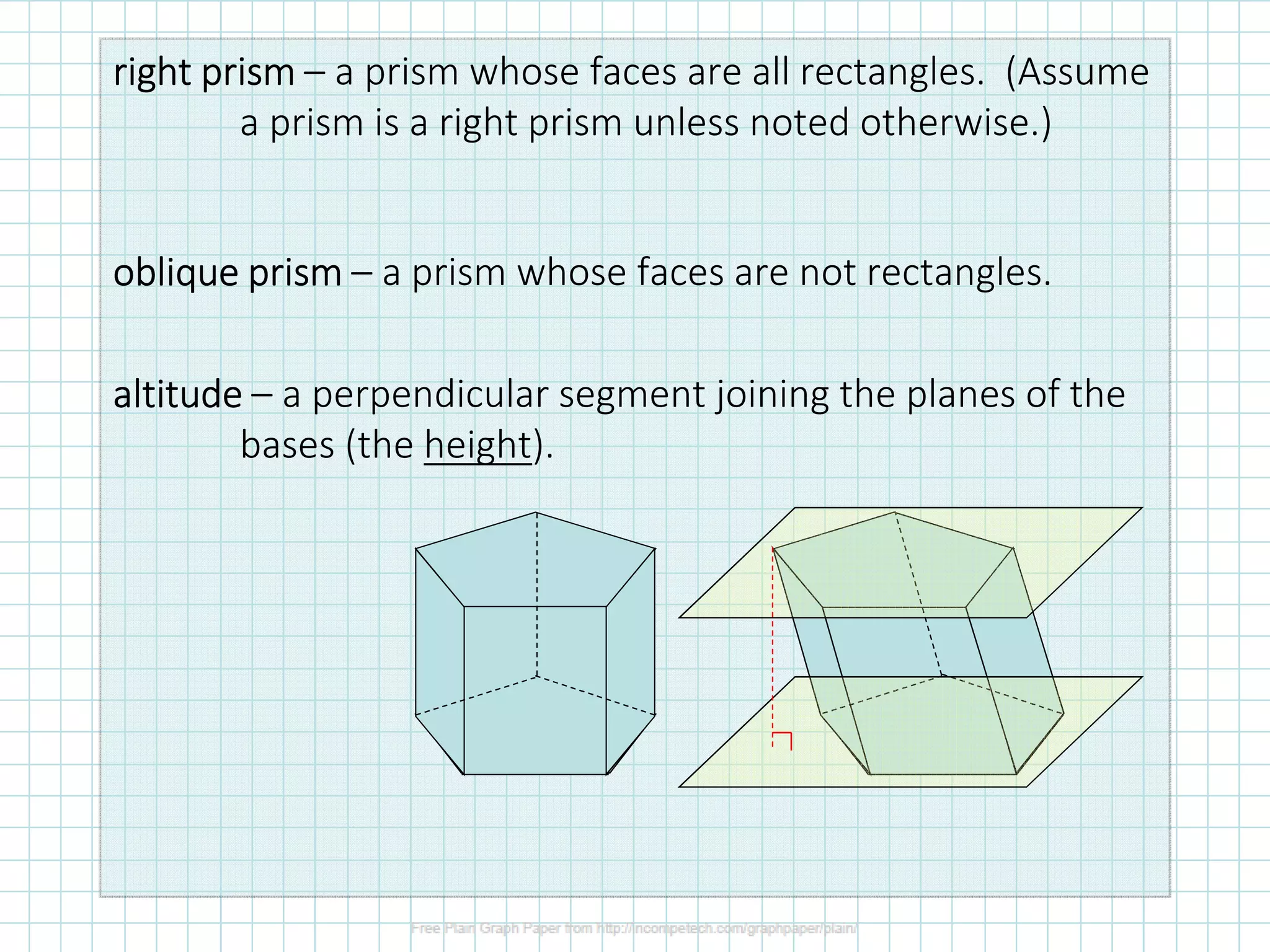
rightrightrightright prismprismprismprism – a prism whose faces are all rectangles. (Assume
a prism is a right prism unless noted otherwise.)
obliqueobliqueobliqueoblique prismprismprismprism – a prism whose faces are not rectangles.
altitudealtitudealtitudealtitude – a perpendicular segment joining the planes of the
bases (the height).
A cubecubecubecube is a prism with six square faces. Other prisms and
pyramids are named for the shape of their bases:
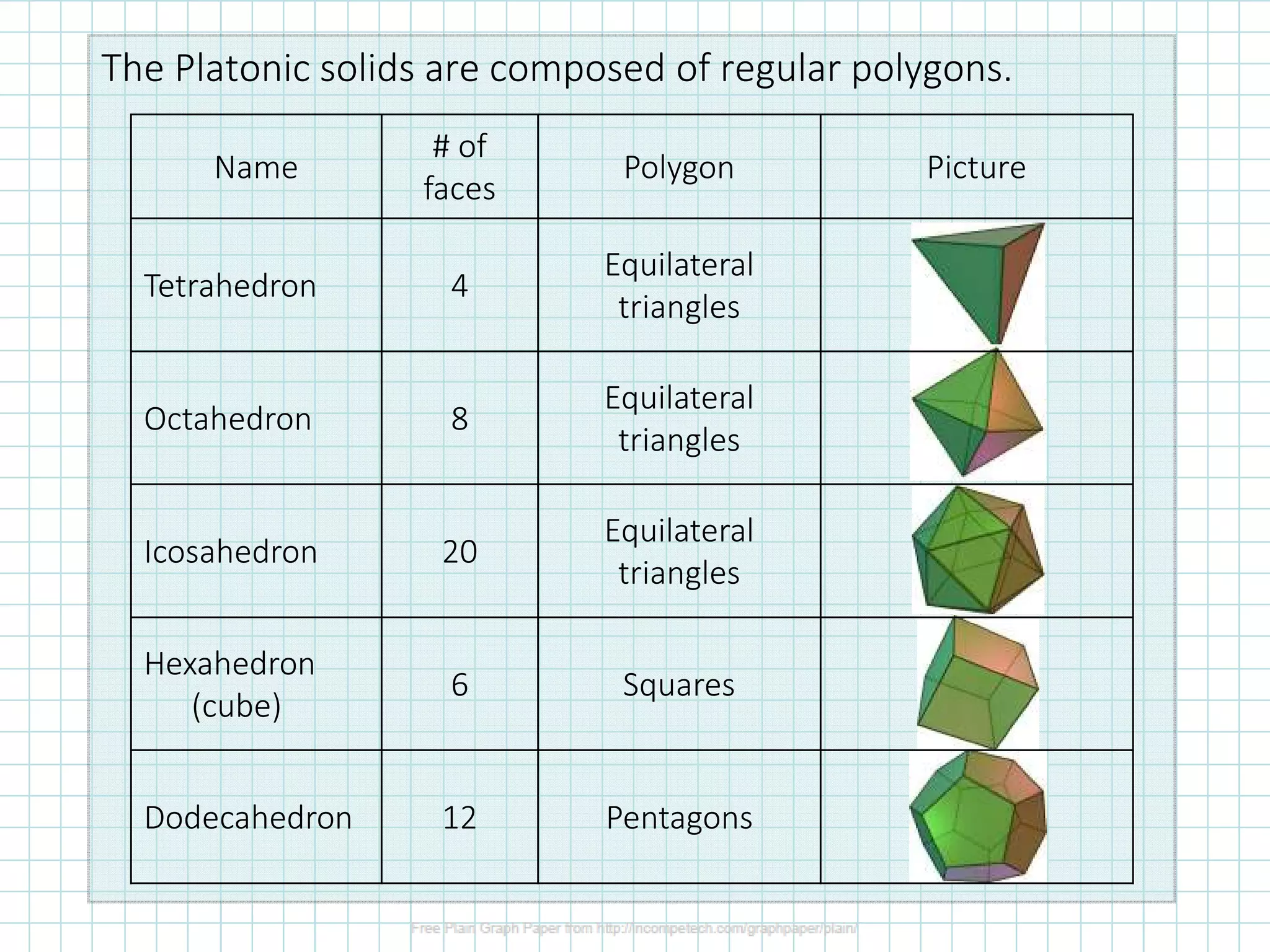
The Platonic solids are composed of regular polygons.
Name
# of
faces
Polygon Picture
Tetrahedron 4
Equilateral
triangles
Octahedron 8
Equilateral
triangles
Icosahedron 20
Equilateral
triangles
Hexahedron
(cube)
6 Squares
Dodecahedron 12 Pentagons
Euler’s Formula
For any polyhedron with V vertices, E edges, and F faces:
V − E + F = 2.
Example: If a given polyhedron has 12 vertices and 18 edges,
how many faces does it have?
− + =
− + =
=
2
12 18 2
8
V E F
F
F
VolumeVolumeVolumeVolume
Let’s consider a deck of cards. If a deck is stacked neatly, it
resembles a right rectangular prism. The volume of the
prism is
V = Bh,
where B is the area of one card, and h is the height of the
deck.
If we shift the deck so that it becomes an
oblique prism, does it have the same
number of cards?
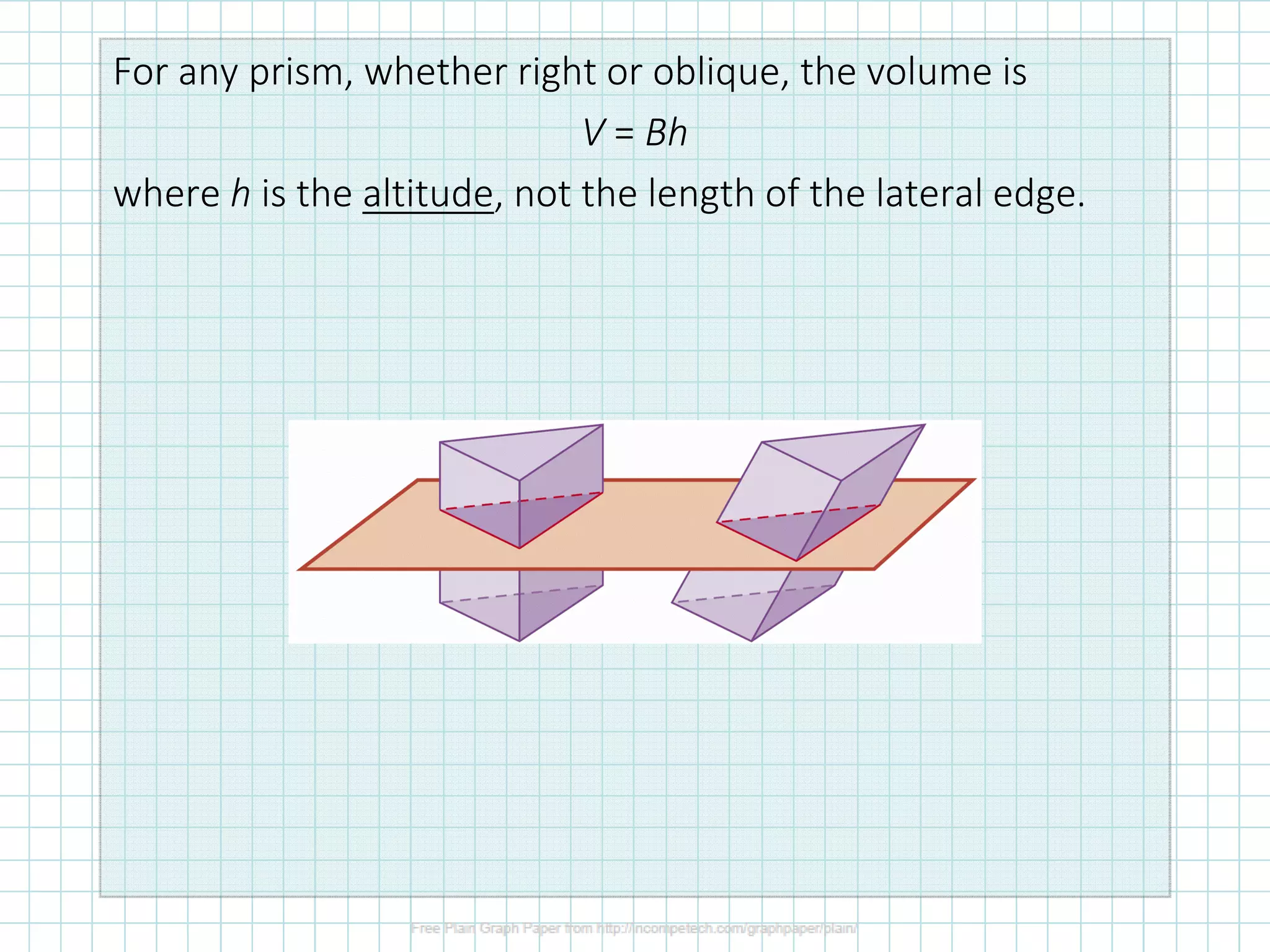
For any prism, whether right or oblique, the volume is
V = Bh
where h is the altitude, not the length of the lateral edge.
Likewise, for cylinders, it doesn’t matter whether the cylinder
is right or oblique, the volume is
V = Bh = πr2h
Examples
Find the volume of each figure:
1.
2.
10 ft.
8 ft.
3 m
19 m
Examples
Find the volume of each figure:
1.
2.
10 ft.
8 ft.
3 m
19 m
( )2 2
3 9 m= π = πB
3
(9 )(19) 171 mV = π = π
( )( )2
5 10
172.05
180
4tan
5
= =
 
 
 
B
V = (172)(8) = 1376 ft3

12.1 Volume of Prisms and Cylinders

  • 1.
    Volume of Prismsand Cylinders The student is able to (I can): • Classify three-dimensional figures according to their properties • Calculate the volumes of prisms and cylinders
  • 2.
    facefacefaceface – theflat polygonal surface on a three-dimensional figure. edgeedgeedgeedge –––– the segment that is the intersection of two faces. vertexvertexvertexvertex – the point that is the intersection of three or more edges. face edge vertex•
  • 3.
    polyhedronpolyhedronpolyhedronpolyhedron – athree-dimensional figure composed of polygons. (plural polyhedrapolyhedrapolyhedrapolyhedra) prismprismprismprism – two parallel congruent polygon bases connected by faces that are parallelograms. cylindercylindercylindercylinder – two parallel congruent circular bases and a curved surface that connects the bases.
  • 4.
    pyramidpyramidpyramidpyramid – apolygonal base with triangular faces that meet at a common vertex. coneconeconecone – a circular base and a curved surface that connects the base to a vertex.
  • 5.
    rightrightrightright prismprismprismprism –a prism whose faces are all rectangles. (Assume a prism is a right prism unless noted otherwise.) obliqueobliqueobliqueoblique prismprismprismprism – a prism whose faces are not rectangles. altitudealtitudealtitudealtitude – a perpendicular segment joining the planes of the bases (the height).
  • 6.
    A cubecubecubecube isa prism with six square faces. Other prisms and pyramids are named for the shape of their bases:
  • 7.
    The Platonic solidsare composed of regular polygons. Name # of faces Polygon Picture Tetrahedron 4 Equilateral triangles Octahedron 8 Equilateral triangles Icosahedron 20 Equilateral triangles Hexahedron (cube) 6 Squares Dodecahedron 12 Pentagons
  • 8.
    Euler’s Formula For anypolyhedron with V vertices, E edges, and F faces: V − E + F = 2. Example: If a given polyhedron has 12 vertices and 18 edges, how many faces does it have? − + = − + = = 2 12 18 2 8 V E F F F
  • 9.
    VolumeVolumeVolumeVolume Let’s consider adeck of cards. If a deck is stacked neatly, it resembles a right rectangular prism. The volume of the prism is V = Bh, where B is the area of one card, and h is the height of the deck. If we shift the deck so that it becomes an oblique prism, does it have the same number of cards?
  • 10.
    For any prism,whether right or oblique, the volume is V = Bh where h is the altitude, not the length of the lateral edge.
  • 11.
    Likewise, for cylinders,it doesn’t matter whether the cylinder is right or oblique, the volume is V = Bh = πr2h
  • 12.
    Examples Find the volumeof each figure: 1. 2. 10 ft. 8 ft. 3 m 19 m
  • 13.
    Examples Find the volumeof each figure: 1. 2. 10 ft. 8 ft. 3 m 19 m ( )2 2 3 9 m= π = πB 3 (9 )(19) 171 mV = π = π ( )( )2 5 10 172.05 180 4tan 5 = =       B V = (172)(8) = 1376 ft3