5.13.6 Spheres & Composite Figures
The student is able to (I can):
• Find the surface area and volume of spheres and
hemispheres
• Find the surface area and volume of composite figures
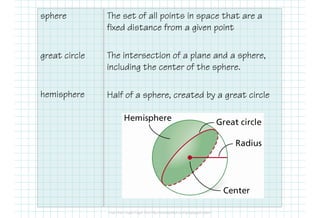
sphere
great circle
hemisphere
The set of all points in space that are a
fixed distance from a given point
The intersection of a plane and a sphere,
including the center of the sphere.
Half of a sphere, created by a great circle
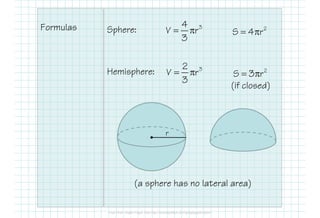
Formulas Sphere:
Hemisphere:
(a sphere has no lateral area)
= π 34
V r
3
r
= π 2
S 4 r
= π 32
V r
3
= π 2
S 3 r
(if closed)
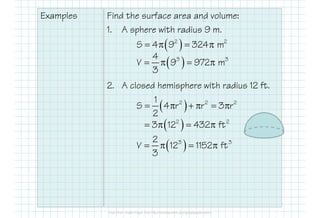
Examples Find the surface area and volume:
1. A sphere with radius 9 m.
2. A closed hemisphere with radius 12 ft.
( )2 2
S 4 9 324 m= π = π
( )3 34
V 9 972 m
3
= π = π
( )2 2 21
S 4 r r 3 r
2
= π + π = π
( )2 2
3 12 432 ft= π = π
( )3 32
V 12 1152 ft
3
= π = π
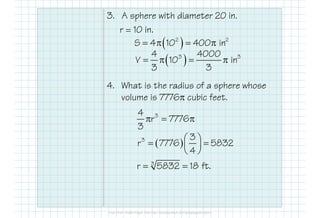
3. A sphere with diameter 20 in.
r = 10 in.
4. What is the radius of a sphere whose
volume is 7776π cubic feet.
( )2 2
S 4 10 400 in= π = π
( )3 34 4000
V 10 in
3 3
= π = π
34
r 7776
3
π = π
( )3 3
r 7776 5832
4
 = = 
 
3
r 5832 18 ft.= =
Much like composite plane figures, to find
the surface area and volume of composite
shapes, break it down into simpler shapes
and combine.
While volume is a fairly straightfoward
process, when you calculate the surface
area of a composite shape, you need to
take into account portions of the shape
that might be covered up by other shapes.
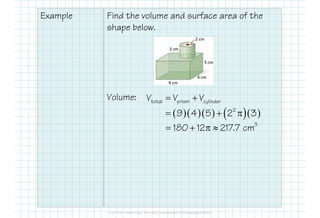
Example Find the volume and surface area of the
shape below.
Volume: total prism cylinderV V V= +
( )( )( ) ( )( )2
9 4 5 2 3= + π
3
180 12 217.7 cm= + π ≈
Example Find the volume and surface area of the
shape below.
Surface Area:
total prism cylS S L= +
( ) ( ) ( )[ ] ( )( )prismS 5 2 9 2 4 2 9 4
202
= + +
=
( )( )cylL 2 2 3
12
= π
= π
2
totalS 202 12 239.7 cm= + π ≈
We only need lateral area
because the one visible base
of the cylinder offsets the
missing circle on the prism.

5.13.6 Spheres and Composite Figures

  • 1.
    5.13.6 Spheres &Composite Figures The student is able to (I can): • Find the surface area and volume of spheres and hemispheres • Find the surface area and volume of composite figures
  • 2.
    sphere great circle hemisphere The setof all points in space that are a fixed distance from a given point The intersection of a plane and a sphere, including the center of the sphere. Half of a sphere, created by a great circle
  • 3.
    Formulas Sphere: Hemisphere: (a spherehas no lateral area) = π 34 V r 3 r = π 2 S 4 r = π 32 V r 3 = π 2 S 3 r (if closed)
  • 4.
    Examples Find thesurface area and volume: 1. A sphere with radius 9 m. 2. A closed hemisphere with radius 12 ft. ( )2 2 S 4 9 324 m= π = π ( )3 34 V 9 972 m 3 = π = π ( )2 2 21 S 4 r r 3 r 2 = π + π = π ( )2 2 3 12 432 ft= π = π ( )3 32 V 12 1152 ft 3 = π = π
  • 5.
    3. A spherewith diameter 20 in. r = 10 in. 4. What is the radius of a sphere whose volume is 7776π cubic feet. ( )2 2 S 4 10 400 in= π = π ( )3 34 4000 V 10 in 3 3 = π = π 34 r 7776 3 π = π ( )3 3 r 7776 5832 4  = =    3 r 5832 18 ft.= =
  • 6.
    Much like compositeplane figures, to find the surface area and volume of composite shapes, break it down into simpler shapes and combine. While volume is a fairly straightfoward process, when you calculate the surface area of a composite shape, you need to take into account portions of the shape that might be covered up by other shapes.
  • 7.
    Example Find thevolume and surface area of the shape below. Volume: total prism cylinderV V V= + ( )( )( ) ( )( )2 9 4 5 2 3= + π 3 180 12 217.7 cm= + π ≈
  • 8.
    Example Find thevolume and surface area of the shape below. Surface Area: total prism cylS S L= + ( ) ( ) ( )[ ] ( )( )prismS 5 2 9 2 4 2 9 4 202 = + + = ( )( )cylL 2 2 3 12 = π = π 2 totalS 202 12 239.7 cm= + π ≈ We only need lateral area because the one visible base of the cylinder offsets the missing circle on the prism.