Topics 3.3 & 7.1Nucleic AcidsIB Biology
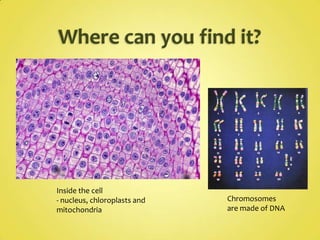
Where can you find it?Inside the cell- nucleus, chloroplasts and mitochondriaChromosomes are made of DNA
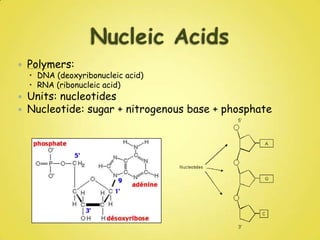
Nucleic AcidsPolymers: DNA (deoxyribonucleic acid) RNA (ribonucleic acid)Units: nucleotidesNucleotide: sugar + nitrogenous base + phosphate
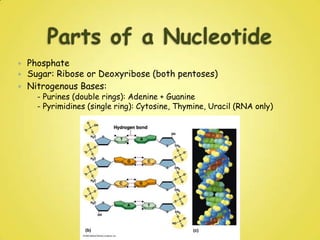
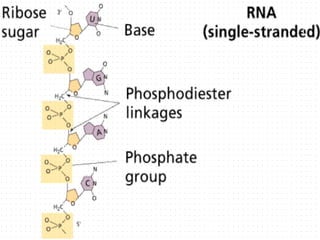
Parts of a NucleotidePhosphateSugar: Ribose or Deoxyribose (both pentoses)Nitrogenous Bases: 	- Purines (double rings): Adenine + Guanine	- Pyrimidines (single ring): Cytosine, Thymine, Uracil (RNA only)
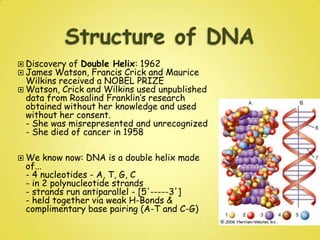
Structure of DNADiscovery of Double Helix: 1962
James Watson, Francis Crick and Maurice Wilkins received a NOBEL PRIZE
Watson, Crick and Wilkins used unpublished data from Rosalind Franklin’s research obtained without her knowledge and used without her consent.	- She was misrepresented and unrecognized 	- She died of cancer in 1958We know now: DNA is a double helix made of... 	- 4 nucleotides - A, T, G, C  	- in 2 polynucleotide strands    - strands run antiparallel - [5'-----3'] - held together via weak H-Bonds & complimentary base pairing (A-T and C-G)
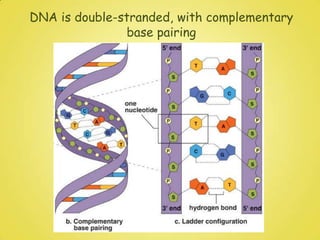
DNA is double-stranded, withcomplementary base pairing
Observe - hydrogen bonds- complementary base pairing :A – TC – G - covalent bonds between 2 nucleotides (formed through condensation)
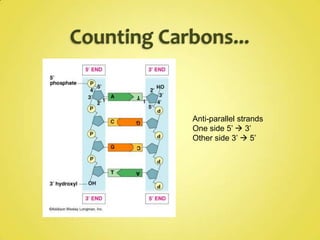
Counting Carbons...Anti-parallel strandsOne side 5’  3’Other side 3’  5’
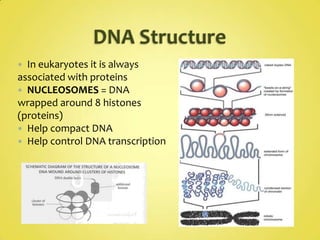
DNA StructureIn eukaryotes it is always associated with proteinsNUCLEOSOMES = DNA wrapped around 8 histones (proteins)Help compact DNA Help control DNA transcription
Single copy x Highly repetitive sequencesMuch of DNA in eukaryotes = repetitive base sequences, which are not translated (satellite DNA) = 5-300 bases / repeated as many as 10,000x5-45% of DNA = function not clearSingle copy/unique genes = actually code for something (small proportion)
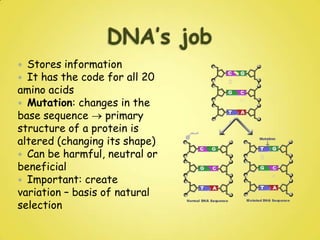
DNA’s jobStores informationIt has the code for all 20 amino acidsMutation: changes in the base sequence  primary structure of a protein is altered (changing its shape)Can be harmful, neutral or beneficial Important: create variation – basis of natural selection

3.3 7.1 Dna Structure

  • 1.
    Topics 3.3 &7.1Nucleic AcidsIB Biology
  • 2.
    Where can youfind it?Inside the cell- nucleus, chloroplasts and mitochondriaChromosomes are made of DNA
  • 3.
    Nucleic AcidsPolymers: DNA(deoxyribonucleic acid) RNA (ribonucleic acid)Units: nucleotidesNucleotide: sugar + nitrogenous base + phosphate
  • 4.
    Parts of aNucleotidePhosphateSugar: Ribose or Deoxyribose (both pentoses)Nitrogenous Bases: - Purines (double rings): Adenine + Guanine - Pyrimidines (single ring): Cytosine, Thymine, Uracil (RNA only)
  • 5.
    Structure of DNADiscoveryof Double Helix: 1962
  • 6.
    James Watson, FrancisCrick and Maurice Wilkins received a NOBEL PRIZE
  • 7.
    Watson, Crick andWilkins used unpublished data from Rosalind Franklin’s research obtained without her knowledge and used without her consent. - She was misrepresented and unrecognized - She died of cancer in 1958We know now: DNA is a double helix made of...  - 4 nucleotides - A, T, G, C   - in 2 polynucleotide strands    - strands run antiparallel - [5'-----3'] - held together via weak H-Bonds & complimentary base pairing (A-T and C-G)
  • 8.
    DNA is double-stranded,withcomplementary base pairing
  • 9.
    Observe - hydrogenbonds- complementary base pairing :A – TC – G - covalent bonds between 2 nucleotides (formed through condensation)
  • 10.
    Counting Carbons...Anti-parallel strandsOneside 5’  3’Other side 3’  5’
  • 11.
    DNA StructureIn eukaryotesit is always associated with proteinsNUCLEOSOMES = DNA wrapped around 8 histones (proteins)Help compact DNA Help control DNA transcription
  • 12.
    Single copy xHighly repetitive sequencesMuch of DNA in eukaryotes = repetitive base sequences, which are not translated (satellite DNA) = 5-300 bases / repeated as many as 10,000x5-45% of DNA = function not clearSingle copy/unique genes = actually code for something (small proportion)
  • 13.
    DNA’s jobStores informationIthas the code for all 20 amino acidsMutation: changes in the base sequence  primary structure of a protein is altered (changing its shape)Can be harmful, neutral or beneficial Important: create variation – basis of natural selection
  • 14.
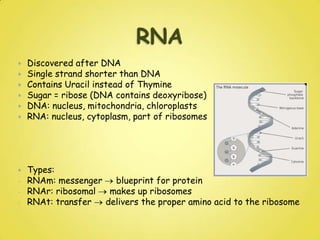
    RNADiscovered after DNASinglestrand shorter than DNAContains Uracil instead of ThymineSugar = ribose (DNA contains deoxyribose)DNA: nucleus, mitochondria, chloroplastsRNA: nucleus, cytoplasm, part of ribosomesTypes:RNAm: messenger blueprint for protein
  • 15.
    RNAr: ribosomal makes up ribosomes
  • 16.
    RNAt: transfer delivers the proper amino acid to the ribosome