Ionic Bonding
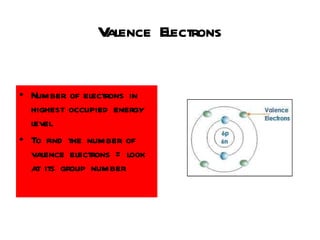
Valence Electrons Number of electrons in highest occupied energy level To find the number of valence electrons = look at its group number
atoms tend to gain or lose electrons in order to achieve the electron configuration of a noble gas Octet Rule
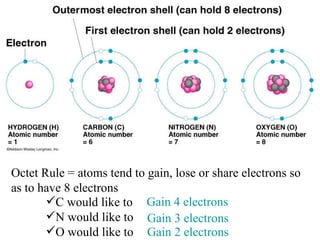
Octet Rule = atoms tend to gain, lose or share electrons so as to have 8 electrons C would like to  N would like to O would like to Gain 4 electrons Gain 3 electrons Gain 2 electrons
REMEMBER... Metals  tend to  lose  their valence electrons Some  nonmetals  tend to  gain  electrons or to  share  with other nonmetallic elements to achieve a noble gas configuration
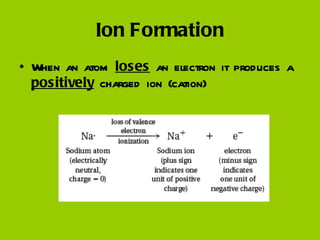
Ion Formation When an atom  loses  an electron it produces a  positively  charged ion (cation)
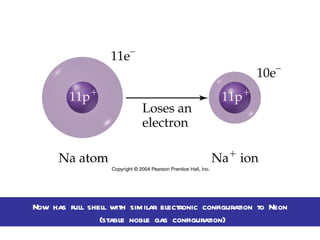
Now has full shell with similar electronic configuration to Neon (stable noble gas configuration)
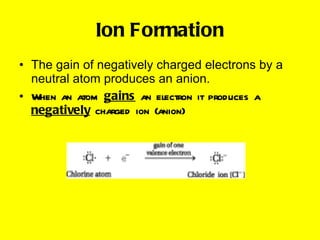
Ion Formation The gain of negatively charged electrons by a neutral atom produces an anion. When an atom  gains  an electron it produces a  negatively  charged ion (anion)
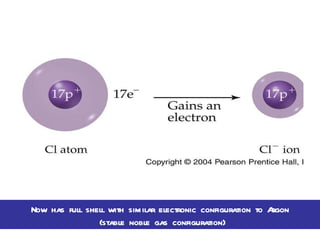
Now has full shell with similar electronic configuration to Argon (stable noble gas configuration)
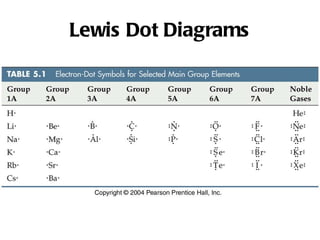
Lewis Dot Diagrams
Ionic Bonds Compounds composed of cations and anions are called  ionic compounds . Although they are composed of ions, ionic compounds are electrically  neutral . The electrostatic force that hold ions together in ionic compounds is called  Ionic Bond
 
Practice, Practice, Practice Use electron dot structures to determine formulas of the ionic compounds formed when 1.  potassium reacts with iodine. 2.  Aluminum reacts with oxygen.
Properties of Ionic Compounds Most are crystalline solids at room temperature. High melting points. Conduct electricity when melted or dissolved in water .
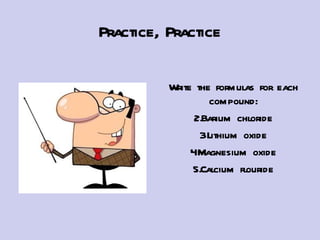
Practice, Practice Write the formulas for each compound: Barium chloride Lithium oxide Magnesium oxide Calcium flouride
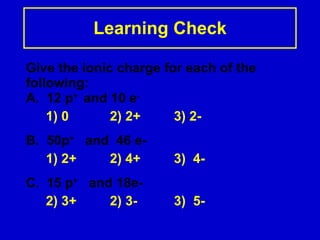
Learning Check Give the ionic charge for each of the following: A.  12 p +  and 10 e - 1) 0 2) 2+ 3) 2- B.  50p +   and  46 e- 1) 2+ 2) 4+ 3)  4- C.  15 p +   and 18e- 2) 3+  2) 3- 3)  5-
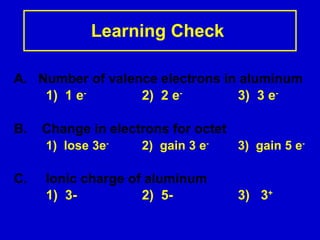
Learning Check   A.  Number of valence electrons in aluminum 1)  1 e -   2)  2 e - 3)  3 e - B.  Change in electrons for octet 1)  lose 3e -  2)  gain 3 e -  3)  gain 5 e - C. Ionic charge of aluminum  1)  3-   2)  5-   3)  3 +
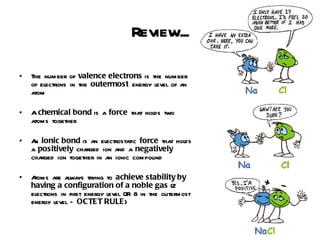
Review... The number of  valence electrons  is the number of electrons in the  outermost  energy level of an atom A  chemical bond  is a  force  that holds two atoms together An  ionic bond  is an electrostatic  force  that holds a  positively  charged ion and a  negatively  charged ion together in an ionic compound Atoms are always trying to  achieve stability by having a configuration of a noble gas  (2 electrons in first energy level OR 8 in the outermost energy level –  OCTET RULE )

IS2 Ionic Bonding

  • 1.
  • 2.
    Valence Electrons Numberof electrons in highest occupied energy level To find the number of valence electrons = look at its group number
  • 3.
    atoms tend togain or lose electrons in order to achieve the electron configuration of a noble gas Octet Rule
  • 4.
    Octet Rule =atoms tend to gain, lose or share electrons so as to have 8 electrons C would like to N would like to O would like to Gain 4 electrons Gain 3 electrons Gain 2 electrons
  • 5.
    REMEMBER... Metals tend to lose their valence electrons Some nonmetals tend to gain electrons or to share with other nonmetallic elements to achieve a noble gas configuration
  • 6.
    Ion Formation Whenan atom loses an electron it produces a positively charged ion (cation)
  • 7.
    Now has fullshell with similar electronic configuration to Neon (stable noble gas configuration)
  • 8.
    Ion Formation Thegain of negatively charged electrons by a neutral atom produces an anion. When an atom gains an electron it produces a negatively charged ion (anion)
  • 9.
    Now has fullshell with similar electronic configuration to Argon (stable noble gas configuration)
  • 10.
  • 11.
    Ionic Bonds Compoundscomposed of cations and anions are called ionic compounds . Although they are composed of ions, ionic compounds are electrically neutral . The electrostatic force that hold ions together in ionic compounds is called Ionic Bond
  • 12.
  • 13.
    Practice, Practice, PracticeUse electron dot structures to determine formulas of the ionic compounds formed when 1. potassium reacts with iodine. 2. Aluminum reacts with oxygen.
  • 14.
    Properties of IonicCompounds Most are crystalline solids at room temperature. High melting points. Conduct electricity when melted or dissolved in water .
  • 15.
    Practice, Practice Writethe formulas for each compound: Barium chloride Lithium oxide Magnesium oxide Calcium flouride
  • 16.
    Learning Check Givethe ionic charge for each of the following: A. 12 p + and 10 e - 1) 0 2) 2+ 3) 2- B. 50p + and 46 e- 1) 2+ 2) 4+ 3) 4- C. 15 p + and 18e- 2) 3+ 2) 3- 3) 5-
  • 17.
    Learning Check A. Number of valence electrons in aluminum 1) 1 e - 2) 2 e - 3) 3 e - B. Change in electrons for octet 1) lose 3e - 2) gain 3 e - 3) gain 5 e - C. Ionic charge of aluminum 1) 3- 2) 5- 3) 3 +
  • 18.
    Review... The numberof valence electrons is the number of electrons in the outermost energy level of an atom A chemical bond is a force that holds two atoms together An ionic bond is an electrostatic force that holds a positively charged ion and a negatively charged ion together in an ionic compound Atoms are always trying to achieve stability by having a configuration of a noble gas (2 electrons in first energy level OR 8 in the outermost energy level – OCTET RULE )