Cell CycleIS3
QuestionsWhy are you bigger now than you were born?Why do cells divide instead of growing?What needs to happen for you to grow?Prokaryotes x Eukaryotes:How do you think their cells divide?
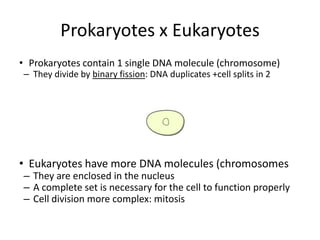
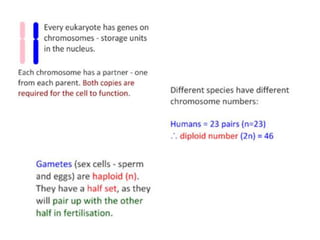
Prokaryotes x EukaryotesProkaryotes contain 1 single DNA molecule (chromosome)They divide by binary fission: DNA duplicates +cell splits in 2Eukaryotes have more DNA molecules (chromosomesThey are enclosed in the nucleusA complete set is necessary for the cell to function properlyCell division more complex: mitosis
What is the purpose of cell division?Growth (example: baby  adult)Reproduction (asexual reproduction in single celled organisms)Replacement of dead/damaged/infected (example: skin/red blood cells/bone cells)Gamete formation in multi-cellular organisms (a special cell division process called meiosis)
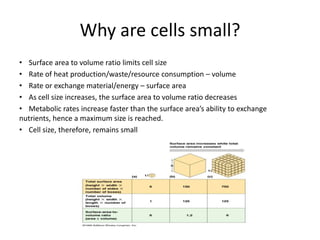
Why are cells small?Surface area to volume ratio limits cell sizeRate of heat production/waste/resource consumption – volumeRate or exchange material/energy – surface areaAs cell size increases, the surface area to volume ratio decreasesMetabolic rates increase faster than the surface area’s ability to exchange nutrients, hence a maximum size is reached.Cell size, therefore, remains small
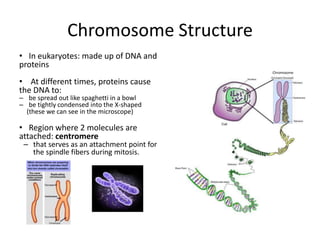
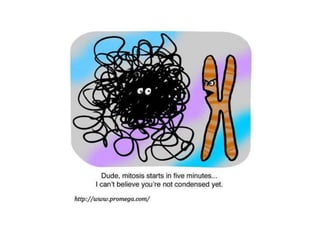
Chromosome StructureIn eukaryotes: made up of DNA and proteins At different times, proteins cause the DNA to:be spread out like spaghetti in a bowlbe tightly condensed into the X-shaped (these we can see in the microscope)Region where 2 molecules are attached: centromerethat serves as an attachment point for the spindle fibers during mitosis.
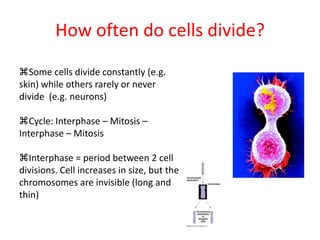
How often do cells divide?Some cells divide constantly (e.g. skin) while others rarely or never divide  (e.g. neurons)
Cycle: Interphase – Mitosis – Interphase – Mitosis
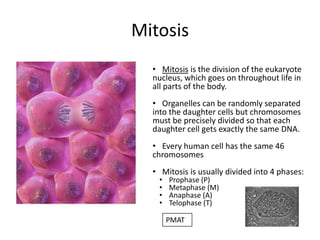
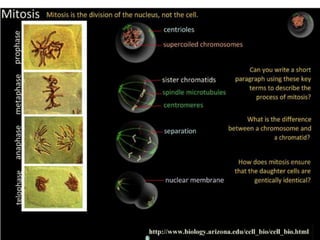
Interphase = period between 2 cell divisions. Cell increases in size, but the chromosomes are invisible (long and thin)MitosisMitosis is the division of the eukaryote nucleus, which goes on throughout life in all parts of the body. Organelles can be randomly separated into the daughter cells but chromosomes must be precisely divided so that each daughter cell gets exactly the same DNA.Every human cell has the same 46 chromosomesMitosis is usually divided into 4 phases:Prophase (P)Metaphase (M)Anaphase (A)Telophase (T)PMAT
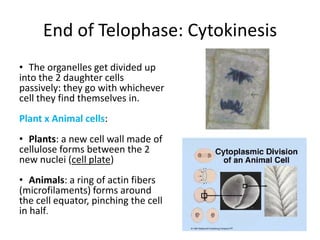
End of Telophase: CytokinesisThe organelles get divided up into the 2 daughter cells passively: they go with whichever cell they find themselves in.Plant x Animal cells:Plants: a new cell wall made of cellulose forms between the 2 new nuclei (cell plate)Animals: a ring of actin fibers (microfilaments) forms around the cell equator, pinching the cell in half.
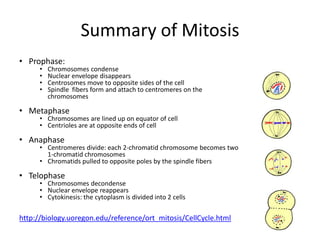
Summary of MitosisProphase: Chromosomes condenseNuclear envelope disappearsCentrosomes move to opposite sides of the cellSpindle  fibers form and attach to centromeres on the chromosomesMetaphaseChromosomes are lined up on equator of cellCentrioles are at opposite ends of cellAnaphaseCentromeres divide: each 2-chromatid chromosome becomes two 1-chromatid chromosomesChromatids pulled to opposite poles by the spindle fibersTelophaseChromosomes decondenseNuclear envelope reappearsCytokinesis: the cytoplasm is divided into 2 cellshttp://biology.uoregon.edu/reference/ort_mitosis/CellCycle.html
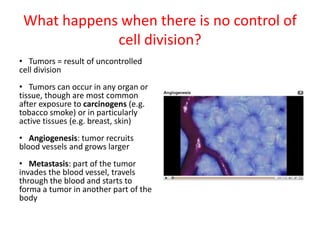
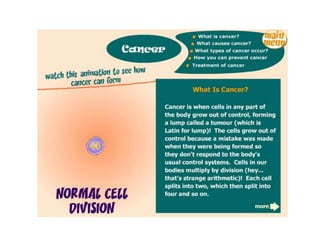
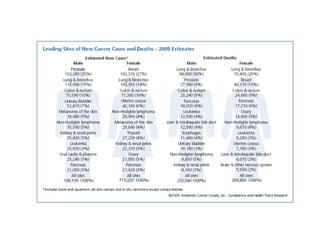
What happens when there is no control of cell division?Tumors = result of uncontrolled cell divisionTumors can occur in any organ or tissue, though are most common after exposure to carcinogens (e.g. tobacco smoke) or in particularly active tissues (e.g. breast, skin)Angiogenesis: tumor recruits blood vessels and grows largerMetastasis: part of the tumor invades the blood vessel, travels through the blood and starts to forma a tumor in another part of the body

IS3 Cell Cycle

  • 1.
  • 2.
    QuestionsWhy are youbigger now than you were born?Why do cells divide instead of growing?What needs to happen for you to grow?Prokaryotes x Eukaryotes:How do you think their cells divide?
  • 3.
    Prokaryotes x EukaryotesProkaryotescontain 1 single DNA molecule (chromosome)They divide by binary fission: DNA duplicates +cell splits in 2Eukaryotes have more DNA molecules (chromosomesThey are enclosed in the nucleusA complete set is necessary for the cell to function properlyCell division more complex: mitosis
  • 4.
    What is thepurpose of cell division?Growth (example: baby  adult)Reproduction (asexual reproduction in single celled organisms)Replacement of dead/damaged/infected (example: skin/red blood cells/bone cells)Gamete formation in multi-cellular organisms (a special cell division process called meiosis)
  • 5.
    Why are cellssmall?Surface area to volume ratio limits cell sizeRate of heat production/waste/resource consumption – volumeRate or exchange material/energy – surface areaAs cell size increases, the surface area to volume ratio decreasesMetabolic rates increase faster than the surface area’s ability to exchange nutrients, hence a maximum size is reached.Cell size, therefore, remains small
  • 6.
    Chromosome StructureIn eukaryotes:made up of DNA and proteins At different times, proteins cause the DNA to:be spread out like spaghetti in a bowlbe tightly condensed into the X-shaped (these we can see in the microscope)Region where 2 molecules are attached: centromerethat serves as an attachment point for the spindle fibers during mitosis.
  • 8.
    How often docells divide?Some cells divide constantly (e.g. skin) while others rarely or never divide (e.g. neurons)
  • 9.
    Cycle: Interphase –Mitosis – Interphase – Mitosis
  • 10.
    Interphase = periodbetween 2 cell divisions. Cell increases in size, but the chromosomes are invisible (long and thin)MitosisMitosis is the division of the eukaryote nucleus, which goes on throughout life in all parts of the body. Organelles can be randomly separated into the daughter cells but chromosomes must be precisely divided so that each daughter cell gets exactly the same DNA.Every human cell has the same 46 chromosomesMitosis is usually divided into 4 phases:Prophase (P)Metaphase (M)Anaphase (A)Telophase (T)PMAT
  • 12.
    End of Telophase:CytokinesisThe organelles get divided up into the 2 daughter cells passively: they go with whichever cell they find themselves in.Plant x Animal cells:Plants: a new cell wall made of cellulose forms between the 2 new nuclei (cell plate)Animals: a ring of actin fibers (microfilaments) forms around the cell equator, pinching the cell in half.
  • 13.
    Summary of MitosisProphase:Chromosomes condenseNuclear envelope disappearsCentrosomes move to opposite sides of the cellSpindle fibers form and attach to centromeres on the chromosomesMetaphaseChromosomes are lined up on equator of cellCentrioles are at opposite ends of cellAnaphaseCentromeres divide: each 2-chromatid chromosome becomes two 1-chromatid chromosomesChromatids pulled to opposite poles by the spindle fibersTelophaseChromosomes decondenseNuclear envelope reappearsCytokinesis: the cytoplasm is divided into 2 cellshttp://biology.uoregon.edu/reference/ort_mitosis/CellCycle.html
  • 15.
    What happens whenthere is no control of cell division?Tumors = result of uncontrolled cell divisionTumors can occur in any organ or tissue, though are most common after exposure to carcinogens (e.g. tobacco smoke) or in particularly active tissues (e.g. breast, skin)Angiogenesis: tumor recruits blood vessels and grows largerMetastasis: part of the tumor invades the blood vessel, travels through the blood and starts to forma a tumor in another part of the body