STRUCTURAL
ORGANIZATION OF
NUCLEIC ACID, DNA & RNA
INTRODUCTION
•Nucleic acid are the main information- carrying molecules of the cell, and by
directing the process of protein synthesis, they determine the inherited
characterstics of every living thing.
The two main classes of nucleic acids are
deoxyribonucleic acid (DNA) and ribonucleic acid (RNA). DNA is the genetic
material in all free-living organisms and most viruses. RNA is the genetic
material of certain viruses, but it also found in all living cells, where it plays an
important role in certain processes such as the making of proteins.
. DNA, the genetic material basically made up of Sugar plus Nitrogenous
bases plus Phosphate when we combine this three things we are going to call
it “Nucleotide” which is basic buliding block.
But, when we have only two things Sugar plus Base that’s called “Nucleoside”.
• DNA and RNA are nucleic acids that carry out cellular processes, especially
the regulation and expression of genes.
NUCLEIC ACID
NUCLEIC ACID COMPOSITION
Both DNA and RNA are made up from
nucleotides, each containing five-carbon sugar
backbone; the pentose sugar (Ribose or
Deoxyribose), a phosphate group and nitrogen
base.
Momomers – Nucleotide ( Nucleoside + Phosphate
Group)
• In DNA the sugar is deoxyribose; De
means deficiency Oxy means oxygen so that’s
mean there is reduce one oxygen in the 2nd carbon.
• In RNA the sugar is ribose sugar.
Nitrogenous bases include :-
• Purine: Adenine and Guanine.
• Pyrimidine: Thymine, Cytosine and Uracil.
• Nucleotides connected by phosphodiester
bonds and form polynucleotide chain.
• The phosphate molecule links the 3’-carbon atom of one sugar of one
nucleiotide to the 5’carbon of the sugar of the succeeding nucleotide. These
nucleoside linkages are called phosphodiester bonds and are the same in
RNA and DNA.
DEOXYRIBONUCLEIC ACID
• A human cell contains at least 2 meters of DNA. This DNA is packed or condensed
into a nucleus that is about 5 mm in diameter. This is about the Eukaryotic
Chromosome.
•And in Prokaryotes the chromosome is very small, shorter and lying in one corner of
the cell.
In DNA the phosphate is H3PO4, which makes it Acidic in nature. And there will
be also a little Basic material called Histone Protein. This histone protein are riched
with positively charged amino acids such as Arginine and Lysine and negatively
charged DNA coils up around it. In eukaryotic chromosome DNA condense by
wrapping around cores of histone proteins forming Nucleosomes. There are 2
molecules of H2a, H2b, H3, H4 types of histone form the inner core of nucleosome.
There is another type of histone
that is H1 protein is known as linker histone.
• Nucleosomes are joined by “linker” DNA.
STRUCTURE OF DNA
• DNA is a chain of nucleotides.
• Each nucleiotides is a complex of three subunits.
• Phosphoric acid (phosphate)
• A pentose sugar (deoxyribose)
• A nitrogen-containing base.
• Friedrich Meischer; Identified DNA and named it as 'Nuclein’.
• James Watson & Francis Crick proposed double helix model of DNA.
• It was based on X-Ray diffraction data produced by Maurice Wilkins &
Rosalind Frakline.
The double helix DNA structure proposed by Watson and Crick
based on X-Ray Crystallography data of Maurice Willkins and Rosalind
Frakline and on Erwin Chargaff’s observation.
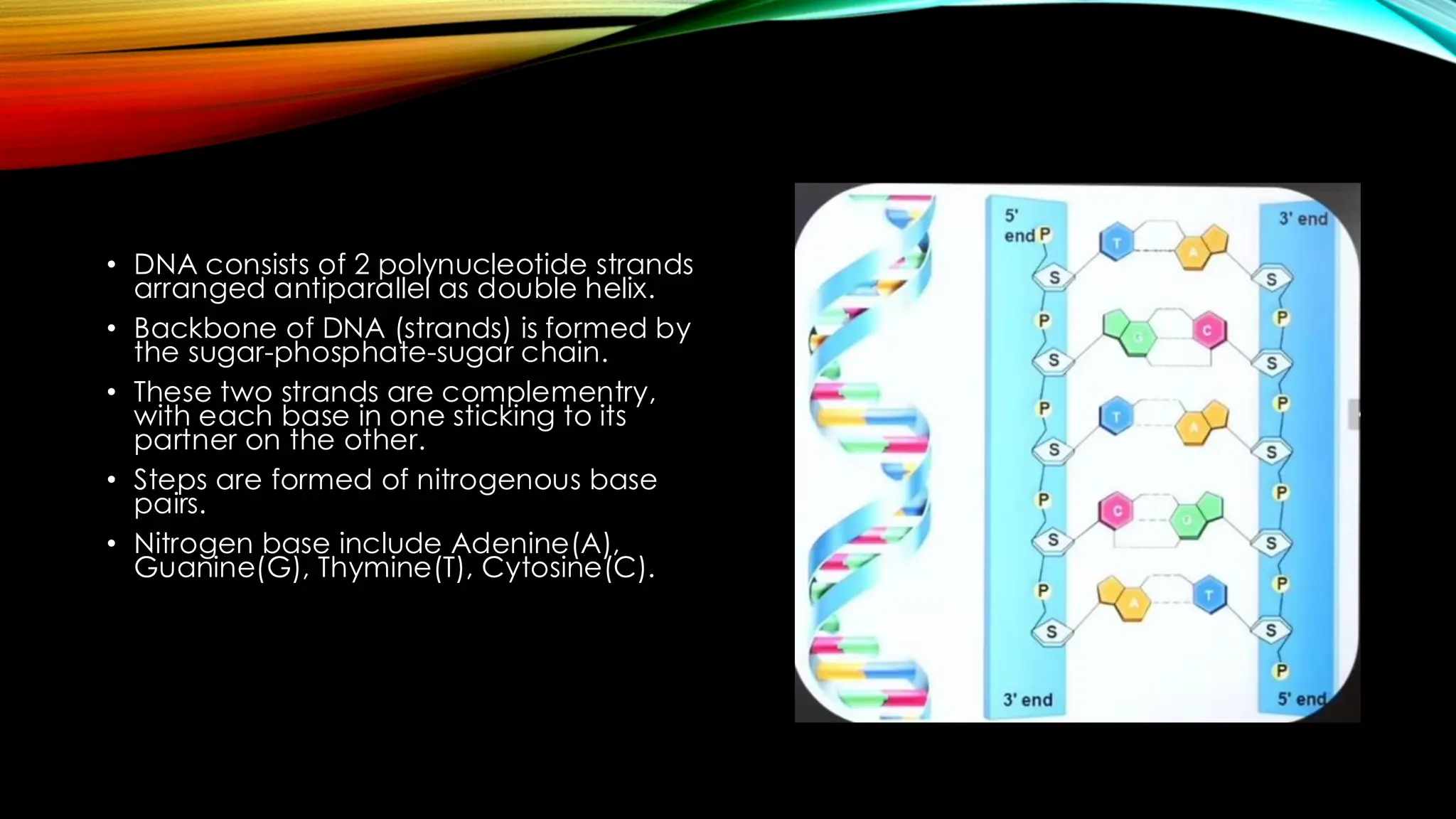
• DNA consists of 2 polynucleotide strands
arranged antiparallel as double helix.
• Backbone of DNA (strands) is formed by
the sugar-phosphate-sugar chain.
• These two strands are complementry,
with each base in one sticking to its
partner on the other.
• Steps are formed of nitrogenous base
pairs.
• Nitrogen base include Adenine(A),
Guanine(G), Thymine(T), Cytosine(C).
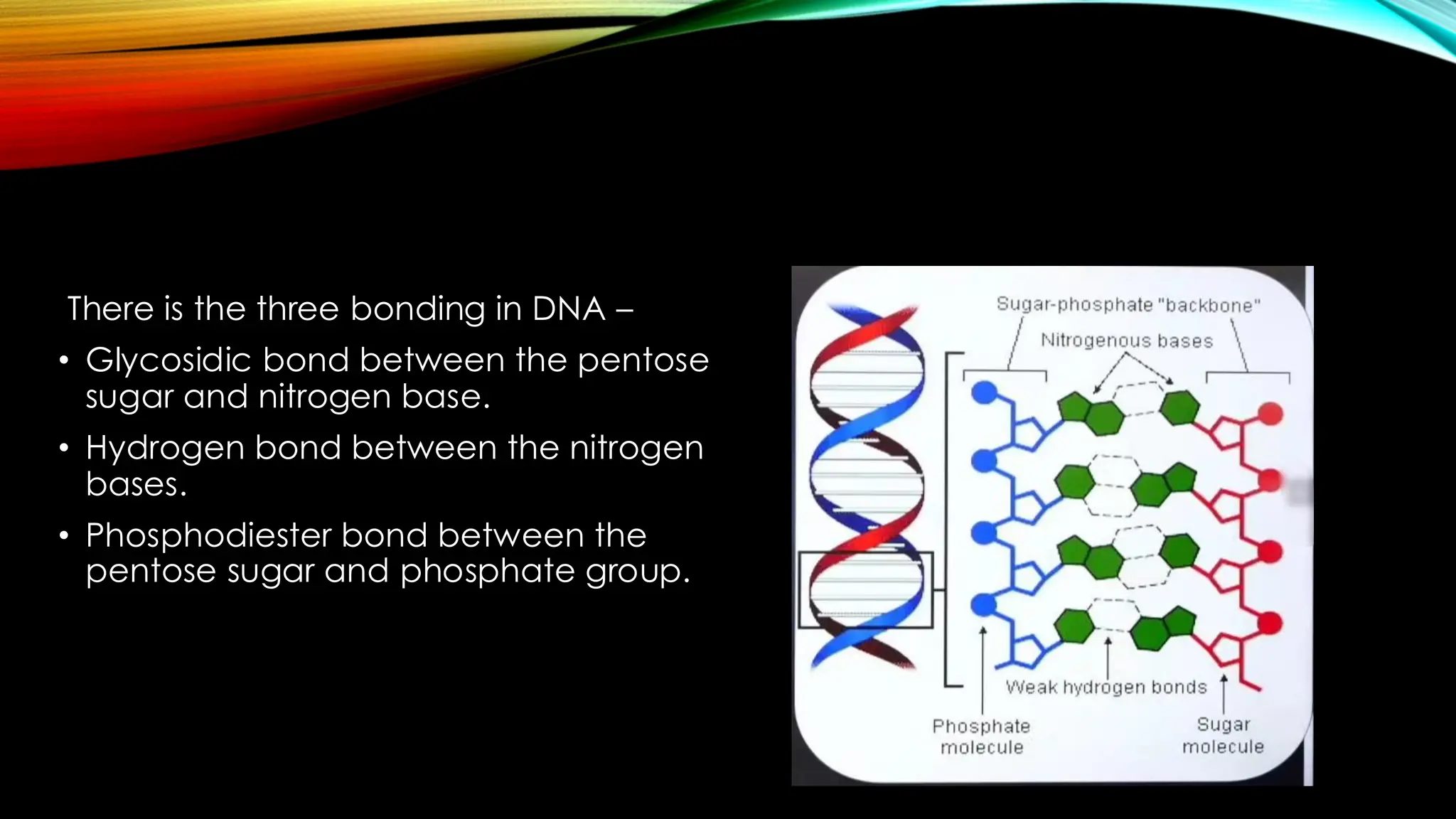
There is the three bonding in DNA –
• Glycosidic bond between the pentose
sugar and nitrogen base.
• Hydrogen bond between the nitrogen
bases.
• Phosphodiester bond between the
pentose sugar and phosphate group.
•Adenine pair with Thymine by 2 hydrogen bonds.
•Guanine pair with Cytosine by 3 hydrogen bonds.
Two rings(Purine) will always join with the single ring
(Pyrimidine) so the number of total ring in all time is three, so that the diameter
of DNA remains constant that is 20 Angstroms.
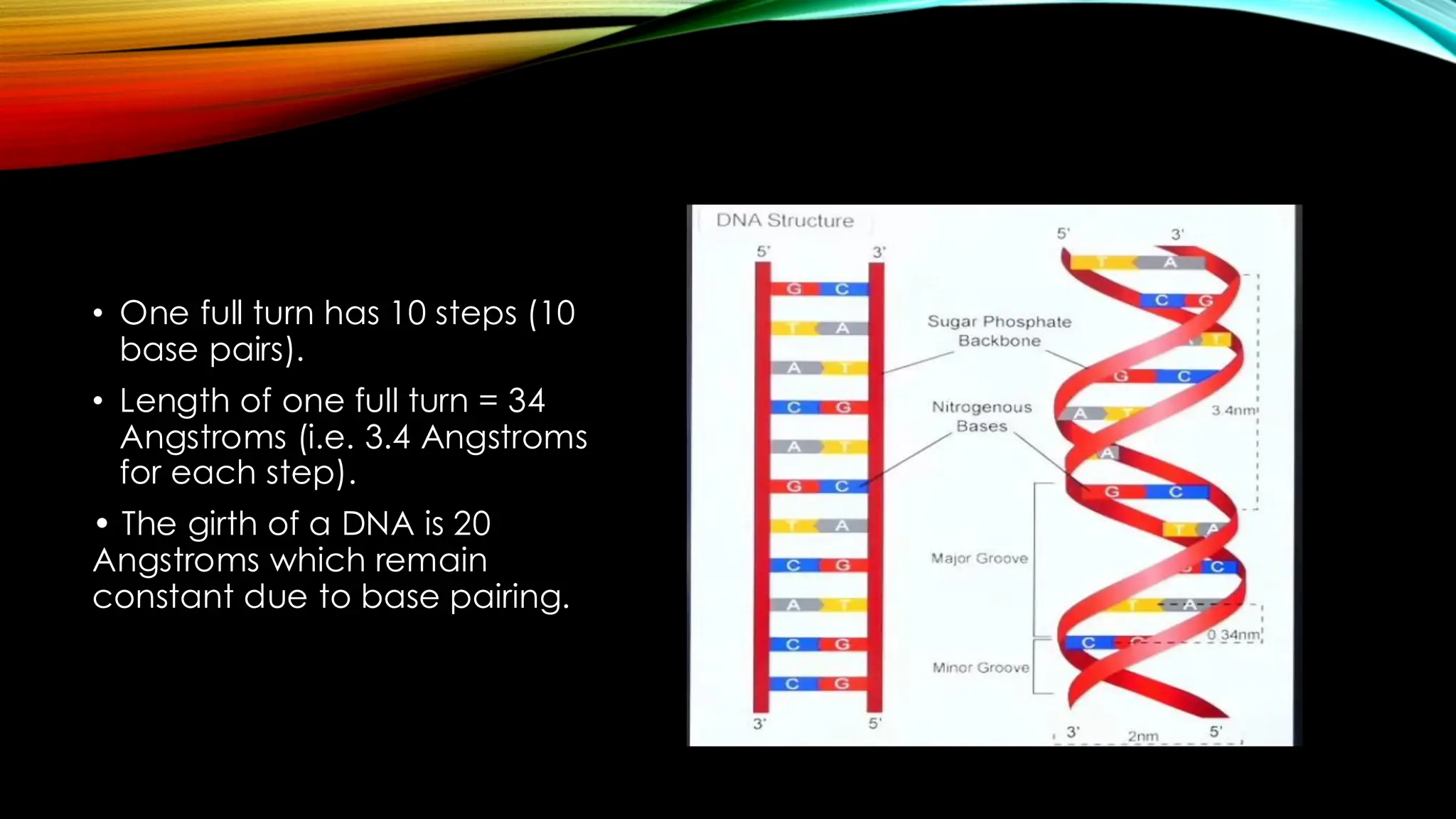
• One full turn has 10 steps (10
base pairs).
• Length of one full turn = 34
Angstroms (i.e. 3.4 Angstroms
for each step).
• The girth of a DNA is 20
Angstroms which remain
constant due to base pairing.
RIBONUCLEIC ACID
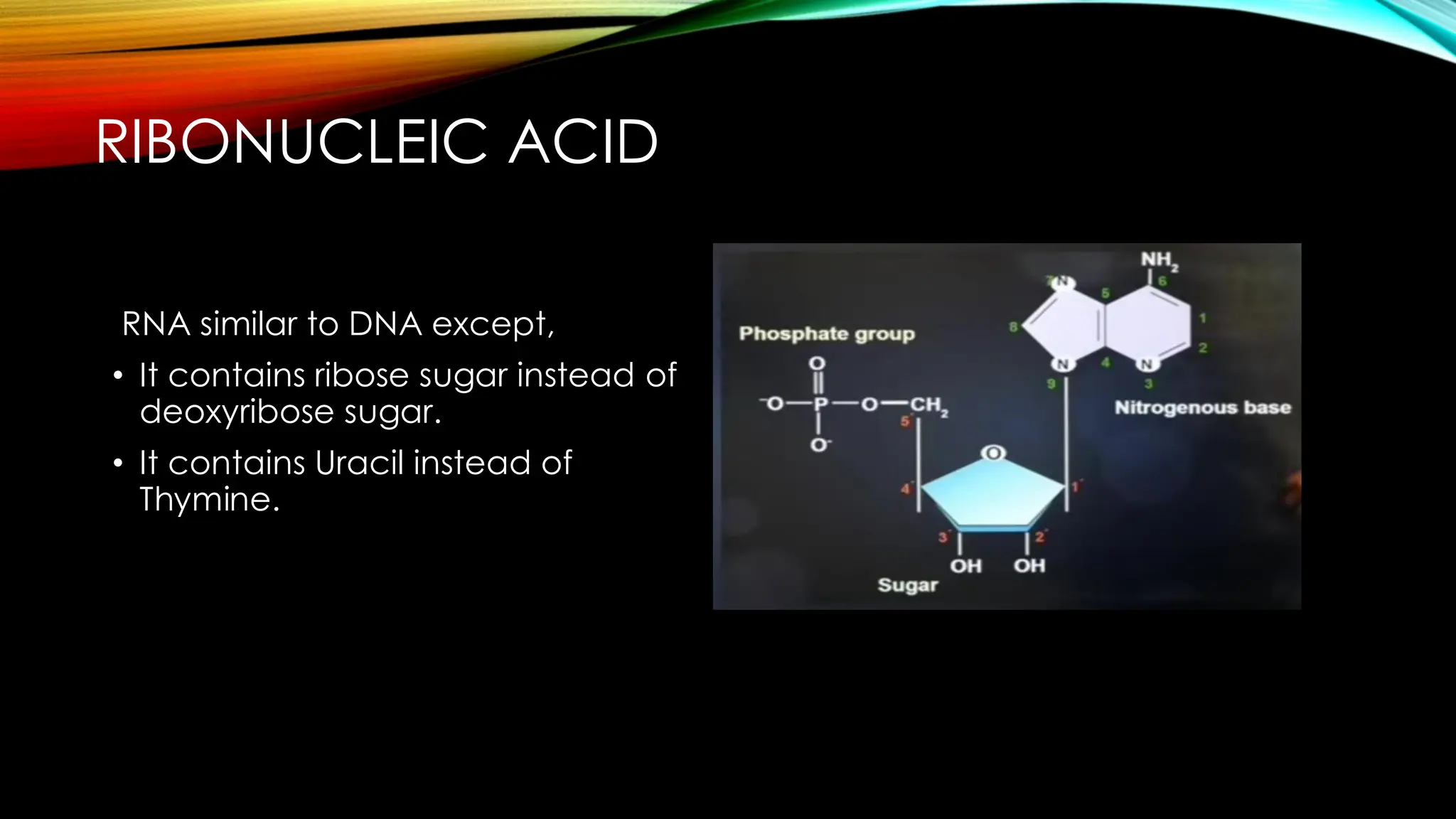
RNA similar to DNA except,
• It contains ribose sugar instead of
deoxyribose sugar.
• It contains Uracil instead of
Thymine.
RNA is single stranded nucleic acid
polymer of four nucleotides, Adenine,
Uracil, Guanine & Cytosine which are
linked by the backbone of alternating
phosphate and ribose sugar.
STRUCTURE OF RNA
RNA as Genetic material
• RNA being single stranded was less stable
• More prone to mutation and lacked mechanism to conserve the genetic
information.
DNA evolved from RNA
• Chemical modification of RNA rise to DNA as genetic material
• DNA being double stranded are more stable
• They have complementary base pairs
• They are less prone to mutation and have evolved a process of repair
RNA is made by coping the base sequence of a section of double-
stranded DNA, called a gene, into a piece of single-stranded
nucleic acid. This process called transcription, is catalysed by an
enzyme called RNA polymerase.
The RNA, forms from DNA transcription, has the polarity 5’-
-->3’. In transcription the 5’ to 3’ DNA act as coding strand and the
3’ to 5’ DNA act as template strand. So there will be always form 5’
to 3’ RNA.
Chargaff’s rules are applicable only for double stranded DNA
molecule. These are not applicable for single stranded DNA
molecule. These are not applicable for single stranded DNA or RNA
molecules. Chargaff’s rule state that DNA helices contain equal
molar ratios of A and T, G and C. This is because in a ds DNA
molecule, complementary base pairing occurs b/w A and T, and C
and G base pairs. This complementary base pairing is not possible
in case of single stranded RNA molecule in case of single stranded
RNA molecule. Thus, Chargaff’s rules are not applicable to RNA
TYPES OF RNA
There are Many types of RNA, the three most well known –
• Messenger RNA – mRNA molecules carry the coding
sequence for protein synthesis. Short lived, commonly
degrades after protein synthesis. It accounts for about 5% of
total RNA in the cell.
• Ribosomal RNA – rRNA molecules form the site of a cell for
protein synthesis and that is ribosome. Most stable, It accounts
for about 80% of total RNA in the cell.
• Transfer RNA – tRNA molecules carry amino acids to the
ribosomes during protein synthesis. It accounts for about 15% of
total RNA in the cell, it is folded coiled like clover leaf structure.
COMPARISON BETWEEN
DNA & RNA
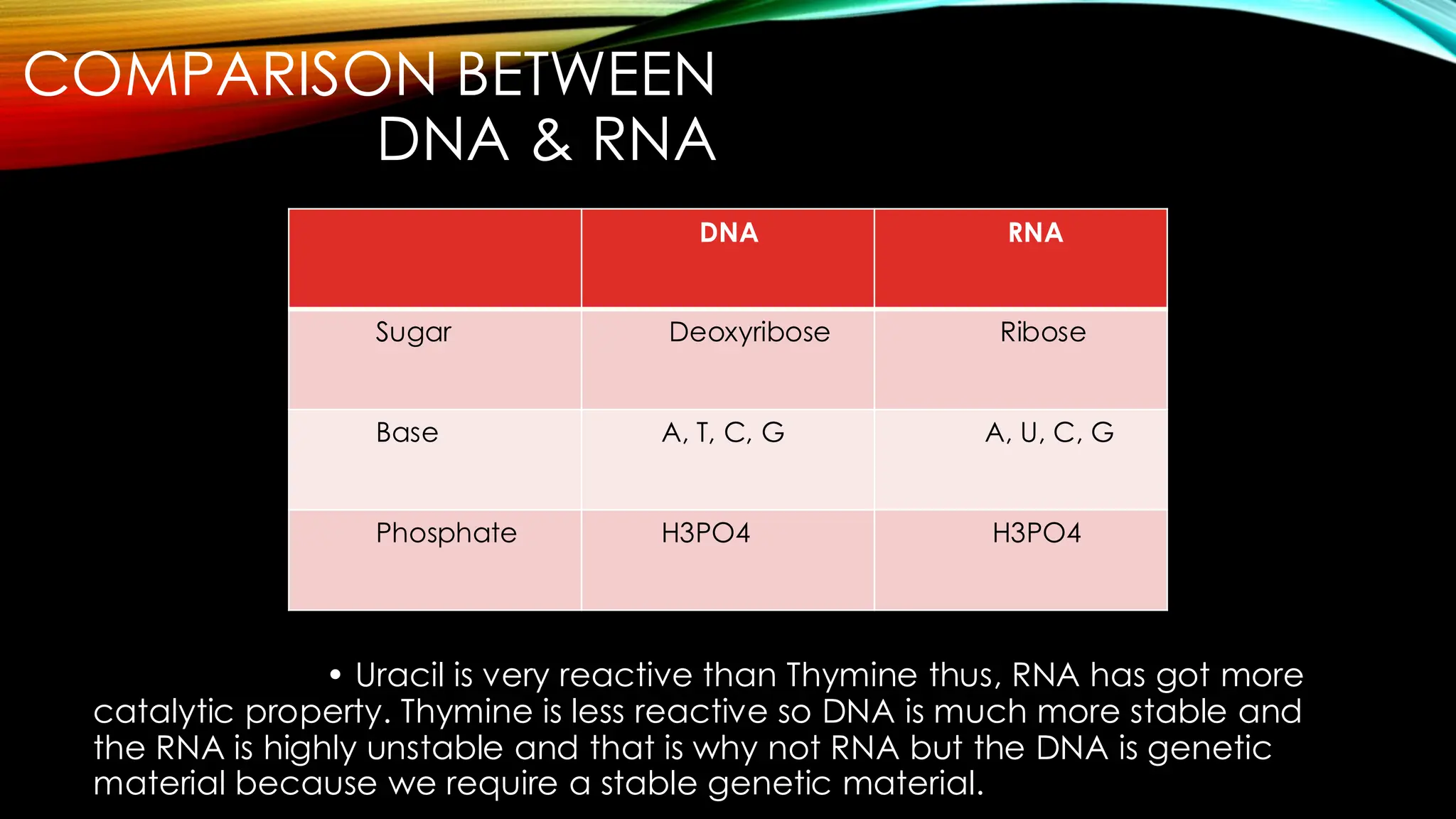
• Uracil is very reactive than Thymine thus, RNA has got more
catalytic property. Thymine is less reactive so DNA is much more stable and
the RNA is highly unstable and that is why not RNA but the DNA is genetic
material because we require a stable genetic material.
DNA RNA
Sugar Deoxyribose Ribose
Base A, T, C, G A, U, C, G
Phosphate H3PO4 H3PO4
Structural Organization Of Nucleic Acids

Structural Organization Of Nucleic Acids

  • 1.
  • 2.
    INTRODUCTION •Nucleic acid arethe main information- carrying molecules of the cell, and by directing the process of protein synthesis, they determine the inherited characterstics of every living thing. The two main classes of nucleic acids are deoxyribonucleic acid (DNA) and ribonucleic acid (RNA). DNA is the genetic material in all free-living organisms and most viruses. RNA is the genetic material of certain viruses, but it also found in all living cells, where it plays an important role in certain processes such as the making of proteins. . DNA, the genetic material basically made up of Sugar plus Nitrogenous bases plus Phosphate when we combine this three things we are going to call it “Nucleotide” which is basic buliding block. But, when we have only two things Sugar plus Base that’s called “Nucleoside”.
  • 3.
    • DNA andRNA are nucleic acids that carry out cellular processes, especially the regulation and expression of genes. NUCLEIC ACID
  • 4.
    NUCLEIC ACID COMPOSITION BothDNA and RNA are made up from nucleotides, each containing five-carbon sugar backbone; the pentose sugar (Ribose or Deoxyribose), a phosphate group and nitrogen base. Momomers – Nucleotide ( Nucleoside + Phosphate Group) • In DNA the sugar is deoxyribose; De means deficiency Oxy means oxygen so that’s mean there is reduce one oxygen in the 2nd carbon. • In RNA the sugar is ribose sugar. Nitrogenous bases include :- • Purine: Adenine and Guanine. • Pyrimidine: Thymine, Cytosine and Uracil. • Nucleotides connected by phosphodiester bonds and form polynucleotide chain.
  • 5.
    • The phosphatemolecule links the 3’-carbon atom of one sugar of one nucleiotide to the 5’carbon of the sugar of the succeeding nucleotide. These nucleoside linkages are called phosphodiester bonds and are the same in RNA and DNA.
  • 6.
    DEOXYRIBONUCLEIC ACID • Ahuman cell contains at least 2 meters of DNA. This DNA is packed or condensed into a nucleus that is about 5 mm in diameter. This is about the Eukaryotic Chromosome. •And in Prokaryotes the chromosome is very small, shorter and lying in one corner of the cell. In DNA the phosphate is H3PO4, which makes it Acidic in nature. And there will be also a little Basic material called Histone Protein. This histone protein are riched with positively charged amino acids such as Arginine and Lysine and negatively charged DNA coils up around it. In eukaryotic chromosome DNA condense by wrapping around cores of histone proteins forming Nucleosomes. There are 2 molecules of H2a, H2b, H3, H4 types of histone form the inner core of nucleosome. There is another type of histone that is H1 protein is known as linker histone. • Nucleosomes are joined by “linker” DNA.
  • 7.
    STRUCTURE OF DNA •DNA is a chain of nucleotides. • Each nucleiotides is a complex of three subunits. • Phosphoric acid (phosphate) • A pentose sugar (deoxyribose) • A nitrogen-containing base.
  • 8.
    • Friedrich Meischer;Identified DNA and named it as 'Nuclein’. • James Watson & Francis Crick proposed double helix model of DNA. • It was based on X-Ray diffraction data produced by Maurice Wilkins & Rosalind Frakline. The double helix DNA structure proposed by Watson and Crick based on X-Ray Crystallography data of Maurice Willkins and Rosalind Frakline and on Erwin Chargaff’s observation.
  • 9.
    • DNA consistsof 2 polynucleotide strands arranged antiparallel as double helix. • Backbone of DNA (strands) is formed by the sugar-phosphate-sugar chain. • These two strands are complementry, with each base in one sticking to its partner on the other. • Steps are formed of nitrogenous base pairs. • Nitrogen base include Adenine(A), Guanine(G), Thymine(T), Cytosine(C).
  • 10.
    There is thethree bonding in DNA – • Glycosidic bond between the pentose sugar and nitrogen base. • Hydrogen bond between the nitrogen bases. • Phosphodiester bond between the pentose sugar and phosphate group.
  • 11.
    •Adenine pair withThymine by 2 hydrogen bonds. •Guanine pair with Cytosine by 3 hydrogen bonds. Two rings(Purine) will always join with the single ring (Pyrimidine) so the number of total ring in all time is three, so that the diameter of DNA remains constant that is 20 Angstroms.
  • 12.
    • One fullturn has 10 steps (10 base pairs). • Length of one full turn = 34 Angstroms (i.e. 3.4 Angstroms for each step). • The girth of a DNA is 20 Angstroms which remain constant due to base pairing.
  • 13.
    RIBONUCLEIC ACID RNA similarto DNA except, • It contains ribose sugar instead of deoxyribose sugar. • It contains Uracil instead of Thymine.
  • 14.
    RNA is singlestranded nucleic acid polymer of four nucleotides, Adenine, Uracil, Guanine & Cytosine which are linked by the backbone of alternating phosphate and ribose sugar. STRUCTURE OF RNA
  • 15.
    RNA as Geneticmaterial • RNA being single stranded was less stable • More prone to mutation and lacked mechanism to conserve the genetic information. DNA evolved from RNA • Chemical modification of RNA rise to DNA as genetic material • DNA being double stranded are more stable • They have complementary base pairs • They are less prone to mutation and have evolved a process of repair
  • 16.
    RNA is madeby coping the base sequence of a section of double- stranded DNA, called a gene, into a piece of single-stranded nucleic acid. This process called transcription, is catalysed by an enzyme called RNA polymerase. The RNA, forms from DNA transcription, has the polarity 5’- -->3’. In transcription the 5’ to 3’ DNA act as coding strand and the 3’ to 5’ DNA act as template strand. So there will be always form 5’ to 3’ RNA.
  • 17.
    Chargaff’s rules areapplicable only for double stranded DNA molecule. These are not applicable for single stranded DNA molecule. These are not applicable for single stranded DNA or RNA molecules. Chargaff’s rule state that DNA helices contain equal molar ratios of A and T, G and C. This is because in a ds DNA molecule, complementary base pairing occurs b/w A and T, and C and G base pairs. This complementary base pairing is not possible in case of single stranded RNA molecule in case of single stranded RNA molecule. Thus, Chargaff’s rules are not applicable to RNA
  • 18.
    TYPES OF RNA Thereare Many types of RNA, the three most well known – • Messenger RNA – mRNA molecules carry the coding sequence for protein synthesis. Short lived, commonly degrades after protein synthesis. It accounts for about 5% of total RNA in the cell. • Ribosomal RNA – rRNA molecules form the site of a cell for protein synthesis and that is ribosome. Most stable, It accounts for about 80% of total RNA in the cell. • Transfer RNA – tRNA molecules carry amino acids to the ribosomes during protein synthesis. It accounts for about 15% of total RNA in the cell, it is folded coiled like clover leaf structure.
  • 19.
    COMPARISON BETWEEN DNA &RNA • Uracil is very reactive than Thymine thus, RNA has got more catalytic property. Thymine is less reactive so DNA is much more stable and the RNA is highly unstable and that is why not RNA but the DNA is genetic material because we require a stable genetic material. DNA RNA Sugar Deoxyribose Ribose Base A, T, C, G A, U, C, G Phosphate H3PO4 H3PO4