DNA Structure
Presented By: Hadiah Bassam Al Mahdi
PhD. Student in Genetics
Faculty of Science , King Adulaziz University
Developmental Genetics Course Bio707
Outline
o History of DNA discovery .
o Chemical component of DNA structure.
o DNA as double helix.
o DNA packaging.
o Conclusion and References
DNA Abbreviation
D N A
Deoxyribo Nucleic Acid
Deoxyribonucleic acid
is the hereditary material in all organisms
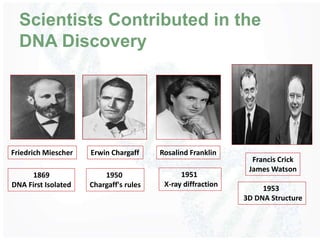
Scientists Contributed in the
DNA Discovery
Friedrich Miescher
1869
DNA First Isolated
Erwin Chargaff
1950
Chargaff's rules
1951
X-ray diffraction
Rosalind Franklin
Francis Crick
James Watson
1953
3D DNA Structure
Building Blocks
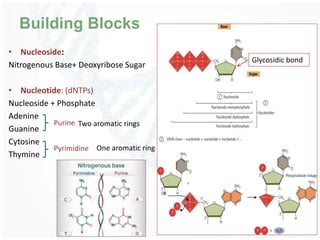
• Nucleoside:
Nitrogenous Base+ Deoxyribose Sugar
• Nucleotide: (dNTPs)
Nucleoside + Phosphate
Adenine
Guanine
Cytosine
Thymine
Pyrimidine
Purine Two aromatic rings
One aromatic ring
Glycosidic bond
Polymer Chain
• Nucleotides considered as a monomer
• Backbone composed of repeating pentose-
phosphate units.
• The sugars are joined together by phosphate
groups that form phosphodiester bonds between
the third and fifth carbon atoms of adjacent sugar
rings.
• 5́  3́ directionality
Nucleotides Percentage
• "Chargaff's Rules"
1. The amount of adenine = thymine
and the amount of guanine = cytosine.
2. The amount of dNTPs in DNA varies
between species.
DNA Helix
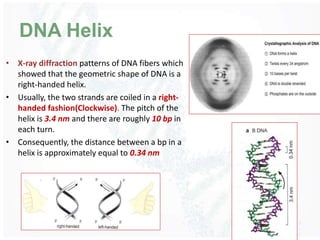
• X-ray diffraction patterns of DNA fibers which
showed that the geometric shape of DNA is a
right-handed helix.
• Usually, the two strands are coiled in a right-
handed fashion(Clockwise). The pitch of the
helix is 3.4 nm and there are roughly 10 bp in
each turn.
• Consequently, the distance between a bp in a
helix is approximately equal to 0.34 nm
DNA Double Helix
• Weston and crick constructed a 3D model of
DNA.
• DNA consists of two associated polynucleotide
strands that twist together to form a helix.
• B form (right handed).
• The orientation of the two strands is
antiparallel.
• The strands are held by formation of base pairs
between the two strands:
“complementary pairs”
A is paired with T through two hydrogen bonds
G is paired with C through three hydrogen bonds
• Hydrophobic and van der Waals interactions
between the stacked adjacent base pairs further
stabilize the double-helical structure.
DNA Grooves
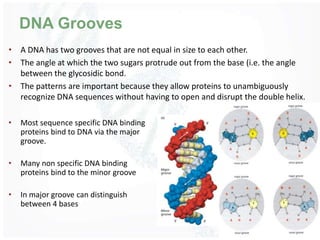
• A DNA has two grooves that are not equal in size to each other.
• The angle at which the two sugars protrude out from the base (i.e. the angle
between the glycosidic bond.
• The patterns are important because they allow proteins to unambiguously
recognize DNA sequences without having to open and disrupt the double helix.
• Most sequence specific DNA binding
proteins bind to DNA via the major
groove.
• Many non specific DNA binding
proteins bind to the minor groove
• In major groove can distinguish
between 4 bases
DNA Different Conformation
3 forms of DNA could be
detected
B – form (Watson & Crick)
A – form
Z – form (Zigzag)
Physical Properties of Double-
Stranded DNA
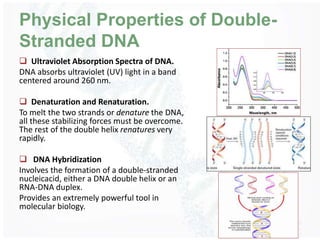
 Ultraviolet Absorption Spectra of DNA.
DNA absorbs ultraviolet (UV) light in a band
centered around 260 nm.
 Denaturation and Renaturation.
To melt the two strands or denature the DNA,
all these stabilizing forces must be overcome.
The rest of the double helix renatures very
rapidly.
 DNA Hybridization
Involves the formation of a double-stranded
nucleicacid, either a DNA double helix or an
RNA-DNA duplex.
Provides an extremely powerful tool in
molecular biology.
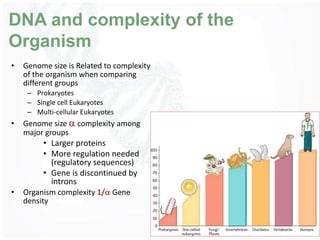
• Genome size is Related to complexity
of the organism when comparing
different groups
– Prokaryotes
– Single cell Eukaryotes
– Multi-cellular Eukaryotes
• Genome size  complexity among
major groups
• Larger proteins
• More regulation needed
(regulatory sequences)
• Gene is discontinued by
introns
• Organism complexity 1/ Gene
density
DNA and complexity of the
Organism
Do all cells have the same DNA
structure ?
• Most Eukaryotes have linear DNA.
• mtDNA and plastid DNA are circular.
• Some viruses, most bacteria & plasmid have
circular DNA.
•  phage can exist in both linear and circular
DNA because of sticky ends.
DNA is compacted into
chromosomes
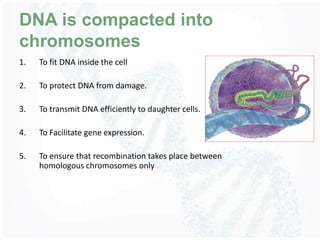
1. To fit DNA inside the cell
2. To protect DNA from damage.
3. To transmit DNA efficiently to daughter cells.
4. To Facilitate gene expression.
5. To ensure that recombination takes place between
homologous chromosomes only
DNA Packaging
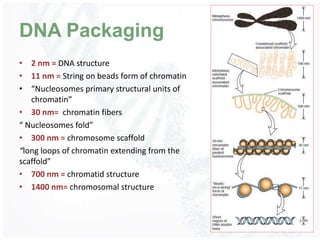
• 2 nm = DNA structure
• 11 nm = String on beads form of chromatin
• “Nucleosomes primary structural units of
chromatin”
• 30 nm= chromatin fibers
“ Nucleosomes fold”
• 300 nm = chromosome scaffold
“long loops of chromatin extending from the
scaffold”
• 700 nm = chromatid structure
• 1400 nm= chromosomal structure
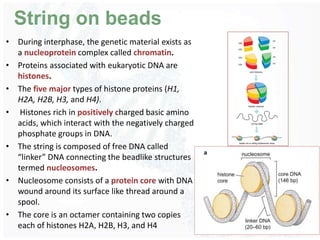
String on beads
• During interphase, the genetic material exists as
a nucleoprotein complex called chromatin.
• Proteins associated with eukaryotic DNA are
histones.
• The five major types of histone proteins (H1,
H2A, H2B, H3, and H4).
• Histones rich in positively charged basic amino
acids, which interact with the negatively charged
phosphate groups in DNA.
• The string is composed of free DNA called
“linker” DNA connecting the beadlike structures
termed nucleosomes.
• Nucleosome consists of a protein core with DNA
wound around its surface like thread around a
spool.
• The core is an octamer containing two copies
each of histones H2A, H2B, H3, and H4
Chromatin fibers
• A chromatosome is a result
of histone H1 binding to
a nucleosome, which contains
a histone octamer and DNA.
Chromosome scaffold
• Nonhistone proteins provide a structural scaffold for long chromatin
loops.
• Folding of the scaffold has been proposed to produce the highly
condensed structure characteristic of metaphase chromosomes.
Chromatid and chromosome structure
Explain in next ppt.
DNA
Structure
in
Prokaryotic
vs
Eukaryotic
Conclusion
 Deoxyribonucleic acid (DNA), the genetic material, carries information to
specify the amino acid sequences of proteins.
 DNA contains four types of adjacent nucleotides in a polynucleotide are linked
by phosphodiester bonds .
 Natural DNA (B DNA) contains two complementary antiparallel polynucleotide
strands wound together into a regular right-handed double helix.
 The bases in nucleic acids can interact via hydrogenbonds. The standard
Watson-Crick base pairs are G·C, A·T (in DNA).
 Each eukaryotic chromosome contains a single DNA molecule packaged into
nucleosomes and folded into a 30-nm chromatin fiber, which is attached to a
protein scaffold at specific sites
References
o SINDEN, R. R. 2012. DNA structure and function,
Elsevier.
o WATSON, J. D., BAKER, T. A., BELL, S. P., GANN, A.,
LEVINE, M., & LOSICK, R. M. (2004). Molecular
biology of the gene.
o LODISH, H., BERK, A., KAISER, C. A., KRIEGER, M.,
SCOTT, M. P., BRETSCHER, A., PLOEGH, H. &
MATSUDAIRA, P. 2008. Molecular cell biology,
Macmillan.
DNA structure

DNA structure

  • 1.
    DNA Structure Presented By:Hadiah Bassam Al Mahdi PhD. Student in Genetics Faculty of Science , King Adulaziz University Developmental Genetics Course Bio707
  • 2.
    Outline o History ofDNA discovery . o Chemical component of DNA structure. o DNA as double helix. o DNA packaging. o Conclusion and References
  • 3.
    DNA Abbreviation D NA Deoxyribo Nucleic Acid Deoxyribonucleic acid is the hereditary material in all organisms
  • 4.
    Scientists Contributed inthe DNA Discovery Friedrich Miescher 1869 DNA First Isolated Erwin Chargaff 1950 Chargaff's rules 1951 X-ray diffraction Rosalind Franklin Francis Crick James Watson 1953 3D DNA Structure
  • 5.
    Building Blocks • Nucleoside: NitrogenousBase+ Deoxyribose Sugar • Nucleotide: (dNTPs) Nucleoside + Phosphate Adenine Guanine Cytosine Thymine Pyrimidine Purine Two aromatic rings One aromatic ring Glycosidic bond
  • 6.
    Polymer Chain • Nucleotidesconsidered as a monomer • Backbone composed of repeating pentose- phosphate units. • The sugars are joined together by phosphate groups that form phosphodiester bonds between the third and fifth carbon atoms of adjacent sugar rings. • 5́  3́ directionality
  • 7.
    Nucleotides Percentage • "Chargaff'sRules" 1. The amount of adenine = thymine and the amount of guanine = cytosine. 2. The amount of dNTPs in DNA varies between species.
  • 8.
    DNA Helix • X-raydiffraction patterns of DNA fibers which showed that the geometric shape of DNA is a right-handed helix. • Usually, the two strands are coiled in a right- handed fashion(Clockwise). The pitch of the helix is 3.4 nm and there are roughly 10 bp in each turn. • Consequently, the distance between a bp in a helix is approximately equal to 0.34 nm
  • 9.
    DNA Double Helix •Weston and crick constructed a 3D model of DNA. • DNA consists of two associated polynucleotide strands that twist together to form a helix. • B form (right handed). • The orientation of the two strands is antiparallel. • The strands are held by formation of base pairs between the two strands: “complementary pairs” A is paired with T through two hydrogen bonds G is paired with C through three hydrogen bonds • Hydrophobic and van der Waals interactions between the stacked adjacent base pairs further stabilize the double-helical structure.
  • 10.
    DNA Grooves • ADNA has two grooves that are not equal in size to each other. • The angle at which the two sugars protrude out from the base (i.e. the angle between the glycosidic bond. • The patterns are important because they allow proteins to unambiguously recognize DNA sequences without having to open and disrupt the double helix. • Most sequence specific DNA binding proteins bind to DNA via the major groove. • Many non specific DNA binding proteins bind to the minor groove • In major groove can distinguish between 4 bases
  • 11.
    DNA Different Conformation 3forms of DNA could be detected B – form (Watson & Crick) A – form Z – form (Zigzag)
  • 12.
    Physical Properties ofDouble- Stranded DNA  Ultraviolet Absorption Spectra of DNA. DNA absorbs ultraviolet (UV) light in a band centered around 260 nm.  Denaturation and Renaturation. To melt the two strands or denature the DNA, all these stabilizing forces must be overcome. The rest of the double helix renatures very rapidly.  DNA Hybridization Involves the formation of a double-stranded nucleicacid, either a DNA double helix or an RNA-DNA duplex. Provides an extremely powerful tool in molecular biology.
  • 13.
    • Genome sizeis Related to complexity of the organism when comparing different groups – Prokaryotes – Single cell Eukaryotes – Multi-cellular Eukaryotes • Genome size  complexity among major groups • Larger proteins • More regulation needed (regulatory sequences) • Gene is discontinued by introns • Organism complexity 1/ Gene density DNA and complexity of the Organism
  • 14.
    Do all cellshave the same DNA structure ? • Most Eukaryotes have linear DNA. • mtDNA and plastid DNA are circular. • Some viruses, most bacteria & plasmid have circular DNA. •  phage can exist in both linear and circular DNA because of sticky ends.
  • 15.
    DNA is compactedinto chromosomes 1. To fit DNA inside the cell 2. To protect DNA from damage. 3. To transmit DNA efficiently to daughter cells. 4. To Facilitate gene expression. 5. To ensure that recombination takes place between homologous chromosomes only
  • 16.
    DNA Packaging • 2nm = DNA structure • 11 nm = String on beads form of chromatin • “Nucleosomes primary structural units of chromatin” • 30 nm= chromatin fibers “ Nucleosomes fold” • 300 nm = chromosome scaffold “long loops of chromatin extending from the scaffold” • 700 nm = chromatid structure • 1400 nm= chromosomal structure
  • 17.
    String on beads •During interphase, the genetic material exists as a nucleoprotein complex called chromatin. • Proteins associated with eukaryotic DNA are histones. • The five major types of histone proteins (H1, H2A, H2B, H3, and H4). • Histones rich in positively charged basic amino acids, which interact with the negatively charged phosphate groups in DNA. • The string is composed of free DNA called “linker” DNA connecting the beadlike structures termed nucleosomes. • Nucleosome consists of a protein core with DNA wound around its surface like thread around a spool. • The core is an octamer containing two copies each of histones H2A, H2B, H3, and H4
  • 18.
    Chromatin fibers • Achromatosome is a result of histone H1 binding to a nucleosome, which contains a histone octamer and DNA.
  • 19.
    Chromosome scaffold • Nonhistoneproteins provide a structural scaffold for long chromatin loops. • Folding of the scaffold has been proposed to produce the highly condensed structure characteristic of metaphase chromosomes.
  • 20.
    Chromatid and chromosomestructure Explain in next ppt.
  • 21.
  • 22.
    Conclusion  Deoxyribonucleic acid(DNA), the genetic material, carries information to specify the amino acid sequences of proteins.  DNA contains four types of adjacent nucleotides in a polynucleotide are linked by phosphodiester bonds .  Natural DNA (B DNA) contains two complementary antiparallel polynucleotide strands wound together into a regular right-handed double helix.  The bases in nucleic acids can interact via hydrogenbonds. The standard Watson-Crick base pairs are G·C, A·T (in DNA).  Each eukaryotic chromosome contains a single DNA molecule packaged into nucleosomes and folded into a 30-nm chromatin fiber, which is attached to a protein scaffold at specific sites
  • 23.
    References o SINDEN, R.R. 2012. DNA structure and function, Elsevier. o WATSON, J. D., BAKER, T. A., BELL, S. P., GANN, A., LEVINE, M., & LOSICK, R. M. (2004). Molecular biology of the gene. o LODISH, H., BERK, A., KAISER, C. A., KRIEGER, M., SCOTT, M. P., BRETSCHER, A., PLOEGH, H. & MATSUDAIRA, P. 2008. Molecular cell biology, Macmillan.

Editor's Notes

  • #4 First step in central dogma
  • #5 which triggered the idea that DNA was a helix. Perhaps the most important aspects of DNA structural variation are likely to be found in the mechanics of molecular recognition and manipulation by proteins.
  • #6 Deoxyribose is the five-carbon sugar molecule that helps form the phosphate backbone of DNA molecules Guanine + thymine = keto Cytosine + Thymine = Amino Glycosidic bond between sugar and base
  • #7 A covalent bond, also called a molecular bond, is a chemical bond that involves the sharing of electron pairs between atoms. DNA polymarase Negative charge
  • #8 Hydrogen bond is non covalent Negative charge Antiparallel means one strand is orientated from 5 to 3 and other orientated from 3 to 5
  • #9 Hydrogen bond is non covalent Antiparllel means one strand is orientated from 5 to 3 and other orientated from 3 to 5 Rosalind Franklin and Maurice Wilkins used a method of X-ray diffraction to investigate the structure of DNA DNA was purified and then fibres were stretched in a thin glass tube (to make most of the strands parallel) The DNA was targeted by a X-ray beam, which was diffracted when it contacted an atom The scattering pattern of the X-ray was recorded on a film and used to elucidate details of mole (a nanometer is one billionth of ameter, that is 10-9 m)
  • #10 Weston and crick constructed a 3D model of DNA. Used information from experiments conducted by other scientist Determined the structure of DNA was a double helix made of two nucleotides Won Nobel Prize 1962
  • #11 The narrow angle = minor groove. The large angle =major grove.
  • #12 Dehydrating condition. (A) High salt concentration.(Z)
  • #16 6 um diameter of nucleolus
  • #18  Lysine and arginine amino acid Linker 147 b.b Each chromosome consists of a single, long molecule of DNA up to ~280 Mb in humans, organized into increasing levels of condensation by the histone and nonhistone proteins with which it is intricately complexed.
  • #20 Histone protien (conserved genes) tandom repeat