By Prof. Liwayway Memije-Cruz
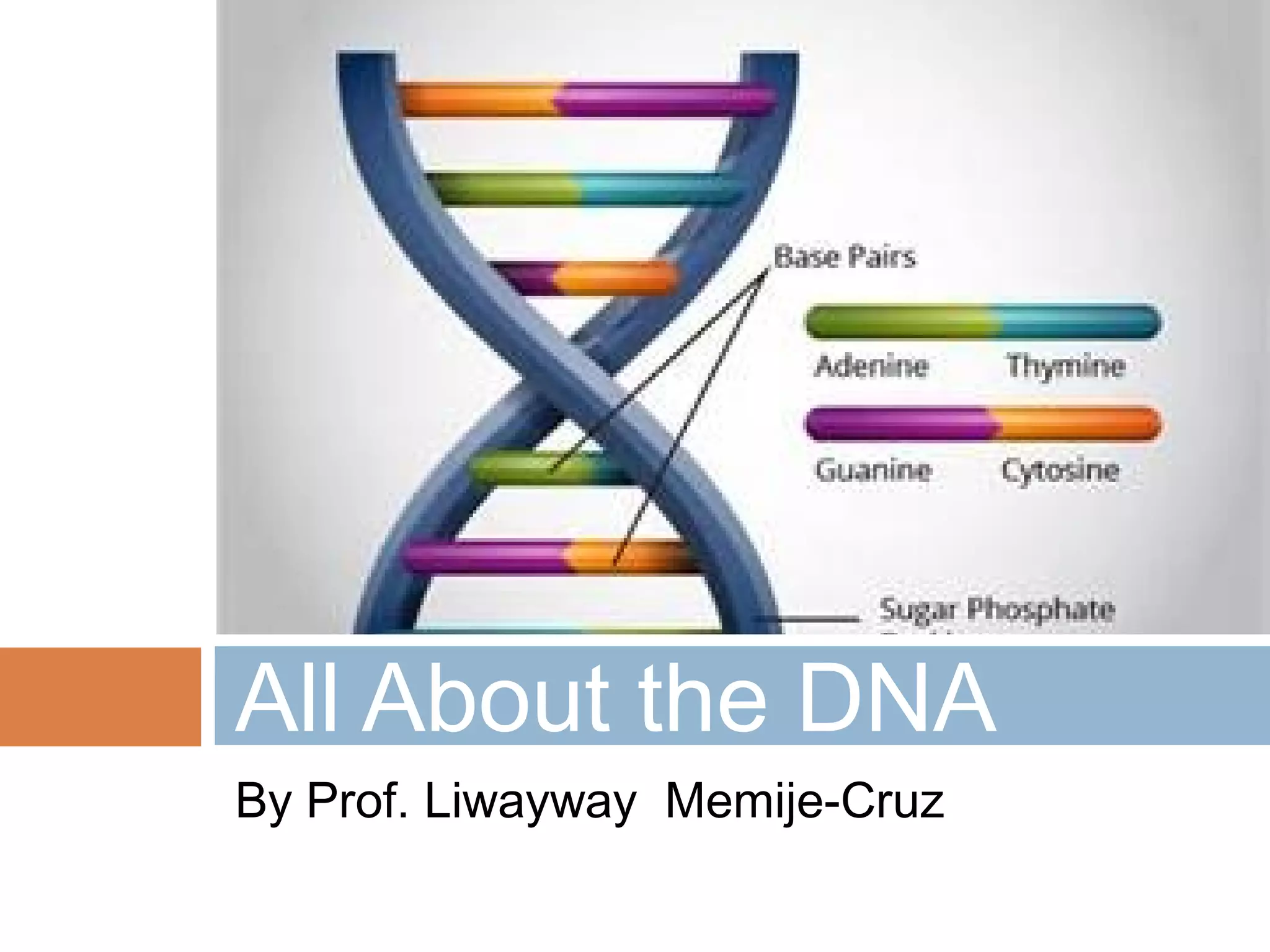
All About the DNA
DNA: Deoxyribonucleic acid
 A molecule that
contains the
instructions an
organism needs to
develop, live and
reproduce. These
instructions are
found inside every
cell, and are passed
down from parents
to their children.
DNA Sequence
 DNA is made up of molecules called nucleotides.
Each nucleotide contains a phosphate group, a
sugar group and a nitrogen base. The four types
of nitrogen bases are adenine (A), thymine (T),
guanine (G) and cytosine (C). The order of these
bases is what determines DNA's instructions, or
genetic code. Similar to the way the order of
letters in the alphabet can be used to form a word,
the order of nitrogen bases in a DNA sequence
forms genes which tells cells how to make
proteins.
 The entire human genome contains about3 billion
DNA Structure
DNA: Double Helix
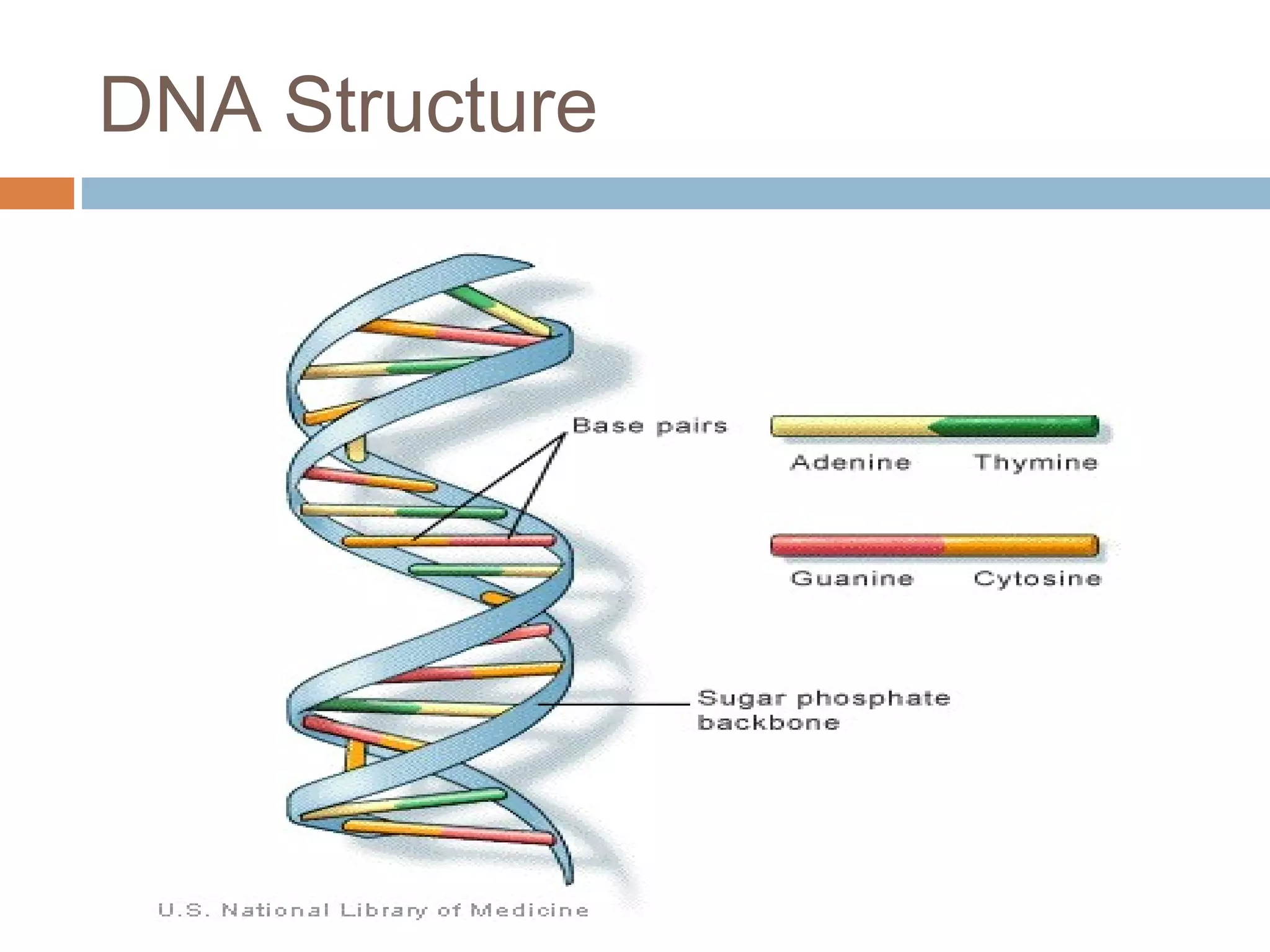
 Nucleotides are attached together to form two long
strands that spiral to create a structure called a double
helix. A double helix structure is like a ladder, the
phosphate and sugar molecules would be the sides, while
the bases would be the rungs. The bases on one strand
pair with the bases on another strand: adenine pairs with
thymine, and guanine pairs with cytosine.
 DNA molecules are long that they can't fit into cells
without the right packaging. DNA is coiled tightly to form
structures we call chromosomes.
 Each chromosome contains a single DNA molecule.
Humans have 23 pairs of chromosomes, which are found
inside the cell's nucleus.
DNA Discovery
 First observed in 1869 by a German biochemist
Frederich Miescher.
 In 1953 James Watson, Francis Crick, Maurice
Wilkins and Rosalind Franklin figured out the
structure of DNA — a double helix — which they
realized could carry biological information.
 Watson, Crick and Wilkins were awarded the
Nobel Prize in Medicine in in 1962 "for their
discoveries concerning the molecular structure of
nucleic acids and its significance for information
transfer in living material.”
DNA Testing
 DNA contains information about our heritage, and
can sometimes reveal whether we're at risk for
certain diseases.
 DNA is used to diagnose genetic disorders, to
determine whether a person is a carrier of a
genetic mutation that they could pass on to their
children, and to examine whether a person is at
risk for a genetic disease
 can have implications for a person's health, and
the tests are often provided along with genetic
counseling to help individuals understand the
DNA Replication: is the process by which
DNA makes a copy of itself during cell
division. 
Importance of DNA
1. Deoxyribonucleic acid is the
universal blueprint for life on Earth.
2. DNA determines what people look
like and how their bodies function.
3. It can cause crippling defects or
protect living creatures from
disease.
4. It may even determine when it’s time
to die.
DNA and Mutations
 A mutation is a change in DNA, the hereditary
material of life.
 Mutations are essential to evolution; they are
the raw material of genetic variation. Without
mutation, evolution could not occur
 An organism's DNA affects how it looks, how it
behaves, and its physiology.
 A change in an organism's DNA can cause
changes in all aspects of its life.
DNA: The molecular basis of
mutations
 Protein-coding DNA can be divided
into codons — sets of three bases that specify
an amino acid or signal the end of the protein.
Codons are identified by the bases that make
them up. The cellular machinery uses these
instructions to assemble a string of
corresponding amino acids (one amino acid
for each three bases) that form a protein. The
amino acid that corresponds to "GCA" is
called alanine; there are twenty different
amino acids synthesized this way in humans.
"Stop" codons signify the end of the newly
built protein. After the protein is built based on
the sequence of bases in the gene, the
Types of Mutations
1. Substitution - a mutation that exchanges
one base for another (i.e., a change in a
single "chemical letter" such as switching
an A to a G). Ex: CTGGAG > CTGGGG
2. Insertions are mutations in which extra
base pairs are inserted into a new place in
the DNA. Ex: CTGGAG > CTGGTGGAG
3. Deletions are mutations in which a section
of DNA is lost, or deleted. Ex: CTGGAG >
CTAG
Causes of Mutations
1. DNA fails to copy accurately
2. External influences can create mutations
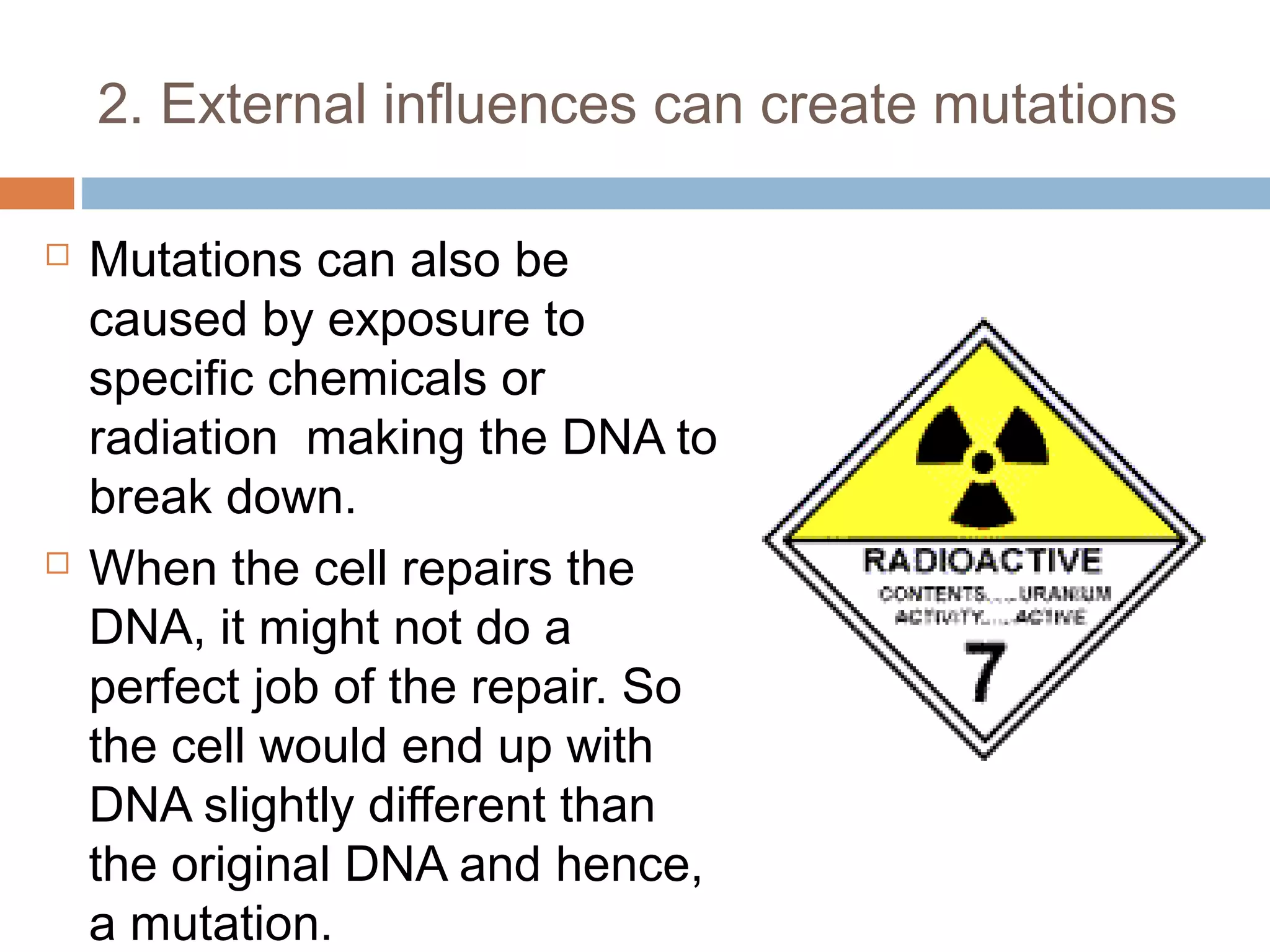
 Mutations can also be
caused by exposure to
specific chemicals or
radiation making the DNA to
break down.
 When the cell repairs the
DNA, it might not do a
perfect job of the repair. So
the cell would end up with
DNA slightly different than
the original DNA and hence,
a mutation.
Genetic Engineering
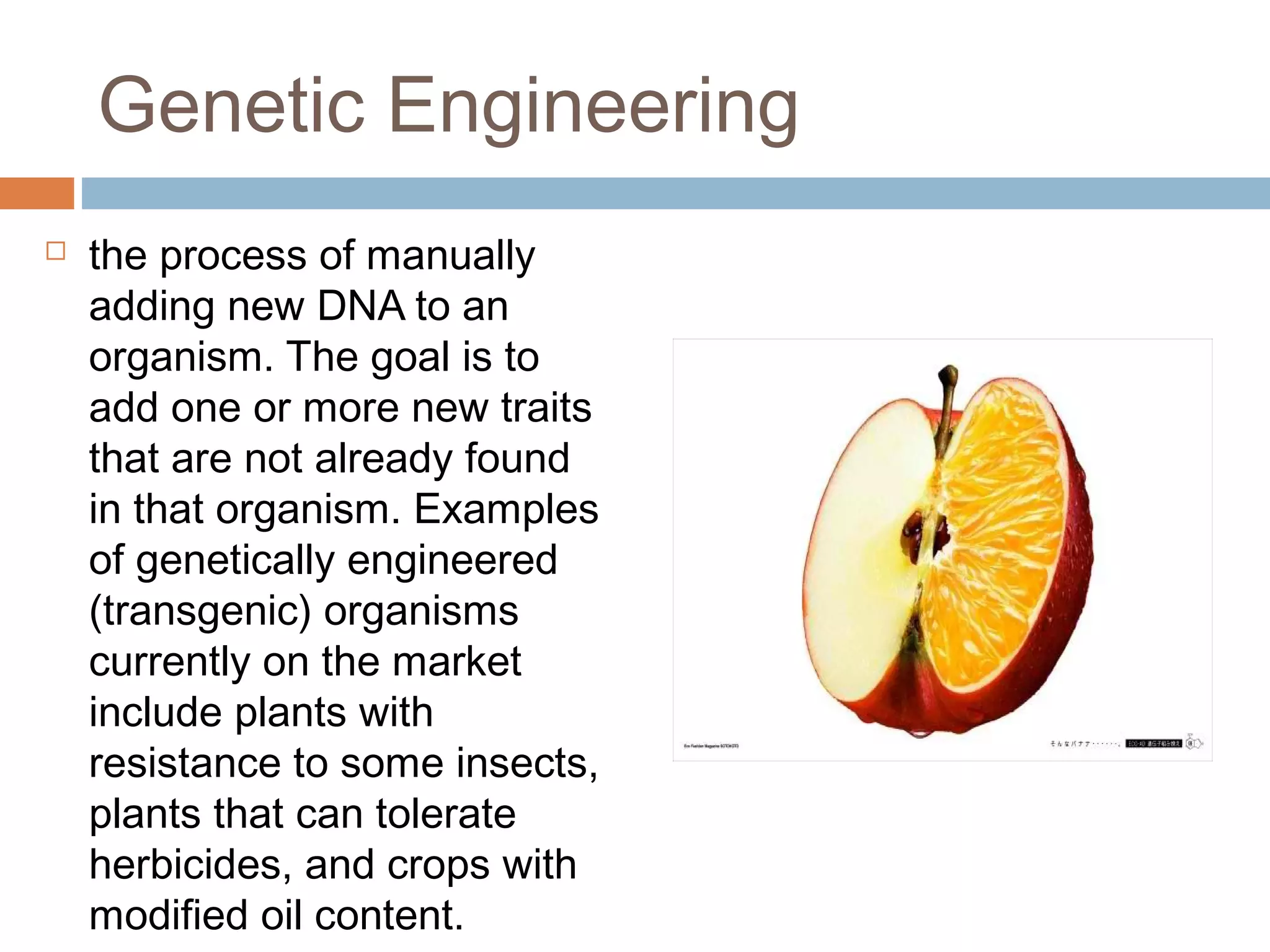
 the process of manually
adding new DNA to an
organism. The goal is to
add one or more new traits
that are not already found
in that organism. Examples
of genetically engineered
(transgenic) organisms
currently on the market
include plants with
resistance to some insects,
plants that can tolerate
herbicides, and crops with
modified oil content.
DNA Fingerprinting
 a laboratory
technique used to
establish a link
between biological
evidence and a
suspect in a
criminal
investigation.
 DNA fingerprinting
is also used to
establish paternity.
Worldwide Demand For DNA
Testing
 DNA testing and research is being used
across a number of sectors and from
companies that specialize in paternity testing,
to those that look at genetic modification of
plants, there is a significant market to be
tapped.
 Independent companies, new branches of
established pharmaceutical companies and
numerous research departments are either
looking at ways that DNA can change our
lives, or offering us DNA testing services.
DNA and Industry
Some examples of how the DNA industry is growing:
 DNA Sunscreen –The DNA on your skin can be damaged long before
you burn, and this damage can contribute to the development of skin
cancer. A company to provide a DNA rating for sunscreen.
 Personalized Healthcare – Thorough analysis of our DNA can show
whether we have a predisposition towards certain diseases or are likely
to react badly to particular medicines. In the long-term, this information
could be used to tailor the healthcare we get which, experts argue, could
prevent a huge amount of wastage in the current health service.
 Soft drinks may damage DNA – In May 2007, researchers at a British
University released details of a study into the effects of some soft drinks
on DNA. They found that one of the ingredients often present in fizzy
drinks, E211 or sodium benzoate may damage DNA, causing problems
similar to those caused by alcohol abuse. Damaging the important
mitochondrial DNA, this chemical could cause cell damage.
 Given the possible effects of
both natural and man-made
environments and
substances, it’s important
that research into DNA
continues, and that the
companies offering DNA
testing uphold the reputation
of this young industry by
providing the best possible
results and service to their
Biological Warfare
 Biological warfare is the
employment of biological
agents to produce
casualties in man or
animals or damage to
plants.
 Biological weapons include
any organism (such as
bacteria, viruses, or fungi)
or toxin found in nature that
can be used to kill or injure
http://www.yourgenome.org/facts/what-is-dna-replication
http://learn.genetics.utah.edu/content/molecules/dna/
http://www.livescience.com/37247-dna.html
http://science.opposingviews.com/importance-dna-human-cell-
19447.html
http://evolution.berkeley.edu/evolibrary/article/mutations
http://agbiosafety.unl.edu/basic_genetics.shtml
http://www.fankids.org/dna-paternity-testing-explained/
https://www.ibdna.com/the-dna-industry/
http://www.emedicinehealth.com/biological_warfare/article_em.htm
References:

All about the DNA

  • 1.
    By Prof. LiwaywayMemije-Cruz All About the DNA
  • 2.
    DNA: Deoxyribonucleic acid A molecule that contains the instructions an organism needs to develop, live and reproduce. These instructions are found inside every cell, and are passed down from parents to their children.
  • 3.
    DNA Sequence  DNAis made up of molecules called nucleotides. Each nucleotide contains a phosphate group, a sugar group and a nitrogen base. The four types of nitrogen bases are adenine (A), thymine (T), guanine (G) and cytosine (C). The order of these bases is what determines DNA's instructions, or genetic code. Similar to the way the order of letters in the alphabet can be used to form a word, the order of nitrogen bases in a DNA sequence forms genes which tells cells how to make proteins.  The entire human genome contains about3 billion
  • 4.
  • 5.
    DNA: Double Helix Nucleotides are attached together to form two long strands that spiral to create a structure called a double helix. A double helix structure is like a ladder, the phosphate and sugar molecules would be the sides, while the bases would be the rungs. The bases on one strand pair with the bases on another strand: adenine pairs with thymine, and guanine pairs with cytosine.  DNA molecules are long that they can't fit into cells without the right packaging. DNA is coiled tightly to form structures we call chromosomes.  Each chromosome contains a single DNA molecule. Humans have 23 pairs of chromosomes, which are found inside the cell's nucleus.
  • 6.
    DNA Discovery  Firstobserved in 1869 by a German biochemist Frederich Miescher.  In 1953 James Watson, Francis Crick, Maurice Wilkins and Rosalind Franklin figured out the structure of DNA — a double helix — which they realized could carry biological information.  Watson, Crick and Wilkins were awarded the Nobel Prize in Medicine in in 1962 "for their discoveries concerning the molecular structure of nucleic acids and its significance for information transfer in living material.”
  • 7.
    DNA Testing  DNAcontains information about our heritage, and can sometimes reveal whether we're at risk for certain diseases.  DNA is used to diagnose genetic disorders, to determine whether a person is a carrier of a genetic mutation that they could pass on to their children, and to examine whether a person is at risk for a genetic disease  can have implications for a person's health, and the tests are often provided along with genetic counseling to help individuals understand the
  • 8.
    DNA Replication: isthe process by which DNA makes a copy of itself during cell division. 
  • 9.
    Importance of DNA 1.Deoxyribonucleic acid is the universal blueprint for life on Earth. 2. DNA determines what people look like and how their bodies function. 3. It can cause crippling defects or protect living creatures from disease. 4. It may even determine when it’s time to die.
  • 10.
    DNA and Mutations A mutation is a change in DNA, the hereditary material of life.  Mutations are essential to evolution; they are the raw material of genetic variation. Without mutation, evolution could not occur  An organism's DNA affects how it looks, how it behaves, and its physiology.  A change in an organism's DNA can cause changes in all aspects of its life.
  • 11.
    DNA: The molecularbasis of mutations  Protein-coding DNA can be divided into codons — sets of three bases that specify an amino acid or signal the end of the protein. Codons are identified by the bases that make them up. The cellular machinery uses these instructions to assemble a string of corresponding amino acids (one amino acid for each three bases) that form a protein. The amino acid that corresponds to "GCA" is called alanine; there are twenty different amino acids synthesized this way in humans. "Stop" codons signify the end of the newly built protein. After the protein is built based on the sequence of bases in the gene, the
  • 12.
    Types of Mutations 1.Substitution - a mutation that exchanges one base for another (i.e., a change in a single "chemical letter" such as switching an A to a G). Ex: CTGGAG > CTGGGG 2. Insertions are mutations in which extra base pairs are inserted into a new place in the DNA. Ex: CTGGAG > CTGGTGGAG 3. Deletions are mutations in which a section of DNA is lost, or deleted. Ex: CTGGAG > CTAG
  • 13.
    Causes of Mutations 1.DNA fails to copy accurately
  • 14.
    2. External influencescan create mutations  Mutations can also be caused by exposure to specific chemicals or radiation making the DNA to break down.  When the cell repairs the DNA, it might not do a perfect job of the repair. So the cell would end up with DNA slightly different than the original DNA and hence, a mutation.
  • 15.
    Genetic Engineering  theprocess of manually adding new DNA to an organism. The goal is to add one or more new traits that are not already found in that organism. Examples of genetically engineered (transgenic) organisms currently on the market include plants with resistance to some insects, plants that can tolerate herbicides, and crops with modified oil content.
  • 16.
    DNA Fingerprinting  alaboratory technique used to establish a link between biological evidence and a suspect in a criminal investigation.  DNA fingerprinting is also used to establish paternity.
  • 17.
    Worldwide Demand ForDNA Testing  DNA testing and research is being used across a number of sectors and from companies that specialize in paternity testing, to those that look at genetic modification of plants, there is a significant market to be tapped.  Independent companies, new branches of established pharmaceutical companies and numerous research departments are either looking at ways that DNA can change our lives, or offering us DNA testing services.
  • 18.
    DNA and Industry Someexamples of how the DNA industry is growing:  DNA Sunscreen –The DNA on your skin can be damaged long before you burn, and this damage can contribute to the development of skin cancer. A company to provide a DNA rating for sunscreen.  Personalized Healthcare – Thorough analysis of our DNA can show whether we have a predisposition towards certain diseases or are likely to react badly to particular medicines. In the long-term, this information could be used to tailor the healthcare we get which, experts argue, could prevent a huge amount of wastage in the current health service.  Soft drinks may damage DNA – In May 2007, researchers at a British University released details of a study into the effects of some soft drinks on DNA. They found that one of the ingredients often present in fizzy drinks, E211 or sodium benzoate may damage DNA, causing problems similar to those caused by alcohol abuse. Damaging the important mitochondrial DNA, this chemical could cause cell damage.
  • 19.
     Given thepossible effects of both natural and man-made environments and substances, it’s important that research into DNA continues, and that the companies offering DNA testing uphold the reputation of this young industry by providing the best possible results and service to their
  • 20.
    Biological Warfare  Biologicalwarfare is the employment of biological agents to produce casualties in man or animals or damage to plants.  Biological weapons include any organism (such as bacteria, viruses, or fungi) or toxin found in nature that can be used to kill or injure
  • 21.