The Structure of Deoxyribonucleic Acid
Deoxyribonucleic Acid Classified as a  Nucleic Acid Long, double stranded molecule made   up of monomers know as  nucleotides   DNA
Nucleic acids, built by polymerizing nucleotides, function primarily as informational molecules for the storage and retrieval of information about the primary sequence of polypeptides.   Nucleic Acids Store and Retrieve Genetic Information Biology Place Tutorial
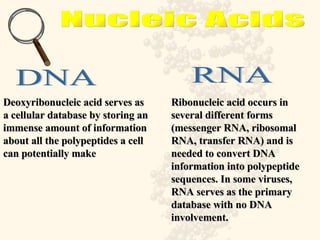
Nucleic Acids DNA RNA Deoxyribonucleic acid serves as a cellular database by storing an immense amount of information about all the polypeptides a cell can potentially make Ribonucleic acid occurs in several different forms (messenger RNA, ribosomal RNA, transfer RNA) and is needed to convert DNA information into polypeptide sequences. In some viruses, RNA serves as the primary database with no DNA involvement.
DNA and RNA
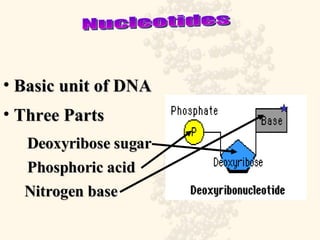
Nucleotides Basic unit of DNA Three Parts Deoxyribose sugar Phosphoric acid Nitrogen base
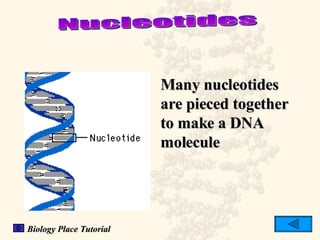
Nucleotides Many nucleotides are pieced together to make a DNA molecule Biology Place Tutorial
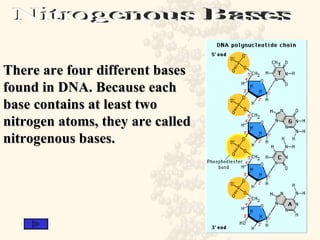
Nitrogenous Bases There are four different bases found in DNA. Because each base contains at least two nitrogen atoms, they are called nitrogenous bases.
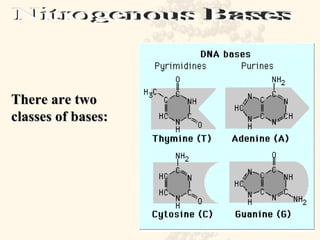
Nitrogenous Bases There are two classes of bases:
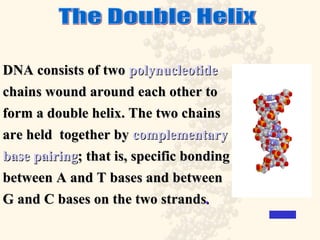
The Double Helix DNA consists of two  polynucleotide chains wound around each other to form a double helix. The two chains are held  together by  complementary  base pairing ; that is, specific bonding  between A and T bases and between G and C bases on the two strands .
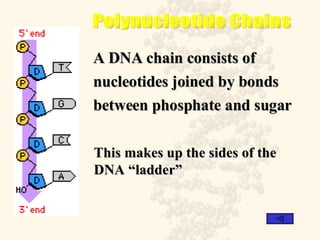
A DNA chain consists of  nucleotides joined by bonds between phosphate and sugar   Polynucleotide Chains This makes up the sides of the DNA “ladder”
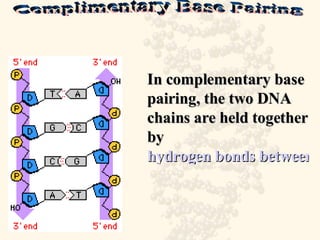
In complementary base pairing, the two DNA chains are held together by  hydrogen bonds between nitrogen bases! Complimentary Base Pairing
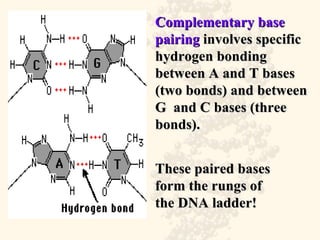
Complementary base pairing  involves specific hydrogen bonding between A and T bases (two bonds) and between G  and C bases (three bonds). These paired bases form the rungs of the DNA ladder!
Do you know your DNA??? Go to the Biology Place to test yourself!
DNA is the Master Molecule of Diversity. Its simple structure holds the key to millions of different genetic codes for all of the species of life on Earth. In the days to follow you will see how DNA carries out its role as the Master Molecule!

Structure Of Dna

  • 1.
    The Structure ofDeoxyribonucleic Acid
  • 2.
    Deoxyribonucleic Acid Classifiedas a Nucleic Acid Long, double stranded molecule made up of monomers know as nucleotides DNA
  • 3.
    Nucleic acids, builtby polymerizing nucleotides, function primarily as informational molecules for the storage and retrieval of information about the primary sequence of polypeptides. Nucleic Acids Store and Retrieve Genetic Information Biology Place Tutorial
  • 4.
    Nucleic Acids DNARNA Deoxyribonucleic acid serves as a cellular database by storing an immense amount of information about all the polypeptides a cell can potentially make Ribonucleic acid occurs in several different forms (messenger RNA, ribosomal RNA, transfer RNA) and is needed to convert DNA information into polypeptide sequences. In some viruses, RNA serves as the primary database with no DNA involvement.
  • 5.
  • 6.
    Nucleotides Basic unitof DNA Three Parts Deoxyribose sugar Phosphoric acid Nitrogen base
  • 7.
    Nucleotides Many nucleotidesare pieced together to make a DNA molecule Biology Place Tutorial
  • 8.
    Nitrogenous Bases Thereare four different bases found in DNA. Because each base contains at least two nitrogen atoms, they are called nitrogenous bases.
  • 9.
    Nitrogenous Bases Thereare two classes of bases:
  • 10.
    The Double HelixDNA consists of two polynucleotide chains wound around each other to form a double helix. The two chains are held together by complementary base pairing ; that is, specific bonding between A and T bases and between G and C bases on the two strands .
  • 11.
    A DNA chainconsists of nucleotides joined by bonds between phosphate and sugar Polynucleotide Chains This makes up the sides of the DNA “ladder”
  • 12.
    In complementary basepairing, the two DNA chains are held together by hydrogen bonds between nitrogen bases! Complimentary Base Pairing
  • 13.
    Complementary base pairing involves specific hydrogen bonding between A and T bases (two bonds) and between G and C bases (three bonds). These paired bases form the rungs of the DNA ladder!
  • 14.
    Do you knowyour DNA??? Go to the Biology Place to test yourself!
  • 15.
    DNA is theMaster Molecule of Diversity. Its simple structure holds the key to millions of different genetic codes for all of the species of life on Earth. In the days to follow you will see how DNA carries out its role as the Master Molecule!