1
2
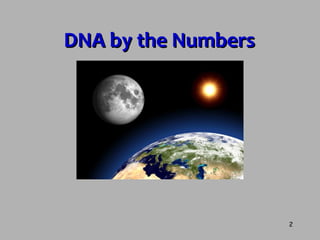
DNA by the NumbersDNA by the Numbers
3
DNADNA
• The blueprint for an
organism’s structure and
function
• Contains the instructions
for making proteins
within the cell.
4
James Watson & Francis Crick’s Model
Rosalind Franklin
5
6
Why is DNADNA so important?
• Found in all organisms
(connects all living
things to one another)
• Medical research –
treatments and cures
• Agriculture, GMO
7
Chromosomes, Genes, and DNAChromosomes, Genes, and DNA
8
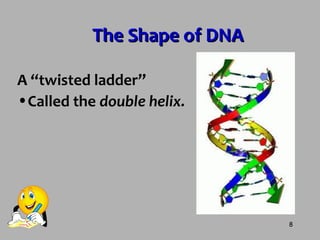
The Shape of DNAThe Shape of DNA
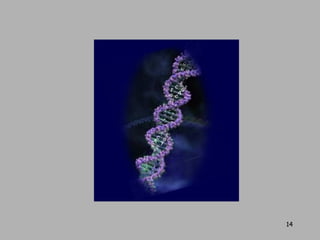
A “twisted ladder”
•Called the double helix.
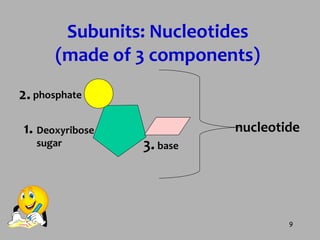
Subunits: Nucleotides
(made of 3 components)
9
nucleotideDeoxyribose
sugar
1.
base3.
phosphate2.
10
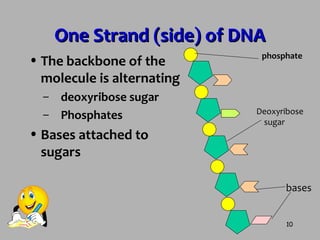
One Strand (side) of DNAOne Strand (side) of DNA
• The backbone of the
molecule is alternating
– deoxyribose sugar
– Phosphates
• Bases attached to
sugars
phosphate
Deoxyribose
sugar
bases
11
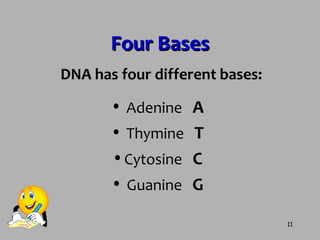
Four BasesFour Bases
• Adenine A
• Thymine T
•Cytosine C
• Guanine G
DNA has four different bases:
12
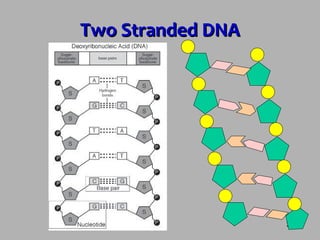
Base Pairing:Base Pairing:
Complimentary StrandsComplimentary Strands
• Adenine (A) with Thymine (T)
A T
• Cytosine (C) with Guanine (G)
C G
13
Two Stranded DNATwo Stranded DNA
14
Knowledge CheckKnowledge Check
1. What are the 3 components that make up
DNA? (6 points)
2. Make a simple sketch of a DNA molecule. Use
different shapes to represent the 3 different
components and label one of each on your
sketch. (4 points)
15
16
How do you think DNA is replicated?How do you think DNA is replicated?
17
Considerations:
• Two identical copies of the DNA molecules come
from one original DNA molecule.
• Special enzymes are involved in DNA replication. (An
enzyme is a type of protein that can move, break
apart, or attach different molecules to one other.)
• The DNA molecule can be broken, torn, or split apart.
18
•The DNA molecule unravels from
the histone proteins around which it
is spooled.
Step 1Step 1
19
•A special enzyme called Helicase
“unzips” the DNA molecule,
breaking it down the middle.
Step 2Step 2
20
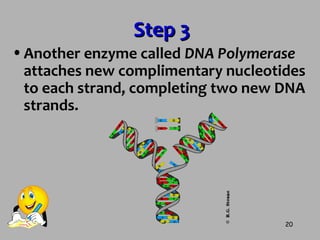
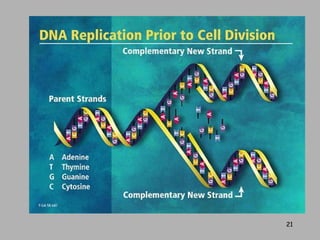
•Another enzyme called DNA Polymerase
attaches new complimentary nucleotides
to each strand, completing two new DNA
strands.
Step 3Step 3
21

DNA Structure

  • 1.
  • 2.
    2 DNA by theNumbersDNA by the Numbers
  • 3.
    3 DNADNA • The blueprintfor an organism’s structure and function • Contains the instructions for making proteins within the cell.
  • 4.
    4 James Watson &Francis Crick’s Model
  • 5.
  • 6.
    6 Why is DNADNAso important? • Found in all organisms (connects all living things to one another) • Medical research – treatments and cures • Agriculture, GMO
  • 7.
    7 Chromosomes, Genes, andDNAChromosomes, Genes, and DNA
  • 8.
    8 The Shape ofDNAThe Shape of DNA A “twisted ladder” •Called the double helix.
  • 9.
    Subunits: Nucleotides (made of3 components) 9 nucleotideDeoxyribose sugar 1. base3. phosphate2.
  • 10.
    10 One Strand (side)of DNAOne Strand (side) of DNA • The backbone of the molecule is alternating – deoxyribose sugar – Phosphates • Bases attached to sugars phosphate Deoxyribose sugar bases
  • 11.
    11 Four BasesFour Bases •Adenine A • Thymine T •Cytosine C • Guanine G DNA has four different bases:
  • 12.
    12 Base Pairing:Base Pairing: ComplimentaryStrandsComplimentary Strands • Adenine (A) with Thymine (T) A T • Cytosine (C) with Guanine (G) C G
  • 13.
  • 14.
  • 15.
    Knowledge CheckKnowledge Check 1.What are the 3 components that make up DNA? (6 points) 2. Make a simple sketch of a DNA molecule. Use different shapes to represent the 3 different components and label one of each on your sketch. (4 points) 15
  • 16.
  • 17.
    How do youthink DNA is replicated?How do you think DNA is replicated? 17 Considerations: • Two identical copies of the DNA molecules come from one original DNA molecule. • Special enzymes are involved in DNA replication. (An enzyme is a type of protein that can move, break apart, or attach different molecules to one other.) • The DNA molecule can be broken, torn, or split apart.
  • 18.
    18 •The DNA moleculeunravels from the histone proteins around which it is spooled. Step 1Step 1
  • 19.
    19 •A special enzymecalled Helicase “unzips” the DNA molecule, breaking it down the middle. Step 2Step 2
  • 20.
    20 •Another enzyme calledDNA Polymerase attaches new complimentary nucleotides to each strand, completing two new DNA strands. Step 3Step 3
  • 21.

Editor's Notes

  • #2 All life on earth uses a chemical called DNA to carry its genetic code or blueprint.
  • #3 If you unravel all the DNA in the chromosomes of one of your cells, it would stretch out 2 meters. If you did this to the DNA in all your cells, it would stretch from here to sun and back more than 200 hundred times!
  • #4 Why is DNA called the blueprint of life?
  • #7 About better food crops, this area is controversial. There is a Dr. Charles Arntzen who is working on bioengineering foods with vaccines in them. People in poor countries could be immunized against diseases just by eating a banana, for instance.
  • #9 {Show students a model of the double helix. Explain what a spiral is and a helix is.}
  • #11 {Point to the 3-D mode, if you have one, to show the parts as you discuss them.}
  • #12 These four bases are abbreviated by using their respective first letters.
  • #14 {Point to the 3-D model to show the parts as you discuss them.}