Piecewise
Functions
2
Piecewise-Defined Functions
 Notice that this function is defined by different rules for
different parts of its domain. Functions whose definitions
involve more than one rule are called piecewise-defined
functions.
 Graphing one of these functions involves graphing each
rule over the appropriate portion of the domain.
Example of a
Piecewise-Defined Function






2if2
2if22
)(
xx
xx
xf
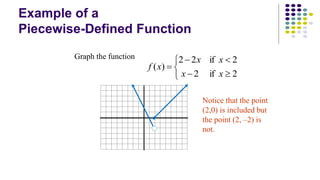
Graph the function
Notice that the point
(2,0) is included but
the point (2, –2) is
not.
 Up to now, we’ve been looking at
functions represented by a single
equation.
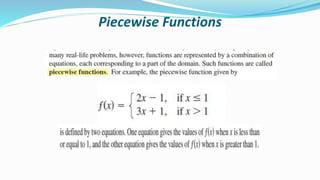
 In real life, however, functions are
represented by a combination of
equations, each corresponding to
a part of the domain.
 These are called piecewise
functions.
Piecewise Functions
 






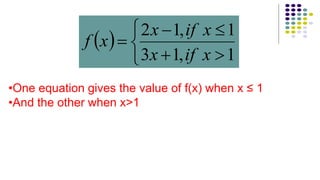
1,13
1,12
xifx
xifx
xf
•One equation gives the value of f(x) when x ≤ 1
•And the other when x>1
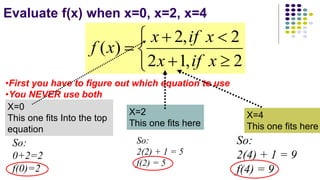
Evaluate f(x) when x=0, x=2, x=4






2,12
2,2
)(
xifx
xifx
xf
•First you have to figure out which equation to use
•You NEVER use both
X=0
This one fits Into the top
equation
So:
0+2=2
f(0)=2
X=2
This one fits here
So:
2(2) + 1 = 5
f(2) = 5
X=4
This one fits here
So:
2(4) + 1 = 9
f(4) = 9
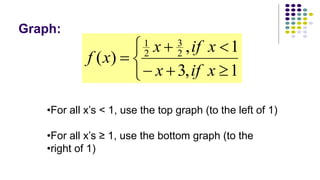
Graph:






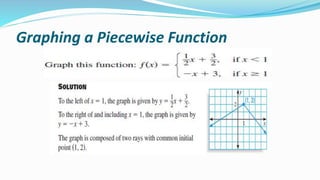
1,3
1,
)( 2
3
2
1
xifx
xifx
xf
•For all x’s < 1, use the top graph (to the left of 1)
•For all x’s ≥ 1, use the bottom graph (to the
•right of 1)
Graphing a Piecewise Function
1
2
3
, 1
2( )
3, 1
x if x
f x
x if x

 
 
  

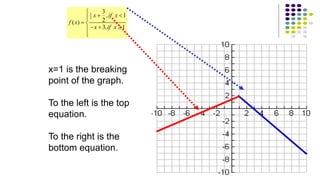
x=1 is the breaking
point of the graph.
To the left is the top
equation.
To the right is the
bottom equation.
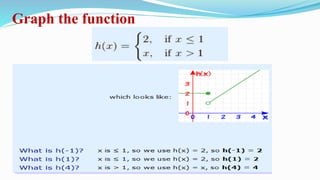
Graph the function
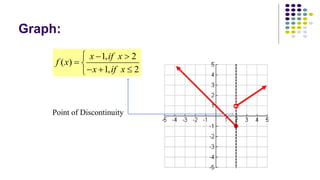
Graph:
1, 2
( )
1, 2
x if x
f x
x if x
  
 
  
Point of Discontinuity
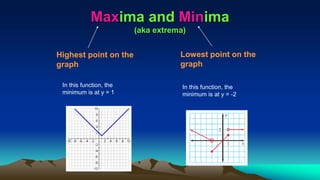
Maxima and Minima
(aka extrema)
In this function, the
minimum is at y = 1
In this function, the
minimum is at y = -2
Highest point on the
graph
Lowest point on the
graph
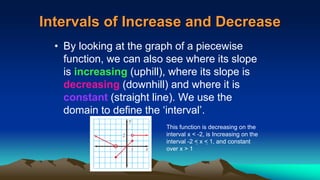
Intervals of Increase and Decrease
• By looking at the graph of a piecewise
function, we can also see where its slope
is increasing (uphill), where its slope is
decreasing (downhill) and where it is
constant (straight line). We use the
domain to define the ‘interval’.
This function is decreasing on the
interval x < -2, is Increasing on the
interval -2 < x < 1, and constant
over x > 1
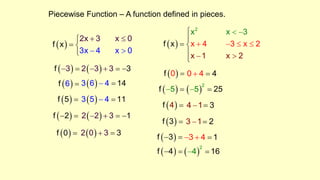
Piecewise Function – A function defined in pieces.
 
3
f
x 4 x 0
x 3 x 0
x
2

 
 


 f 3   2 3 3 3   
 f 6   3 6 14 4 
 f 5   3 5 14 1 
 f 2   2 2 3 1   
 f 0   2 0 33 
 
2
x x 3
x
x 1 x 2
xx 4 3 2f   










 f 0  0 44 
 f 5   
2
25 5 
 f 4  4 31 
 f 3 
 f 3 
 f 4 
3 21 
3 4 1  
 
2
14 6 
 
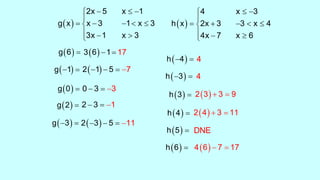
2x 5 x 1
g x x 3 1 x 3
3x 1 x 3
  

    
  
 g 6 
 g 2 
 g 0 
 g 1 
 g 3 
 3 6 11 7 
 2 1 5 7   
0 33  
2 13  
 2 3 5 11   
 
4 x 3
h x 2x 3 3 x 4
4x 7 x 6
 

    
  
 h 4 
 h 3 
 h 3 
 h 4 
 h 5 
 h 6 
4
4
 2 3 3 9 
 2 4 3 11 
DNE
 4 6 7 17 
Piecewise Function – Domain and Range
Domain
Range
(-6, 7)
(-1,5)
Domain
Range
[-7, 7]
(- 4.5,-1] ∪ [0, 4)
Domain
Range
(-7, -1)∪ (-1, 7]
[-1, 5) ∪ {6}
Domain
Range
(-7, 4) ∪ [5, 7)
[-7, -5) ∪ (-2, 7)
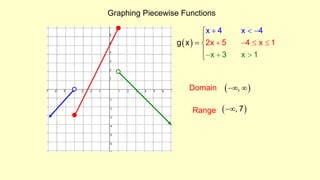
Graphing Piecewise Functions
 
x 4 x 4
2x
x 3 x
1
1
g x 5 4 x  
  
   
 




Domain  , 
Range  , 7
 
3 7 x 4
1
x 2 4 x 0
2
1
x 4
x
0 x 5
5 x 7
g

 
 
  



 

  
  




Domain
Range
(-7, 7]
(-4, -2) ∪ [-1, 4]
 
1
x 6 x 3
3
x 1 3 x 0h x
x 4 0 x 3
x 3 3 x 7

    
     
   

   
Domain
Range
[-6, 7]
[-4, 2] ∪ (4, 7)
• How do graph
piecewise
functions?
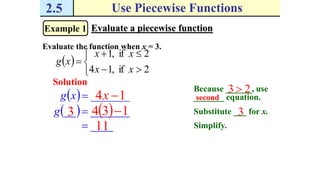
2.5 Use Piecewise Functions
Example 1 Evaluate a piecewise function
Evaluate the function when x = 3.
 






2if,14
2if,1
xx
xx
xg
Solution
Because ______, use
_______ equation.
23 
second  _______xg 14 x
Substitute ___ for x.3  _________ g 3   134 
Simplify.____ 11
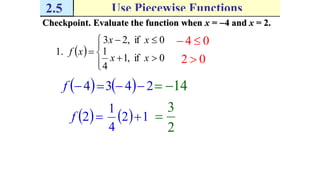
2.5 Use Piecewise Functions
Checkpoint. Evaluate the function when x = 4 and x = 2.
 







0if,1
4
1
0if,23
1.
xx
xx
xf
04 
 4f   243  14
02 
 2f   12
4
1

2
3

2.5 Use Piecewise Functions
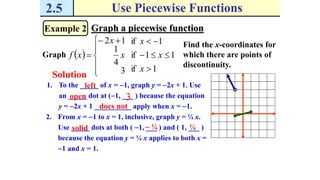
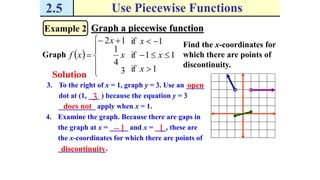
Example 2 Graph a piecewise function
Graph  
1if
11if
1if
3
4
1
12







 

x
x
x
x
x
xf
Solution
Find the x-coordinates for
which there are points of
discontinuity.
1. To the _____ of x = 1, graph y = 2x + 1. Use
an _____ dot at (1, ___ ) because the equation
y = 2x + 1 __________ apply when x = 1.
left
3open
does not
2. From x = 1 to x = 1, inclusive, graph y = ¼ x.
Use _____ dots at both ( 1, ___ ) and ( 1, ___ )
because the equation y = ¼ x applies to both x =
1 and x = 1.
solid  ¼ ¼
2.5 Use Piecewise Functions
Example 2 Graph a piecewise function
Graph  
1if
11if
1if
3
4
1
12







 

x
x
x
x
x
xf
Solution
Find the x-coordinates for
which there are points of
discontinuity.
3. To the right of x = 1, graph y = 3. Use an _____
dot at (1, ___ ) because the equation y = 3
__________ apply when x = 1.
3
open
does not
4. Examine the graph. Because there are gaps in
the graph at x = _____ and x = ___, these are
the x-coordinates for which there are points of
_____________.
1 1
discontinuity
2.5 Use Piecewise Functions
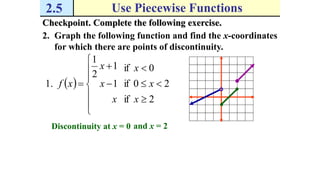
Checkpoint. Complete the following exercise.
 
2if
20if
0if
1
1
2
1
1.













x
x
x
x
x
x
xf
2. Graph the following function and find the x-coordinates
for which there are points of discontinuity.
Discontinuity at x = 0 and x = 2
2.5 Use Piecewise Functions
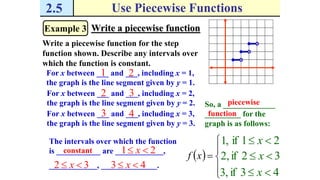
Example 3 Write a piecewise function
Write a piecewise function for the step
function shown. Describe any intervals over
which the function is constant.
For x between ___ and ___, including x = 1,
the graph is the line segment given by y = 1.
1 2
 





xf
,1 21if  x
For x between ___ and ___, including x = 2,
the graph is the line segment given by y = 2.
2 3
,2 32if  x
For x between ___ and ___, including x = 3,
the graph is the line segment given by y = 3.
3 4
,3 43if  x
So, a _____________
_________ for the
graph is as follows:
piecewise
function
The intervals over which the function
is ___________ are ____________,
____________, ______________.
constant 21  x
32  x 43  x
2.5 Use Piecewise Functions
Example 4 Write and analyze a piecewise function
Write the function as a piecewise function.
Find any extrema as well as the rate of change of the function to
the left and to the right of the vertex.
  213  xxf
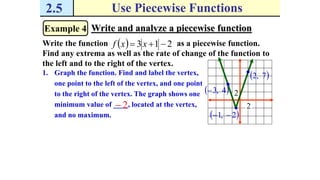
1. Graph the function. Find and label the vertex,
one point to the left of the vertex, and one point
to the right of the vertex. The graph shows one
minimum value of ____, located at the vertex,
and no maximum.  2,1 
2
2 4,3
 7,2
2
2.5 Use Piecewise Functions
Example 4 Write and analyze a piecewise function
Write the function as a piecewise function.
Find any extrema as well as the rate of change of the function to
the left and to the right of the vertex.
  213  xxf
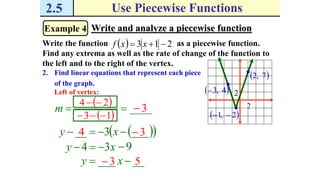
2. Find linear equations that represent each piece
of the graph.
 2,1 
2
2 4,3
 7,2
Left of vertex:
____m
 24 
 13 
3
  ___3__  xy 4 3
_____  xy 3 5
xy 34  9
2.5 Use Piecewise Functions
Example 4 Write and analyze a piecewise function
Write the function as a piecewise function.
Find any extrema as well as the rate of change of the function to
the left and to the right of the vertex.
  213  xxf
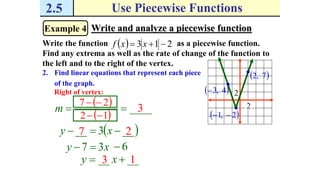
2. Find linear equations that represent each piece
of the graph.
 2,1 
2
2 4,3
 7,2
Right of vertex:
____m
 27 
 12 
3
 __3__  xy 7 2
____  xy 3 1
xy 37  6
2.5 Use Piecewise Functions
Example 4 Write and analyze a piecewise function
Write the function as a piecewise function.
Find any extrema as well as the rate of change of the function to
the left and to the right of the vertex.
  213  xxf
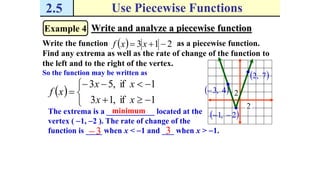
So the function may be written as
 2,1 
2
2 4,3
 7,2
 
1if
1if
,13
,53








x
x
x
x
xf
The extrema is a ____________ located at the
vertex ( 1, 2 ). The rate of change of the
function is ____ when x < 1 and ___ when x > 1.3
minimum
3
2.5 Use Piecewise Functions
Checkpoint. Complete the following exercises.
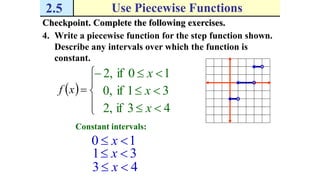
4. Write a piecewise function for the step function shown.
Describe any intervals over which the function is
constant.
 





xf
,2 10if  x
,0 31if  x
,2 43if  x
Constant intervals:
10  x
31  x
43  x
2.5 Use Piecewise Functions
Checkpoint. Complete the following exercises.
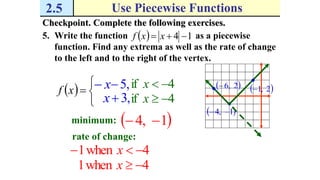
5. Write the function as a piecewise
function. Find any extrema as well as the rate of change
to the left and to the right of the vertex.
  14  xxf
 1,4 
 2,6  2,1 



xf
4if x,5x
4if x,3x
minimum:  1,4 
rate of change:
4when1  x
4when1 x

Piecewise functions

  • 1.
  • 2.
    2 Piecewise-Defined Functions  Noticethat this function is defined by different rules for different parts of its domain. Functions whose definitions involve more than one rule are called piecewise-defined functions.  Graphing one of these functions involves graphing each rule over the appropriate portion of the domain.
  • 3.
    Example of a Piecewise-DefinedFunction       2if2 2if22 )( xx xx xf Graph the function Notice that the point (2,0) is included but the point (2, –2) is not.
  • 4.
     Up tonow, we’ve been looking at functions represented by a single equation.  In real life, however, functions are represented by a combination of equations, each corresponding to a part of the domain.  These are called piecewise functions.
  • 5.
  • 6.
            1,13 1,12 xifx xifx xf •One equationgives the value of f(x) when x ≤ 1 •And the other when x>1
  • 7.
    Evaluate f(x) whenx=0, x=2, x=4       2,12 2,2 )( xifx xifx xf •First you have to figure out which equation to use •You NEVER use both X=0 This one fits Into the top equation So: 0+2=2 f(0)=2 X=2 This one fits here So: 2(2) + 1 = 5 f(2) = 5 X=4 This one fits here So: 2(4) + 1 = 9 f(4) = 9
  • 8.
    Graph:       1,3 1, )( 2 3 2 1 xifx xifx xf •For allx’s < 1, use the top graph (to the left of 1) •For all x’s ≥ 1, use the bottom graph (to the •right of 1)
  • 9.
  • 10.
    1 2 3 , 1 2( ) 3,1 x if x f x x if x          x=1 is the breaking point of the graph. To the left is the top equation. To the right is the bottom equation.
  • 11.
  • 12.
    Graph: 1, 2 ( ) 1,2 x if x f x x if x         Point of Discontinuity
  • 14.
    Maxima and Minima (akaextrema) In this function, the minimum is at y = 1 In this function, the minimum is at y = -2 Highest point on the graph Lowest point on the graph
  • 15.
    Intervals of Increaseand Decrease • By looking at the graph of a piecewise function, we can also see where its slope is increasing (uphill), where its slope is decreasing (downhill) and where it is constant (straight line). We use the domain to define the ‘interval’. This function is decreasing on the interval x < -2, is Increasing on the interval -2 < x < 1, and constant over x > 1
  • 16.
    Piecewise Function –A function defined in pieces.   3 f x 4 x 0 x 3 x 0 x 2         f 3   2 3 3 3     f 6   3 6 14 4   f 5   3 5 14 1   f 2   2 2 3 1     f 0   2 0 33    2 x x 3 x x 1 x 2 xx 4 3 2f               f 0  0 44   f 5    2 25 5   f 4  4 31   f 3   f 3   f 4  3 21  3 4 1     2 14 6 
  • 17.
      2x 5x 1 g x x 3 1 x 3 3x 1 x 3              g 6   g 2   g 0   g 1   g 3   3 6 11 7   2 1 5 7    0 33   2 13    2 3 5 11      4 x 3 h x 2x 3 3 x 4 4x 7 x 6             h 4   h 3   h 3   h 4   h 5   h 6  4 4  2 3 3 9   2 4 3 11  DNE  4 6 7 17 
  • 18.
    Piecewise Function –Domain and Range Domain Range (-6, 7) (-1,5) Domain Range [-7, 7] (- 4.5,-1] ∪ [0, 4)
  • 19.
    Domain Range (-7, -1)∪ (-1,7] [-1, 5) ∪ {6} Domain Range (-7, 4) ∪ [5, 7) [-7, -5) ∪ (-2, 7)
  • 20.
    Graphing Piecewise Functions  x 4 x 4 2x x 3 x 1 1 g x 5 4 x                Domain  ,  Range  , 7
  • 21.
      3 7x 4 1 x 2 4 x 0 2 1 x 4 x 0 x 5 5 x 7 g                         Domain Range (-7, 7] (-4, -2) ∪ [-1, 4]
  • 22.
      1 x 6x 3 3 x 1 3 x 0h x x 4 0 x 3 x 3 3 x 7                      Domain Range [-6, 7] [-4, 2] ∪ (4, 7)
  • 23.
    • How dograph piecewise functions?
  • 24.
    2.5 Use PiecewiseFunctions Example 1 Evaluate a piecewise function Evaluate the function when x = 3.         2if,14 2if,1 xx xx xg Solution Because ______, use _______ equation. 23  second  _______xg 14 x Substitute ___ for x.3  _________ g 3   134  Simplify.____ 11
  • 25.
    2.5 Use PiecewiseFunctions Checkpoint. Evaluate the function when x = 4 and x = 2.          0if,1 4 1 0if,23 1. xx xx xf 04   4f   243  14 02   2f   12 4 1  2 3 
  • 26.
    2.5 Use PiecewiseFunctions Example 2 Graph a piecewise function Graph   1if 11if 1if 3 4 1 12           x x x x x xf Solution Find the x-coordinates for which there are points of discontinuity. 1. To the _____ of x = 1, graph y = 2x + 1. Use an _____ dot at (1, ___ ) because the equation y = 2x + 1 __________ apply when x = 1. left 3open does not 2. From x = 1 to x = 1, inclusive, graph y = ¼ x. Use _____ dots at both ( 1, ___ ) and ( 1, ___ ) because the equation y = ¼ x applies to both x = 1 and x = 1. solid  ¼ ¼
  • 27.
    2.5 Use PiecewiseFunctions Example 2 Graph a piecewise function Graph   1if 11if 1if 3 4 1 12           x x x x x xf Solution Find the x-coordinates for which there are points of discontinuity. 3. To the right of x = 1, graph y = 3. Use an _____ dot at (1, ___ ) because the equation y = 3 __________ apply when x = 1. 3 open does not 4. Examine the graph. Because there are gaps in the graph at x = _____ and x = ___, these are the x-coordinates for which there are points of _____________. 1 1 discontinuity
  • 28.
    2.5 Use PiecewiseFunctions Checkpoint. Complete the following exercise.   2if 20if 0if 1 1 2 1 1.              x x x x x x xf 2. Graph the following function and find the x-coordinates for which there are points of discontinuity. Discontinuity at x = 0 and x = 2
  • 29.
    2.5 Use PiecewiseFunctions Example 3 Write a piecewise function Write a piecewise function for the step function shown. Describe any intervals over which the function is constant. For x between ___ and ___, including x = 1, the graph is the line segment given by y = 1. 1 2        xf ,1 21if  x For x between ___ and ___, including x = 2, the graph is the line segment given by y = 2. 2 3 ,2 32if  x For x between ___ and ___, including x = 3, the graph is the line segment given by y = 3. 3 4 ,3 43if  x So, a _____________ _________ for the graph is as follows: piecewise function The intervals over which the function is ___________ are ____________, ____________, ______________. constant 21  x 32  x 43  x
  • 30.
    2.5 Use PiecewiseFunctions Example 4 Write and analyze a piecewise function Write the function as a piecewise function. Find any extrema as well as the rate of change of the function to the left and to the right of the vertex.   213  xxf 1. Graph the function. Find and label the vertex, one point to the left of the vertex, and one point to the right of the vertex. The graph shows one minimum value of ____, located at the vertex, and no maximum.  2,1  2 2 4,3  7,2 2
  • 31.
    2.5 Use PiecewiseFunctions Example 4 Write and analyze a piecewise function Write the function as a piecewise function. Find any extrema as well as the rate of change of the function to the left and to the right of the vertex.   213  xxf 2. Find linear equations that represent each piece of the graph.  2,1  2 2 4,3  7,2 Left of vertex: ____m  24   13  3   ___3__  xy 4 3 _____  xy 3 5 xy 34  9
  • 32.
    2.5 Use PiecewiseFunctions Example 4 Write and analyze a piecewise function Write the function as a piecewise function. Find any extrema as well as the rate of change of the function to the left and to the right of the vertex.   213  xxf 2. Find linear equations that represent each piece of the graph.  2,1  2 2 4,3  7,2 Right of vertex: ____m  27   12  3  __3__  xy 7 2 ____  xy 3 1 xy 37  6
  • 33.
    2.5 Use PiecewiseFunctions Example 4 Write and analyze a piecewise function Write the function as a piecewise function. Find any extrema as well as the rate of change of the function to the left and to the right of the vertex.   213  xxf So the function may be written as  2,1  2 2 4,3  7,2   1if 1if ,13 ,53         x x x x xf The extrema is a ____________ located at the vertex ( 1, 2 ). The rate of change of the function is ____ when x < 1 and ___ when x > 1.3 minimum 3
  • 34.
    2.5 Use PiecewiseFunctions Checkpoint. Complete the following exercises. 4. Write a piecewise function for the step function shown. Describe any intervals over which the function is constant.        xf ,2 10if  x ,0 31if  x ,2 43if  x Constant intervals: 10  x 31  x 43  x
  • 35.
    2.5 Use PiecewiseFunctions Checkpoint. Complete the following exercises. 5. Write the function as a piecewise function. Find any extrema as well as the rate of change to the left and to the right of the vertex.   14  xxf  1,4   2,6  2,1     xf 4if x,5x 4if x,3x minimum:  1,4  rate of change: 4when1  x 4when1 x