
Exponential & Logarithmic
Functions
Dr. Carol A. Marinas
Table of Contents
Exponential Functions
Logarithmic Functions
Converting between Exponents and
Logarithms
Properties of Logarithms
Exponential and Logarithmic Equations
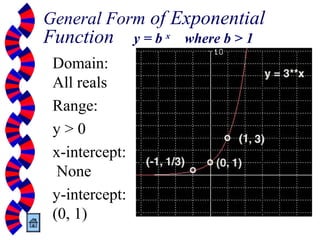
General Form of Exponential
Function y = b x
where b > 1
Domain:
All reals
Range:
y > 0
x-intercept:
None
y-intercept:
(0, 1)
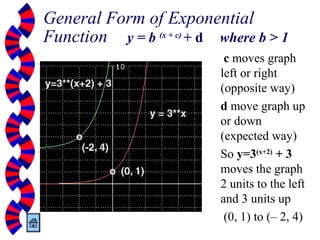
General Form of Exponential
Function y = b (x + c)
+ d where b > 1
c moves graph
left or right
(opposite way)
d move graph up
or down
(expected way)
So y=3(x+2)
+ 3
moves the graph
2 units to the left
and 3 units up
(0, 1) to (– 2, 4)
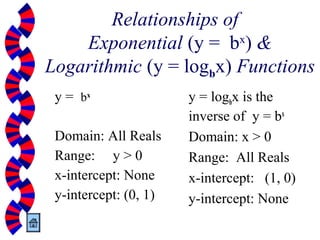
Relationships of
Exponential (y = bx
) &
Logarithmic (y = logbx) Functions
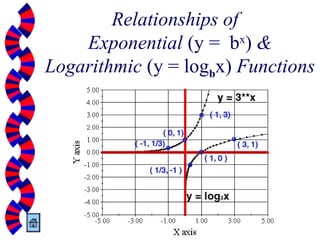
y = logbx is the
inverse of y = bx
Domain: x > 0
Range: All Reals
x-intercept: (1, 0)
y-intercept: None
y = bx
Domain: All Reals
Range: y > 0
x-intercept: None
y-intercept: (0, 1)
Relationships of
Exponential (y = bx
) &
Logarithmic (y = logbx) Functions
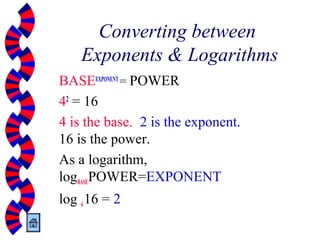
Converting between
Exponents & Logarithms
BASEEXPONENT
= POWER
42
= 16
4 is the base. 2 is the exponent.
16 is the power.
As a logarithm,
logBASEPOWER=EXPONENT
log 416 = 2
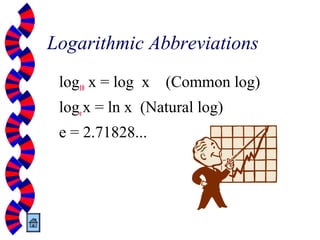
Logarithmic Abbreviations
log10 x = log x (Common log)
logex = ln x (Natural log)
e = 2.71828...
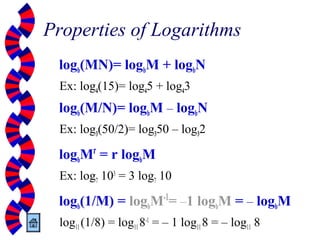
Properties of Logarithms
logb(MN)= logbM + logbN
Ex: log4(15)= log45 + log43
logb(M/N)= logbM – logbN
Ex: log3(50/2)= log350 – log32
logbMr
= r logbM
Ex: log7 103
= 3 log7 10
logb(1/M) = logbM-1
= –1 logbM = – logbM
log11(1/8) = log118-1
= – 1 log118 = – log11 8
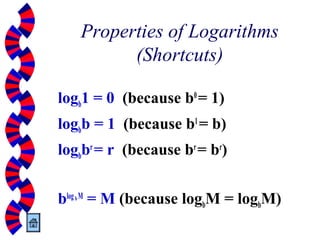
Properties of Logarithms
(Shortcuts)
logb1 = 0 (because b0
= 1)
logbb = 1 (because b1
= b)
logbbr
= r (because br
= br
)
blogbM
= M (because logbM = logbM)
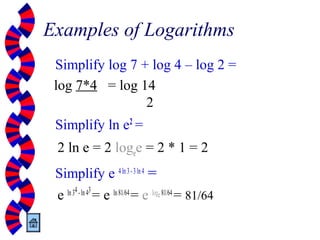
Examples of Logarithms
Simplify log 7 + log 4 – log 2 =
log 7*4 = log 14
2
Simplify ln e2
=
2 ln e = 2 logee = 2 * 1 = 2
Simplify e 4ln3-3ln4
=
e ln34-ln43
= e ln81/64
= e loge81/64
= 81/64
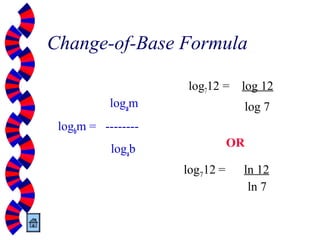
Change-of-Base Formula
logam
logbm = --------
logab
log712 = log 12
log 7
OR
log712 = ln 12
ln 7
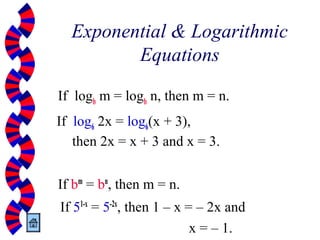
Exponential & Logarithmic
Equations
If logb m = logb n, then m = n.
If log6 2x = log6(x + 3),
then 2x = x + 3 and x = 3.
If bm
= bn
, then m = n.
If 51-x
= 5-2x
, then 1 – x = – 2x and
x = – 1.
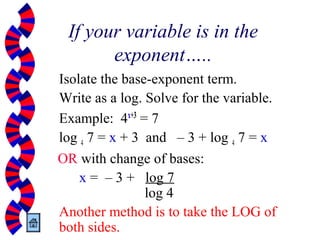
If your variable is in the
exponent…..
Isolate the base-exponent term.
Write as a log. Solve for the variable.
Example: 4x+3
= 7
log 4 7 = x + 3 and – 3 + log 4 7 = x
OR with change of bases:
x = – 3 + log 7
log 4
Another method is to take the LOG of
both sides.
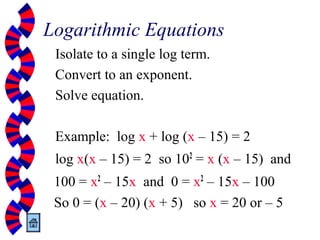
Logarithmic Equations
Isolate to a single log term.
Convert to an exponent.
Solve equation.
Example: log x + log (x – 15) = 2
log x(x – 15) = 2 so 102
= x (x – 15) and
100 = x2
– 15x and 0 = x2
– 15x – 100
So 0 = (x – 20) (x + 5) so x = 20 or – 5
That’s All Folks !

1528 exponential-log

  • 1.
  • 2.
    Table of Contents ExponentialFunctions Logarithmic Functions Converting between Exponents and Logarithms Properties of Logarithms Exponential and Logarithmic Equations
  • 3.
    General Form ofExponential Function y = b x where b > 1 Domain: All reals Range: y > 0 x-intercept: None y-intercept: (0, 1)
  • 4.
    General Form ofExponential Function y = b (x + c) + d where b > 1 c moves graph left or right (opposite way) d move graph up or down (expected way) So y=3(x+2) + 3 moves the graph 2 units to the left and 3 units up (0, 1) to (– 2, 4)
  • 5.
    Relationships of Exponential (y= bx ) & Logarithmic (y = logbx) Functions y = logbx is the inverse of y = bx Domain: x > 0 Range: All Reals x-intercept: (1, 0) y-intercept: None y = bx Domain: All Reals Range: y > 0 x-intercept: None y-intercept: (0, 1)
  • 6.
    Relationships of Exponential (y= bx ) & Logarithmic (y = logbx) Functions
  • 7.
    Converting between Exponents &Logarithms BASEEXPONENT = POWER 42 = 16 4 is the base. 2 is the exponent. 16 is the power. As a logarithm, logBASEPOWER=EXPONENT log 416 = 2
  • 8.
    Logarithmic Abbreviations log10 x= log x (Common log) logex = ln x (Natural log) e = 2.71828...
  • 9.
    Properties of Logarithms logb(MN)=logbM + logbN Ex: log4(15)= log45 + log43 logb(M/N)= logbM – logbN Ex: log3(50/2)= log350 – log32 logbMr = r logbM Ex: log7 103 = 3 log7 10 logb(1/M) = logbM-1 = –1 logbM = – logbM log11(1/8) = log118-1 = – 1 log118 = – log11 8
  • 10.
    Properties of Logarithms (Shortcuts) logb1= 0 (because b0 = 1) logbb = 1 (because b1 = b) logbbr = r (because br = br ) blogbM = M (because logbM = logbM)
  • 11.
    Examples of Logarithms Simplifylog 7 + log 4 – log 2 = log 7*4 = log 14 2 Simplify ln e2 = 2 ln e = 2 logee = 2 * 1 = 2 Simplify e 4ln3-3ln4 = e ln34-ln43 = e ln81/64 = e loge81/64 = 81/64
  • 12.
    Change-of-Base Formula logam logbm =-------- logab log712 = log 12 log 7 OR log712 = ln 12 ln 7
  • 13.
    Exponential & Logarithmic Equations Iflogb m = logb n, then m = n. If log6 2x = log6(x + 3), then 2x = x + 3 and x = 3. If bm = bn , then m = n. If 51-x = 5-2x , then 1 – x = – 2x and x = – 1.
  • 14.
    If your variableis in the exponent….. Isolate the base-exponent term. Write as a log. Solve for the variable. Example: 4x+3 = 7 log 4 7 = x + 3 and – 3 + log 4 7 = x OR with change of bases: x = – 3 + log 7 log 4 Another method is to take the LOG of both sides.
  • 15.
    Logarithmic Equations Isolate toa single log term. Convert to an exponent. Solve equation. Example: log x + log (x – 15) = 2 log x(x – 15) = 2 so 102 = x (x – 15) and 100 = x2 – 15x and 0 = x2 – 15x – 100 So 0 = (x – 20) (x + 5) so x = 20 or – 5
  • 16.