This document provides an overview of solving logarithmic equations and inequalities. It begins with an introduction to logarithmic form, the definition of logarithms, and properties of exponents and logarithms. Examples are then shown for solving different types of logarithmic equations using properties of logarithms and changing forms between logarithmic and exponential. Strategies discussed include rewriting in exponential form, using logarithmic properties, applying the one-to-one property, and using the zero factor property. Finally, properties of logarithmic inequalities are discussed and examples are shown for solving logarithmic inequalities. The document concludes with assigning students to study graphing logarithmic functions.
An overview of solving logarithmic equations and inequalities, prepared by Bernabe L. Manalili Jr.
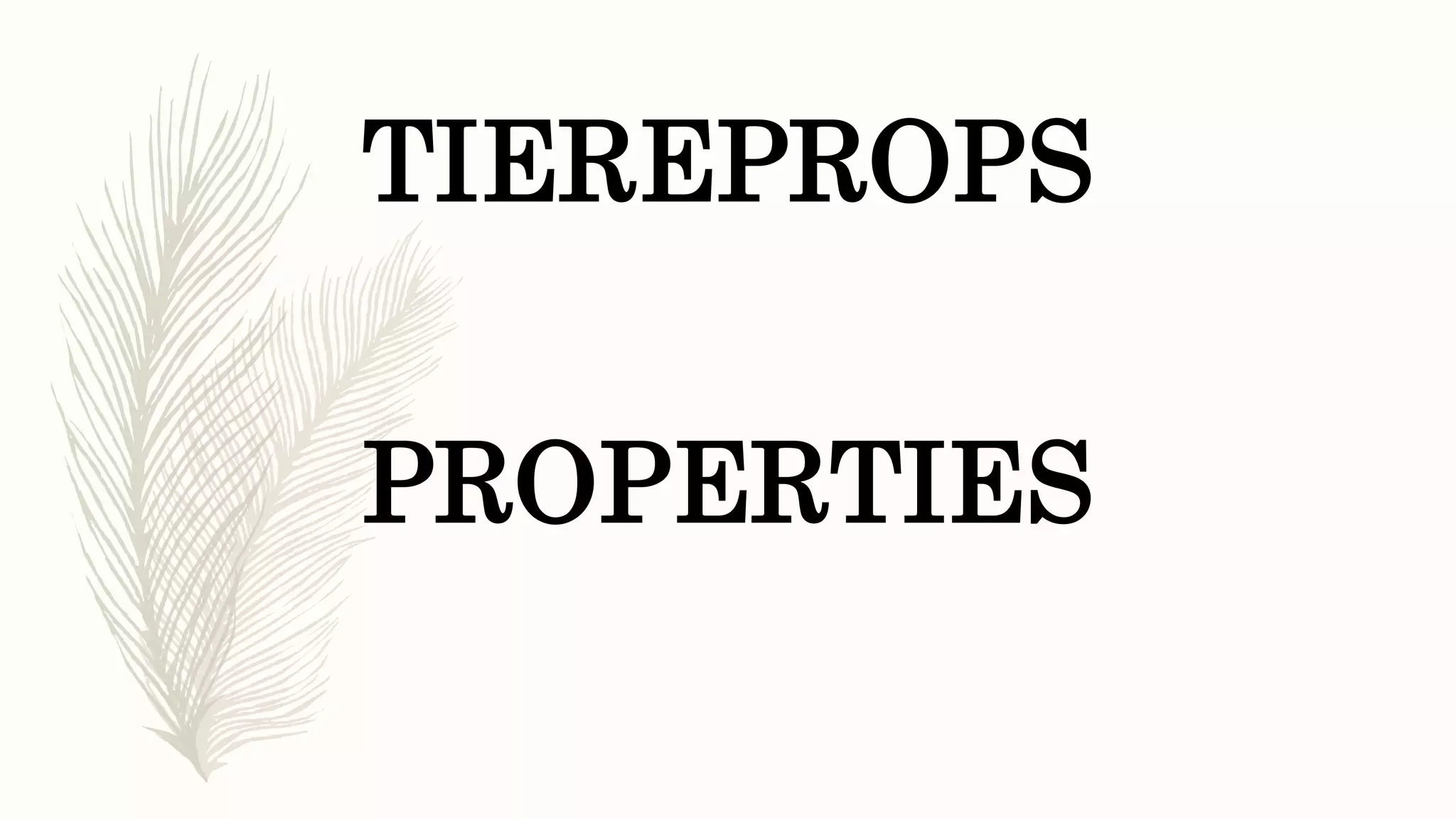
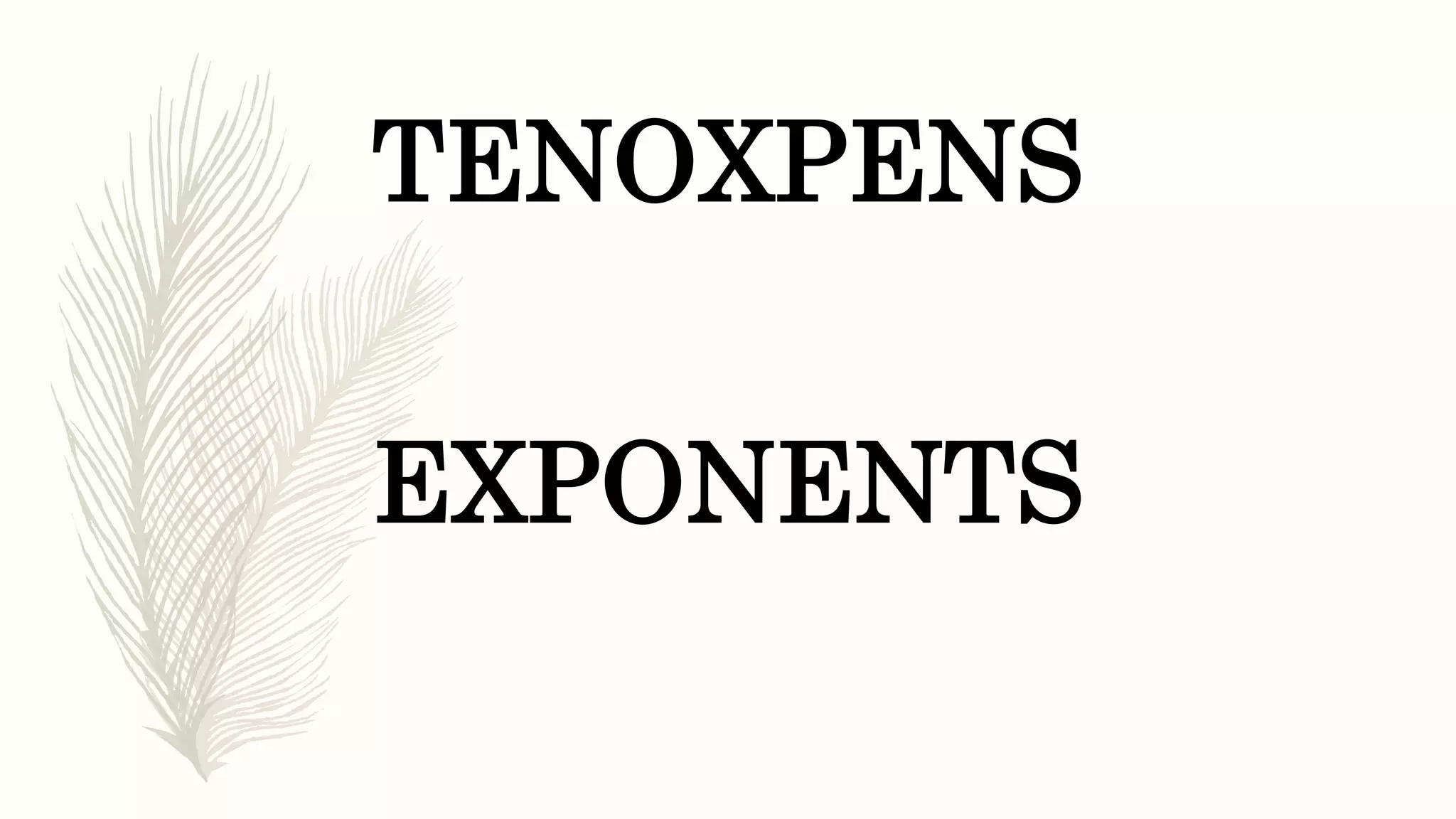
Interactive activity with jumbled letters related to algebra concepts: variables include Algebra, Inequalities, Logarithms, Properties, Exponents, Equation, Factorization.
Introduction to logarithmic form, properties of algebra and exponents, and laws of logarithms including common rules and examples.
Strategies for solving logarithmic equations including rewriting them, applying properties, and the zero factor property.
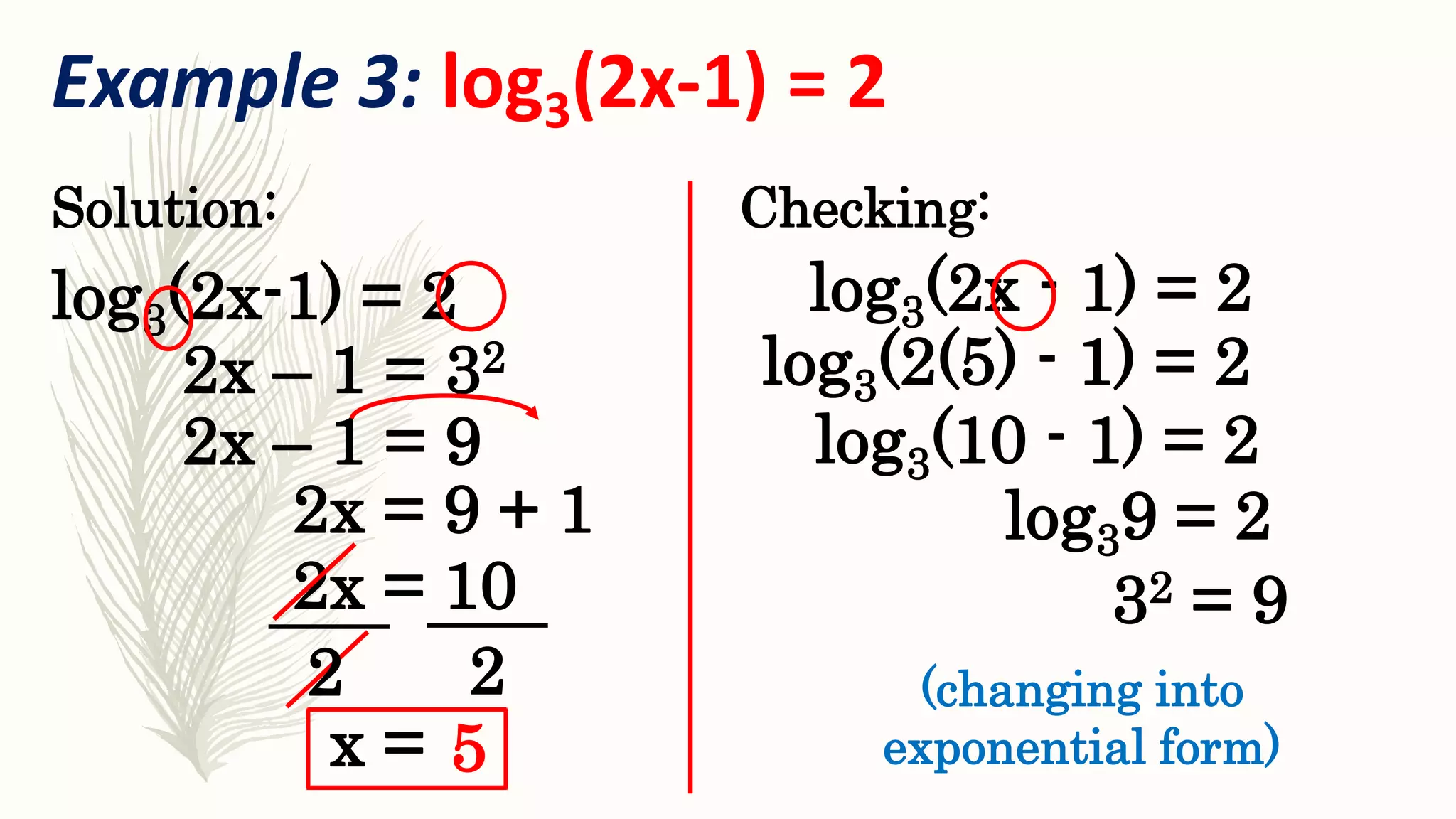
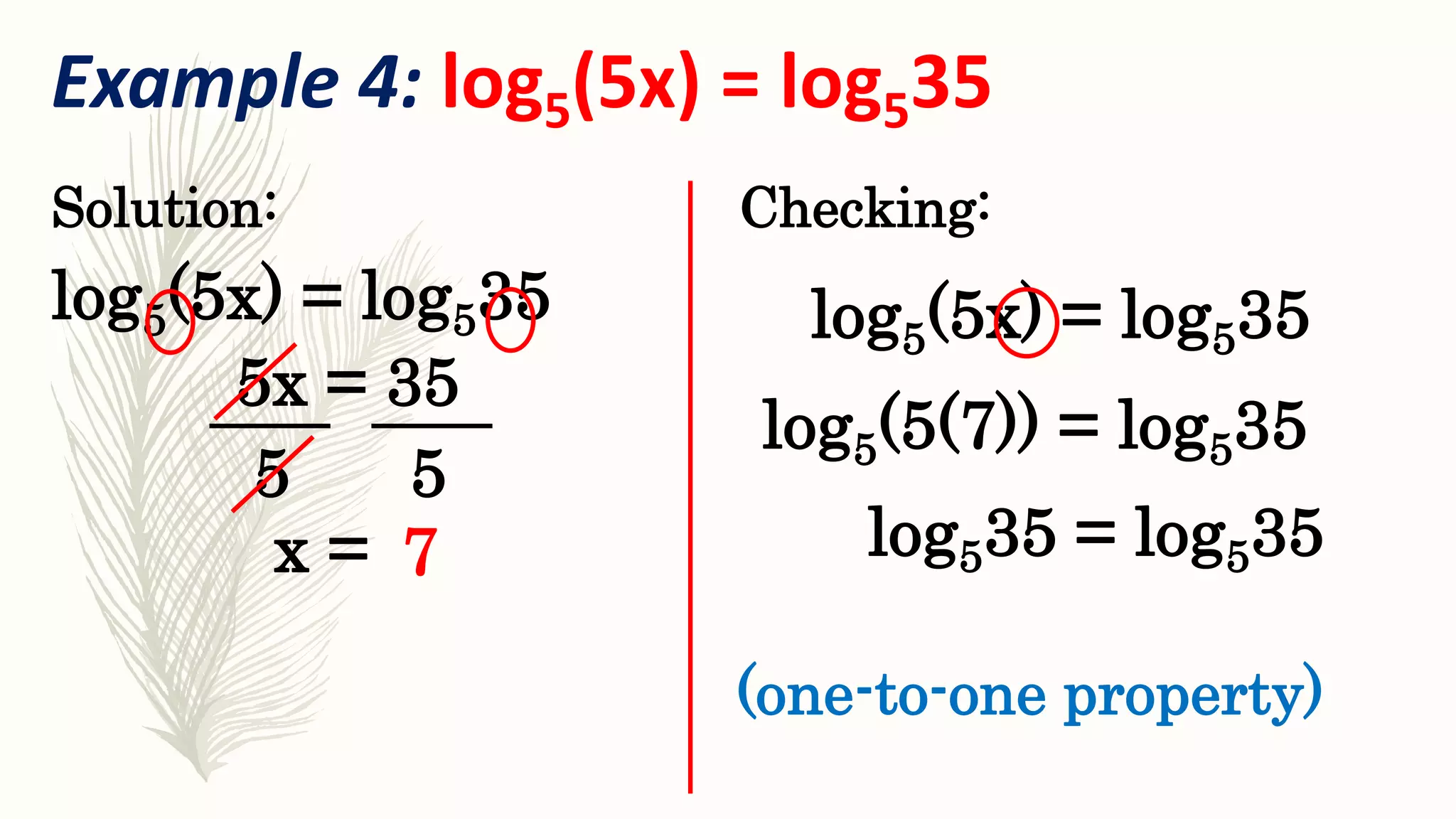
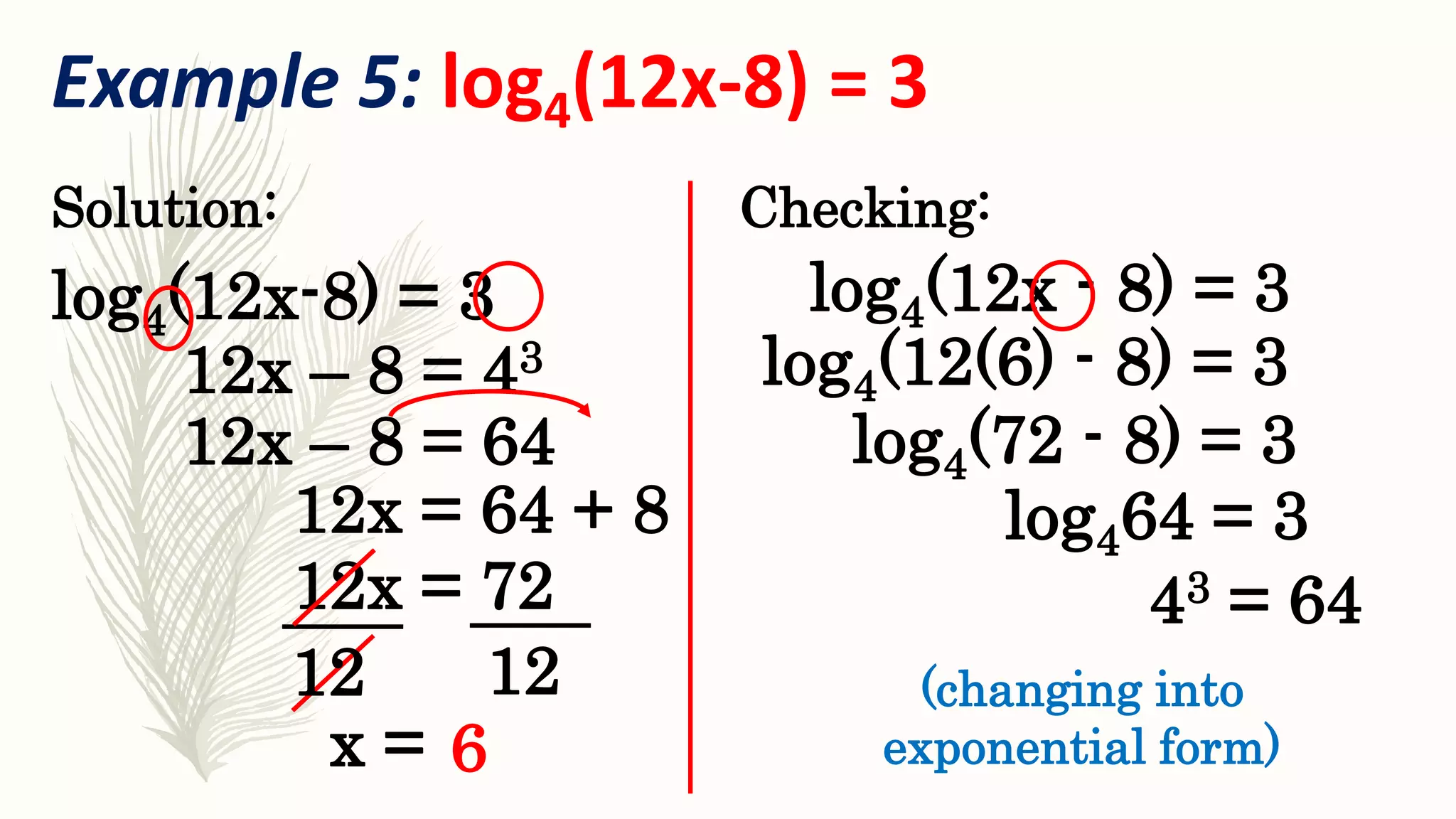
Multiple examples demonstrating the solution of logarithmic equations and verifying results through properties.
Properties of logarithmic inequalities, explaining the relationship between bases and the directional properties of inequalities.
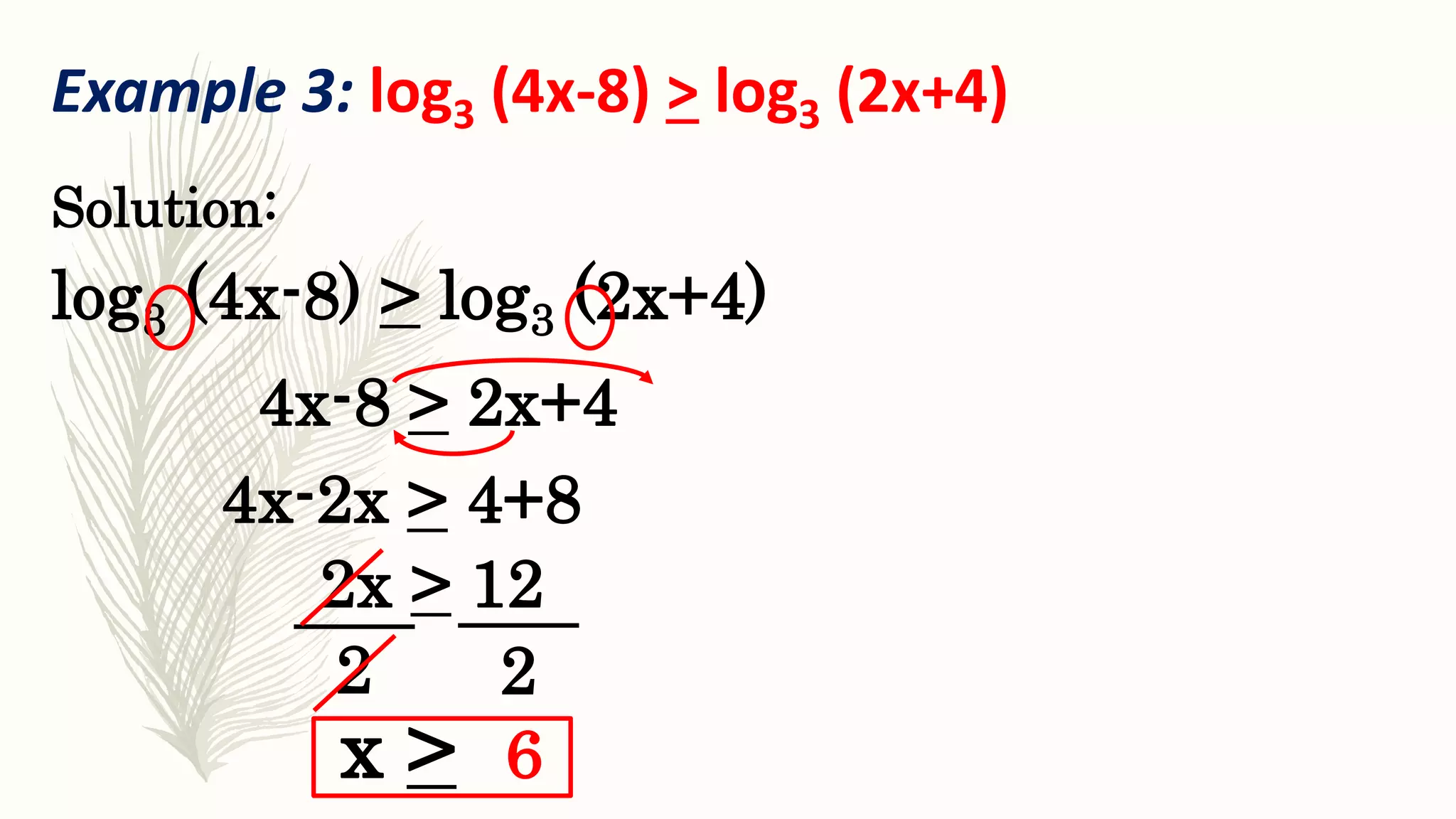
Examples demonstrating the solution of logarithmic inequalities with step-by-step approaches to derive results.
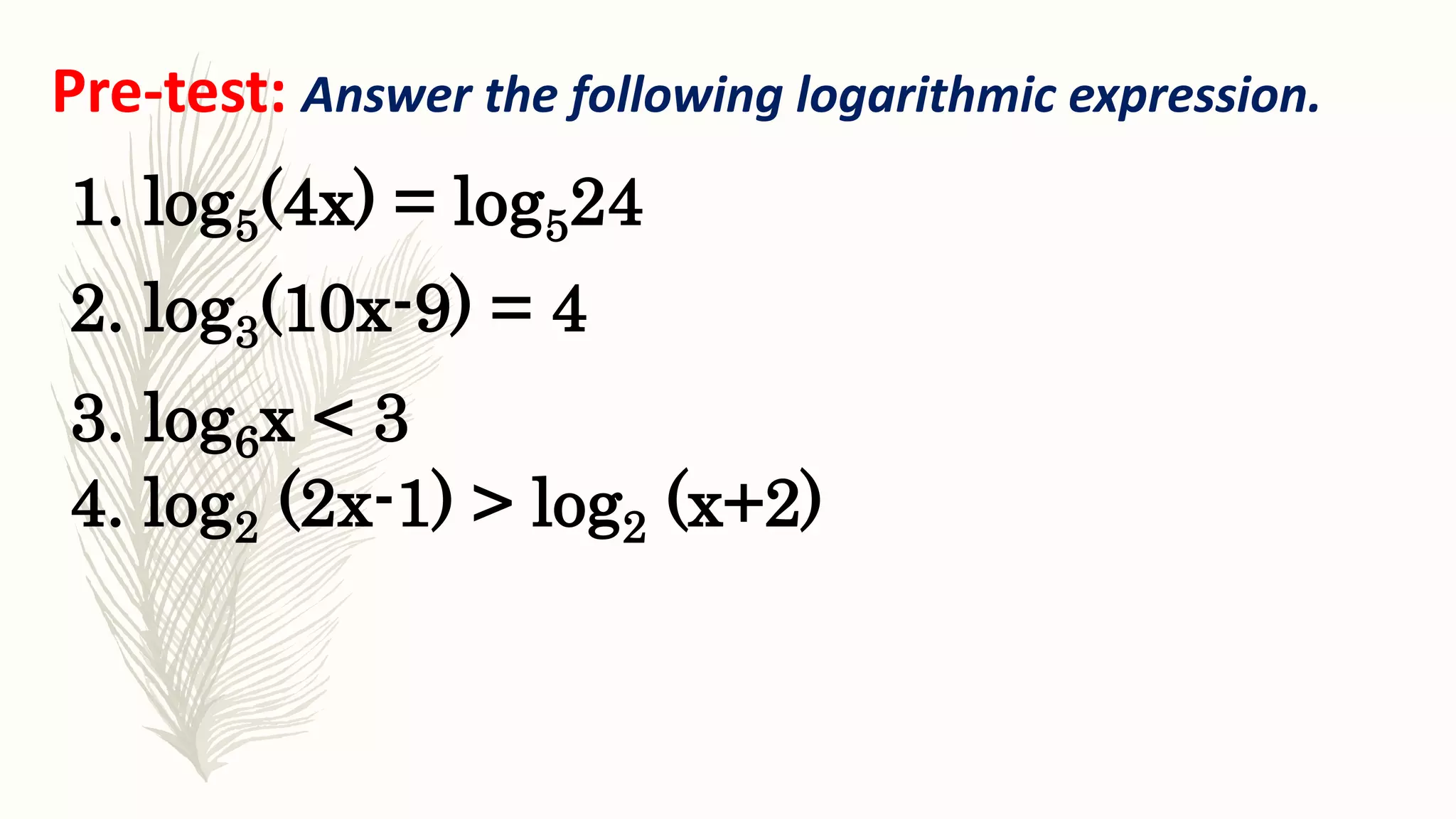
A pre-test with logarithmic expressions to assess understanding of logarithmic concepts.
Assignment task to study the graphing of logarithmic functions for deeper comprehension.
Wrap-up of the session with a closing note, indicating the end of the presentation.
LOGARITHMS
logba Logarithmic Form
by= a Exponential Form
So…. a and b MUST be positive and b can never equal 1
b and a must be real numbers, b > 0, and b = 1
Always remember……
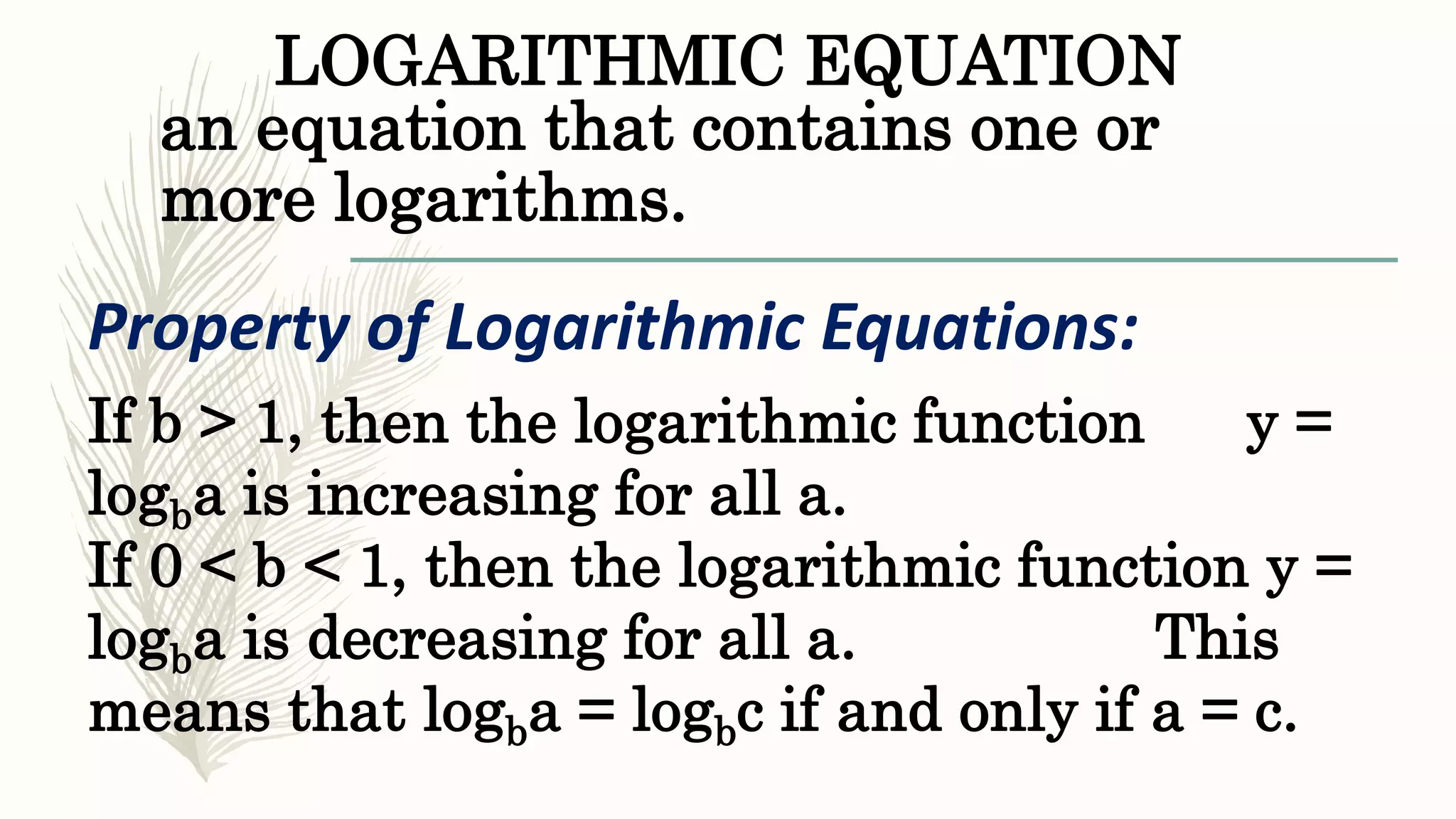
If b >1, then the logarithmic function y =
logba is increasing for all a.
If 0 < b < 1, then the logarithmic function y =
logba is decreasing for all a. This
means that logba = logbc if and only if a = c.
Property of Logarithmic Equations:
LOGARITHMIC EQUATION
an equation that contains one or
more logarithms.
15.
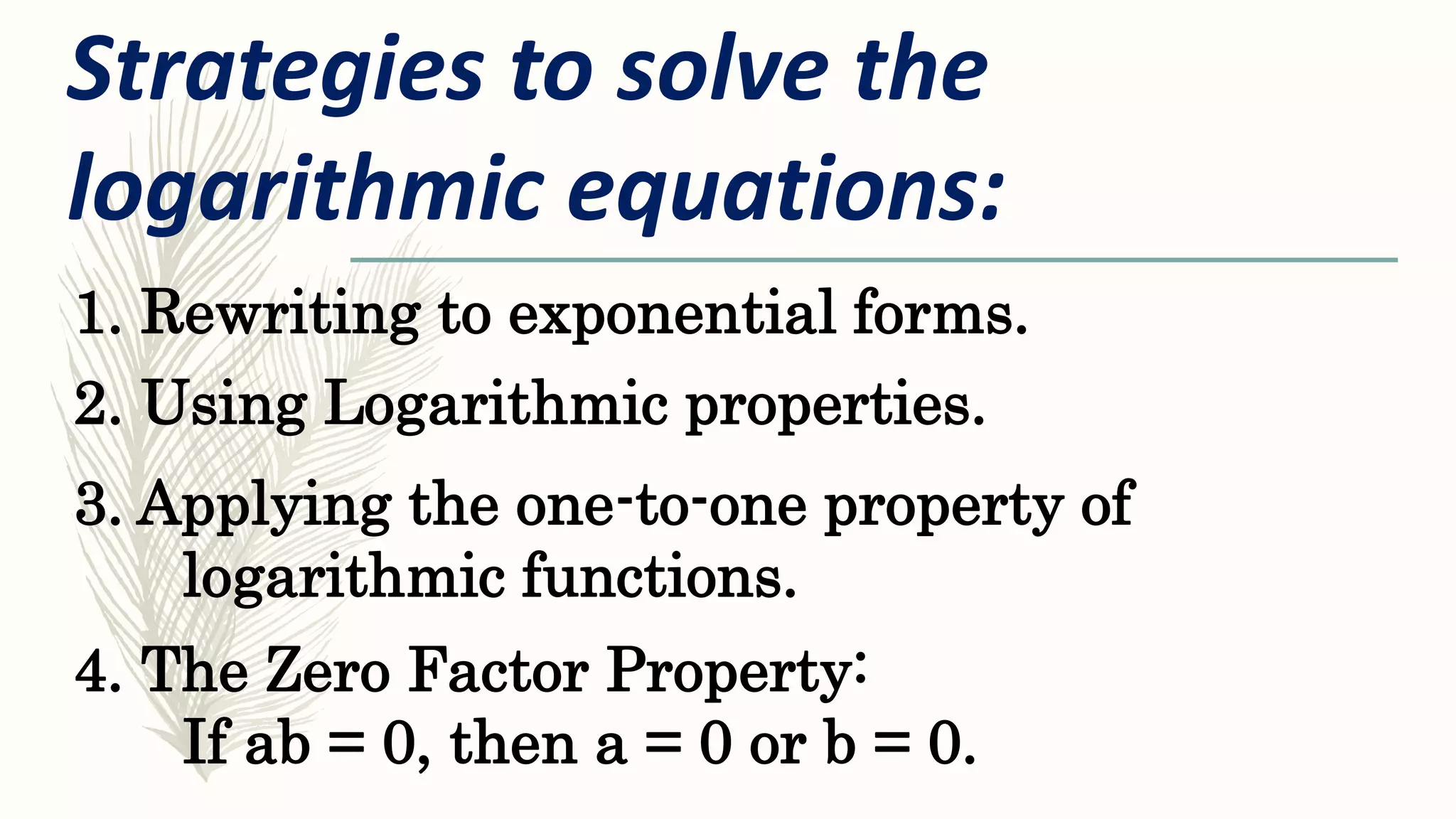
1. Rewriting toexponential forms.
Strategies to solve the
logarithmic equations:
2. Using Logarithmic properties.
3. Applying the one-to-one property of
logarithmic functions.
4. The Zero Factor Property:
If ab = 0, then a = 0 or b = 0.
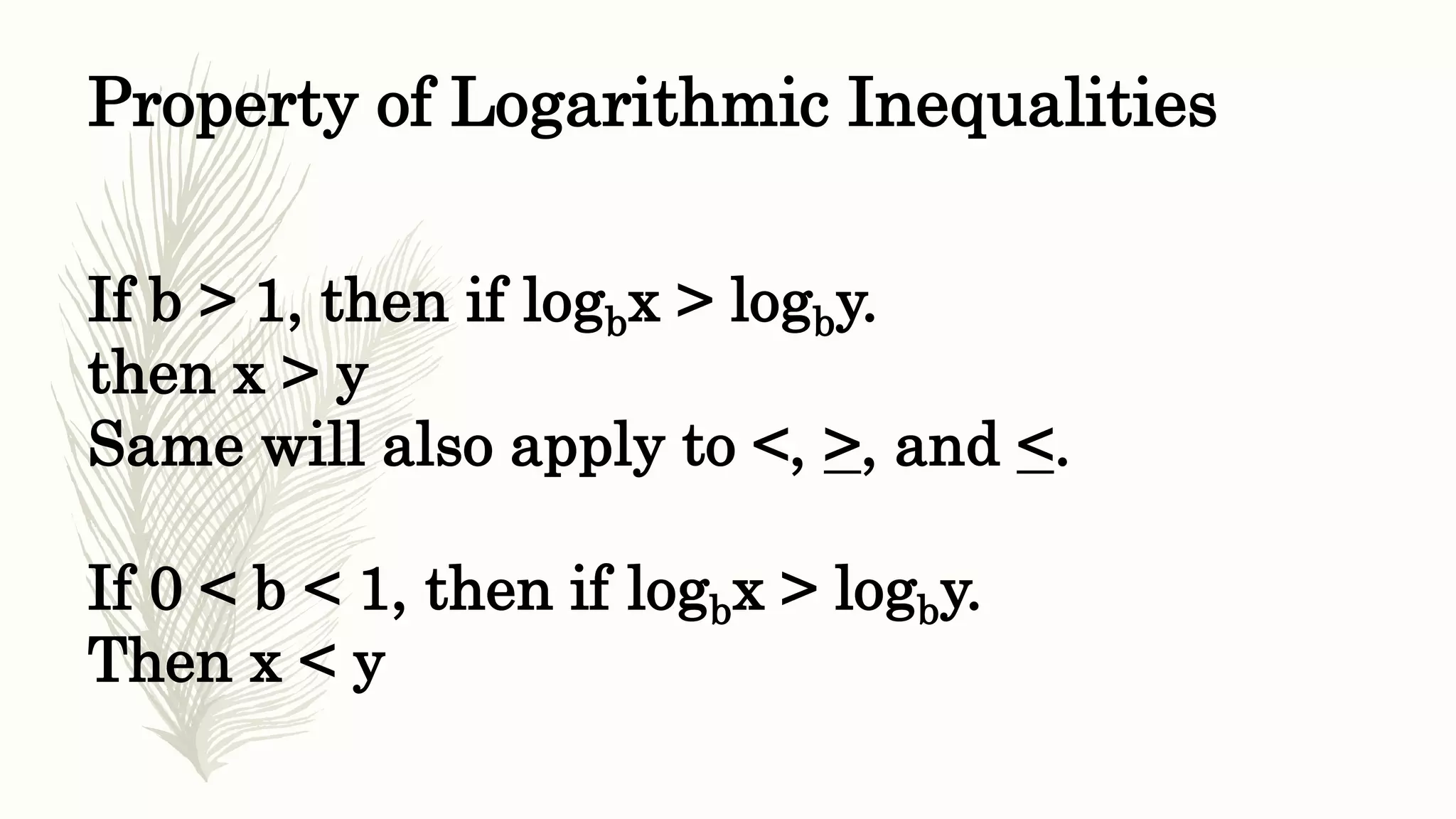
Property of LogarithmicInequalities
If b > 1, then if logbx > logby.
then x > y
Same will also apply to <, >, and <.
If 0 < b < 1, then if logbx > logby.
Then x < y
22.
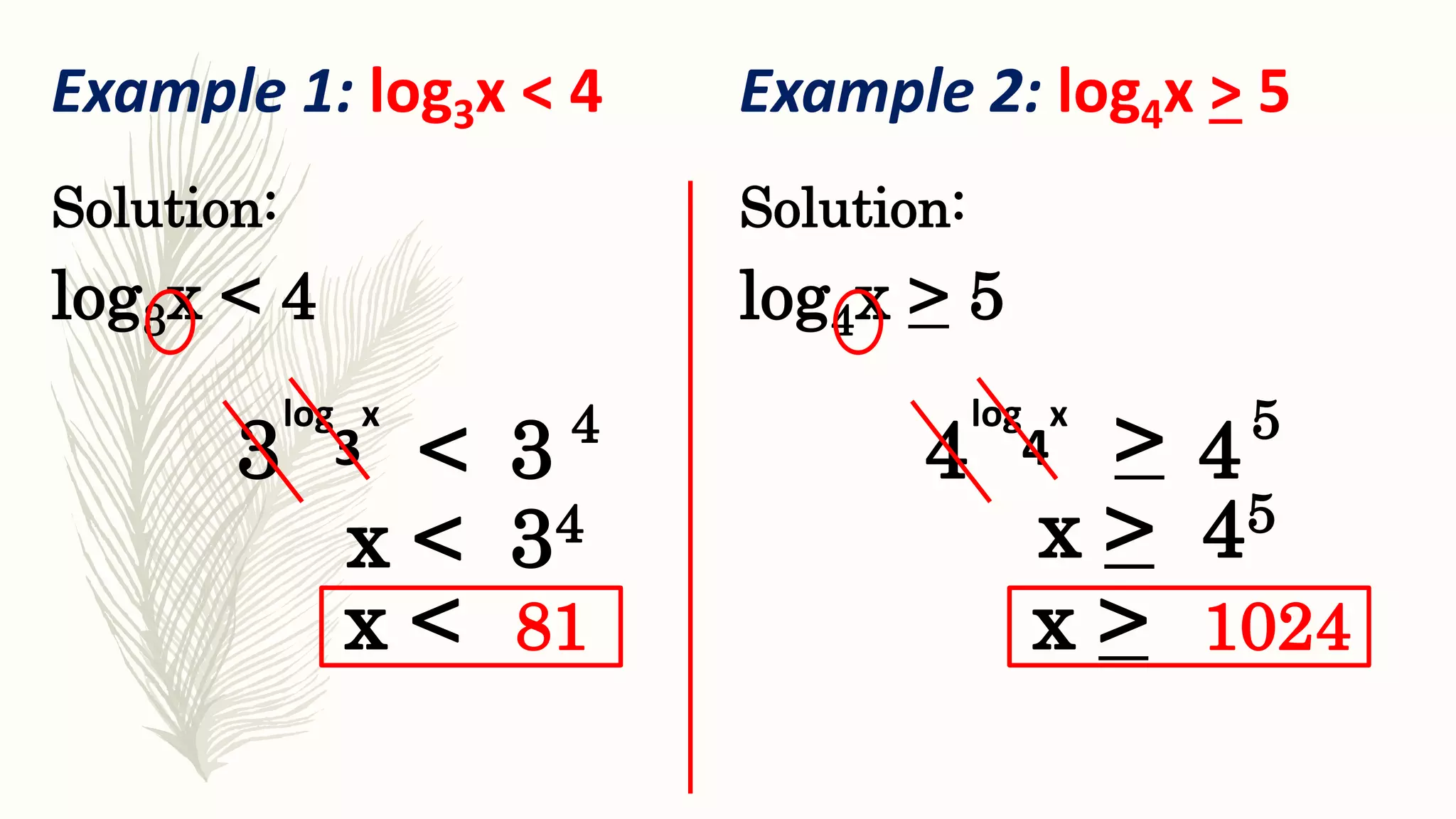
Example 1: log3x< 4
log3x < 4
Solution:
3 3
81
Solution:
log
3
x
x < 34
Example 2: log4x > 5
x <
log4x > 5
4 4
1024
log
4
x
x >
x > 45
4 5
< >
#2 After this discussion you will able to solve logarithmic equations and inequalities and solve problems involving logarithmic functions, equations, and inequalities.
But before we proceed to our lesson proper lets have first a short game.
#3 ARRANGE THOSE JUMBLED LETTERS. I will flash a jumbled letter on the board and if you know the answer just simply raise your hand. The student who got the correct word will be given additional 3 points on their quiz. Are you in favor with that class? Ok Are you ready? Ok the first word is……
#4 1ST WORD
Consist of
Equation / Expressions
Mathematical Operations
Real Numbers
Negative and Positive signs
#5 2ND WORD
Has a greater than and less than signs
#6 3RD WORD
We have two types of this….
Common and Natural “ln”
#7 4TH WORD
In Algebra we have commutative, associative and distributive ________________.
Log base b of one is equal to zero
#8 5TH WORD
Other word is superscript.
The small number or variable that is written on the upper right side of the real number.
#10 Last WORD
The product of two integers and all the integers below it.
Did you enjoy the game?
Ok that’s good, and I know that you will also enjoy our new lesson. Before we proceed to our lesson proper lets have a review about logarithms. What is logarithm?
#11 Why positive? Because a and b are greater than zero (0). A number is greater than zero are positive numbers.
#12 Throughout your study of algebra, you have come across many properties—such as the commutative, associative, and distributive properties. These properties help you take a complicated expression or equation and you just simplify it. Is that clear class.
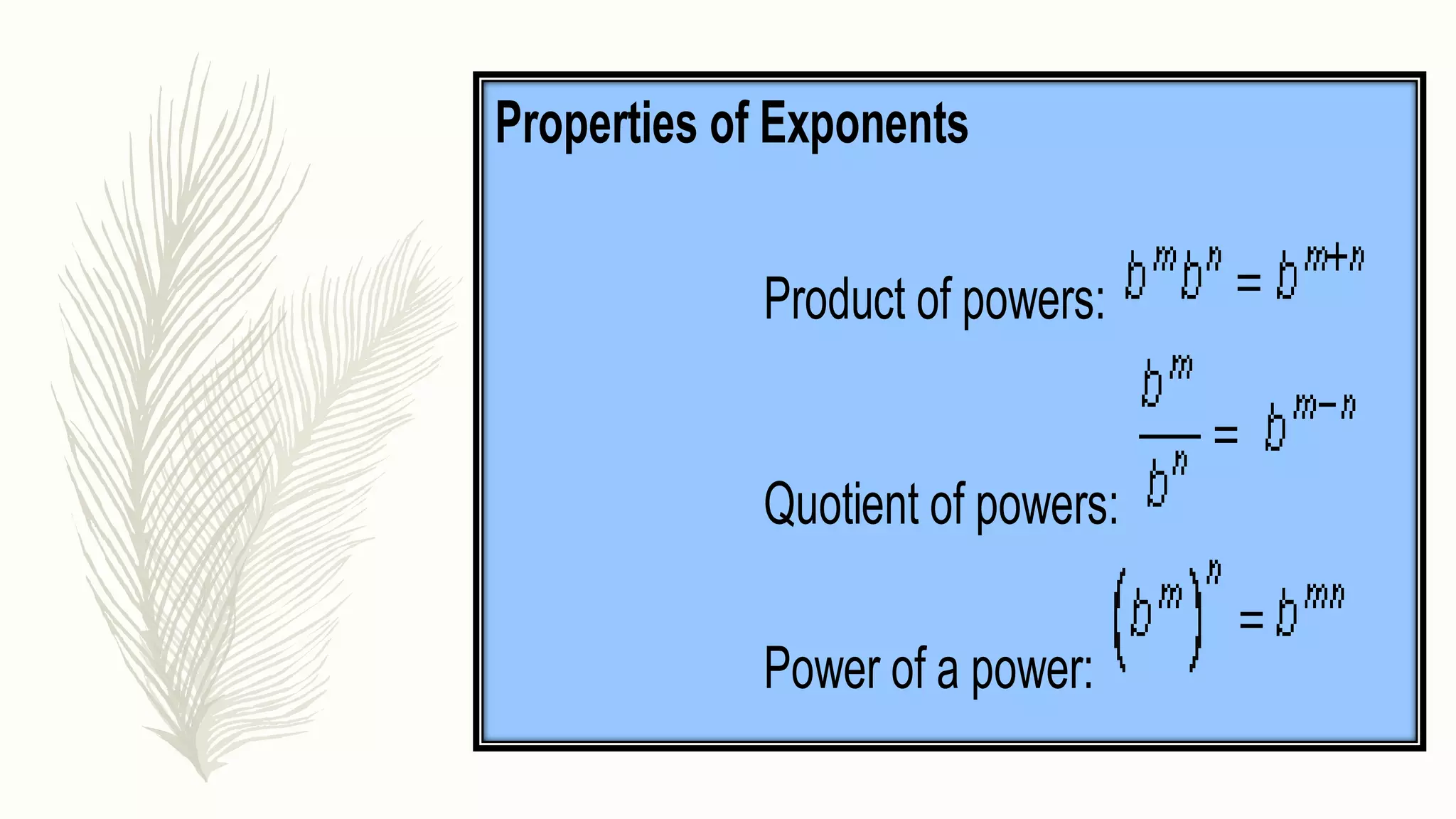
The same is true with logarithms. There are a number of properties that will help you to simplify complex logarithmic expressions. Since logarithms are so closely related to exponential expressions, it is not surprising that the properties of logarithms are very similar to the properties of exponents. As a quick refresher, here are the properties of exponent.
#13 So again, like what I have told you a while ago that logarithms are so closely related to exponentials expressions, that’s why the properties of logarithms are very similar to the properties of exponents. Do I make myself clear class?
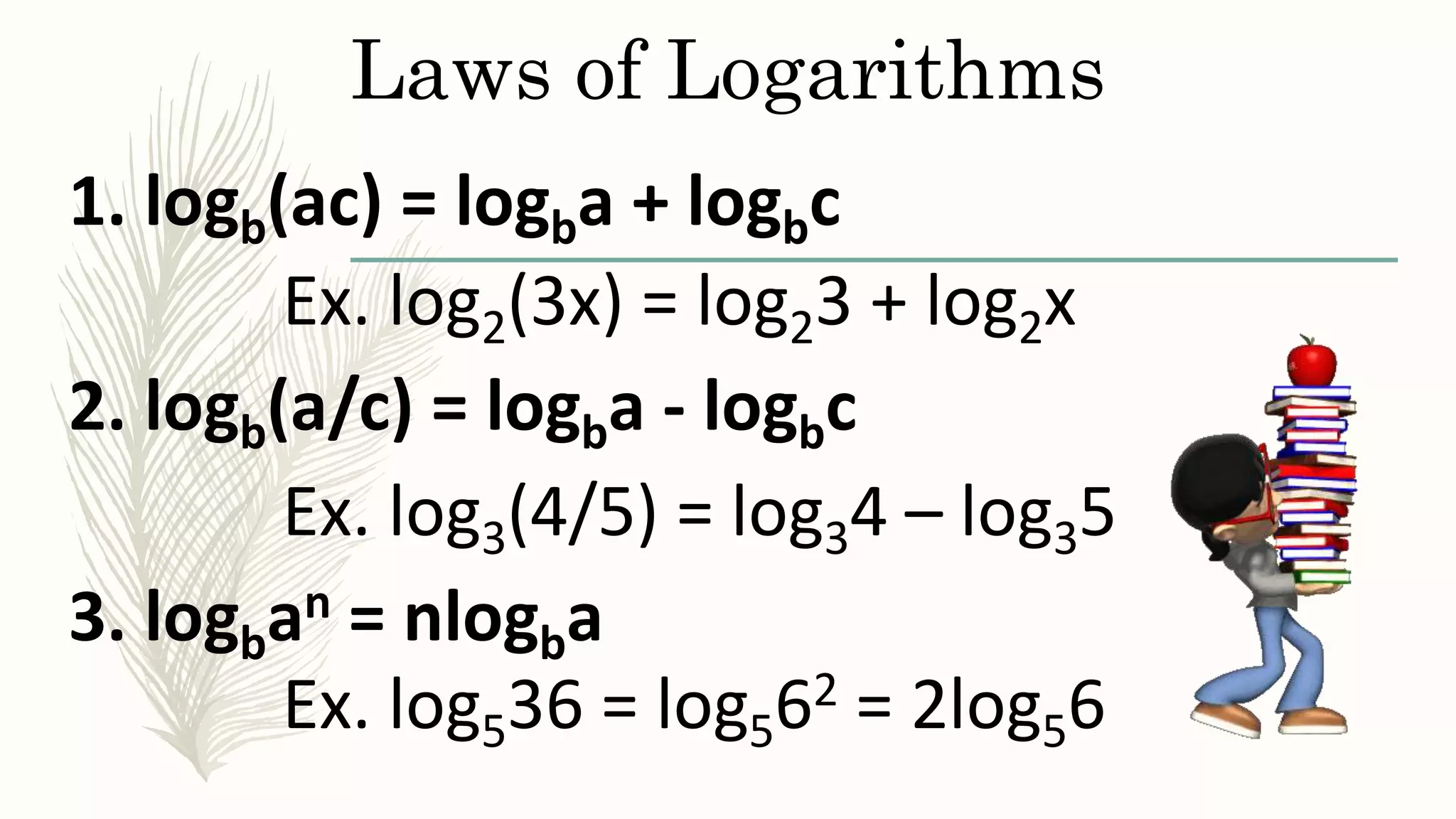
#14 1. Logarithmic Addition Identity – when two logs with the same base are added, we write the argument as the product of the two arguments. The most important thing we should notice here is the base. The base has to be the same.
Ok the next rule is….
2. Logarithmic Subtraction Identity – when two logs with the same base are subtracted, we write the argument as the quotient of the two arguments. And again the most important thing is we have the same base.
This is just a review class. No further questions class?
Ok lets now proceed to our lesson proper. Solving Logarithmic Equations and Inequalities
#16 There are some strategies to solve the logarithmic equations.
The first one is by rewriting it into exponential form;
The second one is by using the logarithmic properties;
The third one is by applying the one-to-one property of a logarithmic functions;
And the last one is The Zero Factor Property: If ab = 0, then a = 0 or b = 0.
Ok lets solve some expressions.
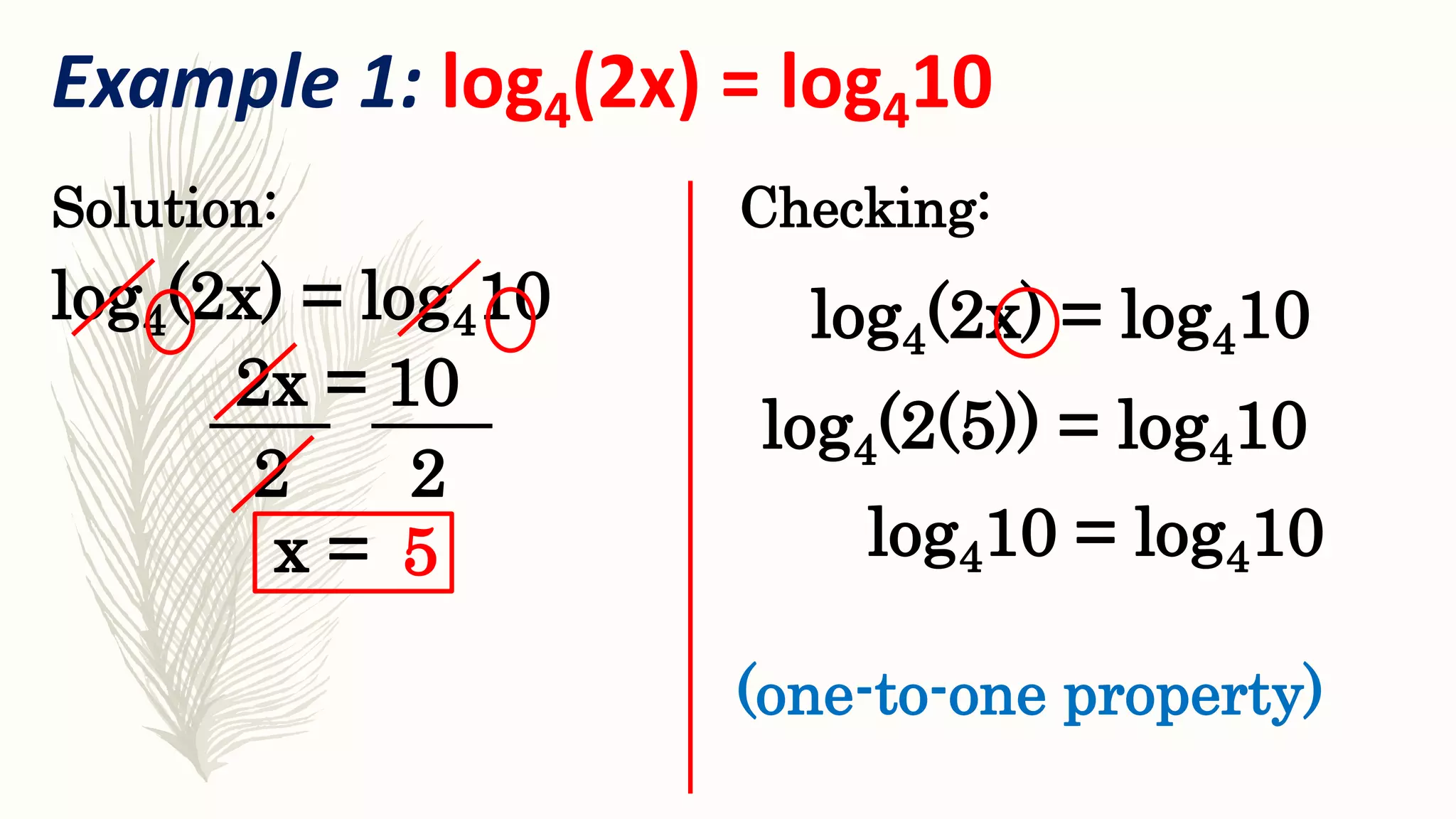
#17 How do we solve this equation? We can solve this equation by using one to one property. We have notice that we have the same base for our two logarithmic term. So, we can now just simply eliminate or cancelled out the log base 4. After cancellation we can now rewrite 2x is equal to 10. To get the value of x we can now divide 2x is equal to 10 by 2. Again, we can cancel 2. So, x is equal to (10 divided by 2 is equal to 5). So, the value of x is 5.
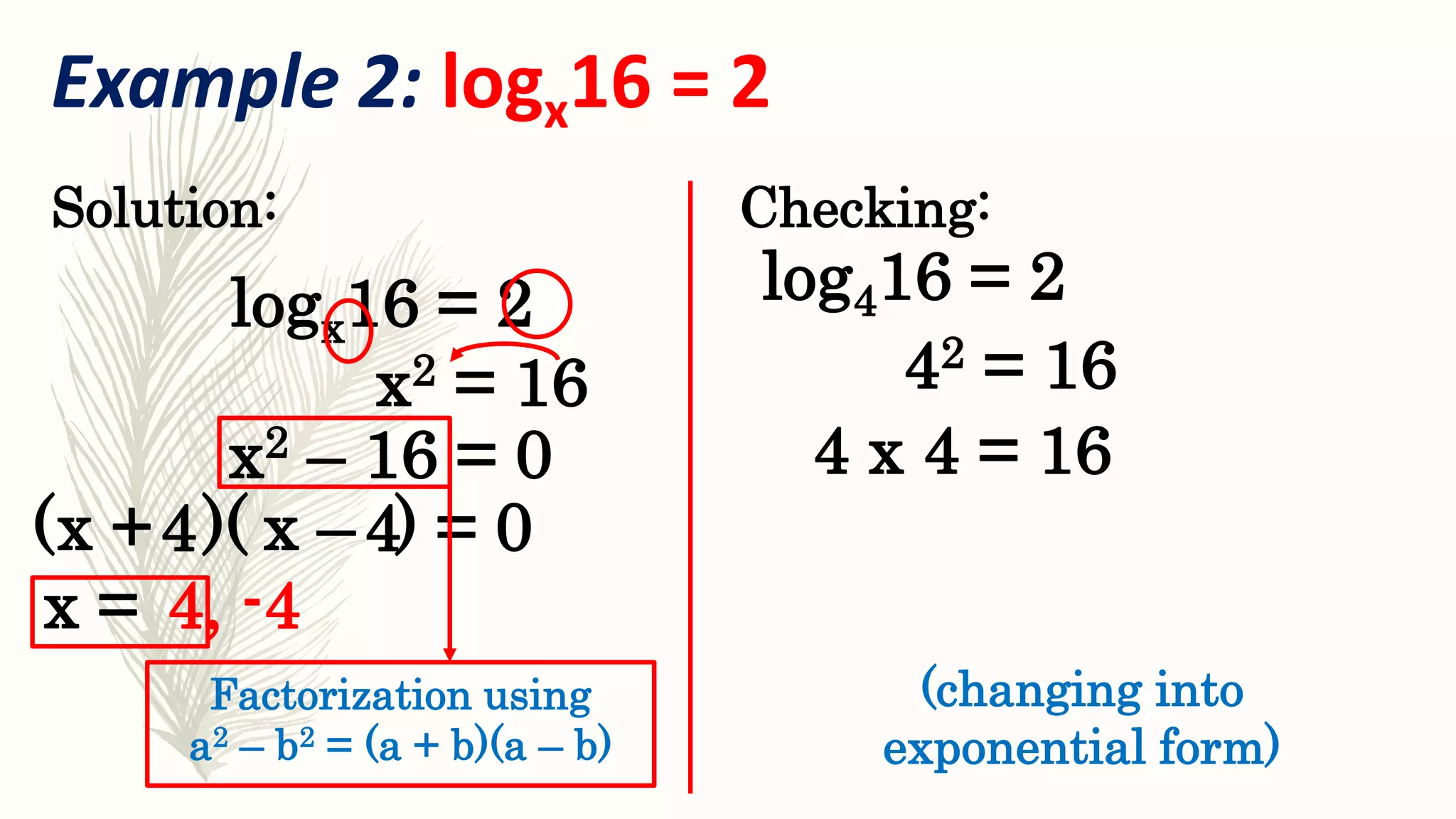
#18 Which of the two is our answer? Positive 4 is the answer since log base 4 of 16 is defined. However, -4 is not a solution since log base negative 4 is not defined (the base cannot be negative).
#20 Asked some students to go on the board and solve the given logarithmic equations
#21 Ok lets now proceed to logarithmic inequalities.
#22 When base of the logarithm is greater or bigger than one, then whenever the logarithm of the given expression is greater than the logarithm of another expression we immediately say that this x is also bigger than y. This only happen when the base of the logarithm is bigger than one.
The second case or the next rule is when the base of the logarithm is less than zero or less than one. Then, if the log of base b of x is greater than log base b of y, but our base is less than to zero or less than one, our x should be or our conclusion should be x is less than to y. So in simple term or in simple understanding, when the base is less than one or less than to zero our inequality will be reversed.
#23 How do we solve this logarithmic inequality? We can simply solve this equation by simplifying it. Since we have base 3 on our logs, we can simply write big 3 on the left and big 3 on the right. We can now write log base 3 of x less than 4 on the upper right side of 3. since log base 3 is the inverse of 3 we can now simply eliminate this two or just canceled. So, x less than 3 raise to 4 is now our expression. What is the value of 3 raise to 4? 81. x is less than 81.
#24 Asked some students to go on the board and solve the given logarithmic inequality.
This is just an algebraic manipulation.