EXPONENTIAL AND
LOGARITHMIC
FUNCTIONS
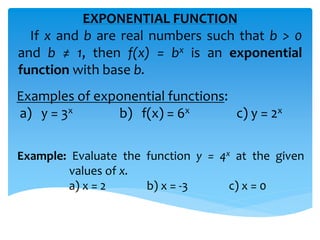
EXPONENTIAL FUNCTION
If x and b are real numbers such that b > 0
and b ≠ 1, then f(x) = bx is an exponential
function with base b.
Examples of exponential functions:
a) y = 3x b) f(x) = 6x c) y = 2x
Example: Evaluate the function y = 4x at the given
values of x.
a) x = 2 b) x = -3 c) x = 0
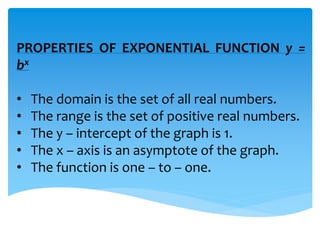
PROPERTIES OF EXPONENTIAL FUNCTION y =
bx
• The domain is the set of all real numbers.
• The range is the set of positive real numbers.
• The y – intercept of the graph is 1.
• The x – axis is an asymptote of the graph.
• The function is one – to – one.
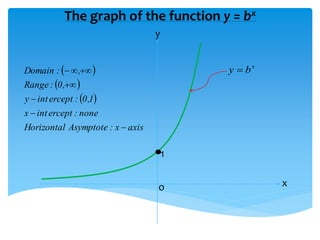
The graph of the function y = bx
1
o
y
x

 
 
 
axisx:AsymptoteHorizontal
none:erceptintx
1,0:erceptinty
,0:Range
,:Domain





x
by 
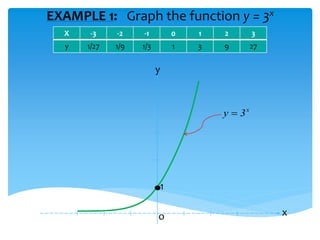
EXAMPLE 1: Graph the function y = 3x
1
X -3 -2 -1 0 1 2 3
y 1/27 1/9 1/3 1 3 9 27
o
y
x

x
3y 
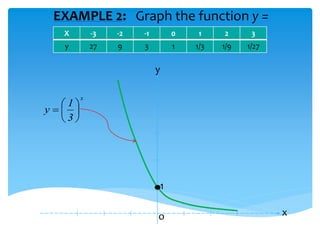
EXAMPLE 2: Graph the function y =
(1/3)x
1
X -3 -2 -1 0 1 2 3
y 27 9 3 1 1/3 1/9 1/27
o
y
x
x
3
1
y 







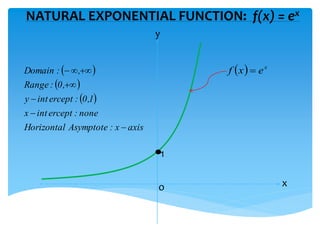
NATURAL EXPONENTIAL FUNCTION: f(x) = ex
1
o
y
x

 
 
 
axisx:AsymptoteHorizontal
none:erceptintx
1,0:erceptinty
,0:Range
,:Domain




   x
exf 
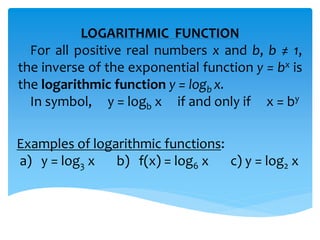
LOGARITHMIC FUNCTION
For all positive real numbers x and b, b ≠ 1,
the inverse of the exponential function y = bx is
the logarithmic function y = logb x.
In symbol, y = logb x if and only if x = by
Examples of logarithmic functions:
a) y = log3 x b) f(x) = log6 x c) y = log2 x
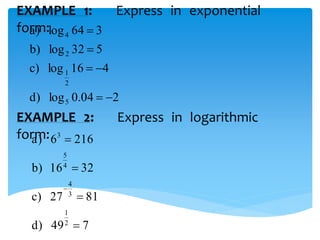
EXAMPLE 1: Express in exponential
form:
204.0log)d
416log)c
532log)b
364log)a
5
2
1
2
4




749)d
8127)c
3216)b
2166)a
2
1
3
4
4
5
3





EXAMPLE 2: Express in logarithmic
form:
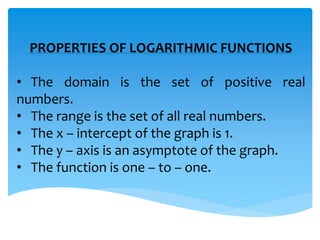
PROPERTIES OF LOGARITHMIC FUNCTIONS
• The domain is the set of positive real
numbers.
• The range is the set of all real numbers.
• The x – intercept of the graph is 1.
• The y – axis is an asymptote of the graph.
• The function is one – to – one.
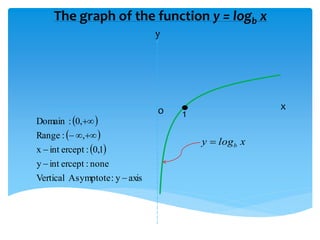
The graph of the function y = logb x
1o
y
x
 
 
 
axisy:AsymptoteVertical
none:erceptinty
1,0:erceptintx
,:Range
,0:Domain





xlogy b

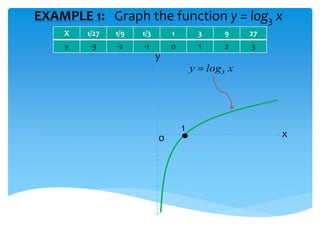
EXAMPLE 1: Graph the function y = log3 x
1
X 1/27 1/9 1/3 1 3 9 27
y -3 -2 -1 0 1 2 3
o
y
x
xlogy 3

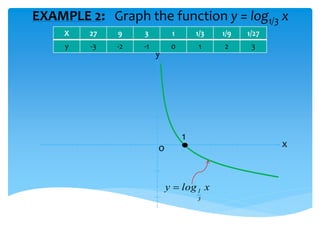
EXAMPLE 2: Graph the function y = log1/3 x
1
o
y
x
X 27 9 3 1 1/3 1/9 1/27
y -3 -2 -1 0 1 2 3
xlogy
3
1

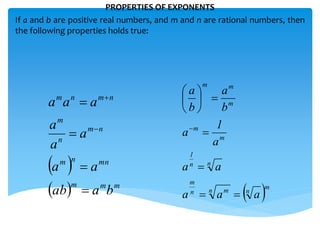
PROPERTIES OF EXPONENTS
If a and b are positive real numbers, and m and n are rational numbers, then
the following properties holds true:
 
  mmm
mnnm
nm
n
m
nmnm
baab
aa
a
a
a
aaa






 m
nn mn
m
nn
1
m
m
m
mm
aaa
aa
a
1
a
b
a
b
a










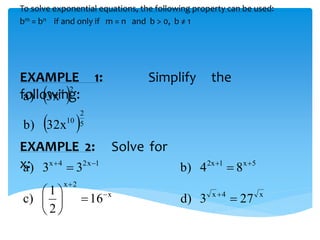
To solve exponential equations, the following property can be used:
bm = bn if and only if m = n and b > 0, b ≠ 1
EXAMPLE 1: Simplify the
following:
EXAMPLE 2: Solve for
x:
x4xx
2x
5x12x1x24x
273d)16
2
1
)c
84b)33)a










 
 5
2
10
24
32x)b
3x)a
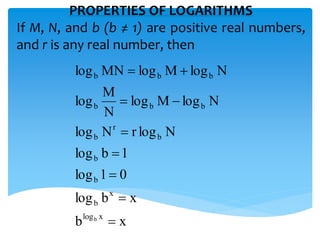
PROPERTIES OF LOGARITHMS
If M, N, and b (b ≠ 1) are positive real numbers,
and r is any real number, then
xb
xblog
01log
1blog
NlogrNlog
NlogMlog
N
M
log
NlogMlogMNlog
xlog
x
b
b
b
b
r
b
bbb
bbb
b







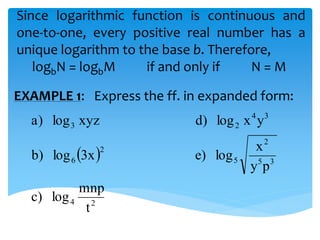
Since logarithmic function is continuous and
one-to-one, every positive real number has a
unique logarithm to the base b. Therefore,
logbN = logbM if and only if N = M
EXAMPLE 1: Express the ff. in expanded form:
 
24
35
2
5
2
6
34
23
t
mnp
log)c
py
x
loge)x3log)b
yxlogd)xyzlog)a
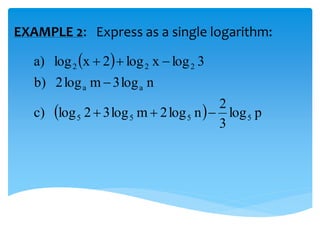
EXAMPLE 2: Express as a single logarithm:
 
  plog
3
2
nlog2mlog32log)c
nlog3mlog2)b
3logxlog2xloga)
5555
aa
222



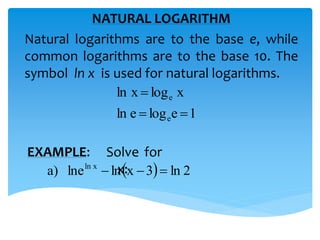
NATURAL LOGARITHM
Natural logarithms are to the base e, while
common logarithms are to the base 10. The
symbol ln x is used for natural logarithms.
  2ln3xlnlnea) ln x

EXAMPLE: Solve for
x:
1elogeln
xlogxln
e
e


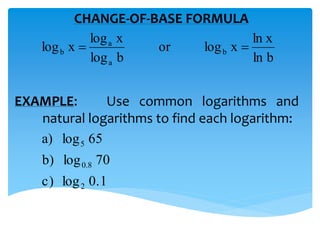
CHANGE-OF-BASE FORMULA
0.1logc)
70logb)
65loga)
2
0.8
5
EXAMPLE: Use common logarithms and
natural logarithms to find each logarithm:
bln
ln x
xlogor
blog
xlog
xlog b
a
a
b 
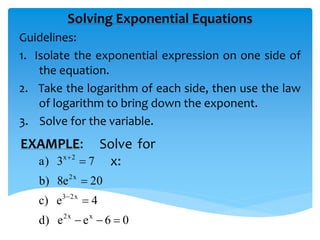
Solving Exponential Equations
Guidelines:
1. Isolate the exponential expression on one side of
the equation.
2. Take the logarithm of each side, then use the law
of logarithm to bring down the exponent.
3. Solve for the variable.
EXAMPLE: Solve for
x:
06ee)d
4e)c
20e8)b
73)a
xx2
x23
x2
2x






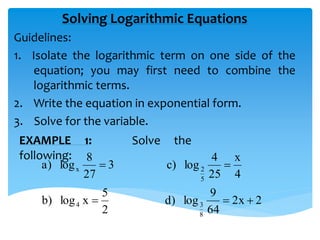
Solving Logarithmic Equations
Guidelines:
1. Isolate the logarithmic term on one side of the
equation; you may first need to combine the
logarithmic terms.
2. Write the equation in exponential form.
3. Solve for the variable.
EXAMPLE 1: Solve the
following:
2x2
64
9
log)d
2
5
xlog)b
4
x
25
4
log)c3
27
8
log)a
8
34
5
2x


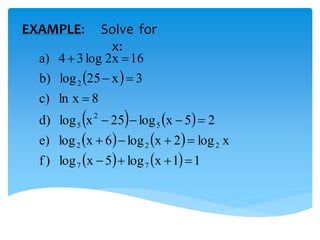
EXAMPLE: Solve for
x:
 
   
   
    11xlog5xlog)f
xlog2xlog6xlog)e
25xlog25xlogd)
8ln x)c
3x25logb)
162xlog34a)
77
222
5
2
5
2






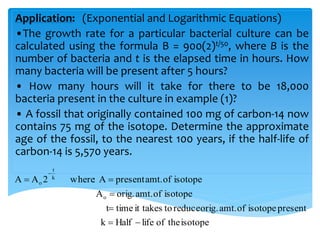
Application: (Exponential and Logarithmic Equations)
•The growth rate for a particular bacterial culture can be
calculated using the formula B = 900(2)t/50, where B is the
number of bacteria and t is the elapsed time in hours. How
many bacteria will be present after 5 hours?
• How many hours will it take for there to be 18,000
bacteria present in the culture in example (1)?
• A fossil that originally contained 100 mg of carbon-14 now
contains 75 mg of the isotope. Determine the approximate
age of the fossil, to the nearest 100 years, if the half-life of
carbon-14 is 5,570 years.
isotopetheoflifeHalfk
presentisotopeofamt.orig.reducetoit takestimet
isotopeofamt..origA
isotopeofamt.presentA:where2AA
o
k
t
o





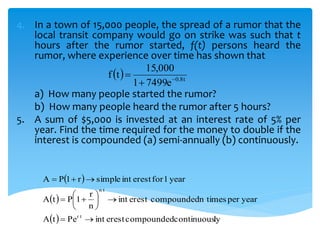
4. In a town of 15,000 people, the spread of a rumor that the
local transit company would go on strike was such that t
hours after the rumor started, f(t) persons heard the
rumor, where experience over time has shown that
a) How many people started the rumor?
b) How many people heard the rumor after 5 hours?
5. A sum of $5,000 is invested at an interest rate of 5% per
year. Find the time required for the money to double if the
interest is compounded (a) semi-annually (b) continuously.
  t8.0
e74991
000,15
tf 


 
 
  lycontinuouscompoundederestintPetA
yearpern timescompoundederestint
n
r
1PtA
year1forerestintsimpler1PA
tr
tn










Exponential and logrithmic functions

  • 1.
  • 2.
    EXPONENTIAL FUNCTION If xand b are real numbers such that b > 0 and b ≠ 1, then f(x) = bx is an exponential function with base b. Examples of exponential functions: a) y = 3x b) f(x) = 6x c) y = 2x Example: Evaluate the function y = 4x at the given values of x. a) x = 2 b) x = -3 c) x = 0
  • 3.
    PROPERTIES OF EXPONENTIALFUNCTION y = bx • The domain is the set of all real numbers. • The range is the set of positive real numbers. • The y – intercept of the graph is 1. • The x – axis is an asymptote of the graph. • The function is one – to – one.
  • 4.
    The graph ofthe function y = bx 1 o y x        axisx:AsymptoteHorizontal none:erceptintx 1,0:erceptinty ,0:Range ,:Domain      x by 
  • 5.
    EXAMPLE 1: Graphthe function y = 3x 1 X -3 -2 -1 0 1 2 3 y 1/27 1/9 1/3 1 3 9 27 o y x  x 3y 
  • 6.
    EXAMPLE 2: Graphthe function y = (1/3)x 1 X -3 -2 -1 0 1 2 3 y 27 9 3 1 1/3 1/9 1/27 o y x x 3 1 y        
  • 7.
    NATURAL EXPONENTIAL FUNCTION:f(x) = ex 1 o y x        axisx:AsymptoteHorizontal none:erceptintx 1,0:erceptinty ,0:Range ,:Domain        x exf 
  • 8.
    LOGARITHMIC FUNCTION For allpositive real numbers x and b, b ≠ 1, the inverse of the exponential function y = bx is the logarithmic function y = logb x. In symbol, y = logb x if and only if x = by Examples of logarithmic functions: a) y = log3 x b) f(x) = log6 x c) y = log2 x
  • 9.
    EXAMPLE 1: Expressin exponential form: 204.0log)d 416log)c 532log)b 364log)a 5 2 1 2 4     749)d 8127)c 3216)b 2166)a 2 1 3 4 4 5 3      EXAMPLE 2: Express in logarithmic form:
  • 10.
    PROPERTIES OF LOGARITHMICFUNCTIONS • The domain is the set of positive real numbers. • The range is the set of all real numbers. • The x – intercept of the graph is 1. • The y – axis is an asymptote of the graph. • The function is one – to – one.
  • 11.
    The graph ofthe function y = logb x 1o y x       axisy:AsymptoteVertical none:erceptinty 1,0:erceptintx ,:Range ,0:Domain      xlogy b 
  • 12.
    EXAMPLE 1: Graphthe function y = log3 x 1 X 1/27 1/9 1/3 1 3 9 27 y -3 -2 -1 0 1 2 3 o y x xlogy 3 
  • 13.
    EXAMPLE 2: Graphthe function y = log1/3 x 1 o y x X 27 9 3 1 1/3 1/9 1/27 y -3 -2 -1 0 1 2 3 xlogy 3 1 
  • 14.
    PROPERTIES OF EXPONENTS Ifa and b are positive real numbers, and m and n are rational numbers, then the following properties holds true:     mmm mnnm nm n m nmnm baab aa a a a aaa        m nn mn m nn 1 m m m mm aaa aa a 1 a b a b a          
  • 15.
    To solve exponentialequations, the following property can be used: bm = bn if and only if m = n and b > 0, b ≠ 1 EXAMPLE 1: Simplify the following: EXAMPLE 2: Solve for x: x4xx 2x 5x12x1x24x 273d)16 2 1 )c 84b)33)a              5 2 10 24 32x)b 3x)a
  • 16.
    PROPERTIES OF LOGARITHMS IfM, N, and b (b ≠ 1) are positive real numbers, and r is any real number, then xb xblog 01log 1blog NlogrNlog NlogMlog N M log NlogMlogMNlog xlog x b b b b r b bbb bbb b       
  • 17.
    Since logarithmic functionis continuous and one-to-one, every positive real number has a unique logarithm to the base b. Therefore, logbN = logbM if and only if N = M EXAMPLE 1: Express the ff. in expanded form:   24 35 2 5 2 6 34 23 t mnp log)c py x loge)x3log)b yxlogd)xyzlog)a
  • 18.
    EXAMPLE 2: Expressas a single logarithm:     plog 3 2 nlog2mlog32log)c nlog3mlog2)b 3logxlog2xloga) 5555 aa 222   
  • 19.
    NATURAL LOGARITHM Natural logarithmsare to the base e, while common logarithms are to the base 10. The symbol ln x is used for natural logarithms.   2ln3xlnlnea) ln x  EXAMPLE: Solve for x: 1elogeln xlogxln e e  
  • 20.
    CHANGE-OF-BASE FORMULA 0.1logc) 70logb) 65loga) 2 0.8 5 EXAMPLE: Usecommon logarithms and natural logarithms to find each logarithm: bln ln x xlogor blog xlog xlog b a a b 
  • 21.
    Solving Exponential Equations Guidelines: 1.Isolate the exponential expression on one side of the equation. 2. Take the logarithm of each side, then use the law of logarithm to bring down the exponent. 3. Solve for the variable. EXAMPLE: Solve for x: 06ee)d 4e)c 20e8)b 73)a xx2 x23 x2 2x      
  • 22.
    Solving Logarithmic Equations Guidelines: 1.Isolate the logarithmic term on one side of the equation; you may first need to combine the logarithmic terms. 2. Write the equation in exponential form. 3. Solve for the variable. EXAMPLE 1: Solve the following: 2x2 64 9 log)d 2 5 xlog)b 4 x 25 4 log)c3 27 8 log)a 8 34 5 2x  
  • 23.
    EXAMPLE: Solve for x:              11xlog5xlog)f xlog2xlog6xlog)e 25xlog25xlogd) 8ln x)c 3x25logb) 162xlog34a) 77 222 5 2 5 2      
  • 24.
    Application: (Exponential andLogarithmic Equations) •The growth rate for a particular bacterial culture can be calculated using the formula B = 900(2)t/50, where B is the number of bacteria and t is the elapsed time in hours. How many bacteria will be present after 5 hours? • How many hours will it take for there to be 18,000 bacteria present in the culture in example (1)? • A fossil that originally contained 100 mg of carbon-14 now contains 75 mg of the isotope. Determine the approximate age of the fossil, to the nearest 100 years, if the half-life of carbon-14 is 5,570 years. isotopetheoflifeHalfk presentisotopeofamt.orig.reducetoit takestimet isotopeofamt..origA isotopeofamt.presentA:where2AA o k t o     
  • 25.
    4. In atown of 15,000 people, the spread of a rumor that the local transit company would go on strike was such that t hours after the rumor started, f(t) persons heard the rumor, where experience over time has shown that a) How many people started the rumor? b) How many people heard the rumor after 5 hours? 5. A sum of $5,000 is invested at an interest rate of 5% per year. Find the time required for the money to double if the interest is compounded (a) semi-annually (b) continuously.   t8.0 e74991 000,15 tf          lycontinuouscompoundederestintPetA yearpern timescompoundederestint n r 1PtA year1forerestintsimpler1PA tr tn         

Editor's Notes