LogarithmsIN MATHEMATICS
1
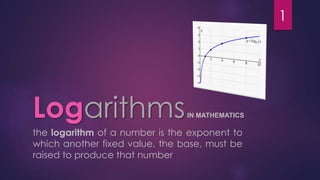
the logarithm of a number is the exponent to
which another fixed value, the base, must be
raised to produce that number
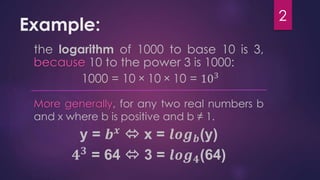
Example:
the logarithm of 1000 to base 10 is 3,
because 10 to the power 3 is 1000:
1000 = 10 × 10 × 10 = 103
2
More generally, for any two real numbers b
and x where b is positive and b ≠ 1.
y = 𝒃 𝒙  x = 𝒍𝒐𝒈 𝒃(y)
𝟒 𝟑
= 64  3 = 𝒍𝒐𝒈 𝟒(64)
Logarithmic identities : 3
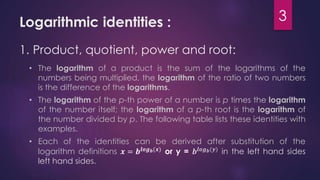
1. Product, quotient, power and root:
• The logarithm of a product is the sum of the logarithms of the
numbers being multiplied, the logarithm of the ratio of two numbers
is the difference of the logarithms.
• The logarithm of the p-th power of a number is p times the logarithm
of the number itself; the logarithm of a p-th root is the logarithm of
the number divided by p. The following table lists these identities with
examples.
• Each of the identities can be derived after substitution of the
logarithm definitions 𝒙 = 𝒃𝒍𝒐𝒈 𝒃(𝒙) or y = 𝒃𝒍𝒐𝒈 𝒃(𝒚) in the left hand sides
left hand sides.
4
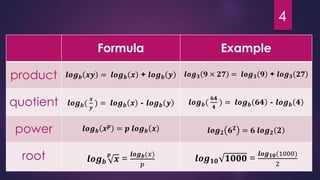
Formula Example
product 𝒍𝒐𝒈 𝒃 𝒙𝒚 = 𝒍𝒐𝒈 𝒃 𝒙 + 𝒍𝒐𝒈 𝒃 𝒚 𝒍𝒐𝒈 𝟑 𝟗 × 𝟐𝟕 = 𝒍𝒐𝒈 𝟑 𝟗 + 𝒍𝒐𝒈 𝟑 𝟐𝟕
quotient 𝒍𝒐𝒈 𝒃(
𝒙
𝒚
) = 𝒍𝒐𝒈 𝒃 𝒙 - 𝒍𝒐𝒈 𝒃 𝒚 𝒍𝒐𝒈 𝒃(
𝟔𝟒
𝟒
) = 𝒍𝒐𝒈 𝒃 𝟔𝟒 - 𝒍𝒐𝒈 𝒃 𝟒
power 𝒍𝒐𝒈 𝒃 𝒙 𝒑 = 𝒑 𝒍𝒐𝒈 𝒃 𝒙 𝒍𝒐𝒈 𝟐 𝟔 𝟐
= 𝟔 𝒍𝒐𝒈 𝟐 𝟐
root 𝒍𝒐𝒈 𝒃
𝒑
𝒙 =
𝒍𝒐𝒈 𝒃(𝑥)
𝑝
𝒍𝒐𝒈 𝟏𝟎 𝟏𝟎𝟎𝟎 =
𝒍𝒐𝒈 𝟏𝟎(1000)
2
5Logarithmic identities :
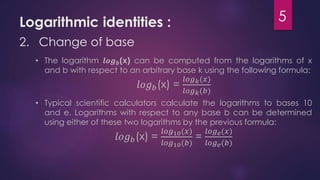
2. Change of base
• The logarithm 𝒍𝒐𝒈 𝒃(x) can be computed from the logarithms of x
and b with respect to an arbitrary base k using the following formula:
𝑙𝑜𝑔 𝑏(x) =
𝑙𝑜𝑔 𝑘(𝑥)
𝑙𝑜𝑔 𝑘(𝑏)
• Typical scientific calculators calculate the logarithms to bases 10
and e. Logarithms with respect to any base b can be determined
using either of these two logarithms by the previous formula:
𝑙𝑜𝑔 𝑏(x) =
𝑙𝑜𝑔10(𝑥)
𝑙𝑜𝑔10(𝑏)
=
𝑙𝑜𝑔 𝑒(𝑥)
𝑙𝑜𝑔 𝑒(𝑏)
6
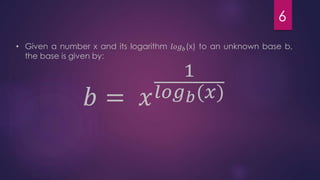
• Given a number x and its logarithm 𝑙𝑜𝑔 𝑏(x) to an unknown base b,
the base is given by:
𝑏 = 𝑥
1
𝑙𝑜𝑔 𝑏(𝑥)
7
HistoryLogarithm tables, slide rules, and historical applications
• By simplifying difficult calculations, logarithms contributed to the advance of
science, and especially of astronomy. They were critical to advances in
surveying, celestial navigation, and other domains. Pierre-Simon Laplace
called logarithms.
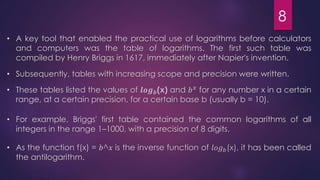
• These tables listed the values of 𝒍𝒐𝒈 𝒃(x) and 𝑏 𝑥
for any number x in a certain
range, at a certain precision, for a certain base b (usually b = 10).
8
• Subsequently, tables with increasing scope and precision were written.
• A key tool that enabled the practical use of logarithms before calculators
and computers was the table of logarithms. The first such table was
compiled by Henry Briggs in 1617, immediately after Napier's invention.
• For example, Briggs' first table contained the common logarithms of all
integers in the range 1–1000, with a precision of 8 digits.
• As the function f(x) = 𝑏^𝑥 is the inverse function of 𝑙𝑜𝑔 𝑏(x), it has been called
the antilogarithm.
9
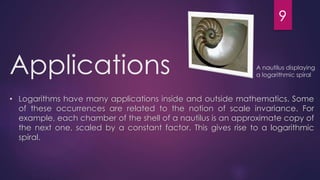
Applications A nautilus displaying
a logarithmic spiral
• Logarithms have many applications inside and outside mathematics. Some
of these occurrences are related to the notion of scale invariance. For
example, each chamber of the shell of a nautilus is an approximate copy of
the next one, scaled by a constant factor. This gives rise to a logarithmic
spiral.
10Application
1. Logarithmic scale
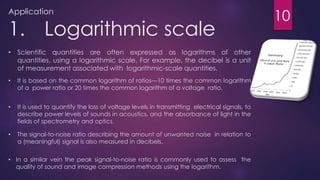
• Scientific quantities are often expressed as logarithms of other
quantities, using a logarithmic scale. For example, the decibel is a unit
of measurement associated with logarithmic-scale quantities.
• It is based on the common logarithm of ratios—10 times the common logarithm
of a power ratio or 20 times the common logarithm of a voltage ratio.
• It is used to quantify the loss of voltage levels in transmitting electrical signals, to
describe power levels of sounds in acoustics, and the absorbance of light in the
fields of spectrometry and optics.
• The signal-to-noise ratio describing the amount of unwanted noise in relation to
a (meaningful) signal is also measured in decibels.
• In a similar vein the peak signal-to-noise ratio is commonly used to assess the
quality of sound and image compression methods using the logarithm.
Application
2. Fractals
11
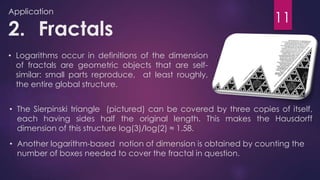
• Logarithms occur in definitions of the dimension
of fractals are geometric objects that are self-
similar: small parts reproduce, at least roughly,
the entire global structure.
• The Sierpinski triangle (pictured) can be covered by three copies of itself,
each having sides half the original length. This makes the Hausdorff
dimension of this structure log(3)/log(2) ≈ 1.58.
• Another logarithm-based notion of dimension is obtained by counting the
number of boxes needed to cover the fractal in question.

Logarithms in mathematics

  • 1.
    LogarithmsIN MATHEMATICS 1 the logarithmof a number is the exponent to which another fixed value, the base, must be raised to produce that number
  • 2.
    Example: the logarithm of1000 to base 10 is 3, because 10 to the power 3 is 1000: 1000 = 10 × 10 × 10 = 103 2 More generally, for any two real numbers b and x where b is positive and b ≠ 1. y = 𝒃 𝒙  x = 𝒍𝒐𝒈 𝒃(y) 𝟒 𝟑 = 64  3 = 𝒍𝒐𝒈 𝟒(64)
  • 3.
    Logarithmic identities :3 1. Product, quotient, power and root: • The logarithm of a product is the sum of the logarithms of the numbers being multiplied, the logarithm of the ratio of two numbers is the difference of the logarithms. • The logarithm of the p-th power of a number is p times the logarithm of the number itself; the logarithm of a p-th root is the logarithm of the number divided by p. The following table lists these identities with examples. • Each of the identities can be derived after substitution of the logarithm definitions 𝒙 = 𝒃𝒍𝒐𝒈 𝒃(𝒙) or y = 𝒃𝒍𝒐𝒈 𝒃(𝒚) in the left hand sides left hand sides.
  • 4.
    4 Formula Example product 𝒍𝒐𝒈𝒃 𝒙𝒚 = 𝒍𝒐𝒈 𝒃 𝒙 + 𝒍𝒐𝒈 𝒃 𝒚 𝒍𝒐𝒈 𝟑 𝟗 × 𝟐𝟕 = 𝒍𝒐𝒈 𝟑 𝟗 + 𝒍𝒐𝒈 𝟑 𝟐𝟕 quotient 𝒍𝒐𝒈 𝒃( 𝒙 𝒚 ) = 𝒍𝒐𝒈 𝒃 𝒙 - 𝒍𝒐𝒈 𝒃 𝒚 𝒍𝒐𝒈 𝒃( 𝟔𝟒 𝟒 ) = 𝒍𝒐𝒈 𝒃 𝟔𝟒 - 𝒍𝒐𝒈 𝒃 𝟒 power 𝒍𝒐𝒈 𝒃 𝒙 𝒑 = 𝒑 𝒍𝒐𝒈 𝒃 𝒙 𝒍𝒐𝒈 𝟐 𝟔 𝟐 = 𝟔 𝒍𝒐𝒈 𝟐 𝟐 root 𝒍𝒐𝒈 𝒃 𝒑 𝒙 = 𝒍𝒐𝒈 𝒃(𝑥) 𝑝 𝒍𝒐𝒈 𝟏𝟎 𝟏𝟎𝟎𝟎 = 𝒍𝒐𝒈 𝟏𝟎(1000) 2
  • 5.
    5Logarithmic identities : 2.Change of base • The logarithm 𝒍𝒐𝒈 𝒃(x) can be computed from the logarithms of x and b with respect to an arbitrary base k using the following formula: 𝑙𝑜𝑔 𝑏(x) = 𝑙𝑜𝑔 𝑘(𝑥) 𝑙𝑜𝑔 𝑘(𝑏) • Typical scientific calculators calculate the logarithms to bases 10 and e. Logarithms with respect to any base b can be determined using either of these two logarithms by the previous formula: 𝑙𝑜𝑔 𝑏(x) = 𝑙𝑜𝑔10(𝑥) 𝑙𝑜𝑔10(𝑏) = 𝑙𝑜𝑔 𝑒(𝑥) 𝑙𝑜𝑔 𝑒(𝑏)
  • 6.
    6 • Given anumber x and its logarithm 𝑙𝑜𝑔 𝑏(x) to an unknown base b, the base is given by: 𝑏 = 𝑥 1 𝑙𝑜𝑔 𝑏(𝑥)
  • 7.
    7 HistoryLogarithm tables, sliderules, and historical applications • By simplifying difficult calculations, logarithms contributed to the advance of science, and especially of astronomy. They were critical to advances in surveying, celestial navigation, and other domains. Pierre-Simon Laplace called logarithms.
  • 8.
    • These tableslisted the values of 𝒍𝒐𝒈 𝒃(x) and 𝑏 𝑥 for any number x in a certain range, at a certain precision, for a certain base b (usually b = 10). 8 • Subsequently, tables with increasing scope and precision were written. • A key tool that enabled the practical use of logarithms before calculators and computers was the table of logarithms. The first such table was compiled by Henry Briggs in 1617, immediately after Napier's invention. • For example, Briggs' first table contained the common logarithms of all integers in the range 1–1000, with a precision of 8 digits. • As the function f(x) = 𝑏^𝑥 is the inverse function of 𝑙𝑜𝑔 𝑏(x), it has been called the antilogarithm.
  • 9.
    9 Applications A nautilusdisplaying a logarithmic spiral • Logarithms have many applications inside and outside mathematics. Some of these occurrences are related to the notion of scale invariance. For example, each chamber of the shell of a nautilus is an approximate copy of the next one, scaled by a constant factor. This gives rise to a logarithmic spiral.
  • 10.
    10Application 1. Logarithmic scale •Scientific quantities are often expressed as logarithms of other quantities, using a logarithmic scale. For example, the decibel is a unit of measurement associated with logarithmic-scale quantities. • It is based on the common logarithm of ratios—10 times the common logarithm of a power ratio or 20 times the common logarithm of a voltage ratio. • It is used to quantify the loss of voltage levels in transmitting electrical signals, to describe power levels of sounds in acoustics, and the absorbance of light in the fields of spectrometry and optics. • The signal-to-noise ratio describing the amount of unwanted noise in relation to a (meaningful) signal is also measured in decibels. • In a similar vein the peak signal-to-noise ratio is commonly used to assess the quality of sound and image compression methods using the logarithm.
  • 11.
    Application 2. Fractals 11 • Logarithmsoccur in definitions of the dimension of fractals are geometric objects that are self- similar: small parts reproduce, at least roughly, the entire global structure. • The Sierpinski triangle (pictured) can be covered by three copies of itself, each having sides half the original length. This makes the Hausdorff dimension of this structure log(3)/log(2) ≈ 1.58. • Another logarithm-based notion of dimension is obtained by counting the number of boxes needed to cover the fractal in question.