Genitourinary
Emergency
Prof. Dr. Mostafa Sakr
Genitourinary Surgery
• Urologic emergency arises when a condition
require rapid diagnosis and immediate treatment
• Compared to other surgical fields there are
relatively few emergencies in urology
Urological Emergencies
1) Non traumatic
1. Hematuria
2. Renal Colic
3. Urinary Retention
4. Acute Scrotum
5. Priapism
2) Traumatic
1) Renal Trauma
2) Ureteral Injury
3) Bladder Trauma
4) Urethral Injury
5) Testicular Trauma
Urological Emergencies
1) Non traumatic
1. Hematuria
2. Renal Colic
3. Urinary Retention
4. Acute Scrotum
5. Priapism
2) Traumatic
1) Renal Trauma
2) Ureteral Injury
3) Bladder Trauma
4) Urethral Injury
5) Testicular Trauma
Hematuria
• Blood in the urine
• Types:
– Macroscopic (frank, or gross hematuria)/
Dipstick hematuria for Microscopic hematuria
(the presence of > 3 red blood cells per high
power microscopic field).
– Painless or painful.
– Initial / Terminal / Total
Hematuria…
• Causes
– Nephrological (medical) or urological (surgical)
– Medical causes:
• glomerular and nonglomerular
• blood dyscrasias, interstitial nephritis, and renovascular
disease
– Surgical/urological nonglomerular causes:
• renal tumours, urothelial tumours (bladder, ureteric, renal
collecting system), prostate cancer, bleeding from vascular
benign prostatic enlargement, trauma, renal or ureteric
stones, and UTI.
• Haematuria in these situations is usually characterised by
circular erythrocytes and absence of proteinuria and casts.
Non traumatic
emergency
Hematuria…
• Presentation:
– Hematuria
– Anemia: bleeding is so heavy (this is rare)
– Urine retention or ureteric colic (Clot retention)
• Work Up :
– History
– Examination
– Investigation :
• Urine culture
• Urine cytology
• Renal US
• Flexible cystoscopy,
• IVU or computed tomography (CT) scan in selected groups.
– Treat the cause
Non traumatic
emergency
Urological Emergencies
1) Non traumatic
1. Hematuria
2. Renal Colic
3. Urinary Retention
4. Acute Scrotum
5. Priapism
2) Traumatic
1) Renal Trauma
2) Ureteral Injury
3) Bladder Trauma
4) Urethral Injury
5) Testicular Trauma
ACUTE FLANK PAIN—URETERIC
OR RENAL COLIC
• The commonest urologic emergency.
• One of the commonest causes of the “Acute Abdomen”.
• Sudden onset of severe pain in the flank
• Most often due to the passage of a stone formed in the
kidney, down through the ureter.
Renal colic….
• The pain is characteristically :
– very sudden onset
– colicky in nature
– Radiates to the groin as the stone passes into the lower ureter.
– May change in location, from the flank to the groin, (the location
of pain does not provide a good indication of the position of the
stone)
– The patient cannot get comfortable, and may roll around in
agony.
– Associated with nausea / Vomiting
– the pain of a ureteric stone as being worse than the pain of
labour.
Non traumatic
emergency
Renal colic….
• Differential diagnoses
– Leaking abdominal aortic aneurysms
– Pneumonia
– Myocardial infarction
– Ovarian pathology (e.g., twisted ovarian cyst)
– Acute appendicitis
– Testicular torsion
– Inflammatory bowel disease (Crohn’s, ulcerative colitis)
– Diverticulitis
– Ectopic pregnancy
– Burst peptic ulcer
– Bowel obstruction
Non traumatic
emergency
Renal colic….
• Work Up :
– History
– Examination: patient want to move around, in
an attempt to find a comfortable position.
– +/- Fever
– Pregnancy test
– MSU
Non traumatic
emergency
Renal colic….
– Radiological investigation :
• KUB / Abdominal US
• IVP (was)
• Helical CTU
– advantages over IVP:
» greater specificity (95%) and sensitivity (97%) for diagnosing
ureteric stones
» Can identify other, non-stone causes of flank pain.
» No need for contrast administration.
» Faster, taking just a few minutes
» the cost of CTU is equivalent to that of IVU
• MRI
– very accurate way of determining whether or not a stone is present
in the ureter
– very high cost
Non traumatic
emergency
Renal colic….
• Acute Management of Ureteric Stones:
– Pain relief
• NSAIDs
• Intramuscular or intravenous injection, by mouth,
or per rectum
• +/- Opiate analgesics (pethidine or morphine).
– ? Hyper hydration
– ‘watchful waiting’ with analgesic supplements
• 95% of stones measuring 5mm or less pass
spontaneously
Non traumatic
emergency
Renal colic….
• Indications for Intervention to Relieve
Obstruction and/or Remove the Stone:
– Pain that fails to respond to analgesics.
– Associated fever.
– Renal function is impaired because of the
stone (solitary kidney obstructed by a stone,
bilateral ureteric stones, or preexisting renal
impairment )
– Obstruction unrelieved for > 4 weeks
– Personal or occupational reasons
Non traumatic
emergency
Renal colic….
• Treatment of the Stone:
– Temporary relief of the obstruction:
• Insertion of a JJ stent or percutaneous
nephrostomy tube.
– Definitive treatment of a ureteric stone:
• ESWL.
• PCNL
• Ureteroscopy
• Open Surgery: very limited.
Non traumatic
emergency
Urological Emergencies
1) Non traumatic
1. Hematuria
2. Renal Colic
3. Urinary Retention
4. Acute Scrotum
5. Priapism
2) Traumatic
1) Renal Trauma
2) Ureteral Injury
3) Bladder Trauma
4) Urethral Injury
5) Testicular Trauma
Urinary Retention
• Acute Urinary retention
• Chronic Urinary retention
Non traumatic
emergency
Acute Urinary retention
• Painful inability to void, with relief of pain
following drainage of the bladder by
catheterization.
• Pathophysiology:
– Increased urethral resistance, i.e., bladder
outlet obstruction (BOO)
– Low bladder pressure, i.e., impaired bladder
contractility
– Interruption of sensory or motor innervations
of the bladder
Non traumatic
emergency
Acute urinary retention…
• Causes :
– Men:
• Benign prostatic enlargement (BPE) due to BPH
• Carcinoma of the prostate
• Urethral stricture
• Prostatic abscess
– Women
• Pelvic prolapse (cystocoele, rectocoele, uterine)
• Urethral stricture;
• Urethral diverticulum;
• Post surgery for ‘stress’ incontinence
• pelvic masses (e.g., ovarian masses)
Non traumatic
emergency
Acute urinary retention…
Causes…
• Both Sex
– Haematuria leading to clot retention
– Drugs
– Pain
– Sacral nerve compression or damage(cauda equina
compression )
– Radical pelvic surgery
– Pelvic fracture rupturing the urethra
– Neurotropic viruses involving the sensory dorsal root ganglia of
S2–S4 (herpes simplex or zoster);
– Multiple sclerosis
– Transverse myelitis
– Diabetic cystopathy
– Damage to dorsal columns of spinal cord causing loss of bladder
sensation (tabes dorsalis, pernicious anaemia).
Non traumatic
emergency
Acute urinary retention…
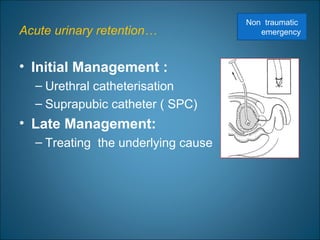
• Initial Management :
– Urethral catheterisation
– Suprapubic catheter ( SPC)
• Late Management:
– Treating the underlying cause
Non traumatic
emergency
Chronic urinary retention
• Obstruction develops slowly, the bladder
is distended (stretched) very gradually
over weeks/months, so pain is not a
feature .
• Presentation:
– Urinary dribbling
– Overflow incontinence
– Palpable lower suprapubic mass
Non traumatic
emergency
Chronic urinary retention…
• Usually associated with
– Reduced renal function.
– Upper tract dilatation
• R/x is directed to renal support.
• Bladder drainage under slow rate to avoid
sudden decompression> hematuria.
• Late R/x of cause.
Non traumatic
emergency
Urological Emergencies
1) Non traumatic
1. Hematuria
2. Renal Colic
3. Urinary Retention
4. Acute Scrotum
5. Priapism
2) Traumatic
1) Renal Trauma
2) Ureteral Injury
3) Bladder Trauma
4) Urethral Injury
5) Testicular Trauma
Acute Scrotum
• Emergency situation requiring prompt
evaluation, differential diagnosis, and
potentially immediate surgical exploration
Non traumatic
emergency
Acute scrotum…
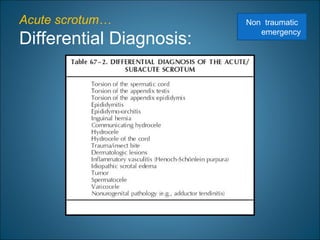
Differential Diagnosis:
Non traumatic
emergency
Acute scrotum…
Differential Diagnosis…
1. Torsion of the Spermatic Cord
(Intravaginal)
– Most serious.
1. Torsion of the Testicular and Epididymal
Appendages.
2. Epididymitis.
– Most common
Non traumatic
emergency
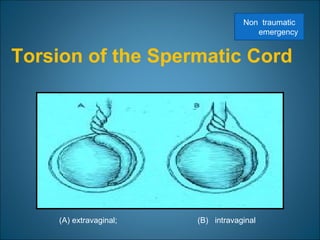
Torsion of the Spermatic Cord
(A) extravaginal; (B) intravaginal
Non traumatic
emergency
Torsion of the Spermatic Cord
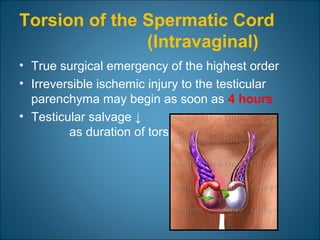
(Intravaginal)
• True surgical emergency of the highest order
• Irreversible ischemic injury to the testicular
parenchyma may begin as soon as 4 hours
• Testicular salvage ↓
as duration of torsion↑
Torsion of the Spermatic Cord…
Presentation:
• Acute onset of scrotal pain.
• Majority with history of prior episodes of
severe, self-limited scrotal pain and swelling.
• N/V
• Referred to the ipsilateral lower quadrant of the
abdomen.
• Dysuria and other bladder symptoms are
usually absent.
Non traumatic
emergency
Torsion of the Spermatic Cord…
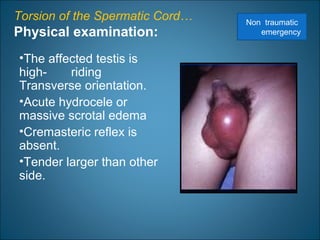
Physical examination:
•The affected testis is
high- riding
Transverse orientation.
•Acute hydrocele or
massive scrotal edema
•Cremasteric reflex is
absent.
•Tender larger than other
side.
Non traumatic
emergency
Torsion of the Spermatic Cord…
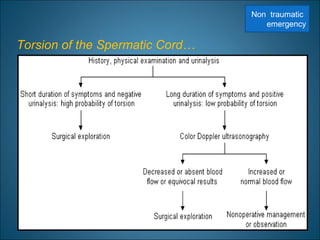
Adjunctive tests:
• To aid in differential diagnosis of the acute
scrotum.
• To confirm the absence of torsion of the
cord.
• Doppler examination of the cord and
testis
– High false-positive and false-negative results
Non traumatic
emergency
Torsion of the Spermatic Cord…
• Color Doppler ultrasound:
– Assessment of anatomy and determining the
presence or absence of blood flow.
– Sensitivity: 88.9% specificity of 98.8%
– Operator dependent.
Torsion of the Spermatic Cord…
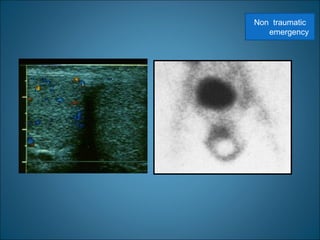
• Radionuclide imaging :
– Assessment of testicular blood flow.
– PPV of 75%, a sensitivity of 90%, and a
specificity of 89%.
– False impression from hyperemia of scrotal
wall.
– Not helpful in Hydrocele and Hematoma
Non traumatic
emergency
Torsion of the Spermatic Cord…
Surgical exploration:
• A median raphe scrotal incision or a transverse
incision.
• The affected side should be examined first
• The cord should be detorsed.
• Testes with marginal viability should be placed in
warm sponges and re-examined after several minutes.
• A necrotic testis should be removed
• If the testis is to be preserved, it should be placed into
the dartos pouch (suture fixation)
• The contralateral testis must be fixed to prevent
subsequent torsion.
Non traumatic
emergency
Torsion of the Spermatic Cord…
Non traumatic
emergency
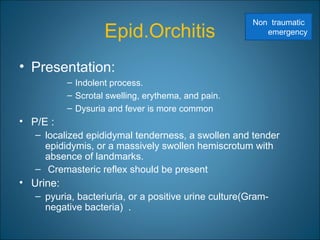
Epid.Orchitis
• Presentation:
– Indolent process.
– Scrotal swelling, erythema, and pain.
– Dysuria and fever is more common
• P/E :
– localized epididymal tenderness, a swollen and tender
epididymis, or a massively swollen hemiscrotum with
absence of landmarks.
– Cremasteric reflex should be present
• Urine:
– pyuria, bacteriuria, or a positive urine culture(Gram-
negative bacteria) .
Non traumatic
emergency
Epid.Orchitis…
• Management:
– Bed rest for 1 to 3 days then relative
restriction .
– Scrotal elevation, the use of an athletic
supporter
– parenteral antibiotic therapy should be
instituted when UTI is documented or
suspected.
– Urethral instrumentation should be avoided
Non traumatic
emergency
Urological Emergencies
1) Non traumatic
1. Hematuria
2. Renal Colic
3. Urinary Retention
4. Acute Scrotum
5. Priapism
2) Traumatic
1) Renal Trauma
2) Ureteral Injury
3) Bladder Trauma
4) Urethral Injury
5) Testicular Trauma
Priapism
• Persistent erection of the penis for more
than 4 hours that is not related or
accompanied by sexual desire.
Non traumatic
emergency
Priapism…
• 2 Types:
– ischaemic (veno-occlusive, low flow (most common)
• Due to haematological disease, malignant infiltration of the
corpora cavernosa with malignant disease, or drugs.
• Painful.
– nonischaemic (arterial, high flow).
• Due to perineal trauma, which creates an arteriovenous
fistula.
• Painless
• Age:
– Any age
– two main age groups affected are 5- to 10-year-old
boys and 20- to 50-year-old men.
Priapism…
• Causes:
– Primary (Idiopathic) : 30%- 50%
– Secondary:
• Drugs
• Trauma
• Neurological
• Hematological disease
• Tumors
• Miscellaneous
Non traumatic
emergency
Priapism…
• The diagnosis
– Usually obvious from the history
• Duration of erection >4 hours?
• Is it painful or not?.
• Previous history and treatment of priapism ?
• Identify any predisposing factors and underlying cause
– Examination
• Erect, tender penis (in low-flow priapism).
• Characteristically the corpora cavernosa are rigid and
the glans is flaccid.
• Abdomen for evidence of malignant disease
• DRE: to examine the prostate and check anal tone.
Non traumatic
emergency
Priapism…
• Investigations:
– CBC (white cell count and differential, reticulocyte
count)
– Hemoglobin electrophoresis for sickle cell test
– Urinalysis including urine toxicology
– Blood gases taken from either corpora,
• low-flow (dark blood; pH <7.25 (acidosis); pO2
<30mmHg (hypoxia); pCO2 >60mmHg (hypercapnia))
• high-flow (bright red blood similar to arterial blood at
room temperature; pH = 7.4; pO2 >90mmHg; pCO2
<40mmHg)
Non traumatic
emergency
Priapism…
– Colour flow duplex ultrasonography in
cavernosal arteries:
• Ischaemic (inflow low or nonexistent)
• Nonischaemic (inflow normal to high).
– Penile pudendal arteriography
Priapism…
• Treatment:
– Depends on the type of priapism.
– Conservative treatment should first be tried
– Medical treatment
– Surgical treatment.
– Treatment of underlying cause
• →→ It is important to warn all patients
with priapism of the possibility of
impotence.
Non traumatic
emergency
Urological Emergencies
1) Non traumatic
1. Hematuria
2. Renal Colic
3. Urinary Retention
4. Acute Scrotum
5. Priapism
2) Traumatic
1) Renal injuries
2) Ureteral injuries
3) Bladder injuries
4) Urethral Injuries
5) Testicular injuries
RENAL INJURIES
• The kidneys relatively protected from
traumatic injuries.
• Considerable degree of force is usually
required to injure a kidney.
Traumatic
emergency
• Mechanisms and cause:
– Blunt
• direct blow or acceleration/ deceleration (road
traffic accidents, falls from a height, fall onto flank)
– Penetrating
• knives, gunshots, iatrogenic, e.g., percutaneous
nephrolithotomy (PCNL)
Renal injuries…
• Indications for renal imaging:
– Macroscopic hematuria
– Penetrating chest, flank, and abdominal wounds
– Microscopic [>5 red blood cells (RBCs) per high
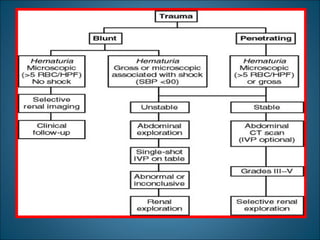
powered field] or dipstick hematuria a
hypotensive patient (SBP <90mmHg )
– A history of a rapid acceleration or deceleration
– Any child with microscopic or dipstick hematuria
who has sustained trauma.
Traumatic
emergency
Renal injuries…
• What Imaging Study?
– IVU:
• replaced by the contrast-enhanced CT scan
• On-table IVU if patient is transferred immediately
to the operating theatre without having had a CT
scan and a retroperitoneal haematoma is found,
– Spiral CT: does not allowaccurate staging
Traumatic
emergency
Renal injuries…
– Renal US:
• Advantages:
– can certainly establish the presence of two kidneys
– the presence of a retroperitoneal hematoma
– power Doppler can identify the presence of blood flow in the
renal vessels.
• Disadvantages:
– cannot accurately identify parenchymal tears, collecting
system injuries, or extravasations of urine until a later stage
when a urine collection has had time to accumulate.
– Contrast-enhanced CT:
• the imaging study of choice
• accurate, rapid, images other intra-abdominal
structures
Traumatic
emergency
Renal injuries…
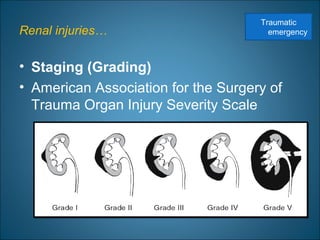
• Staging (Grading)
• American Association for the Surgery of
Trauma Organ Injury Severity Scale
Traumatic
emergency
Renal injuries…
• Management:
– Conservative:
• Over 95% of blunt injuries
• 50% of renal stab injuries and 25% of renal
gunshot wounds (specialized center).
• Include:
– Wide Bore IV line.
– IV antibiotics.
– Bed rest
– serial CBC (Htc)
– F/up US &/or CT.
– 2-3 wks.
Traumatic
emergency
Renal injuries…
• Surgical exploration:
– Persistent bleeding (persistent tachycardia
and/or hypotension failing to respond to
appropriate fluid and blood replacement
– Expanding perirenal haematoma (again the
patient will show signs of continued bleeding)
– Pulsatile perirenal haematoma
Traumatic
emergency
Urological Emergencies
1) Non traumatic
1. Hematuria
2. Renal Colic
3. Urinary Retention
4. Acute Scrotum
5. Priapism
2) Traumatic
1) Renal injuries
2) Ureteral injuries
3) Bladder injuries
4) Urethral Injuries
5) Testicular injuries
URETERIC INJURIES
• The ureters are protected from external
trauma by surrounding bony structures,
muscles and other organs
• Causes and Mechanisms :
– External Trauma
– Internal Trauma
Traumatic
emergency
Ureteric injuries…
• External Trauma:
– Rare
– Severe force is required
– Blunt or penetrating.
– Blunt external trauma severe enough to injure
the ureters will usually be associated with
multiple other injuries
– Knife or bullet wound to the abdomen or chest
may damage the ureter, as well as other
organs.
Traumatic
emergency
Ureteric injuries…
• Internal Trauma
– Uncommon, but is more common than external
trauma
– Surgery:
• Hysterectomy, oophorectomy, and sigmoidcolectomy
• Ureteroscopy
• Caesarean section
• Aortoiliac vascular graft placement,
• Laparoscopic procedures,
• Orthopedic operations
Traumatic
emergency
Ureteric injuries…
• Diagnosis:
– Requires a high index of suspicion
– Intraoperative:
– Late:
• 1. An ileus: the presence of urine within the peritoneal cavity
• 2. Prolonged postoperative fever or overt urinary sepsis
• 3. Persistent drainage of fluid from abdominal or pelvic
drains, from the abdominal wound, or from the vagina.
• 4. Flank pain if the ureter has been ligated
• 5. An abdominal mass, representing a urinoma
• 6. Vague abdominal pain
• 7. The pathology report on the organ that has been removed
may note the presence of a segment of ureter!
Traumatic
emergency
Ureteric injuries…
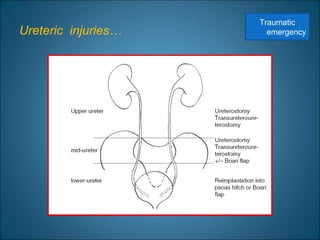
• Treatment options:
– JJ stenting
– Primary closure of partial transection of the ureter
– Direct ureter to ureter anastomosis
– Reimplantation of the ureter into the bladder
(ureteroneocystostomy), either using a psoas hitch or
a Boari flap
– Transureteroureterostomy
– Autotransplantation of the kidney into the pelvis
– Replacement of the ureter with ileum
– Permanent cutaneous ureterostomy
– Nephrectomy
Traumatic
emergency
Ureteric injuries…
Traumatic
emergency
Urological Emergencies
1) Non traumatic
1. Hematuria
2. Renal Colic
3. Urinary Retention
4. Acute Scrotum
5. Priapism
2) Traumatic
1) Renal injuries
2) Ureteral injuries
3) Bladder injuries
4) Urethral Injuries
5) Testicular injuries
BLADDER INJURIES
• Causes:
– Iatrogenic injury
• Transurethral resection of bladder tumour (TURBT)
• Cystoscopic bladder biopsy
• Transurethral resection of prostate (TURP)
• Cystolitholapaxy
• Caesarean section, especially as an emergency
• Total hip replacement (very rare)
– Penetrating trauma to the lower abdomen or back
– Blunt pelvic trauma—in association with pelvic fracture or
‘minor’ trauma in the inebriated patient
– Rapid deceleration injury—seat belt injury with full bladder
in the absence of a pelvic fracture
– Spontaneous rupture after bladder augmentation
Traumatic
emergency
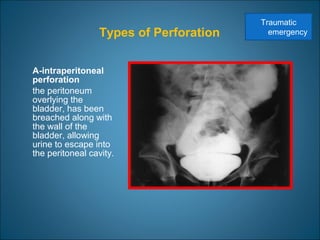
Types of Perforation
A-intraperitoneal
perforation
the peritoneum
overlying the
bladder, has been
breached along with
the wall of the
bladder, allowing
urine to escape into
the peritoneal cavity.
Traumatic
emergency
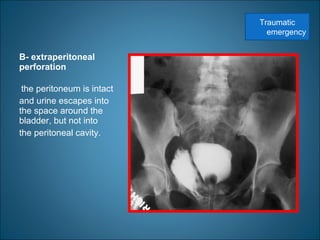
B- extraperitoneal
perforation
the peritoneum is intact
and urine escapes into
the space around the
bladder, but not into
the peritoneal cavity.
Traumatic
emergency
Bladder injuries…
• Presentation:
– Recognized intraoperatively
– The classic triad of symptoms and signs that
are suggestive of a bladder rupture
• suprapubic pain and tenderness, difficulty or
inability in passing urine, and haematuria
Traumatic
emergency
Bladder injuries…
• Management:
– Extraperitoneal
• Bladder drainage +++++
• Open repair +++
– Intra peritoneal :
• open repair…why?
– Unlikely to heal spontaneously.
– Usually large defects.
– Leakage causes peritonitis
– Associated other organ injury.
Traumatic
emergency
Urological Emergencies
1) Non traumatic
1. Hematuria
2. Renal Colic
3. Urinary Retention
4. Acute Scrotum
5. Priapism
2) Traumatic
1) Renal injuries
2) Ureteral injuries
3) Bladder injuries
4) Urethral Injuries
5) Testicular injuries
URETHRAL INJURIES
• ANTERIOR URETHRAL INJURIES
• POSTERIOR URETHRAL INJURIES
Traumatic
emergency
ANTERIOR URETHRAL
INJURIES
• Rare
• Mechanism:
– The majority a result of a straddle injury in
boys or men.
– Direct injuries to the penis
– Penile fractures
– Inflating a catheter balloon in the anterior
urethra
– Penetrating injuries by gunshot wounds.
Ant. Urethral injuries…
• Symptoms and signs:
– Blood at the end of the penis
– Difficulty in passing urine
– Frank hematuria
– Hematoma may around the site of the rupture
– Penile swelling
Traumatic
emergency
Ant. Urethral injuries…
• Diagnosis:
– Retrograde urethrography
• Contusion: no extravasation of contrast:
• Partial rupture : extravasation of contrast, with
contrast also present in the bladder:.
• Complete disruption: no filling of the posterior
urethra or bladder
Traumatic
emergency
Ant. Urethral injuries…
• Management
– Contusion
• A small-gauge urethral catheter for one week
– Partial Rupture of Anterior Urethra
• No urethral catheterization
• Majority can be managed by suprapubic urinary diversion for
one week
• Penetrating partial disruption (e.g., knife, gunshot wound),
primary (immediate) repair.
– Complete Rupture of Anterior Urethra
• patient is unstable a suprapubic catheter.
• patient is stable, the urethra may either be immediately repaired
or a suprapubic catheter
– Penetrating Anterior Urethral Injuries
• generally managed by surgical debridement and repair
Traumatic
emergency
POSTERIOR URETHRAL
INJURIES
• Great majority of posterior urethral injuries
occur in association with pelvic fractures
• 10% to 20% have an associated bladder
rupture
• Signs
– Blood at the meatus, gross hematuria, and
perineal or scrotal bruising.
– High-riding prostate
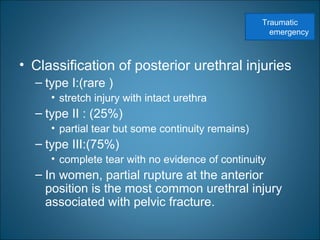
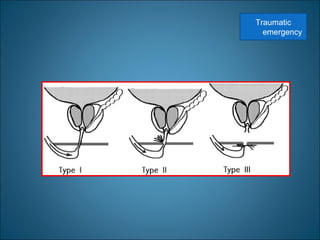
• Classification of posterior urethral injuries
– type I:(rare )
• stretch injury with intact urethra
– type II : (25%)
• partial tear but some continuity remains)
– type III:(75%)
• complete tear with no evidence of continuity
– In women, partial rupture at the anterior
position is the most common urethral injury
associated with pelvic fracture.
Traumatic
emergency
Traumatic
emergency
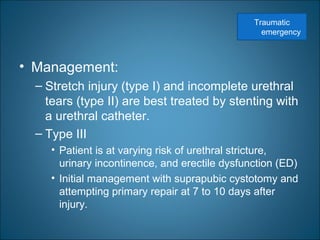
• Management:
– Stretch injury (type I) and incomplete urethral
tears (type II) are best treated by stenting with
a urethral catheter.
– Type III
• Patient is at varying risk of urethral stricture,
urinary incontinence, and erectile dysfunction (ED)
• Initial management with suprapubic cystotomy and
attempting primary repair at 7 to 10 days after
injury.
Traumatic
emergency
Thank you…

3 urological emergency

  • 1.
  • 2.
    • Urologic emergencyarises when a condition require rapid diagnosis and immediate treatment • Compared to other surgical fields there are relatively few emergencies in urology
  • 3.
    Urological Emergencies 1) Nontraumatic 1. Hematuria 2. Renal Colic 3. Urinary Retention 4. Acute Scrotum 5. Priapism 2) Traumatic 1) Renal Trauma 2) Ureteral Injury 3) Bladder Trauma 4) Urethral Injury 5) Testicular Trauma
  • 4.
    Urological Emergencies 1) Nontraumatic 1. Hematuria 2. Renal Colic 3. Urinary Retention 4. Acute Scrotum 5. Priapism 2) Traumatic 1) Renal Trauma 2) Ureteral Injury 3) Bladder Trauma 4) Urethral Injury 5) Testicular Trauma
  • 5.
    Hematuria • Blood inthe urine • Types: – Macroscopic (frank, or gross hematuria)/ Dipstick hematuria for Microscopic hematuria (the presence of > 3 red blood cells per high power microscopic field). – Painless or painful. – Initial / Terminal / Total
  • 6.
    Hematuria… • Causes – Nephrological(medical) or urological (surgical) – Medical causes: • glomerular and nonglomerular • blood dyscrasias, interstitial nephritis, and renovascular disease – Surgical/urological nonglomerular causes: • renal tumours, urothelial tumours (bladder, ureteric, renal collecting system), prostate cancer, bleeding from vascular benign prostatic enlargement, trauma, renal or ureteric stones, and UTI. • Haematuria in these situations is usually characterised by circular erythrocytes and absence of proteinuria and casts. Non traumatic emergency
  • 7.
    Hematuria… • Presentation: – Hematuria –Anemia: bleeding is so heavy (this is rare) – Urine retention or ureteric colic (Clot retention) • Work Up : – History – Examination – Investigation : • Urine culture • Urine cytology • Renal US • Flexible cystoscopy, • IVU or computed tomography (CT) scan in selected groups. – Treat the cause Non traumatic emergency
  • 8.
    Urological Emergencies 1) Nontraumatic 1. Hematuria 2. Renal Colic 3. Urinary Retention 4. Acute Scrotum 5. Priapism 2) Traumatic 1) Renal Trauma 2) Ureteral Injury 3) Bladder Trauma 4) Urethral Injury 5) Testicular Trauma
  • 9.
    ACUTE FLANK PAIN—URETERIC ORRENAL COLIC • The commonest urologic emergency. • One of the commonest causes of the “Acute Abdomen”. • Sudden onset of severe pain in the flank • Most often due to the passage of a stone formed in the kidney, down through the ureter.
  • 10.
    Renal colic…. • Thepain is characteristically : – very sudden onset – colicky in nature – Radiates to the groin as the stone passes into the lower ureter. – May change in location, from the flank to the groin, (the location of pain does not provide a good indication of the position of the stone) – The patient cannot get comfortable, and may roll around in agony. – Associated with nausea / Vomiting – the pain of a ureteric stone as being worse than the pain of labour. Non traumatic emergency
  • 11.
    Renal colic…. • Differentialdiagnoses – Leaking abdominal aortic aneurysms – Pneumonia – Myocardial infarction – Ovarian pathology (e.g., twisted ovarian cyst) – Acute appendicitis – Testicular torsion – Inflammatory bowel disease (Crohn’s, ulcerative colitis) – Diverticulitis – Ectopic pregnancy – Burst peptic ulcer – Bowel obstruction Non traumatic emergency
  • 12.
    Renal colic…. • WorkUp : – History – Examination: patient want to move around, in an attempt to find a comfortable position. – +/- Fever – Pregnancy test – MSU Non traumatic emergency
  • 13.
    Renal colic…. – Radiologicalinvestigation : • KUB / Abdominal US • IVP (was) • Helical CTU – advantages over IVP: » greater specificity (95%) and sensitivity (97%) for diagnosing ureteric stones » Can identify other, non-stone causes of flank pain. » No need for contrast administration. » Faster, taking just a few minutes » the cost of CTU is equivalent to that of IVU • MRI – very accurate way of determining whether or not a stone is present in the ureter – very high cost Non traumatic emergency
  • 14.
    Renal colic…. • AcuteManagement of Ureteric Stones: – Pain relief • NSAIDs • Intramuscular or intravenous injection, by mouth, or per rectum • +/- Opiate analgesics (pethidine or morphine). – ? Hyper hydration – ‘watchful waiting’ with analgesic supplements • 95% of stones measuring 5mm or less pass spontaneously Non traumatic emergency
  • 15.
    Renal colic…. • Indicationsfor Intervention to Relieve Obstruction and/or Remove the Stone: – Pain that fails to respond to analgesics. – Associated fever. – Renal function is impaired because of the stone (solitary kidney obstructed by a stone, bilateral ureteric stones, or preexisting renal impairment ) – Obstruction unrelieved for > 4 weeks – Personal or occupational reasons Non traumatic emergency
  • 16.
    Renal colic…. • Treatmentof the Stone: – Temporary relief of the obstruction: • Insertion of a JJ stent or percutaneous nephrostomy tube. – Definitive treatment of a ureteric stone: • ESWL. • PCNL • Ureteroscopy • Open Surgery: very limited. Non traumatic emergency
  • 17.
    Urological Emergencies 1) Nontraumatic 1. Hematuria 2. Renal Colic 3. Urinary Retention 4. Acute Scrotum 5. Priapism 2) Traumatic 1) Renal Trauma 2) Ureteral Injury 3) Bladder Trauma 4) Urethral Injury 5) Testicular Trauma
  • 18.
    Urinary Retention • AcuteUrinary retention • Chronic Urinary retention Non traumatic emergency
  • 19.
    Acute Urinary retention •Painful inability to void, with relief of pain following drainage of the bladder by catheterization. • Pathophysiology: – Increased urethral resistance, i.e., bladder outlet obstruction (BOO) – Low bladder pressure, i.e., impaired bladder contractility – Interruption of sensory or motor innervations of the bladder Non traumatic emergency
  • 20.
    Acute urinary retention… •Causes : – Men: • Benign prostatic enlargement (BPE) due to BPH • Carcinoma of the prostate • Urethral stricture • Prostatic abscess – Women • Pelvic prolapse (cystocoele, rectocoele, uterine) • Urethral stricture; • Urethral diverticulum; • Post surgery for ‘stress’ incontinence • pelvic masses (e.g., ovarian masses) Non traumatic emergency
  • 21.
    Acute urinary retention… Causes… •Both Sex – Haematuria leading to clot retention – Drugs – Pain – Sacral nerve compression or damage(cauda equina compression ) – Radical pelvic surgery – Pelvic fracture rupturing the urethra – Neurotropic viruses involving the sensory dorsal root ganglia of S2–S4 (herpes simplex or zoster); – Multiple sclerosis – Transverse myelitis – Diabetic cystopathy – Damage to dorsal columns of spinal cord causing loss of bladder sensation (tabes dorsalis, pernicious anaemia). Non traumatic emergency
  • 22.
    Acute urinary retention… •Initial Management : – Urethral catheterisation – Suprapubic catheter ( SPC) • Late Management: – Treating the underlying cause Non traumatic emergency
  • 23.
    Chronic urinary retention •Obstruction develops slowly, the bladder is distended (stretched) very gradually over weeks/months, so pain is not a feature . • Presentation: – Urinary dribbling – Overflow incontinence – Palpable lower suprapubic mass Non traumatic emergency
  • 24.
    Chronic urinary retention… •Usually associated with – Reduced renal function. – Upper tract dilatation • R/x is directed to renal support. • Bladder drainage under slow rate to avoid sudden decompression> hematuria. • Late R/x of cause. Non traumatic emergency
  • 25.
    Urological Emergencies 1) Nontraumatic 1. Hematuria 2. Renal Colic 3. Urinary Retention 4. Acute Scrotum 5. Priapism 2) Traumatic 1) Renal Trauma 2) Ureteral Injury 3) Bladder Trauma 4) Urethral Injury 5) Testicular Trauma
  • 26.
    Acute Scrotum • Emergencysituation requiring prompt evaluation, differential diagnosis, and potentially immediate surgical exploration Non traumatic emergency
  • 27.
  • 28.
    Acute scrotum… Differential Diagnosis… 1.Torsion of the Spermatic Cord (Intravaginal) – Most serious. 1. Torsion of the Testicular and Epididymal Appendages. 2. Epididymitis. – Most common Non traumatic emergency
  • 29.
    Torsion of theSpermatic Cord (A) extravaginal; (B) intravaginal Non traumatic emergency
  • 30.
    Torsion of theSpermatic Cord (Intravaginal) • True surgical emergency of the highest order • Irreversible ischemic injury to the testicular parenchyma may begin as soon as 4 hours • Testicular salvage ↓ as duration of torsion↑
  • 31.
    Torsion of theSpermatic Cord… Presentation: • Acute onset of scrotal pain. • Majority with history of prior episodes of severe, self-limited scrotal pain and swelling. • N/V • Referred to the ipsilateral lower quadrant of the abdomen. • Dysuria and other bladder symptoms are usually absent. Non traumatic emergency
  • 32.
    Torsion of theSpermatic Cord… Physical examination: •The affected testis is high- riding Transverse orientation. •Acute hydrocele or massive scrotal edema •Cremasteric reflex is absent. •Tender larger than other side. Non traumatic emergency
  • 33.
    Torsion of theSpermatic Cord… Adjunctive tests: • To aid in differential diagnosis of the acute scrotum. • To confirm the absence of torsion of the cord. • Doppler examination of the cord and testis – High false-positive and false-negative results Non traumatic emergency
  • 34.
    Torsion of theSpermatic Cord… • Color Doppler ultrasound: – Assessment of anatomy and determining the presence or absence of blood flow. – Sensitivity: 88.9% specificity of 98.8% – Operator dependent.
  • 35.
    Torsion of theSpermatic Cord… • Radionuclide imaging : – Assessment of testicular blood flow. – PPV of 75%, a sensitivity of 90%, and a specificity of 89%. – False impression from hyperemia of scrotal wall. – Not helpful in Hydrocele and Hematoma
  • 36.
  • 37.
    Torsion of theSpermatic Cord… Surgical exploration: • A median raphe scrotal incision or a transverse incision. • The affected side should be examined first • The cord should be detorsed. • Testes with marginal viability should be placed in warm sponges and re-examined after several minutes. • A necrotic testis should be removed • If the testis is to be preserved, it should be placed into the dartos pouch (suture fixation) • The contralateral testis must be fixed to prevent subsequent torsion. Non traumatic emergency
  • 38.
    Torsion of theSpermatic Cord… Non traumatic emergency
  • 39.
    Epid.Orchitis • Presentation: – Indolentprocess. – Scrotal swelling, erythema, and pain. – Dysuria and fever is more common • P/E : – localized epididymal tenderness, a swollen and tender epididymis, or a massively swollen hemiscrotum with absence of landmarks. – Cremasteric reflex should be present • Urine: – pyuria, bacteriuria, or a positive urine culture(Gram- negative bacteria) . Non traumatic emergency
  • 40.
    Epid.Orchitis… • Management: – Bedrest for 1 to 3 days then relative restriction . – Scrotal elevation, the use of an athletic supporter – parenteral antibiotic therapy should be instituted when UTI is documented or suspected. – Urethral instrumentation should be avoided Non traumatic emergency
  • 41.
    Urological Emergencies 1) Nontraumatic 1. Hematuria 2. Renal Colic 3. Urinary Retention 4. Acute Scrotum 5. Priapism 2) Traumatic 1) Renal Trauma 2) Ureteral Injury 3) Bladder Trauma 4) Urethral Injury 5) Testicular Trauma
  • 42.
    Priapism • Persistent erectionof the penis for more than 4 hours that is not related or accompanied by sexual desire. Non traumatic emergency
  • 43.
    Priapism… • 2 Types: –ischaemic (veno-occlusive, low flow (most common) • Due to haematological disease, malignant infiltration of the corpora cavernosa with malignant disease, or drugs. • Painful. – nonischaemic (arterial, high flow). • Due to perineal trauma, which creates an arteriovenous fistula. • Painless • Age: – Any age – two main age groups affected are 5- to 10-year-old boys and 20- to 50-year-old men.
  • 44.
    Priapism… • Causes: – Primary(Idiopathic) : 30%- 50% – Secondary: • Drugs • Trauma • Neurological • Hematological disease • Tumors • Miscellaneous Non traumatic emergency
  • 45.
    Priapism… • The diagnosis –Usually obvious from the history • Duration of erection >4 hours? • Is it painful or not?. • Previous history and treatment of priapism ? • Identify any predisposing factors and underlying cause – Examination • Erect, tender penis (in low-flow priapism). • Characteristically the corpora cavernosa are rigid and the glans is flaccid. • Abdomen for evidence of malignant disease • DRE: to examine the prostate and check anal tone. Non traumatic emergency
  • 46.
    Priapism… • Investigations: – CBC(white cell count and differential, reticulocyte count) – Hemoglobin electrophoresis for sickle cell test – Urinalysis including urine toxicology – Blood gases taken from either corpora, • low-flow (dark blood; pH <7.25 (acidosis); pO2 <30mmHg (hypoxia); pCO2 >60mmHg (hypercapnia)) • high-flow (bright red blood similar to arterial blood at room temperature; pH = 7.4; pO2 >90mmHg; pCO2 <40mmHg) Non traumatic emergency
  • 47.
    Priapism… – Colour flowduplex ultrasonography in cavernosal arteries: • Ischaemic (inflow low or nonexistent) • Nonischaemic (inflow normal to high). – Penile pudendal arteriography
  • 48.
    Priapism… • Treatment: – Dependson the type of priapism. – Conservative treatment should first be tried – Medical treatment – Surgical treatment. – Treatment of underlying cause • →→ It is important to warn all patients with priapism of the possibility of impotence. Non traumatic emergency
  • 49.
    Urological Emergencies 1) Nontraumatic 1. Hematuria 2. Renal Colic 3. Urinary Retention 4. Acute Scrotum 5. Priapism 2) Traumatic 1) Renal injuries 2) Ureteral injuries 3) Bladder injuries 4) Urethral Injuries 5) Testicular injuries
  • 50.
    RENAL INJURIES • Thekidneys relatively protected from traumatic injuries. • Considerable degree of force is usually required to injure a kidney. Traumatic emergency
  • 51.
    • Mechanisms andcause: – Blunt • direct blow or acceleration/ deceleration (road traffic accidents, falls from a height, fall onto flank) – Penetrating • knives, gunshots, iatrogenic, e.g., percutaneous nephrolithotomy (PCNL)
  • 52.
    Renal injuries… • Indicationsfor renal imaging: – Macroscopic hematuria – Penetrating chest, flank, and abdominal wounds – Microscopic [>5 red blood cells (RBCs) per high powered field] or dipstick hematuria a hypotensive patient (SBP <90mmHg ) – A history of a rapid acceleration or deceleration – Any child with microscopic or dipstick hematuria who has sustained trauma. Traumatic emergency
  • 53.
    Renal injuries… • WhatImaging Study? – IVU: • replaced by the contrast-enhanced CT scan • On-table IVU if patient is transferred immediately to the operating theatre without having had a CT scan and a retroperitoneal haematoma is found, – Spiral CT: does not allowaccurate staging Traumatic emergency
  • 54.
    Renal injuries… – RenalUS: • Advantages: – can certainly establish the presence of two kidneys – the presence of a retroperitoneal hematoma – power Doppler can identify the presence of blood flow in the renal vessels. • Disadvantages: – cannot accurately identify parenchymal tears, collecting system injuries, or extravasations of urine until a later stage when a urine collection has had time to accumulate. – Contrast-enhanced CT: • the imaging study of choice • accurate, rapid, images other intra-abdominal structures Traumatic emergency
  • 55.
    Renal injuries… • Staging(Grading) • American Association for the Surgery of Trauma Organ Injury Severity Scale Traumatic emergency
  • 56.
    Renal injuries… • Management: –Conservative: • Over 95% of blunt injuries • 50% of renal stab injuries and 25% of renal gunshot wounds (specialized center). • Include: – Wide Bore IV line. – IV antibiotics. – Bed rest – serial CBC (Htc) – F/up US &/or CT. – 2-3 wks. Traumatic emergency
  • 57.
    Renal injuries… • Surgicalexploration: – Persistent bleeding (persistent tachycardia and/or hypotension failing to respond to appropriate fluid and blood replacement – Expanding perirenal haematoma (again the patient will show signs of continued bleeding) – Pulsatile perirenal haematoma Traumatic emergency
  • 59.
    Urological Emergencies 1) Nontraumatic 1. Hematuria 2. Renal Colic 3. Urinary Retention 4. Acute Scrotum 5. Priapism 2) Traumatic 1) Renal injuries 2) Ureteral injuries 3) Bladder injuries 4) Urethral Injuries 5) Testicular injuries
  • 60.
    URETERIC INJURIES • Theureters are protected from external trauma by surrounding bony structures, muscles and other organs • Causes and Mechanisms : – External Trauma – Internal Trauma Traumatic emergency
  • 61.
    Ureteric injuries… • ExternalTrauma: – Rare – Severe force is required – Blunt or penetrating. – Blunt external trauma severe enough to injure the ureters will usually be associated with multiple other injuries – Knife or bullet wound to the abdomen or chest may damage the ureter, as well as other organs. Traumatic emergency
  • 62.
    Ureteric injuries… • InternalTrauma – Uncommon, but is more common than external trauma – Surgery: • Hysterectomy, oophorectomy, and sigmoidcolectomy • Ureteroscopy • Caesarean section • Aortoiliac vascular graft placement, • Laparoscopic procedures, • Orthopedic operations Traumatic emergency
  • 63.
    Ureteric injuries… • Diagnosis: –Requires a high index of suspicion – Intraoperative: – Late: • 1. An ileus: the presence of urine within the peritoneal cavity • 2. Prolonged postoperative fever or overt urinary sepsis • 3. Persistent drainage of fluid from abdominal or pelvic drains, from the abdominal wound, or from the vagina. • 4. Flank pain if the ureter has been ligated • 5. An abdominal mass, representing a urinoma • 6. Vague abdominal pain • 7. The pathology report on the organ that has been removed may note the presence of a segment of ureter! Traumatic emergency
  • 64.
    Ureteric injuries… • Treatmentoptions: – JJ stenting – Primary closure of partial transection of the ureter – Direct ureter to ureter anastomosis – Reimplantation of the ureter into the bladder (ureteroneocystostomy), either using a psoas hitch or a Boari flap – Transureteroureterostomy – Autotransplantation of the kidney into the pelvis – Replacement of the ureter with ileum – Permanent cutaneous ureterostomy – Nephrectomy Traumatic emergency
  • 65.
  • 66.
    Urological Emergencies 1) Nontraumatic 1. Hematuria 2. Renal Colic 3. Urinary Retention 4. Acute Scrotum 5. Priapism 2) Traumatic 1) Renal injuries 2) Ureteral injuries 3) Bladder injuries 4) Urethral Injuries 5) Testicular injuries
  • 67.
    BLADDER INJURIES • Causes: –Iatrogenic injury • Transurethral resection of bladder tumour (TURBT) • Cystoscopic bladder biopsy • Transurethral resection of prostate (TURP) • Cystolitholapaxy • Caesarean section, especially as an emergency • Total hip replacement (very rare) – Penetrating trauma to the lower abdomen or back – Blunt pelvic trauma—in association with pelvic fracture or ‘minor’ trauma in the inebriated patient – Rapid deceleration injury—seat belt injury with full bladder in the absence of a pelvic fracture – Spontaneous rupture after bladder augmentation Traumatic emergency
  • 68.
    Types of Perforation A-intraperitoneal perforation theperitoneum overlying the bladder, has been breached along with the wall of the bladder, allowing urine to escape into the peritoneal cavity. Traumatic emergency
  • 69.
    B- extraperitoneal perforation the peritoneumis intact and urine escapes into the space around the bladder, but not into the peritoneal cavity. Traumatic emergency
  • 70.
    Bladder injuries… • Presentation: –Recognized intraoperatively – The classic triad of symptoms and signs that are suggestive of a bladder rupture • suprapubic pain and tenderness, difficulty or inability in passing urine, and haematuria Traumatic emergency
  • 71.
    Bladder injuries… • Management: –Extraperitoneal • Bladder drainage +++++ • Open repair +++ – Intra peritoneal : • open repair…why? – Unlikely to heal spontaneously. – Usually large defects. – Leakage causes peritonitis – Associated other organ injury. Traumatic emergency
  • 72.
    Urological Emergencies 1) Nontraumatic 1. Hematuria 2. Renal Colic 3. Urinary Retention 4. Acute Scrotum 5. Priapism 2) Traumatic 1) Renal injuries 2) Ureteral injuries 3) Bladder injuries 4) Urethral Injuries 5) Testicular injuries
  • 73.
    URETHRAL INJURIES • ANTERIORURETHRAL INJURIES • POSTERIOR URETHRAL INJURIES Traumatic emergency
  • 74.
    ANTERIOR URETHRAL INJURIES • Rare •Mechanism: – The majority a result of a straddle injury in boys or men. – Direct injuries to the penis – Penile fractures – Inflating a catheter balloon in the anterior urethra – Penetrating injuries by gunshot wounds.
  • 75.
    Ant. Urethral injuries… •Symptoms and signs: – Blood at the end of the penis – Difficulty in passing urine – Frank hematuria – Hematoma may around the site of the rupture – Penile swelling Traumatic emergency
  • 76.
    Ant. Urethral injuries… •Diagnosis: – Retrograde urethrography • Contusion: no extravasation of contrast: • Partial rupture : extravasation of contrast, with contrast also present in the bladder:. • Complete disruption: no filling of the posterior urethra or bladder Traumatic emergency
  • 77.
    Ant. Urethral injuries… •Management – Contusion • A small-gauge urethral catheter for one week – Partial Rupture of Anterior Urethra • No urethral catheterization • Majority can be managed by suprapubic urinary diversion for one week • Penetrating partial disruption (e.g., knife, gunshot wound), primary (immediate) repair. – Complete Rupture of Anterior Urethra • patient is unstable a suprapubic catheter. • patient is stable, the urethra may either be immediately repaired or a suprapubic catheter – Penetrating Anterior Urethral Injuries • generally managed by surgical debridement and repair Traumatic emergency
  • 78.
    POSTERIOR URETHRAL INJURIES • Greatmajority of posterior urethral injuries occur in association with pelvic fractures • 10% to 20% have an associated bladder rupture • Signs – Blood at the meatus, gross hematuria, and perineal or scrotal bruising. – High-riding prostate
  • 79.
    • Classification ofposterior urethral injuries – type I:(rare ) • stretch injury with intact urethra – type II : (25%) • partial tear but some continuity remains) – type III:(75%) • complete tear with no evidence of continuity – In women, partial rupture at the anterior position is the most common urethral injury associated with pelvic fracture. Traumatic emergency
  • 80.
  • 81.
    • Management: – Stretchinjury (type I) and incomplete urethral tears (type II) are best treated by stenting with a urethral catheter. – Type III • Patient is at varying risk of urethral stricture, urinary incontinence, and erectile dysfunction (ED) • Initial management with suprapubic cystotomy and attempting primary repair at 7 to 10 days after injury. Traumatic emergency
  • 83.

Editor's Notes

  • #21 Fowler’s syndrome (impaired relaxation of external sphincter occurring in premenopausal women, often in association with polycystic ovaries
  • #22 Haematuria leading to clot retention Drugs: anticholinergics, sympathomimetic agents such as ephedrine in nasal decongestants Pain (adrenergic stimulation of the bladder neck) postoperative retention; sacral (S2–S4) nerve compression or damage—so-called cauda equina compression (due to prolapsed L2–L3 disc or L3–L4 intervertebral disc, trauma to the vertebrae, benign or metastatic tumours) radical pelvic surgery damaging the parasympathetic plexus (radical hysterectomy, abdominoperineal resection); pelvic fracture rupturing the urethra (more likely in men than women); neurotropic viruses involving the sensory dorsal root ganglia of S2–S4 (herpes simplex or zoster); multiple sclerosis transverse myelitis diabetic cystopathy Damage to dorsal columns of spinal cord causing loss of bladder sensation (tabes dorsalis, pernicious anaemia).