Definition:
 It is a therapeutic technique that consists in applying
artificial magnetic fields on an affected part of the
human body, controlling intensity and frequency.
 So we expose the affected body’s area to a magnetic
field similar to the Earth’s one (intensity of 0,5 Gauss),
but with artificial magnetic fields we can get higher
levels of frequency and application time.
Biological Effects of Magnetic
Fields:
1. Cellular effects.
2. Effects on Organs and
Systems.
Cellular effects:
1. Enrich the oxygen in the cell.
2. Improve the utilization of oxygen.
3. Increasing the metabolism.
4. Enhance ATP production.
5. Increases energy on the cellular level.
Effects on Organs and Systems:
I. OSSEOUS TROPHIC EFFECT
The magnetic field, due to the piezoelectric property of the bone, makes
better the architectural course of osseous trabeculas in damage zones,
guiding them to the same direction. This means that better osseous
callus is created.
In conclusion, a certain number of exposures to a low frequency magnetic
field provoke the formation of an osseous callus of high-quality in a short
time period.
Magnetic fields:
1. Collagen production increase.
2. Calcium deposit increase.
3. Modification of the osseous architectural process.
4. Stimulation of the hyaluronic acid synthesis.
II. VASCULAR EFFECT
It has been observed that magnetic fields facilitate the
capillary neoformation, the appearance of pericytes in
capillaries, and the opening of precapillary sphincters.
By:
1. There is a vasodilatation in a local level due to arterial
circulation improvement.
2. There is an improvement of the oxygen partial
pressure.
Effects on Organs and Systems:
III. ANALGESIC EFFECT
There is an evident analgesic effect, but the genesis is
still unknown. Hypothesis:
 The production’s increase of oligopeptides that
constitutes the group of endorphins and
encephalins, being this effect at a central and
peripheral level.
Effects on Organs and Systems:
IV. Autonomous Nervous System Effects:
 Increase of chemical mediator levels, as catecholamine
(adrenaline, noradrenalin) or as acetylcholine.
 Depending on the orientation of the nodular ganglion and
vagus nerve in a magnetic field, an increase or inhibition of
the nervous impulse transmission is observed.
 This is due to the orientation produced by the magnetic
field in the ions of the cellular membrane.
How a Magnetic Field is Produced:
1. An electrical current produces an associated
magnetic field.
2. Inside natural magnets is crossed by microscopic
electric currents which cause a magnetic field of
certain intensity and direction due to the structure of
these crystals.
Types of artificial magnets used:
1. Not Stationary (Electro-magnets): work only
when connected to electricity.
 Pulsed: (Pulsed generator connected to a coil 
magnetic field  current flows in tissue).
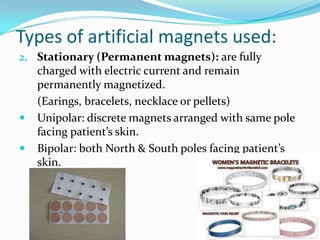
2. Stationary (Permanent magnets): are fully
charged with electric current and remain
permanently magnetized.
(Earings, bracelets, necklace or pellets)
 Unipolar: discrete magnets arranged with same pole
facing patient’s skin.
 Bipolar: both North & South poles facing patient’s
skin.
Types of artificial magnets used:
Application Norms:
1. The patient must NOT introduce metal objects in the solenoid
because they can distort the magnetic field, not for expect an
injurious effect, just for modification of magnetic field parameters.
2. The treatment usually response quickly, but it depends on the
pathology, age, and other conditions of the patient. If after 10
sessions we do not see the patient is advanced along the curative
process, it is better to stop the therapy because it means the patient
is not receptive to the treatment.
3. The therapy time 30 minutes to 2 hours maximum.
4. It is better for the affected zone of the patient to be in direct contact
with solenoid.
5. The sessions must be applied continuously. If it is necessary to
accelerate the recovery’s patient, we could apply two sessions at the
same day but with a separation of 12 hours between them.
6. Electromagnetic fields therapy can be complemented with other
therapies
Basic guidelines
 All treatments should start at lower settings.
 Changes and reactions should be observed to allow
adjustment of treatment settings.
 An increase of pain may occur, which is a positive
indication that the patient is actually responding to
the therapy [reaction phase]
Basic rules
 Increase of pain lower setting
 Less pain stay with setting
 No change in condition go to higher setting
 Head areas & migraine shall never be treated
higher than 1-3mT, 2Hz, 10 min
 Patient with allergies may also require low settings
1-3mT, 2-4Hz, 10-20 min
 Attention must be paid to the patient with sever
circulatory disorders, pain can increase with low
setting due to increased blood flow in peripheral
vessels.
Main applications:
1. Spondylosis.
2. Muscle spasm.
3. Epicondylitis.
4. Sciatica
5. Trigeminal neuralgia.
6. Gout.
7. RA.
8. Recent trauma.
9. Fractures.
10. Trophic ulcers.
11. CRPS.
12. Dupuytren’s contracture.
13. Osteoporosis.
14. Osteomylitis acute &
chronic.
15. Dysmenorrhae &
prostatiosis.
16. Sinusitis.
17. Depression & Migranes.
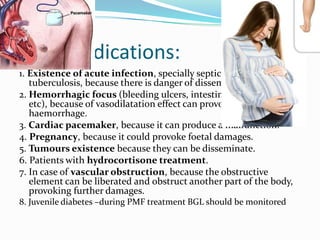
Contraindications:
1. Existence of acute infection, specially septicaemia and
tuberculosis, because there is danger of dissemination.
2. Hemorrhagic focus (bleeding ulcers, intestinal haemorrhages,
etc), because of vasodilatation effect can provoked a
haemorrhage.
3. Cardiac pacemaker, because it can produce a malfunction.
4. Pregnancy, because it could provoke foetal damages.
5. Tumours existence because they can be disseminate.
6. Patients with hydrocortisone treatment.
7. In case of vascular obstruction, because the obstructive
element can be liberated and obstruct another part of the body,
provoking further damages.
8. Juvenile diabetes –during PMF treatment BGL should be monitored

Magnetotherapy

  • 2.
    Definition:  It isa therapeutic technique that consists in applying artificial magnetic fields on an affected part of the human body, controlling intensity and frequency.  So we expose the affected body’s area to a magnetic field similar to the Earth’s one (intensity of 0,5 Gauss), but with artificial magnetic fields we can get higher levels of frequency and application time.
  • 3.
    Biological Effects ofMagnetic Fields: 1. Cellular effects. 2. Effects on Organs and Systems.
  • 4.
    Cellular effects: 1. Enrichthe oxygen in the cell. 2. Improve the utilization of oxygen. 3. Increasing the metabolism. 4. Enhance ATP production. 5. Increases energy on the cellular level.
  • 5.
    Effects on Organsand Systems: I. OSSEOUS TROPHIC EFFECT The magnetic field, due to the piezoelectric property of the bone, makes better the architectural course of osseous trabeculas in damage zones, guiding them to the same direction. This means that better osseous callus is created. In conclusion, a certain number of exposures to a low frequency magnetic field provoke the formation of an osseous callus of high-quality in a short time period. Magnetic fields: 1. Collagen production increase. 2. Calcium deposit increase. 3. Modification of the osseous architectural process. 4. Stimulation of the hyaluronic acid synthesis.
  • 6.
    II. VASCULAR EFFECT Ithas been observed that magnetic fields facilitate the capillary neoformation, the appearance of pericytes in capillaries, and the opening of precapillary sphincters. By: 1. There is a vasodilatation in a local level due to arterial circulation improvement. 2. There is an improvement of the oxygen partial pressure. Effects on Organs and Systems:
  • 7.
    III. ANALGESIC EFFECT Thereis an evident analgesic effect, but the genesis is still unknown. Hypothesis:  The production’s increase of oligopeptides that constitutes the group of endorphins and encephalins, being this effect at a central and peripheral level. Effects on Organs and Systems:
  • 8.
    Effects on Organsand Systems: IV. Autonomous Nervous System Effects:  Increase of chemical mediator levels, as catecholamine (adrenaline, noradrenalin) or as acetylcholine.  Depending on the orientation of the nodular ganglion and vagus nerve in a magnetic field, an increase or inhibition of the nervous impulse transmission is observed.  This is due to the orientation produced by the magnetic field in the ions of the cellular membrane.
  • 9.
    How a MagneticField is Produced: 1. An electrical current produces an associated magnetic field. 2. Inside natural magnets is crossed by microscopic electric currents which cause a magnetic field of certain intensity and direction due to the structure of these crystals.
  • 10.
    Types of artificialmagnets used: 1. Not Stationary (Electro-magnets): work only when connected to electricity.  Pulsed: (Pulsed generator connected to a coil  magnetic field  current flows in tissue).
  • 11.
    2. Stationary (Permanentmagnets): are fully charged with electric current and remain permanently magnetized. (Earings, bracelets, necklace or pellets)  Unipolar: discrete magnets arranged with same pole facing patient’s skin.  Bipolar: both North & South poles facing patient’s skin. Types of artificial magnets used:
  • 12.
    Application Norms: 1. Thepatient must NOT introduce metal objects in the solenoid because they can distort the magnetic field, not for expect an injurious effect, just for modification of magnetic field parameters. 2. The treatment usually response quickly, but it depends on the pathology, age, and other conditions of the patient. If after 10 sessions we do not see the patient is advanced along the curative process, it is better to stop the therapy because it means the patient is not receptive to the treatment. 3. The therapy time 30 minutes to 2 hours maximum. 4. It is better for the affected zone of the patient to be in direct contact with solenoid. 5. The sessions must be applied continuously. If it is necessary to accelerate the recovery’s patient, we could apply two sessions at the same day but with a separation of 12 hours between them. 6. Electromagnetic fields therapy can be complemented with other therapies
  • 13.
    Basic guidelines  Alltreatments should start at lower settings.  Changes and reactions should be observed to allow adjustment of treatment settings.  An increase of pain may occur, which is a positive indication that the patient is actually responding to the therapy [reaction phase]
  • 14.
    Basic rules  Increaseof pain lower setting  Less pain stay with setting  No change in condition go to higher setting  Head areas & migraine shall never be treated higher than 1-3mT, 2Hz, 10 min  Patient with allergies may also require low settings 1-3mT, 2-4Hz, 10-20 min  Attention must be paid to the patient with sever circulatory disorders, pain can increase with low setting due to increased blood flow in peripheral vessels.
  • 15.
    Main applications: 1. Spondylosis. 2.Muscle spasm. 3. Epicondylitis. 4. Sciatica 5. Trigeminal neuralgia. 6. Gout. 7. RA. 8. Recent trauma. 9. Fractures. 10. Trophic ulcers. 11. CRPS. 12. Dupuytren’s contracture. 13. Osteoporosis. 14. Osteomylitis acute & chronic. 15. Dysmenorrhae & prostatiosis. 16. Sinusitis. 17. Depression & Migranes.
  • 16.
    Contraindications: 1. Existence ofacute infection, specially septicaemia and tuberculosis, because there is danger of dissemination. 2. Hemorrhagic focus (bleeding ulcers, intestinal haemorrhages, etc), because of vasodilatation effect can provoked a haemorrhage. 3. Cardiac pacemaker, because it can produce a malfunction. 4. Pregnancy, because it could provoke foetal damages. 5. Tumours existence because they can be disseminate. 6. Patients with hydrocortisone treatment. 7. In case of vascular obstruction, because the obstructive element can be liberated and obstruct another part of the body, provoking further damages. 8. Juvenile diabetes –during PMF treatment BGL should be monitored