Acute Emergencies in Urology
Dr Vijayant Govinda Gupta
MBBS (UCMS)
MS (MAMC)
MCh Urology (PGI Chandigarh)
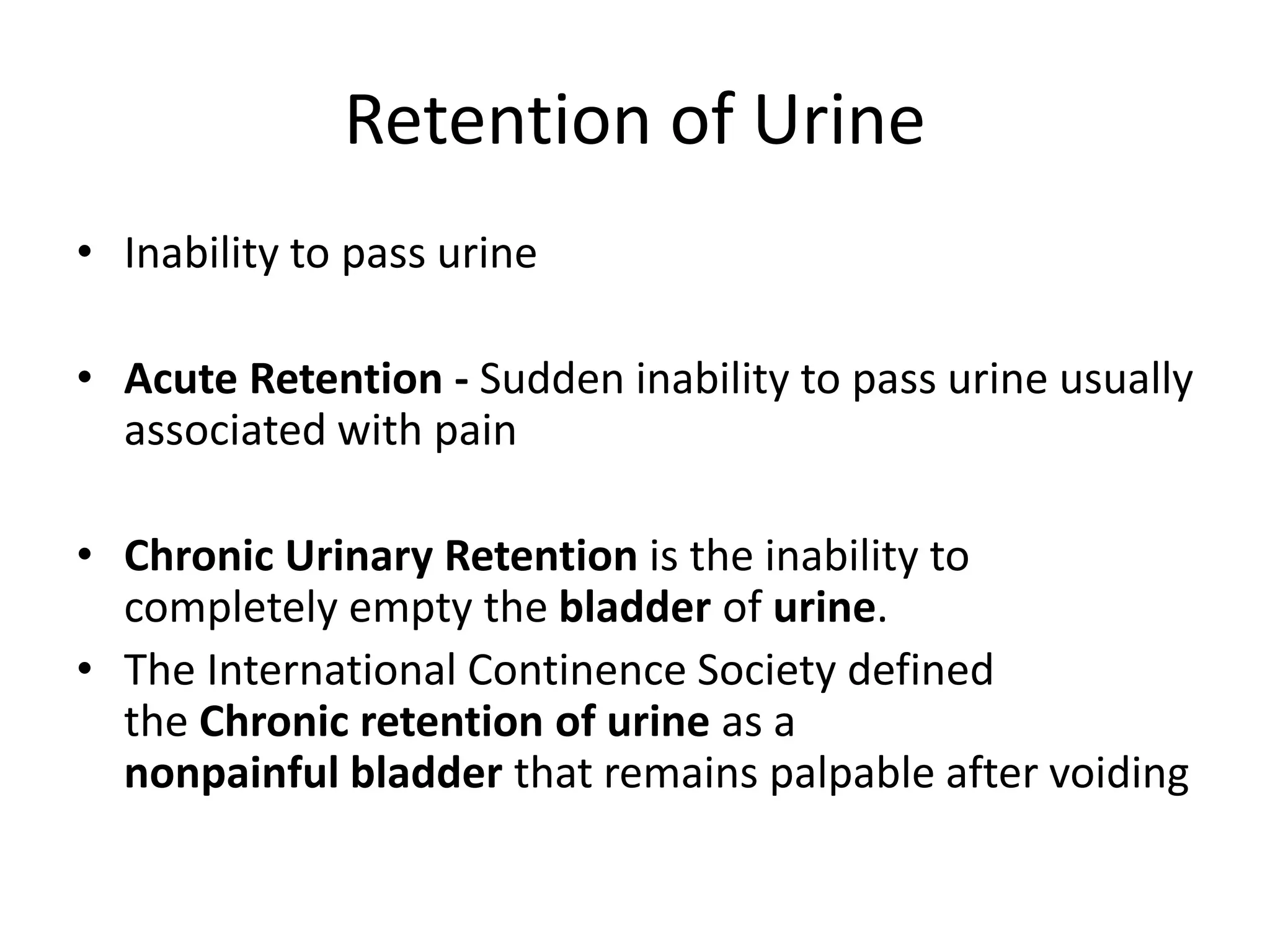
Retention of Urine
• Inability to pass urine
• Acute Retention - Sudden inability to pass urine usually
associated with pain
• Chronic Urinary Retention is the inability to
completely empty the bladder of urine.
• The International Continence Society defined
the Chronic retention of urine as a
nonpainful bladder that remains palpable after voiding
Case Scenario 1
• 65 year old hypertensive
man presented to
emergency department
with inability to pass
urine since last 6 hours.
He is complaining of
severe pain in lower
abdomen and is going to
bathroom again and
again but is not passing
even a drop of urine.
Acute Urinary Retention in Men
• Differential Diagnosis
– Prostate (BPH / Ca Prostate)
– Stone
– Clot Retention
– Severe Acute UTI/ Urethritis
– Urethral Stricture / Trauma / Past Surgery
Relevant Past History
• H/O LUTS – On Urimax since 6 months (AUR on
Treatment – Surgery)
• No H/O overflow incontinence (Acute on Chronic)
• No H/O Surgery (TURP/Urethra), Trauma,
Hematuria (Clot retention), Stone disease
• No Similar Past episode – 2 episodes of AUR
indication for surgery
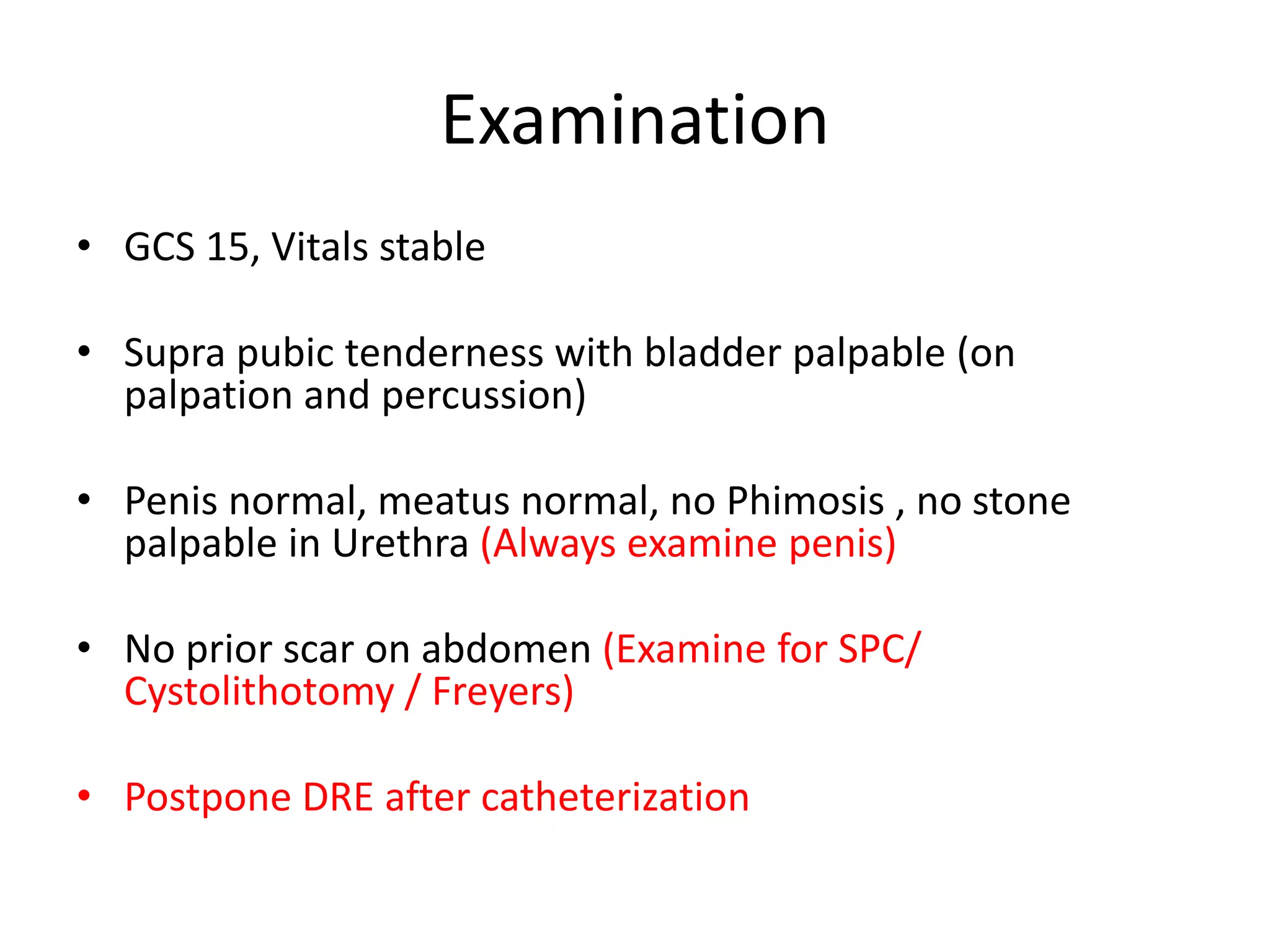
Examination
• GCS 15, Vitals stable
• Supra pubic tenderness with bladder palpable (on
palpation and percussion)
• Penis normal, meatus normal, no Phimosis , no stone
palpable in Urethra (Always examine penis)
• No prior scar on abdomen (Examine for SPC/
Cystolithotomy / Freyers)
• Postpone DRE after catheterization
Investigation
• None required
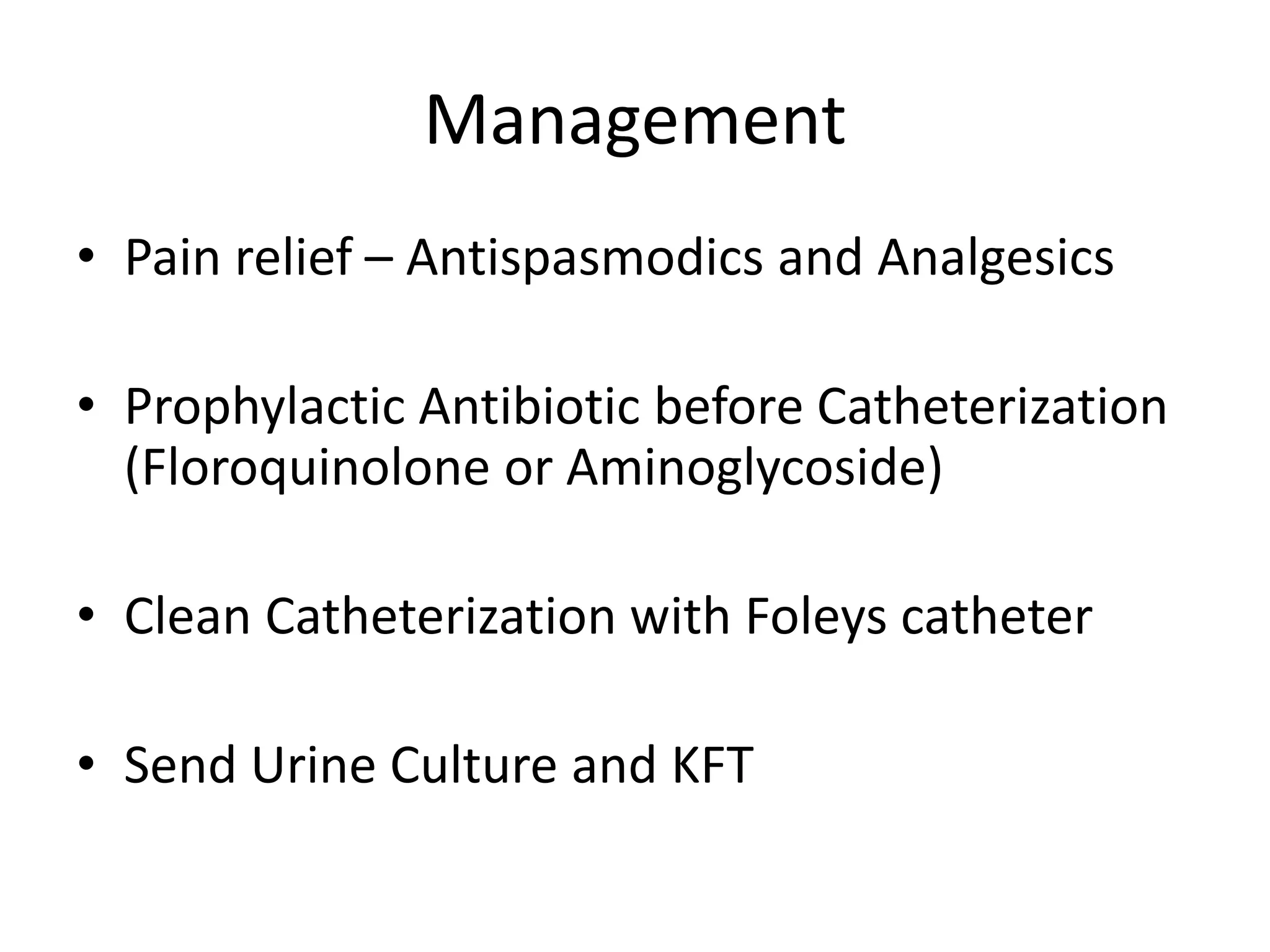
Management
• Pain relief – Antispasmodics and Analgesics
• Prophylactic Antibiotic before Catheterization
(Floroquinolone or Aminoglycoside)
• Clean Catheterization with Foleys catheter
• Send Urine Culture and KFT
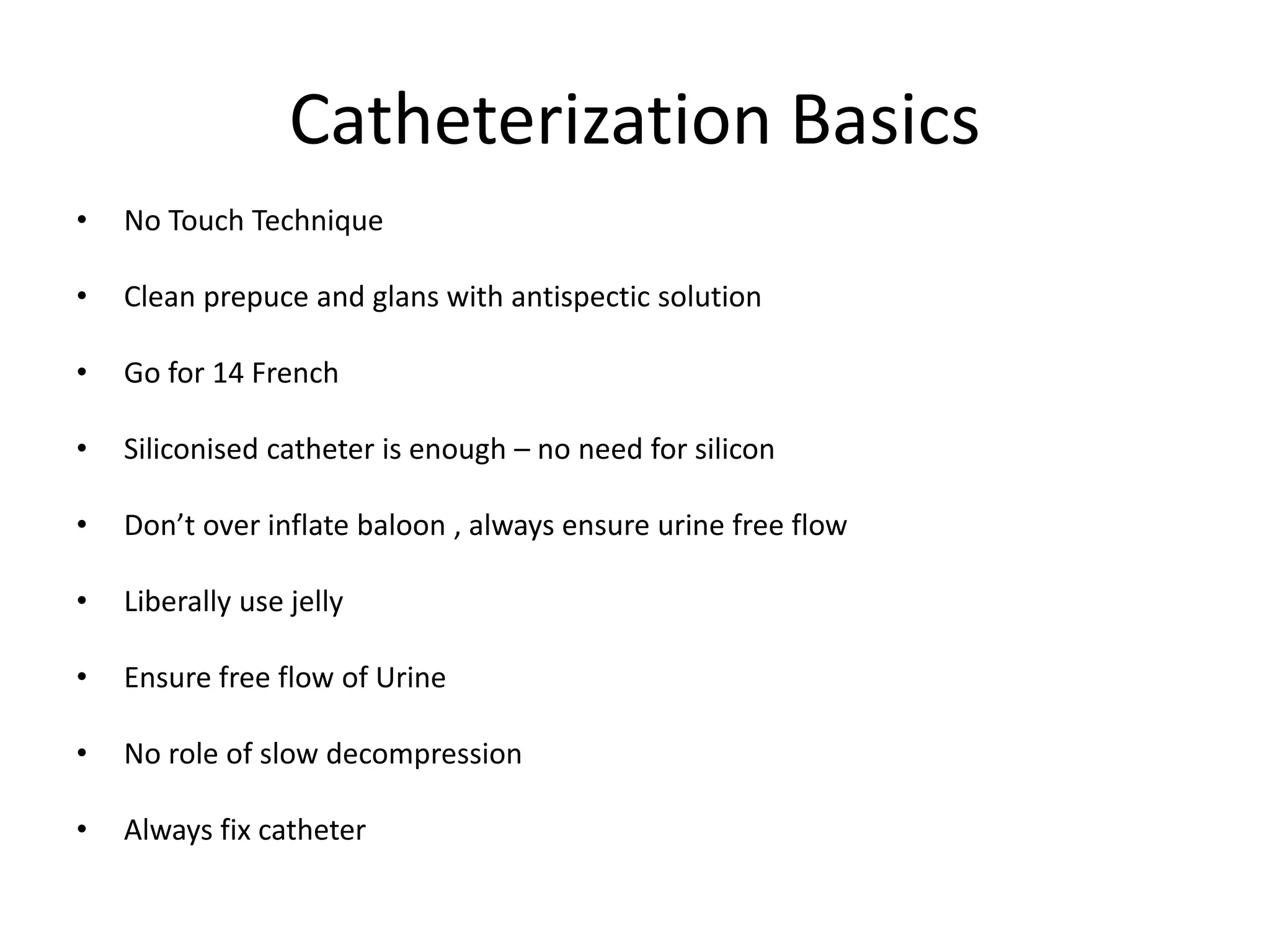
Catheterization Basics
• No Touch Technique
• Clean prepuce and glans with antispectic solution
• Go for 14 French
• Siliconised catheter is enough – no need for silicon
• Don’t over inflate baloon , always ensure urine free flow
• Liberally use jelly
• Ensure free flow of Urine
• No role of slow decompression
• Always fix catheter
Digital Rectal Examination
• Before leaving do a DRE
• See for any Prostate Abscess/ Tenderness or
Hard Prostate
• No role of PSA in AUR – False elevation. PSA
after 3 to 4 days of catheterisation.
Management
• Admit or discharge patient with instructions to
follow up
• One trial of voiding after 3 to 7 days of alpha
blockers can be tried
• If AUR on Medication or recurrent episodes –
work up for TURP / HOLEP
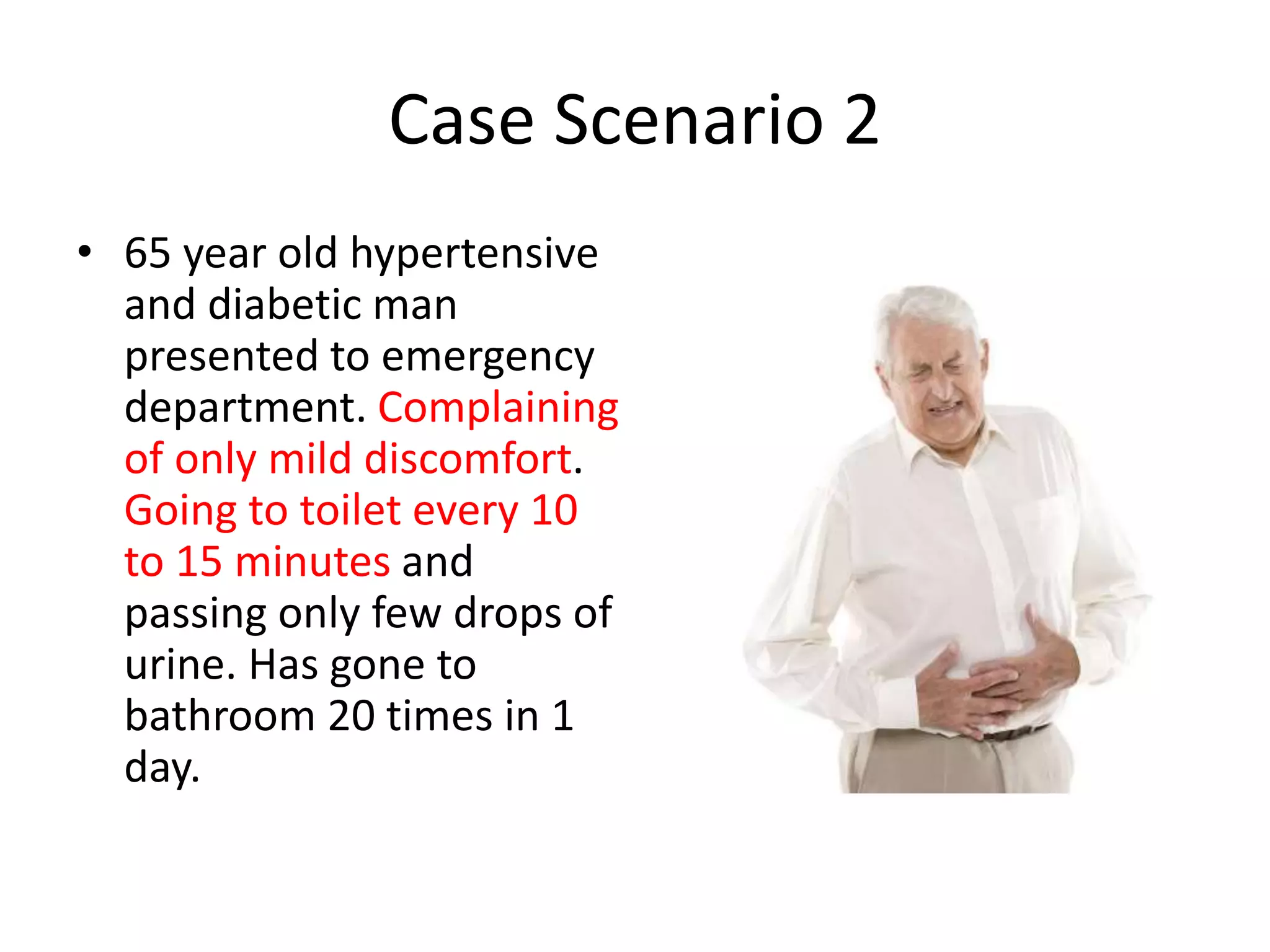
Case Scenario 2
• 65 year old hypertensive
and diabetic man
presented to emergency
department. Complaining
of only mild discomfort.
Going to toilet every 10
to 15 minutes and
passing only few drops of
urine. Has gone to
bathroom 20 times in 1
day.
Chronic Urinary Retention in Men
• Differential Diagnosis
– Prostate (BPH / Ca Prostate)
– Neurogenic Bladder
– Diabetic Cystopathy
Relevant Past History
• H/O LUTS – On Urimax since 6 months.
• Old Ultrasounds show increasing PVR
• H/O overflow incontinence
• No H/O Surgery (TURP/Urethra), Trauma,
Hematuria (Clot retention), Stone disease
• History of multiple AUR in the past –
Decompensated bladder
Examination
• GCS 15, Vitals stable
• No Supra pubic tenderness with bladder palpable (on
palpation and percussion)
• Penis normal, meatus normal, no Phimosis , no stone
palpable in Urethra (Always examine penis)
• No prior scar on abdomen (Examine for SPC/
Cystolithotomy / Freyers)
• DRE may be done
Investigation
• None required
Emergency Management
• No requirement of Pain relief
• Prophylactic Antibiotic before Catheterization
(Floroquinolone or Aminoglycoside)
• Clean Catheterization with Foleys catheter
• Watch for Hematuria – Retention volume may be
more than a litre
Management
• Admit or discharge patient with instructions to
follow up
• No benefit of trial of voiding
• Candidates for surgery – higher chances of
failure of symptoms if NGB/Cystopathy
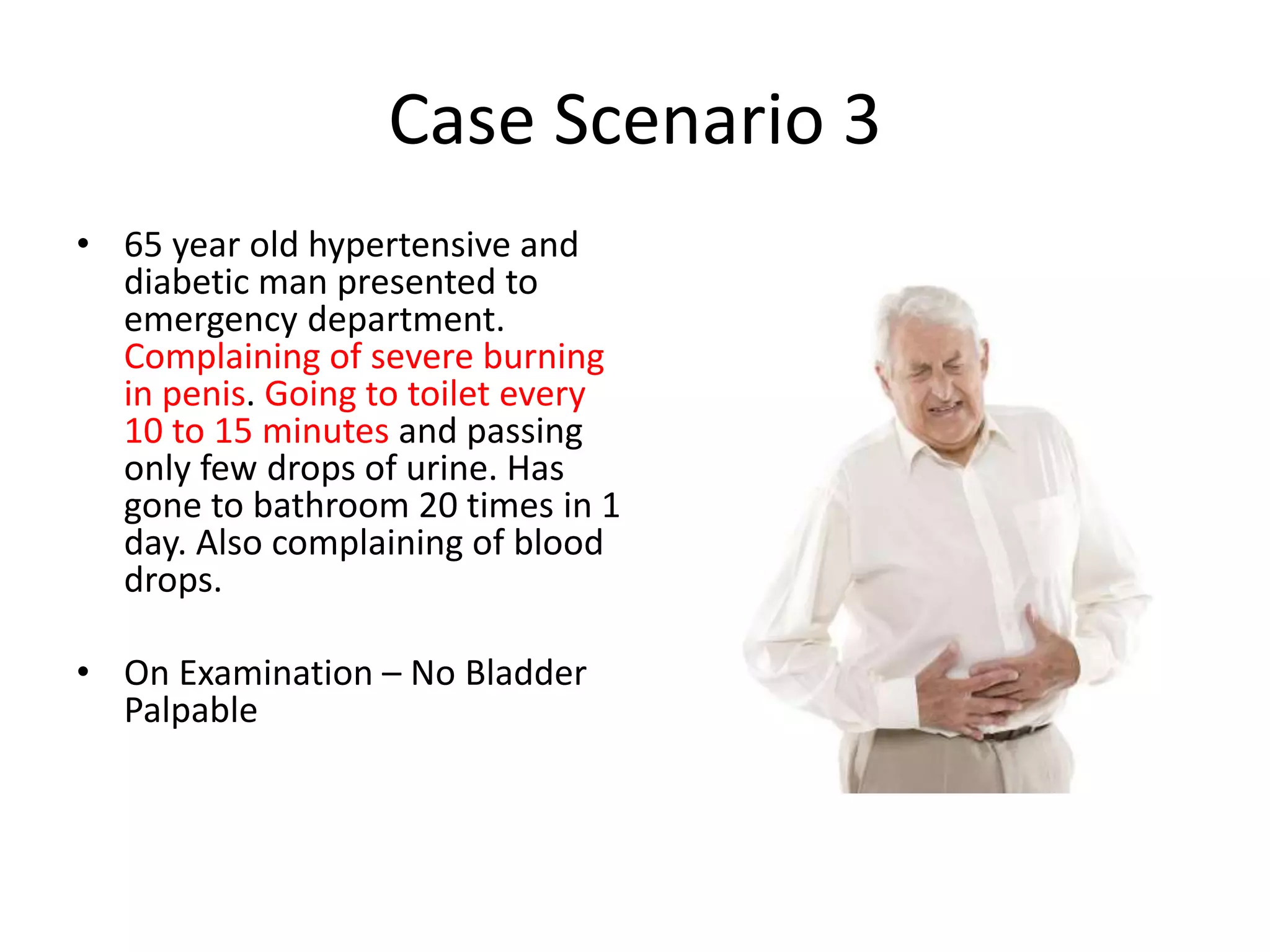
Case Scenario 3
• 65 year old hypertensive and
diabetic man presented to
emergency department.
Complaining of severe burning
in penis. Going to toilet every
10 to 15 minutes and passing
only few drops of urine. Has
gone to bathroom 20 times in 1
day. Also complaining of blood
drops.
• On Examination – No Bladder
Palpable
Acute UTI
• Differential Diagnosis
– Prostatitis / Abscess
– Urethritis/ Cystitis / Stricture
– Stone in Bladder/ Strangury
– Clot/Mass in UB
– UTI in CKD (Anuria)
Examination
• GCS 15, Vitals stable
• No Supra pubic tenderness no bladder palpable (on
palpation and percussion)
• Penis normal, meatus normal, no Phimosis , no stone
palpable in Urethra (Always examine penis)
• Prior scar on abdomen of SPC (Past history of Stricture and
OIU
• DRE Tender
Investigation
• Order Ultrasound
– Bladder wall, Thickness, Mass, Stone
– Stone may be seen in prostatic fossa , VUJ
• Urine Routine – Full Field Pus Cells
• KFT – may be deranged
Emergency Management
• No emergent role of catheterization
• Start
– Analgesics
– Antibiotics
– Antispasmodics
– Fluid management
– Alpha Blockers
• Treat Pathology
– CLT if Stone
– OIU and placement of catheter if stricture
Management
• If Prostatitis and more than 2 episodes a year,
may benefit from surgery
Renal Stones
• Stones in the kidneys can present in many
ways
– Pain
• Colic – Loin to Groin
• Constant Discomfort – Stretch Pain
– Fever – Pyelonephritis / Pyonephrosis
– Uremia – Obstructive Uropathy
– Hematuria
– Cystitis/ Strangury/Retention
Case Scenario 4
• 18 year old female
presented to Emergency
with pain in Right Iliac
Fossa for few hours.
• Pain is colicky in nature
and radiating to the
urethra. Vomited gastric
contents twice after pain
onset.
• Passed a few drops of
blood with urine.
Differential Diagnosis
• Ureteric Colic
• Appendicitis
• Salpingitis
• Ovulation pain
• Dysmenorrhea
• Typhoid/Colitis
• UTI
Relevant History
• Past History of Stones
• No history of Fever
• No Diarrhea/ altered bowel habits
• LMP
• History of sexual intercourse
Examination
• In ureteric colic abdomen rarely has signs
• Maybe some tenderness but usually no rebound
• No features of peritonitis
• Flank tenderness may be present if pyonephrosis
/ pyelonephritis
Emergency management
• Stabilize patient
– Start fluids
– Analgesics, Antibiotics and PPI
Investigation
• Ultrasound is the Initial Investigation of Choice in
the acute emergency setting
• Full Bladder if possible
• Can rule out appendicitis
• Indirect signs like fullness of PCS, HDUN
• Stone may also be visualised
Adjunct findings
• Urine routine may show some RBS’s
• TLC is rarely elevated
NCCT KUB
• Investigation of Choice for Ureteric Calculi
once USG is done
• Size, Shape, Location, Number, Kidney Status
Surgery
1. Infected obstructed kidney = surgical emergency
2. Pain uncontrolled despite PR NSAIDS
3. Stone clearly too large to pass > 7mm
4. CKD
5. Solitary kidney – risk obstructive uropathy
Case Scenario 5
• 18 year old male
presented to
Emergency with
anorexia, lethargy and
nausea. No pain
• History of pain in flank
and past history of
renal stones
• Has not passed urine
for 3 days
Differential Diagnosis
• Obstructive Uropathy
• ESRD
Investigation
• Ultrasound – Bilateral HDUN, UB Empty
• Creatinine 7.5
• Hyponatremia and Hyperkalemia
• ABG reveals acidosis
NCCT KUB
• Investigation of Choice for Obstructive
Uropathy
• Bilateral VUJ Calculi
Emergency management
• Nephrology review
• Consider for Emergency Dialysis to correct
electrolyte abnormalities and acidosis
• Cystoscopy plus URS plus Bilateral DJ Stenting
– Do minimum and rapidly
– CKD predisposes to bleeding
– Poor vision and ureteric edema
Post Obstructive Diuresis
Once Obstruction is relieved patient may go into
Diuresis
• Watch for Urine Output
• Replace 2/3rd output with half saline
• Monitor Electrolytes 6 hourly in first 48 hours
• Monitor decline in creatinine
• Adequate nutrition
• Maintain dialysis access, may require one or two
more sessions if obstruction long standing
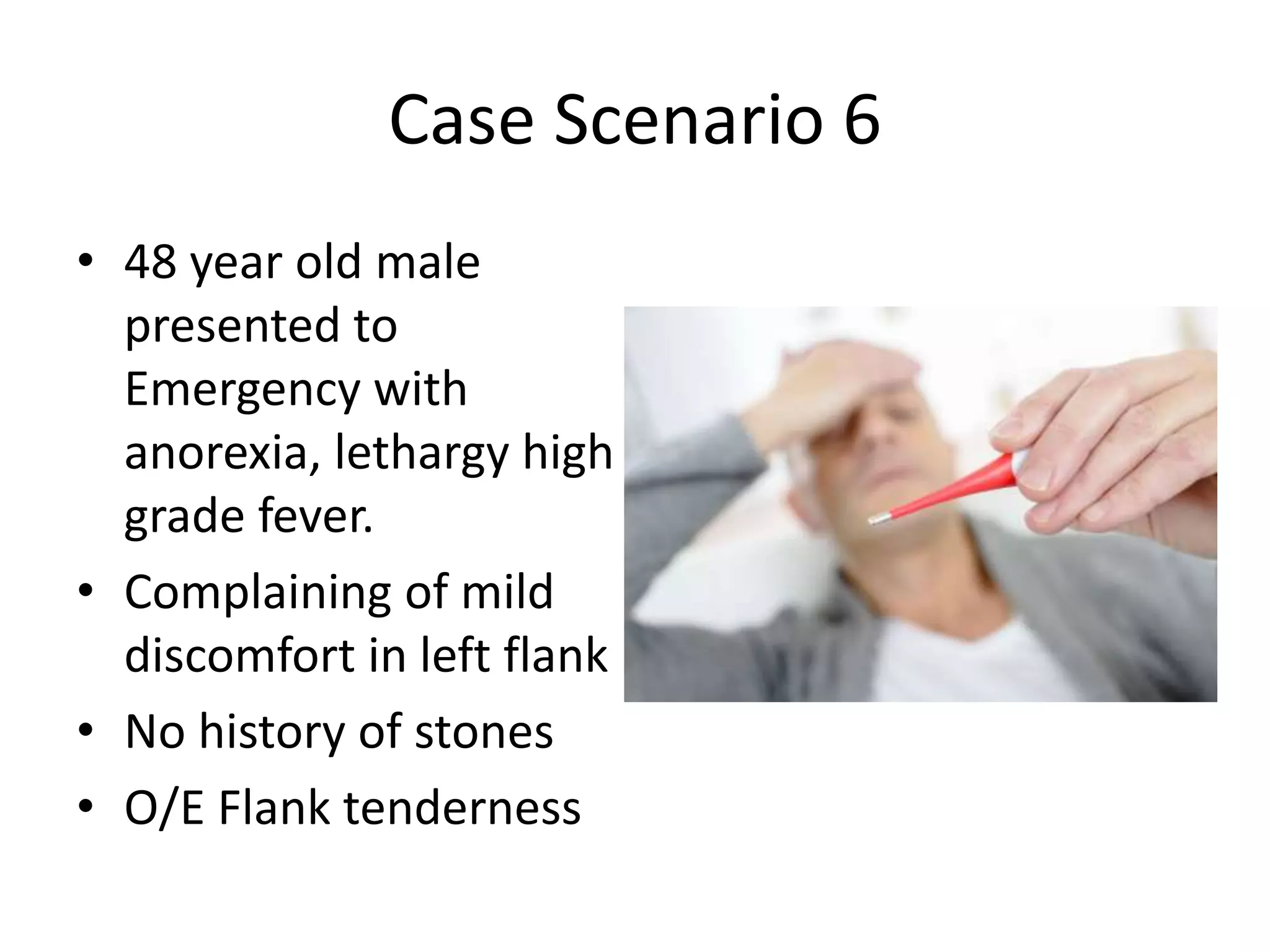
Case Scenario 6
• 48 year old male
presented to
Emergency with
anorexia, lethargy high
grade fever.
• Complaining of mild
discomfort in left flank
• No history of stones
• O/E Flank tenderness
Differential Diagnosis
• Pyelonephritis – Infection of renal
parenchyma
• Pyonephrosis – Pus collection in PCS
Investigation
• Ultrasound – Left Hydronephrosis with
Multiple stones and Internal Echoes
• Creatinine 1.5, Uncontrolled Diabetes
• Urine Routine reveals Pus Cells
CECT KUB
• If Creatinine allows a CECT is better
• Can provide date in evolving abscesses,
parenchyma enhancement, XGPN, Parenchym
function, fistula, lymph nodes etc
Emergency management
• Internal Drainage vs External Drainage
• Both are comparable
• PCN
– Giant hydronephrosis
– Thick Pus
– Air in system
– Solitary Kidney
– Too Sick to move to OT
– Internal Drainage fails
• DJ Stent
Preferable in times of endourology
Comparable outcomes
Hematuria
• Blood in urine in called hematuria
• Visible blood is Gross Hematuria
• Microscopic Hematuria is not always
pathological
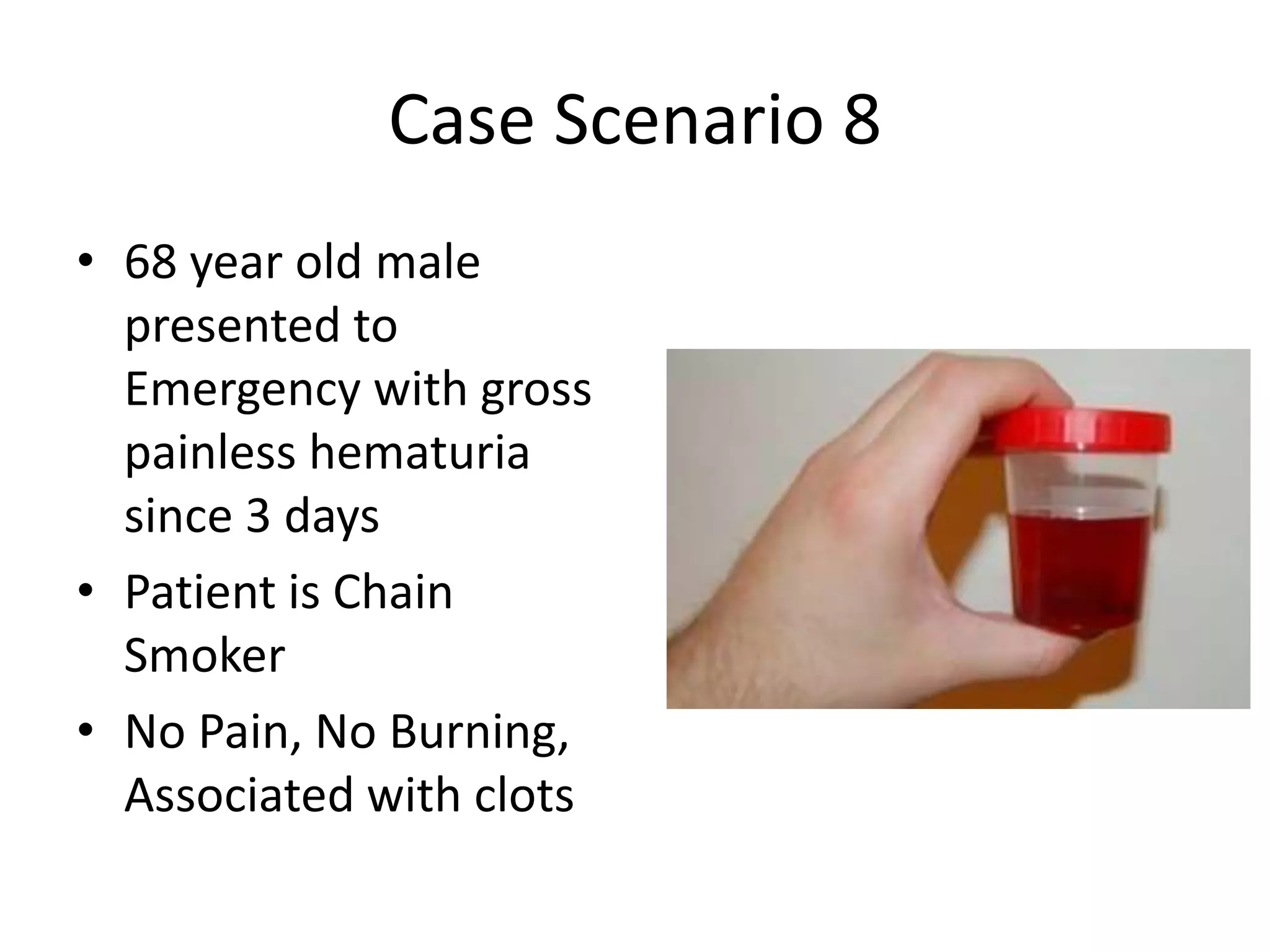
Case Scenario 8
• 68 year old male
presented to
Emergency with gross
painless hematuria
since 3 days
• Patient is Chain
Smoker
• No Pain, No Burning,
Associated with clots
Differential Diagnosis
• Ca UB / Upper Tract TCC
• Coagulopathy
• Prostatic Bleed (Prostatic Piles)
• Pain/Dysuria
– UTI
– Trauma
– Stones
– Renal Origin Bleed
Relevant History
• Pain – Flank or Suprapubic
•
• Any history of Anticoagulation
• Dysuria / Stones ??
Examination
• Check for GCS / Hypotension / Tachycardia
• Check for bladder – Clot retention
Emergency management
• Stabilize patient
– Start fluids
– Analgesics, Antibiotics and PPI
• To catheterize and start irrigation
– Not in every case
– If hemodynamics stable, no clot retention, passing
urine then can wait till investigation is over
Investigation
• Ultrasound is the Initial Investigation of Choice
in the acute emergency setting
• Full Bladder – Will demonstrate mass and
clots
• Always evaluate upper tracts
• A CECT is always required in Hematuria
Management
• Cystoscopy with clot evacuation plus minus
TURBT always
• Sessile lesions common, also helps evaluate
the prostate
• If no mass always wait for ureteric efflux –
may show hematuria – then ureteroscopy
• Cystoscopy may be delayed in suspected cases
of coagulopathy where USG and CT are
normal
• If recurrent hematuria even after tapering
anticoagulants consider cystoscopy
Many More – Limited Time
• Acute Scrotum
– Epidydmoorchitis
– Torsion
– Trauma
• Urological Trauma
• Urethral Stricture and Pelvic Fracture
• Penile Fracture
Acute Emergencies in Urology - Case Scenario

Acute Emergencies in Urology - Case Scenario

  • 1.
    Acute Emergencies inUrology Dr Vijayant Govinda Gupta MBBS (UCMS) MS (MAMC) MCh Urology (PGI Chandigarh)
  • 2.
    Retention of Urine •Inability to pass urine • Acute Retention - Sudden inability to pass urine usually associated with pain • Chronic Urinary Retention is the inability to completely empty the bladder of urine. • The International Continence Society defined the Chronic retention of urine as a nonpainful bladder that remains palpable after voiding
  • 3.
    Case Scenario 1 •65 year old hypertensive man presented to emergency department with inability to pass urine since last 6 hours. He is complaining of severe pain in lower abdomen and is going to bathroom again and again but is not passing even a drop of urine.
  • 4.
    Acute Urinary Retentionin Men • Differential Diagnosis – Prostate (BPH / Ca Prostate) – Stone – Clot Retention – Severe Acute UTI/ Urethritis – Urethral Stricture / Trauma / Past Surgery
  • 5.
    Relevant Past History •H/O LUTS – On Urimax since 6 months (AUR on Treatment – Surgery) • No H/O overflow incontinence (Acute on Chronic) • No H/O Surgery (TURP/Urethra), Trauma, Hematuria (Clot retention), Stone disease • No Similar Past episode – 2 episodes of AUR indication for surgery
  • 6.
    Examination • GCS 15,Vitals stable • Supra pubic tenderness with bladder palpable (on palpation and percussion) • Penis normal, meatus normal, no Phimosis , no stone palpable in Urethra (Always examine penis) • No prior scar on abdomen (Examine for SPC/ Cystolithotomy / Freyers) • Postpone DRE after catheterization
  • 7.
  • 8.
    Management • Pain relief– Antispasmodics and Analgesics • Prophylactic Antibiotic before Catheterization (Floroquinolone or Aminoglycoside) • Clean Catheterization with Foleys catheter • Send Urine Culture and KFT
  • 9.
    Catheterization Basics • NoTouch Technique • Clean prepuce and glans with antispectic solution • Go for 14 French • Siliconised catheter is enough – no need for silicon • Don’t over inflate baloon , always ensure urine free flow • Liberally use jelly • Ensure free flow of Urine • No role of slow decompression • Always fix catheter
  • 10.
    Digital Rectal Examination •Before leaving do a DRE • See for any Prostate Abscess/ Tenderness or Hard Prostate • No role of PSA in AUR – False elevation. PSA after 3 to 4 days of catheterisation.
  • 11.
    Management • Admit ordischarge patient with instructions to follow up • One trial of voiding after 3 to 7 days of alpha blockers can be tried • If AUR on Medication or recurrent episodes – work up for TURP / HOLEP
  • 12.
    Case Scenario 2 •65 year old hypertensive and diabetic man presented to emergency department. Complaining of only mild discomfort. Going to toilet every 10 to 15 minutes and passing only few drops of urine. Has gone to bathroom 20 times in 1 day.
  • 13.
    Chronic Urinary Retentionin Men • Differential Diagnosis – Prostate (BPH / Ca Prostate) – Neurogenic Bladder – Diabetic Cystopathy
  • 14.
    Relevant Past History •H/O LUTS – On Urimax since 6 months. • Old Ultrasounds show increasing PVR • H/O overflow incontinence • No H/O Surgery (TURP/Urethra), Trauma, Hematuria (Clot retention), Stone disease • History of multiple AUR in the past – Decompensated bladder
  • 15.
    Examination • GCS 15,Vitals stable • No Supra pubic tenderness with bladder palpable (on palpation and percussion) • Penis normal, meatus normal, no Phimosis , no stone palpable in Urethra (Always examine penis) • No prior scar on abdomen (Examine for SPC/ Cystolithotomy / Freyers) • DRE may be done
  • 16.
  • 17.
    Emergency Management • Norequirement of Pain relief • Prophylactic Antibiotic before Catheterization (Floroquinolone or Aminoglycoside) • Clean Catheterization with Foleys catheter • Watch for Hematuria – Retention volume may be more than a litre
  • 18.
    Management • Admit ordischarge patient with instructions to follow up • No benefit of trial of voiding • Candidates for surgery – higher chances of failure of symptoms if NGB/Cystopathy
  • 19.
    Case Scenario 3 •65 year old hypertensive and diabetic man presented to emergency department. Complaining of severe burning in penis. Going to toilet every 10 to 15 minutes and passing only few drops of urine. Has gone to bathroom 20 times in 1 day. Also complaining of blood drops. • On Examination – No Bladder Palpable
  • 20.
    Acute UTI • DifferentialDiagnosis – Prostatitis / Abscess – Urethritis/ Cystitis / Stricture – Stone in Bladder/ Strangury – Clot/Mass in UB – UTI in CKD (Anuria)
  • 21.
    Examination • GCS 15,Vitals stable • No Supra pubic tenderness no bladder palpable (on palpation and percussion) • Penis normal, meatus normal, no Phimosis , no stone palpable in Urethra (Always examine penis) • Prior scar on abdomen of SPC (Past history of Stricture and OIU • DRE Tender
  • 22.
    Investigation • Order Ultrasound –Bladder wall, Thickness, Mass, Stone – Stone may be seen in prostatic fossa , VUJ • Urine Routine – Full Field Pus Cells • KFT – may be deranged
  • 23.
    Emergency Management • Noemergent role of catheterization • Start – Analgesics – Antibiotics – Antispasmodics – Fluid management – Alpha Blockers • Treat Pathology – CLT if Stone – OIU and placement of catheter if stricture
  • 24.
    Management • If Prostatitisand more than 2 episodes a year, may benefit from surgery
  • 25.
    Renal Stones • Stonesin the kidneys can present in many ways – Pain • Colic – Loin to Groin • Constant Discomfort – Stretch Pain – Fever – Pyelonephritis / Pyonephrosis – Uremia – Obstructive Uropathy – Hematuria – Cystitis/ Strangury/Retention
  • 26.
    Case Scenario 4 •18 year old female presented to Emergency with pain in Right Iliac Fossa for few hours. • Pain is colicky in nature and radiating to the urethra. Vomited gastric contents twice after pain onset. • Passed a few drops of blood with urine.
  • 27.
    Differential Diagnosis • UretericColic • Appendicitis • Salpingitis • Ovulation pain • Dysmenorrhea • Typhoid/Colitis • UTI
  • 28.
    Relevant History • PastHistory of Stones • No history of Fever • No Diarrhea/ altered bowel habits • LMP • History of sexual intercourse
  • 29.
    Examination • In uretericcolic abdomen rarely has signs • Maybe some tenderness but usually no rebound • No features of peritonitis • Flank tenderness may be present if pyonephrosis / pyelonephritis
  • 30.
    Emergency management • Stabilizepatient – Start fluids – Analgesics, Antibiotics and PPI
  • 31.
    Investigation • Ultrasound isthe Initial Investigation of Choice in the acute emergency setting • Full Bladder if possible • Can rule out appendicitis • Indirect signs like fullness of PCS, HDUN • Stone may also be visualised
  • 32.
    Adjunct findings • Urineroutine may show some RBS’s • TLC is rarely elevated
  • 33.
    NCCT KUB • Investigationof Choice for Ureteric Calculi once USG is done • Size, Shape, Location, Number, Kidney Status
  • 34.
    Surgery 1. Infected obstructedkidney = surgical emergency 2. Pain uncontrolled despite PR NSAIDS 3. Stone clearly too large to pass > 7mm 4. CKD 5. Solitary kidney – risk obstructive uropathy
  • 35.
    Case Scenario 5 •18 year old male presented to Emergency with anorexia, lethargy and nausea. No pain • History of pain in flank and past history of renal stones • Has not passed urine for 3 days
  • 36.
  • 37.
    Investigation • Ultrasound –Bilateral HDUN, UB Empty • Creatinine 7.5 • Hyponatremia and Hyperkalemia • ABG reveals acidosis
  • 38.
    NCCT KUB • Investigationof Choice for Obstructive Uropathy • Bilateral VUJ Calculi
  • 39.
    Emergency management • Nephrologyreview • Consider for Emergency Dialysis to correct electrolyte abnormalities and acidosis • Cystoscopy plus URS plus Bilateral DJ Stenting – Do minimum and rapidly – CKD predisposes to bleeding – Poor vision and ureteric edema
  • 40.
    Post Obstructive Diuresis OnceObstruction is relieved patient may go into Diuresis • Watch for Urine Output • Replace 2/3rd output with half saline • Monitor Electrolytes 6 hourly in first 48 hours • Monitor decline in creatinine • Adequate nutrition • Maintain dialysis access, may require one or two more sessions if obstruction long standing
  • 41.
    Case Scenario 6 •48 year old male presented to Emergency with anorexia, lethargy high grade fever. • Complaining of mild discomfort in left flank • No history of stones • O/E Flank tenderness
  • 42.
    Differential Diagnosis • Pyelonephritis– Infection of renal parenchyma • Pyonephrosis – Pus collection in PCS
  • 43.
    Investigation • Ultrasound –Left Hydronephrosis with Multiple stones and Internal Echoes • Creatinine 1.5, Uncontrolled Diabetes • Urine Routine reveals Pus Cells
  • 44.
    CECT KUB • IfCreatinine allows a CECT is better • Can provide date in evolving abscesses, parenchyma enhancement, XGPN, Parenchym function, fistula, lymph nodes etc
  • 45.
    Emergency management • InternalDrainage vs External Drainage • Both are comparable • PCN – Giant hydronephrosis – Thick Pus – Air in system – Solitary Kidney – Too Sick to move to OT – Internal Drainage fails • DJ Stent Preferable in times of endourology Comparable outcomes
  • 46.
    Hematuria • Blood inurine in called hematuria • Visible blood is Gross Hematuria • Microscopic Hematuria is not always pathological
  • 47.
    Case Scenario 8 •68 year old male presented to Emergency with gross painless hematuria since 3 days • Patient is Chain Smoker • No Pain, No Burning, Associated with clots
  • 48.
    Differential Diagnosis • CaUB / Upper Tract TCC • Coagulopathy • Prostatic Bleed (Prostatic Piles) • Pain/Dysuria – UTI – Trauma – Stones – Renal Origin Bleed
  • 49.
    Relevant History • Pain– Flank or Suprapubic • • Any history of Anticoagulation • Dysuria / Stones ??
  • 50.
    Examination • Check forGCS / Hypotension / Tachycardia • Check for bladder – Clot retention
  • 51.
    Emergency management • Stabilizepatient – Start fluids – Analgesics, Antibiotics and PPI • To catheterize and start irrigation – Not in every case – If hemodynamics stable, no clot retention, passing urine then can wait till investigation is over
  • 52.
    Investigation • Ultrasound isthe Initial Investigation of Choice in the acute emergency setting • Full Bladder – Will demonstrate mass and clots • Always evaluate upper tracts • A CECT is always required in Hematuria
  • 53.
    Management • Cystoscopy withclot evacuation plus minus TURBT always • Sessile lesions common, also helps evaluate the prostate • If no mass always wait for ureteric efflux – may show hematuria – then ureteroscopy
  • 54.
    • Cystoscopy maybe delayed in suspected cases of coagulopathy where USG and CT are normal • If recurrent hematuria even after tapering anticoagulants consider cystoscopy
  • 55.
    Many More –Limited Time • Acute Scrotum – Epidydmoorchitis – Torsion – Trauma • Urological Trauma • Urethral Stricture and Pelvic Fracture • Penile Fracture