



URETHRAL STRICTURE
INTRODUCTION
Urethral stricture is an abnormal narrowing or
loss of distensibility of any part of the urethra as
a result of fibrosis at the site of injury or
inflammation.
RELEVANTANATOMY OF THE MALE
URETHRA
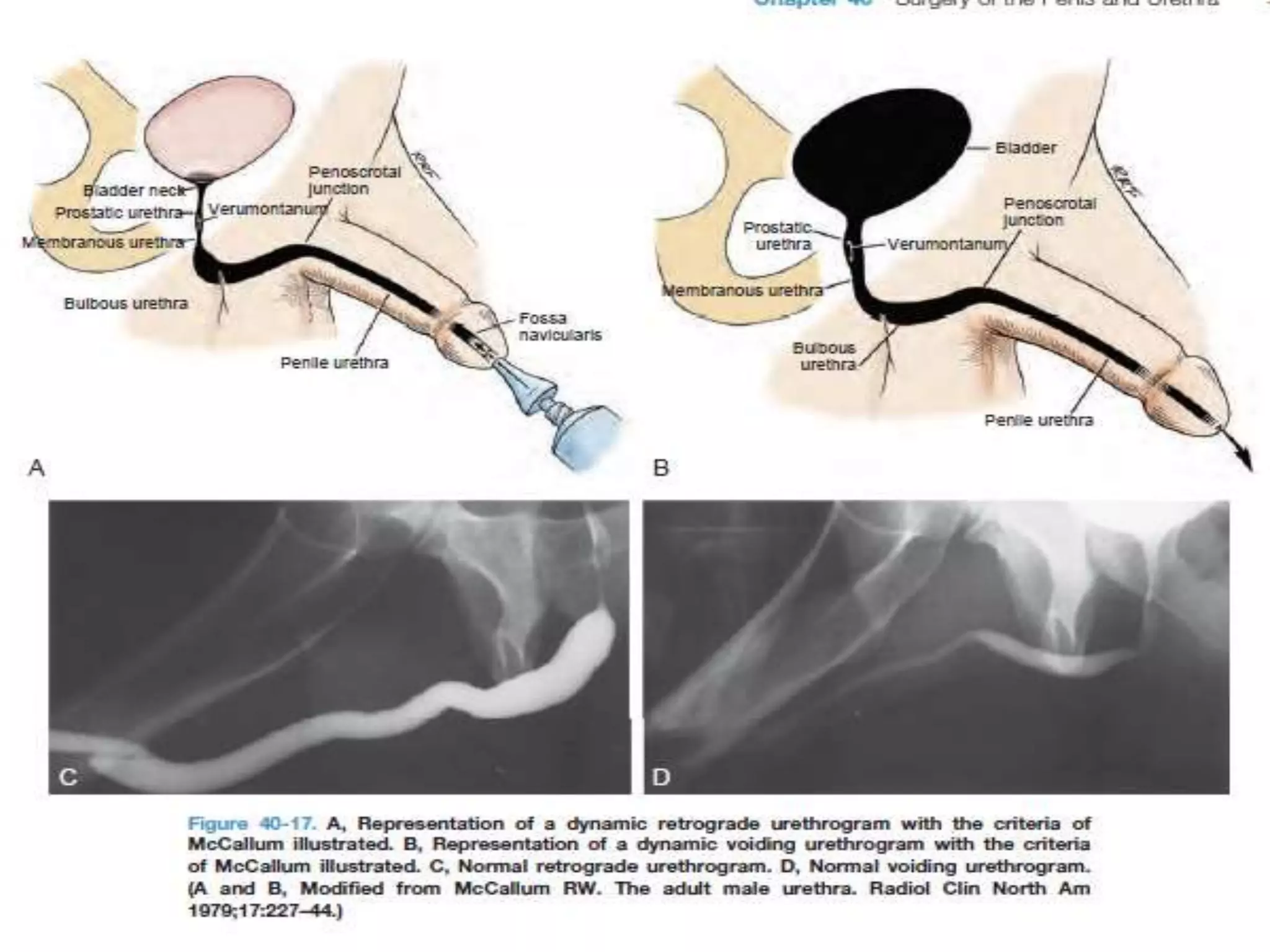
• Male urethra extends from the bladder neck and
terminates at the external urethral meatus.
• It measures about 20.5cm in length and comprises
two(2) part – the anterior and posterior urethra.
• Longer anterior urethra measures about 15cm and
comprises the bulbous and penile urethra
• Shorter posterior urethra comprises the
prostatic and membranous urethras.
AETIOLOGY
 Idiopathic
 Traumatic
 Trauma
 Foreign body or uretheral stone
 Post surgical
 INFLAMMATORY
 Post gonococcal (70%)
 Non specific urethritis Schistosomiasis
 Tuberculous urethritis
 Balanitis xerotica obliterance (BXO)
PATHOGENESIS
• Urethral stricture forms when the urethra heals by
proliferation of fibroblasts which later contracts.
• Post inflammatory strictures are usually confined to
the anterior urethra particularly the bulbous urethra.
• Instrumental injury usually occurs at the bulb but stricture
following prostatic surgery is found at the bladder neck.
• Urethral stricture following pelvic injuries usually
occurs at the membranous urethra
PATHOLOGY
Urethral stricture leads to
• Dilatation of the urethra proximal to the stricture
• Compensatory changes in the bladder musculature
resulting in hypertrophy, trabecculation, sacculation and
diverticular formation
• Hypertrophy of the uretero-trigonal complex or
vesicoureteral reflux causing hydroureters and
hydronephrosis.
• Stasis of urine and subsequent infection of the urinary
tract
CLINICAL FEATURES
• Although stricture following urethritis is formed within a
year, it takes on an average of about 20 years for symptoms
to become apparent.
• Traumatic strictures on the other hand are
symptomatic in two months.
• Symptoms are usually insidious in onset and are usually
LUS which include poor stream, spraying of urine,
frequency, hesitancy, dribbling, acute and chronic
retention.
INVESTIGATIONS
 Urinalysis, Urine microscopy and culture.
 Blood urea and serum creatinine.
 Ultrasound KUB
 Ultrasound of the urethra
 X.ray pelvis
 Retrograde urethrogram
 Antegrade cystourethrogram
 Cystourethroscopy
TREATMENT OPTIONS
 Urethral dilation
 Direct vision internal urethrotomy (DVIU)
 Open urethral reconstruction.
 Indications
 Failed conservative management i.e Intermittent
 Urethrotomy
 Very long strictures or complete strictures with extensive spongiofibrosis
 Complicated strictures with periurethral abscess, calculi or neoplasia.
 Urethroplasty can be anastomostic or substitutional
 Grafts include:
 Buccal mucosa
 bladder mucosa
 penile skin
 scrotal skin
 prepuce
 postauricular skin
TREATMENT OPTIONS
Anterior urethra Strictures :
• Two stage urethroplasty such as the Swinney
technique which involves the initial laying
of the stricture and subsequent reconstruction
the urethra using a graft/flap.
• Free Graft urethroplasty
• Skin island flap implantation
• End to end anastomosis
Evaluating Tools for Characterizing
Anterior Urethral Stricture Disease: A
Comparison of the LSE System and the
Urethral Stricture Score
Article information
 This study was conducted in Department of Urology,
Columbia University Irving Medical Center,
 New York, New York and Published in journal of
American Association of Urology on 1 Aug, 2022.
Introduction
 Several attempts have been made to create
classification systems to describe USD severity, including
the
 ultrasound-based U.L.T.R.A. measurement system,
 the Urethral Stricture Score (U-Score),
 and the LSE classification system (LSE) created from the
Trauma and Urologic Reconstruction Network of
Surgeons database.
 However, none of these schemes have achieved
widespread use.
The U-Score
 The U-Score is a simple
classification tool that
results in a composite
numerical score, which
has
 been reported to
correlate with operative
time and surgical
complexity for anterior
USD.
LSE system
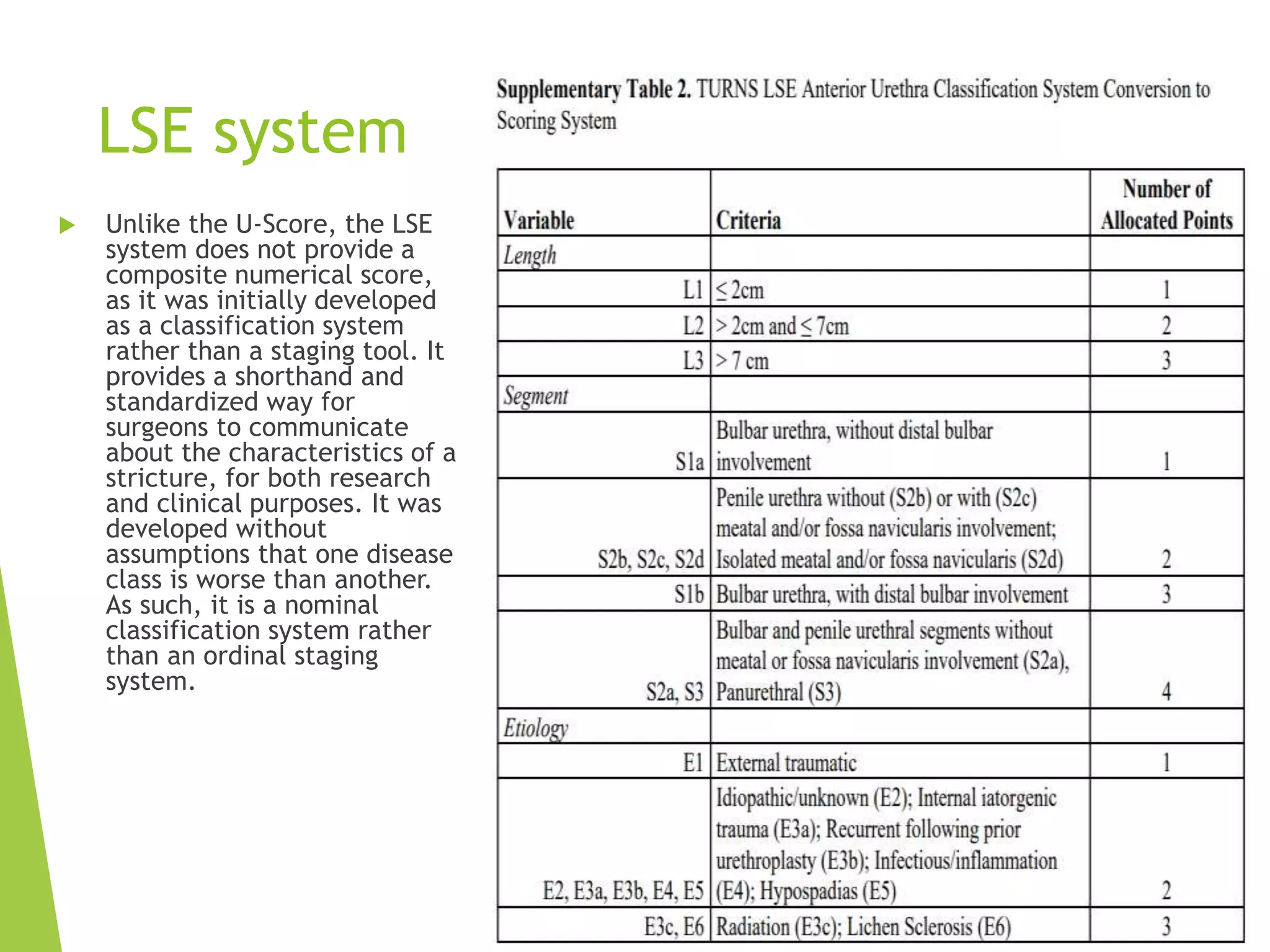
 Unlike the U-Score, the LSE
system does not provide a
composite numerical score,
as it was initially developed
as a classification system
rather than a staging tool. It
provides a shorthand and
standardized way for
surgeons to communicate
about the characteristics of a
stricture, for both research
and clinical purposes. It was
developed without
assumptions that one disease
class is worse than another.
As such, it is a nominal
classification system rather
than an ordinal staging
system.
Objective of the study
 The objective of this study was to evaluate if scores
generated using the LSE and U-
 Score systems are associated with surgical complexity,
operative time, and stricture recurrence.
 Hypothesis was that increasing scores in both systems
would be associated with intraoperative outcomes, but
that only increasing scores based in the LSE system
would be associated with stricture recurrence risk.
Materials and Methods
 Study design: Retrospective
 Population: All patients who underwent a single-stage
anterior urethroplasty and all of them
 were operated on by a single surgeon from 1998 to 2020
at a single tertiary care center.
 A U-Score and an LSE score were calculated for each
patient.
Statistical analysis
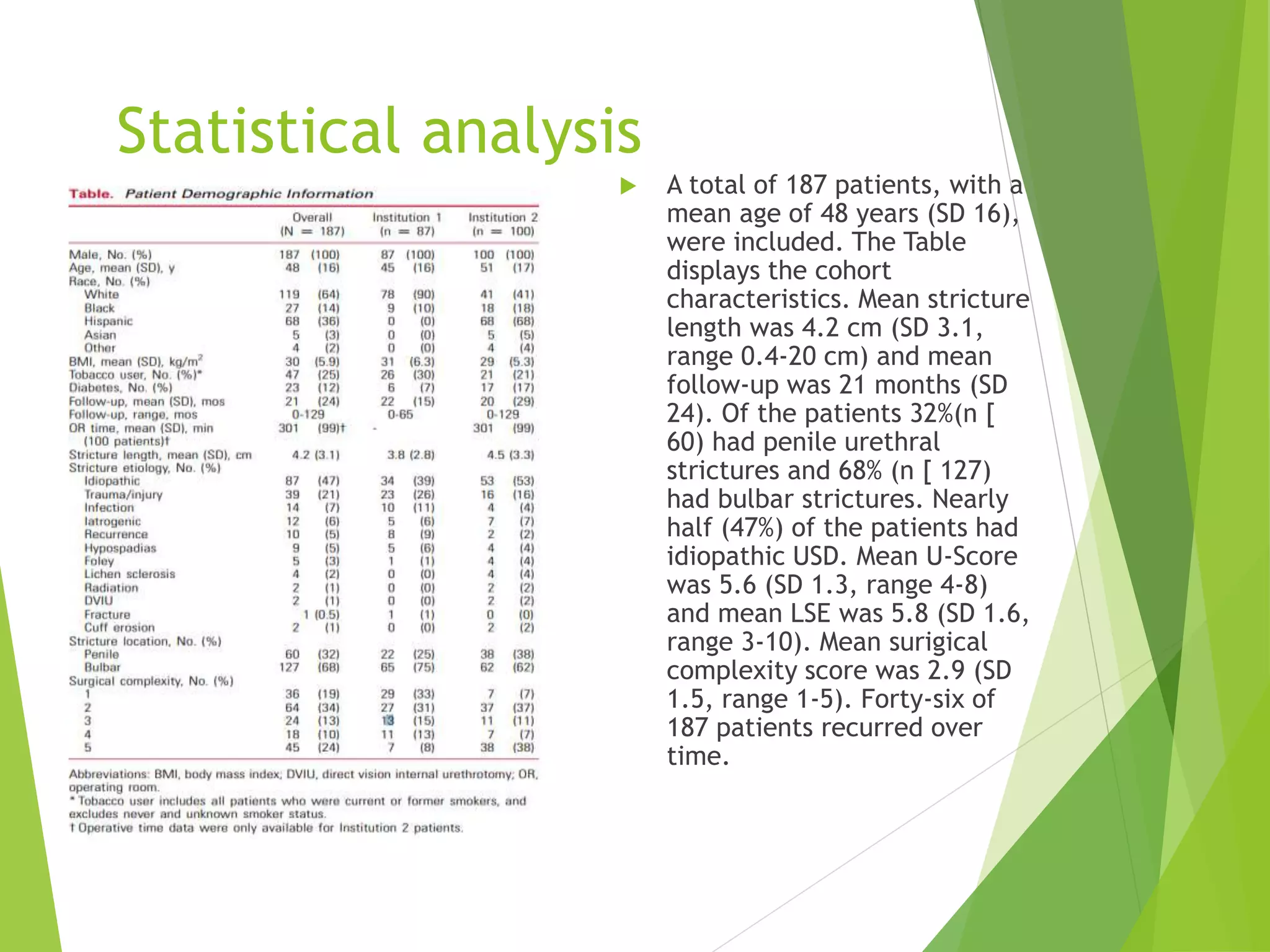
 A total of 187 patients, with a
mean age of 48 years (SD 16),
were included. The Table
displays the cohort
characteristics. Mean stricture
length was 4.2 cm (SD 3.1,
range 0.4-20 cm) and mean
follow-up was 21 months (SD
24). Of the patients 32%(n [
60) had penile urethral
strictures and 68% (n [ 127)
had bulbar strictures. Nearly
half (47%) of the patients had
idiopathic USD. Mean U-Score
was 5.6 (SD 1.3, range 4-8)
and mean LSE was 5.8 (SD 1.6,
range 3-10). Mean surigical
complexity score was 2.9 (SD
1.5, range 1-5). Forty-six of
187 patients recurred over
time.
Outcomes and results
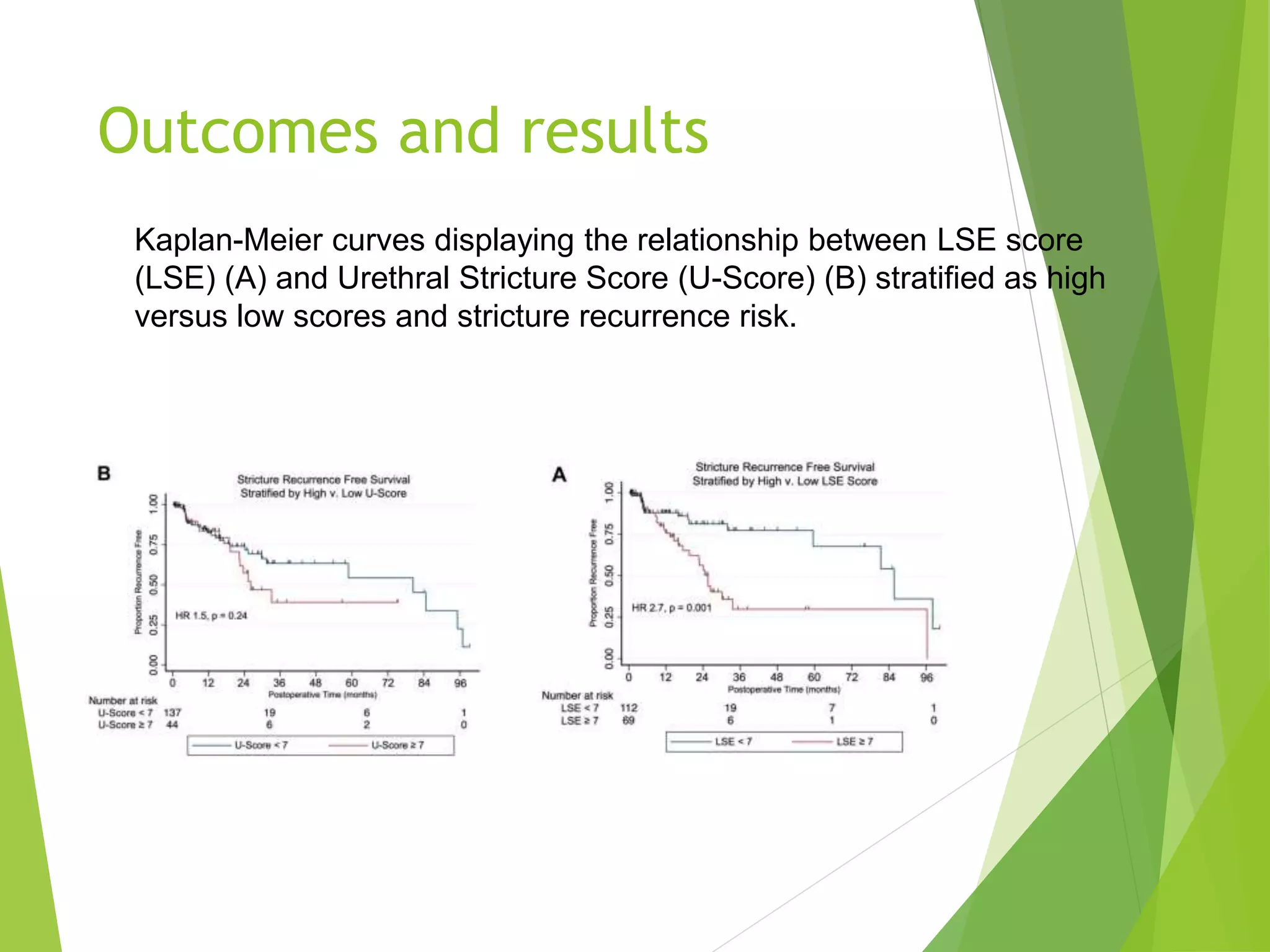
Kaplan-Meier curves displaying the relationship between LSE score
(LSE) (A) and Urethral Stricture Score (U-Score) (B) stratified as high
versus low scores and stricture recurrence risk.
Outcomes and results
 We found a strong and
significant linear
correlation between U-
Score and LSE (r[0.79, P <
.0001, Fig. 1). Both
increasing U-Score and
increasing LSE were
linearly associated with
increasing surgical
complexity (r[0.44, P <
.0001 and r[0.42, P <
.0001, respectively).
Frequency tables
displaying these data are
available in
supplementary Table 4
Discussion
 Both increasing U-Score and LSE were significantly
associated with increasing surgical complexity; however,
only LSE was associated with early stricture recurrence
risk. As LSE increased, the risk of stricture recurrence
increased. In particular, patients with an LSE >7 were at
particularly increased risk.
Strengths
 Increasing U-Score and LSE are both associated with
increasing intraoperative surgical complexity, but only
LSE is associated with short-term stricture recurrence
risk.
Limitations
 First, this was a single-surgeon retrospective cohort study of patients treated
at tertiary care academic center.
 Second, the LSE classification system is previously unstudied and therefore
not validated
 Third, the overall follow-up time for our cohort was relatively short.
Therefore, results only reflect short-term(<3 years) stricture recurrence risk.
 Fourth, both of the scoring systems do not incorporate several important
potentially
 confounding variables that could impact recurrence risk, including:
postoperative infection
 compromised wound healing, comorbidities, or prolonged preoperative
urethral catheterization.
 Finally, neither scoring system utilized statistical modeling to determine cut-
off values or point
 allocation for each component variable. As such, allocating points using
single-point increments may be flawed.

Urethral stricture.pptx

  • 1.
  • 2.
    INTRODUCTION Urethral stricture isan abnormal narrowing or loss of distensibility of any part of the urethra as a result of fibrosis at the site of injury or inflammation.
  • 3.
    RELEVANTANATOMY OF THEMALE URETHRA • Male urethra extends from the bladder neck and terminates at the external urethral meatus. • It measures about 20.5cm in length and comprises two(2) part – the anterior and posterior urethra. • Longer anterior urethra measures about 15cm and comprises the bulbous and penile urethra • Shorter posterior urethra comprises the prostatic and membranous urethras.
  • 5.
    AETIOLOGY  Idiopathic  Traumatic Trauma  Foreign body or uretheral stone  Post surgical  INFLAMMATORY  Post gonococcal (70%)  Non specific urethritis Schistosomiasis  Tuberculous urethritis  Balanitis xerotica obliterance (BXO)
  • 6.
    PATHOGENESIS • Urethral strictureforms when the urethra heals by proliferation of fibroblasts which later contracts. • Post inflammatory strictures are usually confined to the anterior urethra particularly the bulbous urethra. • Instrumental injury usually occurs at the bulb but stricture following prostatic surgery is found at the bladder neck. • Urethral stricture following pelvic injuries usually occurs at the membranous urethra
  • 7.
    PATHOLOGY Urethral stricture leadsto • Dilatation of the urethra proximal to the stricture • Compensatory changes in the bladder musculature resulting in hypertrophy, trabecculation, sacculation and diverticular formation • Hypertrophy of the uretero-trigonal complex or vesicoureteral reflux causing hydroureters and hydronephrosis. • Stasis of urine and subsequent infection of the urinary tract
  • 9.
    CLINICAL FEATURES • Althoughstricture following urethritis is formed within a year, it takes on an average of about 20 years for symptoms to become apparent. • Traumatic strictures on the other hand are symptomatic in two months. • Symptoms are usually insidious in onset and are usually LUS which include poor stream, spraying of urine, frequency, hesitancy, dribbling, acute and chronic retention.
  • 10.
    INVESTIGATIONS  Urinalysis, Urinemicroscopy and culture.  Blood urea and serum creatinine.  Ultrasound KUB  Ultrasound of the urethra  X.ray pelvis  Retrograde urethrogram  Antegrade cystourethrogram  Cystourethroscopy
  • 13.
    TREATMENT OPTIONS  Urethraldilation  Direct vision internal urethrotomy (DVIU)  Open urethral reconstruction.  Indications  Failed conservative management i.e Intermittent  Urethrotomy  Very long strictures or complete strictures with extensive spongiofibrosis  Complicated strictures with periurethral abscess, calculi or neoplasia.
  • 14.
     Urethroplasty canbe anastomostic or substitutional  Grafts include:  Buccal mucosa  bladder mucosa  penile skin  scrotal skin  prepuce  postauricular skin
  • 15.
    TREATMENT OPTIONS Anterior urethraStrictures : • Two stage urethroplasty such as the Swinney technique which involves the initial laying of the stricture and subsequent reconstruction the urethra using a graft/flap. • Free Graft urethroplasty • Skin island flap implantation • End to end anastomosis
  • 17.
    Evaluating Tools forCharacterizing Anterior Urethral Stricture Disease: A Comparison of the LSE System and the Urethral Stricture Score
  • 18.
    Article information  Thisstudy was conducted in Department of Urology, Columbia University Irving Medical Center,  New York, New York and Published in journal of American Association of Urology on 1 Aug, 2022.
  • 19.
    Introduction  Several attemptshave been made to create classification systems to describe USD severity, including the  ultrasound-based U.L.T.R.A. measurement system,  the Urethral Stricture Score (U-Score),  and the LSE classification system (LSE) created from the Trauma and Urologic Reconstruction Network of Surgeons database.  However, none of these schemes have achieved widespread use.
  • 20.
    The U-Score  TheU-Score is a simple classification tool that results in a composite numerical score, which has  been reported to correlate with operative time and surgical complexity for anterior USD.
  • 21.
    LSE system  Unlikethe U-Score, the LSE system does not provide a composite numerical score, as it was initially developed as a classification system rather than a staging tool. It provides a shorthand and standardized way for surgeons to communicate about the characteristics of a stricture, for both research and clinical purposes. It was developed without assumptions that one disease class is worse than another. As such, it is a nominal classification system rather than an ordinal staging system.
  • 23.
    Objective of thestudy  The objective of this study was to evaluate if scores generated using the LSE and U-  Score systems are associated with surgical complexity, operative time, and stricture recurrence.  Hypothesis was that increasing scores in both systems would be associated with intraoperative outcomes, but that only increasing scores based in the LSE system would be associated with stricture recurrence risk.
  • 24.
    Materials and Methods Study design: Retrospective  Population: All patients who underwent a single-stage anterior urethroplasty and all of them  were operated on by a single surgeon from 1998 to 2020 at a single tertiary care center.  A U-Score and an LSE score were calculated for each patient.
  • 25.
    Statistical analysis  Atotal of 187 patients, with a mean age of 48 years (SD 16), were included. The Table displays the cohort characteristics. Mean stricture length was 4.2 cm (SD 3.1, range 0.4-20 cm) and mean follow-up was 21 months (SD 24). Of the patients 32%(n [ 60) had penile urethral strictures and 68% (n [ 127) had bulbar strictures. Nearly half (47%) of the patients had idiopathic USD. Mean U-Score was 5.6 (SD 1.3, range 4-8) and mean LSE was 5.8 (SD 1.6, range 3-10). Mean surigical complexity score was 2.9 (SD 1.5, range 1-5). Forty-six of 187 patients recurred over time.
  • 26.
    Outcomes and results Kaplan-Meiercurves displaying the relationship between LSE score (LSE) (A) and Urethral Stricture Score (U-Score) (B) stratified as high versus low scores and stricture recurrence risk.
  • 27.
    Outcomes and results We found a strong and significant linear correlation between U- Score and LSE (r[0.79, P < .0001, Fig. 1). Both increasing U-Score and increasing LSE were linearly associated with increasing surgical complexity (r[0.44, P < .0001 and r[0.42, P < .0001, respectively). Frequency tables displaying these data are available in supplementary Table 4
  • 28.
    Discussion  Both increasingU-Score and LSE were significantly associated with increasing surgical complexity; however, only LSE was associated with early stricture recurrence risk. As LSE increased, the risk of stricture recurrence increased. In particular, patients with an LSE >7 were at particularly increased risk.
  • 29.
    Strengths  Increasing U-Scoreand LSE are both associated with increasing intraoperative surgical complexity, but only LSE is associated with short-term stricture recurrence risk.
  • 30.
    Limitations  First, thiswas a single-surgeon retrospective cohort study of patients treated at tertiary care academic center.  Second, the LSE classification system is previously unstudied and therefore not validated  Third, the overall follow-up time for our cohort was relatively short. Therefore, results only reflect short-term(<3 years) stricture recurrence risk.  Fourth, both of the scoring systems do not incorporate several important potentially  confounding variables that could impact recurrence risk, including: postoperative infection  compromised wound healing, comorbidities, or prolonged preoperative urethral catheterization.  Finally, neither scoring system utilized statistical modeling to determine cut- off values or point  allocation for each component variable. As such, allocating points using single-point increments may be flawed.