Urinary Obstruction
Pathophysiology
Dept of Urology
Govt Royapettah Hospital and Kilpauk Medical College
Chennai
Moderators:
Professors:
• Prof. Dr. G. Sivasankar, M.S., M.Ch.,
• Prof. Dr. A. Senthilvel, M.S., M.Ch.,
Asst Professors:
• Dr. J. Sivabalan, M.S., M.Ch.,
• Dr. R. Bhargavi, M.S., M.Ch.,
• Dr. S. Raju, M.S., M.Ch.,
• Dr. K. Muthurathinam, M.S., M.Ch.,
• Dr. D. Tamilselvan, M.S., M.Ch.,
• Dr. K. Senthilkumar, M.S., M.Ch.
Dept of Urology, GRH and KMC, Chennai. 2
Urinary Obstruction
Urinary tract obstruction can result in permanent renal
damage.
The degree of injury depends on:
• Severity of the obstruction. (Partial or complete,
unilateral or bilateral),
• Chronicity of the obstruction (acute vs chronic),
• Baseline condition of the kidneys and
• Other mitigating factors such as UTI.
3
Dept of Urology, GRH and KMC, Chennai.
Causes
of
Urinary Obstruction
4
Dept of Urology, GRH and KMC, Chennai.
Congenital
Renal
• Polycystic kidney
• Renal cyst
• Peripelvic cyst
• Ureteropelvic junction
obstruction
Ureter
• Stricture
• Ureterocele
• Obstructing megaureter
• Retrocaval ureter
• Prune belly syndrome
5
Dept of Urology, GRH and KMC, Chennai.
Neoplastic
Renal
• Wilms tumor
• Renal cell carcinoma
• Transitional cell
carcinoma of the
collecting system
• Multiple myeloma
Ureter
• Primary carcinoma of
ureter
• Metastatic carcinoma
6
Dept of Urology, GRH and KMC, Chennai.
Infective and Inflammatory
Renal
• Tuberculosis
• Echinococcus infection
Ureter
• Tuberculosis
• Amyloidosis
• Schistosomiasis
• Abscess
• Ureteritis cystica
• Endometriosis
7
Dept of Urology, GRH and KMC, Chennai.
Renal and Ureteric Causes
Metabolic
• Calculi
Miscellaneous
• Sloughed papillae
• Trauma
• Renal artery aneurysm
8
Dept of Urology, GRH and KMC, Chennai.
Lower Genitourinary Causes
Congenital
• Posterior urethral valve
• Phimosis
• Hydrocolpos
Neoplastic
• Bladder carcinoma
• Prostate carcinoma
• Carcinoma of urethra
• Carcinoma of penis
9
Dept of Urology, GRH and KMC, Chennai.
Lower Genitourinary Causes
Inflammatory
• Prostatitis
• Paraurethral abscess
Miscellaneous
• Benign prostatic
hypertrophy
• Neurogenic bladder
• Urethral stricture
10
Dept of Urology, GRH and KMC, Chennai.
Other Miscellaneous
• Retroperitoneal fibrosis
• Pelvic lipomatosis
• Aortic aneurysm
• Radiation therapy
• Lymphocele
• Trauma
• Urinoma
• Pregnancy
• Radiofrequency
ablation
11
Dept of Urology, GRH and KMC, Chennai.
Physiology
12
Dept of Urology, GRH and KMC, Chennai.
13
Dept of Urology, GRH and KMC, Chennai.
Glomerular Filtration Rate
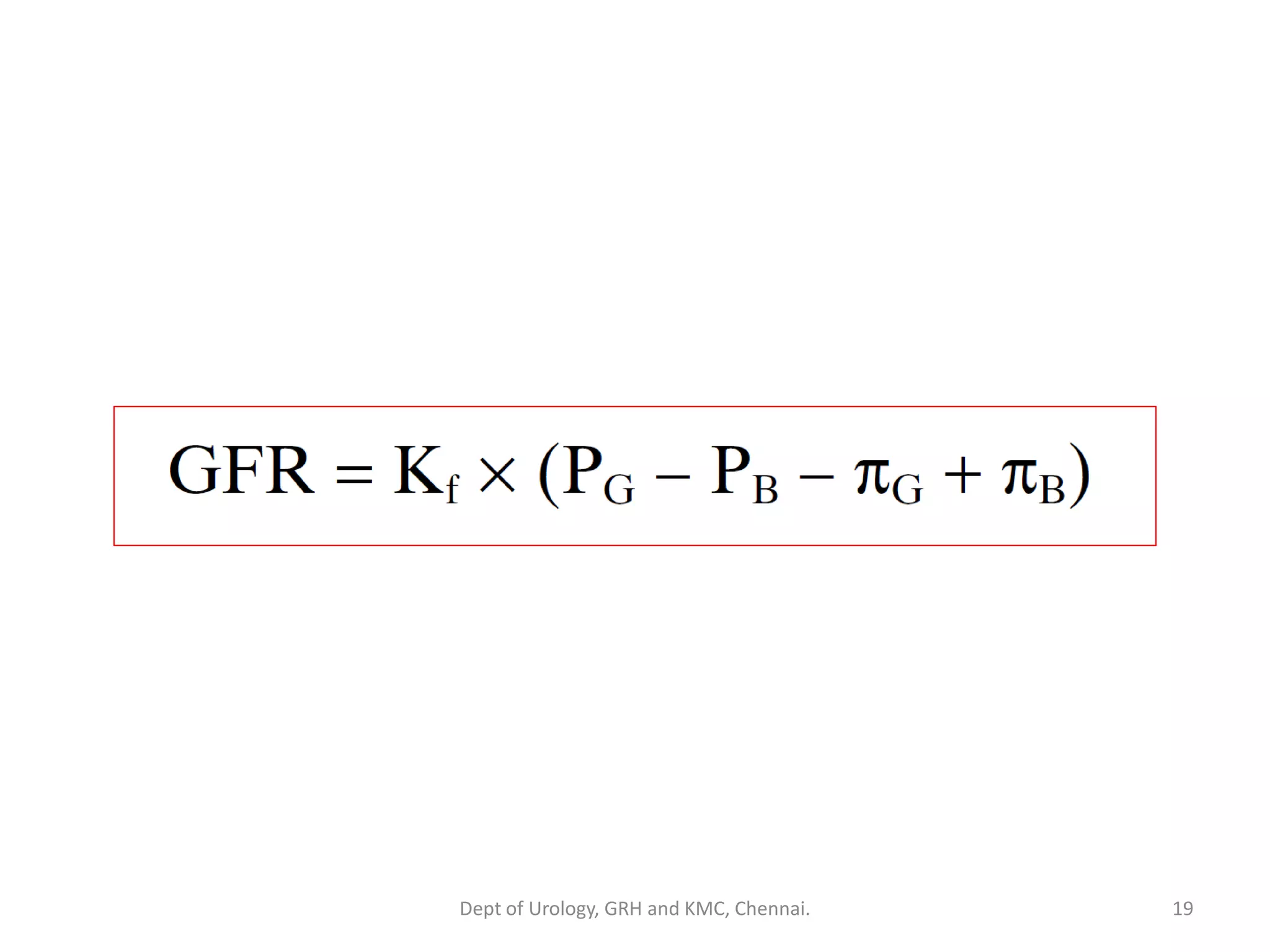
The GFR is determined by
1. The sum of the hydrostatic and colloid osmotic forces
across the glomerular membrane, which gives the
net filtration pressure, and
2. The glomerular capillary filtration coefficient, Kf
GFR = Kf x Net filtration pressure
14
Dept of Urology, GRH and KMC, Chennai.
Pressures In Filtration
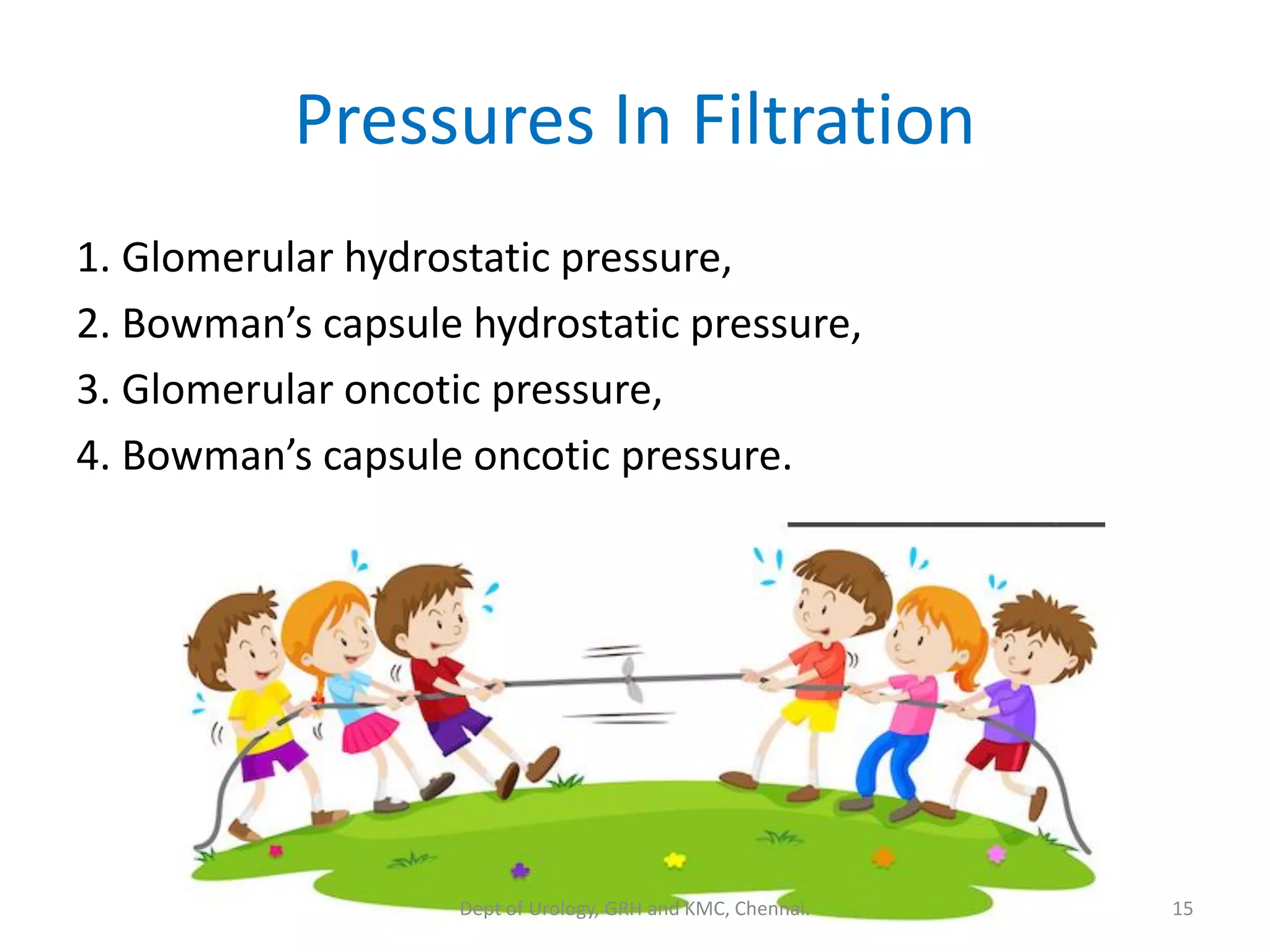
1. Glomerular hydrostatic pressure,
2. Bowman’s capsule hydrostatic pressure,
3. Glomerular oncotic pressure,
4. Bowman’s capsule oncotic pressure.
15
Dept of Urology, GRH and KMC, Chennai.
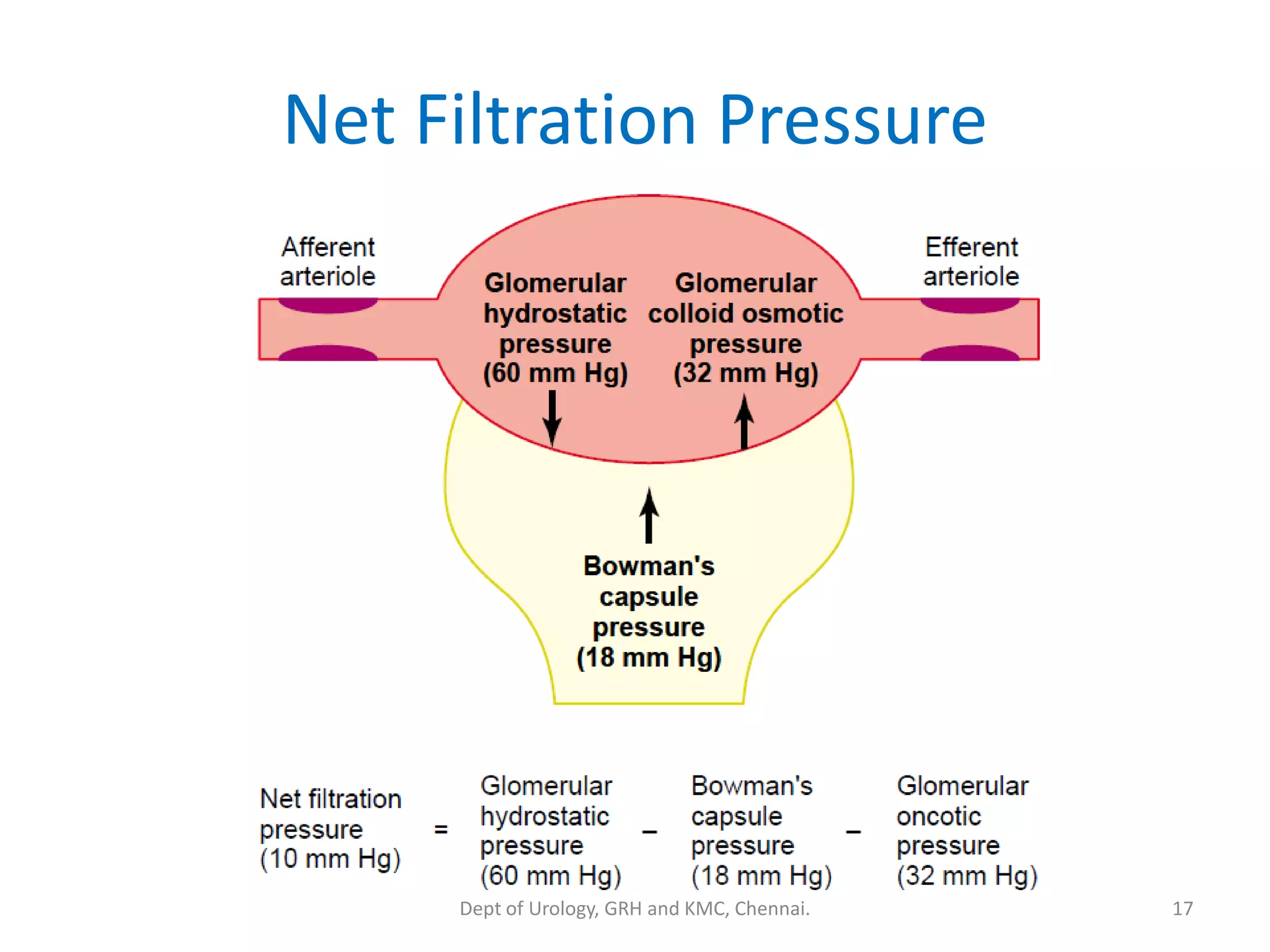
Net filtration pressure
Net filtration pressure represents:
• The sum of the hydrostatic and colloid osmotic forces
• That either favor or oppose filtration
• Across the glomerular capillaries.
16
Dept of Urology, GRH and KMC, Chennai.
Net Filtration Pressure
17
Dept of Urology, GRH and KMC, Chennai.
18
Dept of Urology, GRH and KMC, Chennai.
19
Dept of Urology, GRH and KMC, Chennai.
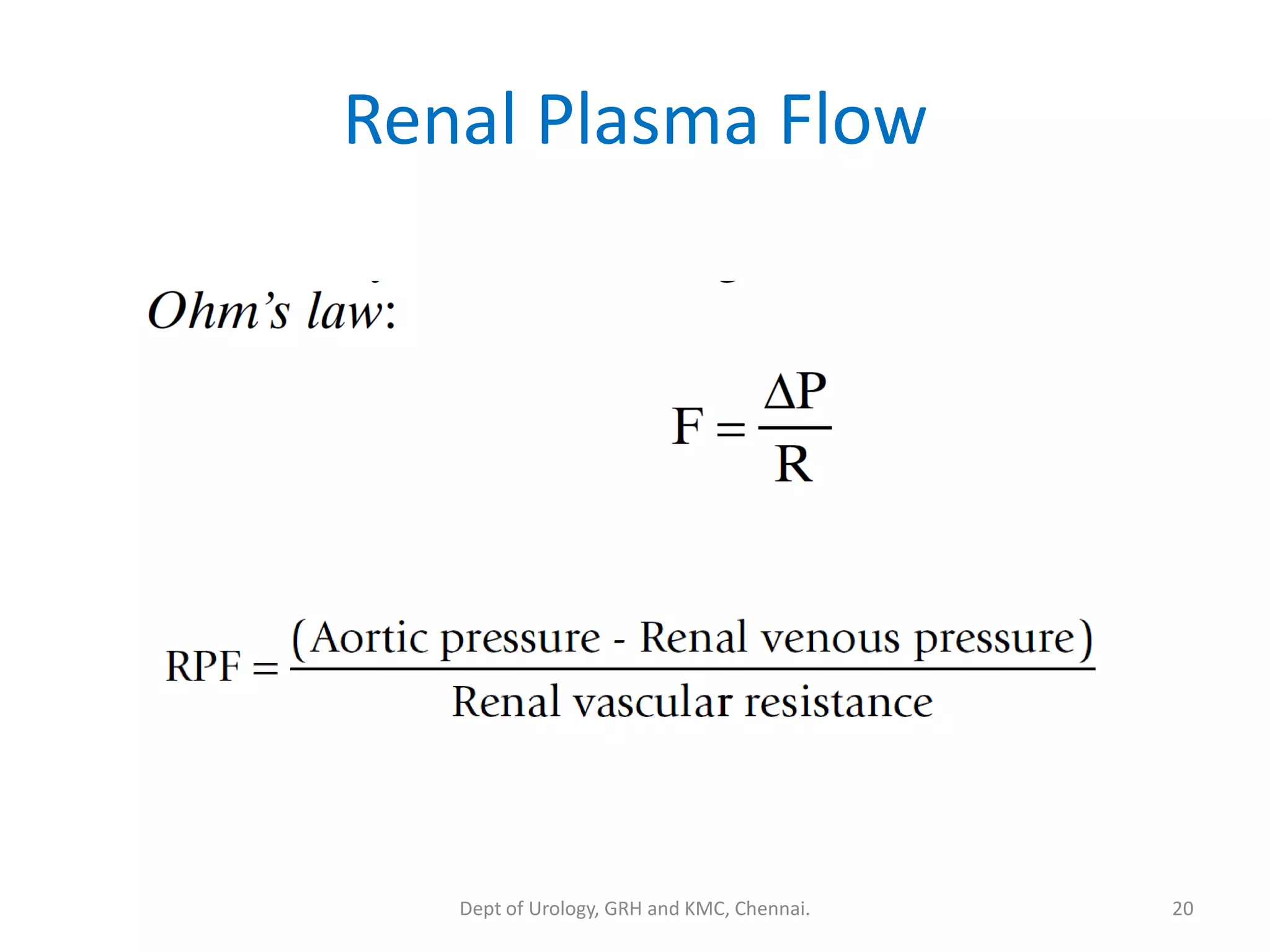
Renal Plasma Flow
20
Dept of Urology, GRH and KMC, Chennai.
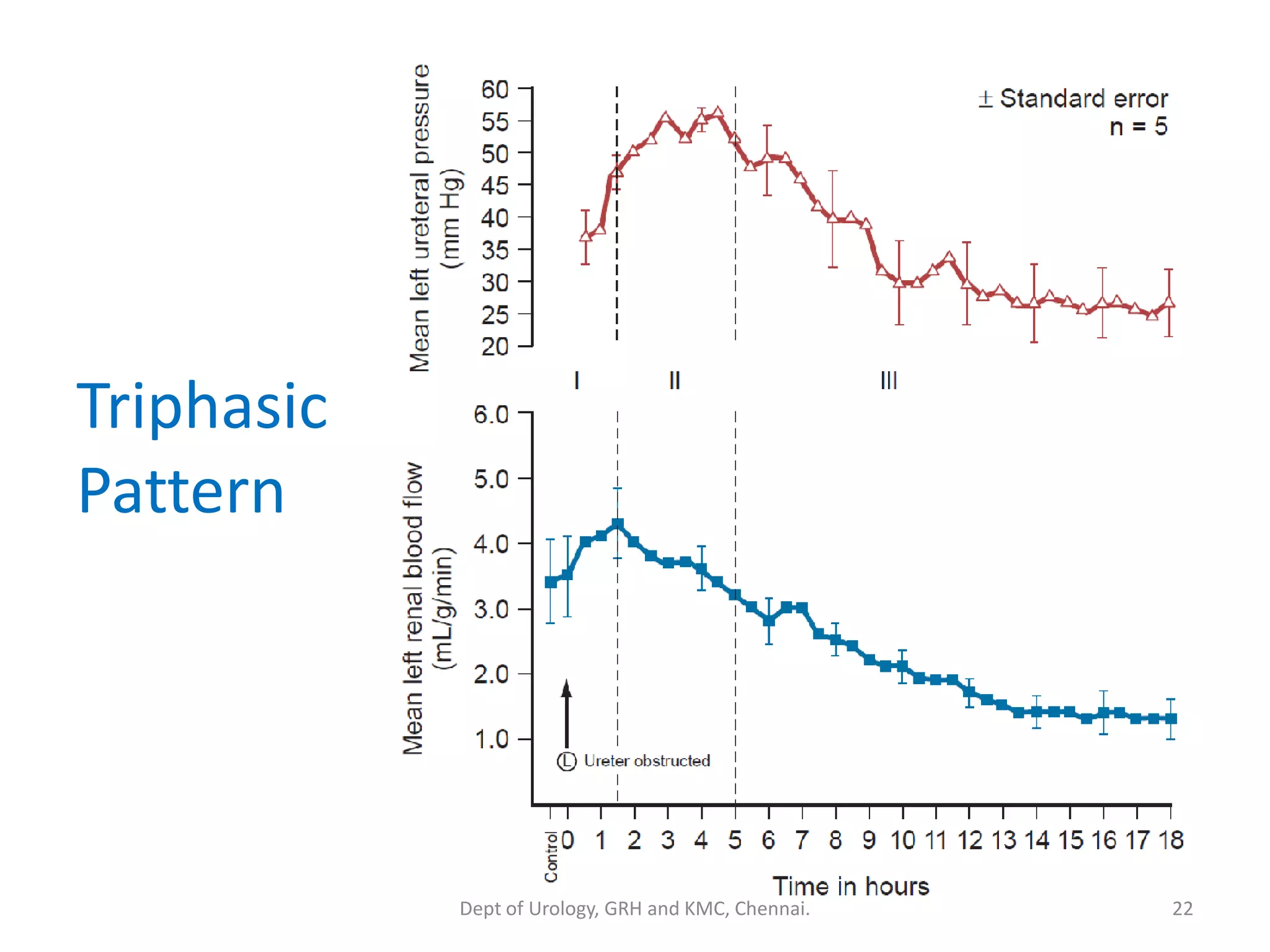
Unilateral Urinary Obstruction
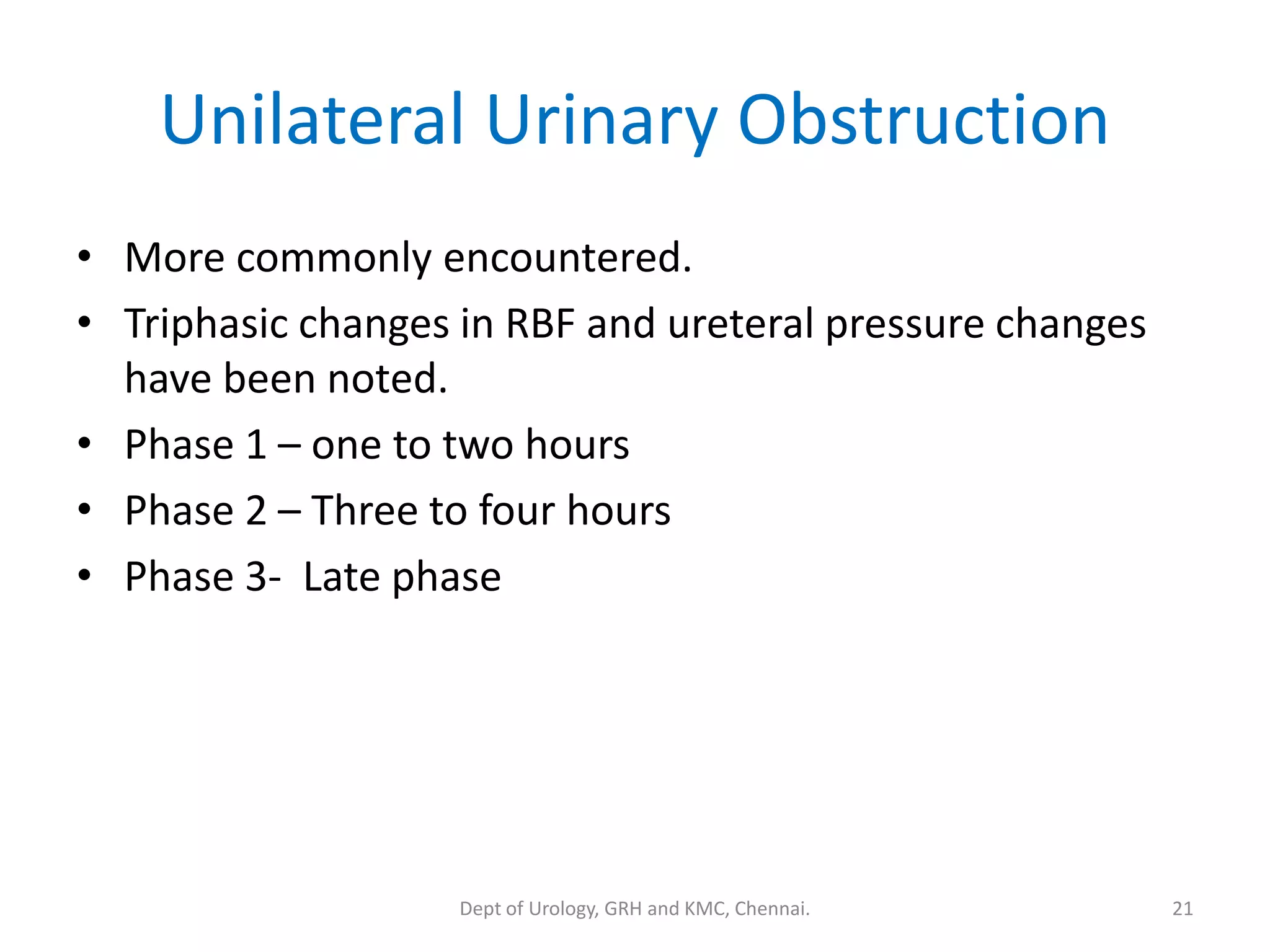
• More commonly encountered.
• Triphasic changes in RBF and ureteral pressure changes
have been noted.
• Phase 1 – one to two hours
• Phase 2 – Three to four hours
• Phase 3- Late phase
21
Dept of Urology, GRH and KMC, Chennai.
Triphasic
Pattern
22
Dept of Urology, GRH and KMC, Chennai.
Key Chemical Mediators
Increase RBF
RAS
NO
PGE2
23
Dept of Urology, GRH and KMC, Chennai.
Renin Angiotensin System
24
Dept of Urology, GRH and KMC, Chennai.
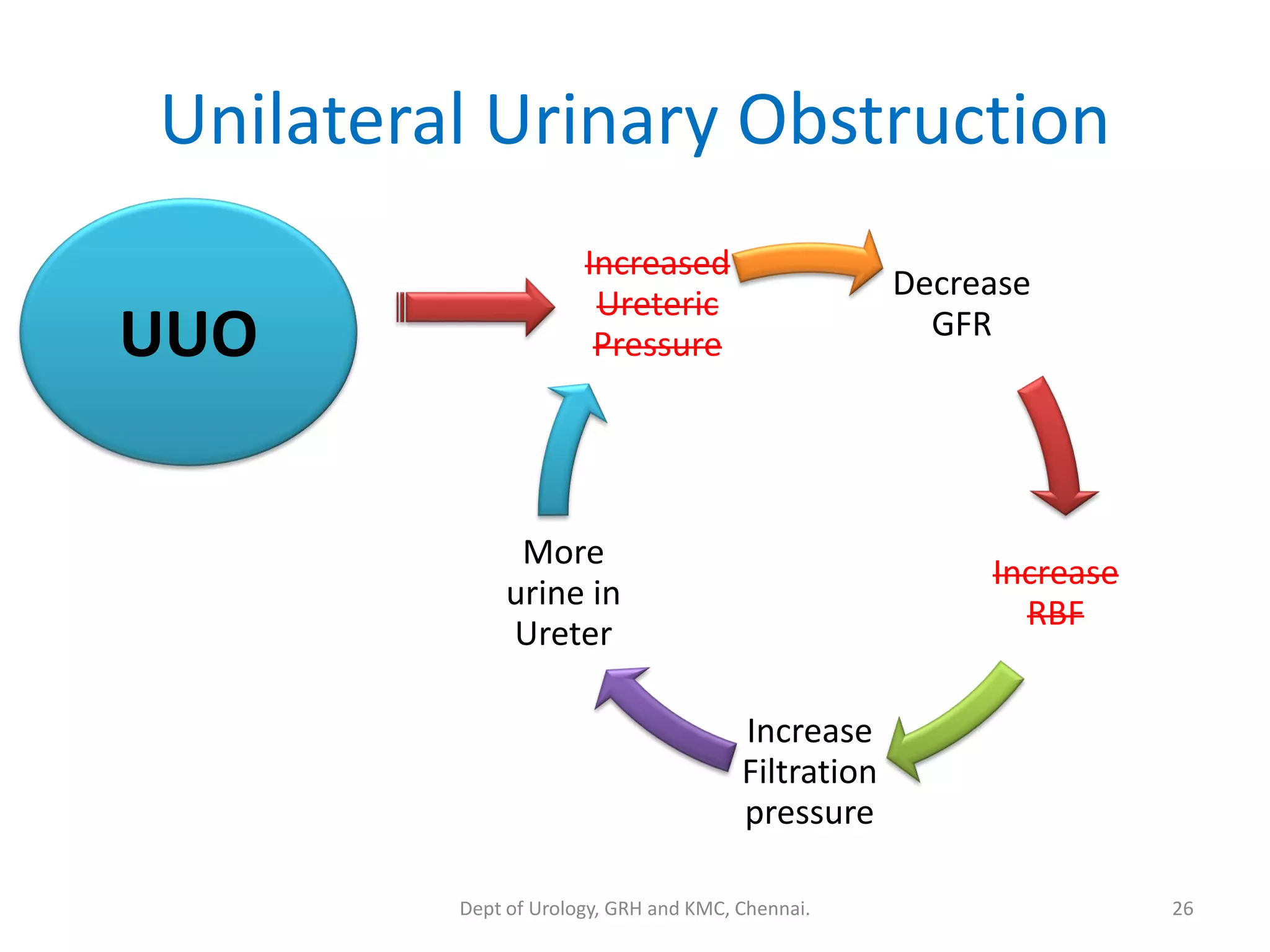
Unilateral Urinary Obstruction
Decrease
GFR
Increase
RBF
Increase
Filtration
pressure
More
urine in
Ureter
Increased
Ureteric
Pressure
UUO
25
Dept of Urology, GRH and KMC, Chennai.
Unilateral Urinary Obstruction
Decrease
GFR
Increase
RBF
Increase
Filtration
pressure
More
urine in
Ureter
Increased
Ureteric
Pressure
UUO
26
Dept of Urology, GRH and KMC, Chennai.
Triphasic Response
27
Dept of Urology, GRH and KMC, Chennai.
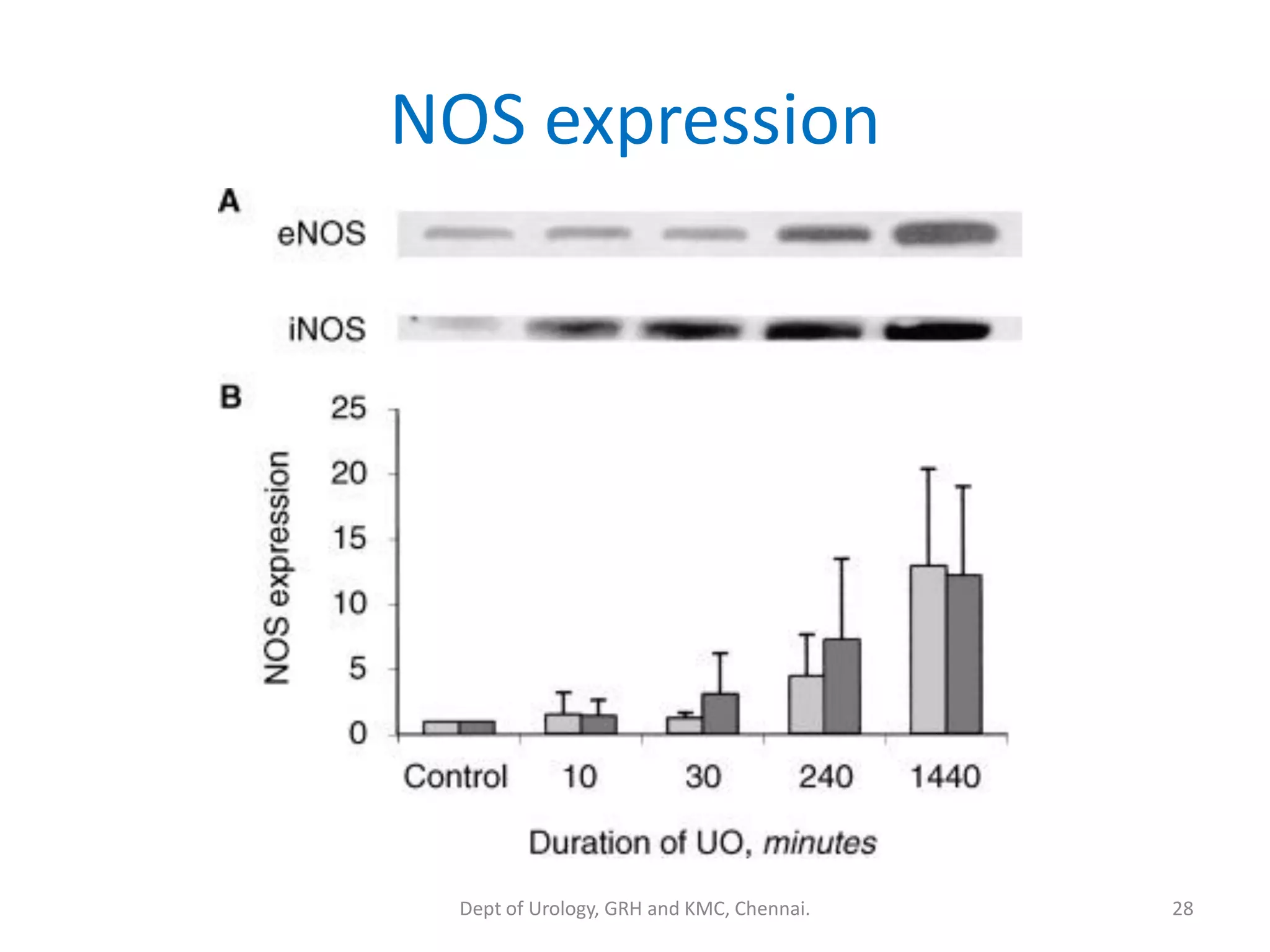
NOS expression
28
Dept of Urology, GRH and KMC, Chennai.
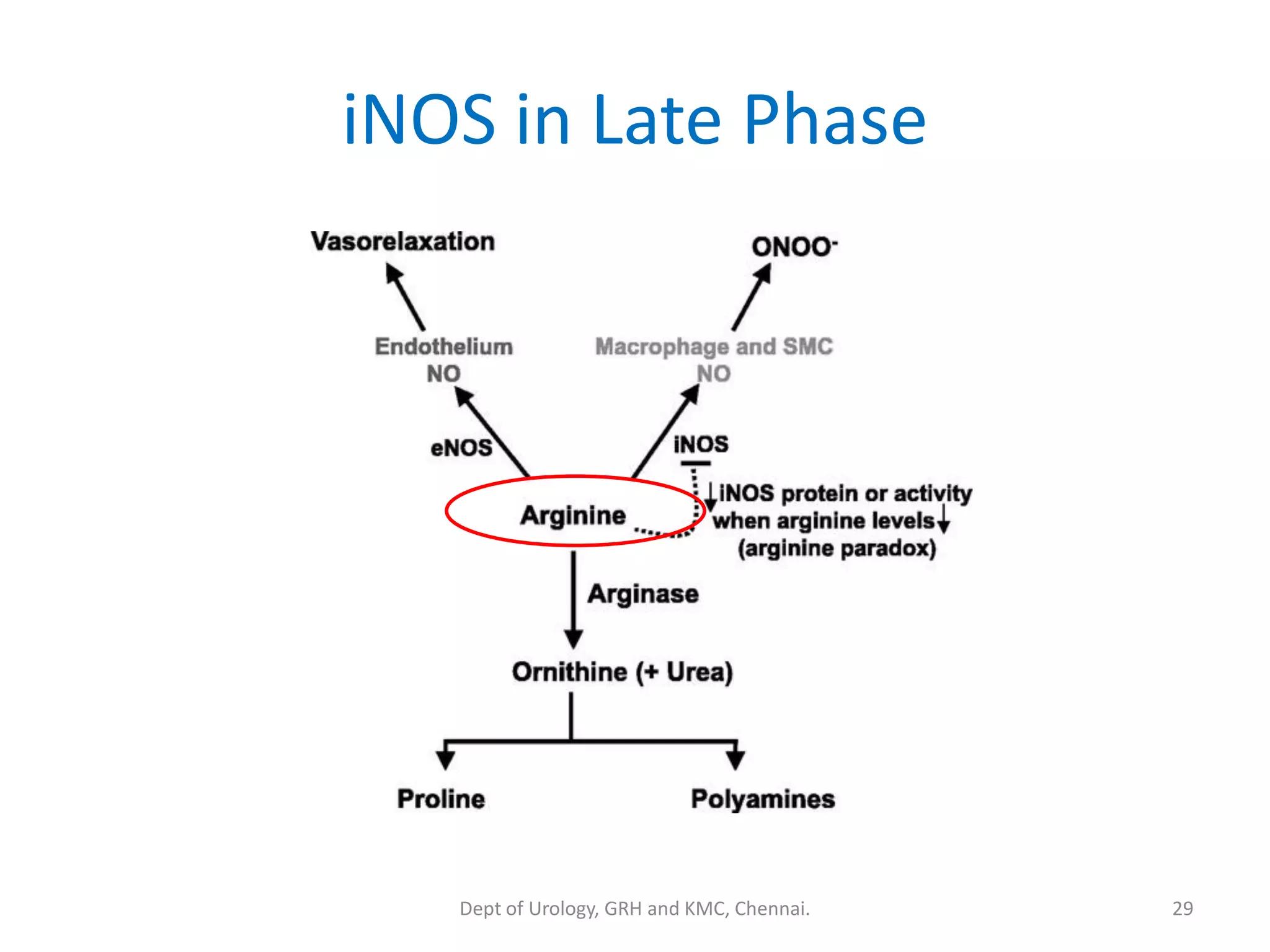
iNOS in Late Phase
29
Dept of Urology, GRH and KMC, Chennai.
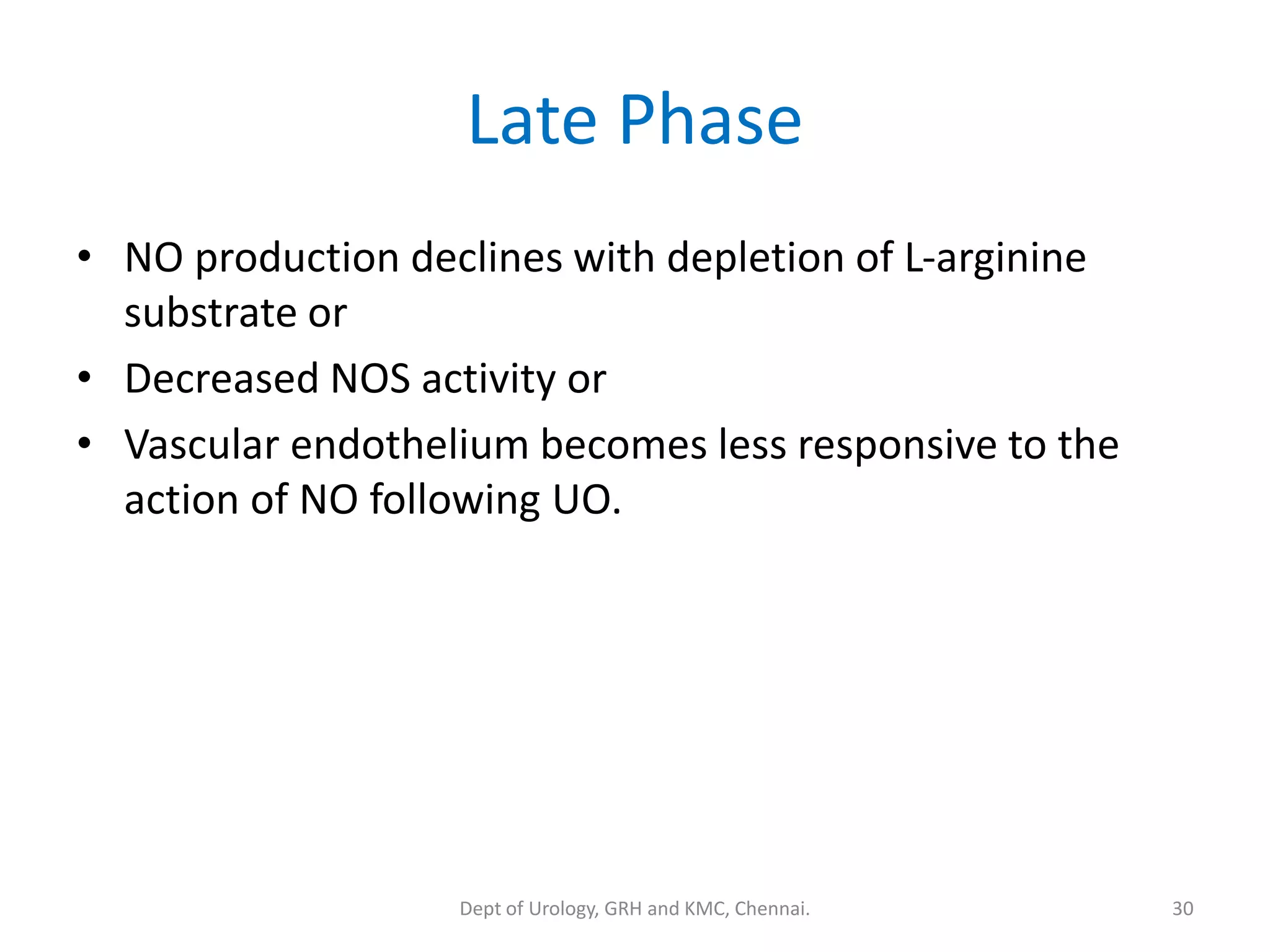
Late Phase
• NO production declines with depletion of L-arginine
substrate or
• Decreased NOS activity or
• Vascular endothelium becomes less responsive to the
action of NO following UO.
30
Dept of Urology, GRH and KMC, Chennai.
Unilateral Ureteric Obstruction
31
Dept of Urology, GRH and KMC, Chennai.
Bilateral Ureteric Obstruction
Afferent Dilataion,
Efferent Constriction
ANP
32
Dept of Urology, GRH and KMC, Chennai.
Bilateral Ureteric Obstruction
P Ureter ↑
GFR ↓
Hypervolemia
Atrial Natriuretic Peptide Production
Afferent Arteriolar Dilatation,
Efferent Arteriolar Constriction,
↑ P Glomerular Capillaries.
P Ureter ↑
33
Dept of Urology, GRH and KMC, Chennai.
Bilateral Ureteric Obstruction
34
Dept of Urology, GRH and KMC, Chennai.
Cortical Vs Juxtamedullary Nephrons
35
Dept of Urology, GRH and KMC, Chennai.
Cortical Vs Juxtaglomerular Nephrons
36
Dept of Urology, GRH and KMC, Chennai.
Cortical Blood Flow Redistribution
37
Dept of Urology, GRH and KMC, Chennai.
Partial Ureteral Obstruction
• Proper animal models not available.
• Behaves mostly like UUO.
• Generally there is decreased RBF and GFR.
• Shift in blood flow from outer cortex to inner cortex is
noted.
38
Dept of Urology, GRH and KMC, Chennai.
Effects
on
Tubular Function
39
Dept of Urology, GRH and KMC, Chennai.
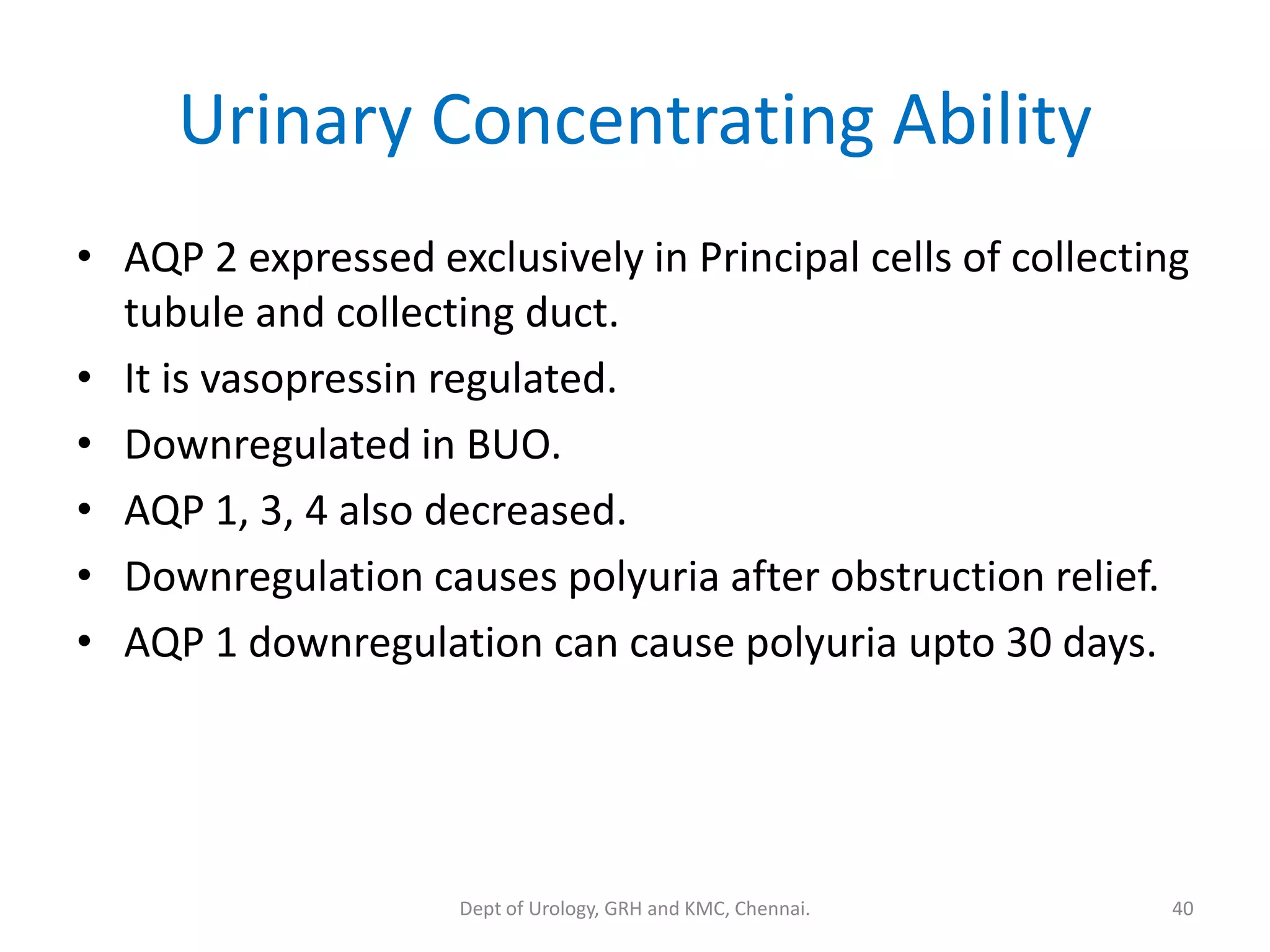
Urinary Concentrating Ability
• AQP 2 expressed exclusively in Principal cells of collecting
tubule and collecting duct.
• It is vasopressin regulated.
• Downregulated in BUO.
• AQP 1, 3, 4 also decreased.
• Downregulation causes polyuria after obstruction relief.
• AQP 1 downregulation can cause polyuria upto 30 days.
40
Dept of Urology, GRH and KMC, Chennai.
AQP 2 Expression
41
Dept of Urology, GRH and KMC, Chennai.
AQP 2 Downregulation
42
Dept of Urology, GRH and KMC, Chennai.
Sodium Transport
• Down regulation of important Na transporters noted in
both UUO and BUO.
• Leads to salt wasting after relief of obstruction.
• Natriuresis is greater in BUO than UUO.
• PGE2 inhibits NaCl reabsorption acting on Na
transporters in loop of henle and through AQP 2.
43
Dept of Urology, GRH and KMC, Chennai.
Hydrogen ion transport
• Obstruction causes urinary acidification.
• Associated with decreased H+ secretion and defective
HCO3- absorption.
• Multiple acid-base transporters are downregulated.
• Mediated by iNOS.
44
Dept of Urology, GRH and KMC, Chennai.
Other Cation Transport
• In UUO, K+ secretion is decreased.
• K+ excretion increases with increase in GFR in BUO after
relief, due to ANP.
• Magnesium excretion is also increased after the release
of UUO and BUO.
45
Dept of Urology, GRH and KMC, Chennai.
46
Dept of Urology, GRH and KMC, Chennai.
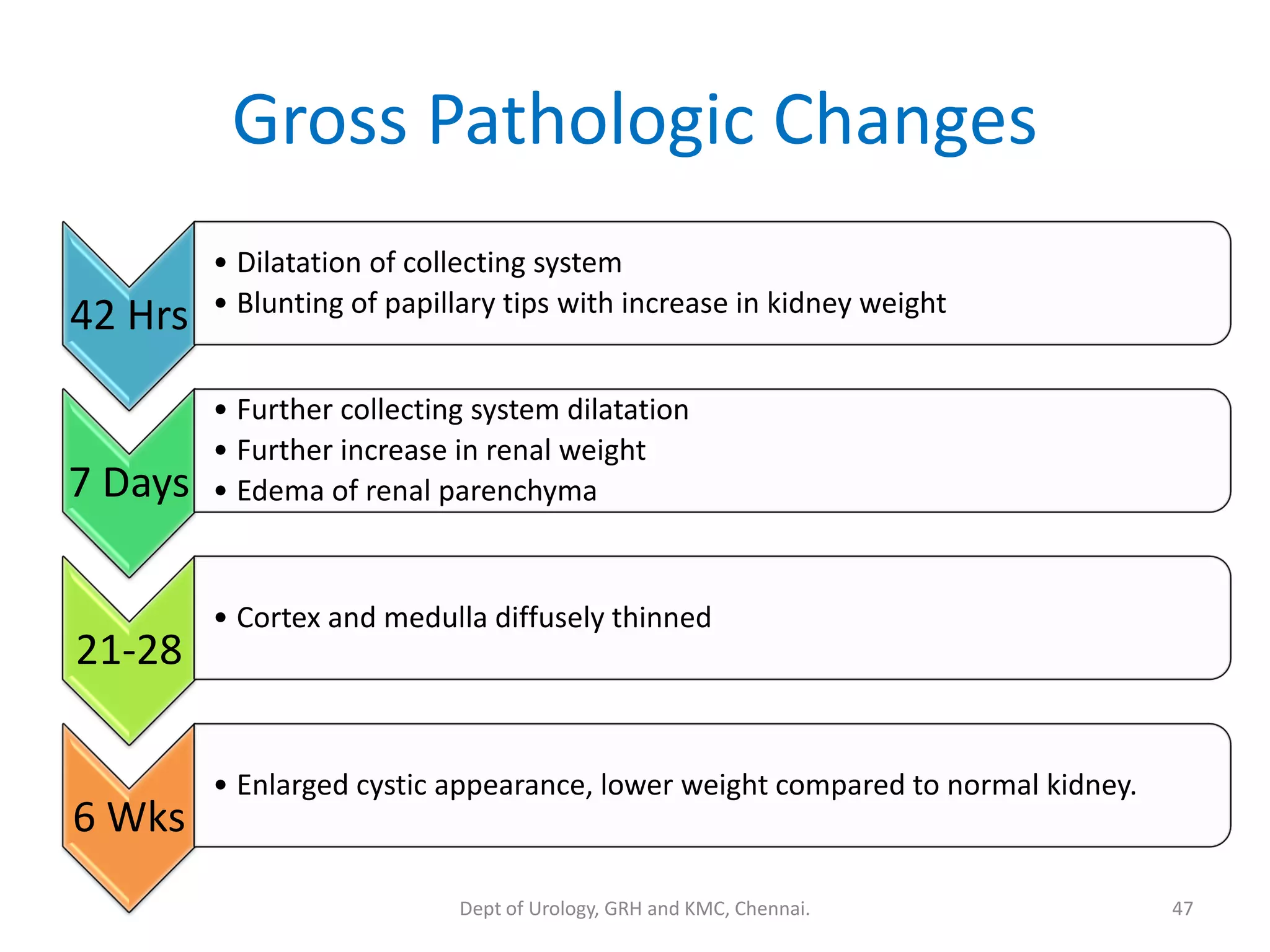
Gross Pathologic Changes
42 Hrs
• Dilatation of collecting system
• Blunting of papillary tips with increase in kidney weight
7 Days
• Further collecting system dilatation
• Further increase in renal weight
• Edema of renal parenchyma
21-28
• Cortex and medulla diffusely thinned
6 Wks
• Enlarged cystic appearance, lower weight compared to normal kidney.
47
Dept of Urology, GRH and KMC, Chennai.
Microscopic Changes
Early Changes:
• Massive tubular dilatation
• Progressive tubulointerstitial fibrosis
• Inflammatory cell infiltration
• Apoptic renal tubular cell death
Late Changes:
• Glomerulosclerosis
48
Dept of Urology, GRH and KMC, Chennai.
Early obstruction
49
Dept of Urology, GRH and KMC, Chennai.
Chronic Obstruction
50
Dept of Urology, GRH and KMC, Chennai.
Chronic Obstruction
51
Dept of Urology, GRH and KMC, Chennai.
Tubulointerstitial fibrosis
52
Dept of Urology, GRH and KMC, Chennai.
Clinical Impact
of
Urinary Obstruction
53
Dept of Urology, GRH and KMC, Chennai.
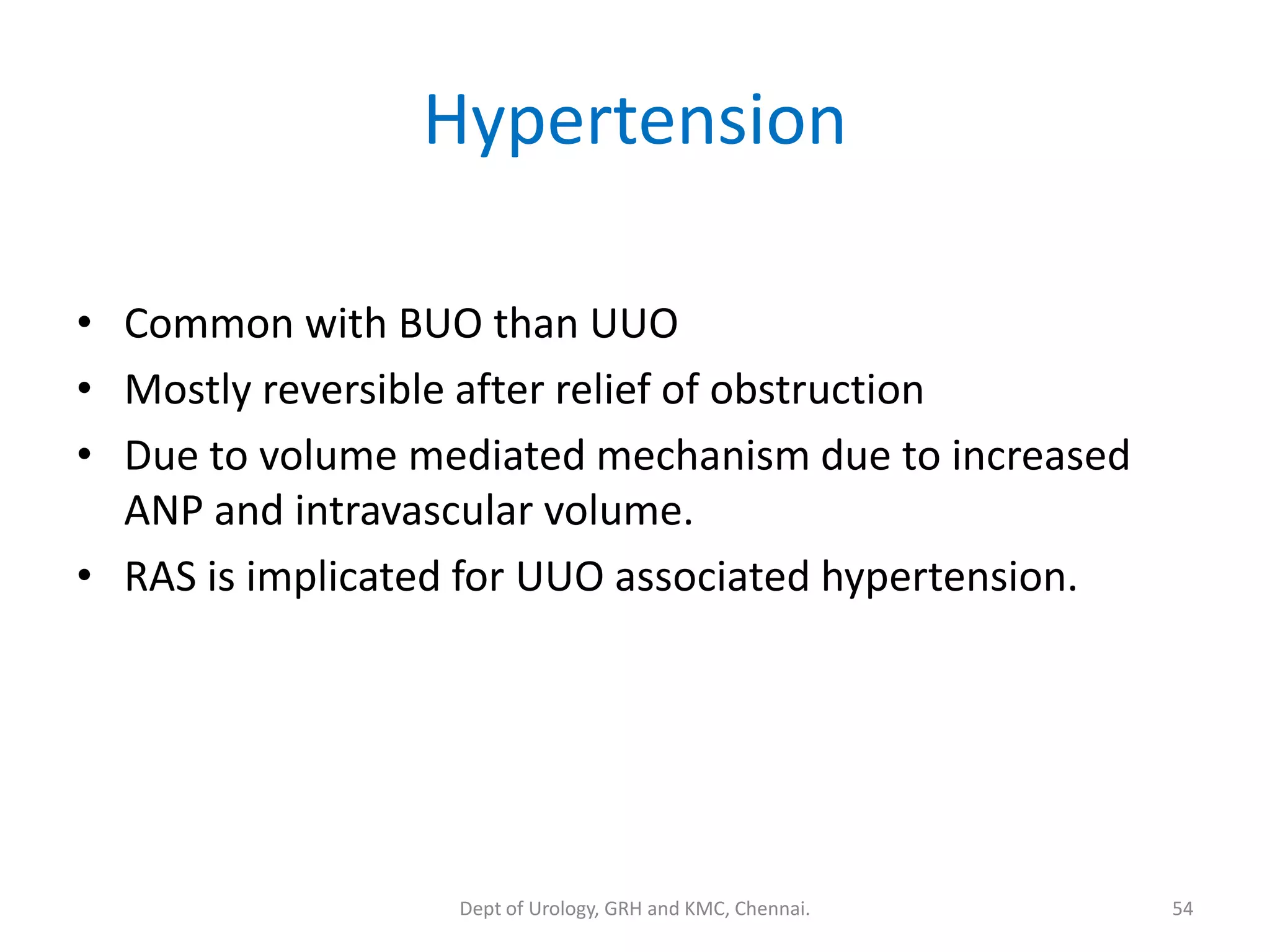
Hypertension
• Common with BUO than UUO
• Mostly reversible after relief of obstruction
• Due to volume mediated mechanism due to increased
ANP and intravascular volume.
• RAS is implicated for UUO associated hypertension.
54
Dept of Urology, GRH and KMC, Chennai.
Compensatory Renal Growth
• Seen in UUO, in contralateral kidney.
• Influenced by age and degree and duration of
obstruction.
• Less prominent in partial UUO.
• Increase in volume is due to hypertrophy not due to
hyperplasia.
• IGF 1 is involvedin renal hypertrophy.
• Sex hormones may also have a role.
55
Dept of Urology, GRH and KMC, Chennai.
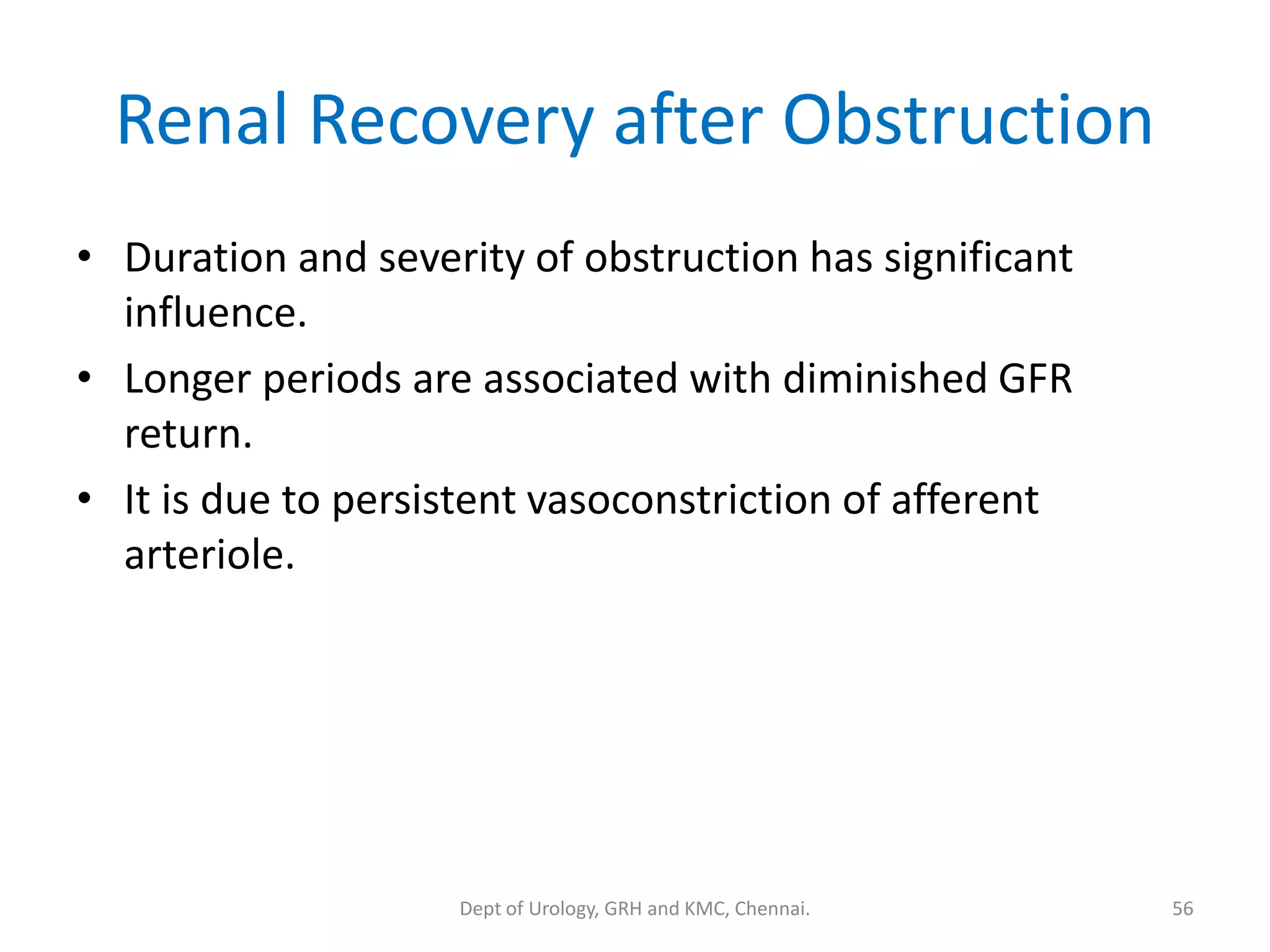
Renal Recovery after Obstruction
• Duration and severity of obstruction has significant
influence.
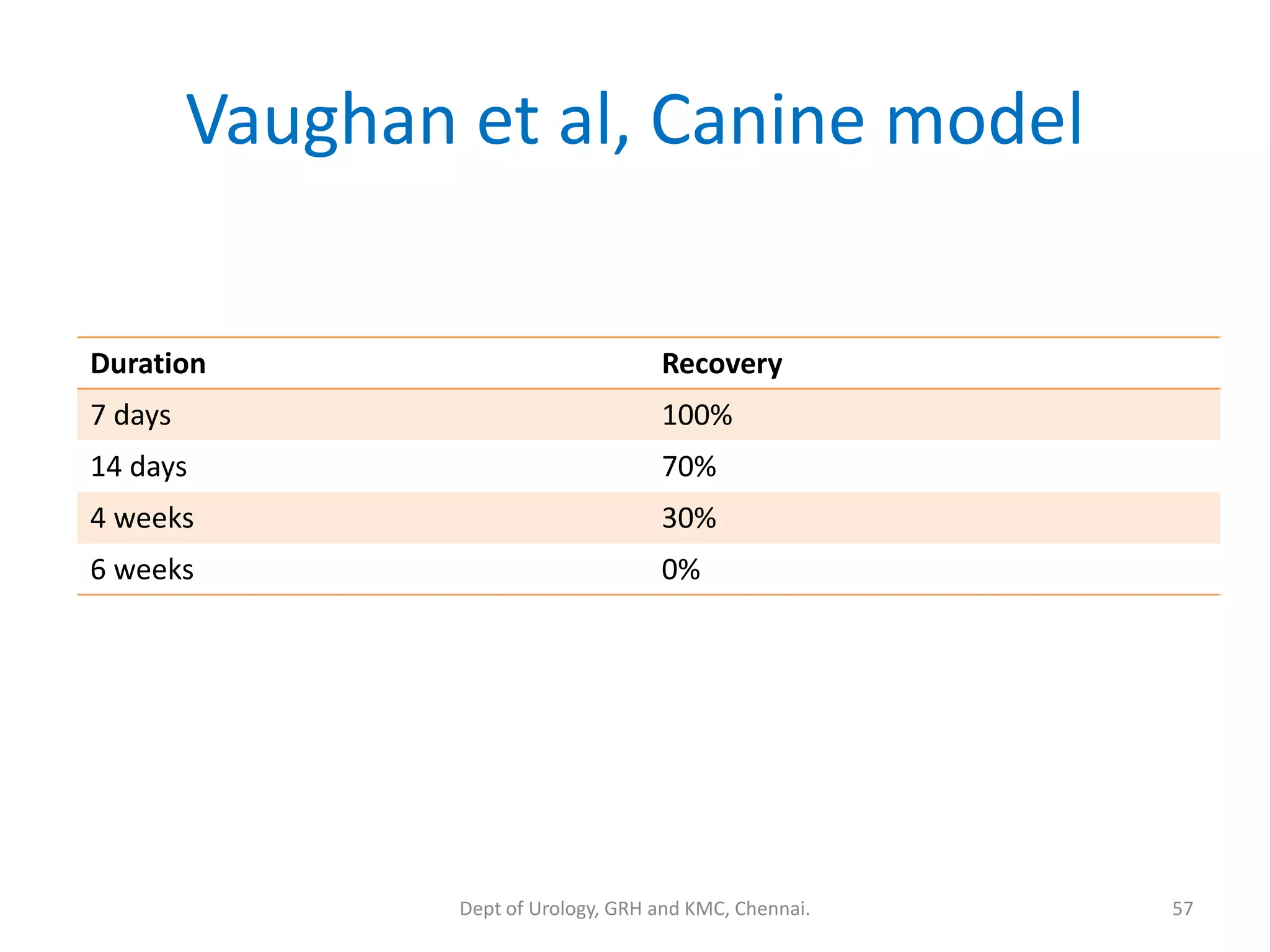
• Longer periods are associated with diminished GFR
return.
• It is due to persistent vasoconstriction of afferent
arteriole.
56
Dept of Urology, GRH and KMC, Chennai.
Vaughan et al, Canine model
Duration Recovery
7 days 100%
14 days 70%
4 weeks 30%
6 weeks 0%
57
Dept of Urology, GRH and KMC, Chennai.
58
Dept of Urology, GRH and KMC, Chennai.

Urinary obstruction pathophysiology

  • 1.
    Urinary Obstruction Pathophysiology Dept ofUrology Govt Royapettah Hospital and Kilpauk Medical College Chennai
  • 2.
    Moderators: Professors: • Prof. Dr.G. Sivasankar, M.S., M.Ch., • Prof. Dr. A. Senthilvel, M.S., M.Ch., Asst Professors: • Dr. J. Sivabalan, M.S., M.Ch., • Dr. R. Bhargavi, M.S., M.Ch., • Dr. S. Raju, M.S., M.Ch., • Dr. K. Muthurathinam, M.S., M.Ch., • Dr. D. Tamilselvan, M.S., M.Ch., • Dr. K. Senthilkumar, M.S., M.Ch. Dept of Urology, GRH and KMC, Chennai. 2
  • 3.
    Urinary Obstruction Urinary tractobstruction can result in permanent renal damage. The degree of injury depends on: • Severity of the obstruction. (Partial or complete, unilateral or bilateral), • Chronicity of the obstruction (acute vs chronic), • Baseline condition of the kidneys and • Other mitigating factors such as UTI. 3 Dept of Urology, GRH and KMC, Chennai.
  • 4.
    Causes of Urinary Obstruction 4 Dept ofUrology, GRH and KMC, Chennai.
  • 5.
    Congenital Renal • Polycystic kidney •Renal cyst • Peripelvic cyst • Ureteropelvic junction obstruction Ureter • Stricture • Ureterocele • Obstructing megaureter • Retrocaval ureter • Prune belly syndrome 5 Dept of Urology, GRH and KMC, Chennai.
  • 6.
    Neoplastic Renal • Wilms tumor •Renal cell carcinoma • Transitional cell carcinoma of the collecting system • Multiple myeloma Ureter • Primary carcinoma of ureter • Metastatic carcinoma 6 Dept of Urology, GRH and KMC, Chennai.
  • 7.
    Infective and Inflammatory Renal •Tuberculosis • Echinococcus infection Ureter • Tuberculosis • Amyloidosis • Schistosomiasis • Abscess • Ureteritis cystica • Endometriosis 7 Dept of Urology, GRH and KMC, Chennai.
  • 8.
    Renal and UretericCauses Metabolic • Calculi Miscellaneous • Sloughed papillae • Trauma • Renal artery aneurysm 8 Dept of Urology, GRH and KMC, Chennai.
  • 9.
    Lower Genitourinary Causes Congenital •Posterior urethral valve • Phimosis • Hydrocolpos Neoplastic • Bladder carcinoma • Prostate carcinoma • Carcinoma of urethra • Carcinoma of penis 9 Dept of Urology, GRH and KMC, Chennai.
  • 10.
    Lower Genitourinary Causes Inflammatory •Prostatitis • Paraurethral abscess Miscellaneous • Benign prostatic hypertrophy • Neurogenic bladder • Urethral stricture 10 Dept of Urology, GRH and KMC, Chennai.
  • 11.
    Other Miscellaneous • Retroperitonealfibrosis • Pelvic lipomatosis • Aortic aneurysm • Radiation therapy • Lymphocele • Trauma • Urinoma • Pregnancy • Radiofrequency ablation 11 Dept of Urology, GRH and KMC, Chennai.
  • 12.
    Physiology 12 Dept of Urology,GRH and KMC, Chennai.
  • 13.
    13 Dept of Urology,GRH and KMC, Chennai.
  • 14.
    Glomerular Filtration Rate TheGFR is determined by 1. The sum of the hydrostatic and colloid osmotic forces across the glomerular membrane, which gives the net filtration pressure, and 2. The glomerular capillary filtration coefficient, Kf GFR = Kf x Net filtration pressure 14 Dept of Urology, GRH and KMC, Chennai.
  • 15.
    Pressures In Filtration 1.Glomerular hydrostatic pressure, 2. Bowman’s capsule hydrostatic pressure, 3. Glomerular oncotic pressure, 4. Bowman’s capsule oncotic pressure. 15 Dept of Urology, GRH and KMC, Chennai.
  • 16.
    Net filtration pressure Netfiltration pressure represents: • The sum of the hydrostatic and colloid osmotic forces • That either favor or oppose filtration • Across the glomerular capillaries. 16 Dept of Urology, GRH and KMC, Chennai.
  • 17.
    Net Filtration Pressure 17 Deptof Urology, GRH and KMC, Chennai.
  • 18.
    18 Dept of Urology,GRH and KMC, Chennai.
  • 19.
    19 Dept of Urology,GRH and KMC, Chennai.
  • 20.
    Renal Plasma Flow 20 Deptof Urology, GRH and KMC, Chennai.
  • 21.
    Unilateral Urinary Obstruction •More commonly encountered. • Triphasic changes in RBF and ureteral pressure changes have been noted. • Phase 1 – one to two hours • Phase 2 – Three to four hours • Phase 3- Late phase 21 Dept of Urology, GRH and KMC, Chennai.
  • 22.
  • 23.
    Key Chemical Mediators IncreaseRBF RAS NO PGE2 23 Dept of Urology, GRH and KMC, Chennai.
  • 24.
    Renin Angiotensin System 24 Deptof Urology, GRH and KMC, Chennai.
  • 25.
    Unilateral Urinary Obstruction Decrease GFR Increase RBF Increase Filtration pressure More urinein Ureter Increased Ureteric Pressure UUO 25 Dept of Urology, GRH and KMC, Chennai.
  • 26.
    Unilateral Urinary Obstruction Decrease GFR Increase RBF Increase Filtration pressure More urinein Ureter Increased Ureteric Pressure UUO 26 Dept of Urology, GRH and KMC, Chennai.
  • 27.
    Triphasic Response 27 Dept ofUrology, GRH and KMC, Chennai.
  • 28.
    NOS expression 28 Dept ofUrology, GRH and KMC, Chennai.
  • 29.
    iNOS in LatePhase 29 Dept of Urology, GRH and KMC, Chennai.
  • 30.
    Late Phase • NOproduction declines with depletion of L-arginine substrate or • Decreased NOS activity or • Vascular endothelium becomes less responsive to the action of NO following UO. 30 Dept of Urology, GRH and KMC, Chennai.
  • 31.
    Unilateral Ureteric Obstruction 31 Deptof Urology, GRH and KMC, Chennai.
  • 32.
    Bilateral Ureteric Obstruction AfferentDilataion, Efferent Constriction ANP 32 Dept of Urology, GRH and KMC, Chennai.
  • 33.
    Bilateral Ureteric Obstruction PUreter ↑ GFR ↓ Hypervolemia Atrial Natriuretic Peptide Production Afferent Arteriolar Dilatation, Efferent Arteriolar Constriction, ↑ P Glomerular Capillaries. P Ureter ↑ 33 Dept of Urology, GRH and KMC, Chennai.
  • 34.
    Bilateral Ureteric Obstruction 34 Deptof Urology, GRH and KMC, Chennai.
  • 35.
    Cortical Vs JuxtamedullaryNephrons 35 Dept of Urology, GRH and KMC, Chennai.
  • 36.
    Cortical Vs JuxtaglomerularNephrons 36 Dept of Urology, GRH and KMC, Chennai.
  • 37.
    Cortical Blood FlowRedistribution 37 Dept of Urology, GRH and KMC, Chennai.
  • 38.
    Partial Ureteral Obstruction •Proper animal models not available. • Behaves mostly like UUO. • Generally there is decreased RBF and GFR. • Shift in blood flow from outer cortex to inner cortex is noted. 38 Dept of Urology, GRH and KMC, Chennai.
  • 39.
    Effects on Tubular Function 39 Dept ofUrology, GRH and KMC, Chennai.
  • 40.
    Urinary Concentrating Ability •AQP 2 expressed exclusively in Principal cells of collecting tubule and collecting duct. • It is vasopressin regulated. • Downregulated in BUO. • AQP 1, 3, 4 also decreased. • Downregulation causes polyuria after obstruction relief. • AQP 1 downregulation can cause polyuria upto 30 days. 40 Dept of Urology, GRH and KMC, Chennai.
  • 41.
    AQP 2 Expression 41 Deptof Urology, GRH and KMC, Chennai.
  • 42.
    AQP 2 Downregulation 42 Deptof Urology, GRH and KMC, Chennai.
  • 43.
    Sodium Transport • Downregulation of important Na transporters noted in both UUO and BUO. • Leads to salt wasting after relief of obstruction. • Natriuresis is greater in BUO than UUO. • PGE2 inhibits NaCl reabsorption acting on Na transporters in loop of henle and through AQP 2. 43 Dept of Urology, GRH and KMC, Chennai.
  • 44.
    Hydrogen ion transport •Obstruction causes urinary acidification. • Associated with decreased H+ secretion and defective HCO3- absorption. • Multiple acid-base transporters are downregulated. • Mediated by iNOS. 44 Dept of Urology, GRH and KMC, Chennai.
  • 45.
    Other Cation Transport •In UUO, K+ secretion is decreased. • K+ excretion increases with increase in GFR in BUO after relief, due to ANP. • Magnesium excretion is also increased after the release of UUO and BUO. 45 Dept of Urology, GRH and KMC, Chennai.
  • 46.
    46 Dept of Urology,GRH and KMC, Chennai.
  • 47.
    Gross Pathologic Changes 42Hrs • Dilatation of collecting system • Blunting of papillary tips with increase in kidney weight 7 Days • Further collecting system dilatation • Further increase in renal weight • Edema of renal parenchyma 21-28 • Cortex and medulla diffusely thinned 6 Wks • Enlarged cystic appearance, lower weight compared to normal kidney. 47 Dept of Urology, GRH and KMC, Chennai.
  • 48.
    Microscopic Changes Early Changes: •Massive tubular dilatation • Progressive tubulointerstitial fibrosis • Inflammatory cell infiltration • Apoptic renal tubular cell death Late Changes: • Glomerulosclerosis 48 Dept of Urology, GRH and KMC, Chennai.
  • 49.
    Early obstruction 49 Dept ofUrology, GRH and KMC, Chennai.
  • 50.
    Chronic Obstruction 50 Dept ofUrology, GRH and KMC, Chennai.
  • 51.
    Chronic Obstruction 51 Dept ofUrology, GRH and KMC, Chennai.
  • 52.
    Tubulointerstitial fibrosis 52 Dept ofUrology, GRH and KMC, Chennai.
  • 53.
    Clinical Impact of Urinary Obstruction 53 Deptof Urology, GRH and KMC, Chennai.
  • 54.
    Hypertension • Common withBUO than UUO • Mostly reversible after relief of obstruction • Due to volume mediated mechanism due to increased ANP and intravascular volume. • RAS is implicated for UUO associated hypertension. 54 Dept of Urology, GRH and KMC, Chennai.
  • 55.
    Compensatory Renal Growth •Seen in UUO, in contralateral kidney. • Influenced by age and degree and duration of obstruction. • Less prominent in partial UUO. • Increase in volume is due to hypertrophy not due to hyperplasia. • IGF 1 is involvedin renal hypertrophy. • Sex hormones may also have a role. 55 Dept of Urology, GRH and KMC, Chennai.
  • 56.
    Renal Recovery afterObstruction • Duration and severity of obstruction has significant influence. • Longer periods are associated with diminished GFR return. • It is due to persistent vasoconstriction of afferent arteriole. 56 Dept of Urology, GRH and KMC, Chennai.
  • 57.
    Vaughan et al,Canine model Duration Recovery 7 days 100% 14 days 70% 4 weeks 30% 6 weeks 0% 57 Dept of Urology, GRH and KMC, Chennai.
  • 58.
    58 Dept of Urology,GRH and KMC, Chennai.