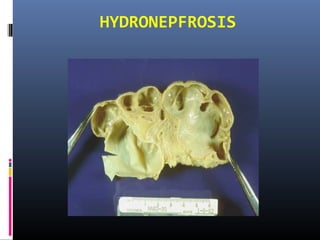
HYDRONEPFROSIS
Definition
Chronic aseptic dilatation of the pelvi-calyceal system due to partial
or complete intermittent obstruction.
Etiology
A- Unilateral
Stone
Stricture
External compression
B- Bilateral
1- Causes in both ureters: ex. Stones, stricture, reflux
2- Causes in the bladder / or bladder neck ex. Bladder tumor, BPH
3- Causes in the urethra ex. stricture
HYDRONEPFROSIS
Pathophysiology:
Nature of obstruction
A- Functional for example increased collagen deposition
at the UPJ leads to reduced distensilbility
B- Organic
- Partial or complete
- Acute or chronic
Impedance to flow of urine higher than normal pressure
above the site of obstruction  Chronic progressive
dilation of pelvi-collecting system Vascular
compression ischemic atrophy  loss of kidney
function.
HYDRONEPFROSIS
Causes of low intra-pelvic pressure are:
1-Protective arterial vasoconstriction
2-Backflow reflux of the intrapelvic contents into the
renal tubules (pyelotubular)rena , the renal veins
(pyelovenous) or the iterstitium of the kidney (-
pyelointerstitial) .
The first renal function to be affected is urine
concentrating power  increasd urine output.
HYDRONEPFROSIS
Clinical picture
Symptoms:
Pain colicky or heaviness in the flank
Swelling
Hematuria usually mild
Signs:
Abdominal swelling
S&S of the cause of hydronephrosis eg; bladder mass,
BPH,etc
HYDRONEPFROSIS
Investigations:
1-Laboratory:
-Urine analysis
-Renal function tests
2-Radiologic:
-Plain X-ray film:
Soft tissue shadow of the kidney
? Stone
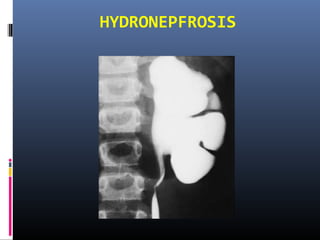
-IVP:
Loss of waist flattening clubbing ballooning
Thin parenchyma
-Ultrasound
Dilated system- Thickness of the remaining parenchyma
HYDRONEPFROSIS
HYDRONEPFROSIS
TREATMENT
A- If the kidney function is good
 treat the cause
B- If the kidney function is bad
 preliminary diversion (Nephrostomy)
 treat the cause
C- Non-functioning kidney (<10% by isotope)
 Nephrectomy
HYDRONEPFROSIS
RENAL FAILURE
The role of urologist:
1- To rule out a correctable obstruction
2- Urologic surgery FOR chronic renal failure of
obstructive cause
ACUTE RENAL FAILURE
Definition: Sudden renal deterioration over a
period of hours to days
Daily increase of serum creatinine of >0.5mg/dl
Oliguria : ( Urine output </= 400ml/24 hours )
Anuria : ( Total cessation of urine output )
ACUTE RENAL FAILURE
Classification and Causes
I- Prerenal :
A. Volume depletion
- Heamorrhage/ Burns/ Third space losses e.g peritonitis
B. Circulatory
- CHF, Sepsis, Shock, Cirrhosis with ascitis
C. Local renal ischeamia
- Renal artery occlusion/ Renal vein occlusion
II- Renal
Acute tubular necrosis/ Acute glomerulonephritis
III- Postrenal
- Bilateral ureteric obstruction
- Unilateral obstruction of a solitary kidney
ACUTE RENAL FAILURE
Drugs Associated with ARF
 Aminoglucosides
 Penicillin
 Sulpha
 Cyclosporin
 Certain anaesthetics
 Iodinated contrast media
 Non-Steroidal anti-inflammatory drugs
 Furosemide and Thiazide
 Captopril
 Cimetidine
ACUTE RENAL FAILURE
Diagnosis of Anuria & acute Retention
*Anuria = Empty bladder
* Acute Urine Retention = Full bladder
Differentiation by:
1. Physical examination
2. Abdominal Ultrasound
3. Urethral catheterization
ACUTE RENAL FAILURE
Treatment
Should be focused on:
1. Reversing the underlying cause
2. Preventing further renal injury
3. Correcting fluid and electrolyte imbalance
4. Providing supportive measures
If ARF is severe and prolonged, it is best treated
with peritoneal dialysis or haemodialysis.

CHRONIC RENAL FAILURE
Definition:
 (Slowly progressive decrease in the GFR and
tubular function)
 When the patient requires renal replacement
therapy End stage renal disease.
Causes:
-DM - Hypertension
- Glomerulonephritis - Congenital diseases
- Obstructive uropathy -Interstitial nephritis
- Chronic pyelonephritis.
CHRONIC RENAL FAILURE
Clinical Picture of CRF
1. Constitutional symptoms
2. GIT symptoms
3. Cardiovascular symptoms
4. Hematological symptoms
5. Neurological symptoms
6. Endocrinal symptoms
7. Renal osteodystrophy
8. Acquired cystic kidney disease
9. Erectile dysfunction
CHRONIC RENAL FAILURE
Treatment of CRF
Is the responsibility of the Nephrologist
1-Treatment of Anaemia
2- Correction of Coagulopathy
3- Protein restriction
4- Potassium restriction
5- Sodium restriction
6- Fluid intake
7- Treatment of Ascitis
8-Treatment of Renal osteodystrophy
CHRONIC RENAL FAILURE
Dialysis “Nephrologist “
Definition:
(Is any process that changes the concentration of solutes
in the plasma by exposure to a second solution across a
semi- permeable membrane)
Indications:
* Urea nitrogen > 100 mg / DL
* Creatinine Clearance < 0.1 ml / min/ Kg
Types:
A. Peritoneal dialysis
B. Haemodialysis
RENAL TRANSPLANTATION
Requirements:
1. Donor
- Living related kidney donor
- Cadaveric renal donor
2. Recipient (ESRD)
3. Pretransplantation work up
4. Immunologic work up
5. Surgical technique
6. Postoperative management
RENAL TRANSPLANTATION
Complications:
1. Graft rejection
2. Vascular complications
3. Urologic complications
4. Complications of drugs (Cyclosporin)
Usually, the graft works for about 10 years

9 hn,rf,transplant 2003

  • 2.
    HYDRONEPFROSIS Definition Chronic aseptic dilatationof the pelvi-calyceal system due to partial or complete intermittent obstruction. Etiology A- Unilateral Stone Stricture External compression B- Bilateral 1- Causes in both ureters: ex. Stones, stricture, reflux 2- Causes in the bladder / or bladder neck ex. Bladder tumor, BPH 3- Causes in the urethra ex. stricture
  • 3.
    HYDRONEPFROSIS Pathophysiology: Nature of obstruction A-Functional for example increased collagen deposition at the UPJ leads to reduced distensilbility B- Organic - Partial or complete - Acute or chronic Impedance to flow of urine higher than normal pressure above the site of obstruction  Chronic progressive dilation of pelvi-collecting system Vascular compression ischemic atrophy  loss of kidney function.
  • 4.
    HYDRONEPFROSIS Causes of lowintra-pelvic pressure are: 1-Protective arterial vasoconstriction 2-Backflow reflux of the intrapelvic contents into the renal tubules (pyelotubular)rena , the renal veins (pyelovenous) or the iterstitium of the kidney (- pyelointerstitial) . The first renal function to be affected is urine concentrating power  increasd urine output.
  • 5.
    HYDRONEPFROSIS Clinical picture Symptoms: Pain colickyor heaviness in the flank Swelling Hematuria usually mild Signs: Abdominal swelling S&S of the cause of hydronephrosis eg; bladder mass, BPH,etc
  • 6.
    HYDRONEPFROSIS Investigations: 1-Laboratory: -Urine analysis -Renal functiontests 2-Radiologic: -Plain X-ray film: Soft tissue shadow of the kidney ? Stone -IVP: Loss of waist flattening clubbing ballooning Thin parenchyma -Ultrasound Dilated system- Thickness of the remaining parenchyma
  • 7.
  • 8.
    HYDRONEPFROSIS TREATMENT A- If thekidney function is good  treat the cause B- If the kidney function is bad  preliminary diversion (Nephrostomy)  treat the cause C- Non-functioning kidney (<10% by isotope)  Nephrectomy
  • 9.
  • 10.
    RENAL FAILURE The roleof urologist: 1- To rule out a correctable obstruction 2- Urologic surgery FOR chronic renal failure of obstructive cause
  • 11.
    ACUTE RENAL FAILURE Definition:Sudden renal deterioration over a period of hours to days Daily increase of serum creatinine of >0.5mg/dl Oliguria : ( Urine output </= 400ml/24 hours ) Anuria : ( Total cessation of urine output )
  • 12.
    ACUTE RENAL FAILURE Classificationand Causes I- Prerenal : A. Volume depletion - Heamorrhage/ Burns/ Third space losses e.g peritonitis B. Circulatory - CHF, Sepsis, Shock, Cirrhosis with ascitis C. Local renal ischeamia - Renal artery occlusion/ Renal vein occlusion II- Renal Acute tubular necrosis/ Acute glomerulonephritis III- Postrenal - Bilateral ureteric obstruction - Unilateral obstruction of a solitary kidney
  • 13.
    ACUTE RENAL FAILURE DrugsAssociated with ARF  Aminoglucosides  Penicillin  Sulpha  Cyclosporin  Certain anaesthetics  Iodinated contrast media  Non-Steroidal anti-inflammatory drugs  Furosemide and Thiazide  Captopril  Cimetidine
  • 14.
    ACUTE RENAL FAILURE Diagnosisof Anuria & acute Retention *Anuria = Empty bladder * Acute Urine Retention = Full bladder Differentiation by: 1. Physical examination 2. Abdominal Ultrasound 3. Urethral catheterization
  • 15.
    ACUTE RENAL FAILURE Treatment Shouldbe focused on: 1. Reversing the underlying cause 2. Preventing further renal injury 3. Correcting fluid and electrolyte imbalance 4. Providing supportive measures If ARF is severe and prolonged, it is best treated with peritoneal dialysis or haemodialysis. 
  • 16.
    CHRONIC RENAL FAILURE Definition: (Slowly progressive decrease in the GFR and tubular function)  When the patient requires renal replacement therapy End stage renal disease. Causes: -DM - Hypertension - Glomerulonephritis - Congenital diseases - Obstructive uropathy -Interstitial nephritis - Chronic pyelonephritis.
  • 17.
    CHRONIC RENAL FAILURE ClinicalPicture of CRF 1. Constitutional symptoms 2. GIT symptoms 3. Cardiovascular symptoms 4. Hematological symptoms 5. Neurological symptoms 6. Endocrinal symptoms 7. Renal osteodystrophy 8. Acquired cystic kidney disease 9. Erectile dysfunction
  • 18.
    CHRONIC RENAL FAILURE Treatmentof CRF Is the responsibility of the Nephrologist 1-Treatment of Anaemia 2- Correction of Coagulopathy 3- Protein restriction 4- Potassium restriction 5- Sodium restriction 6- Fluid intake 7- Treatment of Ascitis 8-Treatment of Renal osteodystrophy
  • 19.
    CHRONIC RENAL FAILURE Dialysis“Nephrologist “ Definition: (Is any process that changes the concentration of solutes in the plasma by exposure to a second solution across a semi- permeable membrane) Indications: * Urea nitrogen > 100 mg / DL * Creatinine Clearance < 0.1 ml / min/ Kg Types: A. Peritoneal dialysis B. Haemodialysis
  • 20.
    RENAL TRANSPLANTATION Requirements: 1. Donor -Living related kidney donor - Cadaveric renal donor 2. Recipient (ESRD) 3. Pretransplantation work up 4. Immunologic work up 5. Surgical technique 6. Postoperative management
  • 21.
    RENAL TRANSPLANTATION Complications: 1. Graftrejection 2. Vascular complications 3. Urologic complications 4. Complications of drugs (Cyclosporin) Usually, the graft works for about 10 years