Elbow Pain
Professor Hamdy Koryem;MD
2012
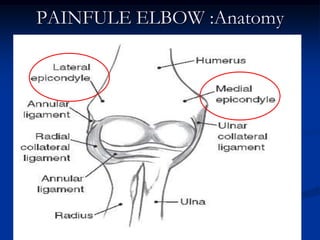
PAINFULE ELBOW :Anatomy
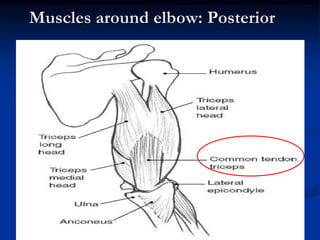
Muscles around elbow: Posterior
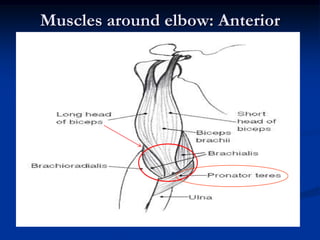
Muscles around elbow: Anterior
Elbow pain may be due to
Generalized causes
OR
Localized causes
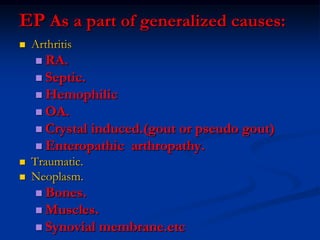
EP As a part of generalized causes:
 Arthritis
 RA.
 Septic.
 Hemophilic
 OA.
 Crystal induced.(gout or pseudo gout)
 Enteropathic arthropathy.
 Traumatic.
 Neoplasm.
 Bones.
 Muscles.
 Synovial membrane.etc
OR
Localized causes for EP
MEDIAL EPICONDYLITIS
Synonyms
• Golfer’s elbow • Little leaguer’s elbow (children)
Medial epicondylitis:
Inflammation of the common flexor tendon.
Little leaguer’s elbow: (children)
Hypertrophy of the medial epicondyle with
micro tearing and fragmentation of the medial
epicondylar apophysis.
MEDIAL EPICONDYLITIS
Mechanism
A repetitive valgus stress commonly seen in
the throwing motion.
• The back and downward motion of a golf
swing just prior to the impact of the ball.
Clinical presentation:
Tenderness over the medial epicondyle.
• Pain may be reproduced with wrist flexion
and pronation.
Treatment:
• Conservative:
 Rest, ice, NSAIDs, immobilization.
• Surgical pinning:
 Reserved for an unstable elbow joint.
•LATERAL EPICONDYLITIS
Synonyms :Tennis elbow
 Mechanism :
Overuse and overload of the extensor and
supinator tendons seen in Sports or Work
that require repetitive extension elbow
movements.
Pathology:
Micro-tearing of the extensor carpi radialis brevis
muscle.
LATERAL EPICONDYLITIS
CLINICAL:
1. Tenderness just distal to the lateral epicondyle
at the common extensor origin.
2. Pain and weakness in hand grip strength.
3. Pain can be produced by Cozens test.
Cozens test
Passive extension of the elbow
with forced flexion of the wrist
may precipitate pain at the
lateral epicondyle
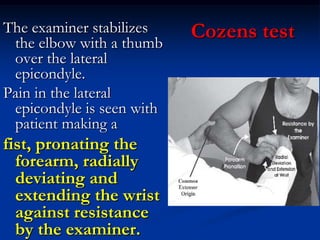
Cozens testThe examiner stabilizes
the elbow with a thumb
over the lateral
epicondyle.
Pain in the lateral
epicondyle is seen with
patient making a
fist, pronating the
forearm, radially
deviating and
extending the wrist
against resistance
by the examiner.
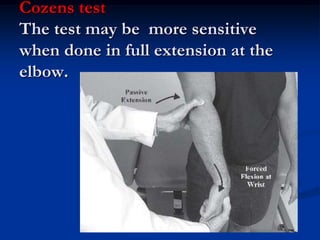
Cozens test
The test may be more sensitive
when done in full extension at the
elbow.
LATERAL EPICONDYLITIS
Treatment
Conservative:
 Relative rest, ice, NSAIDs for 10–14 days
 Physical therapy (modalities)
 Splinting, bands
 Local Corticosteroid injection
 Correct improper technique
Operative:
 ECRB debridement
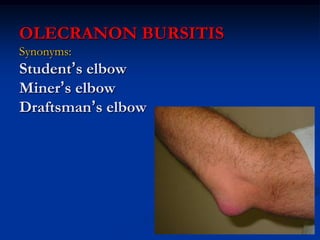
OLECRANON BURSITIS
Synonyms:
Student’s elbow
Miner’s elbow
Draftsman’s elbow
OLECRANON BURSITIS
Mechanism
 Repetitive trauma,
 Inflammatory disorder (gout, pseudogout,
RA)
Pathology
 Inflammation of the bursa located between the
olecranon and skin
Clinical
 Swelling, pain, and a decreased range of motion in the
posterior aspect of the elbow
 A hot, erythematous elbow may indicate infection
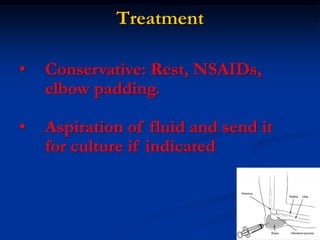
Treatment
• Conservative: Rest, NSAIDs,
elbow padding.
• Aspiration of fluid and send it
for culture if indicated
DISLOCATION OF THE ELBOW
General
 The most common type of dislocation
in children and the second most
common type in adults following
shoulder dislocation.
 Sports activities account for almost
50% of these injuries
DISLOCATION OF THE
ELBOW
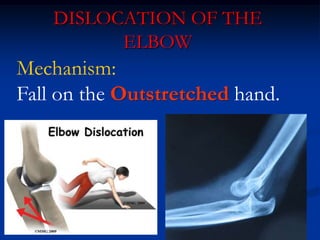
Mechanism:
Fall on the Outstretched hand.
DISLOCATION OF THE ELBOW
Clinical
 Dislocation can be anterior or posterior with
posterior being the most common, occurring
98% of the time .
 Associated injuries include fracture of the radial
head, injury to the brachial artery and median
nerve.
DISLOCATION OF THE ELBOW
Symptoms
 Inability to bend the elbow.
 Pain in the shoulder and wrist
On physical exam:
The most important part of the exam is the
neurovascular evaluation of the radial artery, and
median, ulnar and radial nerves
 Plain AP and lateral radiographs
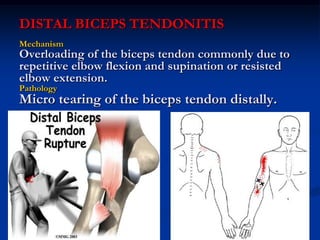
DISTAL BICEPS TENDONITIS
Mechanism
Overloading of the biceps tendon commonly due to
repetitive elbow flexion and supination or resisted
elbow extension.
Pathology
Micro tearing of the biceps tendon distally.
DISTAL BICEPS TENDONITIS
Complication
 Biceps tendon avulsion
Clinical
 Insidious onset of pain in the ante-cubital
fossa usually after an eccentric overload
 Audible snap with an obvious deformity,
swelling, and ecchymosis if an avulsion is
suspected
DISTAL BICEPS TENDONITIS
Treatment
Conservative
 Relative rest, ice, NSAIDs.
 Physical therapy: Modalities.
 Correct improper technique.
Surgical:
 Reattachment.
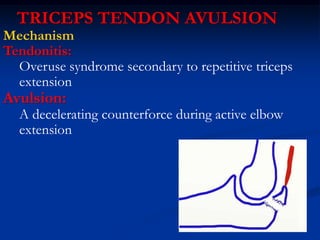
TRICEPS TENDON AVULSION
Mechanism
Tendonitis:
Overuse syndrome secondary to repetitive triceps
extension
Avulsion:
A decelerating counterforce during active elbow
extension
TRICEPS TENDONITIS/AVULSION
Clinical
 Posterior elbow pain with tenderness at the
insertion of the triceps tendon
 Pain with resistive elbow extension or
sudden loss of extension with a palpable
defect in the triceps tendon (avulsion)
Imaging
 Plain films to rule out other causes, if
indicated
TRICEPS TENDONITIS/AVULSION
Treatment
 Conservative
 Surgical:
Reattachment.
VALGUS EXTENSION OVERLOAD
SYNDROME OF THE ELBOW
Synonyms
Boxer’s elbow
Boxer’s elbow
Mechanism
An overuse disorder caused by repetitive and
uncontrolled valgus forces demonstrated
during the throwing motion, especially in late
acceleration and deceleration.
Also may be seen in boxers.
Pathology
Osteophyte and loose body formation occurs
secondary to a repetitive friction of the
olecranon against the fossa.
Boxer’s elbow
Clinical
 Posterior elbow pain with lack of full extension
 Catching or locking during elbow extension
Imaging
 Plain films: AP/lateral may show a loose body or
osteophyte formation at the olecranon
Treatment
 Conservative
 Surgical: Removal of the loose body
ULNAR COLLATERAL LIGAMENT
SPRAIN
Mechanism
 A repetitive valgus stress occurring across
the elbow during the acceleration phase of
throwing.
Pathology
 Inflammation to the anterior band of the
ulnar collateral ligament.
ULNAR COLLATERAL LIGAMENT SPRAIN
Clinical
 Significant medial elbow pain occurring after the
throwing motion
 A pop or click may be heard precipitating the pain
 Medial pain or instability on valgus stress with the
elbow, flexed 20–30 if the UCL is torn.
Provocative Test
 Valgus stress test:
Tenderness over the medial aspect of the elbow which
may be increased with a valgus stress.
Imaging
 Plain films may reveal calcification and spurring along
the UCL
 Valgus stress radiographs demonstrating a 2 mm
joint space suggestive of UCL injury
Treatment
Conservative
1. Rest, ice,
2. NSAIDs
3. Rehabilitation program for strengthening and stretching
Surgical reconstruction if needed
RADIAL COLLATERAL LIGAMENT (RCL)
SPRAIN
Mechanism
 Elbow dislocation from a traumatic event
Clinical
 Recurrent locking or clicking of the elbow with
extension and supination
 Lateral pain or instability on varus stress with the elbow
flexed 20–30 if the RCL is torn
Provocative test
 Varus stress test
Tenderness over the lateral aspect of the elbow, which
may be increased with a varus stress.
Imaging
 Varus stress radiographs demonstrating a 2 mm joint
space suggestive of RCL injury
Treatment
Conservative:
 Rest, ice, NSAIDs
 Rehabilitation program for strengthening and stretching
 Establishing return to play criteria
Surgical reconstruction if needed.
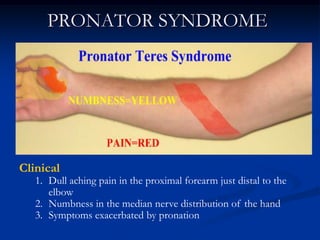
PRONATOR SYNDROME
Clinical
1. Dull aching pain in the proximal forearm just distal to the
elbow
2. Numbness in the median nerve distribution of the hand
3. Symptoms exacerbated by pronation
PRONATOR SYNDROME
Mechanism
Median nerve compression at the elbow by the
following structures:
1. Ligament .
2. Supracondylar spur.
3. Fibrosis.
4. Pronator teres muscle.
5. Between the two heads of the flexor
digitorum superficialis (FDS).
PRONATOR SYNDROME
Imaging
Plain films: Rule out spur
EMG/NCS
Treatment
Conservative
 Modification of activities
 Avoid aggravating factors
 Stretching and strengthening program
Surgical:
Release of the median nerve at the location of the
compression
ENTRAPMENT OF THE ULNAR
NERVE
Synonyms
Cubital tunnel syndrome
Clinical
 An aching pain with paraesthesias, which may radiate distally to
the fourth and fifth digits
 Positive Tinel’s sign at the elbow
 Weakness in the ulnar musculature of the hand, demonstrated
by a weak grip strength and atrophy and poor hand coordination.
Mechanism
 A hyper mobility of the ulnar nerve, excessive valgus force or
loose body/osteophyte formation, which aggravates the integrity
of the ulnar nerve at the elbow.
Pathology
 Hyperirritability of the ulnar nerve
Cubital tunnel syndrome
EMG/NCS
Above and below the elbow
Treatment
Conservative
Relative rest, NSAIDs, elbow protection
(splinting) and technique modification
OSTEOCHONDROSIS DISSECANS
OF THE ELBOW
Synonyms
Panner’s disease.
(involving epiphysial aseptic necrosis of the
capitellum)
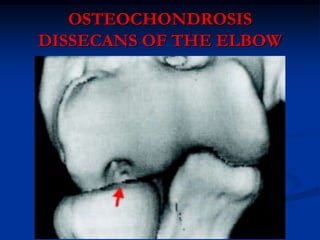
OSTEOCHONDROSIS
DISSECANS OF THE ELBOW
FRACTURES
 FRACTURE OF THE HUMERAL SHAFT
 FRACTURE OF THE DISTAL
HUMERUS
 RADIAL HEAD FRACTURE
 FRACTURE OF THE OLECRANON

Presentation elbow

  • 1.
  • 2.
  • 3.
  • 4.
  • 5.
    Elbow pain maybe due to Generalized causes OR Localized causes
  • 6.
    EP As apart of generalized causes:  Arthritis  RA.  Septic.  Hemophilic  OA.  Crystal induced.(gout or pseudo gout)  Enteropathic arthropathy.  Traumatic.  Neoplasm.  Bones.  Muscles.  Synovial membrane.etc
  • 7.
  • 8.
    MEDIAL EPICONDYLITIS Synonyms • Golfer’selbow • Little leaguer’s elbow (children) Medial epicondylitis: Inflammation of the common flexor tendon. Little leaguer’s elbow: (children) Hypertrophy of the medial epicondyle with micro tearing and fragmentation of the medial epicondylar apophysis.
  • 9.
    MEDIAL EPICONDYLITIS Mechanism A repetitivevalgus stress commonly seen in the throwing motion. • The back and downward motion of a golf swing just prior to the impact of the ball. Clinical presentation: Tenderness over the medial epicondyle. • Pain may be reproduced with wrist flexion and pronation.
  • 10.
    Treatment: • Conservative:  Rest,ice, NSAIDs, immobilization. • Surgical pinning:  Reserved for an unstable elbow joint.
  • 11.
    •LATERAL EPICONDYLITIS Synonyms :Tenniselbow  Mechanism : Overuse and overload of the extensor and supinator tendons seen in Sports or Work that require repetitive extension elbow movements. Pathology: Micro-tearing of the extensor carpi radialis brevis muscle.
  • 12.
    LATERAL EPICONDYLITIS CLINICAL: 1. Tendernessjust distal to the lateral epicondyle at the common extensor origin. 2. Pain and weakness in hand grip strength. 3. Pain can be produced by Cozens test.
  • 13.
    Cozens test Passive extensionof the elbow with forced flexion of the wrist may precipitate pain at the lateral epicondyle
  • 14.
    Cozens testThe examinerstabilizes the elbow with a thumb over the lateral epicondyle. Pain in the lateral epicondyle is seen with patient making a fist, pronating the forearm, radially deviating and extending the wrist against resistance by the examiner.
  • 15.
    Cozens test The testmay be more sensitive when done in full extension at the elbow.
  • 16.
    LATERAL EPICONDYLITIS Treatment Conservative:  Relativerest, ice, NSAIDs for 10–14 days  Physical therapy (modalities)  Splinting, bands  Local Corticosteroid injection  Correct improper technique Operative:  ECRB debridement
  • 17.
  • 18.
    OLECRANON BURSITIS Mechanism  Repetitivetrauma,  Inflammatory disorder (gout, pseudogout, RA) Pathology  Inflammation of the bursa located between the olecranon and skin Clinical  Swelling, pain, and a decreased range of motion in the posterior aspect of the elbow  A hot, erythematous elbow may indicate infection
  • 19.
    Treatment • Conservative: Rest,NSAIDs, elbow padding. • Aspiration of fluid and send it for culture if indicated
  • 20.
    DISLOCATION OF THEELBOW General  The most common type of dislocation in children and the second most common type in adults following shoulder dislocation.  Sports activities account for almost 50% of these injuries
  • 21.
  • 22.
    DISLOCATION OF THEELBOW Clinical  Dislocation can be anterior or posterior with posterior being the most common, occurring 98% of the time .  Associated injuries include fracture of the radial head, injury to the brachial artery and median nerve.
  • 23.
    DISLOCATION OF THEELBOW Symptoms  Inability to bend the elbow.  Pain in the shoulder and wrist On physical exam: The most important part of the exam is the neurovascular evaluation of the radial artery, and median, ulnar and radial nerves  Plain AP and lateral radiographs
  • 24.
    DISTAL BICEPS TENDONITIS Mechanism Overloadingof the biceps tendon commonly due to repetitive elbow flexion and supination or resisted elbow extension. Pathology Micro tearing of the biceps tendon distally.
  • 25.
    DISTAL BICEPS TENDONITIS Complication Biceps tendon avulsion Clinical  Insidious onset of pain in the ante-cubital fossa usually after an eccentric overload  Audible snap with an obvious deformity, swelling, and ecchymosis if an avulsion is suspected
  • 26.
    DISTAL BICEPS TENDONITIS Treatment Conservative Relative rest, ice, NSAIDs.  Physical therapy: Modalities.  Correct improper technique. Surgical:  Reattachment.
  • 27.
    TRICEPS TENDON AVULSION Mechanism Tendonitis: Overusesyndrome secondary to repetitive triceps extension Avulsion: A decelerating counterforce during active elbow extension
  • 28.
    TRICEPS TENDONITIS/AVULSION Clinical  Posteriorelbow pain with tenderness at the insertion of the triceps tendon  Pain with resistive elbow extension or sudden loss of extension with a palpable defect in the triceps tendon (avulsion) Imaging  Plain films to rule out other causes, if indicated
  • 29.
  • 30.
    VALGUS EXTENSION OVERLOAD SYNDROMEOF THE ELBOW Synonyms Boxer’s elbow
  • 31.
    Boxer’s elbow Mechanism An overusedisorder caused by repetitive and uncontrolled valgus forces demonstrated during the throwing motion, especially in late acceleration and deceleration. Also may be seen in boxers. Pathology Osteophyte and loose body formation occurs secondary to a repetitive friction of the olecranon against the fossa.
  • 32.
    Boxer’s elbow Clinical  Posteriorelbow pain with lack of full extension  Catching or locking during elbow extension Imaging  Plain films: AP/lateral may show a loose body or osteophyte formation at the olecranon Treatment  Conservative  Surgical: Removal of the loose body
  • 33.
    ULNAR COLLATERAL LIGAMENT SPRAIN Mechanism A repetitive valgus stress occurring across the elbow during the acceleration phase of throwing. Pathology  Inflammation to the anterior band of the ulnar collateral ligament.
  • 34.
    ULNAR COLLATERAL LIGAMENTSPRAIN Clinical  Significant medial elbow pain occurring after the throwing motion  A pop or click may be heard precipitating the pain  Medial pain or instability on valgus stress with the elbow, flexed 20–30 if the UCL is torn. Provocative Test  Valgus stress test: Tenderness over the medial aspect of the elbow which may be increased with a valgus stress.
  • 35.
    Imaging  Plain filmsmay reveal calcification and spurring along the UCL  Valgus stress radiographs demonstrating a 2 mm joint space suggestive of UCL injury Treatment Conservative 1. Rest, ice, 2. NSAIDs 3. Rehabilitation program for strengthening and stretching Surgical reconstruction if needed
  • 36.
    RADIAL COLLATERAL LIGAMENT(RCL) SPRAIN Mechanism  Elbow dislocation from a traumatic event Clinical  Recurrent locking or clicking of the elbow with extension and supination  Lateral pain or instability on varus stress with the elbow flexed 20–30 if the RCL is torn Provocative test  Varus stress test Tenderness over the lateral aspect of the elbow, which may be increased with a varus stress.
  • 37.
    Imaging  Varus stressradiographs demonstrating a 2 mm joint space suggestive of RCL injury Treatment Conservative:  Rest, ice, NSAIDs  Rehabilitation program for strengthening and stretching  Establishing return to play criteria Surgical reconstruction if needed.
  • 38.
    PRONATOR SYNDROME Clinical 1. Dullaching pain in the proximal forearm just distal to the elbow 2. Numbness in the median nerve distribution of the hand 3. Symptoms exacerbated by pronation
  • 39.
    PRONATOR SYNDROME Mechanism Median nervecompression at the elbow by the following structures: 1. Ligament . 2. Supracondylar spur. 3. Fibrosis. 4. Pronator teres muscle. 5. Between the two heads of the flexor digitorum superficialis (FDS).
  • 40.
    PRONATOR SYNDROME Imaging Plain films:Rule out spur EMG/NCS Treatment Conservative  Modification of activities  Avoid aggravating factors  Stretching and strengthening program Surgical: Release of the median nerve at the location of the compression
  • 41.
    ENTRAPMENT OF THEULNAR NERVE Synonyms Cubital tunnel syndrome
  • 42.
    Cubital tunnel syndrome Clinical An aching pain with paraesthesias, which may radiate distally to the fourth and fifth digits  Positive Tinel’s sign at the elbow  Weakness in the ulnar musculature of the hand, demonstrated by a weak grip strength and atrophy and poor hand coordination. Mechanism  A hyper mobility of the ulnar nerve, excessive valgus force or loose body/osteophyte formation, which aggravates the integrity of the ulnar nerve at the elbow. Pathology  Hyperirritability of the ulnar nerve
  • 43.
    Cubital tunnel syndrome EMG/NCS Aboveand below the elbow Treatment Conservative Relative rest, NSAIDs, elbow protection (splinting) and technique modification
  • 44.
    OSTEOCHONDROSIS DISSECANS OF THEELBOW Synonyms Panner’s disease. (involving epiphysial aseptic necrosis of the capitellum)
  • 45.
  • 46.
    FRACTURES  FRACTURE OFTHE HUMERAL SHAFT  FRACTURE OF THE DISTAL HUMERUS  RADIAL HEAD FRACTURE  FRACTURE OF THE OLECRANON