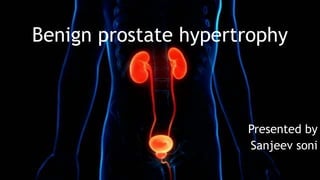
Benign prostate hypertrophy
Presented by
Sanjeev soni
Introduction
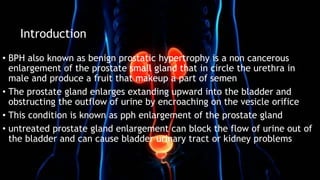
• BPH also known as benign prostatic hypertrophy is a non cancerous
enlargement of the prostate small gland that in circle the urethra in
male and produce a fruit that makeup a part of semen
• The prostate gland enlarges extanding upward into the bladder and
obstructing the outflow of urine by encroaching on the vesicle orifice
• This condition is known as pph enlargement of the prostate gland
• untreated prostate gland enlargement can block the flow of urine out of
the bladder and can cause bladder urinary tract or kidney problems
Definition
• Benign prostate hypertrophy is a enlargement of prostate gland which is
characterized by blocking of urine flow
• OR
• Benign prostatic hyperplasia (BPH) — also called prostate gland
enlargement — is a common condition as men get older.
• An enlarged prostate gland can cause uncomfortable urinary symptoms,
such as blocking the flow of urine out of the bladder. It can also cause
bladder, urinary tract or kidney problems
Anatomy & Physiology of excretory system
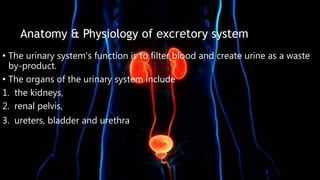
• The urinary system's function is to filter blood and create urine as a waste
by-product.
• The organs of the urinary system include
1. the kidneys,
2. renal pelvis,
3. ureters, bladder and urethra
• Two kidneys. This pair of purplish-brown organs is located below the ribs
toward the middle of the back
• The kidneys remove urea from the blood through tiny filtering units
nephrons. Each nephron consists of a ball formed of small blood
capillaries, called a glomerulus, and a small tube called a renal tubule.
Anatomy & Physiology of excretory system
• Two ureters. These narrow tubes carry urine from the kidneys to the
bladder.
• Muscles in the ureter walls continually tighten and relax forcing urine
downward, away from the kidneys
Anatomy & Physiology of excretory system
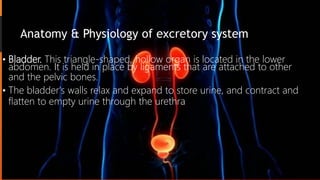
• Bladder. This triangle-shaped, hollow organ is located in the lower
abdomen. It is held in place by ligaments that are attached to other
and the pelvic bones.
• The bladder's walls relax and expand to store urine, and contract and
flatten to empty urine through the urethra
Anatomy & Physiology of excretory system
• Two sphincter muscles. These circular muscles help keep urine from
leaking by closing tightly like a rubber band around the opening of the
bladder
Anatomy & Physiology of excretory system
• Urethra. This tube allows urine to pass outside the body. The brain signals
the bladder muscles to tighten, which squeezes urine out of the bladder.
• At the same time, the brain signals the sphincter muscles to relax to let
urine exit the bladder through the urethra.
• When all the signals occur in the correct order, normal urination occurs
Anatomy & Physiology of excretory system
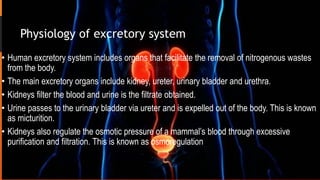
Physiology of excretory system
• Human excretory system includes organs that facilitate the removal of nitrogenous wastes
from the body.
• The main excretory organs include kidney, ureter, urinary bladder and urethra.
• Kidneys filter the blood and urine is the filtrate obtained.
• Urine passes to the urinary bladder via ureter and is expelled out of the body. This is known
as micturition.
• Kidneys also regulate the osmotic pressure of a mammal’s blood through excessive
purification and filtration. This is known as osmoregulation
Etiology and risk factors
• Idiopathic- Exact cause is unknown
• Hormonal alteration-Advancing age the amount of the male hormone
testosterone decreases relative to the amount of circulating estrogen the
main female Reproductive hormone which also circulates in the male
• Aging-prostate -Gland enlargement rearly causes Sign and symptoms in
men younger than 40 but about half the man is there 60 is have some
sign and symptoms
• Family history- Having a blood relative such as father or brother with
prostate problems means you are more likely to have problems as well
• Effects of chronic inflammation
Etiology and risk factors
Pathophysiology
• Due to etiological factor hormonal alterations advance age and heredity
• Normally thin and fibrous outer of prostate become spongy and thick due
to enlargement process
• Hypertrophy (Increase size of the cell) of prostate compress urinary
pathway bladder neck and urethra
• Incomplete emptying bladder & urinary retention occur
• Gradual dialation of ureter and kidneys
• Prolonged urinary retention cause UTI, dysuria, nocturia and heamaturia
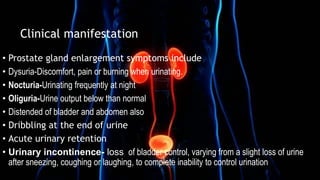
Clinical manifestation
• Prostate gland enlargement symptoms include
• Dysuria-Discomfort, pain or burning when urinating.
• Nocturia-Urinating frequently at night
• Oliguria-Urine output below than normal
• Distended of bladder and abdomen also
• Dribbling at the end of urine
• Acute urinary retention
• Urinary incontinence- loss of bladder control, varying from a slight loss of urine
after sneezing, coughing or laughing, to complete inability to control urination
• Recurrent UTI
• Azoetemia-Elevated levels of urea and other nitrogen compounds in the blood
• Formation of stones in the bladder
• Impaired kidney function
• Renal failure- A condition in which the kidneys lose the ability to remove waste and balance
fluids
Clinical manifestation
Diagnostic evaluation
• Diagnostic evaluation done by following manner
• History taking and
• Physical examination-
• History taking- Nurses should be gather comprehensive data regarding
condition from the patient
1. Nurses should be ask from the patient that
2. Is abdomen pain occur in lower region duration and frequency also?
3. Is dribbling sensation occur at the end of urine?
4. Is urge of urination occur at night?
5. Is blood present in the urine (Haematuria)?
• Physical examination- Nurses should be check His/Her vital sign and
abdomen distention through palpation
Diagnostic evaluation
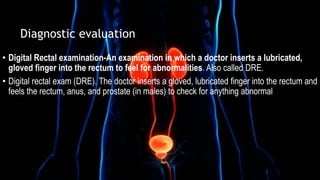
• Digital Rectal examination-An examination in which a doctor inserts a lubricated,
gloved finger into the rectum to feel for abnormalities. Also called DRE.
• Digital rectal exam (DRE). The doctor inserts a gloved, lubricated finger into the rectum and
feels the rectum, anus, and prostate (in males) to check for anything abnormal
Diagnostic evaluation
• Prostate specific antigen (PSA)-Prostate-specific antigen, or PSA, is a
protein produced by normal, as well as malignant, cells of the prostate
gland. The PSA test measures the level of PSA in the blood.
• PSA normal range is about -4.0 ng/mL
Diagnostic evaluation
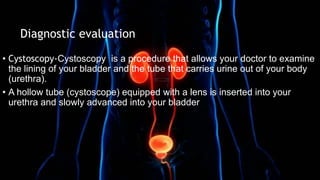
• Cystoscopy-Cystoscopy is a procedure that allows your doctor to examine
the lining of your bladder and the tube that carries urine out of your body
(urethra).
• A hollow tube (cystoscope) equipped with a lens is inserted into your
urethra and slowly advanced into your bladder
Diagnostic evaluation
• Transrectal ultrasound is used to look for abnormalities in the rectum and nearby
structures, including the prostate. Also called endorectal ultrasound, ERUS, and TRUS.
Enlarge. Transrectal ultrasound. An ultrasound probe is inserted into the rectum to check
the prostate
Diagnostic evaluation
• A procedure in which a probe that sends out high-energy sound waves is
inserted into the rectum.
• The sound waves are bounced off internal tissues or organs and make
echoes.
• The echoes form a picture of body tissue called a sonogram. Transrectal
ultrasound is used to look for abnormalities in the rectum and nearby
structures, including the prostate
Diagnostic evaluation
Medical management
• The treatment plant depend on the cause of BPH cbrt of the obstruction
and the condition of the patient
• Alpha- adrenergic receptor blocker- These are drug that can inhibit the
Concentration of the smooth muscle of the prostate gland and bladder
neck and in this way improve the urinary flow rate
• These medication include terazosin and doxazosin
Surgical management
• Surgery may also be used to treat BPH most commonly in men who have
not responded satisfactorily to medication or those who have more
severe problems such as complete inability to urinate
• Transurethral resection of the prostate (TURP)- TURP is the most
common procedure can be carried out through endoscopy
• TURP involve inserting an instrument called resectoscope through the
urethral opening of the penis and guiding it to the constricted portion of
the urethra within the prostate gland
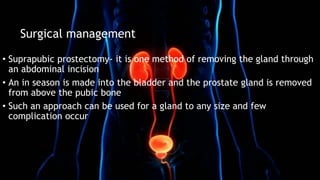
• Suprapubic prostectomy- it is one method of removing the gland through
an abdominal incision
• An in season is made into the bladder and the prostate gland is removed
from above the pubic bone
• Such an approach can be used for a gland to any size and few
complication occur
Surgical management
Nursing management (Assessment)
• Pre operative assessment-obtain history of wording symptom including
on set frequency of day and night time urination dysuria and sensation of
incomplete bladder Amity and decrease force of stream of urine
• Perform abdominal examination to detect destended bladder degree of
prostatic enlargement
• Check vital sign of the patients
• Assess level of pain
• Monitor blood urea nitrogen BUN and creatinine
• Determine balance between intake and output
Nursing diagnosis
1. Urinary Retention related to obstruction in urinary pathway
2. Acute pain related to baldder distension
3. Risk of infection related to Surgery
4. Altered body temperature related to infection
5. Altered Nutritional status related to less intake of food
6. Anxiety related to lack of knowledge about condition
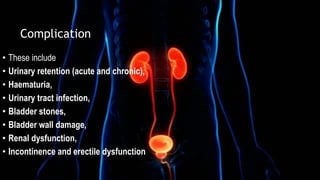
Complication
• These include
• Urinary retention (acute and chronic),
• Haematuria,
• Urinary tract infection,
• Bladder stones,
• Bladder wall damage,
• Renal dysfunction,
• Incontinence and erectile dysfunction
Benign prostate hypertrophy.pptx

Benign prostate hypertrophy.pptx

  • 1.
  • 2.
    Introduction • BPH alsoknown as benign prostatic hypertrophy is a non cancerous enlargement of the prostate small gland that in circle the urethra in male and produce a fruit that makeup a part of semen • The prostate gland enlarges extanding upward into the bladder and obstructing the outflow of urine by encroaching on the vesicle orifice • This condition is known as pph enlargement of the prostate gland • untreated prostate gland enlargement can block the flow of urine out of the bladder and can cause bladder urinary tract or kidney problems
  • 3.
    Definition • Benign prostatehypertrophy is a enlargement of prostate gland which is characterized by blocking of urine flow • OR • Benign prostatic hyperplasia (BPH) — also called prostate gland enlargement — is a common condition as men get older. • An enlarged prostate gland can cause uncomfortable urinary symptoms, such as blocking the flow of urine out of the bladder. It can also cause bladder, urinary tract or kidney problems
  • 4.
    Anatomy & Physiologyof excretory system • The urinary system's function is to filter blood and create urine as a waste by-product. • The organs of the urinary system include 1. the kidneys, 2. renal pelvis, 3. ureters, bladder and urethra
  • 5.
    • Two kidneys.This pair of purplish-brown organs is located below the ribs toward the middle of the back • The kidneys remove urea from the blood through tiny filtering units nephrons. Each nephron consists of a ball formed of small blood capillaries, called a glomerulus, and a small tube called a renal tubule. Anatomy & Physiology of excretory system
  • 6.
    • Two ureters.These narrow tubes carry urine from the kidneys to the bladder. • Muscles in the ureter walls continually tighten and relax forcing urine downward, away from the kidneys Anatomy & Physiology of excretory system
  • 7.
    • Bladder. Thistriangle-shaped, hollow organ is located in the lower abdomen. It is held in place by ligaments that are attached to other and the pelvic bones. • The bladder's walls relax and expand to store urine, and contract and flatten to empty urine through the urethra Anatomy & Physiology of excretory system
  • 8.
    • Two sphinctermuscles. These circular muscles help keep urine from leaking by closing tightly like a rubber band around the opening of the bladder Anatomy & Physiology of excretory system
  • 9.
    • Urethra. Thistube allows urine to pass outside the body. The brain signals the bladder muscles to tighten, which squeezes urine out of the bladder. • At the same time, the brain signals the sphincter muscles to relax to let urine exit the bladder through the urethra. • When all the signals occur in the correct order, normal urination occurs Anatomy & Physiology of excretory system
  • 10.
    Physiology of excretorysystem • Human excretory system includes organs that facilitate the removal of nitrogenous wastes from the body. • The main excretory organs include kidney, ureter, urinary bladder and urethra. • Kidneys filter the blood and urine is the filtrate obtained. • Urine passes to the urinary bladder via ureter and is expelled out of the body. This is known as micturition. • Kidneys also regulate the osmotic pressure of a mammal’s blood through excessive purification and filtration. This is known as osmoregulation
  • 11.
    Etiology and riskfactors • Idiopathic- Exact cause is unknown • Hormonal alteration-Advancing age the amount of the male hormone testosterone decreases relative to the amount of circulating estrogen the main female Reproductive hormone which also circulates in the male
  • 12.
    • Aging-prostate -Glandenlargement rearly causes Sign and symptoms in men younger than 40 but about half the man is there 60 is have some sign and symptoms • Family history- Having a blood relative such as father or brother with prostate problems means you are more likely to have problems as well • Effects of chronic inflammation Etiology and risk factors
  • 13.
    Pathophysiology • Due toetiological factor hormonal alterations advance age and heredity • Normally thin and fibrous outer of prostate become spongy and thick due to enlargement process • Hypertrophy (Increase size of the cell) of prostate compress urinary pathway bladder neck and urethra • Incomplete emptying bladder & urinary retention occur • Gradual dialation of ureter and kidneys • Prolonged urinary retention cause UTI, dysuria, nocturia and heamaturia
  • 14.
    Clinical manifestation • Prostategland enlargement symptoms include • Dysuria-Discomfort, pain or burning when urinating. • Nocturia-Urinating frequently at night • Oliguria-Urine output below than normal • Distended of bladder and abdomen also • Dribbling at the end of urine • Acute urinary retention • Urinary incontinence- loss of bladder control, varying from a slight loss of urine after sneezing, coughing or laughing, to complete inability to control urination
  • 15.
    • Recurrent UTI •Azoetemia-Elevated levels of urea and other nitrogen compounds in the blood • Formation of stones in the bladder • Impaired kidney function • Renal failure- A condition in which the kidneys lose the ability to remove waste and balance fluids Clinical manifestation
  • 16.
    Diagnostic evaluation • Diagnosticevaluation done by following manner • History taking and • Physical examination-
  • 17.
    • History taking-Nurses should be gather comprehensive data regarding condition from the patient 1. Nurses should be ask from the patient that 2. Is abdomen pain occur in lower region duration and frequency also? 3. Is dribbling sensation occur at the end of urine? 4. Is urge of urination occur at night? 5. Is blood present in the urine (Haematuria)? • Physical examination- Nurses should be check His/Her vital sign and abdomen distention through palpation Diagnostic evaluation
  • 18.
    • Digital Rectalexamination-An examination in which a doctor inserts a lubricated, gloved finger into the rectum to feel for abnormalities. Also called DRE. • Digital rectal exam (DRE). The doctor inserts a gloved, lubricated finger into the rectum and feels the rectum, anus, and prostate (in males) to check for anything abnormal Diagnostic evaluation
  • 19.
    • Prostate specificantigen (PSA)-Prostate-specific antigen, or PSA, is a protein produced by normal, as well as malignant, cells of the prostate gland. The PSA test measures the level of PSA in the blood. • PSA normal range is about -4.0 ng/mL Diagnostic evaluation
  • 20.
    • Cystoscopy-Cystoscopy isa procedure that allows your doctor to examine the lining of your bladder and the tube that carries urine out of your body (urethra). • A hollow tube (cystoscope) equipped with a lens is inserted into your urethra and slowly advanced into your bladder Diagnostic evaluation
  • 21.
    • Transrectal ultrasoundis used to look for abnormalities in the rectum and nearby structures, including the prostate. Also called endorectal ultrasound, ERUS, and TRUS. Enlarge. Transrectal ultrasound. An ultrasound probe is inserted into the rectum to check the prostate Diagnostic evaluation
  • 22.
    • A procedurein which a probe that sends out high-energy sound waves is inserted into the rectum. • The sound waves are bounced off internal tissues or organs and make echoes. • The echoes form a picture of body tissue called a sonogram. Transrectal ultrasound is used to look for abnormalities in the rectum and nearby structures, including the prostate Diagnostic evaluation
  • 23.
    Medical management • Thetreatment plant depend on the cause of BPH cbrt of the obstruction and the condition of the patient • Alpha- adrenergic receptor blocker- These are drug that can inhibit the Concentration of the smooth muscle of the prostate gland and bladder neck and in this way improve the urinary flow rate • These medication include terazosin and doxazosin
  • 24.
    Surgical management • Surgerymay also be used to treat BPH most commonly in men who have not responded satisfactorily to medication or those who have more severe problems such as complete inability to urinate • Transurethral resection of the prostate (TURP)- TURP is the most common procedure can be carried out through endoscopy • TURP involve inserting an instrument called resectoscope through the urethral opening of the penis and guiding it to the constricted portion of the urethra within the prostate gland
  • 25.
    • Suprapubic prostectomy-it is one method of removing the gland through an abdominal incision • An in season is made into the bladder and the prostate gland is removed from above the pubic bone • Such an approach can be used for a gland to any size and few complication occur Surgical management
  • 26.
    Nursing management (Assessment) •Pre operative assessment-obtain history of wording symptom including on set frequency of day and night time urination dysuria and sensation of incomplete bladder Amity and decrease force of stream of urine • Perform abdominal examination to detect destended bladder degree of prostatic enlargement • Check vital sign of the patients • Assess level of pain • Monitor blood urea nitrogen BUN and creatinine • Determine balance between intake and output
  • 27.
    Nursing diagnosis 1. UrinaryRetention related to obstruction in urinary pathway 2. Acute pain related to baldder distension 3. Risk of infection related to Surgery 4. Altered body temperature related to infection 5. Altered Nutritional status related to less intake of food 6. Anxiety related to lack of knowledge about condition
  • 28.
    Complication • These include •Urinary retention (acute and chronic), • Haematuria, • Urinary tract infection, • Bladder stones, • Bladder wall damage, • Renal dysfunction, • Incontinence and erectile dysfunction