Edited by: 
Kamrul Islam Shipo
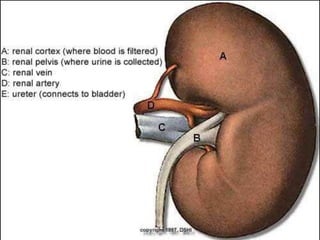
 The urinary tract includes the kidneys, ureters, 
bladder and urethra. Within each kidney, urine 
flows from the outer cortex to the inner 
medulla. 
 The renal pelvis is the funnel through which 
urine exits the kidney and enters the ureter.
 The kidneys remove wastes, control the body's fluid 
balance, and regulate the balance of electrolytes 
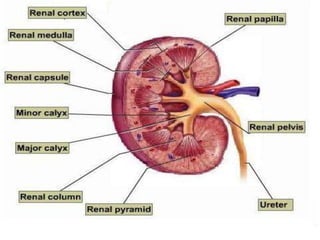
 The medulla is composed of a series of conical 
masses called the renal pyramids. 
 The apex of these pyramids form a papilla which 
projects into the lumen of the minor calyces. 
 The cortex extends between these medullary 
pyramids as the renal columns 
 The minor calyces are cup shaped tubes which 
surround the renal papilla. These converge to form 
the major calyces, which in turn unite to form the 
renal pelvis.
 The stones are solid concretions or calculi (crystal 
aggregations) formed in the kidneys from 
dissolved urinary minerals 
 Stones are formed in the urinary tract when 
urinary concentrations of substances such as 
calcium oxalate, calcium phosphate, and uric acid 
increase
 Urinary calculi are more common in men than in 
women. 
 Incidence of urinary calculi peaks between the 3rd 
and 5th decades of life.
 There is seasonal variation with stone 
occurring more often in the summer months 
suspecting the role of dehydration in this 
process
1)Dietetic. (more calcium oxalate containing food) 
2)Altered urinary solutes and colloids:(reduced water intake=increased 
solid deposition >increased crystallization >stone formation.) 
3)Reduced urinary citrate . 
4)Renal infection. 
5)Inadequate water drainage and urinary stasis. 
6)Prolonged immobilization. 
7)Hyperparathyroidism .(increased calcium deposition .) 
8)Gout.
 Calcium oxalate 
 Calcium phosphate 
 Mixed-Oxalate+Phoaphate 
 Struvite (Ca, Al, Mg, Phosphate) 
 Cystine 
 Xanthine 
 Matrix
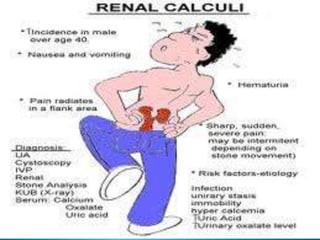
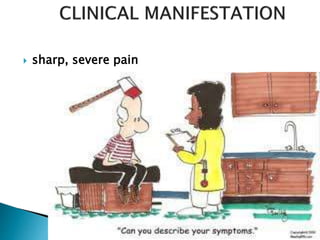
 sharp, severe pain
 most characteristic manifestation of renal or 
ureteral calculi 
 caused by movement of the calculus and 
consequent irritation 
 Renal colic originates deep in the lumbar region 
and radiates around the side and down toward 
the testicle in the male and the bladder in the 
female 
 Ureteral colic radiates toward the genitalia and 
thigh
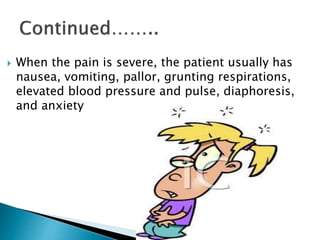
 When the pain is severe, the patient usually has 
nausea, vomiting, pallor, grunting respirations, 
elevated blood pressure and pulse, diaphoresis, 
and anxiety
 Urinary tract infection 
 Other manifestations of calculi include infection 
with an elevated temperature and white blood 
cell (WBC) count and urine obstruction that 
causes hydroureter, hydronephrosis, or both 
 Haematuria 
 Pain resulting from the passage of a calculus 
down the ureter is intense and collicky.
 1. Assessment
 Prior stone formation 
 Renal or bladder colic type pain without 
objective evidence of calculi formation 
 Risk factors 
 Location, character, and duration of current pain 
 Current and previous radiation patterns 
(indicates possible location and movement of 
calculus through the urinary system)
#G/E: 
 Anemia 
 Oedema 
 Dehydration 
 Increased Pulse and BP. 
 Raised Temperature. 
#Urinary System: 
Tenderness on palpation 
Passage of stones.
1.Plain x-Ray of KUB region( radio dense shadow) 
2.Ultrasonography of KUB region(echogenic structure 
with shadow) 
3.Intravenous urography . 
4.Intravenous pyelography . 
5.Excretory urography . 
6.Unenhanced computer tomography 
7.Plain radiograph of the abdomen
 Nowadays Unenhanced computer tomography 
Has been seen more sensitive and specific. It 
can identify both radioluscent and radio opaque 
shadow. 
 90% of the urinary stone is radio opaque . 
 10% gal bladder stone is radio opaque. 
 Uric acid stone , Cystine,struvite stones are 
radioluscent .
#Others : 
-Urine RME and C/s 
-Serum creatinine 
#For Anaesthesia : 
>CBC 
> RBS 
>CX-R 
>ECG
# To indentify the cause: 
 Serum calcium 
 PTH 
 Uric acid Urinary calcium Phosphate
 Obstructive uropathy compromises the 
function of the affected kidney. 
 Microscopic or gross hematuria is rarely 
associated with significant hemorrhage. 
 Urosepsis is infection that may cause shock 
or death without prompt intervention. 
 Ileus may occur
 Stones<5mm,90 percent spontaneous 
passage. 
 Hydration 
 Diuretics 
 Anti-emetics
 involves first visualizing the stone and then 
destroying it. 
 Access to the stone is accomplished by inserting 
a ureteroscope into the ureter and then 
inserting a laser, electrohydraulic lithotriptor, or 
ultrasound device through the ureteroscope to 
fragment and remove the stones. 
 A stent may be inserted and left in place for 48 
hours or more after the procedure to keep the 
ureter patent. 
 Hospital stays are generally brief, and some 
patients can be treated as outpatients.
 LASER LITHOTRIPSY. A newer treatment 
for calculi is laser lithotripsy. Lasers 
are used together with a uretero-scope 
to remove or loosen impacted 
stones. Constant water irrigation of 
the ureter is required to dissipate the 
heat
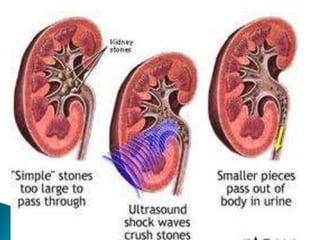
 ESWL is a noninvasive procedure used to break up 
stones in the calyx of the kidney. 
 In ESWL, a high-energy amplitude of pressure, or 
shock wave, is generated by the abrupt release of 
energy and transmitted through water and soft 
tissues. When the shock wave encounters a 
substance of different intensity (a renal stone), a 
compression wave causes the surface of the stone 
to fragment. Repeated shock waves focused on 
the stone eventually reduce it to many small 
pieces.
 These small pieces are excreted inthe urine, 
usually without difficulty.the fragments may be 
passed upto 3 months after the procedure 
 Stone size should be 1.5-2 cm
 Percutaneous lithotripsy involves the insertion of a 
guide percutaneously (through the skin) under 
fluoroscopy near the area of the stone. An 
ultrasonic wave is aimed at the stone to break it 
into fragments. 
 stone size should be >2.5 cm
 IMMEDIATE 
 Pain 
 Urinary infection 
 Obstructive uropathy 
 Haematuria 
 Urinoma-URINOMA HAPPENS AS A RESULT OF URETERAL 
TEAR WHICH ALLOWS THE ENTRY OF FREE FLUID INTO THE 
RETROPERITONEUM 
 Renal and perirenal haematoma 
 Surrounding organ injury
DELAYED 
 Renal functional loss 
 Hypertension 
 Residual calculi 
 Recurrent calculi
 If the stone is too large or lithotripsy procedures 
fail to remove it, an open surgical procedure is 
performed
 Cystolithotomy, removal of bladder calculi 
through a suprapubic incision, is used only 
when stones cannot be crushed and removed 
transurethrally. Stricture (abnormal 
narrowing) is the most common 
postoperative complication. 
 A stone is removed from the renal pelvis by 
pyelo-lithotomy and from the renal calyx by a 
nephrolithotomy
 Despite advances in the treatment of urinary calculi, it 
is often impossible to remove all stone fragments 
completely. From 5 to 30 percent of patients have 
residual stone burden requiring ongoing treatment. 
 Recurrence rate is approximately 30 percent within 
years. 
 Extracorporeal shock wave lithotripsy and endoscopic 
stone removal techniques have significantly improved 
long term prognosis of renal function after calculus 
removal.

Renal colic

  • 2.
    Edited by: KamrulIslam Shipo
  • 3.
     The urinarytract includes the kidneys, ureters, bladder and urethra. Within each kidney, urine flows from the outer cortex to the inner medulla.  The renal pelvis is the funnel through which urine exits the kidney and enters the ureter.
  • 6.
     The kidneysremove wastes, control the body's fluid balance, and regulate the balance of electrolytes  The medulla is composed of a series of conical masses called the renal pyramids.  The apex of these pyramids form a papilla which projects into the lumen of the minor calyces.  The cortex extends between these medullary pyramids as the renal columns  The minor calyces are cup shaped tubes which surround the renal papilla. These converge to form the major calyces, which in turn unite to form the renal pelvis.
  • 8.
     The stonesare solid concretions or calculi (crystal aggregations) formed in the kidneys from dissolved urinary minerals  Stones are formed in the urinary tract when urinary concentrations of substances such as calcium oxalate, calcium phosphate, and uric acid increase
  • 9.
     Urinary calculiare more common in men than in women.  Incidence of urinary calculi peaks between the 3rd and 5th decades of life.
  • 10.
     There isseasonal variation with stone occurring more often in the summer months suspecting the role of dehydration in this process
  • 11.
    1)Dietetic. (more calciumoxalate containing food) 2)Altered urinary solutes and colloids:(reduced water intake=increased solid deposition >increased crystallization >stone formation.) 3)Reduced urinary citrate . 4)Renal infection. 5)Inadequate water drainage and urinary stasis. 6)Prolonged immobilization. 7)Hyperparathyroidism .(increased calcium deposition .) 8)Gout.
  • 12.
     Calcium oxalate  Calcium phosphate  Mixed-Oxalate+Phoaphate  Struvite (Ca, Al, Mg, Phosphate)  Cystine  Xanthine  Matrix
  • 13.
  • 14.
     most characteristicmanifestation of renal or ureteral calculi  caused by movement of the calculus and consequent irritation  Renal colic originates deep in the lumbar region and radiates around the side and down toward the testicle in the male and the bladder in the female  Ureteral colic radiates toward the genitalia and thigh
  • 15.
     When thepain is severe, the patient usually has nausea, vomiting, pallor, grunting respirations, elevated blood pressure and pulse, diaphoresis, and anxiety
  • 16.
     Urinary tractinfection  Other manifestations of calculi include infection with an elevated temperature and white blood cell (WBC) count and urine obstruction that causes hydroureter, hydronephrosis, or both  Haematuria  Pain resulting from the passage of a calculus down the ureter is intense and collicky.
  • 17.
  • 18.
     Prior stoneformation  Renal or bladder colic type pain without objective evidence of calculi formation  Risk factors  Location, character, and duration of current pain  Current and previous radiation patterns (indicates possible location and movement of calculus through the urinary system)
  • 19.
    #G/E:  Anemia  Oedema  Dehydration  Increased Pulse and BP.  Raised Temperature. #Urinary System: Tenderness on palpation Passage of stones.
  • 20.
    1.Plain x-Ray ofKUB region( radio dense shadow) 2.Ultrasonography of KUB region(echogenic structure with shadow) 3.Intravenous urography . 4.Intravenous pyelography . 5.Excretory urography . 6.Unenhanced computer tomography 7.Plain radiograph of the abdomen
  • 21.
     Nowadays Unenhancedcomputer tomography Has been seen more sensitive and specific. It can identify both radioluscent and radio opaque shadow.  90% of the urinary stone is radio opaque .  10% gal bladder stone is radio opaque.  Uric acid stone , Cystine,struvite stones are radioluscent .
  • 22.
    #Others : -UrineRME and C/s -Serum creatinine #For Anaesthesia : >CBC > RBS >CX-R >ECG
  • 23.
    # To indentifythe cause:  Serum calcium  PTH  Uric acid Urinary calcium Phosphate
  • 24.
     Obstructive uropathycompromises the function of the affected kidney.  Microscopic or gross hematuria is rarely associated with significant hemorrhage.  Urosepsis is infection that may cause shock or death without prompt intervention.  Ileus may occur
  • 26.
     Stones<5mm,90 percentspontaneous passage.  Hydration  Diuretics  Anti-emetics
  • 28.
     involves firstvisualizing the stone and then destroying it.  Access to the stone is accomplished by inserting a ureteroscope into the ureter and then inserting a laser, electrohydraulic lithotriptor, or ultrasound device through the ureteroscope to fragment and remove the stones.  A stent may be inserted and left in place for 48 hours or more after the procedure to keep the ureter patent.  Hospital stays are generally brief, and some patients can be treated as outpatients.
  • 29.
     LASER LITHOTRIPSY.A newer treatment for calculi is laser lithotripsy. Lasers are used together with a uretero-scope to remove or loosen impacted stones. Constant water irrigation of the ureter is required to dissipate the heat
  • 30.
     ESWL isa noninvasive procedure used to break up stones in the calyx of the kidney.  In ESWL, a high-energy amplitude of pressure, or shock wave, is generated by the abrupt release of energy and transmitted through water and soft tissues. When the shock wave encounters a substance of different intensity (a renal stone), a compression wave causes the surface of the stone to fragment. Repeated shock waves focused on the stone eventually reduce it to many small pieces.
  • 31.
     These smallpieces are excreted inthe urine, usually without difficulty.the fragments may be passed upto 3 months after the procedure  Stone size should be 1.5-2 cm
  • 32.
     Percutaneous lithotripsyinvolves the insertion of a guide percutaneously (through the skin) under fluoroscopy near the area of the stone. An ultrasonic wave is aimed at the stone to break it into fragments.  stone size should be >2.5 cm
  • 34.
     IMMEDIATE Pain  Urinary infection  Obstructive uropathy  Haematuria  Urinoma-URINOMA HAPPENS AS A RESULT OF URETERAL TEAR WHICH ALLOWS THE ENTRY OF FREE FLUID INTO THE RETROPERITONEUM  Renal and perirenal haematoma  Surrounding organ injury
  • 35.
    DELAYED  Renalfunctional loss  Hypertension  Residual calculi  Recurrent calculi
  • 37.
     If thestone is too large or lithotripsy procedures fail to remove it, an open surgical procedure is performed
  • 38.
     Cystolithotomy, removalof bladder calculi through a suprapubic incision, is used only when stones cannot be crushed and removed transurethrally. Stricture (abnormal narrowing) is the most common postoperative complication.  A stone is removed from the renal pelvis by pyelo-lithotomy and from the renal calyx by a nephrolithotomy
  • 39.
     Despite advancesin the treatment of urinary calculi, it is often impossible to remove all stone fragments completely. From 5 to 30 percent of patients have residual stone burden requiring ongoing treatment.  Recurrence rate is approximately 30 percent within years.  Extracorporeal shock wave lithotripsy and endoscopic stone removal techniques have significantly improved long term prognosis of renal function after calculus removal.