Heyria Hussien
Objective
 To identify the non traumatic urologic emergencies
 To understand their management in the emergency
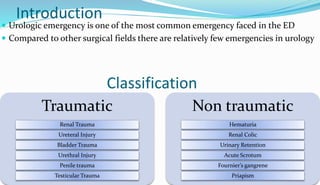
Introduction
 Urologic emergency is one of the most common emergency faced in the ED
 Compared to other surgical fields there are relatively few emergencies in urology
Classification
Traumatic
Renal Trauma
Ureteral Injury
Bladder Trauma
Urethral Injury
Penile trauma
Testicular Trauma
Non traumatic
Hematuria
Renal Colic
Urinary Retention
Acute Scrotum
Fournier’s gangrene
Priapism
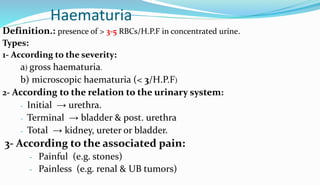
Haematuria
Definition.: presence of > 3-5 RBCs/H.P.F in concentrated urine.
Types:
1- According to the severity:
a) gross haematuria.
b) microscopic haematuria (< 3/H.P.F)
2- According to the relation to the urinary system:
- Initial → urethra.
- Terminal → bladder & post. urethra
- Total → kidney, ureter or bladder.
3- According to the associated pain:
- Painful (e.g. stones)
- Painless (e.g. renal & UB tumors)
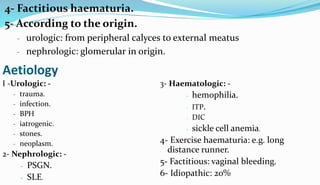
4- Factitious haematuria.
5- According to the origin.
- urologic: from peripheral calyces to external meatus
- nephrologic: glomerular in origin.
Aetiology
I -Urologic: -
- trauma.
- infection.
- BPH
- iatrogenic.
- stones.
- neoplasm.
2- Nephrologic: -
- PSGN.
- SLE.
3- Haematologic: -
- hemophilia.
- ITP.
- DIC
- sickle cell anemia.
4- Exercise haematuria: e.g. long
distance runner.
5- Factitious: vaginal bleeding.
6- Idiopathic: 20%
Presentation:
– Hematuria
– Anemia: bleeding is so heavy (this is rare)
– Urine retention or ureteric colic (Clot retention)
• Diagnosis:
– History
– Examination
– Investigation:
• Urine culture and cytology
• Renal US
• Flexible cystoscopy,
• IVU or CT scan in selected groups.
I- History
1- Age:
a- child → most common nephrologic cause → PSGN
→ most common urologic cause —> UTI
b- adult →most common causes → stones & tumors.
c- old age male → B.P.H. & cancer bladder
2- Sex: female → ask about menstruation.
-most common in female → cystitis.
3- Analysis of hematuria:
A - Colour of hematuria:
- smoky urine (coca cola colour) → PSGN
B -Time of haematuria:
- initial → urethral causes.
- terminal → bladder causes.
- total → kidney, ureter or bladder causes,
C- Other symptoms:
- Frequency → diurnal → stone bladder.
→ nocturnal → BPH.
→ diurnal & nocturnal → cystitis.
- Pain → colicky → stone.
→ dull aching → inflammation.
D - Past history of: - trauma.
- drugs e.g. rifampicin
II) Examination:
A- General: - vital parameters: -
- Temp → infection.
- Hypertension → oedema LL.
- Oedema LL: nephrotic syndrome.
- Purpuric rash: ITP.
B- Abdominal:
- Renal masses: renal causes
- Full bladder: BPH.
- Cirrhotic liver: bleeding tendency
C - PR or PV:
- Bladder mass.
- BPH.
- Cancer prostate
III) Investigations:
a- Laboratory:
1-urine:
- urine analysis.
- urine culture.
- urine cytology.
- Zeihl Nielsen.
2- Blood:
- CBC.
- haematologic tests (Bleeding &
clotting times)
b- Imaging :
- KUB X-ray.
- IVU
- Ascending cystography
- Angiography.
- Abdominal U/S.
- CT
c-Endoscopy:
- cystourethroscope
d- Renal biopsy
Treatment
1. General measures: for shocked patient → IV fluids, blood transfusion,
continues irrigation, .. ...
2. Definitive treatment of the cause.
3. Three ways urethral catheter and bladder wash out for heavy bleeding.
Management of Clot Retention
 History of heavy frank haematuria then painful inability to void
 Commonly tender palpable bladder
 22F 3 way Foley catheter
- Syringe bladder vigorously with sterile saline to break up and wash out
clot – use at least 500 ml.
- Run bladder washout flat out until certain cleared, then slow to keep
urine clear.
 If failure to wash out clot, or washout clotting off – requires emergency
cystoscopy.
 Check Hgb +/- coag profile.
Risk Factors Mandating
Further Evaluation of Heamaturia
 Cigarette smoking
 Occupational exposure
 Analgesic abuse
 Persistent hematuria
 Abdominal pain
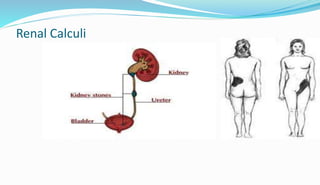
Renal Calculi
Renal Calculi
 The commonest urologic emergency.
 One of the commonest causes of “Acute Abdomen”.
 Sudden onset of severe pain in the flank
 Most often due to the passage of a stone formed in the kidney, down
through the ureter.
Types
 Calcium oxalate stone -75%
 Struvite Infectious stone-15%
 Uric acid stone-10% not radiopaque (radio-lucent)
 Cystine-1%
Pathophysiology
 Super saturation of urine with urinary solutes (dissolved salt condense
and change the urine in to solid)
 Lack of inhibitory substance (citrate, magnesium, uromoduline prevent
crystal formation)
 Stasis of urine (neurogenic bladder, presence of foreign bodies)
Risk factor for urolithiasis
 Metabolic disease/disturbance
 Crohn’s disease
 Milk-alkali syndrome
 Primary hyperparathyroidism
 Hypernitraturia
 Recurrent UTI
 Gout
 Positive family history
 Hot arid climates
 Male gender (white men affected more commonly than black men)
 Previous kidney stone
 Dehydration
Clinical manifestation
 Acute Crampy intermittent flank pain
 Nausea Vomitting
 Hematuria
The pain is characteristically :
- very sudden onset
- colicky in nature
- Radiates to the groin as the stone passes into the lower ureter.
- May change in location, from the flank to the groin,
- The patient cannot get comfortable, and may roll around in agony.
- Associated with nausea / Vomiting
- The pain of a ureteric stone as being worse than the pain of labor.
Diagnosis
– History
– Examination:
– +/- Fever
- Imaging
– Pregnancy test
 Radiological investigation
• KUB / Abdominal US
• IVP
• CT
Acute Management of Ureteric Stones:
- Pain relief
- NSAIDs
- Intramuscular or intravenous injection, by mouth, or per rectum
- +/- Opiate analgesics (pethidine or morphine).
- ? Hyper hydration
- ‘watchful waiting’ with analgesic supplements
- 95% of stones measuring 5mm or less pass spontaneously
Indications for Surgical Intervention
1. Infected obstructed kidney = surgical emergency
2. Pain uncontrolled despite PR NSAIDS
3. Stone clearly too large to pass > 8mm
4. Significant CRF creatinine >2
5. Solitary kidney – risk obstructive uropathy
– Temporary relief of the obstruction:
•Insertion of a JJ stent or percutaneous nephrostomy tube.
– Definitive treatment of a ureteric stone:
• ESWL.
• PCNL
• Ureteroscopy
• Open Surgery
Do we need to over hydrate patient?
 Reason: increase urine output to “Flush” the stone out ?
 In fact, renal blood flow and UO fall in episode of obstruction
 Excess fluid excretion will cause greater hydronephrosis  further impair peristalsis
Urinary Retention
 Acute Urinary retention
 Chronic Urinary retention
Acute Urinary Retention
 Sudden inability to pass urine associated with abdominal distention and pain,
 Pathophysiology:
- Increased urethral resistance, i.e., bladder outlet obstruction (BOO).
- Low bladder pressure, i.e. impaired bladder contractility.
- Interruption of sensory or motor innervations of the bladder.
Ateology
1- Obstructive (mechanical):
- Bladder: BNO, stone & Tumors.
- Prostate: BPH (old age), abscess & carcinoma.
- Urethra: stone (adolescence), stricture, PUV (child)
- pelvis: Tumors.
2- Functional (Neurogenic)
a- spastic (sphincter) as in spinal anaesthesia.
b- atonic (bladder) as in senility, spinal cord lesion, atropine.
3- Hysterical: common in females.
.
 Men:
- BOO (commonest cause)
- Urethral stricture
- Acute uretheritis
- Prostitis
- Phimosis
 Women:
- Pelvic prolapse
- Post surgery (stress incontinence)
- Pelvic mass
 Both
- blood clot,
- urethral calculus,
- rapture of urethra,
- neurogenic,
- drugs,
- spinal anesthesia,
- anal pain,
Clinical manifestation
 Severe desire to micturate.
 Severe suprapubic bursting pain which may be periodic
 The bladder is visible, palpable, tender, dull on percussion.
Diagnosis
 Bed side U/S
 Urine analysis and culture
 CBC
 Renal function and serum electrolyte
Treatment
Goal of ED management is:
 Decompression,
 Identification of the cause
 Prevention of catheter related complication,
 Initiation of prescribed medication
 Promotion of successful voiding
 Urologist consultation
Initial Management:
- Urethral catheterization
- Suprapubic catheter ( SPC)
Late Management:
– Treating the underlying cause
Chronic urinary retention
 Obstruction develops slowly, the bladder is distended (stretched) very gradually over
weeks/months, so pain is not a feature.
Presentation:
 – Urinary dribbling
 – Overflow incontinence
 – Palpable lower suprapubic mass
 Usually associated with
- Reduced renal function
- Upper tract dilatation
• Management
- R/x is directed to renal support.
- Bladder drainage under slow rate to avoid sudden decompression>
hematuria.
- Late R/x of cause
Acute scrotum
 Emergency situation requiring prompt evaluation, differential diagnosis, and
potentially immediate surgical exploration.
 Incidence: - 1 / 4000
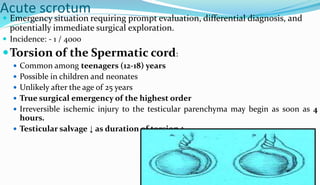
Torsion of the Spermatic cord:
 Common among teenagers (12-18) years
 Possible in children and neonates
 Unlikely after the age of 25 years
 True surgical emergency of the highest order
 Irreversible ischemic injury to the testicular parenchyma may begin as soon as 4
hours.
 Testicular salvage ↓ as duration of torsion ↑
Presentation
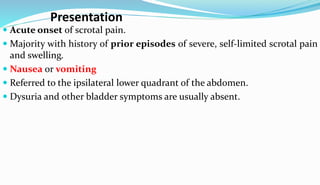
 Acute onset of scrotal pain.
 Majority with history of prior episodes of severe, self-limited scrotal pain
and swelling.
 Nausea or vomiting
 Referred to the ipsilateral lower quadrant of the abdomen.
 Dysuria and other bladder symptoms are usually absent.
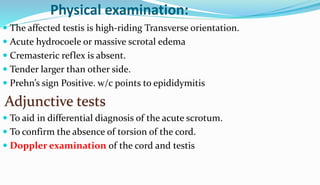
Physical examination:
 The affected testis is high-riding Transverse orientation.
 Acute hydrocoele or massive scrotal edema
 Cremasteric reflex is absent.
 Tender larger than other side.
 Prehn’s sign Positive. w/c points to epididymitis
Adjunctive tests
 To aid in differential diagnosis of the acute scrotum.
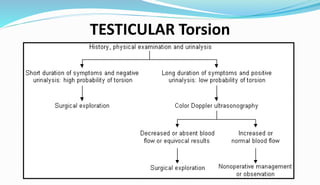
 To confirm the absence of torsion of the cord.
 Doppler examination of the cord and testis
TESTICULAR Torsion
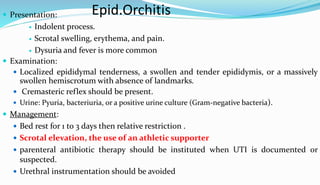
Epid.Orchitis
 Presentation:
 Indolent process.
 Scrotal swelling, erythema, and pain.
 Dysuria and fever is more common
 Examination:
 Localized epididymal tenderness, a swollen and tender epididymis, or a massively
swollen hemiscrotum with absence of landmarks.
 Cremasteric reflex should be present.
 Urine: Pyuria, bacteriuria, or a positive urine culture (Gram-negative bacteria).
 Management:
 Bed rest for 1 to 3 days then relative restriction .
 Scrotal elevation, the use of an athletic supporter
 parenteral antibiotic therapy should be instituted when UTI is documented or
suspected.
 Urethral instrumentation should be avoided
Priapism
 Persistent erection of the penis for more than 4 hours that is not related or
accompanied by sexual desire.
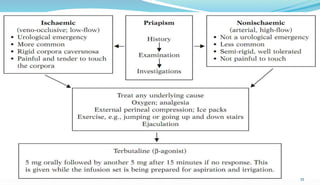
 2 Types:
 Ischemic (veno-occlusive, low flow (most common)
 Nonischaemic (arterial, high flow).
 Causes:
 Primary (Idiopathic): 30-50%
 Secondary:
 Drugs
 Trauma
 Neurological
 Hematological disease
 Tumors
 Miscellaneous
35
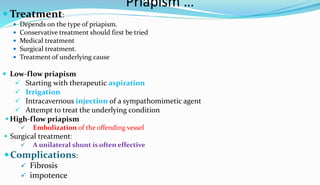
Priapism …
 Treatment:
 Depends on the type of priapism.
 Conservative treatment should first be tried
 Medical treatment
 Surgical treatment.
 Treatment of underlying cause
 Low-flow priapism
 Starting with therapeutic aspiration
 Irrigation
 Intracavernous injection of a sympathomimetic agent
 Attempt to treat the underlying condition
 High-flow priapism
 Embolization of the offending vessel
 Surgical treatment:
 A unilateral shunt is often effective
Complications:
 Fibrosis
 impotence
Fourniers Gangrene
Named after French venereologist Jean Alfred Fournier (1883)
• Fournier gangrene is defined as a polymicrobial necrotizing fasciitis of the perineal,
perianal, or genital areas.
 Initially described as idiopathic
 Now in more than 75% cases inciting cause is known
 Necrotizing process commonly originates from infection in anorectum, urogenital
tract or skin of genitalia.
Etiology & risk factors
 Risk factors
• Diabetes mellitus
• Alcoholism
• Malignancies
• Chronic steroid use
• HIV infection
• Malnutrition
• Morbid Obesity
Clinical features
 Begins with insidious onset of pruritus and discomfort of external genitalia.
 Prodromal symptoms of fever and lethargy, which may be present for 2-7 days
before gangrene.
 The hallmark of Fournier gangrene is out of proportion pain and tenderness in the
genitalia.
 Increasing genital pain and tenderness with progressive erythema of the overlying
skin.
 Dusky appearance of the overlying skin; subcutaneous crepitation; feculent odor.
 Obvious gangrene of a portion of the genitalia; purulent discharge from wounds.
 As gangrene develops, pain subsides
Investigations
 (CBC) Complete blood count
 Electrolytes
 BUN / Serum creatinine
 Blood Sugar
 ABG
 Blood and urine culture with sensitivity
 Coagulation profile for DIC
Treatment
 Medical
 Surgical
Medical Treatment
1. Restoration of normal organ perfusion
2. Reduction of systemic toxicity
3. Broad spectrum antibiotics to cover anaerobes as well (cipro+clinda+metro)
4. Vancomycin for MRSA
5. Tetanus prophylaxis
6. Irrigation with N/S
7. Antifungal – if required
8. Non – conventional
- Unprocessed honey – enzyme action
- dressing with gauze soaked with zinc per oxide
Surgical treatment
 Repeated aggressive debridement
 Preservation of testes
 Reconstruction after infection is over
 Fecal diversion
 Urinary diversion

Urological emergencies

  • 1.
  • 2.
    Objective  To identifythe non traumatic urologic emergencies  To understand their management in the emergency
  • 3.
    Introduction  Urologic emergencyis one of the most common emergency faced in the ED  Compared to other surgical fields there are relatively few emergencies in urology Classification Traumatic Renal Trauma Ureteral Injury Bladder Trauma Urethral Injury Penile trauma Testicular Trauma Non traumatic Hematuria Renal Colic Urinary Retention Acute Scrotum Fournier’s gangrene Priapism
  • 4.
    Haematuria Definition.: presence of> 3-5 RBCs/H.P.F in concentrated urine. Types: 1- According to the severity: a) gross haematuria. b) microscopic haematuria (< 3/H.P.F) 2- According to the relation to the urinary system: - Initial → urethra. - Terminal → bladder & post. urethra - Total → kidney, ureter or bladder. 3- According to the associated pain: - Painful (e.g. stones) - Painless (e.g. renal & UB tumors)
  • 5.
    4- Factitious haematuria. 5-According to the origin. - urologic: from peripheral calyces to external meatus - nephrologic: glomerular in origin. Aetiology I -Urologic: - - trauma. - infection. - BPH - iatrogenic. - stones. - neoplasm. 2- Nephrologic: - - PSGN. - SLE. 3- Haematologic: - - hemophilia. - ITP. - DIC - sickle cell anemia. 4- Exercise haematuria: e.g. long distance runner. 5- Factitious: vaginal bleeding. 6- Idiopathic: 20%
  • 6.
    Presentation: – Hematuria – Anemia:bleeding is so heavy (this is rare) – Urine retention or ureteric colic (Clot retention) • Diagnosis: – History – Examination – Investigation: • Urine culture and cytology • Renal US • Flexible cystoscopy, • IVU or CT scan in selected groups.
  • 7.
    I- History 1- Age: a-child → most common nephrologic cause → PSGN → most common urologic cause —> UTI b- adult →most common causes → stones & tumors. c- old age male → B.P.H. & cancer bladder 2- Sex: female → ask about menstruation. -most common in female → cystitis.
  • 8.
    3- Analysis ofhematuria: A - Colour of hematuria: - smoky urine (coca cola colour) → PSGN B -Time of haematuria: - initial → urethral causes. - terminal → bladder causes. - total → kidney, ureter or bladder causes, C- Other symptoms: - Frequency → diurnal → stone bladder. → nocturnal → BPH. → diurnal & nocturnal → cystitis. - Pain → colicky → stone. → dull aching → inflammation. D - Past history of: - trauma. - drugs e.g. rifampicin
  • 9.
    II) Examination: A- General:- vital parameters: - - Temp → infection. - Hypertension → oedema LL. - Oedema LL: nephrotic syndrome. - Purpuric rash: ITP. B- Abdominal: - Renal masses: renal causes - Full bladder: BPH. - Cirrhotic liver: bleeding tendency C - PR or PV: - Bladder mass. - BPH. - Cancer prostate
  • 10.
    III) Investigations: a- Laboratory: 1-urine: -urine analysis. - urine culture. - urine cytology. - Zeihl Nielsen. 2- Blood: - CBC. - haematologic tests (Bleeding & clotting times) b- Imaging : - KUB X-ray. - IVU - Ascending cystography - Angiography. - Abdominal U/S. - CT c-Endoscopy: - cystourethroscope d- Renal biopsy
  • 11.
    Treatment 1. General measures:for shocked patient → IV fluids, blood transfusion, continues irrigation, .. ... 2. Definitive treatment of the cause. 3. Three ways urethral catheter and bladder wash out for heavy bleeding.
  • 12.
    Management of ClotRetention  History of heavy frank haematuria then painful inability to void  Commonly tender palpable bladder  22F 3 way Foley catheter - Syringe bladder vigorously with sterile saline to break up and wash out clot – use at least 500 ml. - Run bladder washout flat out until certain cleared, then slow to keep urine clear.  If failure to wash out clot, or washout clotting off – requires emergency cystoscopy.  Check Hgb +/- coag profile.
  • 13.
    Risk Factors Mandating FurtherEvaluation of Heamaturia  Cigarette smoking  Occupational exposure  Analgesic abuse  Persistent hematuria  Abdominal pain
  • 14.
  • 15.
    Renal Calculi  Thecommonest urologic emergency.  One of the commonest causes of “Acute Abdomen”.  Sudden onset of severe pain in the flank  Most often due to the passage of a stone formed in the kidney, down through the ureter. Types  Calcium oxalate stone -75%  Struvite Infectious stone-15%  Uric acid stone-10% not radiopaque (radio-lucent)  Cystine-1%
  • 16.
    Pathophysiology  Super saturationof urine with urinary solutes (dissolved salt condense and change the urine in to solid)  Lack of inhibitory substance (citrate, magnesium, uromoduline prevent crystal formation)  Stasis of urine (neurogenic bladder, presence of foreign bodies)
  • 17.
    Risk factor forurolithiasis  Metabolic disease/disturbance  Crohn’s disease  Milk-alkali syndrome  Primary hyperparathyroidism  Hypernitraturia  Recurrent UTI  Gout  Positive family history  Hot arid climates  Male gender (white men affected more commonly than black men)  Previous kidney stone  Dehydration
  • 18.
    Clinical manifestation  AcuteCrampy intermittent flank pain  Nausea Vomitting  Hematuria The pain is characteristically : - very sudden onset - colicky in nature - Radiates to the groin as the stone passes into the lower ureter. - May change in location, from the flank to the groin, - The patient cannot get comfortable, and may roll around in agony. - Associated with nausea / Vomiting - The pain of a ureteric stone as being worse than the pain of labor.
  • 19.
    Diagnosis – History – Examination: –+/- Fever - Imaging – Pregnancy test  Radiological investigation • KUB / Abdominal US • IVP • CT
  • 20.
    Acute Management ofUreteric Stones: - Pain relief - NSAIDs - Intramuscular or intravenous injection, by mouth, or per rectum - +/- Opiate analgesics (pethidine or morphine). - ? Hyper hydration - ‘watchful waiting’ with analgesic supplements - 95% of stones measuring 5mm or less pass spontaneously
  • 21.
    Indications for SurgicalIntervention 1. Infected obstructed kidney = surgical emergency 2. Pain uncontrolled despite PR NSAIDS 3. Stone clearly too large to pass > 8mm 4. Significant CRF creatinine >2 5. Solitary kidney – risk obstructive uropathy
  • 22.
    – Temporary reliefof the obstruction: •Insertion of a JJ stent or percutaneous nephrostomy tube. – Definitive treatment of a ureteric stone: • ESWL. • PCNL • Ureteroscopy • Open Surgery Do we need to over hydrate patient?  Reason: increase urine output to “Flush” the stone out ?  In fact, renal blood flow and UO fall in episode of obstruction  Excess fluid excretion will cause greater hydronephrosis  further impair peristalsis
  • 23.
    Urinary Retention  AcuteUrinary retention  Chronic Urinary retention
  • 24.
    Acute Urinary Retention Sudden inability to pass urine associated with abdominal distention and pain,  Pathophysiology: - Increased urethral resistance, i.e., bladder outlet obstruction (BOO). - Low bladder pressure, i.e. impaired bladder contractility. - Interruption of sensory or motor innervations of the bladder. Ateology 1- Obstructive (mechanical): - Bladder: BNO, stone & Tumors. - Prostate: BPH (old age), abscess & carcinoma. - Urethra: stone (adolescence), stricture, PUV (child) - pelvis: Tumors. 2- Functional (Neurogenic) a- spastic (sphincter) as in spinal anaesthesia. b- atonic (bladder) as in senility, spinal cord lesion, atropine. 3- Hysterical: common in females.
  • 25.
    .  Men: - BOO(commonest cause) - Urethral stricture - Acute uretheritis - Prostitis - Phimosis  Women: - Pelvic prolapse - Post surgery (stress incontinence) - Pelvic mass  Both - blood clot, - urethral calculus, - rapture of urethra, - neurogenic, - drugs, - spinal anesthesia, - anal pain,
  • 26.
    Clinical manifestation  Severedesire to micturate.  Severe suprapubic bursting pain which may be periodic  The bladder is visible, palpable, tender, dull on percussion. Diagnosis  Bed side U/S  Urine analysis and culture  CBC  Renal function and serum electrolyte
  • 27.
    Treatment Goal of EDmanagement is:  Decompression,  Identification of the cause  Prevention of catheter related complication,  Initiation of prescribed medication  Promotion of successful voiding  Urologist consultation Initial Management: - Urethral catheterization - Suprapubic catheter ( SPC) Late Management: – Treating the underlying cause
  • 28.
    Chronic urinary retention Obstruction develops slowly, the bladder is distended (stretched) very gradually over weeks/months, so pain is not a feature. Presentation:  – Urinary dribbling  – Overflow incontinence  – Palpable lower suprapubic mass  Usually associated with - Reduced renal function - Upper tract dilatation • Management - R/x is directed to renal support. - Bladder drainage under slow rate to avoid sudden decompression> hematuria. - Late R/x of cause
  • 29.
    Acute scrotum  Emergencysituation requiring prompt evaluation, differential diagnosis, and potentially immediate surgical exploration.  Incidence: - 1 / 4000 Torsion of the Spermatic cord:  Common among teenagers (12-18) years  Possible in children and neonates  Unlikely after the age of 25 years  True surgical emergency of the highest order  Irreversible ischemic injury to the testicular parenchyma may begin as soon as 4 hours.  Testicular salvage ↓ as duration of torsion ↑
  • 30.
    Presentation  Acute onsetof scrotal pain.  Majority with history of prior episodes of severe, self-limited scrotal pain and swelling.  Nausea or vomiting  Referred to the ipsilateral lower quadrant of the abdomen.  Dysuria and other bladder symptoms are usually absent.
  • 31.
    Physical examination:  Theaffected testis is high-riding Transverse orientation.  Acute hydrocoele or massive scrotal edema  Cremasteric reflex is absent.  Tender larger than other side.  Prehn’s sign Positive. w/c points to epididymitis Adjunctive tests  To aid in differential diagnosis of the acute scrotum.  To confirm the absence of torsion of the cord.  Doppler examination of the cord and testis
  • 32.
  • 33.
    Epid.Orchitis  Presentation:  Indolentprocess.  Scrotal swelling, erythema, and pain.  Dysuria and fever is more common  Examination:  Localized epididymal tenderness, a swollen and tender epididymis, or a massively swollen hemiscrotum with absence of landmarks.  Cremasteric reflex should be present.  Urine: Pyuria, bacteriuria, or a positive urine culture (Gram-negative bacteria).  Management:  Bed rest for 1 to 3 days then relative restriction .  Scrotal elevation, the use of an athletic supporter  parenteral antibiotic therapy should be instituted when UTI is documented or suspected.  Urethral instrumentation should be avoided
  • 34.
    Priapism  Persistent erectionof the penis for more than 4 hours that is not related or accompanied by sexual desire.  2 Types:  Ischemic (veno-occlusive, low flow (most common)  Nonischaemic (arterial, high flow).  Causes:  Primary (Idiopathic): 30-50%  Secondary:  Drugs  Trauma  Neurological  Hematological disease  Tumors  Miscellaneous
  • 35.
  • 36.
    Priapism …  Treatment: Depends on the type of priapism.  Conservative treatment should first be tried  Medical treatment  Surgical treatment.  Treatment of underlying cause  Low-flow priapism  Starting with therapeutic aspiration  Irrigation  Intracavernous injection of a sympathomimetic agent  Attempt to treat the underlying condition  High-flow priapism  Embolization of the offending vessel  Surgical treatment:  A unilateral shunt is often effective Complications:  Fibrosis  impotence
  • 37.
    Fourniers Gangrene Named afterFrench venereologist Jean Alfred Fournier (1883) • Fournier gangrene is defined as a polymicrobial necrotizing fasciitis of the perineal, perianal, or genital areas.  Initially described as idiopathic  Now in more than 75% cases inciting cause is known  Necrotizing process commonly originates from infection in anorectum, urogenital tract or skin of genitalia. Etiology & risk factors  Risk factors • Diabetes mellitus • Alcoholism • Malignancies • Chronic steroid use • HIV infection • Malnutrition • Morbid Obesity
  • 38.
    Clinical features  Beginswith insidious onset of pruritus and discomfort of external genitalia.  Prodromal symptoms of fever and lethargy, which may be present for 2-7 days before gangrene.  The hallmark of Fournier gangrene is out of proportion pain and tenderness in the genitalia.  Increasing genital pain and tenderness with progressive erythema of the overlying skin.  Dusky appearance of the overlying skin; subcutaneous crepitation; feculent odor.  Obvious gangrene of a portion of the genitalia; purulent discharge from wounds.  As gangrene develops, pain subsides
  • 39.
    Investigations  (CBC) Completeblood count  Electrolytes  BUN / Serum creatinine  Blood Sugar  ABG  Blood and urine culture with sensitivity  Coagulation profile for DIC Treatment  Medical  Surgical
  • 40.
    Medical Treatment 1. Restorationof normal organ perfusion 2. Reduction of systemic toxicity 3. Broad spectrum antibiotics to cover anaerobes as well (cipro+clinda+metro) 4. Vancomycin for MRSA 5. Tetanus prophylaxis 6. Irrigation with N/S 7. Antifungal – if required 8. Non – conventional - Unprocessed honey – enzyme action - dressing with gauze soaked with zinc per oxide Surgical treatment  Repeated aggressive debridement  Preservation of testes  Reconstruction after infection is over  Fecal diversion  Urinary diversion