Trauma in Pregnancy
• Trauma is not just something that happens to other 
people. Trauma is a disease that could affect 
anyone, but it is more importantly it is something 
that we can all prevent.
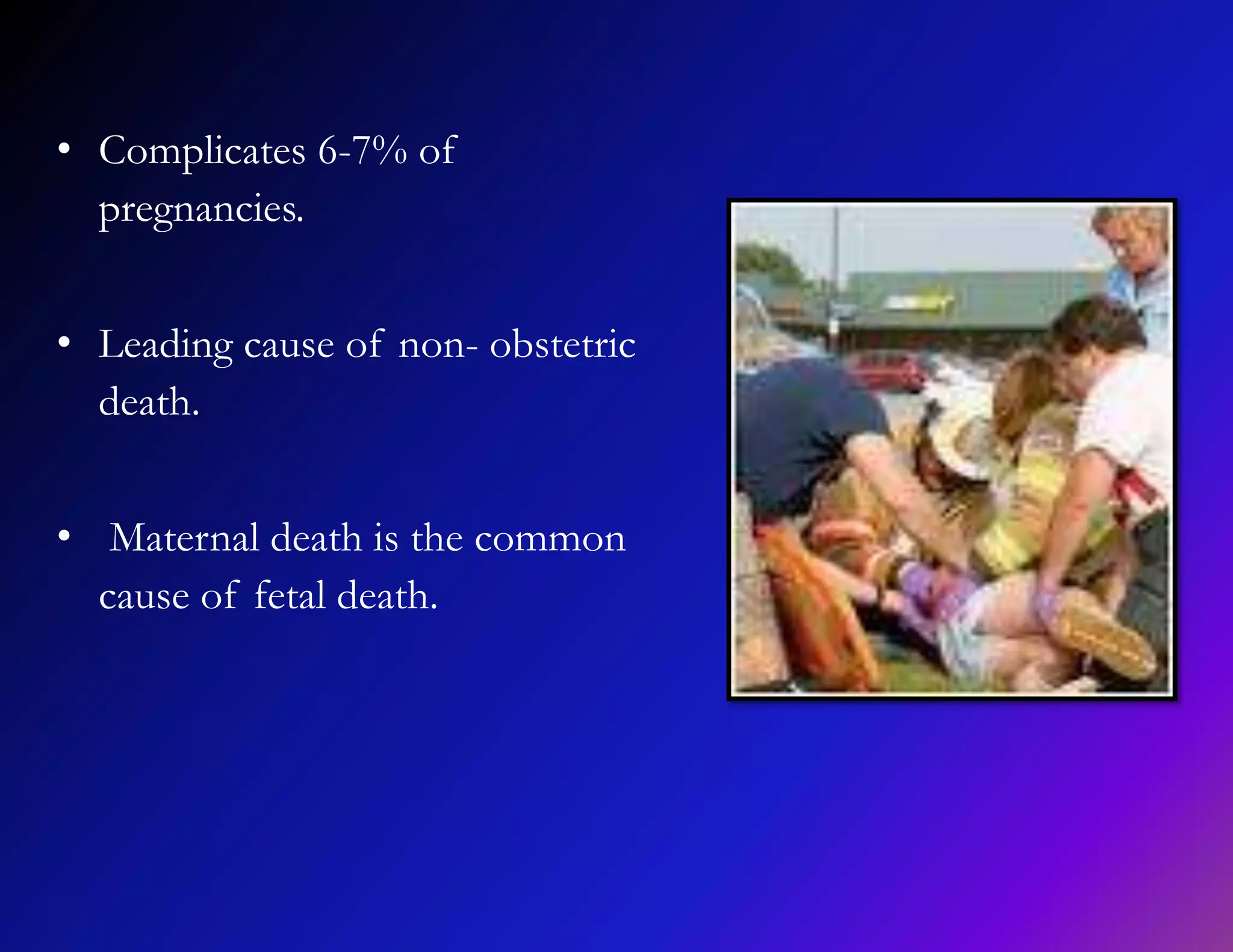
• Complicates 6-7% of 
pregnancies. 
• Leading cause of non- obstetric 
death. 
• Maternal death is the common 
cause of fetal death.
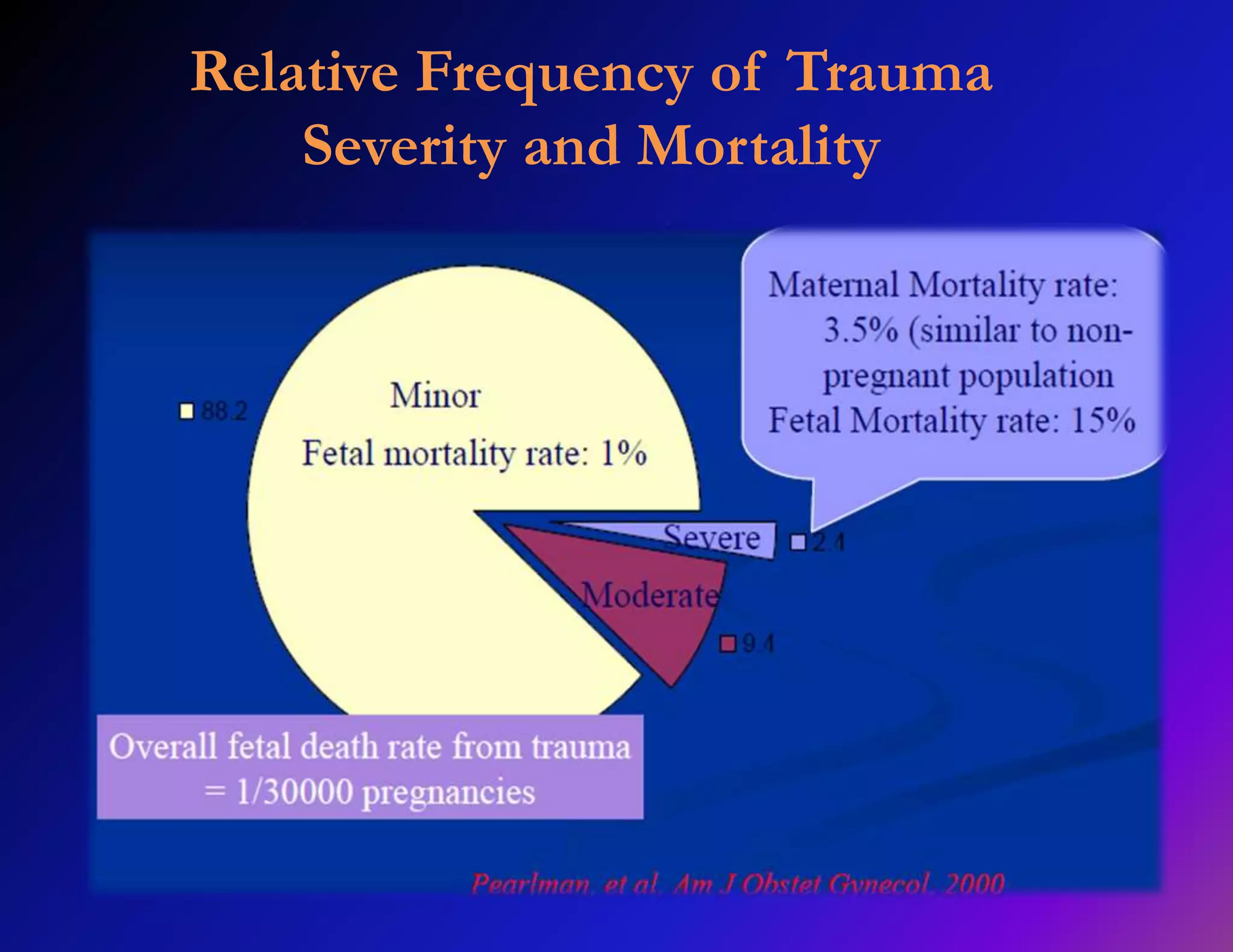
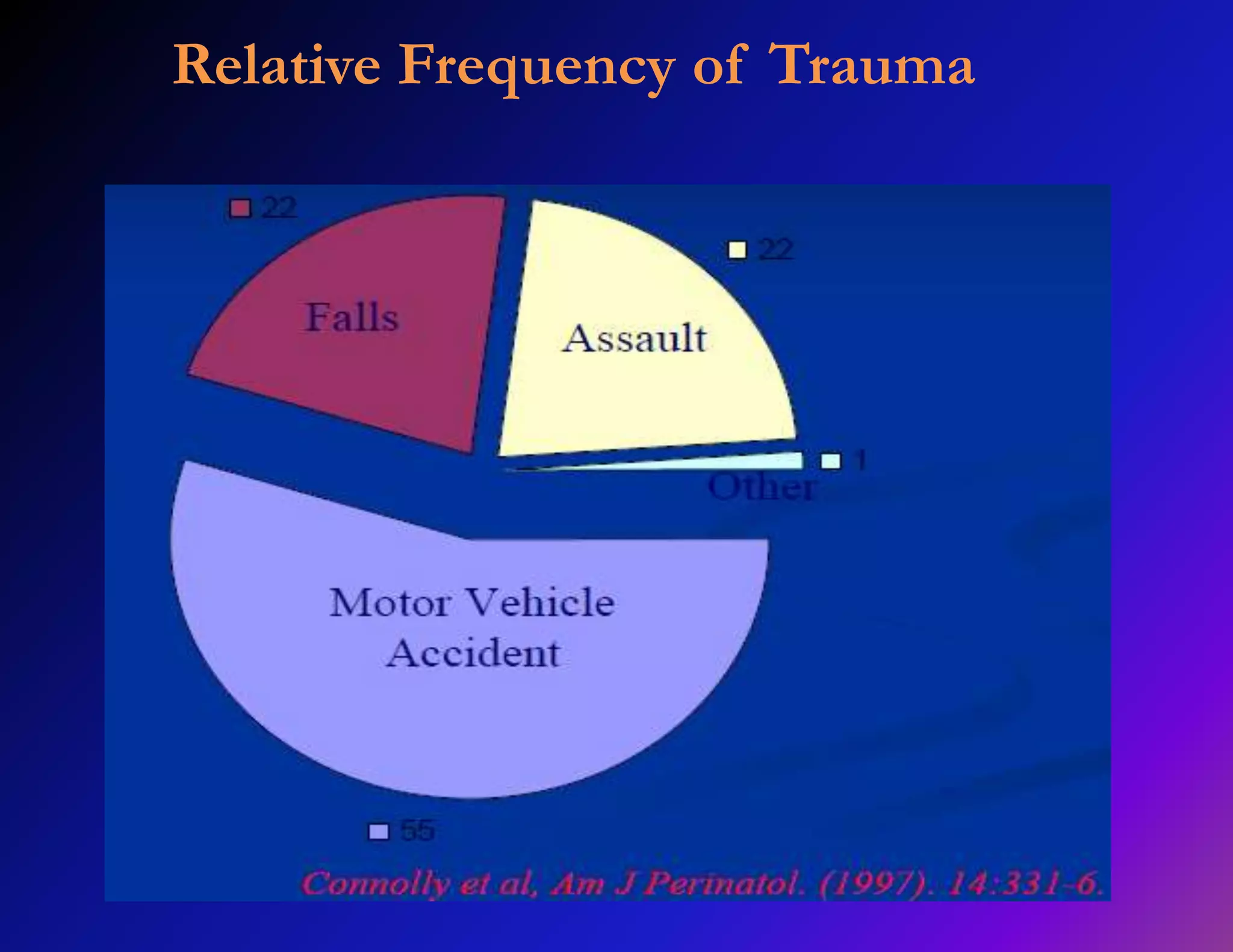
Relative Frequency of Trauma 
Severity and Mortality
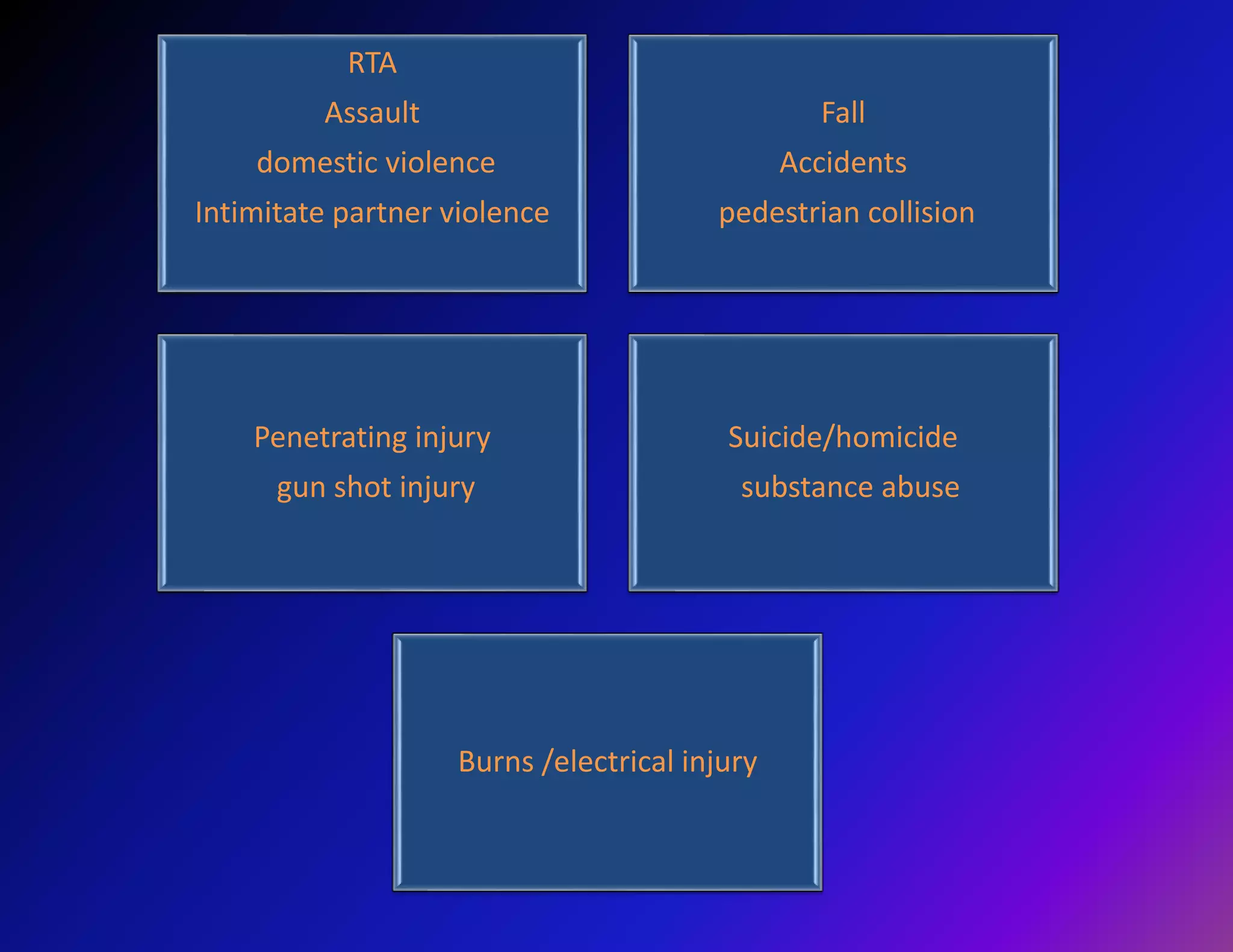
RTA 
Assault 
Causes 
domestic violence 
Intimitate partner violence 
Fall 
Accidents 
pedestrian collision 
Penetrating injury 
gun shot injury 
Suicide/homicide 
substance abuse 
Burns /electrical injury
Relative Frequency of Trauma
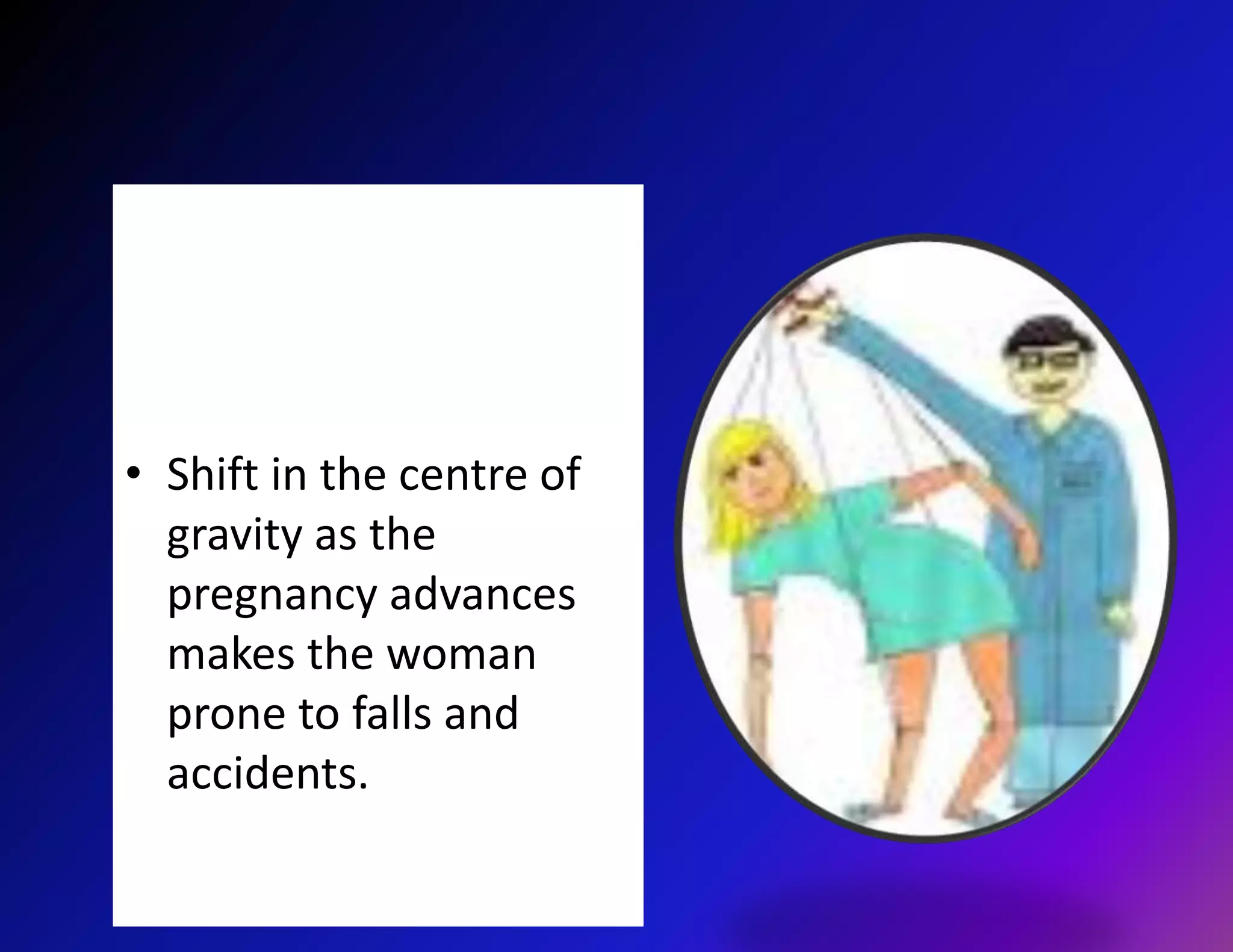
• Shift in the centre of 
gravity as the 
pregnancy advances 
makes the woman 
prone to falls and 
accidents.
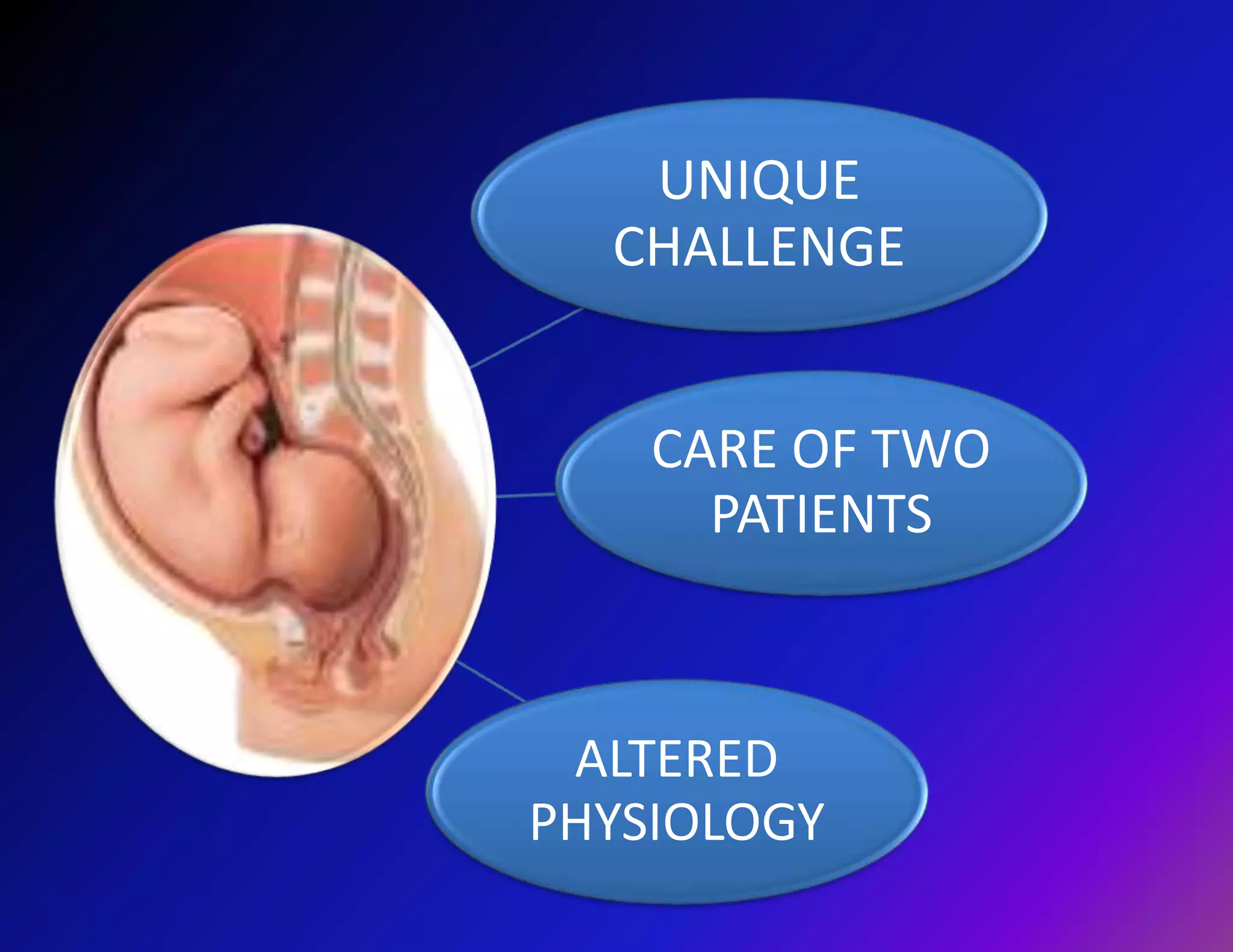
UNIQUE 
CHALLENGE 
CARE OF TWO 
PATIENTS 
ALTERED 
PHYSIOLOGY
Predictors of Mortality 
• Severity and type of trauma 
• Gestational age 
• Complications 
• Internal injuries 
• Severe hemorrhage
Keel et al reported the major killers in polytrauma 
 head injury (66%). 
 hemorrhagic shock (21%). 
 sepsis and multiorgan failure (13%) 
 coagulopathies (dilutional and 
consumption).
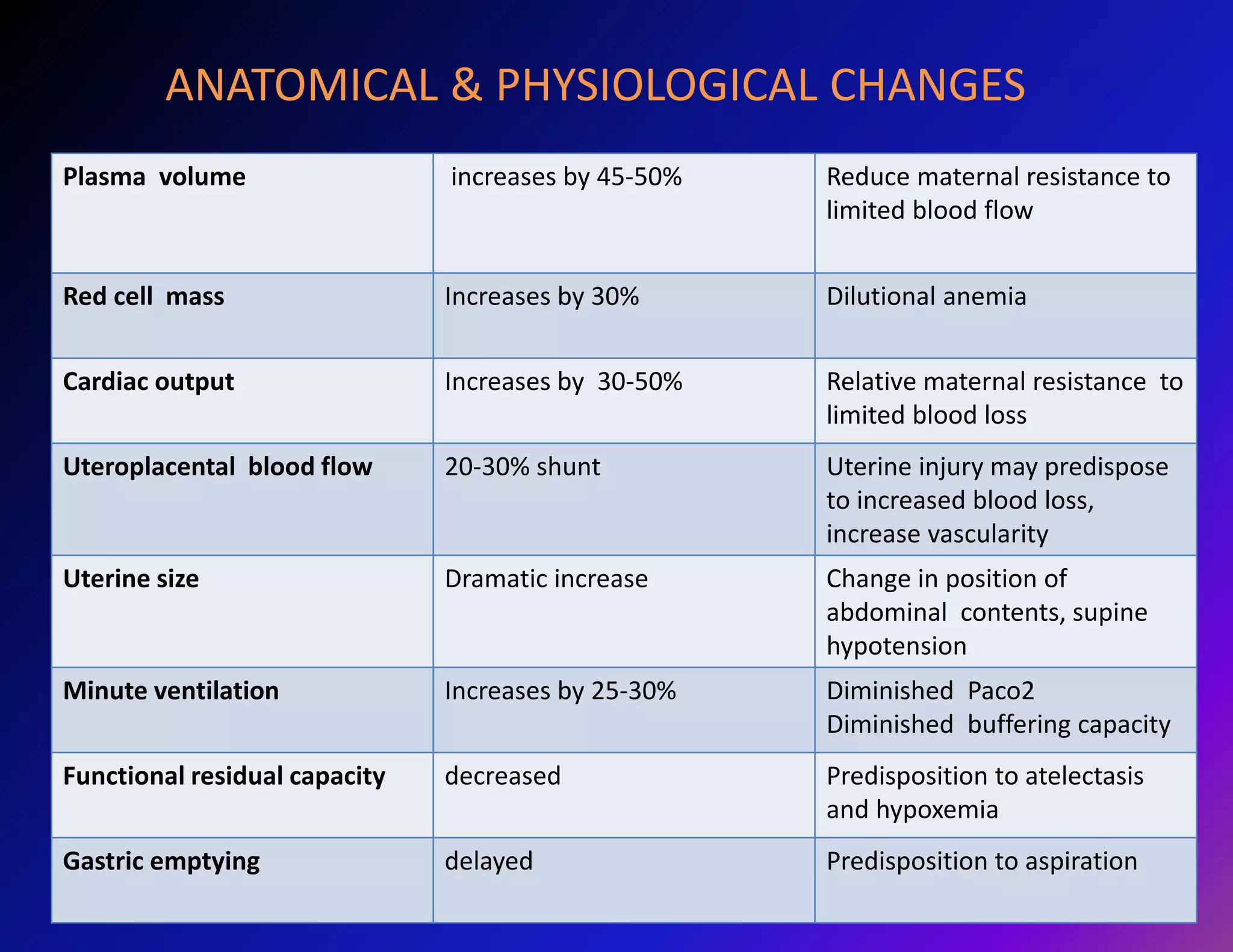
ANATOMICAL & PHYSIOLOGICAL CHANGES 
Plasma volume increases by 45-50% Reduce maternal resistance to 
limited blood flow 
Red cell mass Increases by 30% Dilutional anemia 
Cardiac output Increases by 30-50% Relative maternal resistance to 
limited blood loss 
Uteroplacental blood flow 20-30% shunt Uterine injury may predispose 
to increased blood loss, 
increase vascularity 
Uterine size Dramatic increase Change in position of 
abdominal contents, supine 
hypotension 
Minute ventilation Increases by 25-30% Diminished Paco2 
Diminished buffering capacity 
Functional residual capacity decreased Predisposition to atelectasis 
and hypoxemia 
Gastric emptying delayed Predisposition to aspiration
Injury specific 
considerations
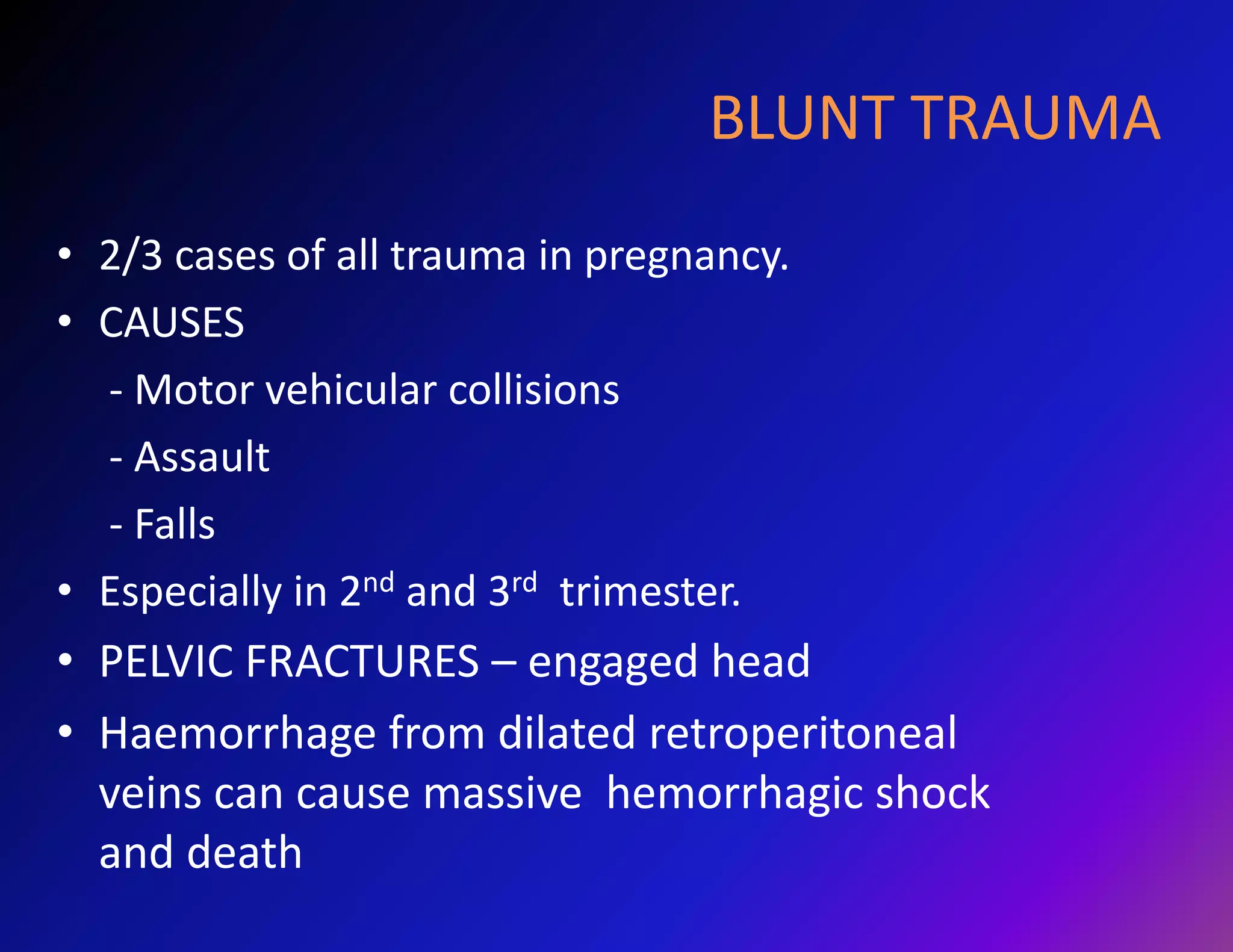
BLUNT TRAUMA 
• 2/3 cases of all trauma in pregnancy. 
• CAUSES 
- Motor vehicular collisions 
- Assault 
- Falls 
• Especially in 2nd and 3rd trimester. 
• PELVIC FRACTURES – engaged head 
• Haemorrhage from dilated retroperitoneal 
veins can cause massive hemorrhagic shock 
and death
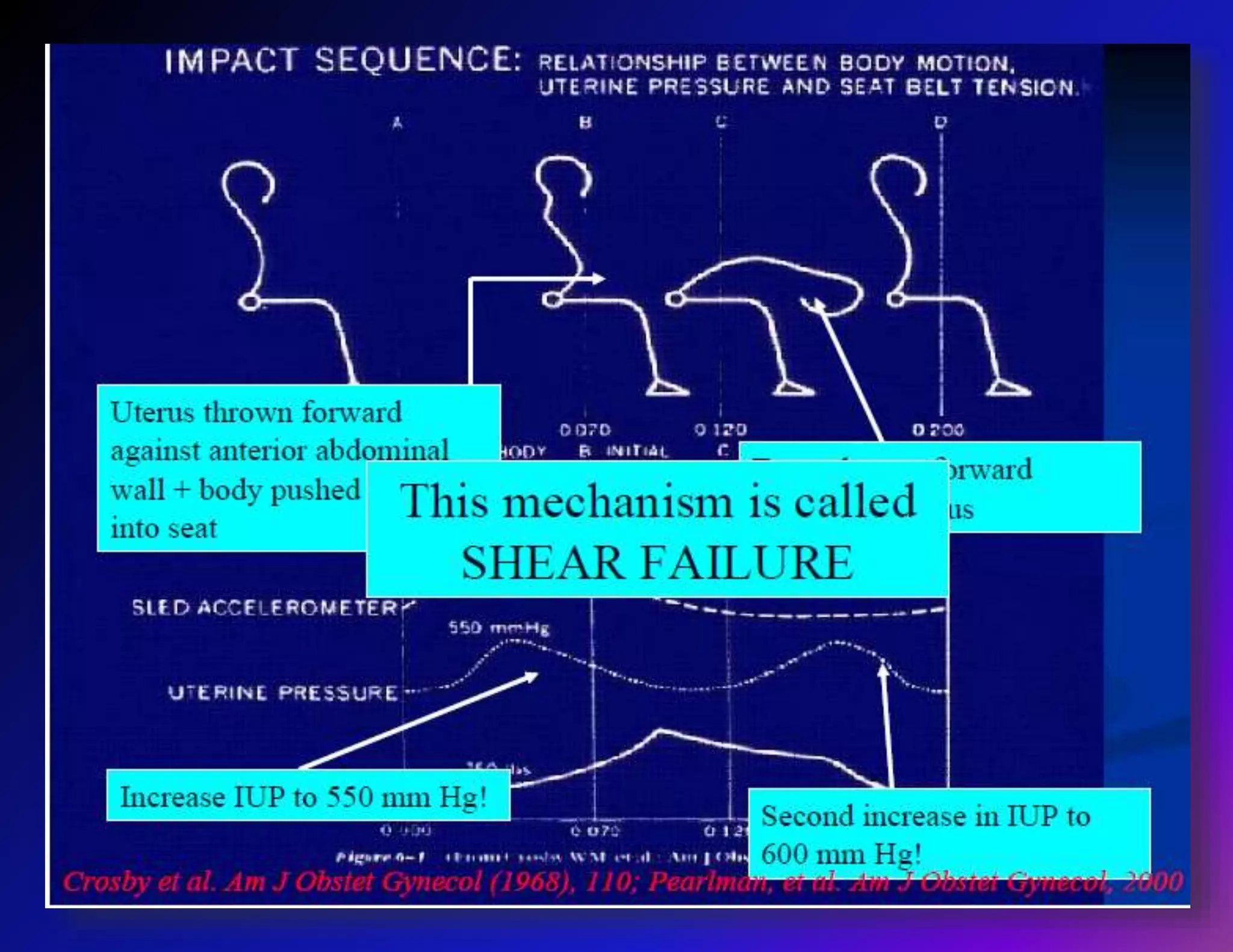
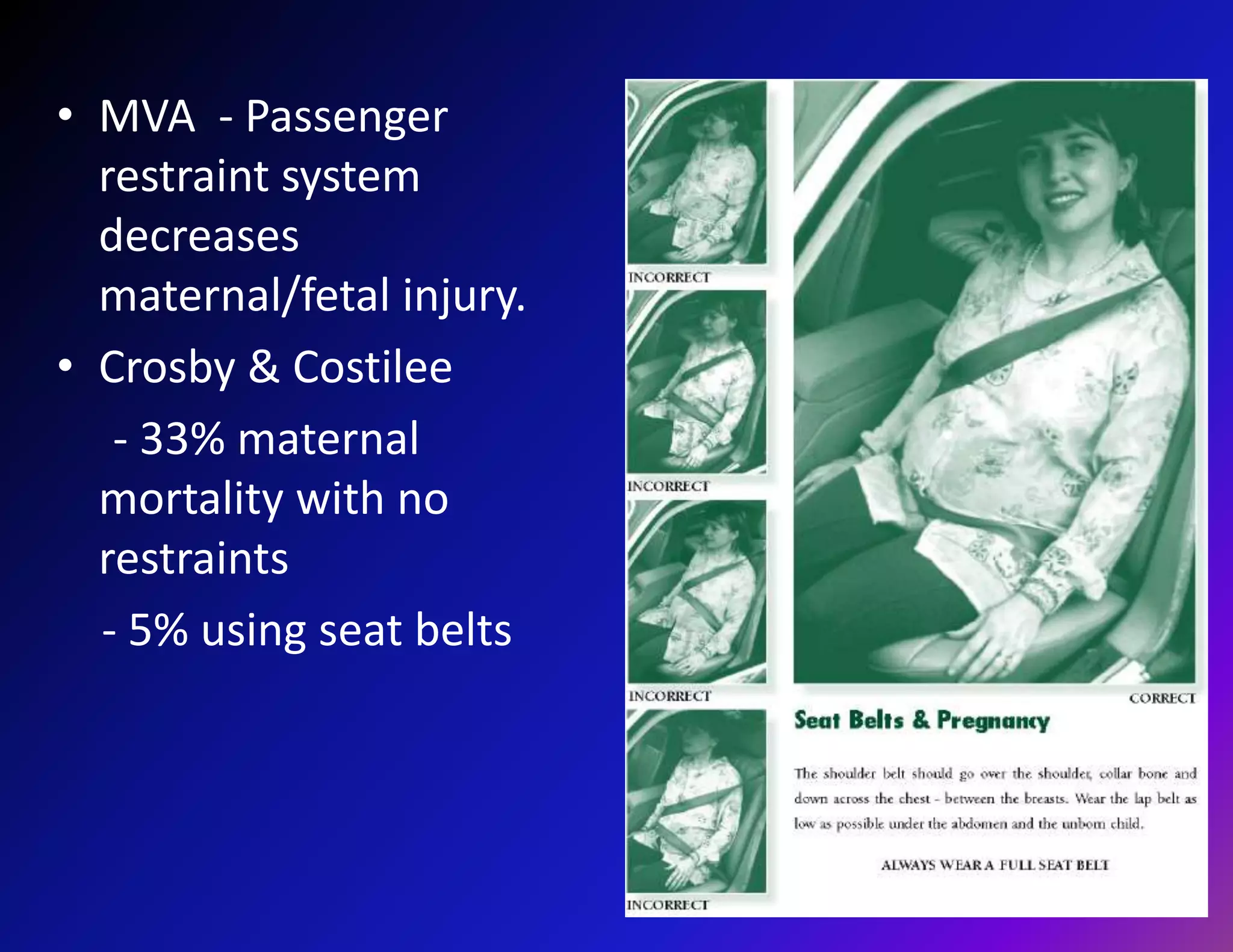
• MVA - Passenger 
restraint system 
decreases 
maternal/fetal injury. 
• Crosby & Costilee 
- 33% maternal 
mortality with no 
restraints 
- 5% using seat belts
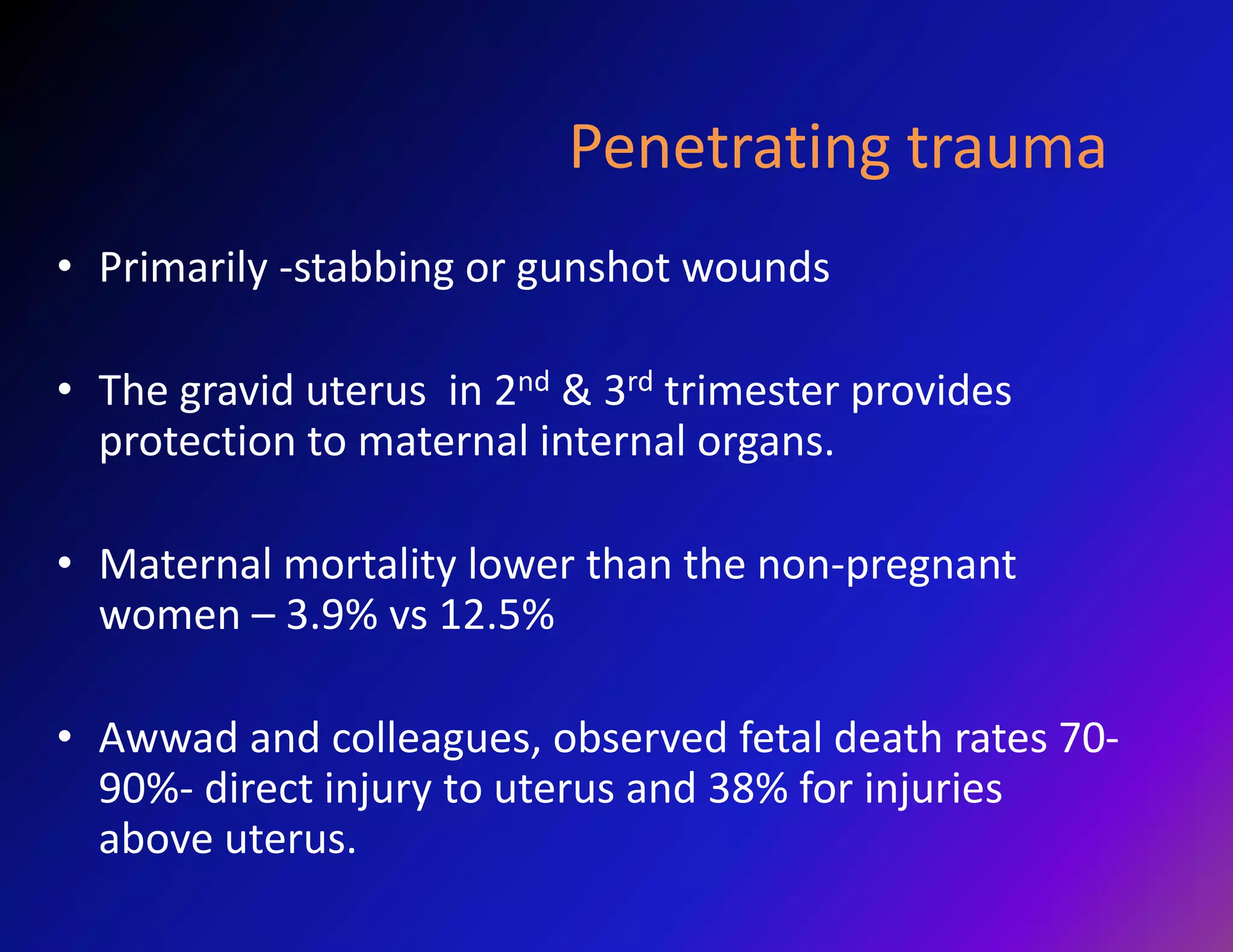
Penetrating trauma 
• Primarily -stabbing or gunshot wounds 
• The gravid uterus in 2nd & 3rd trimester provides 
protection to maternal internal organs. 
• Maternal mortality lower than the non-pregnant 
women – 3.9% vs 12.5% 
• Awwad and colleagues, observed fetal death rates 70- 
90%- direct injury to uterus and 38% for injuries 
above uterus.
BURNS 
• BURNS -6.8% to 7.8% of all pregnancies 
• Fetal loss is 56% -if 15-25% of body surface area(BSA) 
involved. 
63% - If 25-50% BSA involved. 
100%- If >50% BSA involved. 
• Maternal and fetal deaths are often a result of 
inadequate fluid resuscitation, prolonged hypotension, 
shock, hypoxia, septicemia and hyponatremia. 
• Potential for carbon monoxide poisoning
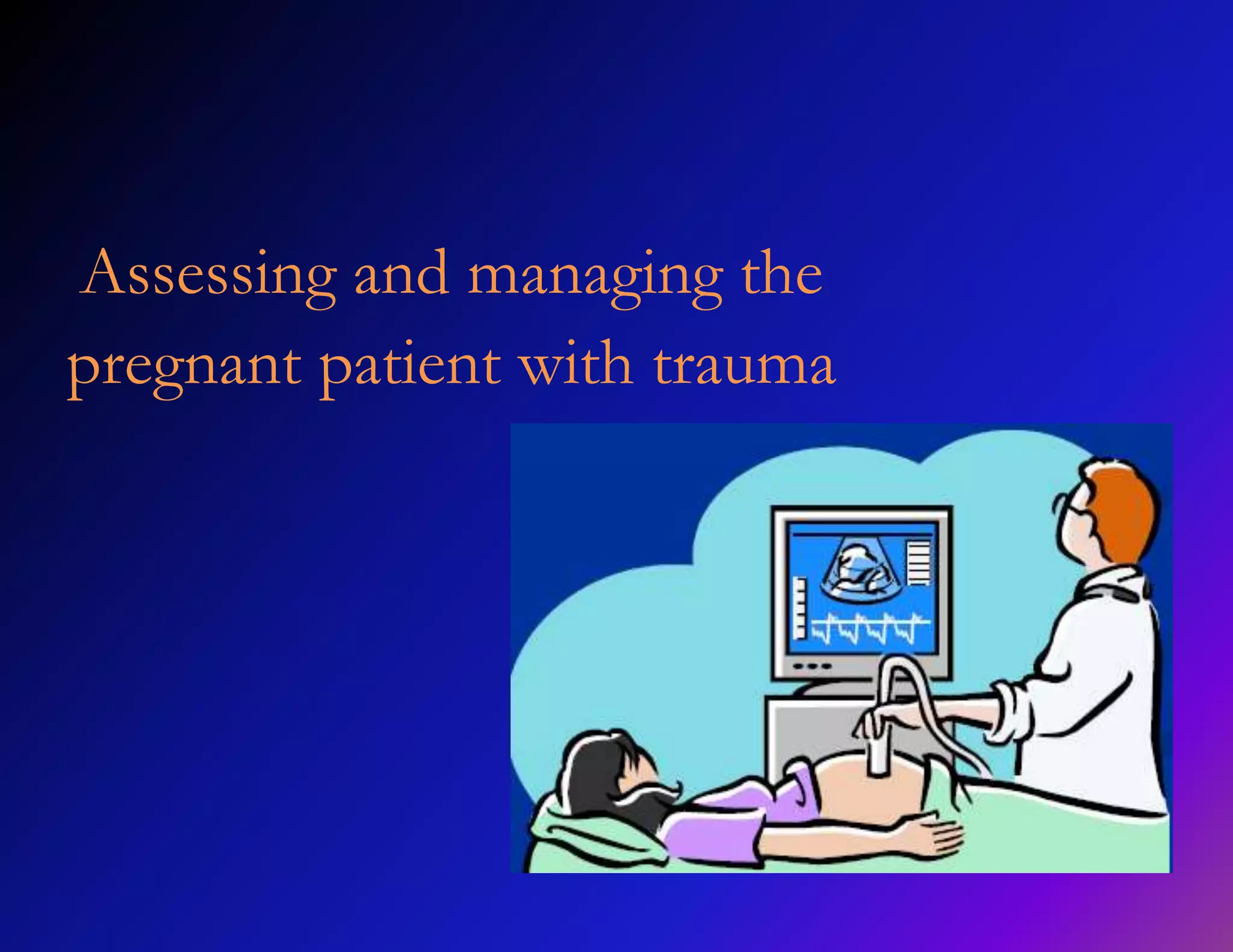
Assessing and managing the 
pregnant patient with trauma
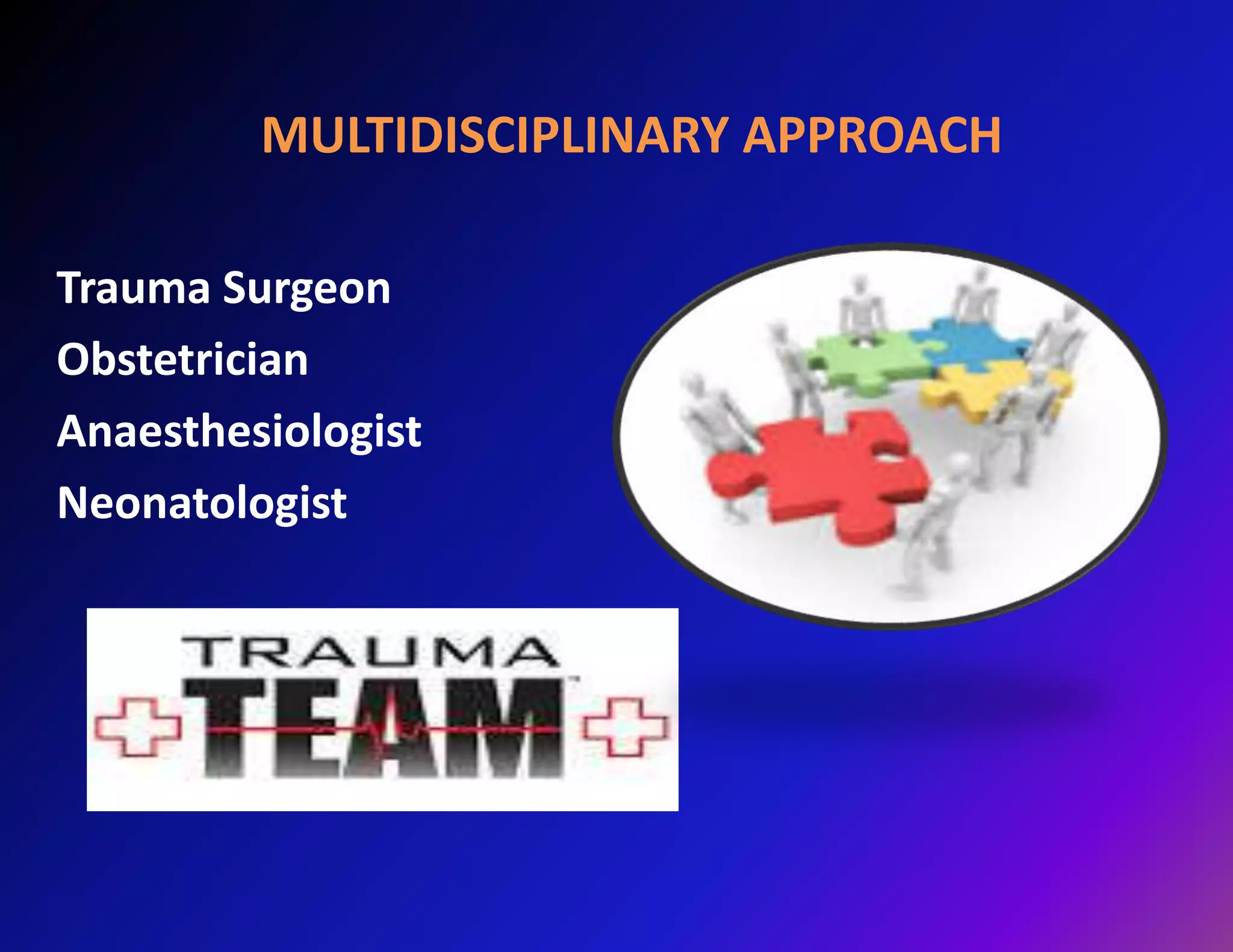
MULTIDISCIPLINARY APPROACH 
Trauma Surgeon 
Obstetrician 
Anaesthesiologist 
Neonatologist
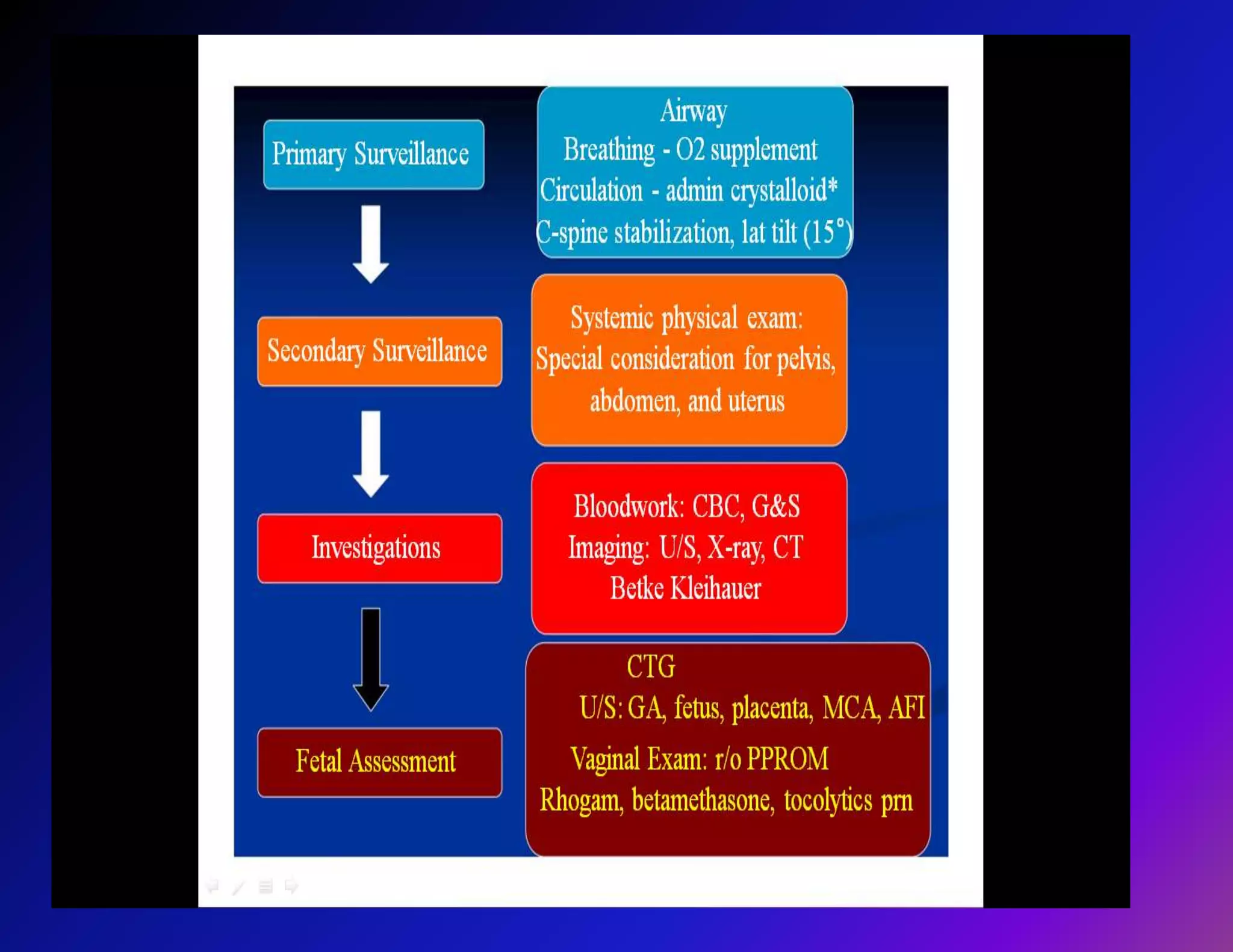
Primary Survey 
Maternal assessment 
„ Fetal age assessment & presence of life 
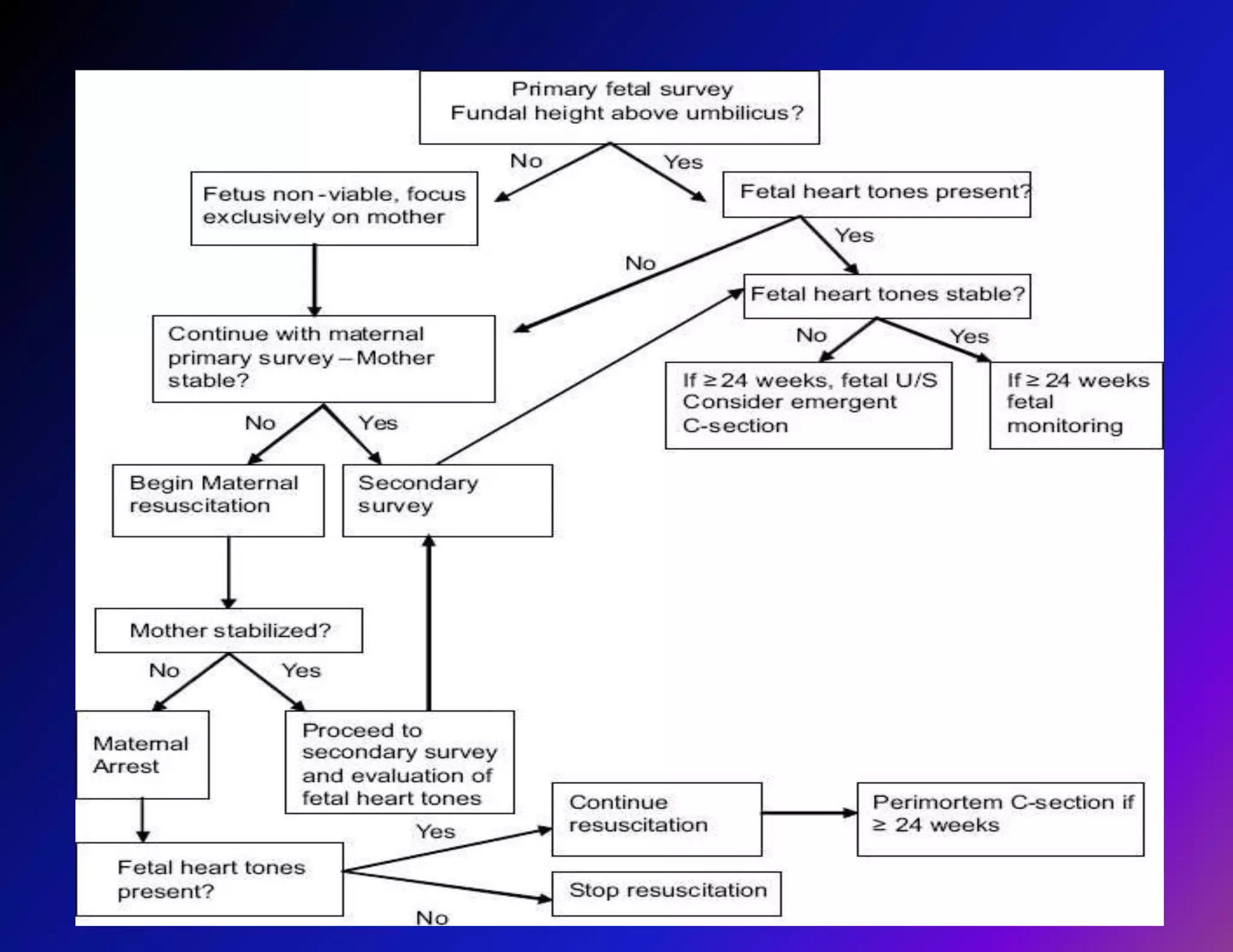
If CPR unsuccessful consider Perimortem CS 
Minimize effect of uterine compression on maternal 
resuscitation 
Fetal resuscitation
Maternal Resuscitation 
The main principle guiding 
therapy must be that 
resuscitating the mother will 
resuscitate the fetus.
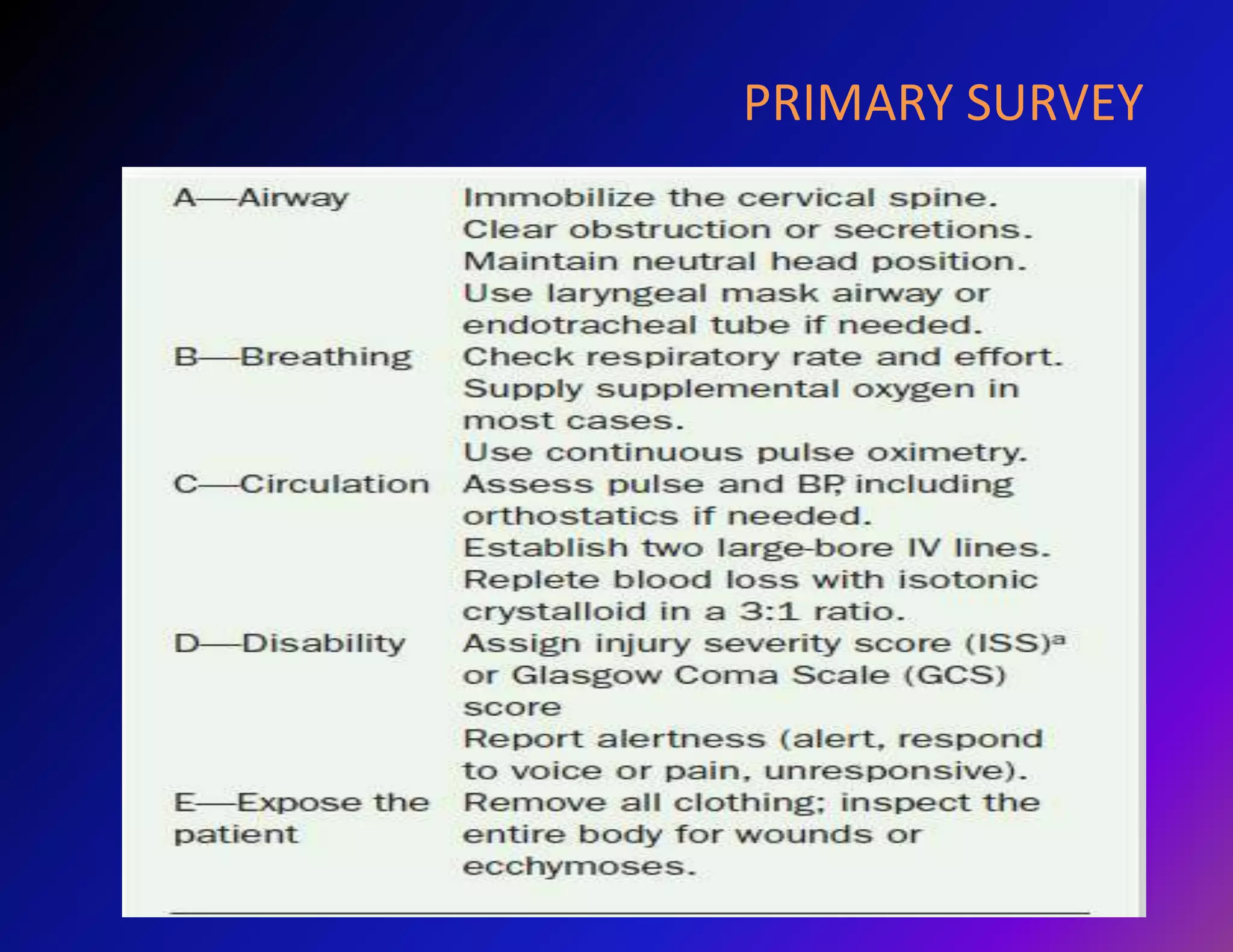
PRIMARY SURVEY
CIRCULATION 
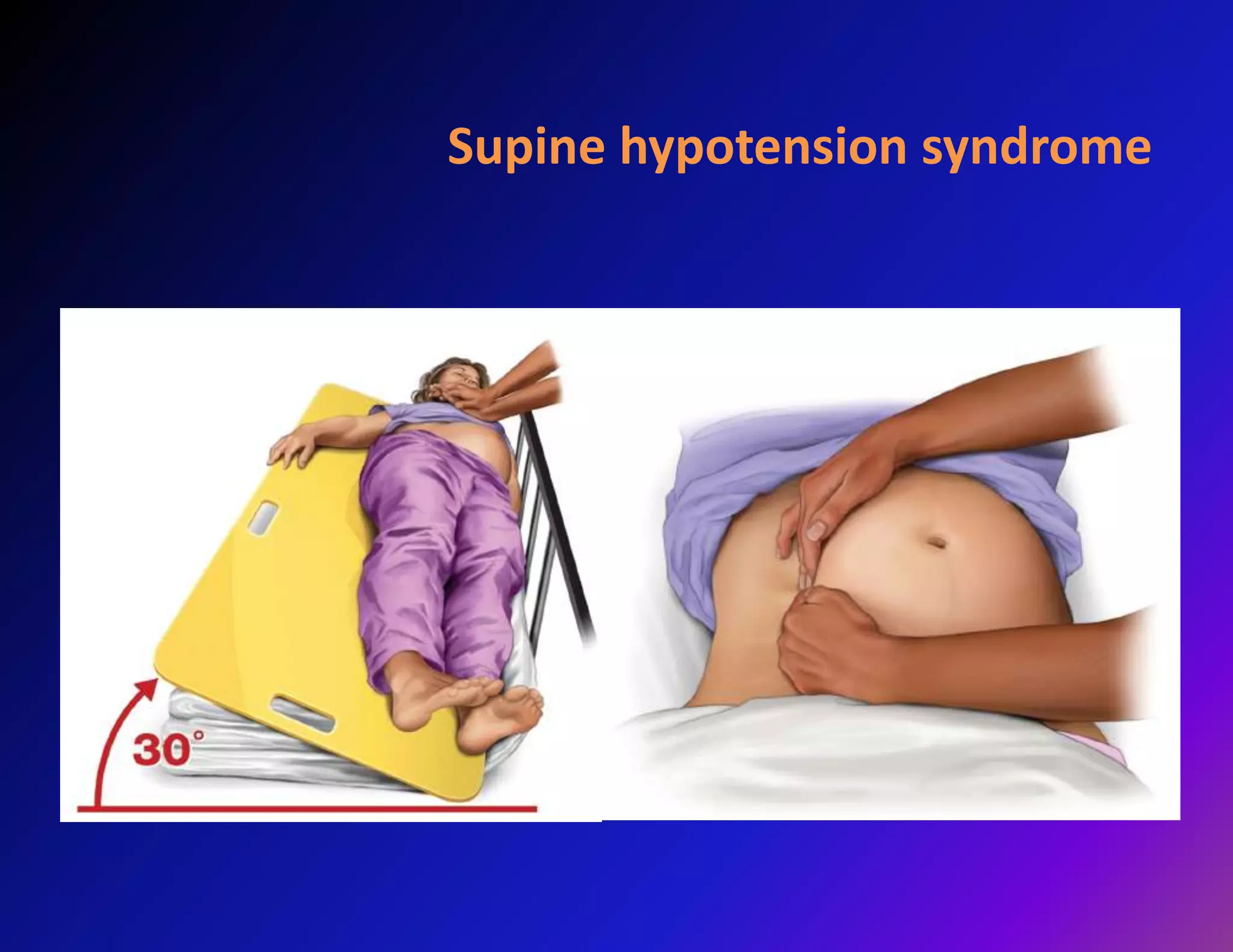
• Position- 30 degrees to left. 
• Volume resuscitation. 
Crystalloid- 3:1 replacement 
Blood transfusion 
• Maternal B.P,H.R- not a reliable indicator of maternal and 
fetal well being. 
• Uterus not critical organ- after acute blood loss- uterine 
blood flow decreased to maintain normal maternal B.P. 
• When signs of shock appear- fetal compromise far advanced
Supine hypotension syndrome
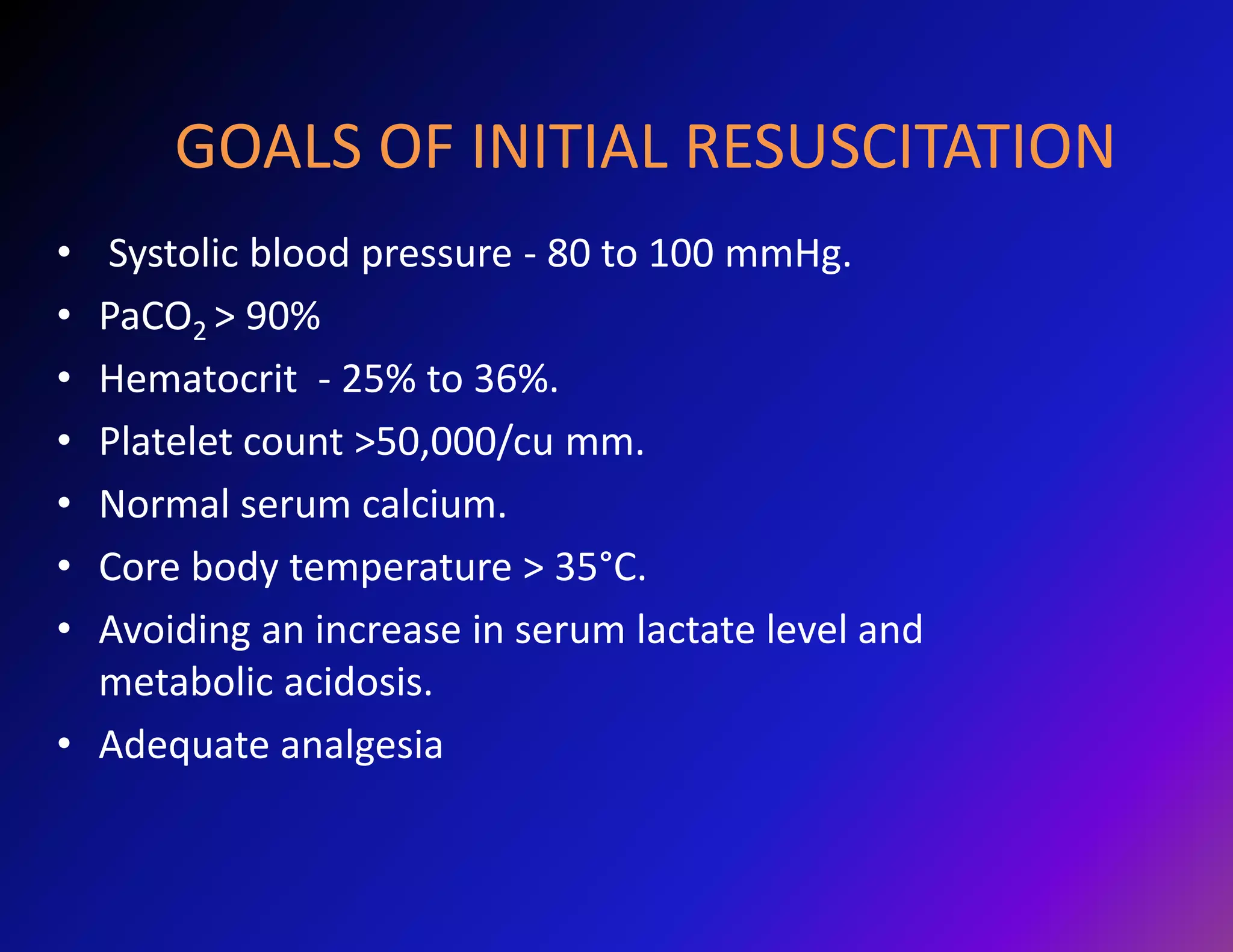
GOALS OF INITIAL RESUSCITATION 
• Systolic blood pressure - 80 to 100 mmHg. 
• PaCO2 > 90% 
• Hematocrit - 25% to 36%. 
• Platelet count >50,000/cu mm. 
• Normal serum calcium. 
• Core body temperature > 35°C. 
• Avoiding an increase in serum lactate level and 
metabolic acidosis. 
• Adequate analgesia
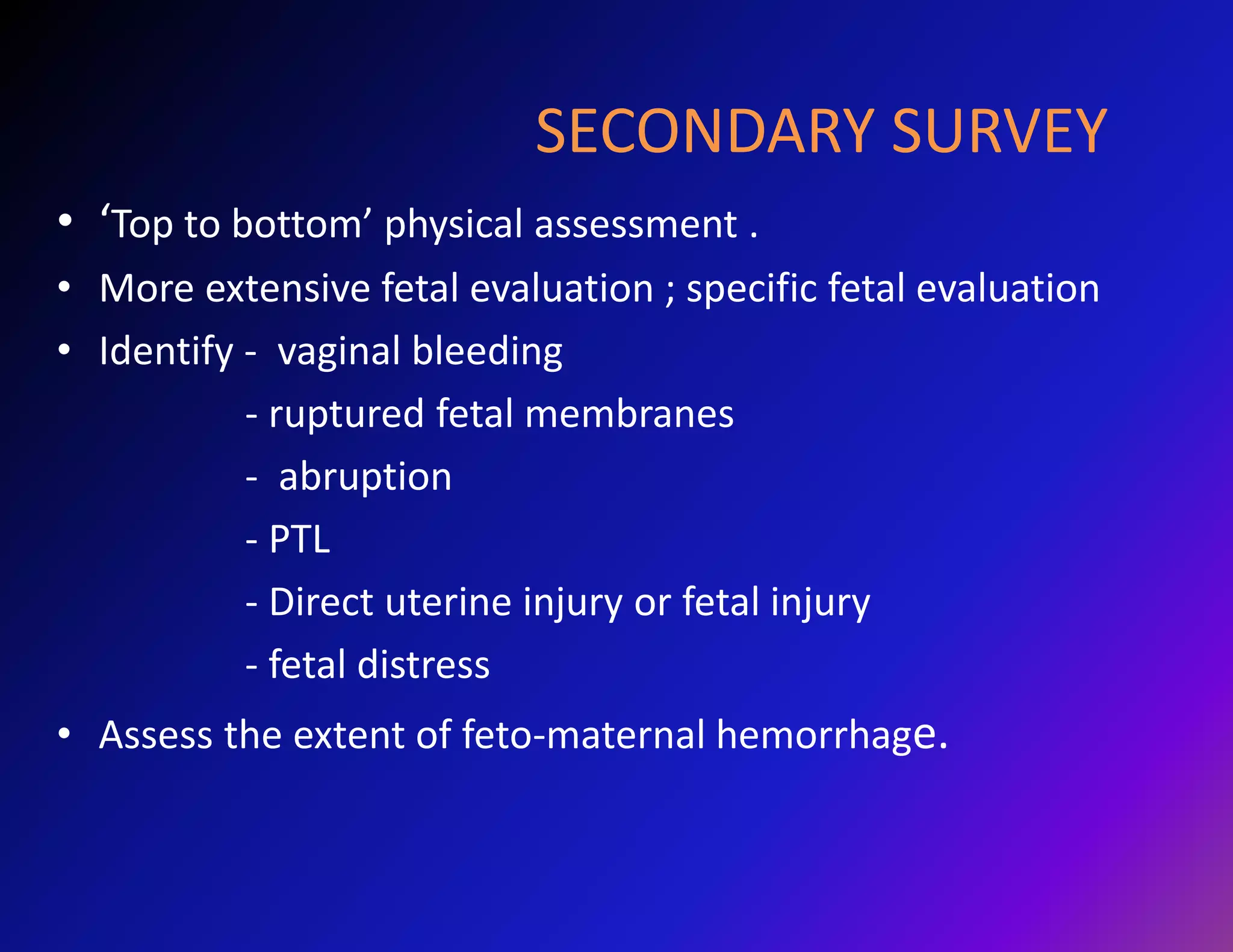
SECONDARY SURVEY 
• ‘Top to bottom’ physical assessment . 
• More extensive fetal evaluation ; specific fetal evaluation 
• Identify - vaginal bleeding 
- ruptured fetal membranes 
- abruption 
- PTL 
- Direct uterine injury or fetal injury 
- fetal distress 
• Assess the extent of feto-maternal hemorrhage.
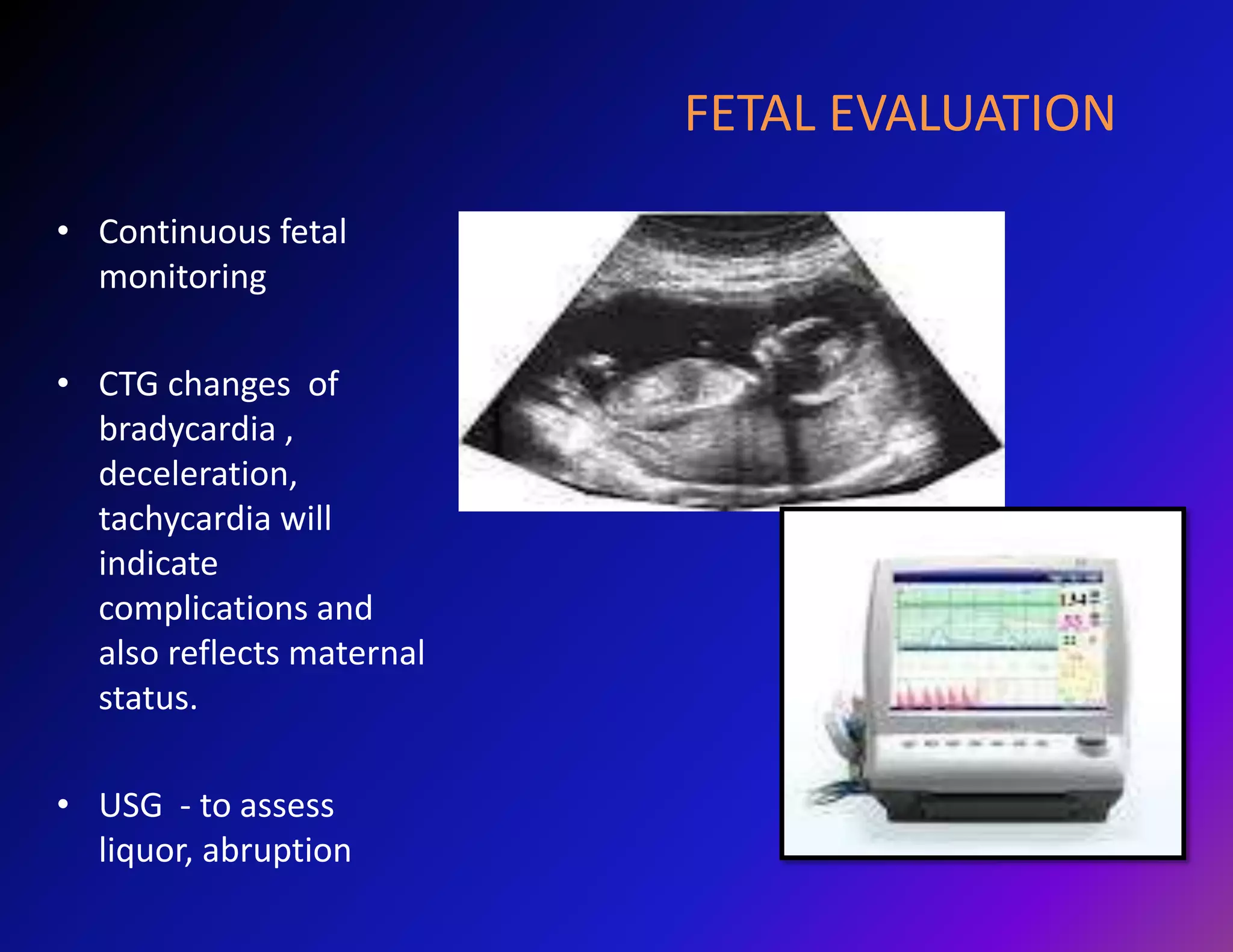
FETAL EVALUATION 
• Continuous fetal 
monitoring 
• CTG changes of 
bradycardia , 
deceleration, 
tachycardia will 
indicate 
complications and 
also reflects maternal 
status. 
• USG - to assess 
liquor, abruption
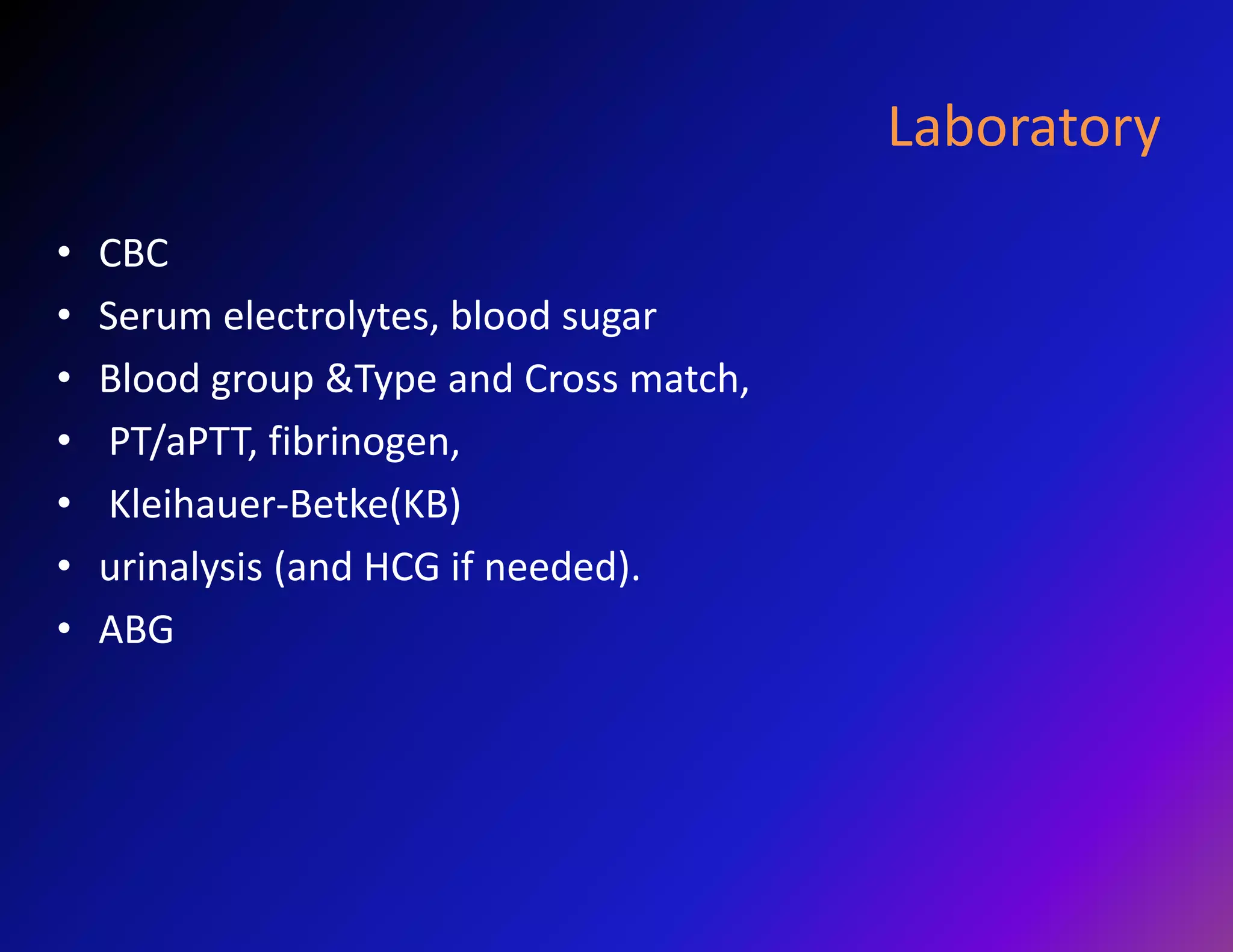
Laboratory 
• CBC 
• Serum electrolytes, blood sugar 
• Blood group &Type and Cross match, 
• PT/aPTT, fibrinogen, 
• Kleihauer-Betke(KB) 
• urinalysis (and HCG if needed). 
• ABG
Diagnostic Imaging 
Investigations During 
Pregnancy
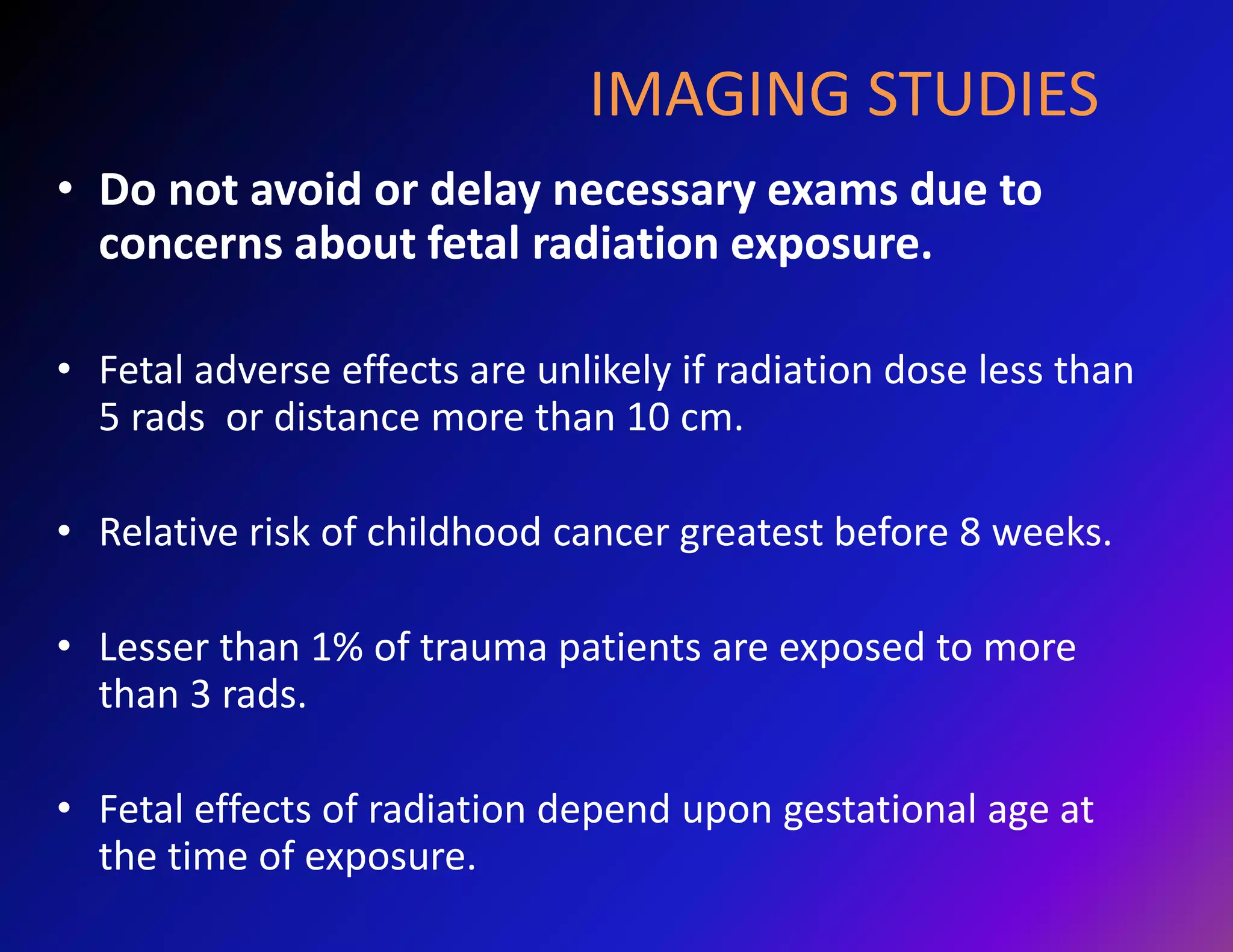
IMAGING STUDIES 
• Do not avoid or delay necessary exams due to 
concerns about fetal radiation exposure. 
• Fetal adverse effects are unlikely if radiation dose less than 
5 rads or distance more than 10 cm. 
• Relative risk of childhood cancer greatest before 8 weeks. 
• Lesser than 1% of trauma patients are exposed to more 
than 3 rads. 
• Fetal effects of radiation depend upon gestational age at 
the time of exposure.
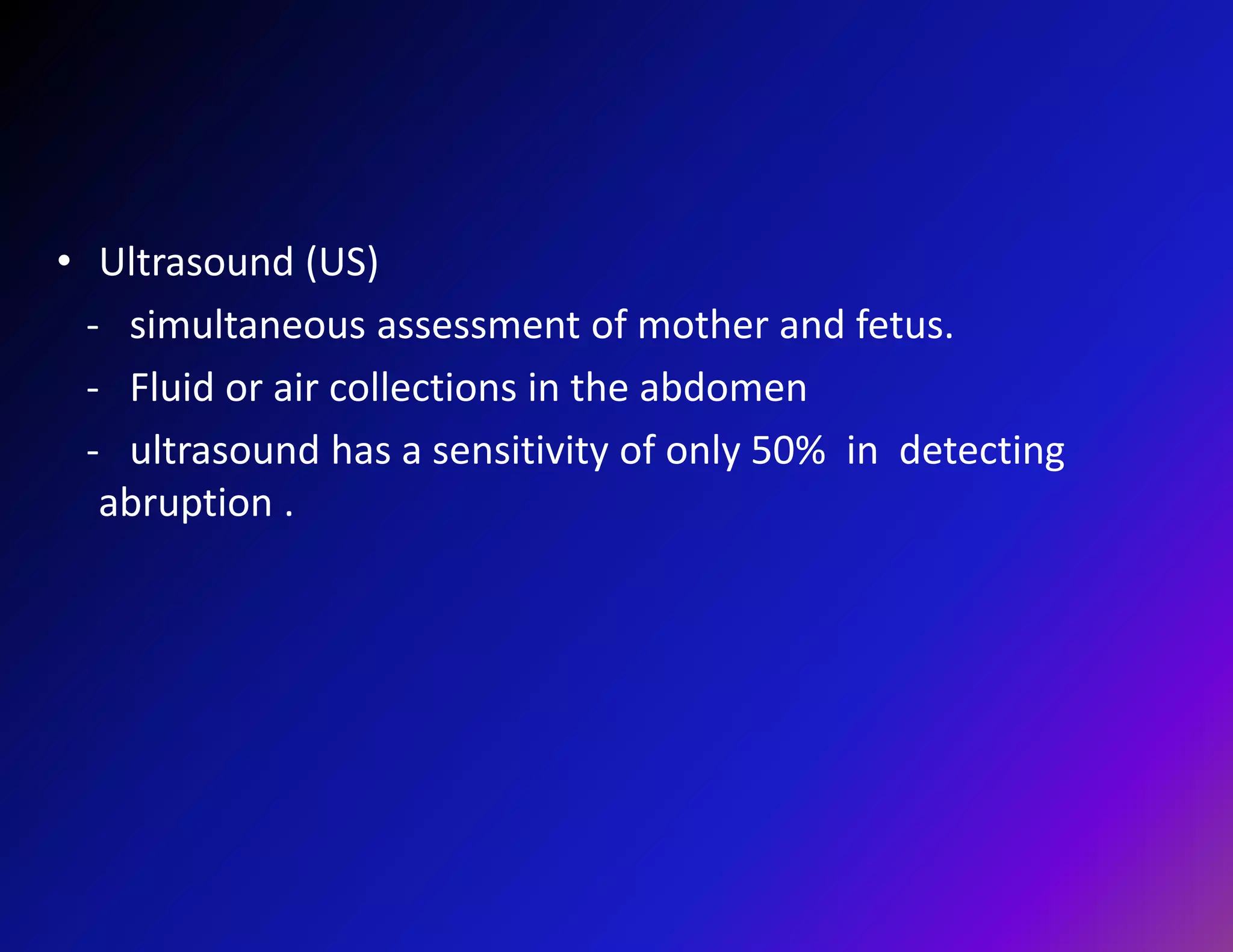
• Ultrasound (US) 
- simultaneous assessment of mother and fetus. 
- Fluid or air collections in the abdomen 
- ultrasound has a sensitivity of only 50% in detecting 
abruption .
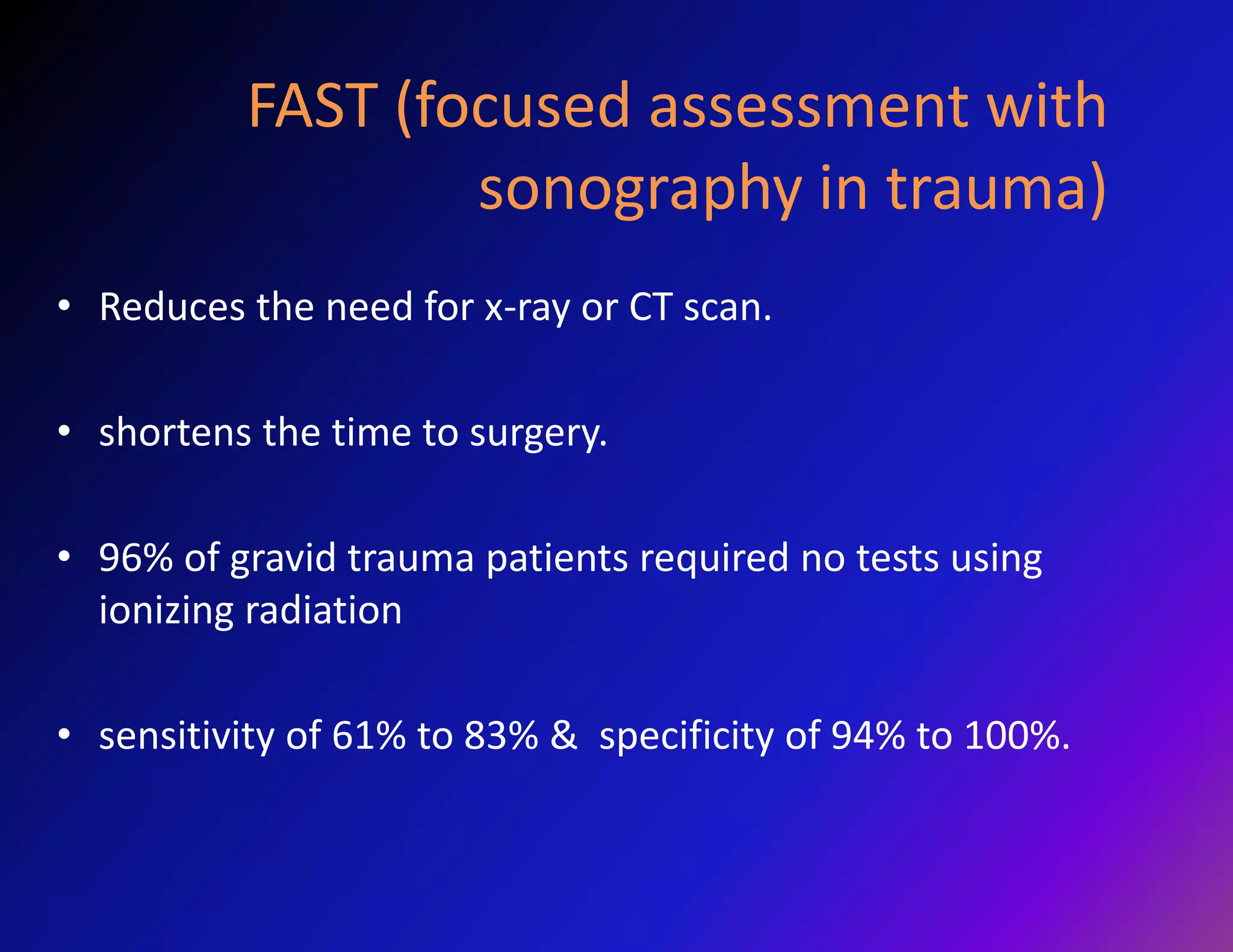
FAST (focused assessment with 
sonography in trauma) 
• Reduces the need for x-ray or CT scan. 
• shortens the time to surgery. 
• 96% of gravid trauma patients required no tests using 
ionizing radiation 
• sensitivity of 61% to 83% & specificity of 94% to 100%.
• CT scan 
- Head and chest CT- 1 rads 
- abdomen above uterus- 3 rads 
- pelvic CT- 3 to 9 rads 
• MRI – no documented fetal effects reported including 
mutagenic.
DIAGNOSTIC PERITONEAL LAVAGE 
• DPL is an invasive, rapid, and highly accurate test for 
evaluating intraperitoneal haemorrhage or a ruptured 
hollow viscus. 
• Performed less frequently; replaced by FAST and helical 
computed tomography (CT).
Anesthesia in OB trauma 
• Maintain good anesthesia, oxygenation, normotension, 
normothermia, normocarbia (PaCO2 = 30) and left uterine 
displacement. 
• Avoid ketamine > 2 mg /kg (uterine hypertonus). 
• Monitor FHTs if practical. Loss of variability is normal, but 
fetal tachy or bradycardia may mean hypoxia. 
• Avoid benzodiazepines and N2O early in gestation
MOTHER STABLE, FETUS STABLE 
• Once mother is stabilized, focus on fetus. 
• Direct impact – not necessary for feto placental 
pathology. 
• No obvious abdominal trauma- still needs 
monitoring. 
• 4hr- CTG monitoring recommended.(Pearlman 
et al.)
MOTHER STABLE, FETUS UNSTABLE 
• CESAREAN SECTION 
- Fetal distress despite optimizing mother. 
- uterine rupture. 
- placental rupture 
- Fetal malpresentation during preterm labor. 
- uterus mechanically limits maternal repair
MOTHER UNSTABLE FETUS UNSTABLE 
• Primary repair of maternal injuries- best course 
• Even in fetal distress, as critically injured mother will not 
withstand cesarean section. 
• Early restoration of maternal physiology – best initial action 
for fetus. 
• If mother can withstand- cesarean section can be 
performed
When to Salvage Fetus ?
PERIMORTEM CS 
• Maternal resuscitation as per ACLS guidelines. 
• If no response- decision for perimortem cesarean section. 
• No return of spontaneous circulation after resuscitation for 
four minutes. 
• Delivery within 5 min carries the best chance of fetal and 
maternal survival.
CONCLUSION 
• Most diagnostic and therapeutic modalities relating to 
trauma care should not be modified or avoided during 
pregnancy. 
• Co-management /multidisciplinary approach , function to 
insure appropriate care of the trauma victim and her fetus.
trauma in pregnanacy

trauma in pregnanacy

  • 1.
  • 2.
    • Trauma isnot just something that happens to other people. Trauma is a disease that could affect anyone, but it is more importantly it is something that we can all prevent.
  • 3.
    • Complicates 6-7%of pregnancies. • Leading cause of non- obstetric death. • Maternal death is the common cause of fetal death.
  • 4.
    Relative Frequency ofTrauma Severity and Mortality
  • 5.
    RTA Assault Causes domestic violence Intimitate partner violence Fall Accidents pedestrian collision Penetrating injury gun shot injury Suicide/homicide substance abuse Burns /electrical injury
  • 6.
  • 7.
    • Shift inthe centre of gravity as the pregnancy advances makes the woman prone to falls and accidents.
  • 10.
    UNIQUE CHALLENGE CAREOF TWO PATIENTS ALTERED PHYSIOLOGY
  • 11.
    Predictors of Mortality • Severity and type of trauma • Gestational age • Complications • Internal injuries • Severe hemorrhage
  • 12.
    Keel et alreported the major killers in polytrauma  head injury (66%).  hemorrhagic shock (21%).  sepsis and multiorgan failure (13%)  coagulopathies (dilutional and consumption).
  • 13.
    ANATOMICAL & PHYSIOLOGICALCHANGES Plasma volume increases by 45-50% Reduce maternal resistance to limited blood flow Red cell mass Increases by 30% Dilutional anemia Cardiac output Increases by 30-50% Relative maternal resistance to limited blood loss Uteroplacental blood flow 20-30% shunt Uterine injury may predispose to increased blood loss, increase vascularity Uterine size Dramatic increase Change in position of abdominal contents, supine hypotension Minute ventilation Increases by 25-30% Diminished Paco2 Diminished buffering capacity Functional residual capacity decreased Predisposition to atelectasis and hypoxemia Gastric emptying delayed Predisposition to aspiration
  • 14.
  • 15.
    BLUNT TRAUMA •2/3 cases of all trauma in pregnancy. • CAUSES - Motor vehicular collisions - Assault - Falls • Especially in 2nd and 3rd trimester. • PELVIC FRACTURES – engaged head • Haemorrhage from dilated retroperitoneal veins can cause massive hemorrhagic shock and death
  • 16.
    • MVA -Passenger restraint system decreases maternal/fetal injury. • Crosby & Costilee - 33% maternal mortality with no restraints - 5% using seat belts
  • 17.
    Penetrating trauma •Primarily -stabbing or gunshot wounds • The gravid uterus in 2nd & 3rd trimester provides protection to maternal internal organs. • Maternal mortality lower than the non-pregnant women – 3.9% vs 12.5% • Awwad and colleagues, observed fetal death rates 70- 90%- direct injury to uterus and 38% for injuries above uterus.
  • 18.
    BURNS • BURNS-6.8% to 7.8% of all pregnancies • Fetal loss is 56% -if 15-25% of body surface area(BSA) involved. 63% - If 25-50% BSA involved. 100%- If >50% BSA involved. • Maternal and fetal deaths are often a result of inadequate fluid resuscitation, prolonged hypotension, shock, hypoxia, septicemia and hyponatremia. • Potential for carbon monoxide poisoning
  • 19.
    Assessing and managingthe pregnant patient with trauma
  • 20.
    MULTIDISCIPLINARY APPROACH TraumaSurgeon Obstetrician Anaesthesiologist Neonatologist
  • 22.
    Primary Survey Maternalassessment „ Fetal age assessment & presence of life If CPR unsuccessful consider Perimortem CS Minimize effect of uterine compression on maternal resuscitation Fetal resuscitation
  • 23.
    Maternal Resuscitation Themain principle guiding therapy must be that resuscitating the mother will resuscitate the fetus.
  • 24.
  • 25.
    CIRCULATION • Position-30 degrees to left. • Volume resuscitation. Crystalloid- 3:1 replacement Blood transfusion • Maternal B.P,H.R- not a reliable indicator of maternal and fetal well being. • Uterus not critical organ- after acute blood loss- uterine blood flow decreased to maintain normal maternal B.P. • When signs of shock appear- fetal compromise far advanced
  • 26.
  • 27.
    GOALS OF INITIALRESUSCITATION • Systolic blood pressure - 80 to 100 mmHg. • PaCO2 > 90% • Hematocrit - 25% to 36%. • Platelet count >50,000/cu mm. • Normal serum calcium. • Core body temperature > 35°C. • Avoiding an increase in serum lactate level and metabolic acidosis. • Adequate analgesia
  • 28.
    SECONDARY SURVEY •‘Top to bottom’ physical assessment . • More extensive fetal evaluation ; specific fetal evaluation • Identify - vaginal bleeding - ruptured fetal membranes - abruption - PTL - Direct uterine injury or fetal injury - fetal distress • Assess the extent of feto-maternal hemorrhage.
  • 29.
    FETAL EVALUATION •Continuous fetal monitoring • CTG changes of bradycardia , deceleration, tachycardia will indicate complications and also reflects maternal status. • USG - to assess liquor, abruption
  • 30.
    Laboratory • CBC • Serum electrolytes, blood sugar • Blood group &Type and Cross match, • PT/aPTT, fibrinogen, • Kleihauer-Betke(KB) • urinalysis (and HCG if needed). • ABG
  • 31.
  • 32.
    IMAGING STUDIES •Do not avoid or delay necessary exams due to concerns about fetal radiation exposure. • Fetal adverse effects are unlikely if radiation dose less than 5 rads or distance more than 10 cm. • Relative risk of childhood cancer greatest before 8 weeks. • Lesser than 1% of trauma patients are exposed to more than 3 rads. • Fetal effects of radiation depend upon gestational age at the time of exposure.
  • 33.
    • Ultrasound (US) - simultaneous assessment of mother and fetus. - Fluid or air collections in the abdomen - ultrasound has a sensitivity of only 50% in detecting abruption .
  • 34.
    FAST (focused assessmentwith sonography in trauma) • Reduces the need for x-ray or CT scan. • shortens the time to surgery. • 96% of gravid trauma patients required no tests using ionizing radiation • sensitivity of 61% to 83% & specificity of 94% to 100%.
  • 35.
    • CT scan - Head and chest CT- 1 rads - abdomen above uterus- 3 rads - pelvic CT- 3 to 9 rads • MRI – no documented fetal effects reported including mutagenic.
  • 36.
    DIAGNOSTIC PERITONEAL LAVAGE • DPL is an invasive, rapid, and highly accurate test for evaluating intraperitoneal haemorrhage or a ruptured hollow viscus. • Performed less frequently; replaced by FAST and helical computed tomography (CT).
  • 37.
    Anesthesia in OBtrauma • Maintain good anesthesia, oxygenation, normotension, normothermia, normocarbia (PaCO2 = 30) and left uterine displacement. • Avoid ketamine > 2 mg /kg (uterine hypertonus). • Monitor FHTs if practical. Loss of variability is normal, but fetal tachy or bradycardia may mean hypoxia. • Avoid benzodiazepines and N2O early in gestation
  • 38.
    MOTHER STABLE, FETUSSTABLE • Once mother is stabilized, focus on fetus. • Direct impact – not necessary for feto placental pathology. • No obvious abdominal trauma- still needs monitoring. • 4hr- CTG monitoring recommended.(Pearlman et al.)
  • 39.
    MOTHER STABLE, FETUSUNSTABLE • CESAREAN SECTION - Fetal distress despite optimizing mother. - uterine rupture. - placental rupture - Fetal malpresentation during preterm labor. - uterus mechanically limits maternal repair
  • 40.
    MOTHER UNSTABLE FETUSUNSTABLE • Primary repair of maternal injuries- best course • Even in fetal distress, as critically injured mother will not withstand cesarean section. • Early restoration of maternal physiology – best initial action for fetus. • If mother can withstand- cesarean section can be performed
  • 41.
  • 42.
    PERIMORTEM CS •Maternal resuscitation as per ACLS guidelines. • If no response- decision for perimortem cesarean section. • No return of spontaneous circulation after resuscitation for four minutes. • Delivery within 5 min carries the best chance of fetal and maternal survival.
  • 44.
    CONCLUSION • Mostdiagnostic and therapeutic modalities relating to trauma care should not be modified or avoided during pregnancy. • Co-management /multidisciplinary approach , function to insure appropriate care of the trauma victim and her fetus.