CONTENT
   Introduction
   History
   How we see 3D
   How to create 3D ?
   Common 3D display technique
   Viewing through glass
   Anaglyphic 3D
   Polarization 3D
   Active glasses
 Auto stereoscopic display
   Lenticular lenses
    Parallax barrier
 Architecture of 3D TV
 Transmission
 3D display
 Application
     Advantages and disadvantage
INTRODUCTION
   A 3D television is a television that employs techniques
    of 3D presentation, such as stereoscopic capture, multi-
    view capture, or 2D plus depth, and a 3D display a
    special viewing device to project a television program
    into a realistic three-dimensional field.

   Three dimensional TV is expected to be next revolution
    in the TV history.
HISTORY
 The stereoscope was first invented by Sir Charles
 Wheatstone in 1838.
 Stereoscopic 3D television was demonstrated for
 the first time on 10 August 1928.
 A    stereoscope is a device for viewing
 a stereoscopic pair of separate images, depicting
 left-eye and right-eye views of the same scene, as
 a single three-dimensional image.
HOW WE SEE 3D
 Basic principle tricking our dumb, binocular brain
 into interpreting a 2Dimage into one with depth.

A key part of this process is binocular disparity. It
 means each eye has a slightly different viewpoint.

 When an object is far away, the light traveling to one
 eye is parallel with the light traveling to the other
 eye. But as an object gets closer, the lines are no
 longer parallel --they converge and our eyes shift to
 compensate.
HOW TO CREATE 3D?
   It involves the usage of two cameras (or a camera having
    two lenses), placed side by side with the center of their
    lenses spaced approximately and ideally, the same
    distance as the space between our eyes.

   Both cameras record in sync and the resulting left and
    right eye videos or images are then edited and presented
    to the viewer (in cinemas) via different techniques.
COMMON 3D DISPLAY TECHNOLOGY

   Projecting stereoscopic image pairs to the viewer
    include:

   Passive glass:
    Anaglyphic 3D (with red-blue glasses)
    Polarization 3D (with polarized glasses)

 Active glass: Alternate-frame sequencing
 Auto stereoscopic displays (without glasses)
VIEWING THROUGH GLASSES
 Two   sets of images are meant to be seen by only
  particular eye.

 Hence  each eye can only see one set of images,
  your brain interprets this to mean that both eyes
  are looking at the same object.

 That's   what creates the illusion of depth.
ANAGLYPHIC 3D
              RED-BLUE GLASSES
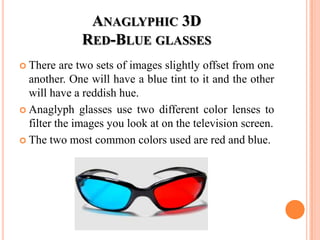
 There   are two sets of images slightly offset from one
  another. One will have a blue tint to it and the other
  will have a reddish hue.
 Anaglyph glasses use two different color lenses to
  filter the images you look at on the television screen.
 The two most common colors used are red and blue.
POLARIZATION 3D
             POLARIZED GLASSES
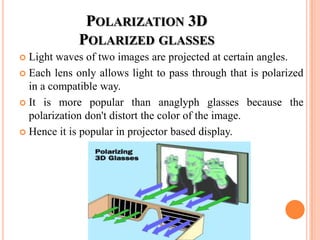
 Light waves of two images are projected at certain angles.
 Each lens only allows light to pass through that is polarized
  in a compatible way.
 It is more popular than anaglyph glasses because the
  polarization don't distort the color of the image.
 Hence it is popular in projector based display.
ACTIVE GLASSES
    ALTERNATE-FRAME SEQUENCING
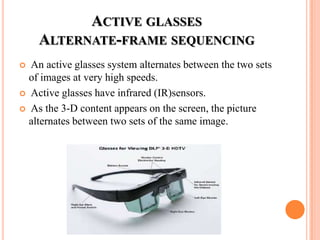
 An active glasses system alternates between the two sets
  of images at very high speeds.
 Active glasses have infrared (IR)sensors.

 As the 3-D content appears on the screen, the picture
  alternates between two sets of the same image.
ADVANTAGE OF ACTIVE GLASSES OVER
                  PASSIVE GLASSES
   It's easier to present 3-D in HD content using active
    glasses than with passive glasses.

   That's because with a passive glass system, the television
    has to display two sets of images at the same time.

    An active glasses system alternates between that two
    sets of images at very high speeds--it's less information
    for the television to handle at any particular moment.
BUT STILL HAVE A PROBLEM WITH
                 THOSE GLASSES?

Stereoscopic method leads to problems:
 The glasses are really cumbersome and expensive, and
  you don't want to accidentally sit on one or lose it. And
  what to do when we don't have enough lenses.

    Plus, it takes away the simplicity of television as it
    stands today, where you simply hit the remote and start
    watching.

   Also, without the glasses, any 3D content is completely
    unusable.
AUTO STEREOSCOPIC DISPLAY

   Two main technologies that rely on it:

     Lenticular lenses
     Parallax barrier
LENTICULAR LENSES
 Basically A lenticular lens is an array of
  magnifying or directing lenses, designed so
  that when viewed from slightly different
  angles, different images are magnified.
 Lenticulars are tiny lenses on the base side
  of a special film.
 The screen displays two sets of the same
  image. The lenses direct the light from the
  images to your eyes each eye sees only one
  image.
 It creates a particular space from which
  images can seen clearly called ‘sweet spot’.
PARALLAX BARRIER

    On a 3D screen, a very fine grating, called a "parallax
    barrier", is placed in front of the LCD screen.

    The parallax barrier is a fine grating of liquid crystals
    placed in front of the screen, with slits in it that
    correspond to certain columns of pixels of the screen.

    It does the job of the polarizing glasses, directing
    light from each image slightly in different direction so
    that at a so-called "sweet spot" about 30 inches in front
    of the screen the two images are separated just enough
    that the brain will create a composite 3D image.
ADVANTAGE OF PARALLAX BARRIER
          OVER LENTICULAR LENSES

    parallax barrier can be switched on and off with
    ease (one button on the remote is all it would
    take), allowing the TV to be used for 2D or3D
    viewing. So on a computer monitor, you could play
    video games in full 3D and then easily switch to 2D
    mode for your work requirements.
ARCHITECTURE OF 3D TV
TRANSMISSION


Gigabit Ethernet
 A transmission technology, enables super net to deliver enhanced network
  performance.
APPLICATION OF 3D TV
   video games
    TV
    applications for physicists, scientists, and engineers
    could also be extremely useful.
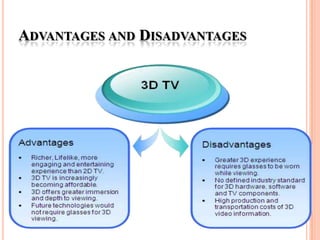
   Richer ,Lifelike and entertaining experience than 2D
    TV for home users.
   Future use in mobile.
ADVANTAGES AND DISADVANTAGES
CONCLUSION
 Thus  we have seen various technologies used for 3D
  imaging and viewing.
 We also explained technology of 3D TV, discussed
  various aspects and features of 3D TV.
 Another area of future research is precise colour
  reproduction of natural scenes on multiview
  displays.
 In future we will be able to touch and smell the
  objects being projected from a screen to the viewers.

3 d tv

  • 2.
    CONTENT  Introduction  History  How we see 3D  How to create 3D ?  Common 3D display technique  Viewing through glass  Anaglyphic 3D  Polarization 3D  Active glasses  Auto stereoscopic display  Lenticular lenses  Parallax barrier  Architecture of 3D TV  Transmission  3D display  Application Advantages and disadvantage
  • 3.
    INTRODUCTION  A 3D television is a television that employs techniques of 3D presentation, such as stereoscopic capture, multi- view capture, or 2D plus depth, and a 3D display a special viewing device to project a television program into a realistic three-dimensional field.  Three dimensional TV is expected to be next revolution in the TV history.
  • 4.
    HISTORY  The stereoscopewas first invented by Sir Charles Wheatstone in 1838.  Stereoscopic 3D television was demonstrated for the first time on 10 August 1928.  A stereoscope is a device for viewing a stereoscopic pair of separate images, depicting left-eye and right-eye views of the same scene, as a single three-dimensional image.
  • 5.
    HOW WE SEE3D  Basic principle tricking our dumb, binocular brain into interpreting a 2Dimage into one with depth. A key part of this process is binocular disparity. It means each eye has a slightly different viewpoint.  When an object is far away, the light traveling to one eye is parallel with the light traveling to the other eye. But as an object gets closer, the lines are no longer parallel --they converge and our eyes shift to compensate.
  • 6.
    HOW TO CREATE3D?  It involves the usage of two cameras (or a camera having two lenses), placed side by side with the center of their lenses spaced approximately and ideally, the same distance as the space between our eyes.  Both cameras record in sync and the resulting left and right eye videos or images are then edited and presented to the viewer (in cinemas) via different techniques.
  • 7.
    COMMON 3D DISPLAYTECHNOLOGY  Projecting stereoscopic image pairs to the viewer include:  Passive glass: Anaglyphic 3D (with red-blue glasses) Polarization 3D (with polarized glasses)  Active glass: Alternate-frame sequencing  Auto stereoscopic displays (without glasses)
  • 8.
    VIEWING THROUGH GLASSES Two sets of images are meant to be seen by only particular eye.  Hence each eye can only see one set of images, your brain interprets this to mean that both eyes are looking at the same object.  That's what creates the illusion of depth.
  • 9.
    ANAGLYPHIC 3D RED-BLUE GLASSES  There are two sets of images slightly offset from one another. One will have a blue tint to it and the other will have a reddish hue.  Anaglyph glasses use two different color lenses to filter the images you look at on the television screen.  The two most common colors used are red and blue.
  • 10.
    POLARIZATION 3D POLARIZED GLASSES  Light waves of two images are projected at certain angles.  Each lens only allows light to pass through that is polarized in a compatible way.  It is more popular than anaglyph glasses because the polarization don't distort the color of the image.  Hence it is popular in projector based display.
  • 11.
    ACTIVE GLASSES ALTERNATE-FRAME SEQUENCING  An active glasses system alternates between the two sets of images at very high speeds.  Active glasses have infrared (IR)sensors.  As the 3-D content appears on the screen, the picture alternates between two sets of the same image.
  • 12.
    ADVANTAGE OF ACTIVEGLASSES OVER PASSIVE GLASSES  It's easier to present 3-D in HD content using active glasses than with passive glasses.  That's because with a passive glass system, the television has to display two sets of images at the same time.  An active glasses system alternates between that two sets of images at very high speeds--it's less information for the television to handle at any particular moment.
  • 13.
    BUT STILL HAVEA PROBLEM WITH THOSE GLASSES? Stereoscopic method leads to problems:  The glasses are really cumbersome and expensive, and you don't want to accidentally sit on one or lose it. And what to do when we don't have enough lenses.  Plus, it takes away the simplicity of television as it stands today, where you simply hit the remote and start watching.  Also, without the glasses, any 3D content is completely unusable.
  • 14.
    AUTO STEREOSCOPIC DISPLAY  Two main technologies that rely on it:  Lenticular lenses  Parallax barrier
  • 15.
    LENTICULAR LENSES  BasicallyA lenticular lens is an array of magnifying or directing lenses, designed so that when viewed from slightly different angles, different images are magnified.  Lenticulars are tiny lenses on the base side of a special film.  The screen displays two sets of the same image. The lenses direct the light from the images to your eyes each eye sees only one image.  It creates a particular space from which images can seen clearly called ‘sweet spot’.
  • 16.
    PARALLAX BARRIER  On a 3D screen, a very fine grating, called a "parallax barrier", is placed in front of the LCD screen.  The parallax barrier is a fine grating of liquid crystals placed in front of the screen, with slits in it that correspond to certain columns of pixels of the screen.  It does the job of the polarizing glasses, directing light from each image slightly in different direction so that at a so-called "sweet spot" about 30 inches in front of the screen the two images are separated just enough that the brain will create a composite 3D image.
  • 17.
    ADVANTAGE OF PARALLAXBARRIER OVER LENTICULAR LENSES  parallax barrier can be switched on and off with ease (one button on the remote is all it would take), allowing the TV to be used for 2D or3D viewing. So on a computer monitor, you could play video games in full 3D and then easily switch to 2D mode for your work requirements.
  • 18.
  • 19.
    TRANSMISSION Gigabit Ethernet  Atransmission technology, enables super net to deliver enhanced network performance.
  • 21.
    APPLICATION OF 3DTV  video games  TV  applications for physicists, scientists, and engineers could also be extremely useful.  Richer ,Lifelike and entertaining experience than 2D TV for home users.  Future use in mobile.
  • 22.
  • 23.
    CONCLUSION  Thus we have seen various technologies used for 3D imaging and viewing.  We also explained technology of 3D TV, discussed various aspects and features of 3D TV.  Another area of future research is precise colour reproduction of natural scenes on multiview displays.  In future we will be able to touch and smell the objects being projected from a screen to the viewers.