Pulse Code Modulation
Pulse Code Modulation (PCM)
Analog voice data must be translated into a series of
  binary digits before they can be transmitted.
With Pulse Code Modulation (PCM), the amplitude of
  the sound wave is sampled at regular intervals and
  translated into a binary number.
The difference between the original analog signal and
  the translated digital signal is called quantizing error.
PCM

PCM uses a sampling rate of 8000 samples per
  second.

Each sample is an 8 bit sample resulting in a
  digital rate of 64,000 bps (8 x 8000).
Converting Samples to Bits
   Quantizing
   Similar concept to pixelization
   Breaks wave into pieces, assigns a value in a
    particular range
   8-bit range allows for 256 possible sample
    levels
   More bits means greater detail, fewer bits
    means less detail
MULTIPLEXING TYPES

Frequency Division Multiplexing

Time Division Multiplexing

Wavelength Division Multiplexing
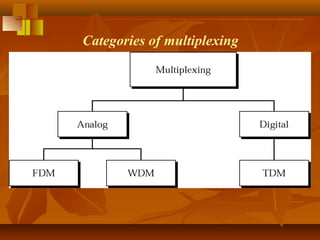
Categories of multiplexing
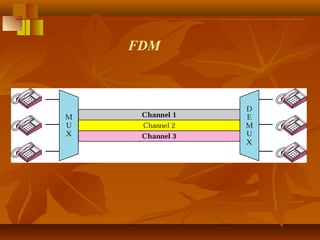
FDM


Is the process of translating
individual speech circuits (300-
3400Hz) into pre assigned slots
within the bandwith of transmission
medium. and, the preassigned slots
are always available to each user
FDM
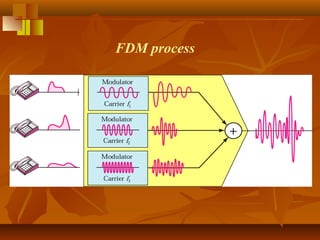
FDM process
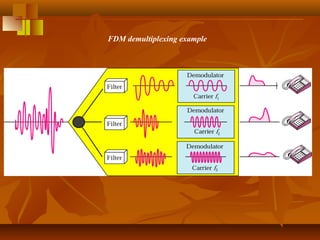
FDM demultiplexing example
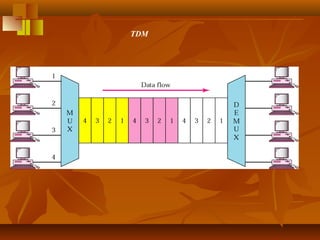
TDM
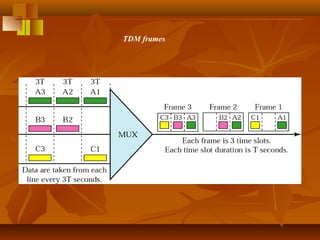
The process where a transmission
medium is shared by a number of circuits
in time domain by establishing a
sequence of time slots during which
individual channels can be transmitted…
Thus the entire bandwidth is periodically
available to each channel
TDM
TDM frames
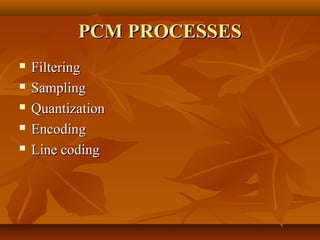
PCM PROCESSES
   Filtering
   Sampling
   Quantization
   Encoding
   Line coding
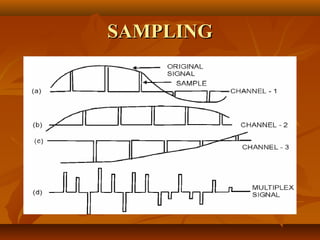
SAMPLING
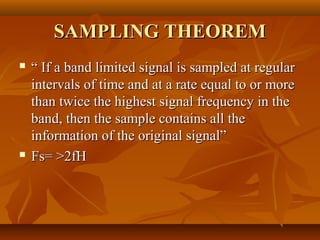
SAMPLING THEOREM
   “ If a band limited signal is sampled at regular
    intervals of time and at a rate equal to or more
    than twice the highest signal frequency in the
    band, then the sample contains all the
    information of the original signal”
   Fs= >2fH
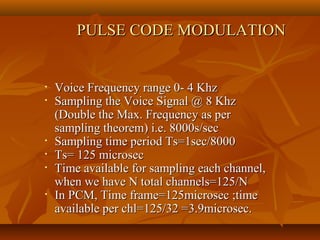
PULSE CODE MODULATION


•   Voice Frequency range 0- 4 Khz
•   Sampling the Voice Signal @ 8 Khz
    (Double the Max. Frequency as per
    sampling theorem) i.e. 8000s/sec
•   Sampling time period Ts=1sec/8000
•   Ts= 125 microsec
•   Time available for sampling each channel,
    when we have N total channels=125/N
•   In PCM, Time frame=125microsec ;time
    available per chl=125/32 =3.9microsec.
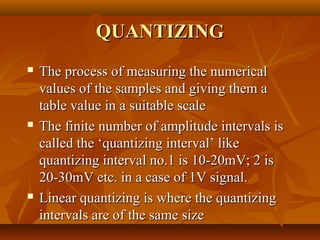
QUANTIZING
   The process of measuring the numerical
    values of the samples and giving them a
    table value in a suitable scale
   The finite number of amplitude intervals is
    called the ‘quantizing interval’ like
    quantizing interval no.1 is 10-20mV; 2 is
    20-30mV etc. in a case of 1V signal.
   Linear quantizing is where the quantizing
    intervals are of the same size
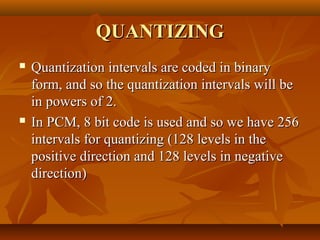
QUANTIZING
   Quantization intervals are coded in binary
    form, and so the quantization intervals will be
    in powers of 2.
   In PCM, 8 bit code is used and so we have 256
    intervals for quantizing (128 levels in the
    positive direction and 128 levels in negative
    direction)
QUANTIZATION DISTORTION
   The deviation between the amplitude of
    samples at the transmitter and receiving ends
   In linear quantization, the distortion is more
    and to decrease the distortion, the no. of steps
    in the given amplitude range has to be
    increased.
   Due to BW limitations, more quantum levels in
    small amplitude region are planned results to
    Non linear (uniform) quantization
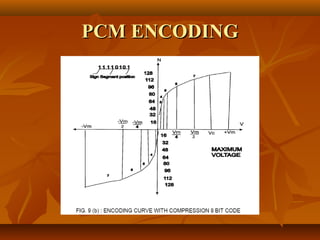
COMPANDING
   Is the process where non uniform quantization
    is achieved using segmented quantization
   In companding, to specify the location of
    sample value, the following are necessary…
    sign of the sample, the segment no., the
    quantum level within the segment.
PCM ENCODING
FRAME STRUCTURE
   In PCM we have 32 Ts and Ts 0 (FAW)
    carries the synchronization signals and FAW
    digit value is X 0 0 1 1 0 1 1 . FAW
    transmitted in alternate frame. In FAW unused
    frames, supervisory and alarm signals are
    transmitted
   Ts 16 carries the signalling information (for 2
    channels)
FRAME STRUCTURE
   For carrying the signalling for all 30 chls and
    for carrying sync. Data for all frames, in PCM
    16 frame pattern is used and it is known as
    multi frame
   Duration of multi frame is 2msecs.
PCM Standards
   THERE ARE TWO STANDARDS OF PCM
    NAMELY
   1) THE EUROPEAN    2 ) THE AMERICAN.
   THEY DIFFER SLIGHTLY IN THE DETAIL OF
    THEIR WORKING BUT THE PRINCIPLES ARE
    THE SAME.
   EUROPEAN PCM = 30 CHANNELS
   NORTH AMERICAN PCM = 24 CHANNELS
   JAPANESE PCM = 24 CHANNELS
   IN INDIA WE FOLLOW THE EUROPEAN PCM
    OF 30 CHANNELS SYSTEM WORKING.
JUSTIFICATION TYPES
   Positive justification: Common
    synchronization bit rate offered at each
    tributary is higher than the bit rate of
    individual tributary.
   Positive-negative justification
   Negative justification

Pulse code modulation

  • 1.
  • 2.
    Pulse Code Modulation(PCM) Analog voice data must be translated into a series of binary digits before they can be transmitted. With Pulse Code Modulation (PCM), the amplitude of the sound wave is sampled at regular intervals and translated into a binary number. The difference between the original analog signal and the translated digital signal is called quantizing error.
  • 3.
    PCM PCM uses asampling rate of 8000 samples per second. Each sample is an 8 bit sample resulting in a digital rate of 64,000 bps (8 x 8000).
  • 4.
    Converting Samples toBits  Quantizing  Similar concept to pixelization  Breaks wave into pieces, assigns a value in a particular range  8-bit range allows for 256 possible sample levels  More bits means greater detail, fewer bits means less detail
  • 5.
    MULTIPLEXING TYPES Frequency DivisionMultiplexing Time Division Multiplexing Wavelength Division Multiplexing
  • 6.
  • 7.
    FDM Is the processof translating individual speech circuits (300- 3400Hz) into pre assigned slots within the bandwith of transmission medium. and, the preassigned slots are always available to each user
  • 8.
  • 9.
  • 10.
  • 11.
    TDM The process wherea transmission medium is shared by a number of circuits in time domain by establishing a sequence of time slots during which individual channels can be transmitted… Thus the entire bandwidth is periodically available to each channel
  • 12.
  • 13.
  • 14.
    PCM PROCESSES  Filtering  Sampling  Quantization  Encoding  Line coding
  • 15.
  • 16.
    SAMPLING THEOREM  “ If a band limited signal is sampled at regular intervals of time and at a rate equal to or more than twice the highest signal frequency in the band, then the sample contains all the information of the original signal”  Fs= >2fH
  • 17.
    PULSE CODE MODULATION • Voice Frequency range 0- 4 Khz • Sampling the Voice Signal @ 8 Khz (Double the Max. Frequency as per sampling theorem) i.e. 8000s/sec • Sampling time period Ts=1sec/8000 • Ts= 125 microsec • Time available for sampling each channel, when we have N total channels=125/N • In PCM, Time frame=125microsec ;time available per chl=125/32 =3.9microsec.
  • 18.
    QUANTIZING  The process of measuring the numerical values of the samples and giving them a table value in a suitable scale  The finite number of amplitude intervals is called the ‘quantizing interval’ like quantizing interval no.1 is 10-20mV; 2 is 20-30mV etc. in a case of 1V signal.  Linear quantizing is where the quantizing intervals are of the same size
  • 19.
    QUANTIZING  Quantization intervals are coded in binary form, and so the quantization intervals will be in powers of 2.  In PCM, 8 bit code is used and so we have 256 intervals for quantizing (128 levels in the positive direction and 128 levels in negative direction)
  • 20.
    QUANTIZATION DISTORTION  The deviation between the amplitude of samples at the transmitter and receiving ends  In linear quantization, the distortion is more and to decrease the distortion, the no. of steps in the given amplitude range has to be increased.  Due to BW limitations, more quantum levels in small amplitude region are planned results to Non linear (uniform) quantization
  • 21.
    COMPANDING  Is the process where non uniform quantization is achieved using segmented quantization  In companding, to specify the location of sample value, the following are necessary… sign of the sample, the segment no., the quantum level within the segment.
  • 22.
  • 23.
    FRAME STRUCTURE  In PCM we have 32 Ts and Ts 0 (FAW) carries the synchronization signals and FAW digit value is X 0 0 1 1 0 1 1 . FAW transmitted in alternate frame. In FAW unused frames, supervisory and alarm signals are transmitted  Ts 16 carries the signalling information (for 2 channels)
  • 24.
    FRAME STRUCTURE  For carrying the signalling for all 30 chls and for carrying sync. Data for all frames, in PCM 16 frame pattern is used and it is known as multi frame  Duration of multi frame is 2msecs.
  • 25.
    PCM Standards  THERE ARE TWO STANDARDS OF PCM NAMELY  1) THE EUROPEAN 2 ) THE AMERICAN.  THEY DIFFER SLIGHTLY IN THE DETAIL OF THEIR WORKING BUT THE PRINCIPLES ARE THE SAME.  EUROPEAN PCM = 30 CHANNELS  NORTH AMERICAN PCM = 24 CHANNELS  JAPANESE PCM = 24 CHANNELS  IN INDIA WE FOLLOW THE EUROPEAN PCM OF 30 CHANNELS SYSTEM WORKING.
  • 26.
    JUSTIFICATION TYPES  Positive justification: Common synchronization bit rate offered at each tributary is higher than the bit rate of individual tributary.  Positive-negative justification  Negative justification