Presented by
Shammas ALI
ABOUT 3D TV
TV that employs techniques of 3D presentation, such as
stereoscopic nature and 3D display .
This presents a three dimensional view of the scene to the
viewers.
It is expexted to be the next revolution in TV history.
This requires a 3D TV system with real time acquisition,
transmission & 3D display of dynamic scenes.
Principle of 3D view
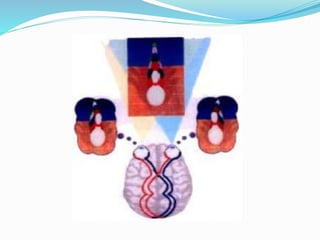
Human vision –each eye sees a slightly different
perspective of the same scene as eyes are 3 inches
apart.
The brain takes images from both eyes, merges them
together to form our 3D view.
Getting the 3D effect at home involves tricking the
brain into doing something similar with the images
that it gets from a TV set.
Figure out a way to precisely show a set of slightly
different images to each of your eyes.
Technical Overview
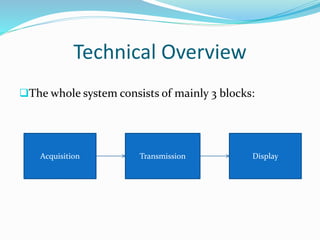
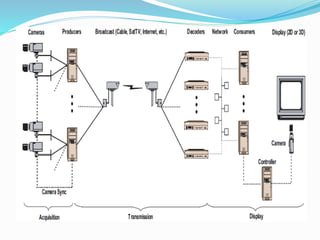
The whole system consists of mainly 3 blocks:
Acquisition Transmission Display
Acquisition
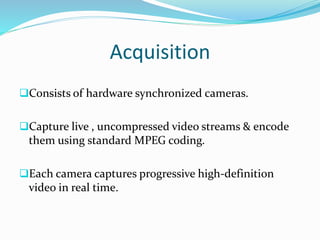
Consists of hardware synchronized cameras.
Capture live , uncompressed video streams & encode
them using standard MPEG coding.
Each camera captures progressive high-definition
video in real time.
Transmission
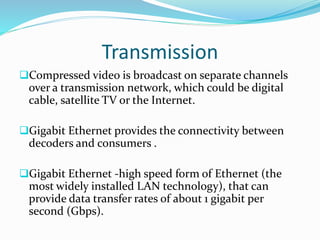
Compressed video is broadcast on separate channels
over a transmission network, which could be digital
cable, satellite TV or the Internet.
Gigabit Ethernet provides the connectivity between
decoders and consumers .
Gigabit Ethernet -high speed form of Ethernet (the
most widely installed LAN technology), that can
provide data transfer rates of about 1 gigabit per
second (Gbps).
Technologies to display 3D content
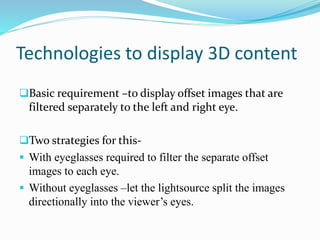
Basic requirement –to display offset images that are
filtered separately to the left and right eye.
Two strategies for this-
 With eyeglasses required to filter the separate offset
images to each eye.
 Without eyeglasses –let the lightsource split the images
directionally into the viewer’s eyes.
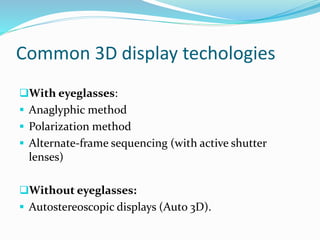
Common 3D display techologies
With eyeglasses:
 Anaglyphic method
 Polarization method
 Alternate-frame sequencing (with active shutter
lenses)
Without eyeglasses:
 Autostereoscopic displays (Auto 3D).
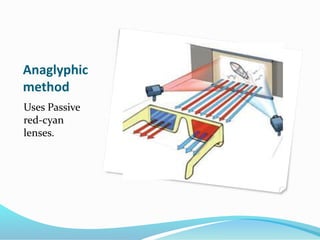
Anaglyphic
method
Uses Passive
red-cyan
lenses.
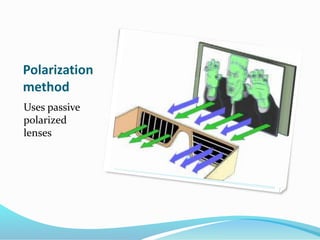
Polarization
method
Uses passive
polarized
lenses
Autostereoscopy
Any method of displaying stereoscopic images without the use
of special eyeglasses.
TV projects two different images that are picked up by the right
eye and the left eye - without having to wear any glasses.
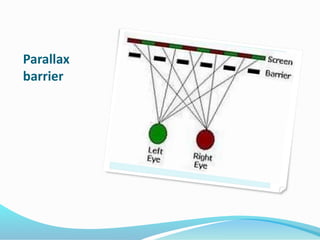
Autostereoscopic display technologies include:
 lenticular viewing
 parallel barrier
 other methods
Parallax
barrier
Applications
Education, Training and Simulation.
Medicine and dentistry
Entertainment and game industry.
Military.
Market application.
Cultural Heritage.
Future of 3D TV
More realistic with view from any angle.
More features that will give a lively experience.
Japan plans to make the futuristic television a commercial
reality by 2020.
The targeted “virtual reality” television would allow
people to view high definition images in 3D from any
angle, in addition to being able to touch and smell the
object being projected upwards from a screen to the floor.
Such a TV could be useful in home-shopping programs,
medical industry,etc
Conclusion
Concept of 3D is known for decades . Stereoscopic 3D TV
is an old concept. Autostereoscopy is a new one to
develop efficiently. There is a need of more development
in this field. Improvement required in the color
reproduction of natural scenes on multi-view display. In
future, there will be a live television experience similar to
real time experience.
Thank you

3dtelevisiontechnologygajendrasingh 141013084759-conversion-gate01

  • 1.
  • 2.
    ABOUT 3D TV TVthat employs techniques of 3D presentation, such as stereoscopic nature and 3D display . This presents a three dimensional view of the scene to the viewers. It is expexted to be the next revolution in TV history. This requires a 3D TV system with real time acquisition, transmission & 3D display of dynamic scenes.
  • 3.
    Principle of 3Dview Human vision –each eye sees a slightly different perspective of the same scene as eyes are 3 inches apart. The brain takes images from both eyes, merges them together to form our 3D view. Getting the 3D effect at home involves tricking the brain into doing something similar with the images that it gets from a TV set. Figure out a way to precisely show a set of slightly different images to each of your eyes.
  • 5.
    Technical Overview The wholesystem consists of mainly 3 blocks: Acquisition Transmission Display
  • 6.
    Acquisition Consists of hardwaresynchronized cameras. Capture live , uncompressed video streams & encode them using standard MPEG coding. Each camera captures progressive high-definition video in real time.
  • 7.
    Transmission Compressed video isbroadcast on separate channels over a transmission network, which could be digital cable, satellite TV or the Internet. Gigabit Ethernet provides the connectivity between decoders and consumers . Gigabit Ethernet -high speed form of Ethernet (the most widely installed LAN technology), that can provide data transfer rates of about 1 gigabit per second (Gbps).
  • 9.
    Technologies to display3D content Basic requirement –to display offset images that are filtered separately to the left and right eye. Two strategies for this-  With eyeglasses required to filter the separate offset images to each eye.  Without eyeglasses –let the lightsource split the images directionally into the viewer’s eyes.
  • 10.
    Common 3D displaytechologies With eyeglasses:  Anaglyphic method  Polarization method  Alternate-frame sequencing (with active shutter lenses) Without eyeglasses:  Autostereoscopic displays (Auto 3D).
  • 11.
  • 12.
  • 13.
    Autostereoscopy Any method ofdisplaying stereoscopic images without the use of special eyeglasses. TV projects two different images that are picked up by the right eye and the left eye - without having to wear any glasses. Autostereoscopic display technologies include:  lenticular viewing  parallel barrier  other methods
  • 14.
  • 15.
    Applications Education, Training andSimulation. Medicine and dentistry Entertainment and game industry. Military. Market application. Cultural Heritage.
  • 16.
    Future of 3DTV More realistic with view from any angle. More features that will give a lively experience. Japan plans to make the futuristic television a commercial reality by 2020. The targeted “virtual reality” television would allow people to view high definition images in 3D from any angle, in addition to being able to touch and smell the object being projected upwards from a screen to the floor. Such a TV could be useful in home-shopping programs, medical industry,etc
  • 17.
    Conclusion Concept of 3Dis known for decades . Stereoscopic 3D TV is an old concept. Autostereoscopy is a new one to develop efficiently. There is a need of more development in this field. Improvement required in the color reproduction of natural scenes on multi-view display. In future, there will be a live television experience similar to real time experience.
  • 18.