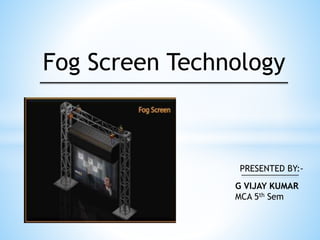
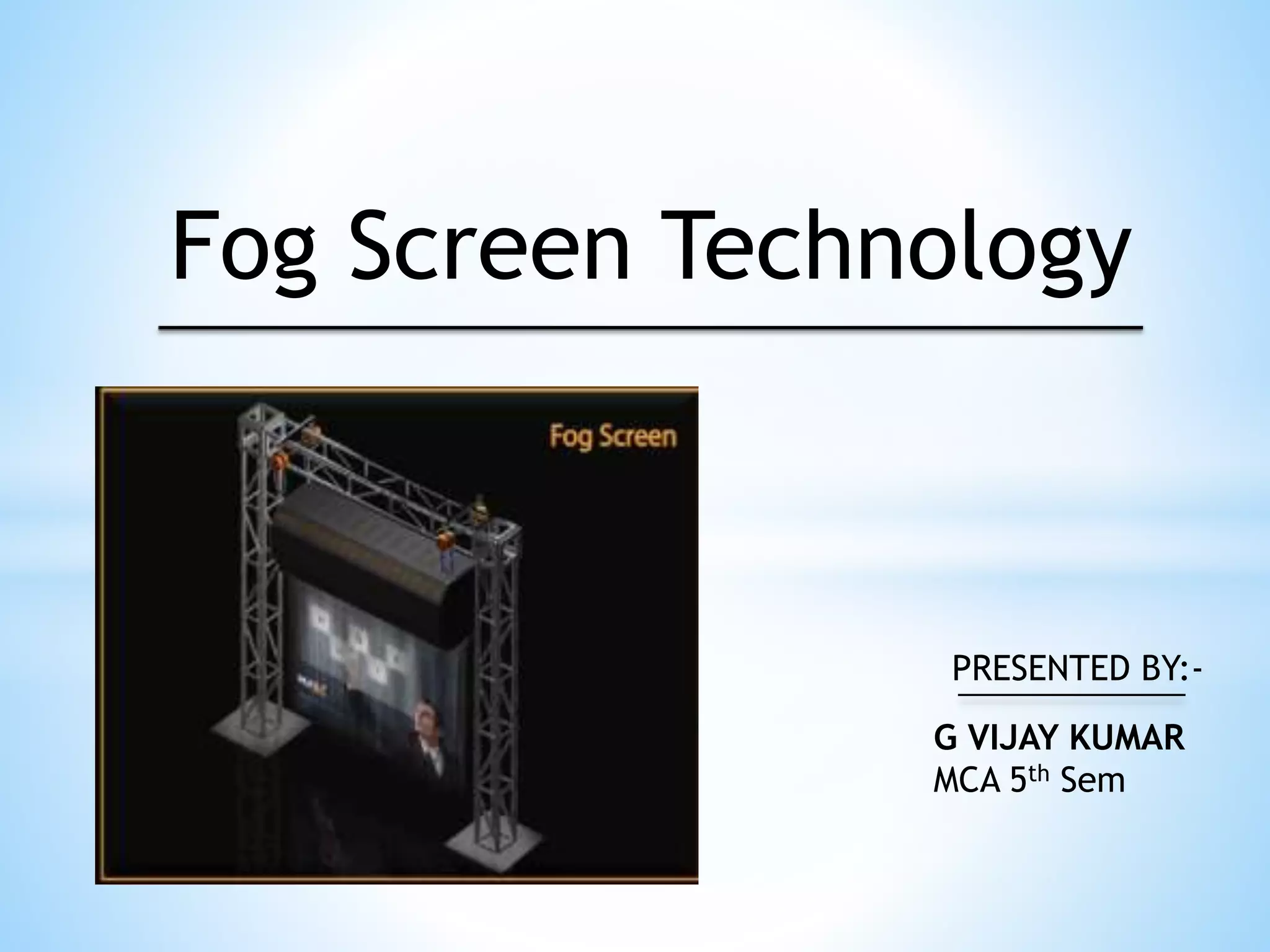
Fog Screen Technology
PRESENTED BY:-
G VIJAY KUMAR
MCA 5th Sem
Contents
• Introduction
• Breif History
• What is Fog Screen
• Formation of Fog Screen
• Working of Fog Screen
• Advantages
• Disadvantages
• Limitations
• Application
• Opportunities
• conclusion
INTRODUCTION
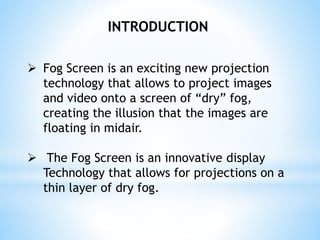
 Fog Screen is an exciting new projection
technology that allows to project images
and video onto a screen of “dry” fog,
creating the illusion that the images are
floating in midair.
 The Fog Screen is an innovative display
Technology that allows for projections on a
thin layer of dry fog.
Breif History
 Fog Screen, which was initially known as WAVE
(Walk-Through Virtual Environment), It was
announced in December 2001.
 The first public demonstration of FogScreen was in
Finland in October 2002.
 Till then it is in use in different areas and
improvements are being done to increase its
effectiveness.
What is Fog Screen
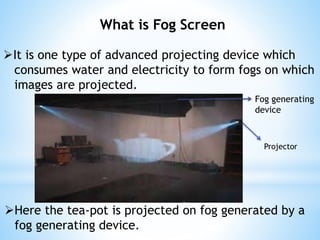
It is one type of advanced projecting device which
consumes water and electricity to form fogs on which
images are projected.
Here the tea-pot is projected on fog generated by a
fog generating device.
Fog generating
device
Projector
Formation of Fog Screen
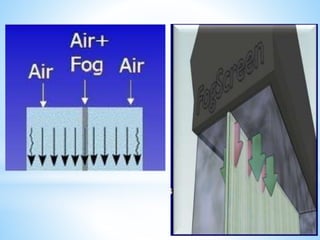
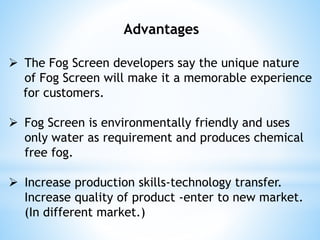
 Fog screen technology is a high-tech version of
the technology in a cool air humidifier.
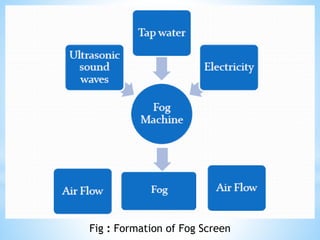
 Tap water is pumped into the fog tank where it
is blasted with ultrasound.
 Turning it instantly into a thick fog made of tiny
water particles 2-3 microns in diameter.
Fig : Formation of Fog Screen
Advantages
 The Fog Screen developers say the unique nature
of Fog Screen will make it a memorable experience
for customers.
 Fog Screen is environmentally friendly and uses
only water as requirement and produces chemical
free fog.
 Increase production skills-technology transfer.
Increase quality of product -enter to new market.
(In different market.)
Disadvantages
 Projections can be obscured.
 Storage space.
 Sizing issues and setup.
 Damage the screen.
 Health Dangers.
Limitations
 Fog Screen works best indoors with a dark
background that enhances the brightness of the
image on the Fog Screen behind the projector. So,
it can’t be used in daylight.
 Need 1kW of energy to produce 1m long fog
screen.
 And it is produce 3-5 litres of water in one hour
which should be vent. And you can't make a high
fog screen, because fog would diffuse with
distance.
Applications
 FogScreen has been used in live malls, Product
launches, museums, to attract more and more
peoples
 It is used in case of projection a 3D image esp. in
studies.
 It can be used in seminars to make it more
interactive(we can walk through the screen).
 It can be used in place of air curtain in clubs to
make it more attractive.
Opportunities
 There are endless opportunities to use the
products, but for now these have been mostly
innovative marketing solutions and different
exhibitions.
 Presently it is in demands in countries like Japan,
Malaysia, Germany, France, Greece, Russia, the
UK and the USA; in recent future it will replace
the existing method of projection.
Conclusion
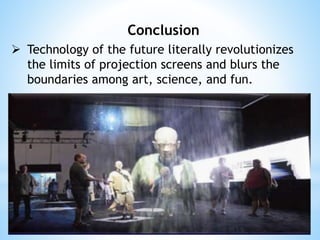
 Technology of the future literally revolutionizes
the limits of projection screens and blurs the
boundaries among art, science, and fun.
Any Queires ???
Thank You !

Fog Screen technology

  • 1.
    Fog Screen Technology PRESENTEDBY:- G VIJAY KUMAR MCA 5th Sem
  • 2.
    Contents • Introduction • BreifHistory • What is Fog Screen • Formation of Fog Screen • Working of Fog Screen • Advantages • Disadvantages • Limitations • Application • Opportunities • conclusion
  • 3.
    INTRODUCTION  Fog Screenis an exciting new projection technology that allows to project images and video onto a screen of “dry” fog, creating the illusion that the images are floating in midair.  The Fog Screen is an innovative display Technology that allows for projections on a thin layer of dry fog.
  • 4.
    Breif History  FogScreen, which was initially known as WAVE (Walk-Through Virtual Environment), It was announced in December 2001.  The first public demonstration of FogScreen was in Finland in October 2002.  Till then it is in use in different areas and improvements are being done to increase its effectiveness.
  • 5.
    What is FogScreen It is one type of advanced projecting device which consumes water and electricity to form fogs on which images are projected. Here the tea-pot is projected on fog generated by a fog generating device. Fog generating device Projector
  • 6.
    Formation of FogScreen  Fog screen technology is a high-tech version of the technology in a cool air humidifier.  Tap water is pumped into the fog tank where it is blasted with ultrasound.  Turning it instantly into a thick fog made of tiny water particles 2-3 microns in diameter.
  • 7.
    Fig : Formationof Fog Screen
  • 9.
    Advantages  The FogScreen developers say the unique nature of Fog Screen will make it a memorable experience for customers.  Fog Screen is environmentally friendly and uses only water as requirement and produces chemical free fog.  Increase production skills-technology transfer. Increase quality of product -enter to new market. (In different market.)
  • 10.
    Disadvantages  Projections canbe obscured.  Storage space.  Sizing issues and setup.  Damage the screen.  Health Dangers.
  • 11.
    Limitations  Fog Screenworks best indoors with a dark background that enhances the brightness of the image on the Fog Screen behind the projector. So, it can’t be used in daylight.  Need 1kW of energy to produce 1m long fog screen.  And it is produce 3-5 litres of water in one hour which should be vent. And you can't make a high fog screen, because fog would diffuse with distance.
  • 12.
    Applications  FogScreen hasbeen used in live malls, Product launches, museums, to attract more and more peoples  It is used in case of projection a 3D image esp. in studies.  It can be used in seminars to make it more interactive(we can walk through the screen).  It can be used in place of air curtain in clubs to make it more attractive.
  • 13.
    Opportunities  There areendless opportunities to use the products, but for now these have been mostly innovative marketing solutions and different exhibitions.  Presently it is in demands in countries like Japan, Malaysia, Germany, France, Greece, Russia, the UK and the USA; in recent future it will replace the existing method of projection.
  • 14.
    Conclusion  Technology ofthe future literally revolutionizes the limits of projection screens and blurs the boundaries among art, science, and fun.
  • 15.
  • 16.