
3D Television
NAME:- VIRENDRASINH VAGHELA (SEM-5 FOT-TB1)
SUB:- AUDIO VIDEO SYSTEM
GUIDE:- KAUSHAL DOSHI
3D Television
History
Watching movies in the third dimension
might seem like space-age entertainment,
but the technology is older than your great
grand father.
According to sensio, a Canada-based
manufacturer of 3D home Technology
“Stereoscopic photography, or the
technique of creating a ‘Third dimension’
was first invented in 1838”
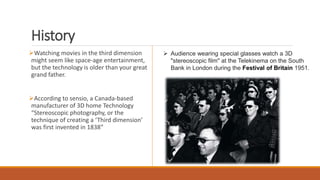
 Audience wearing special glasses watch a 3D
"stereoscopic film" at the Telekinema on the South
Bank in London during the Festival of Britain 1951.
3D Technology
3D technology stands for three-dimensional technology.
3D technology is the illusion of depth, it is a visual representation system that tries to create or
reproduce moving objects in the third dimension.
In simple that we have feel that whatever happens in 3D effect it is part of our real life.3D films
have existed in some form since 1915.
The costly hardware and processes required to produce and display a 3D film
Lack of a standardized format for all segments of the entertainment business.
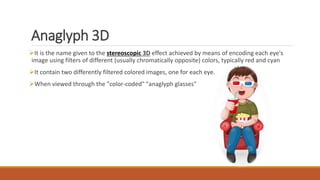
Anaglyph 3D
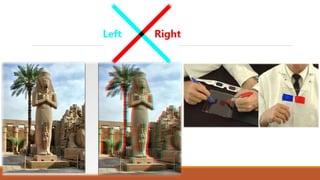
It is the name given to the stereoscopic 3D effect achieved by means of encoding each eye's
image using filters of different (usually chromatically opposite) colors, typically red and cyan
It contain two differently filtered colored images, one for each eye.
When viewed through the "color-coded" "anaglyph glasses"
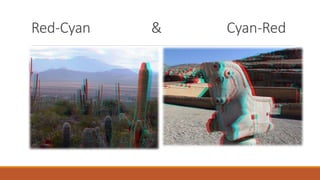
Red-Cyan & Cyan-Red
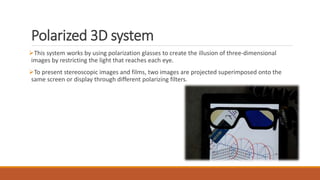
Polarized 3D system
This system works by using polarization glasses to create the illusion of three-dimensional
images by restricting the light that reaches each eye.
To present stereoscopic images and films, two images are projected superimposed onto the
same screen or display through different polarizing filters.
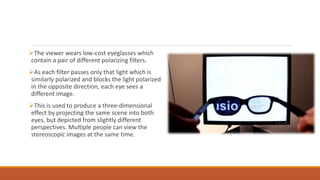
The viewer wears low-cost eyeglasses which
contain a pair of different polarizing filters.
As each filter passes only that light which is
similarly polarized and blocks the light polarized
in the opposite direction, each eye sees a
different image.
This is used to produce a three-dimensional
effect by projecting the same scene into both
eyes, but depicted from slightly different
perspectives. Multiple people can view the
stereoscopic images at the same time.
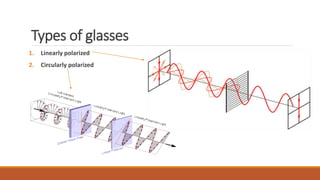
Types of glasses
1. Linearly polarized
2. Circularly polarized
Linearly Polarised
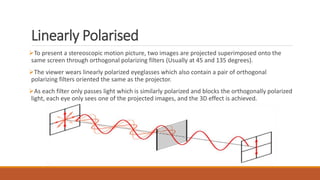
To present a stereoscopic motion picture, two images are projected superimposed onto the
same screen through orthogonal polarizing filters (Usually at 45 and 135 degrees).
The viewer wears linearly polarized eyeglasses which also contain a pair of orthogonal
polarizing filters oriented the same as the projector.
As each filter only passes light which is similarly polarized and blocks the orthogonally polarized
light, each eye only sees one of the projected images, and the 3D effect is achieved.
Linearly polarized glasses require the viewer to keep his or her head level, as tilting of the
viewing filters will cause the images of the left and right channels to bleed over to the opposite
channel.
This can make prolonged viewing uncomfortable as head movement is limited to maintain
the 3D effect.
A linear polarizer converts an unpolarised beam into one with a single linear polarization. The
vertical components of all waves are transmitted, while the horizontal components are absorbed
and reflected.
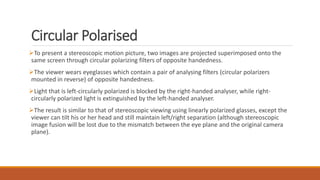
Circular Polarised
To present a stereoscopic motion picture, two images are projected superimposed onto the
same screen through circular polarizing filters of opposite handedness.
The viewer wears eyeglasses which contain a pair of analysing filters (circular polarizers
mounted in reverse) of opposite handedness.
Light that is left-circularly polarized is blocked by the right-handed analyser, while right-
circularly polarized light is extinguished by the left-handed analyser.
The result is similar to that of stereoscopic viewing using linearly polarized glasses, except the
viewer can tilt his or her head and still maintain left/right separation (although stereoscopic
image fusion will be lost due to the mismatch between the eye plane and the original camera
plane).
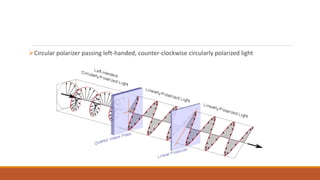
Circular polarizer passing left-handed, counter-clockwise circularly polarized light
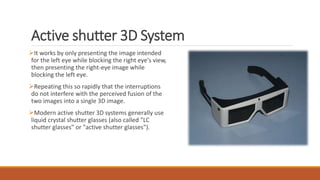
Active shutter 3D System
It works by only presenting the image intended
for the left eye while blocking the right eye's view,
then presenting the right-eye image while
blocking the left eye.
Repeating this so rapidly that the interruptions
do not interfere with the perceived fusion of the
two images into a single 3D image.
Modern active shutter 3D systems generally use
liquid crystal shutter glasses (also called "LC
shutter glasses" or "active shutter glasses").
Each eye's glass contains a liquid crystal layer which has the property of becoming opaque
when voltage is applied, being otherwise transparent.
The glasses are controlled by a timing signal that allows the glasses to alternately block one
eye, and then the other, in synchronization with the refresh rate of the screen.
The timing synchronization to the video equipment may be achieved via a wired signal, or
wirelessly by either an infrared or radio frequency (e.g. Bluetooth, DLP link) transmitter.
Advantage
Unlike red/cyan colour filter (anaglyph) 3D glasses, LC shutter glasses are colour neutral,
enabling 3D viewing in the full colour spectrum.
Unlike in a Polarized 3D system, where the screen resolution is halved when the images are
combined, the active shutter system retains full resolution by combining the images over time.
Disadvantage
Flicker can be noticed except at very high refresh rates, as each eye is effectively receiving only
half of the monitor's actual refresh rate.
Modern LC glasses generally work in higher refresh rates and eliminate this problem for most
people.
some modern flat-panel monitors now support high-enough refresh rates to work with some LC
shutter systems.
When used with LCDs, extreme localized differences between the image to be displayed in one
eye and the other may lead to crosstalk, due to LCD panels' pixels sometimes being unable to
fully switch.
For example from black to white, in the time that separates the left eye's image from the right
one.
Autostereoscopy
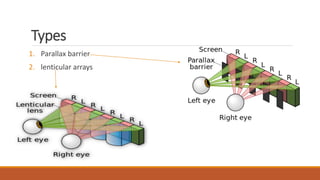
Autostereoscopy is any method of displaying stereoscopic images (adding binocular perception
of 3D depth) without the use of special headgear or glasses on the part of the viewer.
Because headgear is not required.
It is also called "glasses-free 3D" or "glassesless 3D".
There are two broad approaches currently used to accommodate motion parallax and wider
viewing angles: eye-tracking, and multiple views so that the display does not need to sense
where the viewers' eyes are located.
Types
1. Parallax barrier
2. lenticular arrays
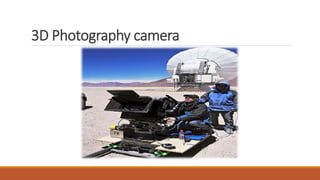
3D Photography camera
Reference
Google web
Google images
Wikipedia
Thank You

3 d television

  • 1.
    3D Television NAME:- VIRENDRASINHVAGHELA (SEM-5 FOT-TB1) SUB:- AUDIO VIDEO SYSTEM GUIDE:- KAUSHAL DOSHI 3D Television
  • 2.
    History Watching movies inthe third dimension might seem like space-age entertainment, but the technology is older than your great grand father. According to sensio, a Canada-based manufacturer of 3D home Technology “Stereoscopic photography, or the technique of creating a ‘Third dimension’ was first invented in 1838”  Audience wearing special glasses watch a 3D "stereoscopic film" at the Telekinema on the South Bank in London during the Festival of Britain 1951.
  • 3.
    3D Technology 3D technologystands for three-dimensional technology. 3D technology is the illusion of depth, it is a visual representation system that tries to create or reproduce moving objects in the third dimension. In simple that we have feel that whatever happens in 3D effect it is part of our real life.3D films have existed in some form since 1915. The costly hardware and processes required to produce and display a 3D film Lack of a standardized format for all segments of the entertainment business.
  • 4.
    Anaglyph 3D It isthe name given to the stereoscopic 3D effect achieved by means of encoding each eye's image using filters of different (usually chromatically opposite) colors, typically red and cyan It contain two differently filtered colored images, one for each eye. When viewed through the "color-coded" "anaglyph glasses"
  • 6.
  • 7.
    Polarized 3D system Thissystem works by using polarization glasses to create the illusion of three-dimensional images by restricting the light that reaches each eye. To present stereoscopic images and films, two images are projected superimposed onto the same screen or display through different polarizing filters.
  • 8.
    The viewer wearslow-cost eyeglasses which contain a pair of different polarizing filters. As each filter passes only that light which is similarly polarized and blocks the light polarized in the opposite direction, each eye sees a different image. This is used to produce a three-dimensional effect by projecting the same scene into both eyes, but depicted from slightly different perspectives. Multiple people can view the stereoscopic images at the same time.
  • 9.
    Types of glasses 1.Linearly polarized 2. Circularly polarized
  • 10.
    Linearly Polarised To presenta stereoscopic motion picture, two images are projected superimposed onto the same screen through orthogonal polarizing filters (Usually at 45 and 135 degrees). The viewer wears linearly polarized eyeglasses which also contain a pair of orthogonal polarizing filters oriented the same as the projector. As each filter only passes light which is similarly polarized and blocks the orthogonally polarized light, each eye only sees one of the projected images, and the 3D effect is achieved.
  • 11.
    Linearly polarized glassesrequire the viewer to keep his or her head level, as tilting of the viewing filters will cause the images of the left and right channels to bleed over to the opposite channel. This can make prolonged viewing uncomfortable as head movement is limited to maintain the 3D effect. A linear polarizer converts an unpolarised beam into one with a single linear polarization. The vertical components of all waves are transmitted, while the horizontal components are absorbed and reflected.
  • 12.
    Circular Polarised To presenta stereoscopic motion picture, two images are projected superimposed onto the same screen through circular polarizing filters of opposite handedness. The viewer wears eyeglasses which contain a pair of analysing filters (circular polarizers mounted in reverse) of opposite handedness. Light that is left-circularly polarized is blocked by the right-handed analyser, while right- circularly polarized light is extinguished by the left-handed analyser. The result is similar to that of stereoscopic viewing using linearly polarized glasses, except the viewer can tilt his or her head and still maintain left/right separation (although stereoscopic image fusion will be lost due to the mismatch between the eye plane and the original camera plane).
  • 13.
    Circular polarizer passingleft-handed, counter-clockwise circularly polarized light
  • 14.
    Active shutter 3DSystem It works by only presenting the image intended for the left eye while blocking the right eye's view, then presenting the right-eye image while blocking the left eye. Repeating this so rapidly that the interruptions do not interfere with the perceived fusion of the two images into a single 3D image. Modern active shutter 3D systems generally use liquid crystal shutter glasses (also called "LC shutter glasses" or "active shutter glasses").
  • 15.
    Each eye's glasscontains a liquid crystal layer which has the property of becoming opaque when voltage is applied, being otherwise transparent. The glasses are controlled by a timing signal that allows the glasses to alternately block one eye, and then the other, in synchronization with the refresh rate of the screen. The timing synchronization to the video equipment may be achieved via a wired signal, or wirelessly by either an infrared or radio frequency (e.g. Bluetooth, DLP link) transmitter.
  • 16.
    Advantage Unlike red/cyan colourfilter (anaglyph) 3D glasses, LC shutter glasses are colour neutral, enabling 3D viewing in the full colour spectrum. Unlike in a Polarized 3D system, where the screen resolution is halved when the images are combined, the active shutter system retains full resolution by combining the images over time.
  • 17.
    Disadvantage Flicker can benoticed except at very high refresh rates, as each eye is effectively receiving only half of the monitor's actual refresh rate. Modern LC glasses generally work in higher refresh rates and eliminate this problem for most people. some modern flat-panel monitors now support high-enough refresh rates to work with some LC shutter systems. When used with LCDs, extreme localized differences between the image to be displayed in one eye and the other may lead to crosstalk, due to LCD panels' pixels sometimes being unable to fully switch. For example from black to white, in the time that separates the left eye's image from the right one.
  • 18.
    Autostereoscopy Autostereoscopy is anymethod of displaying stereoscopic images (adding binocular perception of 3D depth) without the use of special headgear or glasses on the part of the viewer. Because headgear is not required. It is also called "glasses-free 3D" or "glassesless 3D". There are two broad approaches currently used to accommodate motion parallax and wider viewing angles: eye-tracking, and multiple views so that the display does not need to sense where the viewers' eyes are located.
  • 19.
  • 20.
  • 21.
  • 22.