
Brahmanandachari.K
115A20003
THE NEW DIMENSION OF ENTERTAINMENT
CONTENTS
 Introduction
 3D image
 Producing 3D films
◦ Displaying 3D filmsAnaglyph system
◦ Polarization system
◦ Interference filter technology
 3D televisions
◦ Eclipse method
◦ Lenticular displays
◦ 3D broadcast system
INTRODUCTION
 A 3D or 3-D (three dimensional) image is a
motion picture that enhances the illusion of
depth perception.
 It is derived from stereoscopic photography,
 a regular motion picture camera system is
used to record the images as seen from two
perspectives and special projection hardware
and/or eyewear are used to provide the
illusion of depth when viewing the film.
 Television broadcasts and direct to video
3-D image ?
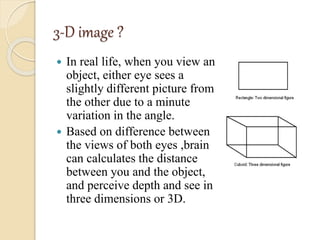
 In real life, when you view an
object, either eye sees a
slightly different picture from
the other due to a minute
variation in the angle.
 Based on difference between
the views of both eyes ,brain
can calculates the distance
between you and the object,
and perceive depth and see in
three dimensions or 3D.
Producing 3d films
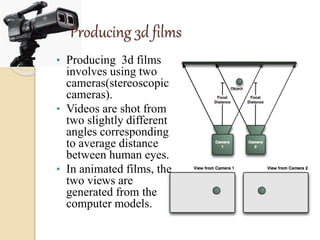
• Producing 3d films
involves using two
cameras(stereoscopic
cameras).
• Videos are shot from
two slightly different
angles corresponding
to average distance
between human eyes.
• In animated films, the
two views are
generated from the
computer models.
Displaying 3d films
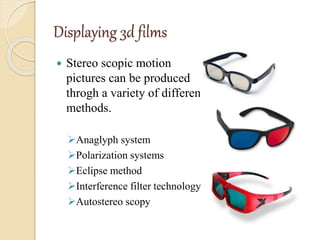
 Stereo scopic motion
pictures can be produced
throgh a variety of different
methods.
Anaglyph system
Polarization systems
Eclipse method
Interference filter technology
Autostereo scopy
Anaglyph system
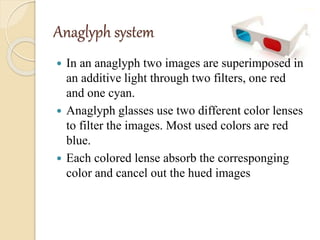
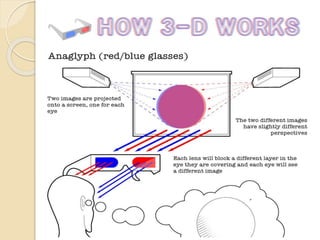
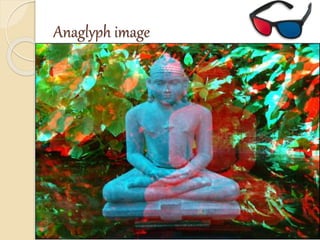
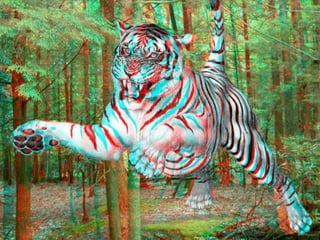
 In an anaglyph two images are superimposed in
an additive light through two filters, one red
and one cyan.
 Anaglyph glasses use two different color lenses
to filter the images. Most used colors are red
blue.
 Each colored lense absorb the corresponging
color and cancel out the hued images
Anaglyph image
Polarization system
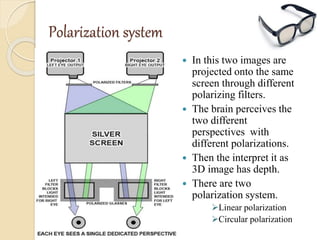
 In this two images are
projected onto the same
screen through different
polarizing filters.
 The brain perceives the
two different
perspectives with
different polarizations.
 Then the interpret it as
3D image has depth.
 There are two
polarization system.
Linear polarization
Circular polarization
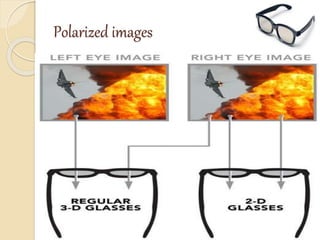
Polarized images
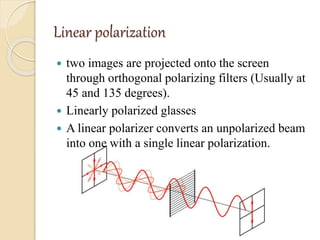
Linear polarization
 two images are projected onto the screen
through orthogonal polarizing filters (Usually at
45 and 135 degrees).
 Linearly polarized glasses
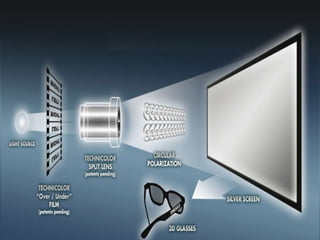
 A linear polarizer converts an unpolarized beam
into one with a single linear polarization.
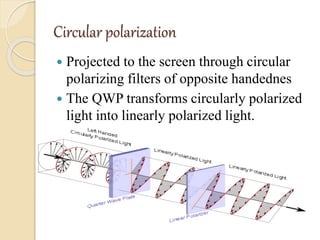
Circular polarization
 Projected to the screen through circular
polarizing filters of opposite handednes
 The QWP transforms circularly polarized
light into linearly polarized light.
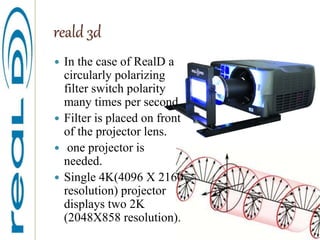
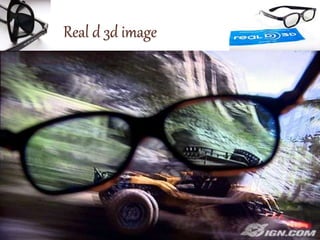
reald 3d
 In the case of RealD a
circularly polarizing
filter switch polarity
many times per second.
 Filter is placed on front
of the projector lens.
 one projector is
needed.
 Single 4K(4096 X 2160
resolution) projector
displays two 2K
(2048X858 resolution).
Real d 3d image
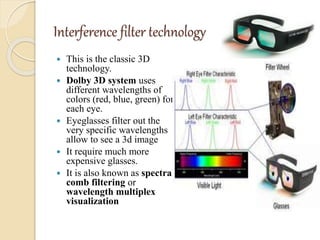
Interference filter technology
 This is the classic 3D
technology.
 Dolby 3D system uses
different wavelengths of
colors (red, blue, green) for
each eye.
 Eyeglasses filter out the
very specific wavelengths
allow to see a 3d image
 It require much more
expensive glasses.
 It is also known as spectral
comb filtering or
wavelength multiplex
visualization
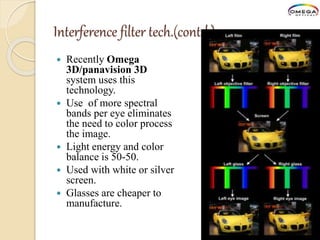
Interference filter tech.(contd.)
 Recently Omega
3D/panavision 3D
system uses this
technology.
 Use of more spectral
bands per eye eliminates
the need to color process
the image.
 Light energy and color
balance is 50-50.
 Used with white or silver
screen.
 Glasses are cheaper to
manufacture.
Health effects
o There are two effects of 3D film that are
unnatural for human vision.
• Cross talk between the eyes.
• Mismatch between convergence and
accommodation.
o 12% of the people are unable to properly
see 3D images.
o 30% of the people have very weak
stereoscopic vision.
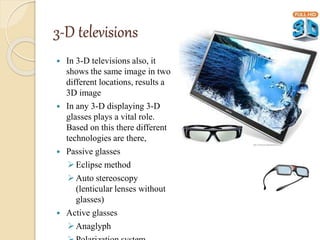
3-D televisions
 In 3-D televisions also, it
shows the same image in two
different locations, results a
3D image
 In any 3-D displaying 3-D
glasses plays a vital role.
Based on this there different
technologies are there,
 Passive glasses
Eclipse method
Auto stereoscopy
(lenticular lenses without
glasses)
 Active glasses
Anaglyph
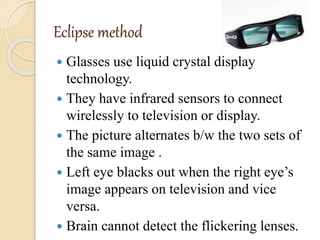
Eclipse method
 Glasses use liquid crystal display
technology.
 They have infrared sensors to connect
wirelessly to television or display.
 The picture alternates b/w the two sets of
the same image .
 Left eye blacks out when the right eye’s
image appears on television and vice
versa.
 Brain cannot detect the flickering lenses.
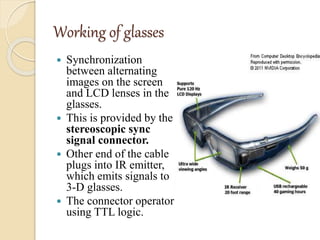
Working of glasses
 Synchronization
between alternating
images on the screen
and LCD lenses in the
glasses.
 This is provided by the
stereoscopic sync
signal connector.
 Other end of the cable
plugs into IR emitter,
which emits signals to
3-D glasses.
 The connector operator
using TTL logic.
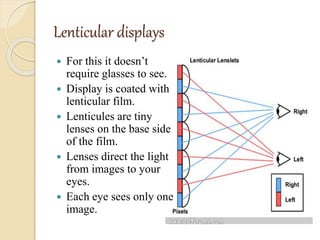
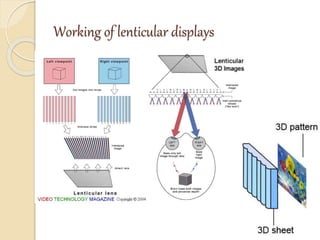
Lenticular displays
 For this it doesn’t
require glasses to see.
 Display is coated with
lenticular film.
 Lenticules are tiny
lenses on the base side
of the film.
 Lenses direct the light
from images to your
eyes.
 Each eye sees only one
image.
Working of lenticular displays
Problems with lenticular displays
 The displays depend upon the audience
being in a sweet spot to get the 3d effects.
 Motion sickness after watching a
lenticular display.
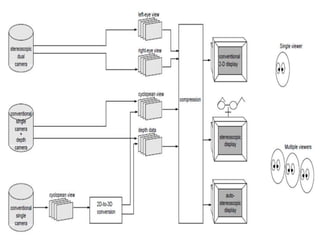
3d-tv broadcast system
 3D tv broadcast system involves three
steps.
Content generation
Compression and transmission
Stereoscopic and auto stereoscopic displays
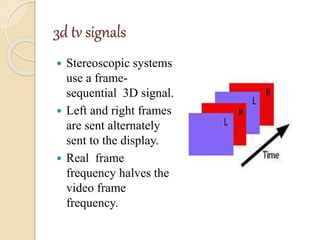
3d tv signals
 Stereoscopic systems
use a frame-
sequential 3D signal.
 Left and right frames
are sent alternately
sent to the display.
 Real frame
frequency halves the
video frame
frequency.
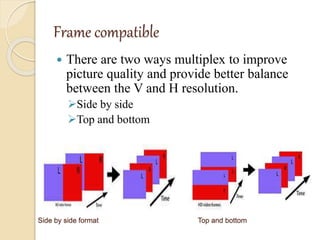
Frame compatible
 There are two ways multiplex to improve
picture quality and provide better balance
between the V and H resolution.
Side by side
Top and bottom
Side by side format Top and bottom
Advantages and disadvantages
applications
 Home entertainments
 Comics
 Science and mathematics
◦ Used to display scientific data sheets and
illustrate the mathematical functions
◦ Chemistry computer software uses
3 d technology
3 d technology

3 d technology

  • 1.
  • 2.
    CONTENTS  Introduction  3Dimage  Producing 3D films ◦ Displaying 3D filmsAnaglyph system ◦ Polarization system ◦ Interference filter technology  3D televisions ◦ Eclipse method ◦ Lenticular displays ◦ 3D broadcast system
  • 3.
    INTRODUCTION  A 3Dor 3-D (three dimensional) image is a motion picture that enhances the illusion of depth perception.  It is derived from stereoscopic photography,  a regular motion picture camera system is used to record the images as seen from two perspectives and special projection hardware and/or eyewear are used to provide the illusion of depth when viewing the film.  Television broadcasts and direct to video
  • 4.
    3-D image ? In real life, when you view an object, either eye sees a slightly different picture from the other due to a minute variation in the angle.  Based on difference between the views of both eyes ,brain can calculates the distance between you and the object, and perceive depth and see in three dimensions or 3D.
  • 6.
    Producing 3d films •Producing 3d films involves using two cameras(stereoscopic cameras). • Videos are shot from two slightly different angles corresponding to average distance between human eyes. • In animated films, the two views are generated from the computer models.
  • 7.
    Displaying 3d films Stereo scopic motion pictures can be produced throgh a variety of different methods. Anaglyph system Polarization systems Eclipse method Interference filter technology Autostereo scopy
  • 8.
    Anaglyph system  Inan anaglyph two images are superimposed in an additive light through two filters, one red and one cyan.  Anaglyph glasses use two different color lenses to filter the images. Most used colors are red blue.  Each colored lense absorb the corresponging color and cancel out the hued images
  • 10.
  • 12.
    Polarization system  Inthis two images are projected onto the same screen through different polarizing filters.  The brain perceives the two different perspectives with different polarizations.  Then the interpret it as 3D image has depth.  There are two polarization system. Linear polarization Circular polarization
  • 13.
  • 14.
    Linear polarization  twoimages are projected onto the screen through orthogonal polarizing filters (Usually at 45 and 135 degrees).  Linearly polarized glasses  A linear polarizer converts an unpolarized beam into one with a single linear polarization.
  • 15.
    Circular polarization  Projectedto the screen through circular polarizing filters of opposite handednes  The QWP transforms circularly polarized light into linearly polarized light.
  • 16.
    reald 3d  Inthe case of RealD a circularly polarizing filter switch polarity many times per second.  Filter is placed on front of the projector lens.  one projector is needed.  Single 4K(4096 X 2160 resolution) projector displays two 2K (2048X858 resolution).
  • 17.
    Real d 3dimage
  • 18.
    Interference filter technology This is the classic 3D technology.  Dolby 3D system uses different wavelengths of colors (red, blue, green) for each eye.  Eyeglasses filter out the very specific wavelengths allow to see a 3d image  It require much more expensive glasses.  It is also known as spectral comb filtering or wavelength multiplex visualization
  • 19.
    Interference filter tech.(contd.) Recently Omega 3D/panavision 3D system uses this technology.  Use of more spectral bands per eye eliminates the need to color process the image.  Light energy and color balance is 50-50.  Used with white or silver screen.  Glasses are cheaper to manufacture.
  • 20.
    Health effects o Thereare two effects of 3D film that are unnatural for human vision. • Cross talk between the eyes. • Mismatch between convergence and accommodation. o 12% of the people are unable to properly see 3D images. o 30% of the people have very weak stereoscopic vision.
  • 21.
    3-D televisions  In3-D televisions also, it shows the same image in two different locations, results a 3D image  In any 3-D displaying 3-D glasses plays a vital role. Based on this there different technologies are there,  Passive glasses Eclipse method Auto stereoscopy (lenticular lenses without glasses)  Active glasses Anaglyph
  • 22.
    Eclipse method  Glassesuse liquid crystal display technology.  They have infrared sensors to connect wirelessly to television or display.  The picture alternates b/w the two sets of the same image .  Left eye blacks out when the right eye’s image appears on television and vice versa.  Brain cannot detect the flickering lenses.
  • 23.
    Working of glasses Synchronization between alternating images on the screen and LCD lenses in the glasses.  This is provided by the stereoscopic sync signal connector.  Other end of the cable plugs into IR emitter, which emits signals to 3-D glasses.  The connector operator using TTL logic.
  • 24.
    Lenticular displays  Forthis it doesn’t require glasses to see.  Display is coated with lenticular film.  Lenticules are tiny lenses on the base side of the film.  Lenses direct the light from images to your eyes.  Each eye sees only one image.
  • 25.
  • 26.
    Problems with lenticulardisplays  The displays depend upon the audience being in a sweet spot to get the 3d effects.  Motion sickness after watching a lenticular display.
  • 27.
    3d-tv broadcast system 3D tv broadcast system involves three steps. Content generation Compression and transmission Stereoscopic and auto stereoscopic displays
  • 29.
    3d tv signals Stereoscopic systems use a frame- sequential 3D signal.  Left and right frames are sent alternately sent to the display.  Real frame frequency halves the video frame frequency.
  • 30.
    Frame compatible  Thereare two ways multiplex to improve picture quality and provide better balance between the V and H resolution. Side by side Top and bottom Side by side format Top and bottom
  • 31.
  • 32.
    applications  Home entertainments Comics  Science and mathematics ◦ Used to display scientific data sheets and illustrate the mathematical functions ◦ Chemistry computer software uses