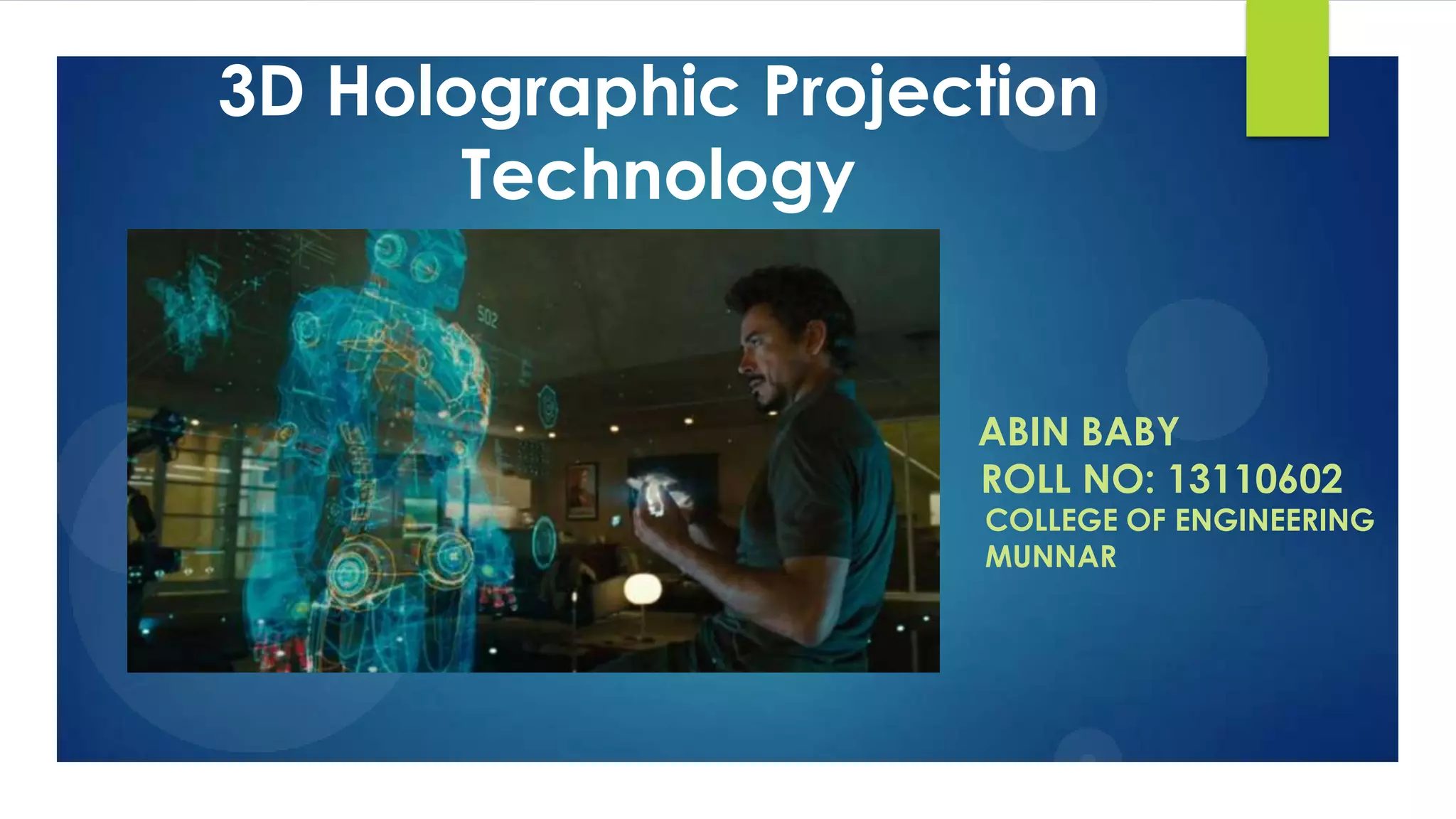
3D Holographic Projection
Technology

ABIN BABY
ROLL NO: 13110602

COLLEGE OF ENGINEERING
MUNNAR
Contents

2
What is Holography

•

Why Holography

•

Types of Holograms

•

How Holograms work

•

Recording of hologram

•

Reconstruction of hologram

•

Advances in technology

•

Applications & Future scope

•
College of Engineering Munnar

•

Conclusion
What is holography

3

 Holography

is a technique that allows the light
scattered from an object to be recorded and later
reconstructed.

 The

technique to optically store, retrieve, and process
information.

 Preserve

subject

College of Engineering Munnar

the 3-D information of a holographed
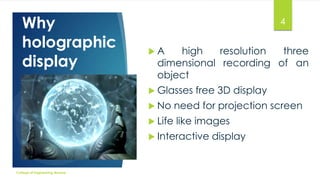
Why
holographic
display

4
A

high
resolution
three
dimensional recording of an
object

 Glasses

free 3D display

 No

need for projection screen

 Life

like images

 Interactive

College of Engineering Munnar

display
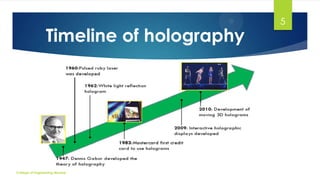
Timeline of holography

College of Engineering Munnar

5
Types of
Holograms

6
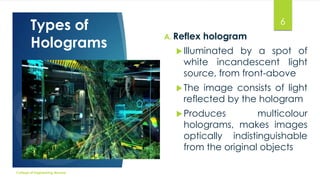
A. Reflex

hologram

 Illuminated

by a spot of
white incandescent light
source, from front-above

 The

image consists of light
reflected by the hologram

 Produces

multicolour
holograms, makes images
optically indistinguishable
from the original objects

College of Engineering Munnar
7
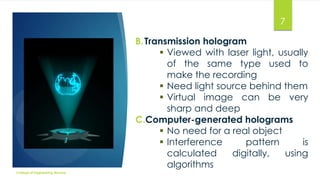
B. Transmission hologram
 Viewed with laser light, usually
of the same type used to
make the recording
 Need light source behind them
 Virtual image can be very
sharp and deep
C.Computer-generated holograms
 No need for a real object
 Interference
pattern
is
calculated
digitally,
using
algorithms
College of Engineering Munnar
How
holograms
work

College of Engineering Munnar

8

The time-varying light field
of a scene with all its physical
properties is to be recorded
and then regenerated.
 Hence the working of
holography is divided into
two phases:
•Recording
•Reconstruction
Recording
of hologram

9
 Basic

tools required to
make
a
hologram
includes a red lasers,
lenses,
beam
splitter,
mirrors and holographic
film

 Holograms

are recorded
in darker environment

College of Engineering Munnar
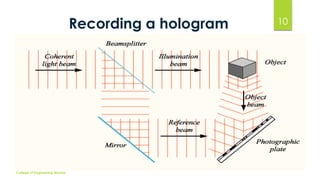
Recording a hologram

College of Engineering Munnar

10
11
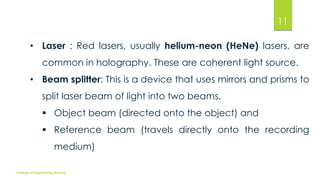
• Laser : Red lasers, usually helium-neon (HeNe) lasers, are
common in holography. These are coherent light source.
• Beam splitter: This is a device that uses mirrors and prisms to
split laser beam of light into two beams.
 Object beam (directed onto the object) and
 Reference beam (travels directly onto the recording

medium)
College of Engineering Munnar
12
• Mirrors: These direct the beams of light to the correct

locations
• Holographic film: Holographic film can record light at
a very high resolution, which is necessary for creating
a hologram. It's a layer of light-sensitive compounds
on a transparent surface, like photographic film.

Eg: Silver Halide Emulsion
College of Engineering Munnar
Process


13

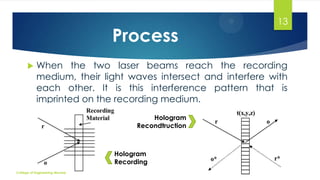
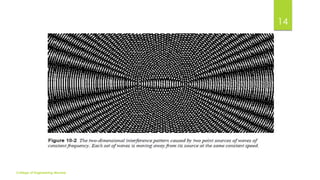
When the two laser beams reach the recording
medium, their light waves intersect and interfere with
each other. It is this interference pattern that is
imprinted on the recording medium.
Hologram
Recondtruction

Hologram
Recording
College of Engineering Munnar
14

College of Engineering Munnar
15

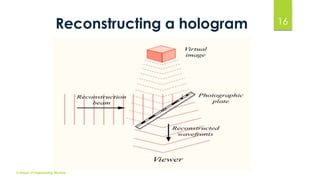
Reconstruction
of hologram
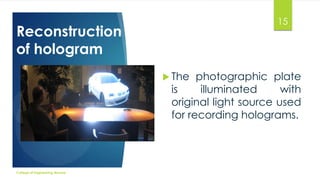
 The

photographic plate
is
illuminated
with
original light source used
for recording holograms.

College of Engineering Munnar
Reconstructing a hologram

College of Engineering Munnar

16
Capturing of
holographic
video

College of Engineering Munnar

17

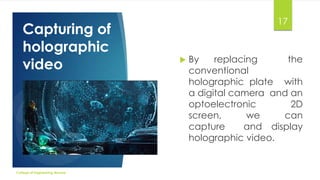


By
replacing
the
conventional
holographic plate with
a digital camera and an
optoelectronic
2D
screen,
we
can
capture
and display
holographic video.
Projection of
holographic
video

18

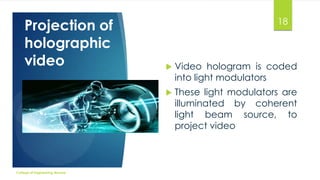
Video hologram is coded
into light modulators



College of Engineering Munnar



These light modulators are
illuminated by coherent
light beam source, to
project video
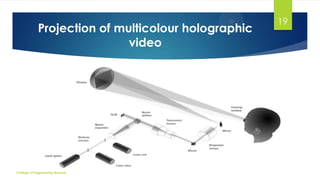
Projection of multicolour holographic
video

College of Engineering Munnar

19
Advances in
technology

20
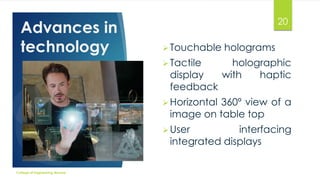
 Touchable

holograms

 Tactile

holographic
with
haptic

display
feedback

 Horizontal

360º view of a
image on table top

 User

interfacing
integrated displays

College of Engineering Munnar
Applications
& Future scope

21
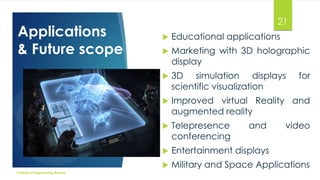
Educational applications



Marketing with 3D holographic
display



3D simulation displays
scientific visualization



Improved virtual Reality and
augmented reality



Telepresence
conferencing



Entertainment displays


College of Engineering Munnar



Military and Space Applications

and

for

video
22




Intense
rooms



College of Engineering Munnar

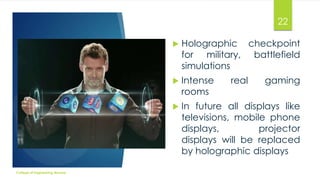
Holographic checkpoint
for military, battlefield
simulations

In future all displays like
televisions, mobile phone
displays,
projector
displays will be replaced
by holographic displays

real

gaming
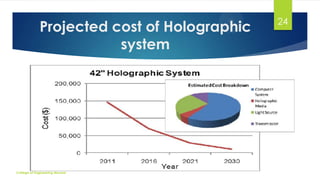
Projected cost of Holographic
system

College of Engineering Munnar

24
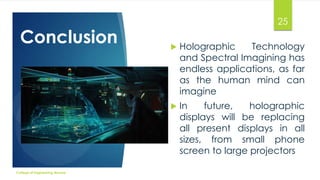
Conclusion

25

Holographic
Technology
and Spectral Imagining has
endless applications, as far
as the human mind can
imagine



College of Engineering Munnar



In
future,
holographic
displays will be replacing
all present displays in all
sizes, from small phone
screen to large projectors
References

26

• “Holographic Projection Technology: The World is Changing.”;
Ahmed
Elmorshidy,
Ph.D
JOURNAL OF TELECOMMUNICATIONS, VOLUME 2, ISSUE 2, MAY 2010
• “Capture, processing, and display of real-world 3D objects using
digital holography”; Thomas J. Naughton; 2010 IEEE Invited Paper
• “Touchable
Holography”;
Takayuki
Hoshi;
The University of Tokyo; 2009
• “Holographic 3-D Displays - Electro-holography within the Grasp of
Commercialization”; Stephan Reichelt, Ralf Haussler, Norbert Leister,
Gerald Futterer, Hagen Stolle and Armin Schwerdtner (2010)
• “How Holograms Work.”; Wilson, Tracy V. 2010.“ HowStuffWorks, Inc.
Downloaded
November
05,
2010.
<http://science.howstuffworks.com/hologram.html>
College of Engineering Munnar
27

Thank you
College of Engineering Munnar
28

Questions?
College of Engineering Munnar
29

For 17 other reference papers in this topic and
if you have any doubts contact me
Facebook/abin2892

College of Engineering Munnar

Holographic Projection Technology COMPLETE DETAILS NEW PPT

  • 1.
    3D Holographic Projection Technology ABINBABY ROLL NO: 13110602 COLLEGE OF ENGINEERING MUNNAR
  • 2.
    Contents 2 What is Holography • WhyHolography • Types of Holograms • How Holograms work • Recording of hologram • Reconstruction of hologram • Advances in technology • Applications & Future scope • College of Engineering Munnar • Conclusion
  • 3.
    What is holography 3 Holography is a technique that allows the light scattered from an object to be recorded and later reconstructed.  The technique to optically store, retrieve, and process information.  Preserve subject College of Engineering Munnar the 3-D information of a holographed
  • 4.
    Why holographic display 4 A high resolution three dimensional recording ofan object  Glasses free 3D display  No need for projection screen  Life like images  Interactive College of Engineering Munnar display
  • 5.
    Timeline of holography Collegeof Engineering Munnar 5
  • 6.
    Types of Holograms 6 A. Reflex hologram Illuminated by a spot of white incandescent light source, from front-above  The image consists of light reflected by the hologram  Produces multicolour holograms, makes images optically indistinguishable from the original objects College of Engineering Munnar
  • 7.
    7 B. Transmission hologram Viewed with laser light, usually of the same type used to make the recording  Need light source behind them  Virtual image can be very sharp and deep C.Computer-generated holograms  No need for a real object  Interference pattern is calculated digitally, using algorithms College of Engineering Munnar
  • 8.
    How holograms work College of EngineeringMunnar 8 The time-varying light field of a scene with all its physical properties is to be recorded and then regenerated.  Hence the working of holography is divided into two phases: •Recording •Reconstruction
  • 9.
    Recording of hologram 9  Basic toolsrequired to make a hologram includes a red lasers, lenses, beam splitter, mirrors and holographic film  Holograms are recorded in darker environment College of Engineering Munnar
  • 10.
    Recording a hologram Collegeof Engineering Munnar 10
  • 11.
    11 • Laser :Red lasers, usually helium-neon (HeNe) lasers, are common in holography. These are coherent light source. • Beam splitter: This is a device that uses mirrors and prisms to split laser beam of light into two beams.  Object beam (directed onto the object) and  Reference beam (travels directly onto the recording medium) College of Engineering Munnar
  • 12.
    12 • Mirrors: Thesedirect the beams of light to the correct locations • Holographic film: Holographic film can record light at a very high resolution, which is necessary for creating a hologram. It's a layer of light-sensitive compounds on a transparent surface, like photographic film. Eg: Silver Halide Emulsion College of Engineering Munnar
  • 13.
    Process  13 When the twolaser beams reach the recording medium, their light waves intersect and interfere with each other. It is this interference pattern that is imprinted on the recording medium. Hologram Recondtruction Hologram Recording College of Engineering Munnar
  • 14.
  • 15.
    15 Reconstruction of hologram  The photographicplate is illuminated with original light source used for recording holograms. College of Engineering Munnar
  • 16.
    Reconstructing a hologram Collegeof Engineering Munnar 16
  • 17.
    Capturing of holographic video College ofEngineering Munnar 17  By replacing the conventional holographic plate with a digital camera and an optoelectronic 2D screen, we can capture and display holographic video.
  • 18.
    Projection of holographic video 18 Video hologramis coded into light modulators  College of Engineering Munnar  These light modulators are illuminated by coherent light beam source, to project video
  • 19.
    Projection of multicolourholographic video College of Engineering Munnar 19
  • 20.
    Advances in technology 20  Touchable holograms Tactile holographic with haptic display feedback  Horizontal 360º view of a image on table top  User interfacing integrated displays College of Engineering Munnar
  • 21.
    Applications & Future scope 21 Educationalapplications  Marketing with 3D holographic display  3D simulation displays scientific visualization  Improved virtual Reality and augmented reality  Telepresence conferencing  Entertainment displays  College of Engineering Munnar  Military and Space Applications and for video
  • 22.
    22   Intense rooms  College of EngineeringMunnar Holographic checkpoint for military, battlefield simulations In future all displays like televisions, mobile phone displays, projector displays will be replaced by holographic displays real gaming
  • 24.
    Projected cost ofHolographic system College of Engineering Munnar 24
  • 25.
    Conclusion 25 Holographic Technology and Spectral Imagininghas endless applications, as far as the human mind can imagine  College of Engineering Munnar  In future, holographic displays will be replacing all present displays in all sizes, from small phone screen to large projectors
  • 26.
    References 26 • “Holographic ProjectionTechnology: The World is Changing.”; Ahmed Elmorshidy, Ph.D JOURNAL OF TELECOMMUNICATIONS, VOLUME 2, ISSUE 2, MAY 2010 • “Capture, processing, and display of real-world 3D objects using digital holography”; Thomas J. Naughton; 2010 IEEE Invited Paper • “Touchable Holography”; Takayuki Hoshi; The University of Tokyo; 2009 • “Holographic 3-D Displays - Electro-holography within the Grasp of Commercialization”; Stephan Reichelt, Ralf Haussler, Norbert Leister, Gerald Futterer, Hagen Stolle and Armin Schwerdtner (2010) • “How Holograms Work.”; Wilson, Tracy V. 2010.“ HowStuffWorks, Inc. Downloaded November 05, 2010. <http://science.howstuffworks.com/hologram.html> College of Engineering Munnar
  • 27.
    27 Thank you College ofEngineering Munnar
  • 28.
  • 29.
    29 For 17 otherreference papers in this topic and if you have any doubts contact me Facebook/abin2892 College of Engineering Munnar