Screenless
Display
Introduction
• Screenless display technology has the
main aim of displaying (or) transmitting
the information without any help of the
screen (or) the projector.
• It displays the information directly into
the retina of eye rather than displaying
through screen like LCD monitor, Touch
Screen Display, etc.
• It is one of the TOP 10 emerging
technologies in IT field.
• We will be using Screenless display
technology during 2020’s.
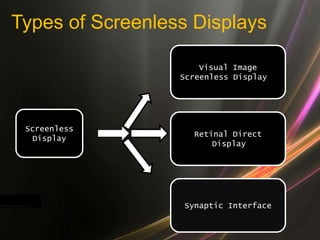
Types of Screenless Displays
Screenless
Display
Visual Image
Screenless Display
Synaptic Interface
Retinal Direct
Display
Visual Image
• Visual Image screen less display includes any screen less
image that the eye can perceive or see.
• Example: Hologram
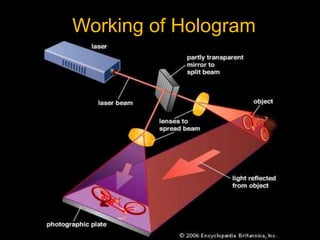
• It is made by illuminating with lasers or display in a
darkened room with carefully directed lighting.
• They're two-dimensional surfaces that show absolutely
precise, three-dimensional images of real objects.
• If you look at these holograms from different angles, you
see objects from different perspectives, just like you would
if you were looking at a real object. Some holograms even
appear to move as you walk past them and look at them from
different angles. Others change colors or include views of
completely different objects, depending on how you look at
them.
Working of Hologram
Products of Visual Screen
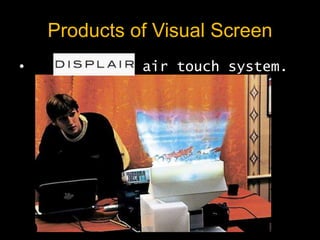
• air touch system.
air touch system.
• It works by projecting laser
beem into humid air molecules.
• We have to move our hands our
the humid air where the display
is present.
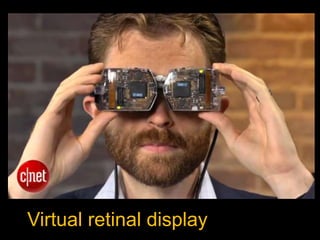
Virtual retinal display
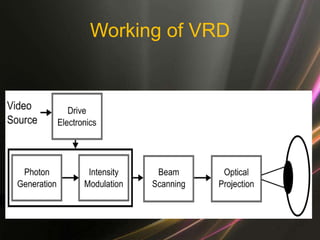
Working of VRD
Virtual retinal display
• They are screen less displays in which images
are projected directly onto the retina of eye
• They are distinguished from visual image
systems because light is not reflected from
some intermediate object onto the retina.
• It is instead projected directly onto the
retina.
• The user sees what appears to be a
conventional display floating in space in
front of them.
Working of VRD
Virtual retinal display
• The VRD was invented at the University of
Washington in the Human Interface Technology
Lab in 1991.
• The development of high-brightness LEDs have
made the displays bright enough to be used
during the day and adaptive optics have
allowed systems to dynamically correct for
irregularities in the eye.
•
Products using VRD
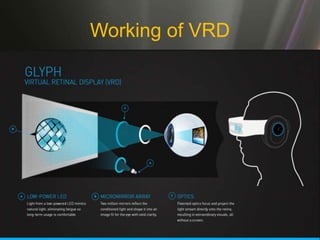
GLYPH1.
GLYPH
GLYPH
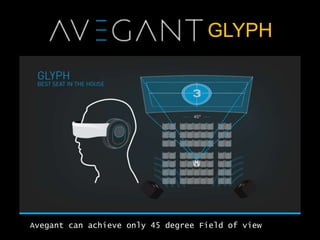
Avegant can achieve only 45 degree Field of view
GLYPH
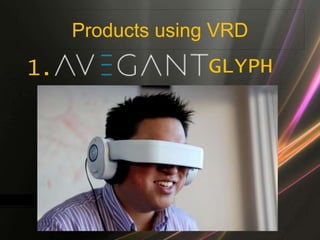
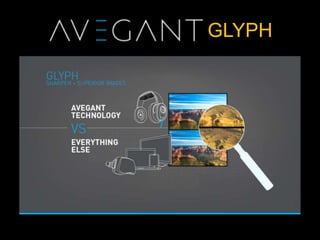
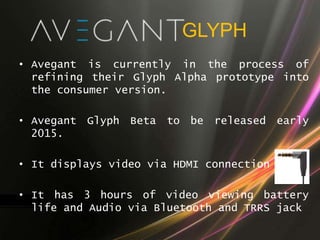
• Avegant is currently in the process of
refining their Glyph Alpha prototype into
the consumer version.
• Avegant Glyph Beta to be released early
2015.
• It displays video via HDMI connection
• It has 3 hours of video viewing battery
life and Audio via Bluetooth and TRRS jack
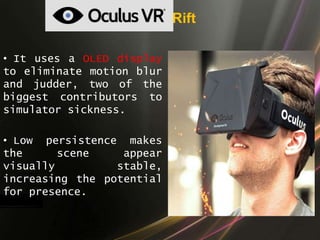
Rift
• It uses a OLED display
to eliminate motion blur
and judder, two of the
biggest contributors to
simulator sickness.
• Low persistence makes
the scene appear
visually stable,
increasing the potential
for presence.
2.
• Oculus VR is still in Prototype Stage
• It is used for playing immersive games
• We can play games in 360 degree Head
Tracking.
• The Oculus Rift creates a stereoscopic 3D
view with excellent depth, scale, and
parallax.
• Oculus Rift provides an approximately
100° field of view
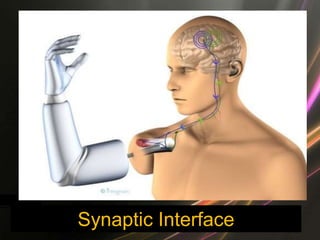
Synaptic Interface
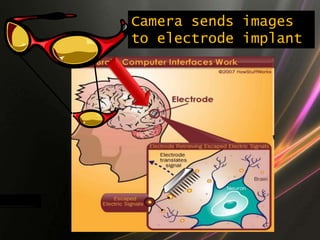
Camera sends images
to electrode implant
Synaptic Interface
• Synaptic Interface screen less video does
not use light at all.
• Visual information completely bypasses the
eye and is Transmitted directly to the
brain. While such systems have yet to be
implemented in humans,
• success has been achieved in sampling
usable video signals from the biological
eyes of a living horseshoe crab through
their optic nerves,
• In sending video signals from electronic
cameras into the creatures' brains.
Advantages Screenless Display
• Low power requirements- Only six diodes are required
and a few of a watts to deliver their images to the
user’s eyes.
• Higher resolution images- The pixels in the images
projected by the diodes can be made smaller than is
possible with any CRT or flat panel display, so
higher resolution can be achieved. With retinal
projectors, the only limitation in the resolution of
visual images will be the resolving power of the
users’ eyes.
• Greater portability- The combination of diodes,
lenses, and processing components in a retinal
projector system will weigh only a few ounces.
Advantages Screenless Display
• Wider angle of view- Retinal projectors
will be able to provide a wider field of
view than is possible with display screens.
• Greater brightness and better contrast-
Retinal projectors can provide higher
levels of contrast and brightness than any
other display system.
Disadvantages Screenless Display
• The principle disadvantage is that
Virtual retinal display (VRD) is not
yet available in the significan
number.
• Prototypes and special experimental
models are now being Built, but their
cost per unit is high.
• The VRD technology is still under
progress and Development.
Conclusion
• The future technologies makes our
life even better for the development
of mankind in all aspects of life.
• We should effectively apply these
technologies in reasonable
situations and make life easier.
• Physically and Mentally challenged
people also have to be equipped with
latest technologies, to enable them
to live a peaceful life.
Screenless display

Screenless display

  • 1.
  • 2.
    Introduction • Screenless displaytechnology has the main aim of displaying (or) transmitting the information without any help of the screen (or) the projector. • It displays the information directly into the retina of eye rather than displaying through screen like LCD monitor, Touch Screen Display, etc. • It is one of the TOP 10 emerging technologies in IT field. • We will be using Screenless display technology during 2020’s.
  • 3.
    Types of ScreenlessDisplays Screenless Display Visual Image Screenless Display Synaptic Interface Retinal Direct Display
  • 4.
    Visual Image • VisualImage screen less display includes any screen less image that the eye can perceive or see. • Example: Hologram • It is made by illuminating with lasers or display in a darkened room with carefully directed lighting. • They're two-dimensional surfaces that show absolutely precise, three-dimensional images of real objects. • If you look at these holograms from different angles, you see objects from different perspectives, just like you would if you were looking at a real object. Some holograms even appear to move as you walk past them and look at them from different angles. Others change colors or include views of completely different objects, depending on how you look at them.
  • 5.
  • 6.
    Products of VisualScreen • air touch system.
  • 7.
    air touch system. •It works by projecting laser beem into humid air molecules. • We have to move our hands our the humid air where the display is present.
  • 8.
  • 9.
  • 10.
    Virtual retinal display •They are screen less displays in which images are projected directly onto the retina of eye • They are distinguished from visual image systems because light is not reflected from some intermediate object onto the retina. • It is instead projected directly onto the retina. • The user sees what appears to be a conventional display floating in space in front of them.
  • 11.
  • 12.
    Virtual retinal display •The VRD was invented at the University of Washington in the Human Interface Technology Lab in 1991. • The development of high-brightness LEDs have made the displays bright enough to be used during the day and adaptive optics have allowed systems to dynamically correct for irregularities in the eye. •
  • 13.
  • 14.
  • 15.
    GLYPH Avegant can achieveonly 45 degree Field of view
  • 16.
    GLYPH • Avegant iscurrently in the process of refining their Glyph Alpha prototype into the consumer version. • Avegant Glyph Beta to be released early 2015. • It displays video via HDMI connection • It has 3 hours of video viewing battery life and Audio via Bluetooth and TRRS jack
  • 17.
    Rift • It usesa OLED display to eliminate motion blur and judder, two of the biggest contributors to simulator sickness. • Low persistence makes the scene appear visually stable, increasing the potential for presence.
  • 18.
    2. • Oculus VRis still in Prototype Stage • It is used for playing immersive games • We can play games in 360 degree Head Tracking. • The Oculus Rift creates a stereoscopic 3D view with excellent depth, scale, and parallax. • Oculus Rift provides an approximately 100° field of view
  • 19.
  • 20.
    Camera sends images toelectrode implant
  • 21.
    Synaptic Interface • SynapticInterface screen less video does not use light at all. • Visual information completely bypasses the eye and is Transmitted directly to the brain. While such systems have yet to be implemented in humans, • success has been achieved in sampling usable video signals from the biological eyes of a living horseshoe crab through their optic nerves, • In sending video signals from electronic cameras into the creatures' brains.
  • 22.
    Advantages Screenless Display •Low power requirements- Only six diodes are required and a few of a watts to deliver their images to the user’s eyes. • Higher resolution images- The pixels in the images projected by the diodes can be made smaller than is possible with any CRT or flat panel display, so higher resolution can be achieved. With retinal projectors, the only limitation in the resolution of visual images will be the resolving power of the users’ eyes. • Greater portability- The combination of diodes, lenses, and processing components in a retinal projector system will weigh only a few ounces.
  • 23.
    Advantages Screenless Display •Wider angle of view- Retinal projectors will be able to provide a wider field of view than is possible with display screens. • Greater brightness and better contrast- Retinal projectors can provide higher levels of contrast and brightness than any other display system.
  • 24.
    Disadvantages Screenless Display •The principle disadvantage is that Virtual retinal display (VRD) is not yet available in the significan number. • Prototypes and special experimental models are now being Built, but their cost per unit is high. • The VRD technology is still under progress and Development.
  • 25.
    Conclusion • The futuretechnologies makes our life even better for the development of mankind in all aspects of life. • We should effectively apply these technologies in reasonable situations and make life easier. • Physically and Mentally challenged people also have to be equipped with latest technologies, to enable them to live a peaceful life.

Editor's Notes

  • #21 A camera that might be incorporated into eyeglasses picks up images. These images are sent to an electrode implanted in the brain. The brain can then interpret these signals, thus creating artificial sight. This can be used to provide vision who have a defect of the eye by bypassing the damaged eye parts and sending a visual signal straight to the brain.